
And that is even the smaller/older version which is based on the A300.
Currently Airbus uses the "Beluga XL" whoch is based on the A330 frame. Easily recognizeable on the wingtips.
2
61


747-8i is one of my favourite aircraft’s ever. Very rare and very beautiful with those raked wingtips
1
8

Dana's at the White House and can't be bothered to wear some freakin' wingtips.
19

Zach is too much of a coward for the Neo Nazis and tries to hide his racism like Wolfe does behind a pair of wingtips. Trash is trash
1
6
139

Known today as compression lift, the idea of the XB-70's folding wingtips, was to use the shock waves generated by its own supersonic flight to generate lift.
This clip shows what the Valkyrie could have been.
45


3. Engines (Great from side or front view)
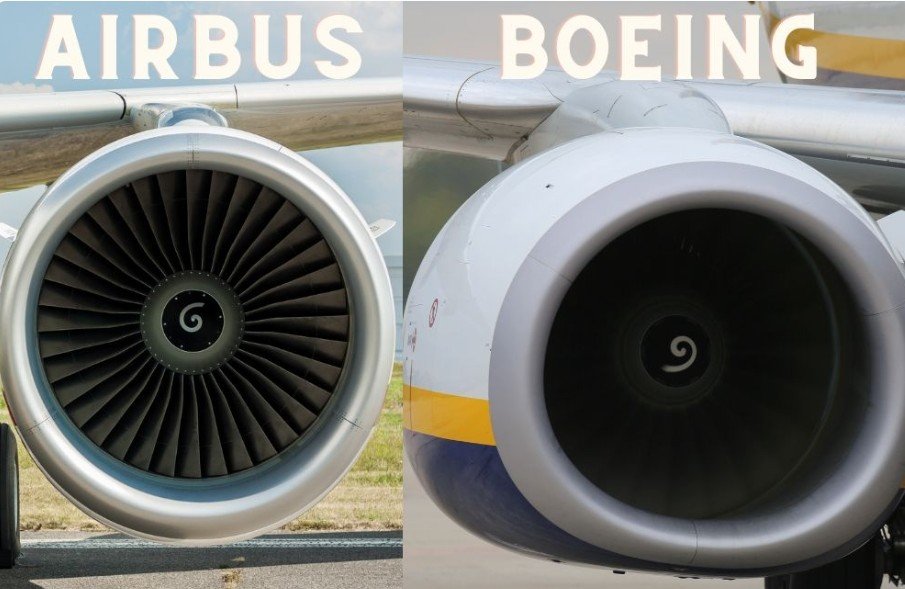
Boeing 737 (especially Classic/NG/MAX): Oval/elliptical nacelles with a distinctly flattened bottom (to fit lower ground clearance). MAX models have chevrons (sawtooth edges) on the exhaust.
Airbus A320 family: Perfectly round engine nacelles. Sits higher on longer landing gear.
Airbus A220: Round engines, but smaller overall aircraft with more slender wings/engines.
Engine comparison (Airbus round vs Boeing flattened):
How to differentiate between Boeing and Airbus aircraft - Grupo One Air
4. Overall Size & Proportions
A220: Smallest of the three (typically 100-150 seats). Shorter fuselage, distinctive high-wing appearance relative to size, and a more "tucked" look.
737 & A320: Similar size (A320 family slightly longer in some variants), but the 737 often looks a bit more "hunched" due to shorter landing gear.
Side views for overall comparison:
Boeing 737 (pointed nose, flattened engines visible):
Airbus A320 (rounded nose, round engines, higher stance):
Airbus A220 (compact, sleek, rounded features):
5. Other Helpful Cues
Wingtips: Airbus often has upward-curving "sharklets" (especially A320neo). Boeing uses blended/split scimitar winglets on many 737s.
Landing Gear: 737 sits lower (shorter gear). A320 sits taller.
Tail: 737 often has a dorsal fin (smooth extension from fuselage to vertical stabilizer). A320 tail is more abrupt.
At night: Look at wingtip strobe patterns or engine glow.
With practice, the nose cockpit windows combo lets you ID them quickly even at a distance. Apps like Flightradar24 help confirm, but spotting is more fun with these visual clues.
Next time I'll look at the internal wing structure, the centre of gravity and how fuel is cleverly controlled so it's storage system keeps the plane level, even if an engine goes out of action. It's fascinating stuff. Enjoy ✈️
1
53

Jun 14
Put a propellor on the wingtips facing outwards to have a rotating fan.
3
764

marty sieben retweeted

Jun 12
👨✈️ Known today as compression lift, the idea of the XB-70's folding wingtips, was to use the shock waves generated by its own supersonic flight to generate lift. 👀
1
6
43
3,581


Walk a mile in my wingtips before you start with the names.
14

Jun 13
I'm good with my first pair of airpods pro 3 my first earbuds without wingtips love'em.🥂😏
382


Jun 13
Looks like it has canards like the rendering did. I see some sort of canted wingtips too. F47 is going to be badass
17

Interesting -
I flew free flight contest models as a kid and adult, degree in aero engr. & private pilot lic as an adult.
My mind loves slow 'glider style' aero (did my sr. project on it), STOL-style wingtips etc. & I can understand this logic about 'adjusting' the mind . .
1
4
253