

Meanwhile, I spent the rest of the day working on the Alliance tasks.
However, it seems the workaround allowing multiple accesses to some collaborative tasks has been fixed.
If that's the case, then the number of tasks available on my side is now much more limited than before.
1
2

This was always the purpose and intent.
The UK govt could never get support for requiring identification in order to use the internet or social media.... The social media "age bill" is the workaround.

JUST IN: UK Government clarifies adults will still be able to use social media by verifying their identities with digital IDs, facial recognition, passports and credit cards.
5
18
35
1,068

11m
A growing number of drivers in China have found an oddly low-tech way to fool one of Tesla's most important safety features.
They're placing small plastic head figurines, the kind sold for ten to forty dollars on sites like Taobao and Douyin, in the driver's seat to trick Autopilot's in-cabin camera into thinking someone is paying attention.
One driver reportedly used a Dwayne Johnson figurine for 250 miles of a 400 mile trip.
Tesla's system is supposed to intervene within about 30 minutes if it detects inattentiveness, so this workaround raises real questions about how reliable that safeguard actually is.

1
3

13m
If you think under-16's won't find a workaround and wind up on even sketchier platforms, you need to have your head checked.
39

I use social media via my browser. And VPNs are a workaround that Australian kids are said to be using.
17

So you’re suggesting a “workaround” which requires navigating BA’s turgid system to find, maybe, an option that allows us to try a right BA’s wrongful closing of our case? That would seem to confirm a system that is designed not to work for the customer
Noted
15


The funniest thing is the government thinking it has banned social media for children.
Truth be told they will have found a workaround within 10 seconds of the ban.
😂😂
6

The memo Scharf wrote is stamped confidential and dated April 29, 2025.
Miller told reporters outside the West Wing: "It's an option we are actively looking at."
The proposal faded. The workaround didn't. Bond hearings eliminated. Federal judges ignored. The weapon set aside but not disarmed.
That's the complete picture.
1
39

Ukraine’s defense firms didn’t choose distributed manufacturing. Russian drone and missile strikes made large centralized factories too easy to destroy, so production was broken into 5, 10, or even 15 smaller sites — often with only a few dozen workers at each.
European governments now have the same strategic choice. They can wait until the first major attack forces a chaotic, expensive scramble to disperse, or they can start deliberately building a resilient distributed defense industrial base while time and relative stability remain. Ukraine’s experience shows that early action reduces later pain.
A European distributed model would not require every country to duplicate full factories. Instead, components and subsystems would be produced across a networked web of sites spanning multiple nations. This creates natural redundancy and removes single points of failure.
Ukrainian companies like Ark Robotics are already expanding teams and production into other parts of Europe precisely for this reason. The approach turns national industrial bases into a stronger collective capability that can absorb hits and keep output flowing.
Making this future real requires focused investment in three areas. Facilities must be designed or upgraded for rapid dispersion and relocation from the start. Digital coordination systems are needed to manage the constant movement of parts and people that Ukrainian executives call the hardest part of the model.
Political agreements must treat dispersed production as a shared alliance asset rather than pure national competition. Without these foundations, dispersion remains a wartime workaround instead of a sustainable strength.
The challenges are significant and openly acknowledged by those already using the model. Distributed manufacturing is slower and more expensive than traditional centralized production. Any single site loss still hurts. Smaller European countries with limited geographic depth cannot simply copy Ukraine’s approach without deep regional cooperation.
There ar other downsides than just efficiency and cost. Distributed manufacturing sites require significantly more robust logistics networks and fuel. As we have seen, fuel is a top target
Success depends on honest planning that accounts for these frictions instead of treating dispersion as an easy or cost-free solution.
The window to shape Europe’s defense industry for the threats of the coming decade is open today. Ukraine has already paid the high price of learning these lessons under fire. European leaders can either apply them proactively or repeat the same painful transition later at greater cost.
Distributed manufacturing is not a perfect or cheap fix, but it is now a proven element of industrial resilience.

Ukraine's drone and arms makers don't work out of large factories. Instead, they work across multiple sites and often underground. It makes work safer, but also a lot harder. And now, they warn, Europe needs to start considering doing the same. businessinsider.com/ukraine-…
1
1
41

Does the bml limitations still apply to Paypal or is there any workaround way to use mvr for e-commerce? I can't seem to find any details
8

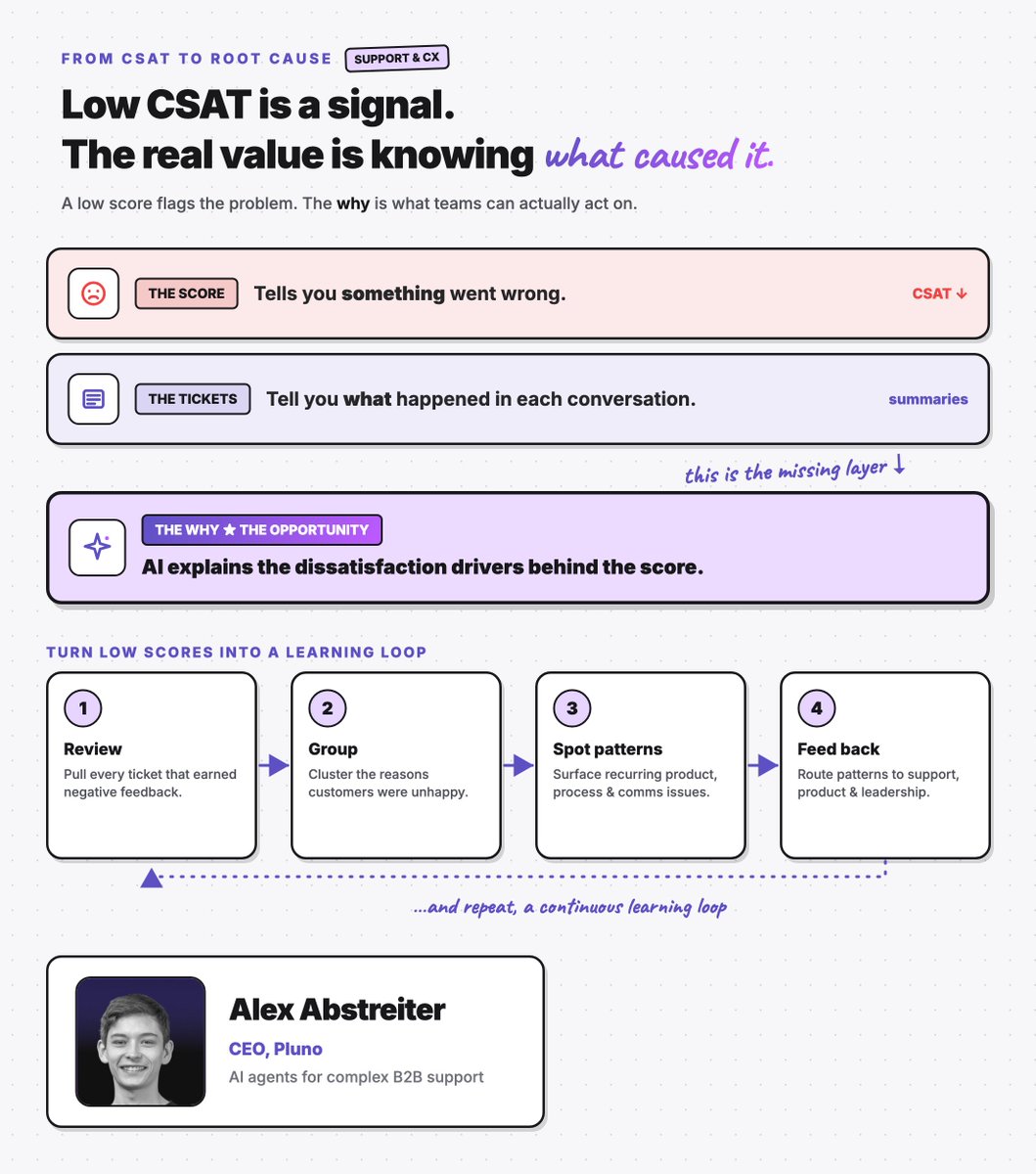
Low CSAT is a signal.
The real value is knowing what caused it.
That is where CSAT workflows get interesting.
Because the score tells you something went wrong.
The ticket tells you what happened.
But support teams still need the layer in between:
Why was the customer actually unhappy?
Slow response?
Wrong answer?
Unclear handoff?
Missing product capability?
Bug with no workaround?
Too much back-and-forth before escalation?
That layer is usually manual today.
Someone reads the comment.
Then the ticket.
Then the internal notes.
Then maybe the escalation.
Then maybe the Jira issue.
By the time the pattern is clear, the moment to act has already started slipping away.
The real opportunity for AI in support is bigger than ticket summaries.
It is feedback pattern analysis.
A single summary helps an agent understand one conversation.
Summarized patterns help a team understand what customers are repeatedly experiencing.
That changes the operating rhythm:
Review negative CSAT tickets.
Group dissatisfaction drivers.
Spot recurring product, process, and communication issues.
Feed those patterns back into support, product, and leadership.
For example, Pluno can use structured ticket summaries, field tagging, and QA context inside your helpdesk to help teams connect negative feedback to the underlying issue behind the conversation.
That is the shift.
CSAT stops being a dashboard metric.
It becomes a learning loop.
Where do you think CSAT analysis usually breaks down: collecting the feedback, finding the root cause, or getting teams to act on it?
2
2
13

Starmer spent 6 months consulting.
Ran government trials.
Visited Australia to study their ban.
Announced a curfew.
Announced a romantic AI chatbot ban.
Announced phone scanning.
Signal threatened to leave.
Today he announced the actual ban.
Under-16s. No social media.
The platforms said they’d comply.
The same platforms that said they’d comply in Australia.
While one fifth of Australian teens immediately downloaded VPNs.
The Online Safety Act took 8 years to pass.
It had a chatbot-sized hole in it.
This ban has no enforcement mechanism yet.
Details come in July.
The teenagers are already in the group chat planning the workaround.
On WhatsApp.
Which is exempt from the ban.

BREAKING: Prime Minister Sir Keir Starmer has announced a social media ban for under-16s.
Live updates: trib.al/AaXv2Tr
2
126


No. It’s failed.
More than 70% of kids had identified a workaround within days.
By any measure that is a monumental failure.
Pointing at 30% “partial compliance” for an egregious and harmful imposition is a weak cope.
That’s before the secondary harms are considered.
1
5

45m
The only reason I switched to YouTube from Spotify from Apple Music is the share option of music. I found a workaround and can return to Apple Music where I can train the algorithm
2
14

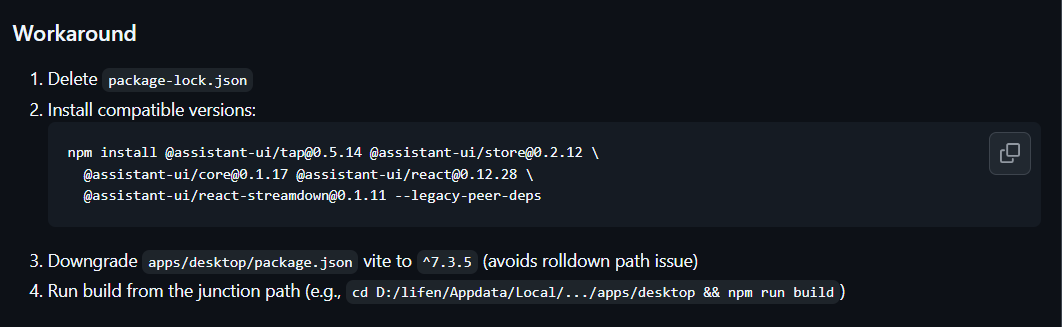
failed at build step again.
now found this workaround on hermes github issues address this same issues (i think?) so gonna try this one next
9

Hi, Konstantin! We know how important it is to access your account, and we want to provide you with the best assistance. Since the chatbot isn't loading, a quick workaround for the redirect loop is to manually add your country code /am/ right after "spotify.com" in your browser URL. If it still fails, you can reach out to support@spotify.com. We're looking forward to your message!
16