
Jun 15
neet rates and worklessness can actually be attributed to the absolute non existence of jobs currently. thank you for telling us just how wildly out of touch you are
1
22
357


Jun 14
We just need a government that actually gets the fact that Incentivising building things, work, productivity as opposed to blocking things, worklessness, and doing nothing are policy decisions. The world is moving on.... fast. We have the potential.
1
1
4
105

Jun 13
McFadden Flew to Rotterdam to Solve a Problem His Own Department Already Explained.
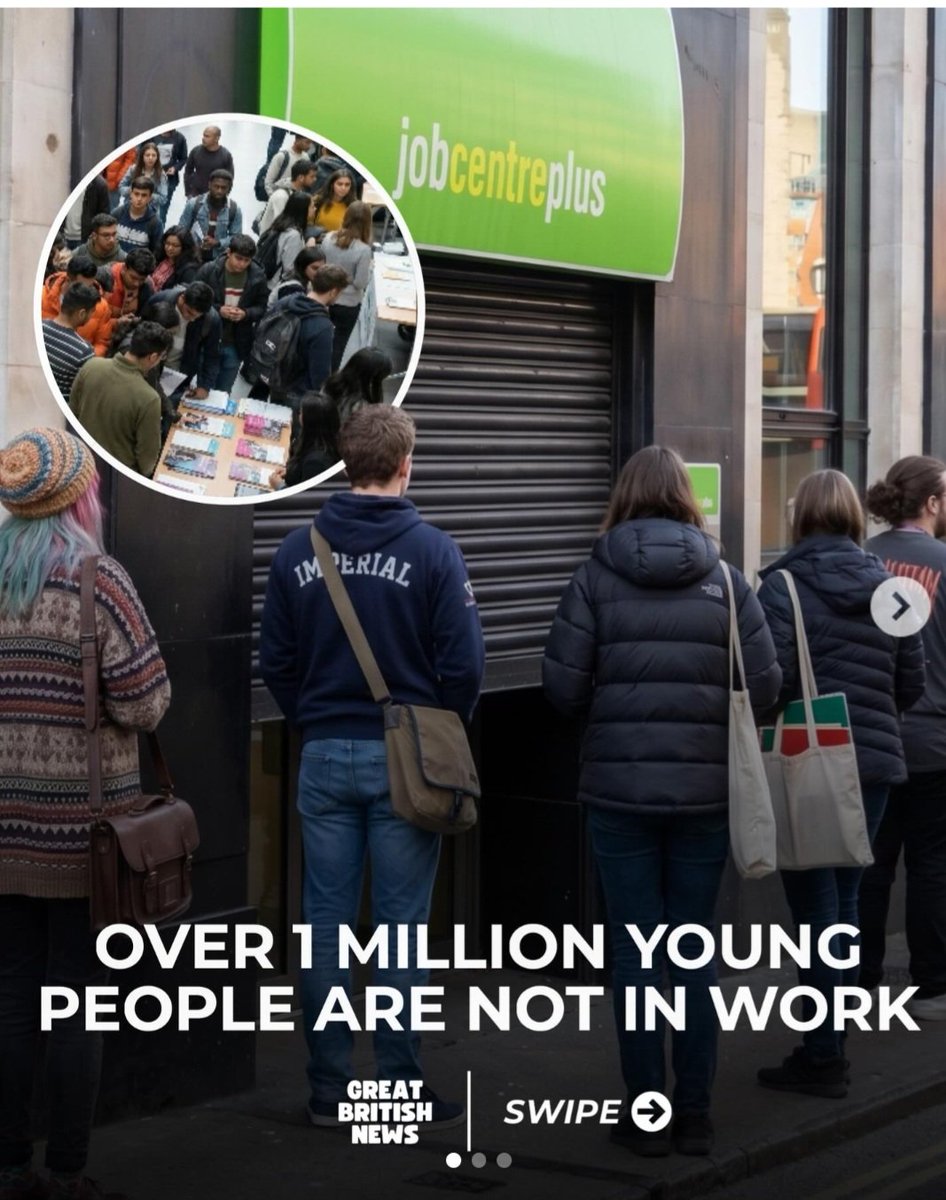
Pat McFadden has been to the Netherlands. He visited a Jongerenpunt, a Dutch youth hub, and came back impressed. The Netherlands has a NEET (Not in Education, Employment, or Training) rate of 4.9 percent among 18 to 24 year olds. Britain's is 15.1 percent. McFadden's solution is to open 180 Youth Hubs over the next two years, rising to 360 by 2029, offering wraparound services, CV advice, housing support and apprenticeship pathways, backed by £2.5 billion over three years.
But he did not need to fly to Rotterdam. The explanation for the gap between Britain and the Netherlands is sitting in his own department's data.
Since 2020, 27 young non-EU migrants have been hired in Britain for every one young British worker. Non-EU youth employment has risen 355 percent. The young British workforce has grown by 0.3 percent. Over the same period, NEET numbers have risen by almost 250,000, now exceeding one million. The Centre for Social Justice published these figures, drawn from the government's own HMRC payroll data, on the same day Alan Milburn's review into youth worklessness concluded there was "no evidence" that immigration played any role. The government's own numbers say otherwise. McFadden's department has the evidence. It chose Rotterdam instead.
The £2.5 billion figure deserves scrutiny. Spread across three years and "almost one million young people," it amounts to roughly £800 per person per year. The government has separately confirmed it spends twenty-five times more paying unemployed young people benefits than it spends helping them find work. £2.5 billion against that backdrop is not a system reset. It is a press release with a budget line attached.
The document contains an admission worth dwelling on. It notes that Dutch youth report the second highest rate of depressive symptoms in the world, behind only Britain's, and that Dutch anxiety rates are only slightly lower than Britain's. It then concludes that "the difference is not health but how the country responds to it." This quietly demolishes years of government framing that attributed Britain's NEET crisis substantially to a mental health epidemic among young people. If a country with comparable mental health outcomes can achieve a NEET rate three times lower, mental health was never the primary explanation. The government has now admitted this in writing while continuing to commission reviews that lead with it.
What the Netherlands actually does, and what this document carefully avoids drawing any connection to, is maintain a labour market where 35 percent of young people pursue vocational training against 22 percent in Britain, and where over half of Dutch young people have workplace experience by age 19. That requires entry-level jobs to exist in sufficient numbers for young nationals to fill them. Britain's October budget did the opposite. The employer National Insurance rise and a near twenty percent jump in the youth minimum wage made entry-level hiring more expensive at the exact moment 27 migrants were being hired for every one British young person. Two policies, the same government, working in the same direction, both squeezing British youth out of the market the Netherlands keeps open for its own.
McFadden's Youth Hubs may help some young people navigate a broken system. They will not address why the system is broken. A generation of British youngsters has been priced out of the jobs that once gave their parents a start, replaced by imported labour at a rate of 27 to 1, while the minister responsible flew to Rotterdam to study a country that simply never created the problem Britain manufactured at home. The answer was never in the Netherlands. It was in the HMRC data, on his own desk, the whole time.
"The £2.5 billion figure deserves scrutiny. Spread across three years and 'almost one million young people,' it amounts to roughly £800 per person per year."

22
259
596
14,090

Jun 12
📉 NEETs just passed 1 MILLION, the highest in 12 years. Hospitality cuts and closures are a driver. We employ 28% of 18–20 year olds.
Youth worklessness costs ~£27bn a year in lost GDP. NEET at 18–19 = 20% likelier unemployed a decade on. That's the real bill Dan should focus on.
1
351

Jun 11
The closing.
The welfare state was built with genuine compassion.
Beveridge was right to identify the giants.
But his report was implemented through a different philosophical framework than he intended.
Not contributory insurance.
Not mutual obligation.
Fabian unconditional entitlement.
And that shift —
from Beveridge’s Liberal vision
to the Fabian socialist model —
Is where the welfare state’s
most serious design flaws
were introduced.
After seventy-five years —
after £334 billion annually —
Has it worked?
Has it ended poverty?
Reduced — not ended.
Has it strengthened families?
The incentive structure
has worked against them.
Has it ended long-term worklessness?
The unconditional model
has made it financially sustainable.
Has it ended homelessness?
Demand subsidies without supply reform have contributed to it.
The giants Beveridge identified —
Want. Disease. Ignorance.
Squalor. Idleness.
Are still standing.
The verdict:
A system built on
Fabian unconditional entitlement —
rather than
Liberal contributory obligation —
Will always tend toward
dependency over self-reliance —
state provision over civil society — management of poverty over its genuine resolution.
The vulnerable deserve better.
Not the abolition of support.
The return to principles
that actually work.
Contribution. Obligation. Mutuality.
Civil society. Self-reliance.
Work that always pays.
“Whatever is done for men
or classes, to a certain extent
takes away the stimulus
and necessity of doing
for themselves.”
— Samuel Smiles. 1859.
He was right in 1859.
The Fabian Society ignored him in 1945.
The evidence of seventy-five years confirms who was correct.
The question is not whether we care about the vulnerable.
The question is whether we care enough to be honest
about what actually helps them.
Follow. Share. Pass it on.
⚖️🇬🇧📜

48
Jun 11
The tax burden.
Every consequence
described in this thread —
Family breakdown.
Worklessness.
Homelessness.
Addiction.
Crime.
Has a cost —
Paid by ordinary working families —
Through taxation —
Whether they can afford it or not.
Britain’s tax burden —
approaching 38% of GDP —
among the highest
in its post-war history.
A working family
on median income —
pays approximately
£15,000-20,000
in combined taxation annually.
Much of this directly funding
a welfare system —
Whose Fabian design contributes to some of the social pathologies it claims to address.
The working poor —those who earn too much to qualify
for significant benefits —
Pay taxes to fund a system
from which they receive little —
While living in genuine financial hardship.
1
8
Jun 11
Long-term worklessness.
First generation welfare dependency is often genuine and necessary.
Job loss. Illness.
Bereavement. Disability.
The welfare state was designed for this.
The honest picture:
Research shows
genuine two-generation worklessness —
parent and child
never having worked —
is documented and concerning.
True three-generation worklessness across entire households
is rarer than political rhetoric sometimes suggests.
But the broader picture
is genuinely serious:
Approximately one million young people —
aged 16-24 —
not in employment,
education, or training.
Economic inactivity among working age adults —
approximately 9 million —
among the highest in modern British history.
Hundreds of thousands of households in long-term worklessness —where work has never been a normal part of life.
The Fabian design problem:
Beveridge’s contributory model — you paid in, you received out —maintained the connection between contribution and benefit.
The Fabian entitlement model —
unconditional provision
as a right —severed it.
Herbert Spencer identified the consequence in 1851:
“The ultimate result of shielding men from the effects of folly is to fill the world with fools.”
This is not a judgment
on individuals in difficult circumstances.
It is a judgment on a system
whose Fabian design makes those circumstances harder to escape.

1
4

Jun 11
Today’s news brings home the fact that tackling worklessness is not just a moral responsibility to those parked on the margins.
Getting one fifth of those on long-term benefits back to work would generate £18 billion for HMT.
That’s the same as:
⚓️15 new warships
✈️220 typhoon jets
🇬🇧Defence at 3% of GDP
Or, should you prefer:
💷A £2,000 tax cut for every worker
🏥15 new hospitals
💳15% slashed from our massive deficit
Britain cannot afford to keep writing people off.
centreforsocialjustice.org.u…
87

"Captain's Log Stardate 16/02/2025"
🦈Voluntary Worklessness and Economically Inactive 🏴sharkfishinginwales.blogspot…
16

Jun 10
☕️ For our June Business Council Breakfast this morning, rather than hosting a guest speaker, we had the pleasure of hearing from our very own President @matthew_elliott , who was interviewed by the fantastic @wallaceme.
📈 Matthew spoke about his career in campaigning and how to make change in politics and policy. In particular, he spoke about how his career to date has led him to founding the Jobs Foundation, and how we can successfully campaign to help solve the challenge of our time - supporting businesses to create more jobs and opportunity to solve the worklessness crisis.
Watch more⬇️
2
7
670




Alan Milburn says youth worklessness is costing the UK £125bn a year and the NEET total has passed one million.
That is not a “soft” social problem — it is a fiscal crisis, a skills crisis, and a political failure rolled into one.
But instead of stripping out the barriers to first jobs, ministers are still making hiring more complicated.
2
72

🎙️“Growth felt by everyone” - what is needed to achieve this?
On the podcast: deprivation, youth worklessness, Manchester, London and the practical links between city growth and opportunity.
Listen now 🎧👇
buff.ly/L9PUqjW
1
260

True! Particularly COVID. The worklessness endemic has ballooned. Blair/Brown started the nanny state and it has grown since them. Every problem is now the responsibility of the taxpayer.
2

When will you understand these things simply lead to one thing. Worklessness. They are not worth the sacrifice that is unemployment
1
1
355

In the late 70s the Labour rejected a blueprint for redeploying skills, ideas and workers that private industry didn't want to retain, into socially useful work. And now we have a Labour government promoting AI as a "solution" to worklessness and skills "deficits".
2
3
7
151

Jun 8
Why the UK should consider selective Nordic-inspired reforms.
The Nordic countries (Denmark, Finland, Iceland, Norway, and Sweden) consistently achieve strong outcomes on measures that matter most to ordinary citizens.
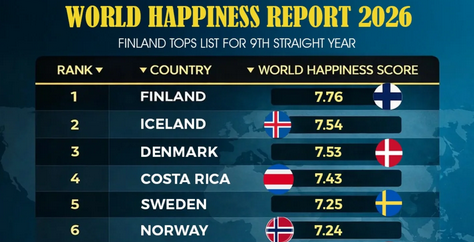
They rank among the world’s highest performers on life satisfaction, social mobility, employment, educational attainment, and child well-being. In the World Happiness Report 2026, Finland ranked first, followed by Iceland, Denmark, Sweden, and Norway in the global top six, while the UK ranked 29th.
Finland’s average life-evaluation score was around 7.7 out of 10, compared with roughly 6.7 for the UK: a gap that is not just statistical but substantively meaningful.
Nordic countries also generally report lower income inequality, with Gini coefficients typically around 27–30 compared with roughly 33 in the UK. Relative child poverty rates are likewise generally lower, although the size of the gap varies depending on the measure used.
The UK nevertheless retains important strengths of its own, including world-class universities, leading financial and professional services, strong research institutions, internationally significant innovation clusters, and the advantages that come with being a major English-speaking economy.
The real question is therefore not which model is “better” overall, but where Britain can realistically learn from areas in which the Nordics have consistently delivered stronger outcomes for typical citizens.
These achievements deserve serious attention. However, they should not be interpreted as evidence that the UK can simply import a “Nordic model” and expect equivalent results. Nordic success emerged from specific historical, cultural, demographic, and institutional conditions that differ markedly from those of modern Britain. The task is not to replicate Scandinavia, but to learn selectively from what has worked and adapt it intelligently to British realities.
The Nordic countries combine dynamic market economies with relatively strong social protections. Contrary to some stereotypes, they are not heavily state-directed economies. Most score highly on measures of economic freedom, maintain competitive private sectors, and broadly support open trade, entrepreneurship, transparency, and innovation.
Several features appear particularly important. These include high-quality universal public services, especially in early childhood education, healthcare, and schooling; sustained investment in skills, vocational education, and lifelong learning; active labour market policies designed to help people return to work quickly; high labour-force participation, including among women; and long-term investment in infrastructure and regional development.
Effective public institutions and historically high levels of social trust have also helped sustain durable political support for taxation and welfare. However, the relative importance of culture, trust, institutions, and policy remains contested. Nordic outcomes are best understood as the result of multiple reinforcing factors rather than any single explanatory driver.
I am under no illusion that simple direct copying would be challenging. Britain is larger, more geographically varied, and economically diverse than any Nordic country. It combines a globally significant financial centre in London with regions still adjusting to the long tail of industrial decline. Regional disparities remain among the most pronounced in Western Europe. London alone generates roughly a quarter of UK economic output, a level of geographic concentration without a close Nordic parallel.
The UK is also significantly more ethnically and culturally diverse. This diversity brings substantial benefits, including innovation, entrepreneurship, international networks, and access to global talent. At the same time, rapid population change can place pressure on housing, schools, infrastructure, and public services where capacity does not expand in step, while also creating integration challenges if institutions are not sufficiently adaptive. But these issues can be overcome with the focused political will to do it.
Several Nordic countries have faced similar pressures in recent years, including concerns around segregation, educational attainment gaps, and poverty among some immigrant communities. This does not imply that diversity leads to weaker outcomes, but it does suggest that successful integration depends heavily on sustained investment, institutional capacity, and realistic policy design.
Some Nordic advantages are also structurally difficult to replicate. Norway benefits from substantial oil and gas wealth managed through its sovereign wealth fund, while the high levels of social trust seen across much of the Nordic region evolved slowly, and cannot simply be engineered through policy alone.
No system is without costs or trade-offs.
Nordic countries generally impose higher tax burdens than the UK, particularly on consumption and middle incomes, though employment rates typically remain around 75–80% of the working-age population, which are among the highest in Europe. Their welfare systems are generous, but more conditional and work-oriented than is sometimes assumed.
Housing affordability has become an increasingly significant challenge in parts of Scandinavia, especially in major cities where supply has failed to keep pace with demand. Wage compression helps reduce inequality but can weaken financial incentives at the top end of the labour market.
Recent years have also seen increases in child poverty, housing pressures, and social segregation in parts of the region, underscoring that even high-performing societies face evolving challenges and ongoing policy trade-offs. Nordic economies also benefit from innovation and technological advances generated across the wider global economy, including from several major advanced economies.
The Nordic experience therefore illustrates a broader truth: all policy systems involve balancing competing objectives, for example equality and incentives, security and flexibility, and universality and cost.
So what could the UK realistically learn from the Nordic countries? Rather than pursuing wholesale transformation, imho Britain should focus on adapting those elements with the strongest evidence base and the best fit with domestic institutions and constraints.
1. Housing and Planning Reform
Perhaps the most important lesson is not uniquely Nordic but fundamental to economic performance: housing supply matters.
Housing costs shape poverty, inequality, labour mobility, productivity, family formation, and regional opportunity. By some estimates, housing costs are a major reason lower- and middle-income British households have weaker disposable living standards than comparable households in several north-west European countries.
Expanding housing supply in high-demand areas through planning reform and sustained construction would improve living standards across the country. Without meaningful progress on housing, many other social and economic reforms are likely to deliver weaker results than intended.
2, High-Quality Early Childhood Provision
High-quality early childhood provision is among the most consistently supported investments in social policy research. Expanding affordable, well-staffed early years provision can improve child development, raise parental employment (particularly among mothers) and reduce educational inequalities before they become entrenched.
The challenge is not simply expanding provision, but ensuring sustained quality, effective delivery, and strong value for money.
3. Skills, Vocational Education, and Lifelong Learning
The UK’s long-standing divide between academic and vocational pathways arguably remains a structural weakness. Denmark and Finland have developed respected technical routes that offer credible alternatives to traditional university degrees.
Expanding high-quality apprenticeships, technical education, and adult retraining could strengthen productivity, improve labour-market resilience, and widen opportunity for those who do not follow conventional academic paths.
4. Labour Market Flexibility With Security
This is perhaps more controversial for many left-leaning people. Denmark’s “flexicurity” model (combining relatively flexible hiring and firing rules with strong job support, retraining, and activation policies) offers a useful guiding principle: protecting people from long-term unemployment rather than attempting to shield every existing job.
Adapting elements of this approach could help preserve labour-market dynamism while reducing persistent worklessness.
5. State Capacity and Delivery
Improving state capacity may be one of the least discussed but most consequential lessons.
Many Nordic advantages may stem as much from effective implementation as from policy design itself. Stronger project delivery, more effective planning systems, improved procurement, higher local government capability, and better public-service management could improve outcomes regardless of ideological orientation. In practice, execution often matters as much as design.
6. Regional Development and Integration
Long-term regional development (rather than short funding cycles and repeated policy resets) could help address persistent geographic inequalities.
Well-designed integration policies that prioritise language acquisition, employment participation, educational attainment, and civic engagement can also help maximise the benefits of immigration while reducing social tensions and long-term disadvantage.
Taken together, the evidence does not suggest that the Nordic countries have discovered a perfect model of society. Their successes are substantial, but so are their challenges and limitations. Outcomes everywhere depend on policy, institutions, culture, family stability, media output and ownership, economic structure, demographics, and levels of social trust.
Nevertheless, across multiple decades the Nordic countries have generally achieved stronger outcomes for the median citizen than the UK in areas such as life satisfaction, child well-being, social mobility, and broad-based opportunity. This does not diminish Britain’s significant strengths, nor does it imply that Nordic solutions can be transplanted wholesale into a different national context.
What it does suggest is that Britain should remain open to learning from countries that consistently perform well on outcomes that matter to ordinary people. The goal is not imitation, but adaptation: identifying what works, testing it rigorously, and applying it in ways suited to British circumstances.
An approach that is practical, evidence-based, and focused on outcomes rather than ideological labels, offers one of the most promising paths toward raising living standards and expanding opportunity across the United Kingdom.
In practice, elements of this agenda already appear, at least in part and in different combinations, across the main UK political parties, even if none offers a fully coherent Nordic-inspired strategy for Britain.
Labour has placed particular emphasis on early years provision, skills policy, and regional development. The Liberal Democrats have long advocated stronger investment in public services, education, and devolved capacity. The Conservatives have at times pursued welfare activation, labour market flexibility, and economic competitiveness measures consistent with aspects of flexicurity. The Greens argue for the largest increase in public investment and redistribution. Reform UK and Restore Britain prioritise substantial reductions in immigration, lower overall taxes, and a smaller state, reflecting a distinct approach to the role of taxation, public services, and welfare provision compared with the Nordic model.
Taken together, these positions show that different elements of the agenda are spread across the political spectrum. Ultimately, whether the UK moves closer to the kinds of broad-based outcomes seen in the Nordic countries will depend less on party labels and more on whether any government can combine human capital investment, effective state delivery, and labour market adaptability into a coherent, long-term strategy, while managing the unavoidable trade-offs in taxation, incentives, and institutional capacity.
9 Dec 2025

🧵
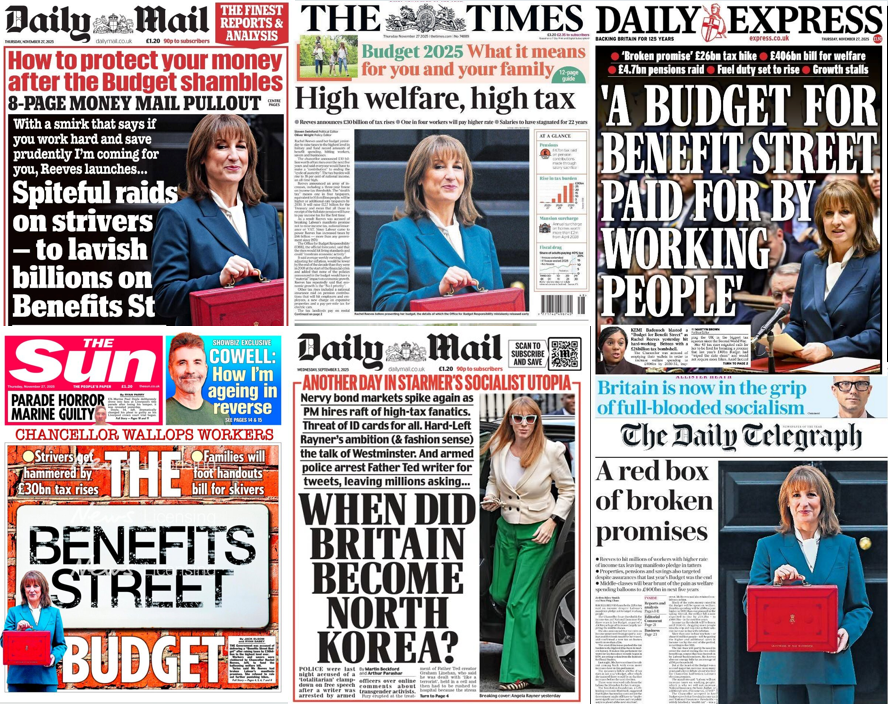
How have populist UK politicians and Britain’s right-wing press and broadcasters got away with repeating — day after day, year after year — the brazenly false and wildly misleading claim that we live in a “high-welfare, high-tax” country?
3
11
29
1,529

Jun 6
🚨 A record 300,000 non student households where work has never existed - highest on record
429,000 adults.
221,000 children
It is a failure of government policy.
If the system pays people to stay outside work, why are we shocked when work disappears?
Is worklessness into a lifestyle?
5
78
168
7,366