Bruised_Buns retweeted

3 Sep 2025
Moxxie's not handling the heavy workload very well.
Moxxie model - @valorlynz &
Rigged by @CaptainFlapcats
Loona model - @AeridicCore
Octavia model - @VulgarVictor583 Octavia model owned by @Arvelo_iC8D
#blender #3d #3dart #3Dartist #furry #furryartist #lewd #nsfw

24
419
3,557
61,501


No, Lopez. The combination of him and Holmes were really taxing the bullpen early, leading to the heavy workload from Bummer and others. All those bullpen guys were trending towards career high workloads. They need starters who can eat innings.
1
7

0!=1 retweeted

Jun 13
SPEC CPU 2026 Workload Analysis (INT Rate): jia.je/software/2026/05/22/s…
1
1
2

Allen daws would not be good. Allen was good last year but we could pick our spots starting him, and give him a manageable workload. Allen playing 60 games isn’t happening at his age. And I wouldn’t trust daws to start 40 NHL games. Bad idea
I’m down to keep daws as the 3 goalie. Fine by me but he may want a guaranteed nhl chance somewhere else
1
55


They didn't give a shit about siraj's workload. Now only they are giving him rest. Is bumrah reserved specifically for world cups and ipl? Idk what kind of crap is this but it's crazy. Are other bowlers not worthy of rest?
2

Would Passengers Be Comfortable With This? Tight Rosters and Fatigue in Indian Airlines Right Now
This roster isn’t hypothetical — it’s representative of the kind of scheduling pressures facing pilots at major Indian airlines right now in June 2026
22:00 – Delhi to Kolkata
00:20 – Arrive Kolkata
01:35 – Reach hotel
06:45 – Leave hotel
08:30 – Kolkata to Delhi
13:35 – Delhi to Ahmedabad
15:55 – Ahmedabad to Delhi (after a tight 40-minute turnaround)
19:30 – Deadhead Delhi to Bengaluru
22:20 – Arrive Bengaluru
On paper, there’s a 5-hour 10-minute hotel layover. In reality, after transport, check-in, meals, and unwinding from a late arrival, pilots might scrape together just 3–4 hours of actual sleep. The next day piles on four sectors, a high-pressure short turnaround, and a near-15-hour duty period.
These rosters are legal under current DGCA rules, but the fatigue is very real — and airlines have been rejecting over 95% of fatigue reports in some cases, with pilots facing penalties for filing them.
June Monsoon Compounds the Risks
India’s southwest monsoon is active in June, bringing added volatility to routes like Delhi-Kolkata-Ahmedabad. Thunderstorms, turbulence, heavy rain, reduced visibility, and sudden wind shifts are common. These conditions often cause delays, holding patterns, diversions, or go-arounds — extending already long duties and increasing workload precisely when rest has been minimal.
A pilot running on fragmented sleep now contends with:
Monitoring rapidly evolving weather and fuel for alternates.
Managing turbulence and convective activity.
Executing precise approaches in low ceilings or waterlogged conditions.
Maintaining focus during a crammed schedule with minimal buffers.
Recent DGCA tightening of Flight Duty Time Limitations (FDTL) and Fatigue Risk Management Systems (FRMS) aimed to address this, but implementation delays and gaps persist. Airlines have faced warnings for systemic lapses in fatigue management, weekly rest violations, and scheduling oversights.
Aviation Safety Depends on Human Margins
Fatigue impairs reaction time, decision-making, and situational awareness — effects amplified by monsoon weather. While pilots are highly trained professionals, no amount of skill fully compensates for chronic sleep debt in high-pressure, weather-challenged operations.
This isn’t abstract. Pilot unions and reports highlight “inhumane rosters,” rising fatigue reports, and industry strain amid rapid growth and crew shortages.
The Passenger Question — Revisited
If passengers knew that the pilots on their Delhi-Kolkata or Delhi-Ahmedabad flight may have had only a few hours of broken sleep before facing this multi-sector day — now layered with active monsoon thunderstorms, turbulence, and potential delays — would they consider it an acceptable standard of safety?
Most would likely say no.
Travellers expect crews at peak performance, especially when environmental factors demand extra vigilance.
Greater transparency, stricter adherence to fatigue reporting without penalty, robust FRMS, and weather-resilient scheduling are essential. In June’s unpredictable Indian skies, protecting pilot rest isn’t optional — it’s fundamental to safety for everyone on board.
Airlines, regulators (DGCA), and the flying public must push for rosters that truly prioritize recovery.
Until systemic changes take hold, the question remains urgent:
Are you comfortable with this?
1
2
90

honest answer from my own runs, at near full 256k i have not seen a meaningful hit. but here is the nuance that is actually real, the key cache is more sensitive to quantization than the value cache.
so if you want to play it safe, run q8 on k and q4 on v, you keep most of the memory savings and protect long context recall.
most of the mixed reports out there are synthetic needle in a haystack worst cases. on real agentic loops and normal chat it holds up fine. test it on your own workload though, that is the only answer that counts. greetings back to venezuela, glad the info is landing.
20
Disagree. With any heavy workload Daws would not perform well. I’m almost sure of it. he has okay numbers in small chunks of time, that doesn’t impress me
He is an NHL backup option. We have Allen, if Markstrom is moved out they should be looking for a new goalie
10


If you've run workloads on AWS for a while, you've probably built a secret-distribution system in some form. Entrypoint scripts, init containers, and cron jobs reloading NGINX are examples. Each one works, and each one becomes something your team owns forever.
The AWS Workload Credentials Provider is a local daemon that handles secret retrieval, caching, and ACM certificate renewal using the identity your workload already has. It's the Vault Agent model, but native. The article from Ashish Kasaudhan does a good job describing how the tool works and where it doesn't fit, including the SSRF token and privilege model details most posts skip. Check it out!
lckhd.eu/BPlOEQ
1
31

27m
AMD CEO Lisa Su may have just undercut Nvidia’s $4,000 AI machine with a $1,499 device that fits in your hand.
On stage, she lifted it with one hand and ran a 235 billion parameter model live. No data center, no cloud, no rented GPUs.
The real surprise is inside. AMD’s Ryzen AI Max 395 is the first x86 chip where the CPU and GPU share a unified 128GB memory pool. That single design choice allows a desktop system to run models that previously required full server racks.
From that 128GB, Linux can allocate around 110GB directly to the GPU. For comparison, an RTX 5090 offers 32GB, while a 4090 has 24GB. This small system delivers more than triple that capacity in a form factor the size of a thick paperback.
The moment that caught everyone’s attention was the benchmark. This chip outperformed an Nvidia RTX 5080 by over 3x on DeepSeek R1 inference. A $1,499 compact machine beating a $1,000 GPU on a real AI workload challenges a decade of assumptions about what hardware you need for serious AI.
There is a bigger implication that is not being widely discussed. Many heavy AI users today spend around $200 on Claude Code Max, $200 on ChatGPT Pro, $20 on Cursor, and $20 on Gemini every month. That adds up to $5,280 per year. This machine could effectively pay for itself in under a year and then continue running without ongoing costs.
The setup is straightforward. Install Ollama, download a model like Qwen3 235B, and point your tools to localhost. You keep the same interface, but everything runs locally. No data leaves your system, no usage fees, and no throttling when you are working late.
This could be the point where AI subscriptions become optional rather than essential. Legal teams gain more control over data privacy. Developers stop worrying about token limits. Founders can prototype without the risk of escalating cloud costs.
Those who understand and adopt this early may gain a strong advantage in private AI consulting over the next couple of years.
Save this and take a closer look. This is what the next shift in AI computing looks like before it becomes mainstream.
1
19

"Burnout is often equated with overwhelm but rust-out is far more common and not just related to workload. It leaves people feeling understimulated, disconnected, and just going through the motions."
fastcompany.com/91543404/rus… | @FastCompany
75
ambitious_masculinity retweeted

20h
MORE CARDANO NEWS 👇
👀 Cardano DReps Report Workload and Public Pressure During 2026 Budget Process
#Cardano #CardanoNews #CardanoCommunity $ADA
songmarketcap.com/cardanonew…
11
40
502

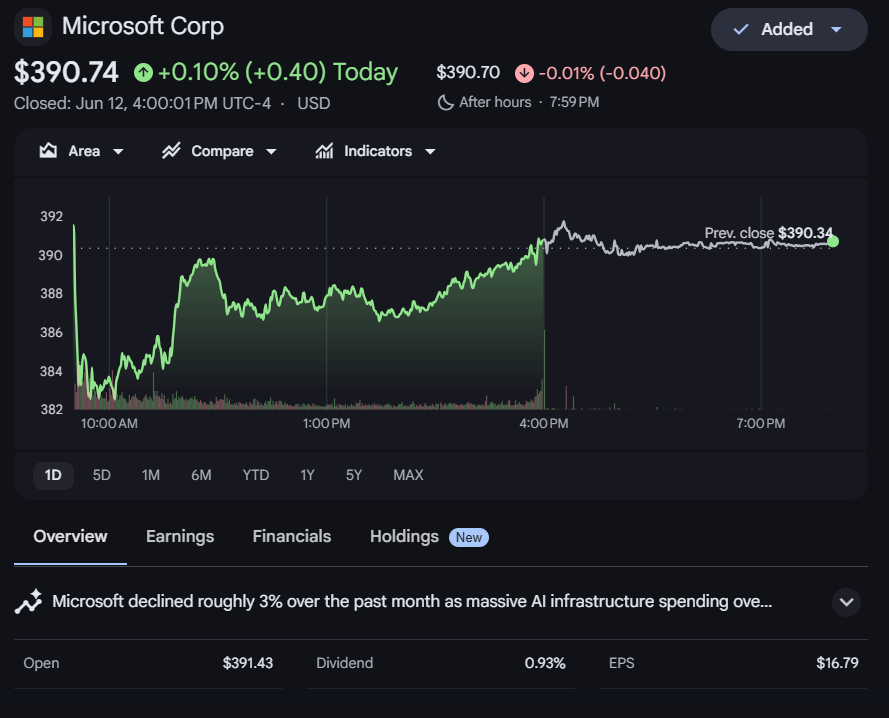
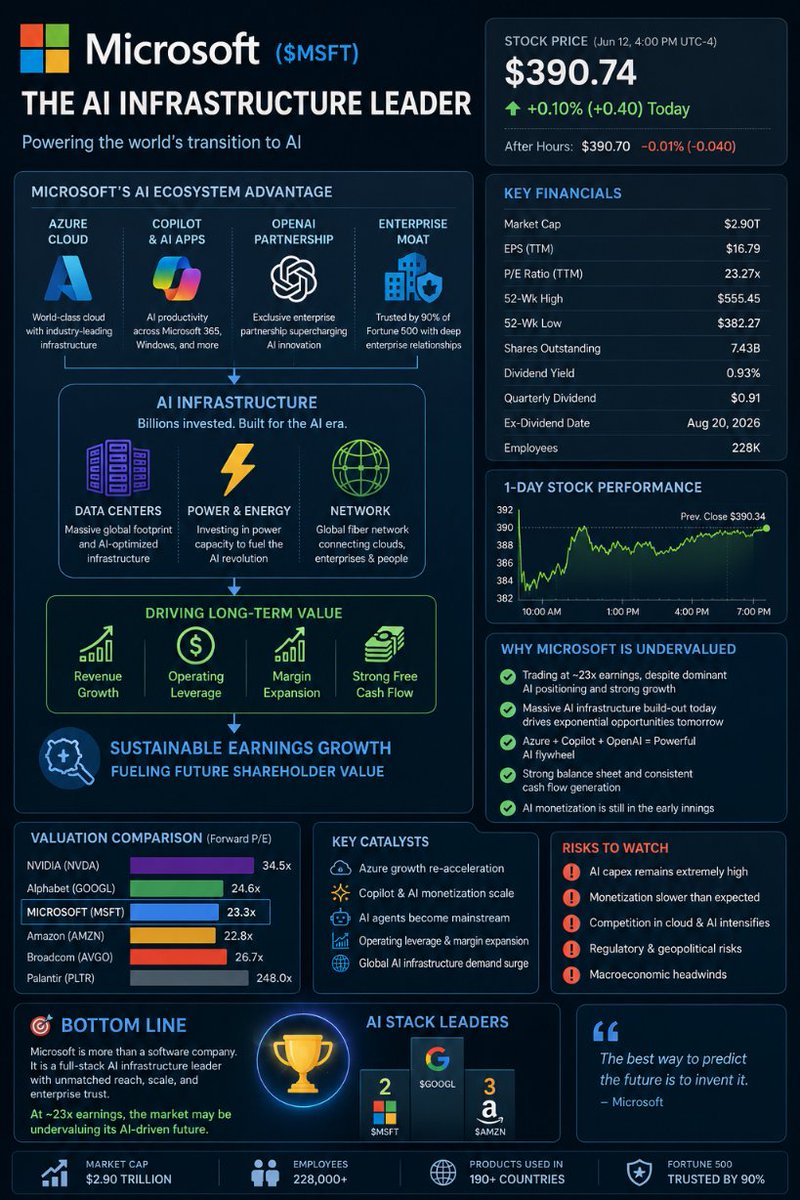
🚀 $MSFT -MICROSOFT: IS IT UNDERVALUED?
Looking at the screenshot, the market appears to be pricing Microsoft as if it were a mature software company, while increasingly ignoring that it sits at the center of the AI infrastructure buildout.
📊 What the Numbers Say
💰 Market Cap: ~$2.9T
📈 EPS: $16.79
🏷️ P/E Ratio: 23.3x
📉 Down ~30% from the 52-week high ($555)
For a company with:
☁️ Azure
🤖 Copilot
🧠 OpenAI partnership
💻 Enterprise software dominance
📡 Global AI infrastructure
...a 23x earnings multiple looks surprisingly reasonable.
🔥 The Market's Concern
Investors have been worried about:
⚡ Massive AI capex
🏗️ Data center spending
🔌 Power constraints
📉 Margin pressure
Microsoft is spending tens of billions building AI infrastructure before all the revenue arrives.
This is similar to:
📦 Amazon building AWS in the 2010s
📱 Apple investing before the iPhone supercycle
🌐 Google investing before cloud monetization
The market often punishes companies during the investment phase.
🤖 Microsoft's Hidden Asset: Azure AI
The biggest bull case isn't Windows.
It isn't Office.
It's Azure.
Microsoft is becoming:
☁️ Cloud provider
🤖 AI provider
🧠 Agent platform
💼 Enterprise AI operating system
Every Copilot deployment, AI agent, and enterprise AI workload strengthens Azure.
💰 Valuation Compared to Peers
Approximate forward multiples:
🔹 Microsoft: ~23x
🔹 Nvidia: significantly higher
🔹 Broadcom: higher
🔹 Palantir: dramatically higher
🔹 CrowdStrike: higher
Yet Microsoft arguably has:
✅ More recurring revenue
✅ Stronger balance sheet
✅ Lower risk
✅ Larger distribution
🚀 What Could Re-rate The Stock?
1️⃣ Azure growth re-accelerates
2️⃣ Copilot monetization exceeds expectations
3️⃣ AI agents become mainstream
4️⃣ AI capex begins converting into profits
5️⃣ Margin fears fade
If those occur, the market may start viewing Microsoft as an AI infrastructure company rather than a mature software company.
🎯 Investment Thesis
The bear case:
⚠️ AI spending remains elevated
⚠️ Monetization takes longer
⚠️ Margins stay under pressure
The bull case:
🔥 Azure becomes the operating system of enterprise AI
🔥 Copilot reaches hundreds of millions of users
🔥 AI infrastructure spending creates a moat few can match
Bottom Line
Microsoft doesn't look "cheap" in the traditional value-investing sense.
But relative to its AI positioning, balance sheet strength, and long-term earnings power, Microsoft may be one of the most attractively valued mega-cap AI stocks today.
If AI becomes as important as cloud computing became over the last decade, a 23x earnings multiple could eventually look surprisingly low for a company at the center of that transformation.
My ranking among mega-cap AI stocks:
🥇 Alphabet $GOOGL
🥈 Microsoft $MSFT
🥉 Amazon $AMZN
These three currently offer the strongest combination of AI exposure, cash flow, and valuation.
1
54

32m
2/3
Most Anganwadi Workers are 50 years old and are dedicated to serving children and mothers. Expecting them to handle lengthy spreadsheets, formulas, and digital reporting without adequate training creates unnecessary stress and workload.
#AnganwadiWorkers
@AjantaNeog
1
3