
Jun 13
Artificial Intelligence is becoming abundant.
Computation is becoming scarce.
Infrastructure is becoming strategic.
The future of civilization may depend on who provides computation.
THE COMPUTATION AGE #ICP
A Special Chapter from The World Computer Files ∞ Series.
#WorldComputerFiles #Documentary #InternetComputer #WorldComputer
Jun 12

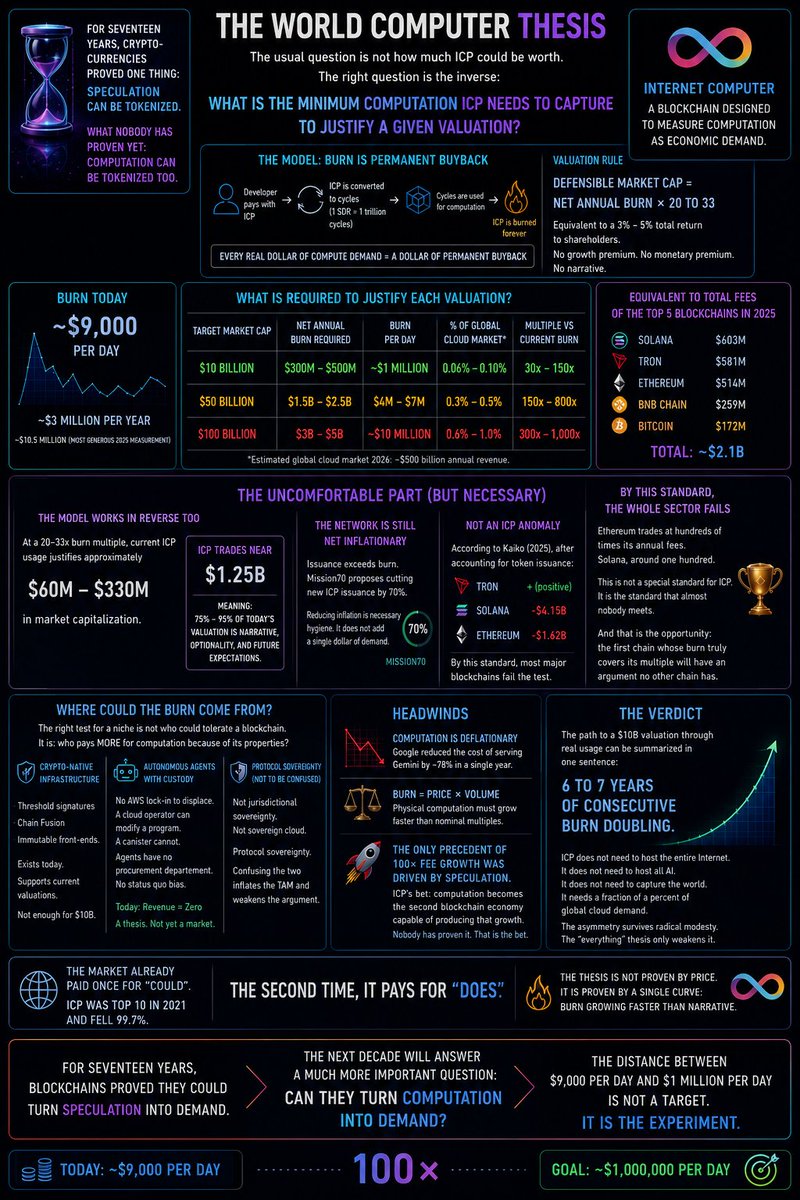
THE WORLD COMPUTER THESIS ∞
For seventeen years, cryptocurrencies have demonstrated one thing:
They can tokenize speculation.
What they have not yet demonstrated is whether they can tokenize computation.
That is the World Computer thesis.
And the usual question — How much could ICP be worth? — is the wrong question, because any number can answer it, and none can test it.
The correct question is the inverse:
What is the minimum amount of computation #ICP must capture to justify a given valuation?
That formulation forces us to answer with economics rather than narrative.
THE MODEL
In ICP, computation burns the token.
Developers convert ICP into cycles at a fixed rate — 1 SDR per trillion cycles — and the ICP used in that conversion is permanently destroyed.
Every real dollar of computation demand becomes a dollar of permanent buyback.
A perpetual buyback can be valued with a simple framework:
Defensible Market Capitalization = Net Annual Burn × 20–33
Equivalent to a 3–5% shareholder yield.
No growth premium.
No monetary premium.
No narrative premium.
That is the entire model.
Nothing more than a multiplication.
THE UNCOMFORTABLE PART
The model works in reverse too.
At a 20–33x multiple of annual burn, ICP’s current network usage justifies approximately $60 million to $330 million in market capitalization.
ICP trades at roughly $1.25 billion.
In other words, between 75% and 95% of today’s valuation is narrative, optionality, and future expectations.
There is more.
The network remains net inflationary.
Token issuance still exceeds burn.
That is precisely why Mission70 exists: to reduce new ICP issuance by 70%.
Reducing inflation is necessary hygiene.
It does not add a single dollar of demand.
Nor is this unique to ICP.
According to Kaiko, after accounting for token issuance, only Tron was net positive in 2025.
Solana diluted holders by approximately $4.15 billion.
Ethereum diluted holders by approximately $1.62 billion.
By the same standard, most major blockchains fail the test.
Ethereum trades at hundreds of times its annual fees.
Solana trades around one hundred times.
This is not a special standard for ICP.
It is the standard that almost nobody in the sector meets.
And that is exactly why it matters.
The first blockchain whose real economic activity genuinely supports its valuation will possess an argument no other blockchain can make.
THE NUMBERS
Current ICP burn is approximately $9,000 per day.
Roughly $3 million per year.
About $10.5 million using the most generous 2025 measurement.
To justify a $10 billion valuation:
Approximately $1 million of burn per day.
Roughly 0.06%–0.10% of the global cloud market.
To justify a $50 billion valuation:
Approximately $4–7 million of burn per day.
Equivalent to the combined annual fees of Solana, Tron, Ethereum, BNB Chain, and Bitcoin in 2025.
To justify a $100 billion valuation:
Approximately $10 million of burn per day.
Roughly 1% of the global cloud market.
The percentages sound small.
The multiples do not.
Two orders of magnitude for the first threshold.
Three for the last.
WHERE COULD THE BURN COME FROM?
The correct test for a niche is not:
Who could tolerate a blockchain?
The correct question is:
Who pays more for computation because of its properties?
Crypto-native infrastructure — threshold signatures, chain fusion, immutable front-ends — already exists and pays today.
Its ceiling can justify current valuations.
It does not justify $10 billion.
Autonomous agents with custody are the more interesting bet.
The demand is new.
There is no AWS lock-in to displace.
The property is binary:
A cloud operator can always modify a program.
A canister cannot.
And autonomous agents have neither procurement departments nor institutional inertia.
Today, however, revenue is effectively zero.
It is a thesis.
Not yet a market.
A note on terminology:
Hyperscalers already sell jurisdictional sovereignty.
ICP sells something different:
Protocol sovereignty.
Confusing the two inflates the TAM and weakens the argument.
THE HEADWINDS
Computation is deflationary.
Google reportedly reduced the cost of serving Gemini by roughly 78% in a single year.
And burn is simply:
Burn = Price × Volume
Physical work must therefore grow faster than nominal multiples.
The only major precedent for two orders of magnitude growth in blockchain fees was driven by speculation.
Exactly the demand ICP is not designed to optimize for.
ICP’s wager is that computation can become the second major economic category capable of producing that kind of growth.
Nobody has demonstrated that yet.
That is the wager.
THE VERDICT
The path to a $10 billion valuation through real usage can be summarized in a single sentence:
Six to seven consecutive years of burn doubling.
ICP does not need to host the entire Internet.
It does not need to host all AI.
It does not need to capture the world.
It needs to capture a fraction of a percent of global cloud demand.
The asymmetry survives radical modesty.
The “everything” thesis only weakens it.
The market already paid once for “could.”
ICP was a Top 10 crypto asset in 2021 and later fell 99.7%.
The second time, the market will pay for “does.”
For seventeen years, blockchains have proven they can turn speculation into demand.
The next decade will answer a much more important question:
Can they turn computation into demand?
The distance between $9,000 per day and $1 million per day is not a target.
It is the experiment.
∞
#WorldComputer #InternetComputer
2
4
24
1,021
May 23
THE WORLD COMPUTER FILES ∞
Special Episode 03 — “Sovereign Infrastructure”
When a key figure from the foundation behind #InternetComputer joins a United Nations blockchain advisory group, it is worth pausing to understand what that actually means.
Not in terms of price.
In terms of architecture.
The UNDP is now exploring how blockchain infrastructure could support:
financial inclusion,
digital identity,
transparent aid distribution,
and verifiable public services at global scale.
And this is where the conversation becomes structural.
Because the moment global institutions begin evaluating infrastructure for coordinating systems across nations, the discussion changes completely.
The question is no longer:
“Which chain moves tokens faster?”
The real question becomes:
“What infrastructure can actually host sovereign, verifiable and tamper-resistant systems without depending on the corporate cloud layers that currently centralize control?”
That question is not new to Internet Computer.
It is precisely what ICP was designed for.
Not as another blockchain.
But as sovereign computational infrastructure.
A true World Computer. ∞
And this does not begin from zero.
Since 2024, the foundation behind Internet Computer has already been providing infrastructure for the UNDP’s Universal Trusted Credentials (UTC) pilot in Cambodia:
verifiable digital credentials for small businesses, with a declared roadmap to expand to ten countries.
That is already institutional collaboration in motion.
One advisory role does not change the world.
Neither does a pilot in a single country.
But direction matters.
Because while most blockchains were optimized for transactions, ICP was built for something far deeper:
hosting computation itself —
verifiably,
sovereignly,
and without a centralized kill switch.
With emerging technologies like Cloud Engines, Chain Key cryptography, native interoperability, and sovereign on-chain infrastructure, ICP is architecturally designed for a future where computation itself becomes part of critical global infrastructure.
The next era of infrastructure will not simply be cloud infrastructure.
It will be sovereign computational infrastructure.
And very few technologies on Earth are already architecturally designed for that future.
∞
#WorldComputerFiles #ICP #InternetComputer #WorldComputer #UNDP #SovereignCompute
May 23

Looking forward to joining the @UNDP Blockchain Advisory Group
3
21
86
1,684
May 23
THE WORLD COMPUTER FILES ∞
A new micro-documentary series exploring the future of sovereign computation, AI infrastructure, and the architecture of the next internet.
This is not content about hype.
It’s about one of the most ambitious technological experiments ever attempted:
The creation of a true World Computer.
The reception of Episode 01 has been extraordinary.
Because of that…
this series will continue expanding.
Stay tuned for Episode 02. 🌍
#WorldComputerFiles ∞
#WorldComputer #InternetComputer
May 21
552.97 million #ICP.
8.3 billion humans.👤
If #InternetComputer were distributed equally across the entire planet today…
each person would receive only:
0.066 ICP ∞
Less than 1 ICP for every 15 people on Earth.
Let that sink in.
People still talk about ICP as if it were an “unlimited supply” asset…
without realizing how scarce it actually becomes when viewed as global computational infrastructure instead of just another cryptocurrency.
Bitcoin was designed to secure value.
Internet Computer was designed to secure computation.
And if the world truly moves toward:
• sovereign AI
• autonomous agents
• on-chain applications
• decentralized social networks
• tokenized assets
• world-scale computation
…then the question changes completely.
Not:
“Is 552 million too much?”
But rather:
“Is it enough for a planetary-scale computer?” 🌍∞
The #WorldComputer is Here
1
12
72
2,187