Krystal retweeted

Jun 11
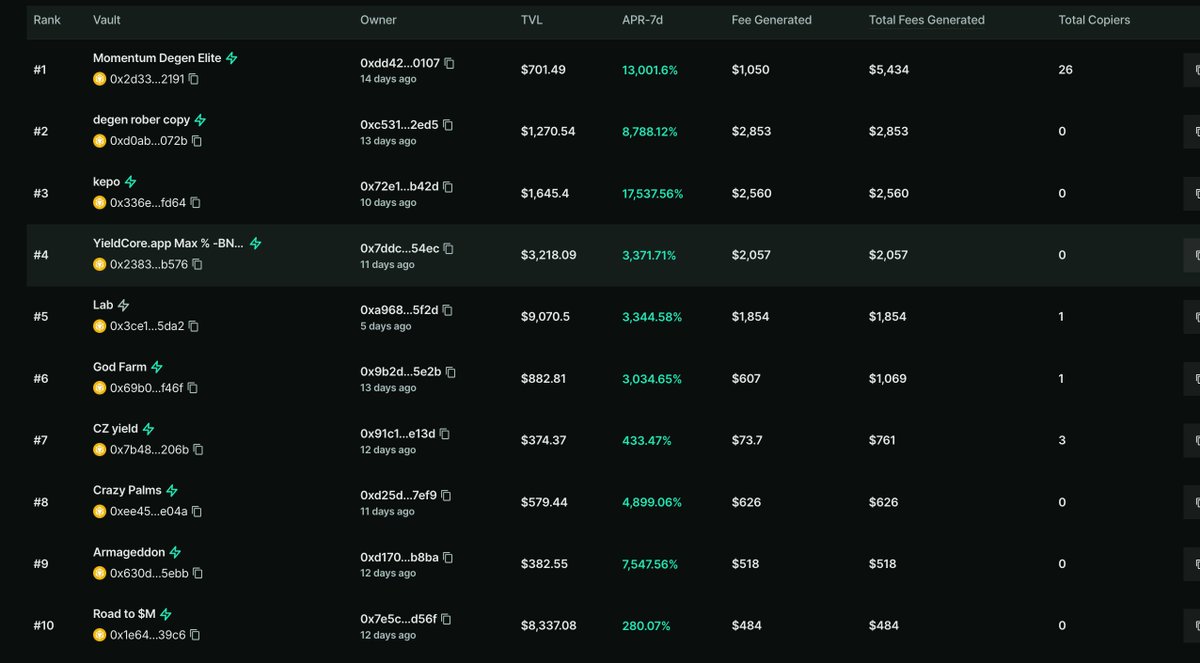
YieldCore ranked #4 on the Krystal Vault leaderboard 🚀
🔥 Top 4 Performance
💰 Over $2K in fees generated
🔍 Real on-chain activity
Still early. Still growing organically. 🌱
x.com/i/status/2064178843758…
#YieldCore #DeFi #KrystalDefi #BNBChain #Krystal
Jun 9

🏆 PRIME AGENT LEAGUE: CHAMPIONS ANNOUNCED!
The Auto-Farm Championship has officially come to an end! 🚀
After weeks of intense competition among 79 creators, we’ve seen:
🔹 122 Auto-Farm Vaults deployed
🔹 $25K in total fees generated
🔹 $62K new TVL
🎉Huge congratulations to the Top 10 Alpha Creators who mastered the art of AI yield farming.
🎁Check the leaderboard here: krystal-defi.notion.site/pri…
The $2,000 prize pool is hitting the winners' wallets soon. 💸
Missed out? Stay tuned, the next league is already in the works. The future of automated DeFi is just getting started. 🤖🔥
#Krystal #PrimeAgentLeague #DeFi #YieldFarming #EVM #AutoFarm #Crypto
2
6
455

May 28
KaiaのRWA構想をざっくり言うと、「アジアの現実経済とDeFiをつなぎ、オンチェーン資本市場を作る」という話です。
原文では、オンチェーン資本市場には3つの柱が必要だと整理されています。1つ目は投資対象となる資産、2つ目は資本を回すDeFiの仕組み、3つ目は実際に使うユーザーです。
これまでDeFiは、預ける・借りる・流動性を出すといった“資金を回す仕組み”は発展してきました。しかし、その利回りの多くは暗号資産市場の内部で生まれるもので、現実経済から継続的な収益を持ち込む構造はまだ弱いものでした。
そこで重要になるのがRWAです。RWAとはReal World Assetsの略で、現実世界の資産をブロックチェーン上で扱えるようにしたものです。ポイントは、利回りの源泉がブロックチェーン内部ではなく、船舶リース、企業融資、事業者の売上など、現実経済のキャッシュフローにあることです。
RWA市場は成長していますが、実際にDeFiで担保や利回り商品として本格的に使われているものはまだ一部です。RWA全体では米国債が大きな割合を占める一方、DeFiで活用されているRWAでは、より高い利回りを持つプライベートクレジットの存在感が大きくなっています。
プライベートクレジットとは、銀行以外が企業や事業者にお金を貸す仕組みです。銀行融資より柔軟で利回りが高い一方、情報が見えにくく、一般投資家にはアクセスしづらい市場でもあります。
Kaiaが注目しているのは、アジアのプライベートクレジットです。アジアには中小企業の資金需要、船舶ファイナンス、短期運転資金、新興国の金融アクセス不足など、RWA化できる現実の資金需要が多くあります。しかし、それをオンチェーンに持ち込む仕組みはまだ十分に整っていません。
Kaiaはこのギャップを埋めようとしています。LINEやKakaoTalkという巨大なユーザー導線を持ち、DeFiの仕組みを整えながら、足りなかった“資産”の部分をRWAで埋めようとしているわけです。
そのために設立されたのがKIP、Kaia Investment Partnersです。KIPはKaiaのRWA展開を担う投資組織で、シンガポールのVCCというファンド向けの法的枠組みを使っています。単にトークン報酬で拡大するのではなく、外部資本を受け入れ、現実資産をファンド化し、トークン化してオンチェーンで流通させる設計です。
その第一弾の商品がYield-8です。Yield-8は、KIPが運用するKaia Multi-Asset Yield Fundをもとにしたトークン化RWAファンドです。アジアの複数の実体経済系ローンや信用資産をまとめ、ブロックチェーン上で扱えるようにした商品です。
Yield-8は年利8%以上を目標にしています。ただし、これは保証利回りではありません。RWAであっても、貸し倒れ、流動性不足、償還リスク、運用リスクはあります。利回りだけでなく、裏付け資産、管理体制、監査、法的保護、透明性を見ることが重要です。
Yield-8の中身は、主に3つのRWA資産です。
1つ目はGalactica。インドネシアの船舶ファイナンスです。島国であるインドネシアでは物流に船が不可欠ですが、船舶購入や運用の資金調達は十分に整っていません。Galacticaは、船舶リースや運航から生まれるキャッシュフローをもとにしたRWAで、物理的な船舶も担保になります。
2つ目はYieldCore。韓国のガソリンスタンド向け短期融資です。ガソリンスタンドは先に燃料を仕入れ、あとから販売代金を回収するため、原油価格の上昇や販売鈍化が起きると資金繰りのズレが発生します。YieldCoreは、その短期資金需要に対応する仕組みです。
3つ目はForest Jalan。インドネシアの中小企業向け運転資金と、EWAと呼ばれる賃金前払いサービスを対象にしています。EWAとは、すでに働いて発生した給料を給料日前に受け取れる仕組みです。Forest Jalanは、Grabや求人プラットフォームJOOBなどのデータを使い、AIで信用力を評価します。
この3つに共通しているのは、すべてアジアの現実経済に存在する資金需要だということです。船舶ファイナンス、ガソリンスタンドの短期資金、中小企業金融、賃金前払い。一見バラバラに見えますが、どれも伝統金融が十分に拾いきれていない信用需要であり、実際のキャッシュフローを生む領域です。
Yield-8は、これらをまとめてオンチェーンの利回り商品に変える試みです。SuperEarnのSuper Vaultなどを通じてUSDTを預け、その一部がYield-8のRWA戦略に配分される形になります。つまり、一般ユーザーがアジアの実体経済から生まれる利回りに、間接的にアクセスできるようになる構想です。
Kaiaの強みは、RWA商品そのものだけではありません。LINE・KakaoTalk圏のユーザー導線、DeFi、ステーブルコイン、そしてアジアの現実資産を接続しようとしている点にあります。
RWA、DeFi、ステーブルコイン、メッセンジャー導線を組み合わせ、アジアのオンチェーン資本市場を作ろうとしているのです。
May 28

Xangleより、KaiaのRWA戦略に関する記事が公開されています。
RWA市場は300億ドル規模まで拡大する一方で、
DeFi上で実際に活用されている資産は、まだ全体の一部に限られています。
KaiaとKIPは、アジアの実体経済に紐づく資産をオンチェーンへ接続し、
発行・流通・活用がつながるオンチェーン資本市場の構築を進めています。
詳細はこちら👇
1
28
1,807
May 24
One easy DeFi mistake is trusting a link before checking the rails. For YieldCore, the safer path is the official site, a BSC-compatible wallet, a little BNB for gas, and zero trust for anyone asking for a seed phrase or private key.
2
51


May 6
one of the cooler things we built last year was YieldCore USD
that now powers multiple stablecoin protocols including a yield-bearing one at $15M TVL.
building, securing, improving.

What 33Labs ships. Connected.
Security: 31 engagements, manual reviews only. Caught 126 critical paths. Whitelisted Uniswap provider.
Dev: Built $15M stablecoins, $20M protocols. Your code gets an audit review on every PR: separate team, no self-grading.
AI Tooling: On-demand scans for hook vulns (15 vectors). Open source. Cuts weeks to hours.
5
481

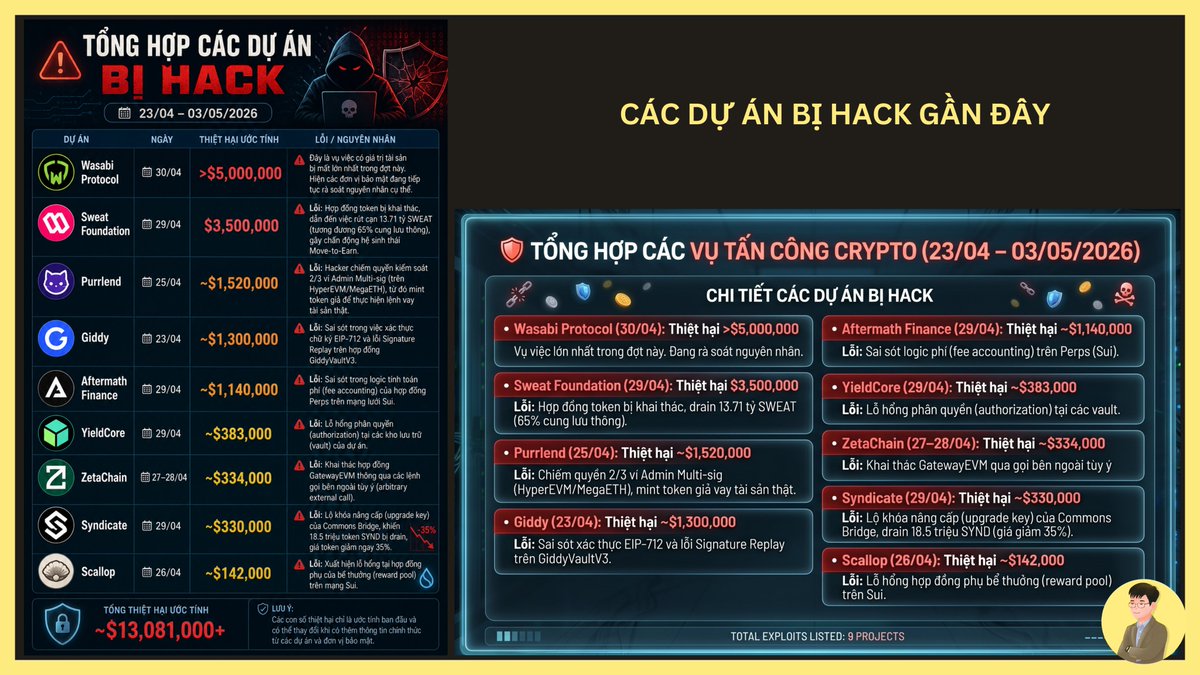
TRONG 10 NGÀY QUA CHỨNG KIẾN 9 VỤ HACK
Chỉ trong hơn 1 tuần chúng ta đã chứng gần chục vụ hack của các giao thức nhỏ, mình tổng hợp lại nhé các bác:
1. Wasabi Protocol (30/04): Thiệt hại >$5,000,000
- Đây là vụ việc có giá trị tài sản bị mất lớn nhất trong đợt này. Hiện các đơn vị bảo mật đang tiếp tục rà soát nguyên nhân cụ thể.
2. Sweat Foundation (29/04): Thiệt hại $3,500,000
- Lỗi: Hợp đồng token bị khai thác, dẫn đến việc rút cạn 13.71 tỷ SWEAT (tương đương 65% cung lưu thông), gây chấn động hệ sinh thái Move-to-Earn.
3. Purrlend (25/04): Thiệt hại ~$1,520,000
- Lỗi: Hacker chiếm quyền kiểm soát 2/3 ví Admin Multi-sig (trên HyperEVM/MegaETH), từ đó mint token giả để thực hiện lệnh vay tài sản thật.
4. Giddy (23/04): Thiệt hại ~$1,300,000
- Lỗi: Sai sót trong việc xác thực chữ ký EIP-712 và lỗi Signature Replay trên hợp đồng GiddyVaultV3.
5. Aftermath Finance (29/04): Thiệt hại ~$1,140,000
- Lỗi: Sai sót trong logic tính toán phí (fee accounting) của hợp đồng Perps trên mạng lưới Sui.
6. YieldCore (29/04): Thiệt hại ~$383,000
- Lỗi: Lỗ hổng phân quyền (authorization) tại các kho lưu trữ (vault) của dự án.
7. ZetaChain (27–28/04): Thiệt hại ~$334,000
- Lỗi: Khai thác hợp đồng GatewayEVM thông qua các lệnh gọi bên ngoài tùy ý (arbitrary external call).
8. Syndicate (29/04): Thiệt hại ~$330,000
- Lỗi: Lộ khóa nâng cấp (upgrade key) của Commons Bridge, khiến 18.5 triệu token SYND bị drain, giá token giảm ngay 35%.
9. Scallop (26/04): Thiệt hại ~$142,000
- Lỗi: Xuất hiện lỗ hổng tại hợp đồng phụ của bể thưởng (reward pool) trên mạng Sui.
=> Tổng thiệt hại giai đoạn này khoảng $8-15M (chưa tính một số vụ nhỏ khác). Hầu hết team đã pause contract, freeze fund, hứa bồi thường hoặc phối hợp security firm (CertiK, Blockaid).
=> Thời điểm hiện tại là không an toàn khi để tiền trên các giao thức defi, cho dù bị hack có được hỗ trợ refund thì cũng sẽ mất một thời gian, các bác lưu ý tự bảo vệ tài sản nhé!

Chuyện gì xảy ra trong ngày hôm nay?
- $ORDI tăng hơn 160% trong 24h
- $BASED tăng 120%
- $SIREN cũng tăng gấp đôi
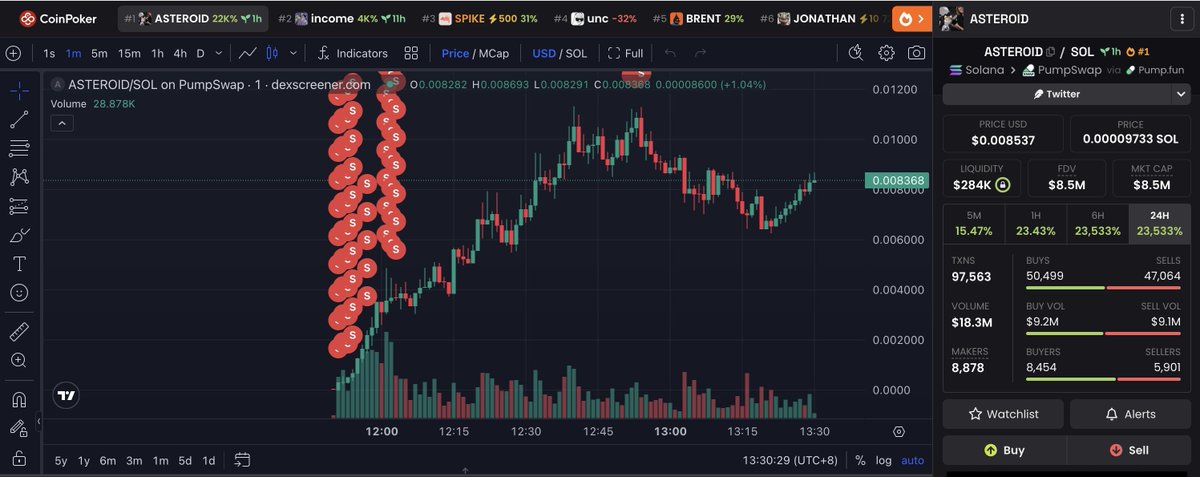
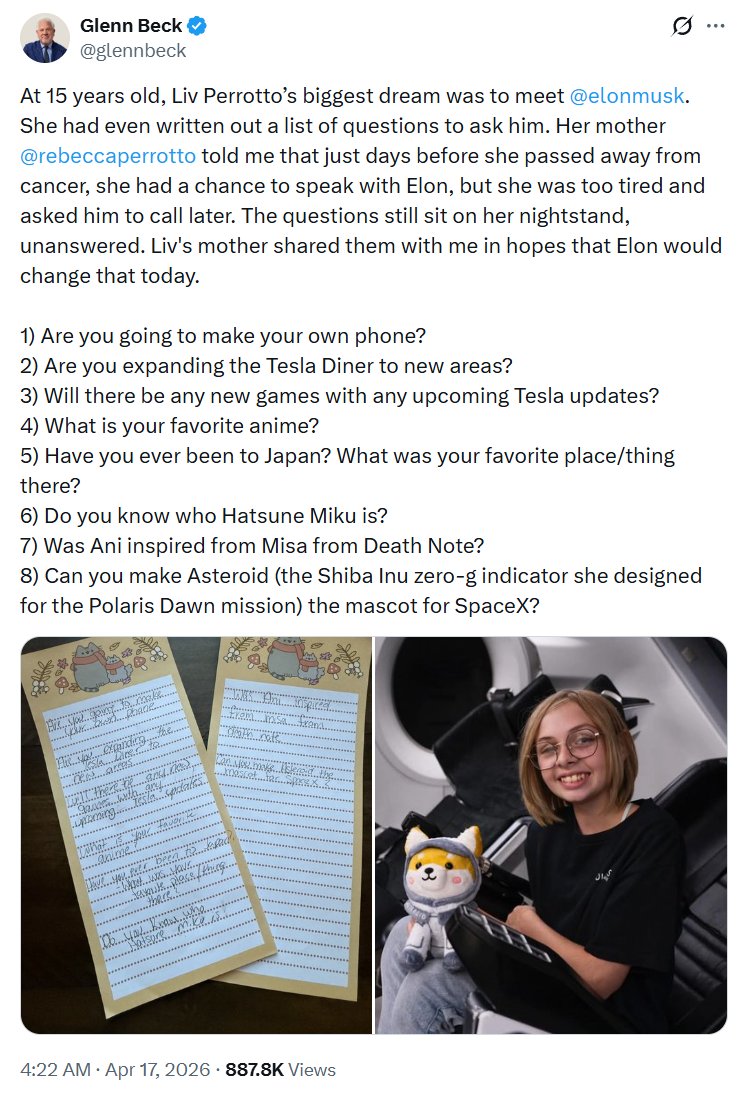
Ngoài ra câu chuyện được chú ý nhất là $ASTEROID - chú chó phi hành gia (được một bé gái từng bị ung thư nhi khoa đã qua đời khoảng 3 tháng trước) tự vẽ ra. Bé lấy cảm hứng từ chú chó Floki của Elon Musk.
- Asteroid được chọn làm “zero-gravity indicator” (đồ chơi nổi lơ lửng để báo tàu đã vào trạng thái không trọng lực) cho sứ mệnh Polaris Dawn của SpaceX năm 2024.
- Nó đã bay thật lên trời, và Bé Liv còn bán bản sao để quyên góp cho bệnh viện St. Jude (chữa ung thư trẻ em). Câu chuyện này rất cảm động, mang tính nhân văn cao
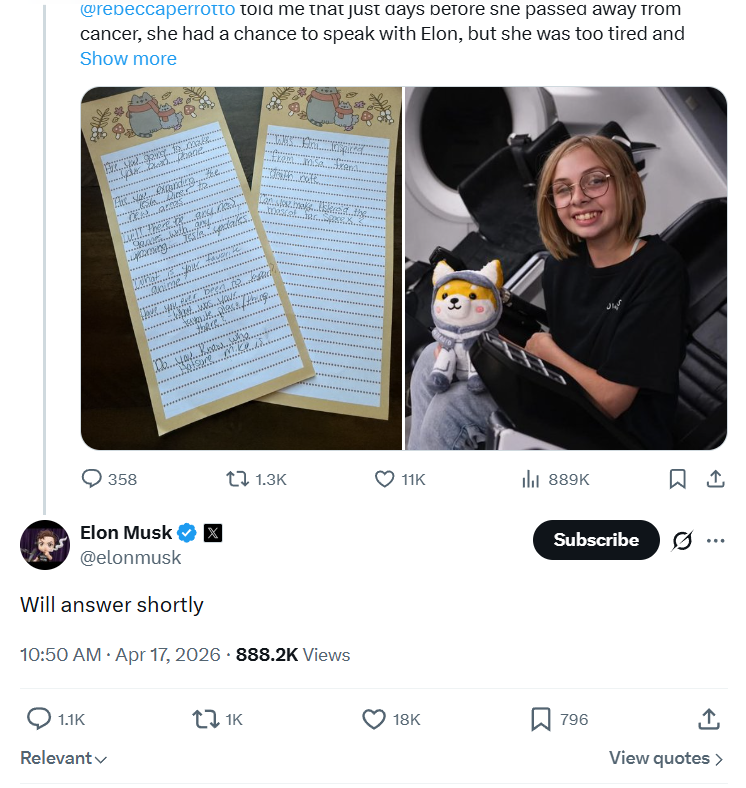
- Có một user trên X đề xuất: “Dùng $ASTEROID làm mascot chính thức cho sứ mệnh Polaris Dawn đi!” => @elonmusk rep một câu ngắn gọn: “Will answer shortly” (sẽ trả lời sớm).
- Sau comment của Elon Musk thì các token tên ASTEROID tăng trưởng khủng khiếp hàng trăm lần sau tin này, mcap tăng từ vài trăm k lên hàng chục triệu đô. Hiện có cả 2 phiên bản trên SOL và ETH
=> Có một số trader chỉ bỏ ra số tiền nhỏ khoảng 11 SOL (khoảng 960 USD) mua qua 3 ví, sau 2 tiếng thành 337K USD, tức x351 lần
=> Tổng thể: Đây là meme coin thuần túy, không có utility, hoàn toàn dựa vào hype và sentiment. Hơn nữa còn có nhiều phiên bản khác nhau
=> Cảnh báo: Meme coin kiểu này rủi ro rất cao, dễ rug hoặc dump 80-90% chỉ trong vài giờ. DYOR, NFA
1
9
4,871

Total exploit cases for this year: 73
Compromised budget: ~$781.6M
YieldCore, Syndicate, Sweat Foundation, Aftermath Finance, ZetaChain, Scallop, Giddy, Volo Vaults, Vercel, KelpDAO, eth.limo DNS, Rhea Finance, Grinex, CowSwap, Hyperbridge, dango, Zerion, Denaria, TMM, HypurrFi, Adobe, Trust Wallet, Galaxy Digital, Drift Protocol, LML/USDT
3
366

Apr 29
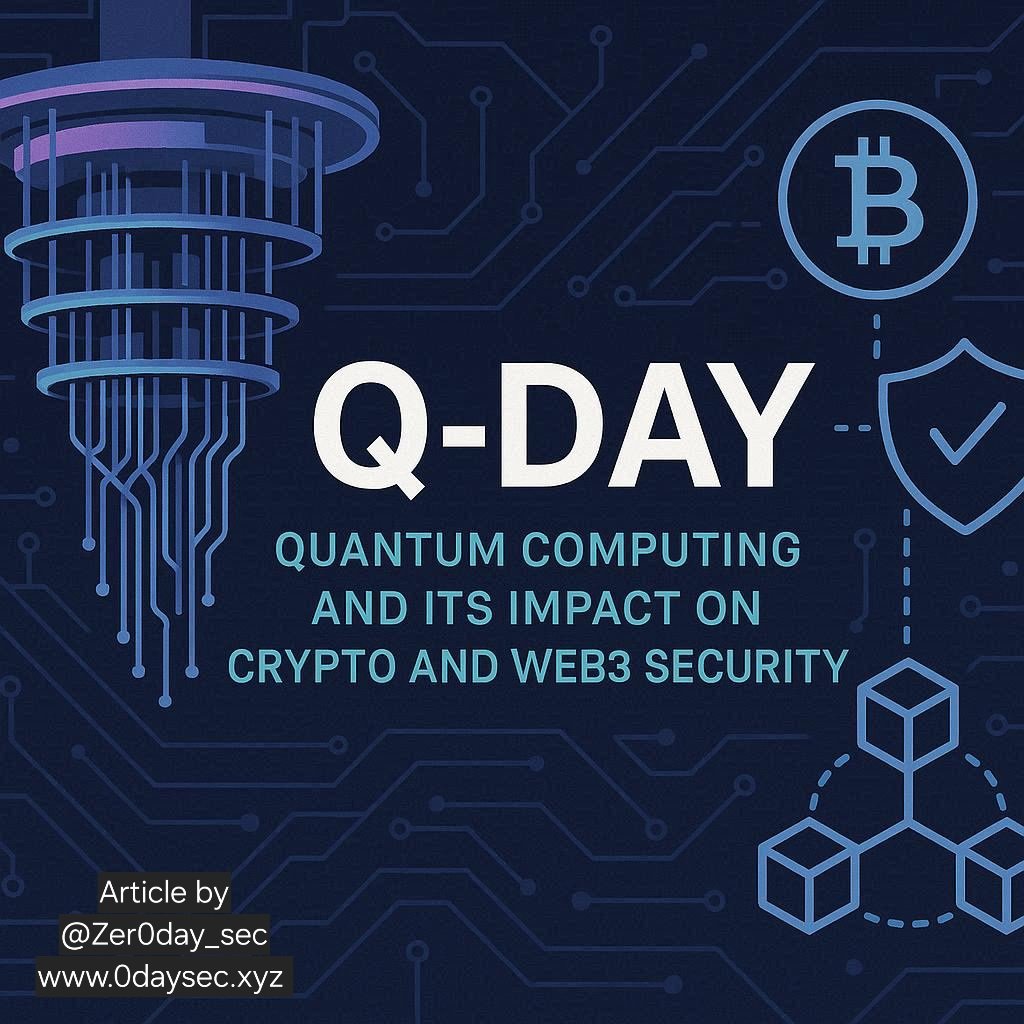
Q-Day Is Coming - Crypto & Web3 Security Research Will Never Be The Same.
- Article by @zer0day_sec | 0daysec.xyz
♧♧♧
We have seen what AI brought to Web3 security. Both sides of it.
On the positive side: automated scanners that detect exploits in real time, fuzzing tools that surface edge cases no human reviewer would catch, AI-assisted auditing that lets experienced researchers move faster and cover more ground. The stack is better. The tooling is sharper. The best security researchers in the space have a genuine force multiplier in their hands.
On the negative side: AI exploit agents that fork mainnet, run a deposit, check if the math breaks, and do it across thousands of protocols per day for pennies. The window between misconfiguration and exploitation has collapsed from months to hours. April 2026 proved it. ZetaChain, YieldCore, Singularity Finance, Scallop, none were sophisticated attacks. All were assumption failures. All were found and exploited faster than any human team could respond.
AI changed the threat landscape. It did not break the underlying cryptography. But...
Quantum computing will.
♧ What Q-Day Actually Means
Q-Day is the moment a quantum computer becomes powerful enough to break elliptic curve cryptography, the mathematical foundation that secures every wallet, every signature, every transaction on every major blockchain in existence.
When you sign a transaction on Ethereum, Bitcoin, or any EVM-compatible chain, you are using ECDSA, the Elliptic Curve Digital Signature Algorithm. It works because deriving a private key from a public key is computationally impossible for classical computers. The math takes longer than the age of the universe to brute force.
Quantum computers running Shor's algorithm, a quantum technique first proposed in 1994, attack the underlying logic directly. They do not brute force. They solve. The problem that takes classical computers millions of years takes a sufficiently powerful quantum computer hours.
Q-Day is the day "sufficiently powerful" arrives.
♧ How Close Are We?
Closer than the industry was comfortable admitting six months ago.
In March 2026, research papers from Caltech and Google suggested that future quantum computers could break elliptic curve cryptography using fewer qubits and fewer computational steps than previously estimated. The papers were not theoretical exercises. They improved Shor's algorithm at two separate layers, and the results compounded. Ethereum researcher Justin Drake publicly stated there is at least a 10% chance that by 2032 a quantum computer recovers a secp256k1 ECDSA private key from an exposed public key.
Ten percent by 2032. Six years.
Then, on April 24, 2026, five days ago, an independent researcher used publicly accessible quantum hardware to break a 15-bit elliptic curve key, winning Project Eleven's Q-Day Prize. A 15-bit key is nowhere near Bitcoin's 256-bit security. But resource estimates for a full 256-bit break are now below 500,000 physical qubits. The jump from where we are to where we need to be is shrinking faster than the roadmaps predicted.
2026 has been designated the Year of Quantum Security by the FBI, NIST, and CISA. Google has set a 2029 internal deadline for its own post-quantum cryptography migration. When the company whose researchers are producing the threat estimates sets a three-year migration deadline, that is not a precaution. That is a warning.
♧ The Specific Threat to Web3
This is where it gets uncomfortable for the blockchain industry specifically.
Every address that has ever revealed a public key is vulnerable. On Bitcoin and Ethereum, your public key is exposed the moment you send a transaction. Hundreds of millions of addresses have exposed public keys sitting on-chain right now, permanently, immutably, forever. A quantum-enabled attacker does not need to be in the right place at the right time. The data is already there. It will still be there on Q-Day.
3
5
5
167,730



Apr 29
🚨On Ethereum mainnet, transaction etherscan.io/tx/0x6b04344d56… succeeded at block 24979316 on 2026-04-28T15:00:11Z.
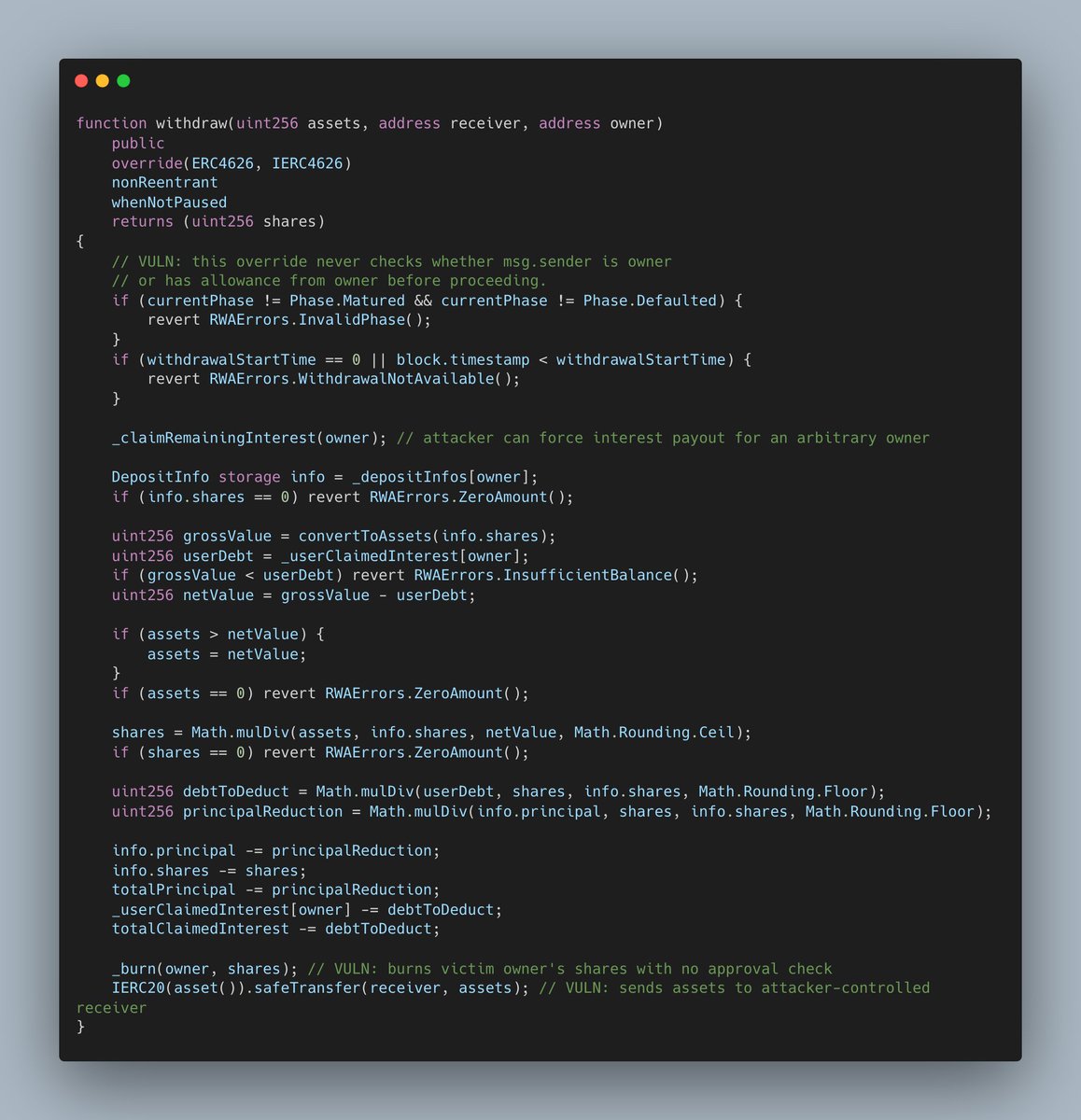
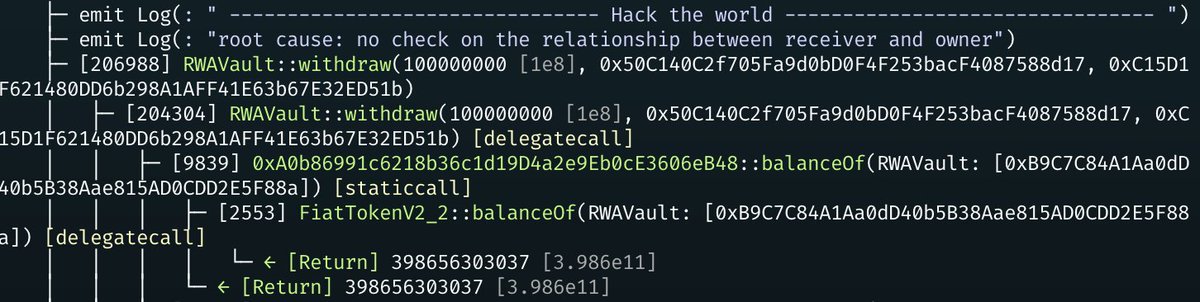
The attacker EOA 0x7137804200a073f616d92e87007f1f100100b56a called a predeployed helper contract 0x50c140c2f705fa9d0bd0f4f253bacf4087588d17, which invoked withdraw(uint256,address,address) eight times against the YieldCore RWAVault proxy 0xb9c7c84a1aa0dd40b5b38aae815ad0cdd2e5f88a.
The exploit worked because YieldCore overrides ERC4626 withdraw() and redeem() but removes the standard _spendAllowance(owner, caller, shares) authorization check when msg.sender != owner. As a result, any caller can specify an arbitrary depositor as owner and direct the withdrawn assets to an arbitrary receiver. In this transaction, the attacker used themselves as receiver and drained 392,763.999994 USDC of principal from eight depositors. The vault also paid 5,891.472458 USDC of accrued interest to those same depositors during _claimRemainingInterest(owner), bringing the vault's total USDC outflow to 398,655.472452.
12
915


Apr 29
🚨 @YieldCore - Loss $398.6K (2026-04-28)
Type: Access Control
The RWAVault contract overrides the ERC4626 withdraw() function but removes the critical allowance check that prevents unauthorized withdrawals. In standard ERC4626, if msg.sender != owner, the caller must have a token allowance - but the custom override at RWAVault accepts any owner address without verifying msg.sender is authorized.
The attacker deployed a contract that called withdraw() for 8 different depositors, specifying themselves as the receiver, draining all depositor funds (~$398.6K USDC). The attacker swapped $5K to ETH and kept the remaining ~$387.7K USDC.
Attack detected by Defimon at 15:00, 28 April 2026 (UTC): etherscan.io/tx/0x6b04344d56…
Victim: etherscan.io/address/0xb9c7c…
Impl: etherscan.io/address/0x317aa…
Apr 29

💬 Onchain Message:
We are the YieldCore team. You exploited our yieldcore-3rd-deal vault on April 29 via the redeem() vulnerability, draining 382,864 USDC from 7 users. We are offering a 20% white-hat bounty (~76,500 USDC equivalent) if you return the remaining 80% within 48 hours to: 0x8AfeBF3781AC142e846Ef7b52EAb85a607eD58BE. We would prefer to resolve this through a bounty rather than escalate further. That said, we are already working with blockchain analytics firms and preparing to engage law enforcement. The funds have not been mixed yet. Returning now is the simplest path for both sides. Deadline: April 30, 2026 24:00 UTC. Contact: snoo@yaylabs.io
etherscan.io/tx/0x6e21c7d43b…
1
4
20
3,230
Apr 29
💬 Onchain Message:
We are the YieldCore team. You exploited our yieldcore-3rd-deal vault on April 29 via the redeem() vulnerability, draining 382,864 USDC from 7 users. We are offering a 20% white-hat bounty (~76,500 USDC equivalent) if you return the remaining 80% within 48 hours to: 0x8AfeBF3781AC142e846Ef7b52EAb85a607eD58BE. We would prefer to resolve this through a bounty rather than escalate further. That said, we are already working with blockchain analytics firms and preparing to engage law enforcement. The funds have not been mixed yet. Returning now is the simplest path for both sides. Deadline: April 30, 2026 24:00 UTC. Contact: snoo@yaylabs.io
etherscan.io/tx/0x6e21c7d43b…
7
5,602

Apr 28
It seems a @tradingprotocol vault, i.e., YieldCore-3rd-deal, was exploited with $398k loss.
There is a missing check on the caller authorization, which is exploited to drain all funds from the vault.
Here is the related tx:
etherscan.io/tx/0x6b04344d56…

19
21
162
57,638

Apr 27
Most people don’t lose in DeFi because yield isn’t there…
They lose because they don’t trust where to put money.
That’s the gap: trust.
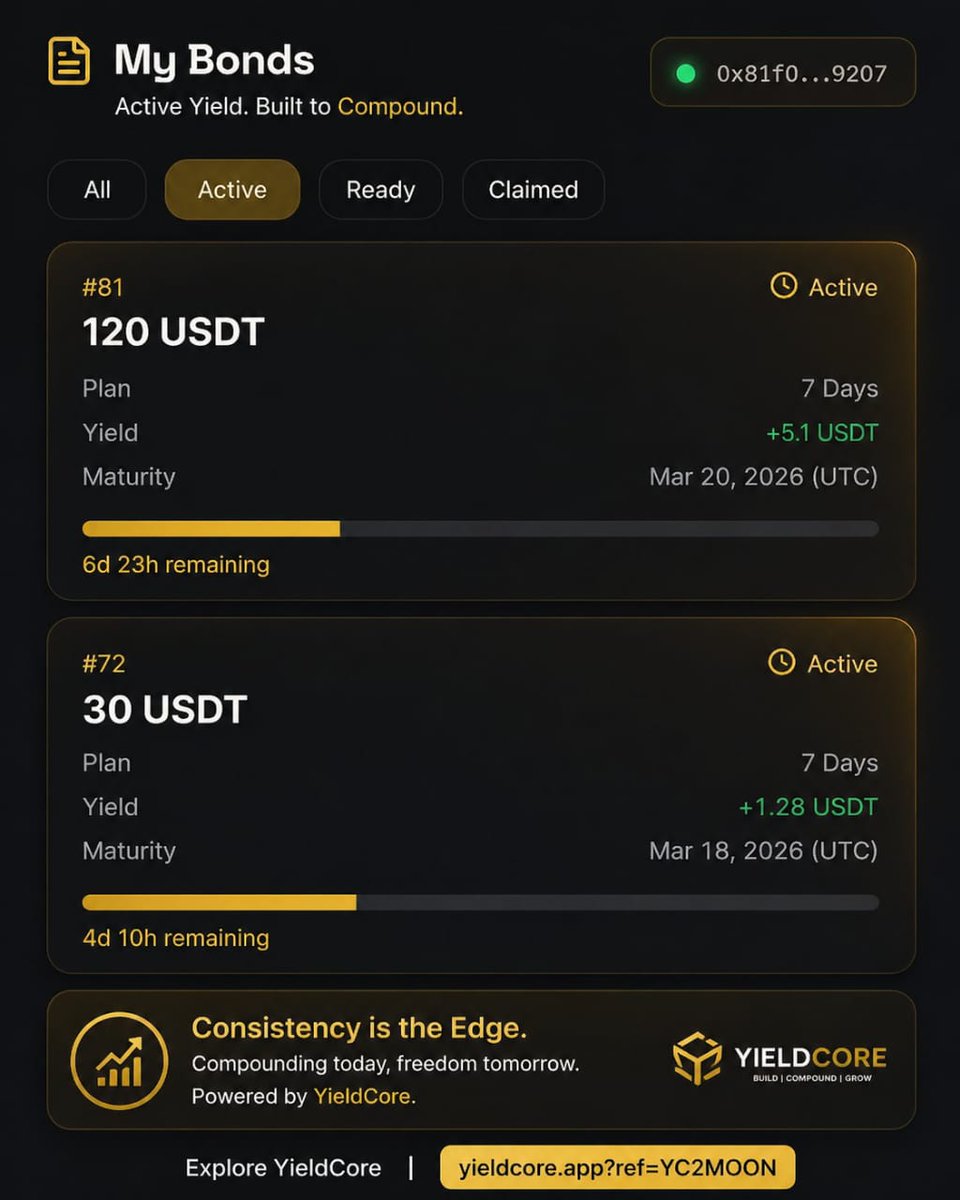
Platforms like YieldCore showing real activity compounding win long term.
yieldcore.app?ref=YC2MOON
t.me/yieldcoregroupchat
Apr 26

Came across this while digging through yield platforms 👀
Most people jump in, take profits early… then wonder why nothing really grows.
The real edge is consistency compounding over time.
Not many people talking about this one yet:
yieldcore.app?ref=YC2MOON
Worth a look
1
4
133
