Jun 12
Array1[微分積分, 線形代数, コンピュータ, 情報, 理系基礎, ディジタル, 電磁気学, 力学, 基礎, 数理, フーリエ, プログラミング, null]
Array2[及び演習, 演習, 数学, 入門, アーキテクチャ, 理論, 回路, 化学, 工学, 解析, null]
Array3[I, II, III, IV, 応用, 特論, 結合論, 概論, null]
4
916


Mari kita bahas:
cell = A520:A1018
Formula:
=HSTACK(
IF( MOD(cell;2); cell &". TTD .........."; "" );
IF(cell;"");
IF(MOD(cell;2)=0;cell&". TTD ..........";""))
1. HSTACK berfungsi untuk menggabungkan beberapa array atau range secara horizontal menjadi satu tabel.
Terdapat 3 array:
• array1 untuk TTD nomer ganjil
• array2 cell kosong
• array3 TTD untuk nomer Genap
2. Array1 → IF( MOD(cell;2); cell &". TTD .........."; "" )
• MOD(cell;2): bilangan ketika dibagi 2 akan menyisakan 1 untuk bilangan ganjil dan 0 untuk genap, artinya formula hanya menampilkan data pada urutan ganjil (kerean 1 adalah TRUE dan 0 adalah FALSE).
• cell &". TTD ..........": menggabungkan nomer ganjil dengan teks tambahan "TTD ………..". • IF(...; ...; "" ): jika FALSE, atau artunya bilangan genap akan menjadi string kosong.
3. Array2 → IF(cell;"") Karena cell berupa angka (semua angka selain 0 dianggap TRUE), maka semua isi cell akan menghasilkan "" (string kosong).
4. Array3 → IF( MOD(cell;2)=0; cell &". TTD .........."; "" ) Perbedaannya hanya di MOD(cell;2)=0, untuk membalik logika sehingga nilai 0 dianggap TRUE, artinya formula diterapkan pada urutan angka genap.
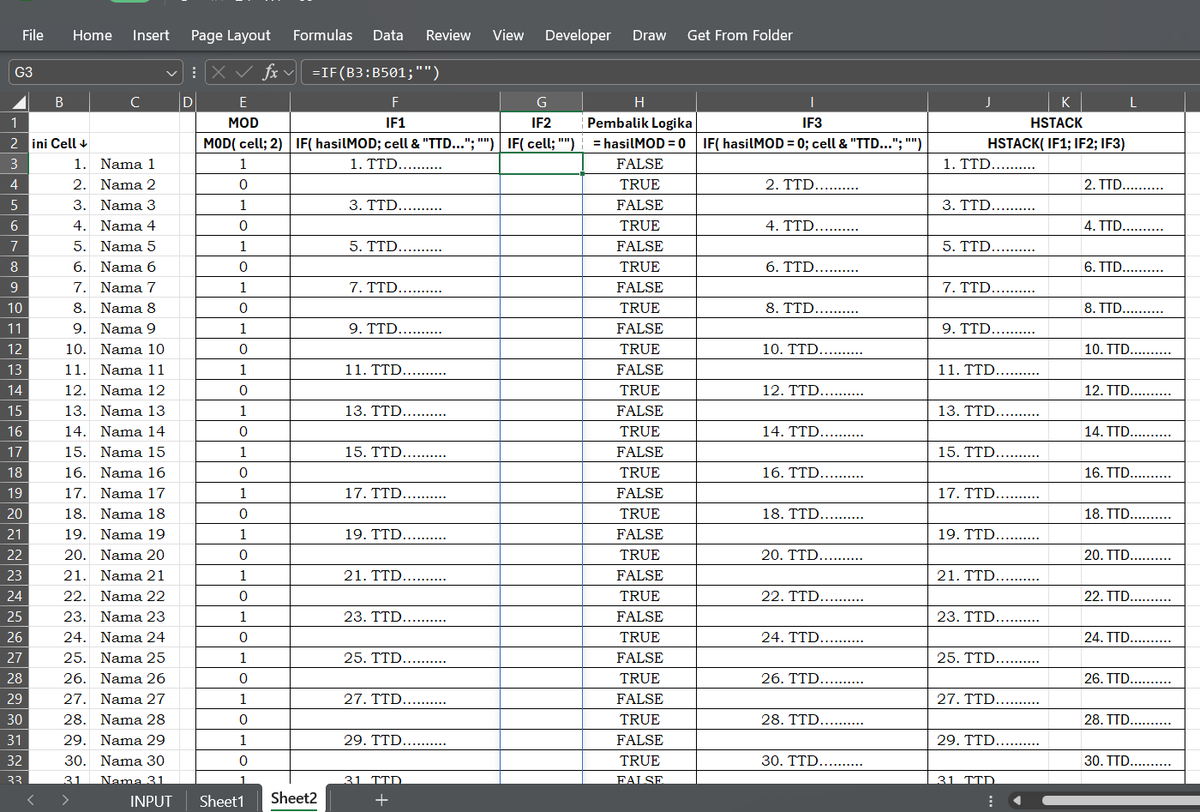

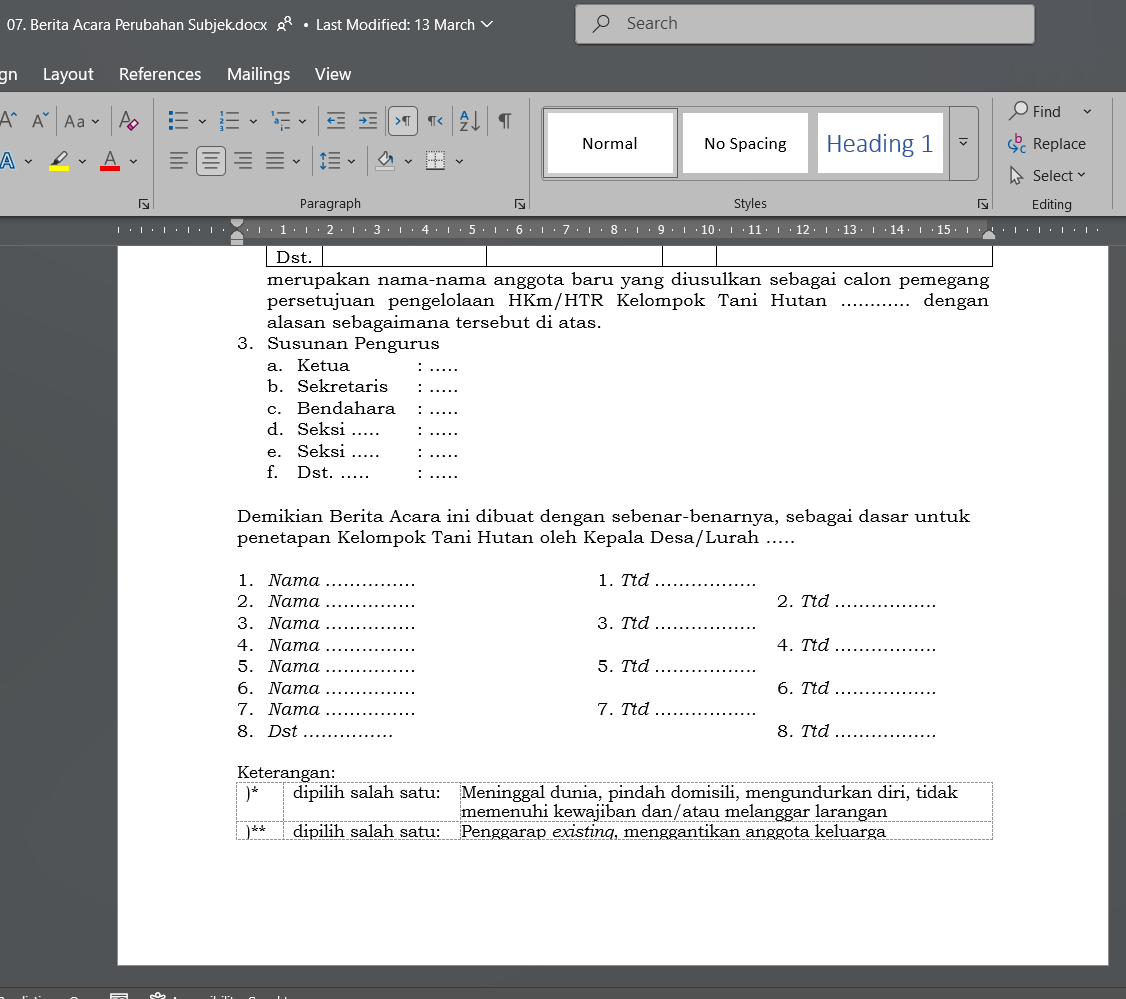
Salah satu alasan saya memilih Excel daripada Mail Merge di word 🔥🔥
👩🦰: Mas bil, bikin kolom TTDnya biar cepet gimana sihh? Namanya ada hampir 500, kolom TTDnya selang seling ganjil genap, mana ada 1 kolom nyempil ditengah 😅
👨💻: Jadi gini, nah iya gitu...
Sesudah vs Sebelum:
3
18
143
4,775

Apr 21
1 hour of downtime.
1 missed variable assignment.
1 very stressful talk with my lead.
array1.concat(array2) returns a NEW array, folks.
Don’t be like me.
Don't deploy to prod at 5:59 PM. 💀
3
40


Apr 5
Look at all that heap allocation!
corries\boundaryconditions\custom[.]rs: modes: Vec<(usize, CustomBoundaryMode)>,
corries\boundaryconditions\custom[.]rs: /// * `modes` - Vector of pairs that pair up a [usize] equation index with a
corries\boundaryconditions\custom[.]rs: modes: modes.to_vec(),
corries\boundaryconditions\custom[.]rs: &Array2::from_shape_vec(
corries\boundaryconditions\custom[.]rs: vec![
corries\boundaryconditions\custom[.]rs: let prim_expect = Array2::from_shape_vec(
corries\boundaryconditions\custom[.]rs: vec![
corries\boundaryconditions\custom[.]rs: &Array2::from_shape_vec(
corries\boundaryconditions\custom[.]rs: vec![
corries\boundaryconditions\custom[.]rs: let prim_expect = Array2::from_shape_vec(
corries\boundaryconditions\custom[.]rs: vec![
corries\boundaryconditions\custom[.]rs: &Array2::from_shape_vec(
corries\boundaryconditions\custom[.]rs: vec![
corries\boundaryconditions\custom[.]rs: let prim_expect = Array2::from_shape_vec(
corries\boundaryconditions\custom[.]rs: vec![
corries\boundaryconditions\custom[.]rs: &Array2::from_shape_vec(
corries\boundaryconditions\custom[.]rs: vec![
corries\boundaryconditions\custom[.]rs: let prim_expect = Array2::from_shape_vec(
corries\boundaryconditions\custom[.]rs: vec![
corries\boundaryconditions\custom[.]rs: &Array2::from_shape_vec(
corries\boundaryconditions\custom[.]rs: vec![
corries\boundaryconditions\custom[.]rs: let prim_expect = Array2::from_shape_vec(
corries\boundaryconditions\custom[.]rs: vec![
corries\boundaryconditions\custom[.]rs: &Array2::from_shape_vec(
corries\boundaryconditions\custom[.]rs: vec![
corries\boundaryconditions\custom[.]rs: let prim_expect = Array2::from_shape_vec(
corries\boundaryconditions\custom[.]rs: vec![
corries\boundaryconditions[.]rs: .collect::<Vec<(usize, CustomBoundaryMode)>>();
corries\boundaryconditions[.]rs: .collect::<Vec<(usize, CustomBoundaryMode)>>();
corries\config\outputconfig[.]rs: /// Whether the `Output` converts its incoming data to a single [String] or a [`Vec<String>`]
corries\config\outputconfig[.]rs: /// Whether to include ghost cells in vector data
corries\config\outputconfig[.]rs: pub data_names: Vec<DataName>,
corries\config\outputconfig[.]rs: Self::default_stdout_with_names(vec![DataName::Iter, DataName::T, DataName::Dt, DataName::DtKind])
corries\config\outputconfig[.]rs: /// * `data_names` - a vector of [DataName] objects that will be printed to stdout
corries\config\outputconfig[.]rs: /// NOTE: `data_names` cannot contain identifiers for vector-like values, like
corries\config\outputconfig[.]rs: /// let data_names = vec![DataName::Iter, DataName::T];
corries\config\outputconfig[.]rs: pub fn default_stdout_with_names(data_names: Vec<DataName>) -> Self {
corries\config\outputconfig[.]rs: /// assert_eq!(stdout_config.string_conversion_mode, ToStringConversionMode::Vector);
corries\config\outputconfig[.]rs: let mut data_names = vec![DataName::T, DataName::XiCent];
corries\config\outputconfig[.]rs: /// * `data_names` - a vector of `DataName` objects that will be printed to stdout
corries\config\outputconfig[.]rs: /// let data_names = vec![DataName::Iter, DataName::T, DataName::Prim(0), DataName::Prim(1)];
corries\config\outputconfig[.]rs: /// assert_eq!(stdout_config.string_conversion_mode, ToStringConversionMode::Vector);
corries\config\outputconfig[.]rs: pub fn default_file_with_names(folder_name: &str, file_name: &str, data_names: Vec<DataName>) -> Self {
corries\config\outputconfig[.]rs: string_conversion_mode: ToStringConversionMode::Vector,
corries\config\outputconfig[.]rs: name.data_type() != DataType::VectorFloat,
corries\config\outputconfig[.]rs: "You cannot write vectors into an Output in Scalar mode! Got data_name = {:?}",
corries\config\outputconfig[.]rs:/// Enumerates whether an `Output` writes scalar or vector values
corries\config\outputconfig[.]rs: /// Writes vectors
corries\config\outputconfig[.]rs: Vector,
corries\config[.]rs: Custom(Vec<(usize, CustomBoundaryMode)>),
corries\config[.]rs: pub writer_config: Vec<OutputConfig>,
corries\config[.]rs: writer_config: vec![
corries\lib[.]rs://! coordinate vectors in [Mesh] are called xi_*, for example.
corries\lib[.]rs://! // mode in the embedded vector. Check out the documentation for the [Physics]
corries\lib[.]rs://! // vector. See `boundary_condition_east` to see how that would look like.
corries\lib[.]rs://! boundary_condition_west: BoundaryMode::Custom(vec![
corries\lib[.]rs://! // This is a vector, where every entry is a instance of [OutputConfig], and each of these
corries\lib[.]rs://! writer_config: vec![
corries\lib[.]rs://! // vec![DataName::Iter, DataName::T, DataName::Dt, DataName::DtKind]
corries\lib[.]rs://! // Ignored for scalar output; for vector output, this sets whether to include the
corries\lib[.]rs://! data_names: vec![DataName::Iter, DataName::T, DataName::Dt, DataName::DtKind],
corries\lib[.]rs://! // vec![DataName::T, DataName::XiCent, DataName::Prim(0), DataName::Prim(1), DataName::Prim(2)],
corries\lib[.]rs://! // Defines that the data is written as vectors. This allows the output to write
corries\lib[.]rs://! // data like DataName::XiCent or DataName::Prim(n), which are vector-like values.
corries\lib[.]rs://! string_conversion_mode: ToStringConversionMode::Vector,
corries\lib[.]rs://! // Whether to include ghostcells when writing vector-like values.
corries\lib[.]rs://! data_names: vec![
corries\lib[.]rs://! # writer_config: vec![
corries\lib[.]rs://! # writer_config: vec![
corries\mesh[.]rs:/// and special indexes like the first non-ghost-cell cell index, but also vectors containing the
corries\mesh[.]rs: (StructAssociation::Mesh, DataName::XiCent) => self.write_vector(&self.xi_cent.view(), data, mesh_offset),
corries\mesh[.]rs: (StructAssociation::Mesh, DataName::XiWest) => self.write_vector(&self.xi_west.view(), data, mesh_offset),
corries\mesh[.]rs: (StructAssociation::Mesh, DataName::XiEast) => self.write_vector(&self.xi_east.view(), data, mesh_offset),
corries\rhs\numflux\hll[.]rs: let dflux_dxi_prim_expect = Array2::from_shape_vec(
corries\rhs\numflux\hll[.]rs: vec![
corries\rhs\numflux\kt[.]rs: let dflux_dxi_prim_expect = Array2::from_shape_vec(
corries\rhs\numflux\kt[.]rs: vec![
corries\state\physics[.]rs: /// Returns a view to a vector of zeros if this value is not even a derived value for the
corries\state\physics[.]rs: vars.zero_vec()
corries\state\physics[.]rs: /// Returns a view to a vector of zeros if this value is not even a derived value for the
corries\state\physics[.]rs: vars.zero_vec()
corries\state\physics[.]rs: /// Accessor to the xi velocity vector, derived from the `vars` argument.
corries\state\physics[.]rs: /// Returns a view to a vector of zeros if this value is not even a derived value for the
corries\state\physics[.]rs: vars.zero_vec()
corries\state\physics[.]rs: /// Accessor to the xi momentum vector, derived from the `vars` argument.
corries\state\physics[.]rs: /// Returns a view to a vector of zeros if this value is not even a derived value for the
corries\state\physics[.]rs: vars.zero_vec()
corries\state\physics[.]rs: /// Accessor to the eta velocity vector, derived from the `vars` argument.
corries\state\physics[.]rs: /// Returns a view to a vector of zeros if this value is not even a derived value for the
corries\state\physics[.]rs: vars.zero_vec()
corries\state\physics[.]rs: /// Accessor to the eta momentum vector, derived from the `vars` argument.
corries\state\physics[.]rs: /// Returns a view to a vector of zeros if this value is not even a derived value for the
corries\state\physics[.]rs: vars.zero_vec()
corries\state\physics[.]rs: /// Accessor to the pressure vector, derived from the `vars` argument.
corries\state\physics[.]rs: /// Returns a view to a vector of zeros if this value is not even a derived value for the
corries\state\physics[.]rs: vars.zero_vec()
corries\state\physics[.]rs: /// Accessor to the inner energy vector, derived from the `vars` argument.
corries\state\physics[.]rs: /// Returns a view to a vector of zeros if this value is not even a derived value for the
corries\state\physics[.]rs: vars.zero_vec()
corries\state\systems\euler1dadiabatic[.]rs:/// Accessors to any of these will return a vector of zeroes, whereas the corresponding equation
corries\state\systems\euler1disot[.]rs:/// energy. Accessors to any of these will return a vector of zeroes, whereas the corresponding
corries\state\variables[.]rs: /// Helper vector that only contains zeros
corries\state\variables[.]rs: zero_vec: Array1<f64>,
corries\state\variables[.]rs: zero_vec: Array1::zeros(S),
corries\state\variables[.]rs: /// Accessor function to a vector of zeroes.
corries\state\variables[.]rs: pub fn zero_vec(&self) -> ArrayView1<f64> {
corries\state\variables[.]rs: self.zero_vec.view()
corries\state\variables[.]rs: /// Return a view to the vector of minimal eigen values.
corries\state\variables[.]rs: /// Return a view to the vector of maximal eigen values.
corries\state\variables[.]rs: (StructAssociation::Physics, DataName::Prim(j)) => self.write_vector(&self.prim.row(j), data, mesh_offset),
corries\state\variables[.]rs: (StructAssociation::Physics, DataName::Cons(j)) => self.write_vector(&self.cons.row(j), data, mesh_offset),
corries\state\variables[.]rs: self.write_vector(&self.c_sound.view(), data, mesh_offset)
corries\time\rkf\butchertableau[.]rs: /// Coefficient vector b for high-order solutions
corries\time\rkf\butchertableau[.]rs: /// Coefficient vector b for low-order solutions
corries\time\rkf\butchertableau[.]rs: /// Coefficient vector c
corries\time\rkf\butchertableau[.]rs: a: Array2::from_shape_vec(
corries\time\rkf\butchertableau[.]rs: vec![0.0]
corries\time\rkf\butchertableau[.]rs: b_high: Array1::from_shape_vec(
corries\time\rkf\butchertableau[.]rs: vec![1.0]
corries\time\rkf\butchertableau[.]rs: b_low: Array1::from_shape_vec(
corries\time\rkf\butchertableau[.]rs: vec![0.0]
corries\time\rkf\butchertableau[.]rs: c: Array1::from_shape_vec(
corries\time\rkf\butchertableau[.]rs: vec![0.0]
corries\time\rkf\butchertableau[.]rs: a: Array2::from_shape_vec(
corries\time\rkf\butchertableau[.]rs: vec![0.0, 0.0,
corries\time\rkf\butchertableau[.]rs: b_high: Array1::from_shape_vec(
corries\time\rkf\butchertableau[.]rs: vec![0.0, 1.0]
corries\time\rkf\butchertableau[.]rs: b_low: Array1::from_shape_vec(
corries\time\rkf\butchertableau[.]rs: vec![0.0, 0.0]
corries\time\rkf\butchertableau[.]rs: c: Array1::from_shape_vec(
corries\time\rkf\butchertableau[.]rs: vec![0.0, 0.5]
corries\time\rkf\butchertableau[.]rs: a: Array2::from_shape_vec(
corries\time\rkf\butchertableau[.]rs: vec![0.0, 0.0, 0.0,
corries\time\rkf\butchertableau[.]rs: b_high: Array1::from_shape_vec(
corries\time\rkf\butchertableau[.]rs: vec![1.0/6.0, 2.0/3.0, 1.0/6.0]
corries\time\rkf\butchertableau[.]rs: b_low: Array1::from_shape_vec(
corries\time\rkf\butchertableau[.]rs: vec![0.0, 1.0, 0.0]
corries\time\rkf\butchertableau[.]rs: c: Array1::from_shape_vec(
corries\time\rkf\butchertableau[.]rs: vec![0.0, 0.5, 1.0]
corries\time\rkf\butchertableau[.]rs: a: Array2::from_shape_vec(
corries\time\rkf\butchertableau[.]rs: vec![0.0, 0.0, 0.0, 0.0,
corries\time\rkf\butchertableau[.]rs: b_high: Array1::from_shape_vec(
corries\time\rkf\butchertableau[.]rs: vec![1.0/6.0, 1.0/3.0, 1.0/3.0, 1.0/6.0]
corries\time\rkf\butchertableau[.]rs: b_low: Array1::from_shape_vec(
corries\time\rkf\butchertableau[.]rs: vec![0.0, 0.0, 0.0, 0.0]
corries\time\rkf\butchertableau[.]rs: c: Array1::from_shape_vec(
corries\time\rkf\butchertableau[.]rs: vec![0.0, 0.5, 0.5, 1.0]
corries\time\rkf\butchertableau[.]rs: a: Array2::from_shape_vec(
corries\time\rkf\butchertableau[.]rs: vec![0.0, 0.0,
corries\time\rkf\butchertableau[.]rs: b_high: Array1::from_shape_vec(
corries\time\rkf\butchertableau[.]rs: vec![0.5, 0.5]
corries\time\rkf\butchertableau[.]rs: b_low: Array1::from_shape_vec(
corries\time\rkf\butchertableau[.]rs: vec![1.0, 0.0]
corries\time\rkf\butchertableau[.]rs: c: Array1::from_shape_vec(
corries\time\rkf\butchertableau[.]rs: vec![0.0, 1.0]
corries\time\rkf\butchertableau[.]rs: a: Array2::from_shape_vec(
corries\time\rkf\butchertableau[.]rs: vec![0.0, 0.0, 0.0,
corries\time\rkf\butchertableau[.]rs: b_high: Array1::from_shape_vec(
corries\time\rkf\butchertableau[.]rs: vec![1.0/512.0, 255.0/256.0, 1.0/512.0]
corries\time\rkf\butchertableau[.]rs: b_low: Array1::from_shape_vec(
corries\time\rkf\butchertableau[.]rs: vec![1.0/256.0, 255.0/256.0, 0.0]
corries\time\rkf\butchertableau[.]rs: c: Array1::from_shape_vec(
corries\time\rkf\butchertableau[.]rs: vec![0.0, 0.5, 1.0]
corries\time\rkf\butchertableau[.]rs: a: Array2::from_shape_vec(
corries\time\rkf\butchertableau[.]rs: vec![0.0, 0.0, 0.0, 0.0, 0.0, 0.0,
corries\time\rkf\butchertableau[.]rs: b_high: Array1::from_shape_vec(
corries\time\rkf\butchertableau[.]rs: vec![16.0/135.0, 0.0, 6656.0/12825.0, 28561.0/56430.0, -9.0/50.0, 2.0/55.0]
corries\time\rkf\butchertableau[.]rs: b_low: Array1::from_shape_vec(
corries\time\rkf\butchertableau[.]rs: vec![25.0/216.0, 0.0, 1408.0/2565.0, 2197.0/4104.0, -0.2, 0.0]
corries\time\rkf\butchertableau[.]rs: c: Array1::from_shape_vec(
corries\time\rkf\butchertableau[.]rs: vec![0.0, 0.25, 0.375, 12.0/13.0, 1.0, 0.5]
corries\time\rkf\butchertableau[.]rs: a: Array2::from_shape_vec(
corries\time\rkf\butchertableau[.]rs: vec![0.0, 0.0, 0.0,
corries\time\rkf\butchertableau[.]rs: b_high: Array1::from_shape_vec(
corries\time\rkf\butchertableau[.]rs: vec![1.0/6.0, 1.0/6.0, 2.0/3.0]
corries\time\rkf\butchertableau[.]rs: b_low: Array1::from_shape_vec(
corries\time\rkf\butchertableau[.]rs: vec![0.5, 0.5, 0.0]
corries\time\rkf\butchertableau[.]rs: c: Array1::from_shape_vec(
corries\time\rkf\butchertableau[.]rs: vec![0.0, 1.0, 0.5]
corries\time\rkf\butchertableau[.]rs: a: Array2::from_shape_vec(
corries\time\rkf\butchertableau[.]rs: vec![0.0, 0.0, 0.0, 0.0, 0.0,
corries\time\rkf\butchertableau[.]rs: b_high: Array1::from_shape_vec(
corries\time\rkf\butchertableau[.]rs: vec![0.17279, 0.094505, 0.12947, 0.29899, 0.30424]
corries\time\rkf\butchertableau[.]rs: b_low: Array1::from_shape_vec(
corries\time\rkf\butchertableau[.]rs: vec![0.12293, 0.31981, -0.15316, 0.31887, 0.39155]
corries\time\rkf\butchertableau[.]rs: c: Array1::from_shape_vec(
corries\time\rkf\butchertableau[.]rs: vec![0.0, 0.36717, 0.58522, 0.44156, 0.8464]
corries\writer\data[.]rs: /// * `mesh_offset` - The possible offset for vector-like values
corries\writer\data[.]rs: DataType::VectorFloat => DataValue::VectorFloat(Array1::zeros([S - 2 * mesh_offset])),
corries\writer\data[.]rs: /// xi coordinates at the cell centre (Vector)
corries\writer\data[.]rs: /// xi coordinates at a cell's west border (Vector)
corries\writer\data[.]rs: /// xi coordinates at a cell's east border (Vector)
corries\writer\data[.]rs: /// Value is a vector-like container of `f64`
corries\writer\data[.]rs: VectorFloat,
corries\writer\data[.]rs: Self::XiCent => DataType::VectorFloat,
corries\writer\data[.]rs: Self::XiWest => DataType::VectorFloat,
corries\writer\data[.]rs: Self::XiEast => DataType::VectorFloat,
corries\writer\data[.]rs: Self::Prim(_) => DataType::VectorFloat,
corries\writer\data[.]rs: Self::Cons(_) => DataType::VectorFloat,
corries\writer\data[.]rs: Self::CSound => DataType::VectorFloat,
corries\writer\output[.]rs: pub data: Vec<Data>,
corries\writer\output[.]rs: ToStringConversionMode::Vector => {
corries\writer\output[.]rs: if let ToStringConversionMode::Vector = outputconfig.string_conversion_mode {
corries\writer\output[.]rs: // vector output files are seperated into multiple files, and have to enumerated.
corries\writer\output[.]rs: ToStringConversionMode::Vector => {
corries\writer\output[.]rs: || self.string_conversion_mode == ToStringConversionMode::Vector
corries\writer\output[.]rs: DataValue::VectorFloat(x) => write!(buffer, "{:>width$.*e}", self.precision, x[j], width = self.width)
corries\writer[.]rs: pub outputs: Vec<Output>,
corries\writer[.]rs: VectorFloat(Array1<f64>),
corries\writer[.]rs: let mut outputs = vec![];
corries\writer[.]rs: /// * `mesh_offset` - In case of writing vector data, how many cells should be skipped at the
corries\writer[.]rs: /// beginning and the end of the vector
corries\writer[.]rs: /// Writes a vector-like `field` to a `value`.
corries\writer[.]rs: /// * `field` - The vector-like piece of data
corries\writer[.]rs: /// * `mesh_offset` - In case of writing vector data, how many cells should be skipped at the
corries\writer[.]rs: /// beginning and the end of the vector
corries\writer[.]rs: fn write_vector(&self, field: &ArrayView1<f64>, data: &mut Data, mesh_offset: usize) -> Result<()> {
corries\writer[.]rs: DataValue::VectorFloat(v) => {
corries\writer[.]rs: "Tried assigning vector field to non-vector DataValue!\nfield: {}\nvalue: {:?}",
9
222

Feb 2
The answer is A
array1 is an array in memory.
array2 = array1 does NOT create a copy.
It makes array2 point to the same array as array1
Setting length = 0 mutates the array itself, clearing it.
Since both variables reference the same array, both get emptied
1
3
326

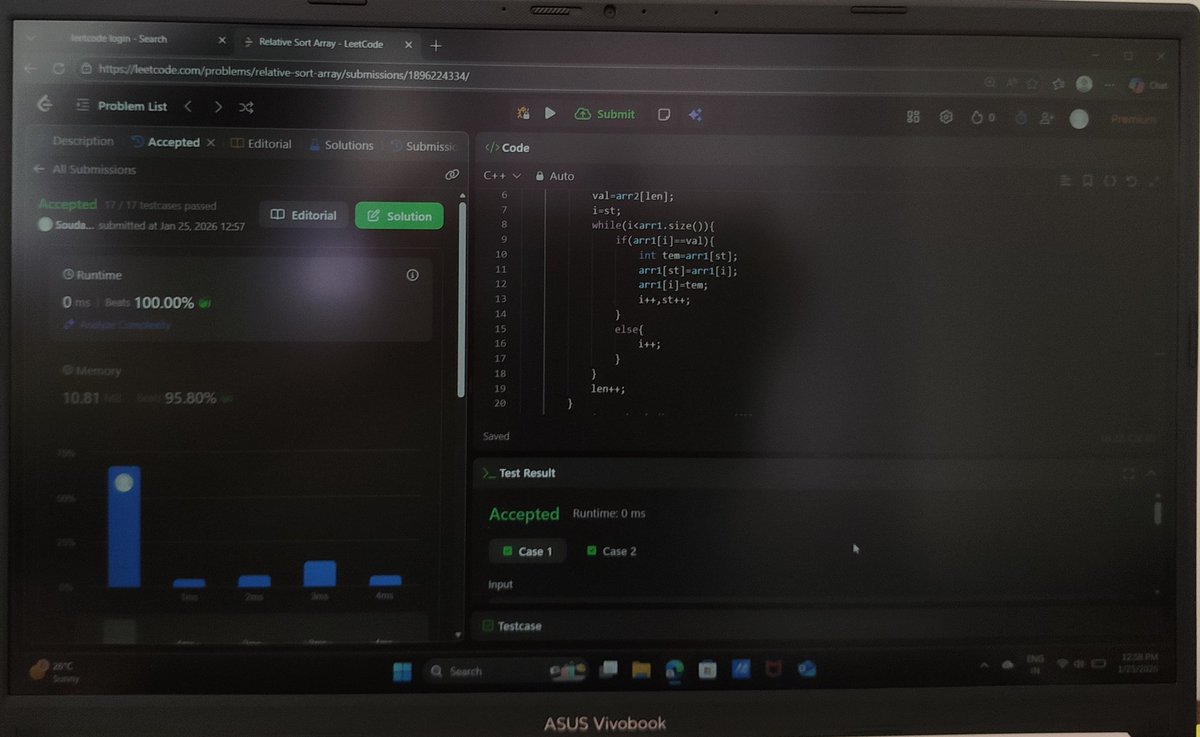
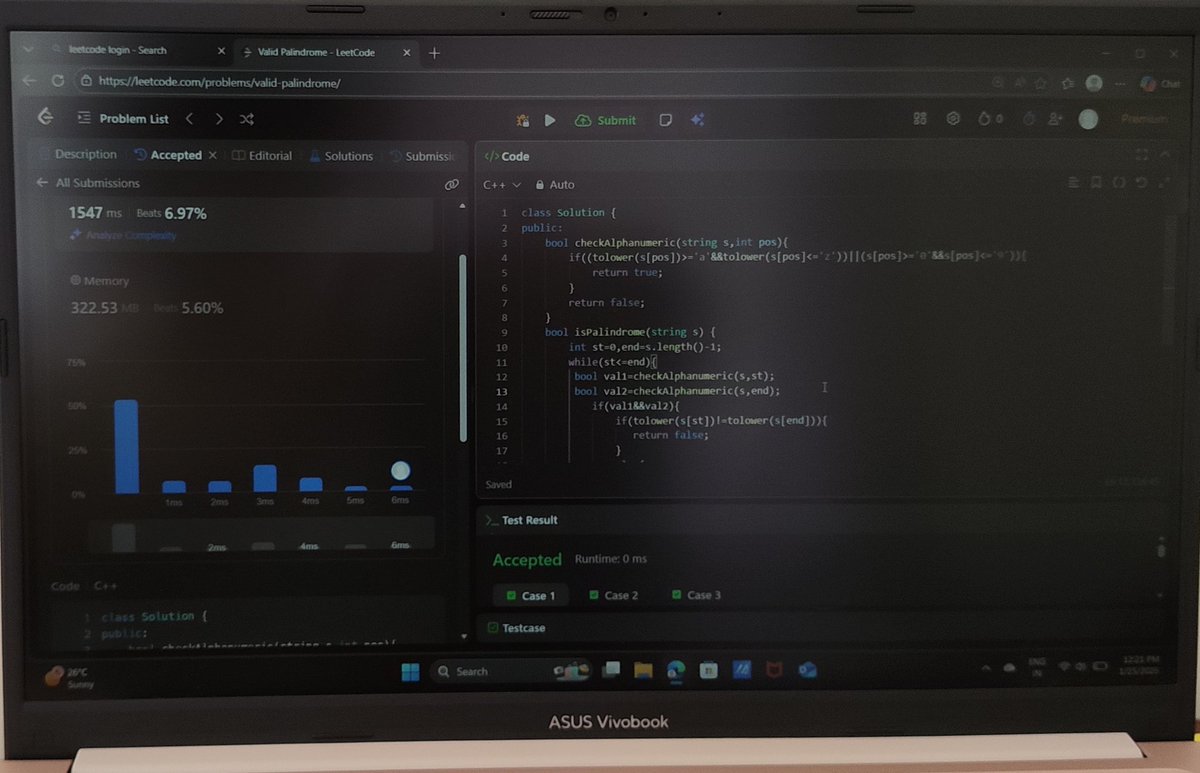
Day 41 of #100DaysOfCode
Worked on two useful problems today:
• Valid Palindrome — checking whether a string is a palindrome while considering only alphanumeric characters
• Relative Sort Array — rearranging array1 based on the order of elements in array2
3
48


24 Nov 2025
Quest new feature of leetcode part-> array-1
Q1. Concatenation of Array
Q2. Shuffle the Array
Q3. Max Consecutive Ones
#codereview #LeetCode #challenge #100DayChallenge #coderarmy #quest #array1 #softwareprogrammer
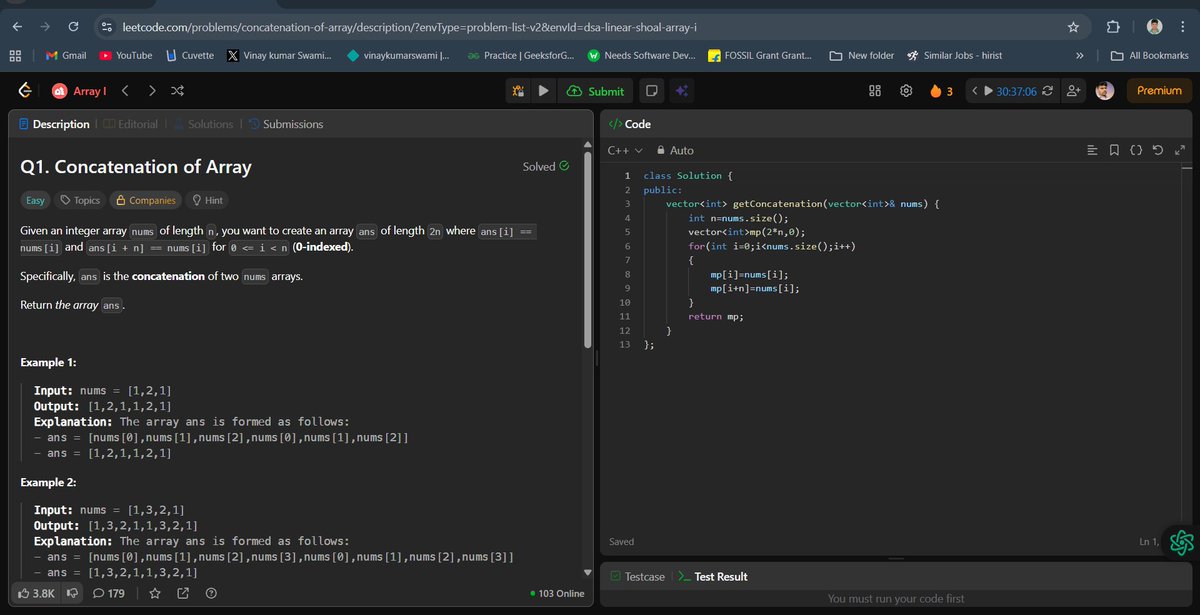
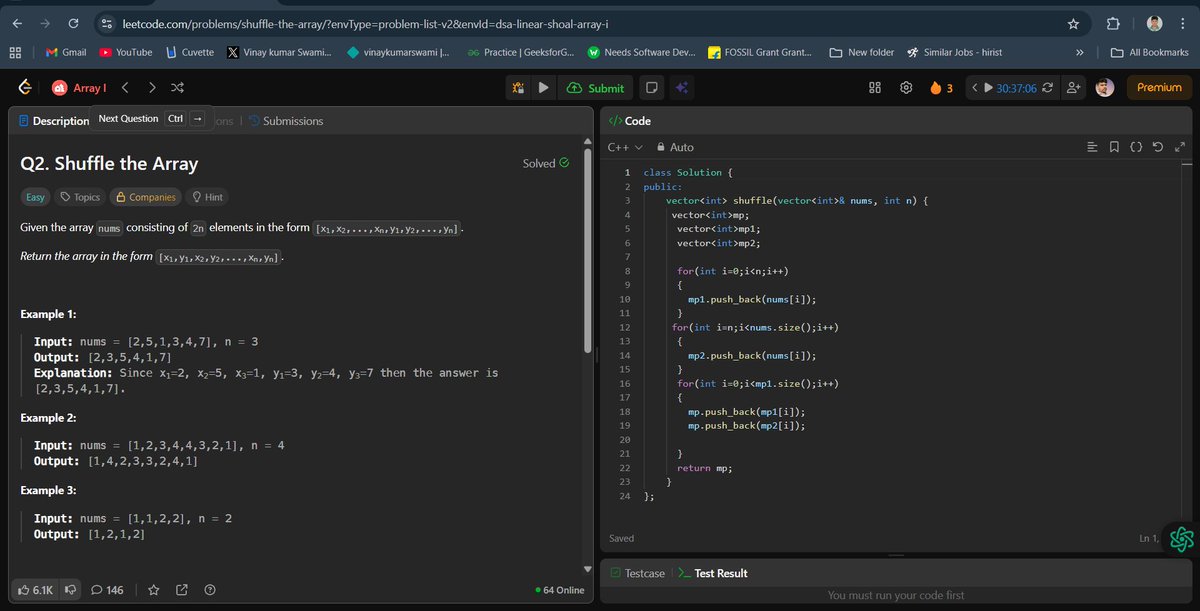
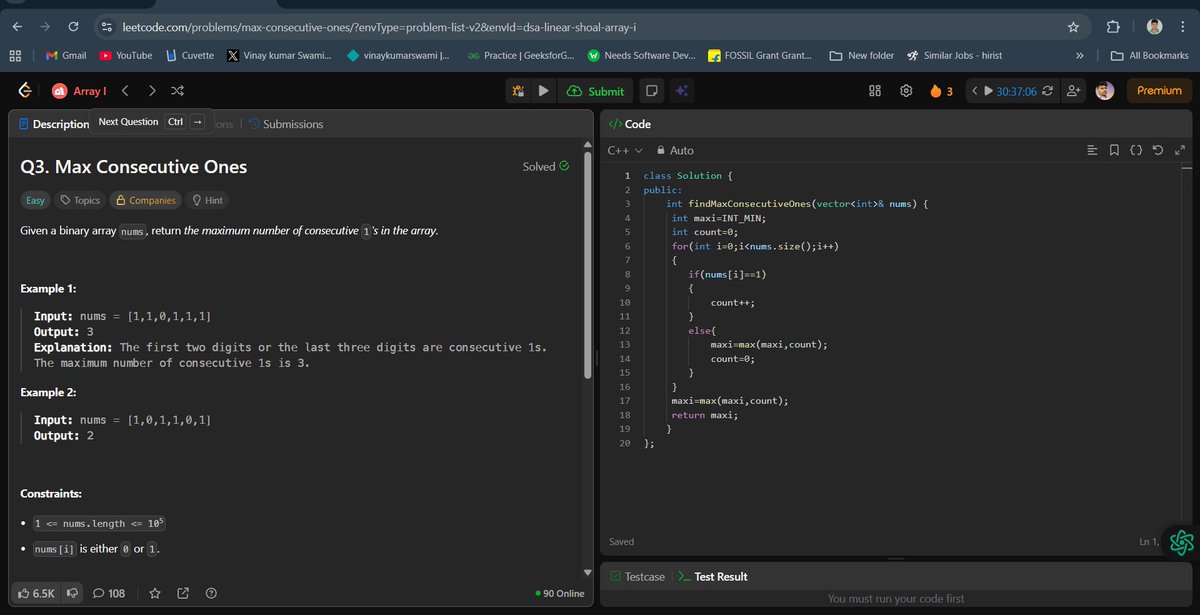
5
143

25 Oct 2025
C mei sabhi index par try kro ki kya hum ye element lekar last element bna skte hai kya. Kitne steps mei? Let's say array1 se first uthaya array2 se second and third is the last element. So the minimum step will be to take the median of these three elements and try to make it.
1
2
97

21 Oct 2025
une struct MyIterable { array1, array2, un truc, un autre truc}
j'ai besoin d'une syntaxe genre "for obj : MyIterable" comme on peut en faire en python c rust et surement bien d'autres
IMPOSSIBLE, on peut itérer que sur LEUR array de con de merde
ça m'a fait craquer
2
3
37

29 Sep 2025
💡Very useful functions in Excel:
👉Matrix Multiplication:
"=MMULT(array1;array2)"
👉Matrix Inverse:
"=MINVERSE(array)"
☝️Where an array: "CellXₘ:CellXₙ,
(often diagonally taken)
1
2
203

7 Aug 2025
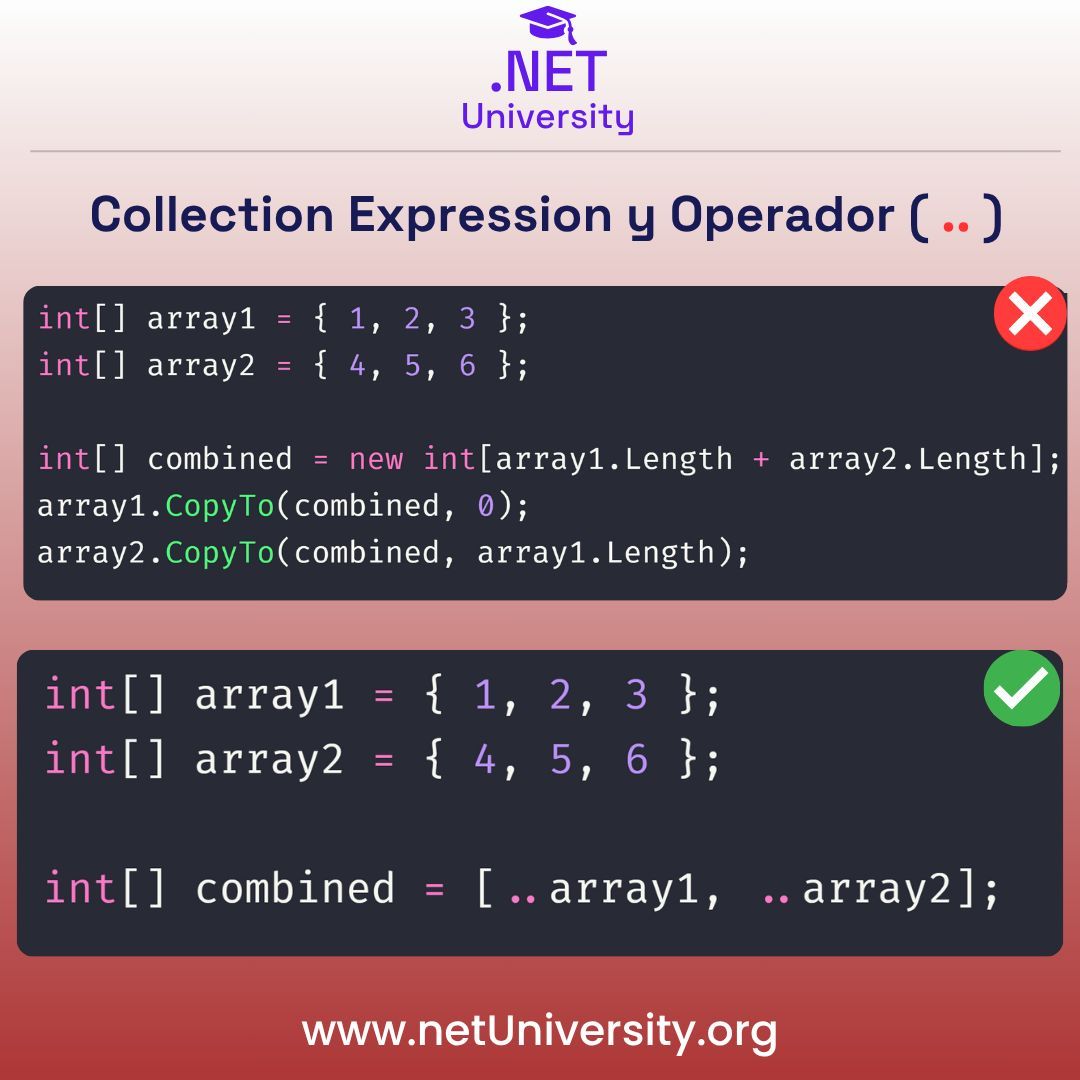
🚀 C# 12: Collection Expression y Operador (...)
¿Por qué usarlas?
1️⃣ ✂️ Menos código, más limpio
2️⃣ ⚡ Combina colecciones sin bucles
3️⃣ 🧩 Más legible y expresivo
4️⃣ 🚀 Mejor rendimiento con Span<T>
¡Haz tu código más poderoso! 👩💻✨
🔙 Antes de C# 12
Tenías que crear un nuevo array y copiar manualmente los elementos de ambos arrays 🛠️📋
🆕 Crear un array nuevo
📥 Copiar los elementos del primero
📤 Copiar los elementos del segundo después del primero
🙅 Código más largo, menos legible y con riesgo de errores
✅ Ahora con C# 12
Con las expresiones de colección y el operador .., combinas arrays en 1 línea ✨
✍️ Solo escribes [..array1, ..array2]
🔄 El operador .. despliega los elementos dentro del nuevo array 🔥
#csharp12 #dotnet #devtips #programacion
1
4
240


27 Jul 2025
Today's work is here 😎,
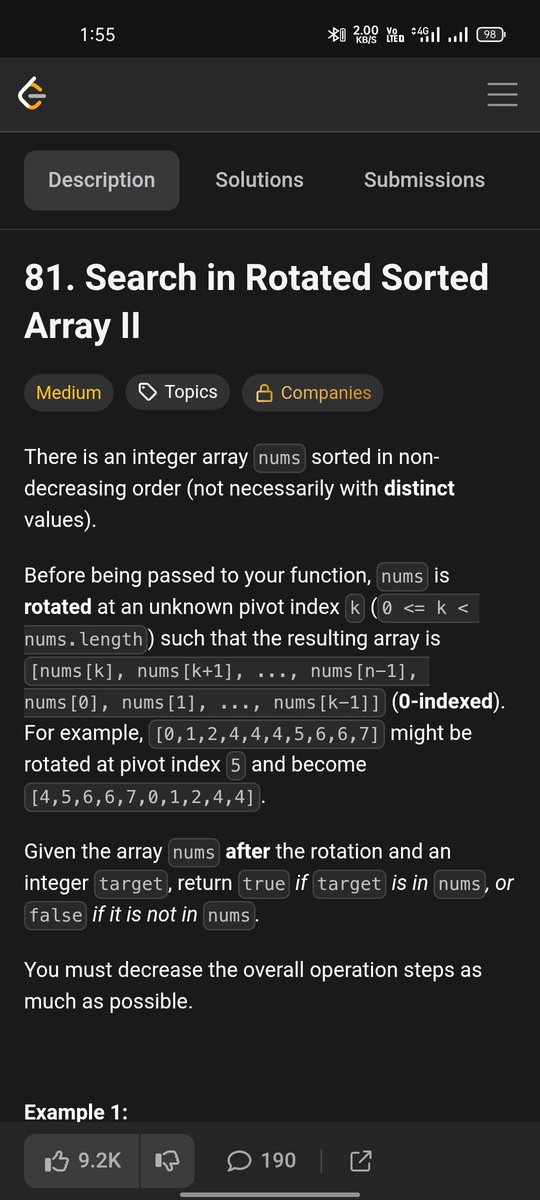
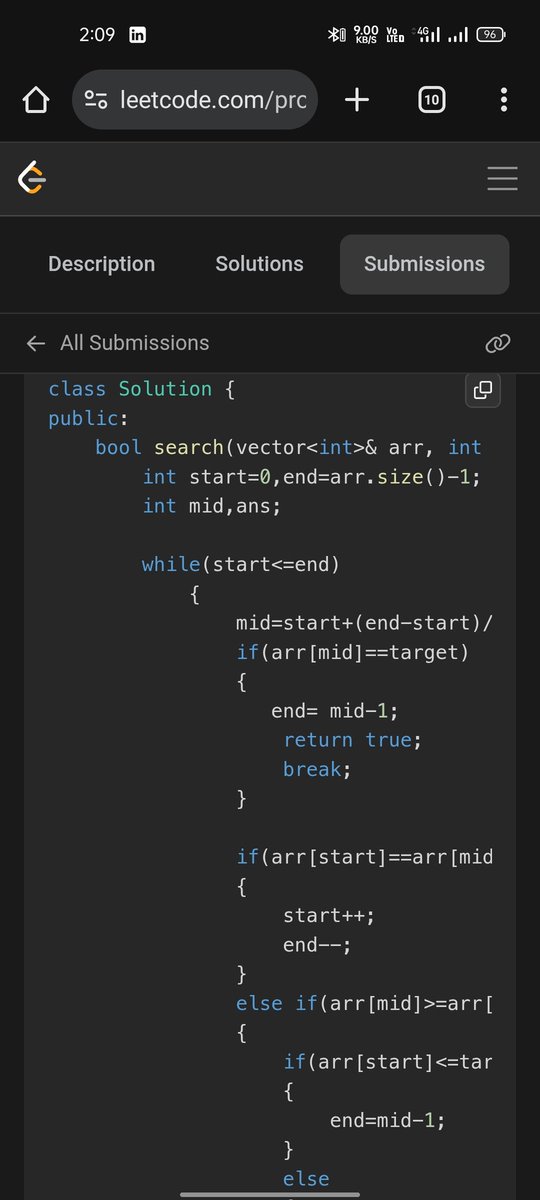
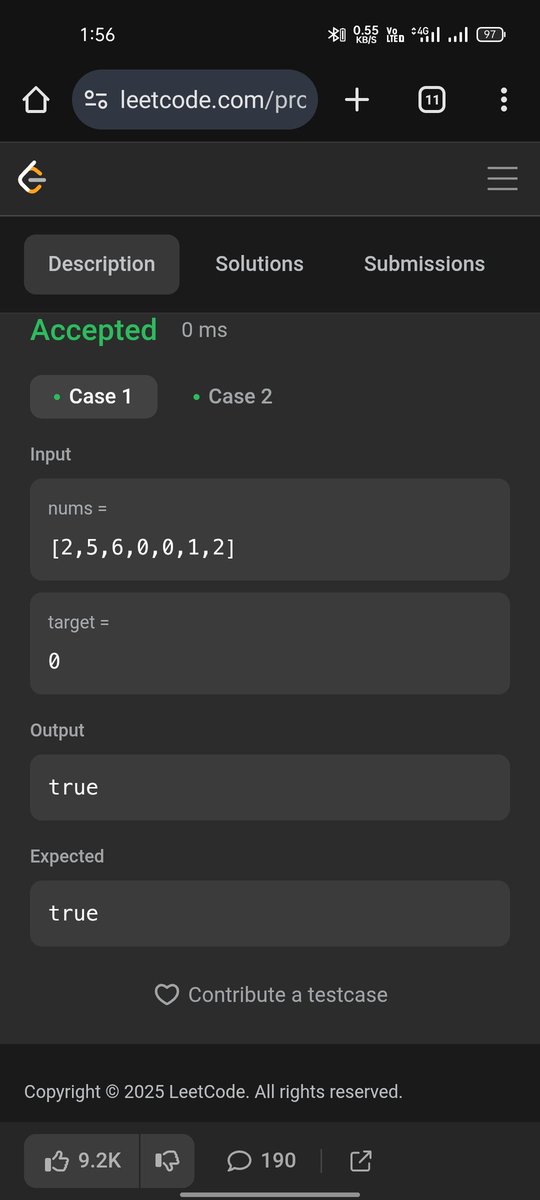
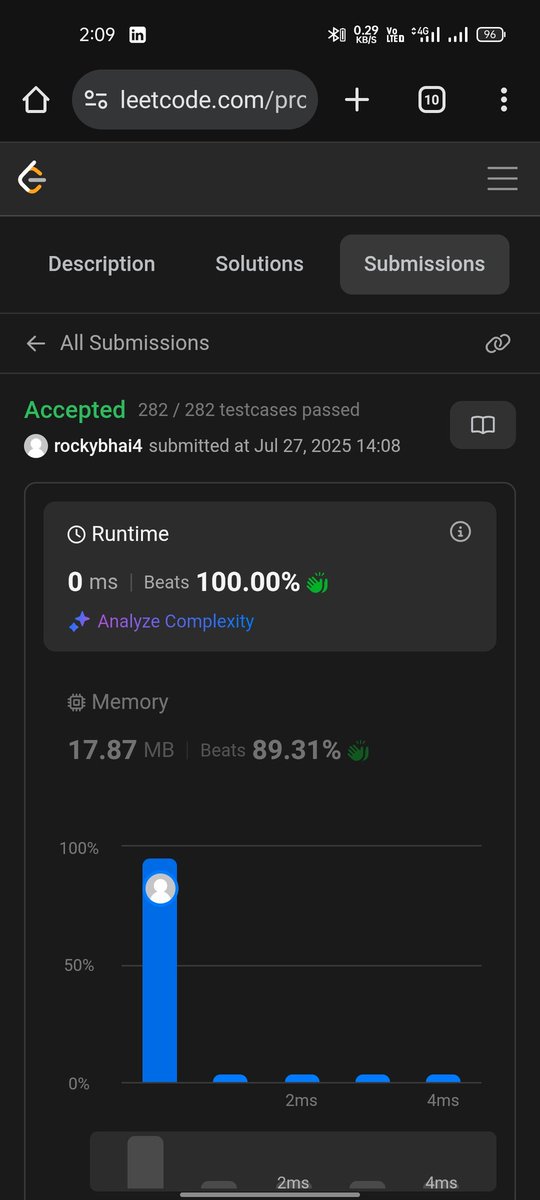
Solved 1 Leetcode problem of "Search in Rotated Sorted Array ||' ,
Approach 🧠:- So first understood the problem,this problem is majorly same as Search in Rotated Sorted Array1,but some exceptions.
Thanks to fav
@rohit_negi9 ❤️.
#DSA #cpp #leetcode
3
56

15 Jul 2025
JavaScript って、こんな書き方できるのか!
ChatGPTに、「要素eからなる配列array1に対して、eのプロパティtypeが特定の値xであるインデックスの配列array2を返すJavaScriptのコードを書いて」と言ったら、以下のような1行のプログラムを示してきた:
array2 = array1.map((e,i) => ({e,i}).fliter(({e}) => e.type === x).map(({i})=>i);
私はJavaScript初心者なので、一瞬「えっ!?」と思考が止まった。何この呪文。怖い。ChatGPTに、この呪文の解説をお願いしたら、非常に丁寧に解説してくれた:
・array1 → .map() → .filter() → .map() と、戻り値を次々に受け渡す「メソッドチェーン」で書かれている。
・アロー関数式「=>」を使うことで、その場で関数を定義して渡せる。(わざわざ別に定義した関数を呼び出さずに済むので「無名関数」と呼ばれる。)
・アロー関数式の定義でオブジェクト{}を示す場合、関数本体と誤解されないようカッコで括って ({}) と書く
つまり、上述の1行のプログラムは、「ステップ1.配列の要素e とインデックス番号i のペアのオブジェクト{e,i}の配列を返す」→「ステップ2.{e,i}から要素{e} を分割代入し、e.type === x の条件を満たすオブジェクトのみを抽出して返す」→「ステップ3.抽出されたオブジェクト{e,i}から要素{i}を分割代入し、インデックス番号iの配列を返す」という三段階のプログラムを、メソッドチェーンとアロー関数を駆使して1行で書いていたわけだ。
あぁ、なんてエレガントなコードだ…。独学では、このコードを書けるようにはならなかったと思う。生成AI のプログラミング能力の高さを見せつけられたわ……。
1
183