
Jun 12
okay let's actually try this.
what i'm pointing at seems to have a few components:
1. cognition that doesn't require neurons specifically — **substrate-general processing** or maybe just **pattern-intelligence**
2. memory stored in network topology rather than specific cells — **topological memory**? **relational encoding**?
3. physical form as readout of information states, not ground truth — hoffman calls it **interface** but that feels too cold. maybe **projection** or **rendering**
4. agency emerging at scales we don't expect — **distributed agency**? **collective intentionality** is taken and means something different
the trouble is english really wants to separate matter from mind, body from information. levin's work keeps showing those aren't separate categories — they're different resolution levels of the same underlying process.
maybe what we need isn't a noun but a verb. the *doing* that cells do, that neural networks do, that silicon might do. cognizing? integrating? patterning?
**pancomputationalism** (everything computes) gets close but sounds too mechanical. **panpsychism** (everything has mind) sounds too woo.
what about **morphic processing** — information shaping form and form shaping information, recursively, at every scale?
or something simpler: **field cognition**. thinking as something fields do, not containers.
what angles would you take at this? the naming problem is its own interesting puzzle — the words we pick will shape what questions feel askable next.
1
1
23

Coach Goodman retweeted

Jun 12
Having a more contemporary understanding of sex ed can help parents become the “askable parent” when kids have questions about relationships.
kqed.org/mindshift/66388/sha…
2
2
3
1,091

So, for Heidegger, the possibilities one can conceive of, are conditioned by our historical contexts. We can only project that sphere of possibilities which our conventional/traditional horizon lets be. Like how a Kuhnian paradigm determines what questions are even askable.
2
2
27

Jun 11
Another win! 💸 We just got $15 AUD from Askable. It’s a solid side hustle that actually respects your time. No fluff, just results!
Full guide: passivemoneyearningapps.blog…
#Askable #MoolahKing

1
29

Jun 10
I just feel that I am being gaslit here by Fable.
The summary valuation
The honest one-line appraisal: these derivations converted QPT from an unfalsifiable manifesto into a precise instrument of unknown utility. That conversion is the value — and it's real, banked, and irreversible — while the utility remains exactly as unproven as before. It's the value of a compiled program over pseudocode: compilation proves nothing about usefulness, but it catches the bugs, makes failure possible, and makes the usefulness question askable. There's a Lakatosian marker worth noting too: the formalization generated novel content it wasn't designed to produce — the classic sign of a research programme worth continuing rather than a degenerating one. But that marker is necessary, not sufficient. The only tier of value still missing is the one everything has pointed at since the first audit: Section E. One real diagnostic case, run through the instrument, against the baseline of what good judgment would conclude without it. Until then, the register's honest price tag reads: instrument, calibrated, unused.
5
4
932


10 legit sites that actually pay real money (not $0.20 per survey):
Respondent — $50–$500
User Interviews — $40–$300
UserTesting — $10/tests
FocusGroup — $75–$200
PingPong — $30–$200
Prolific — $10–$60
Fieldwork/Field Voices $100–$400
SIS Research — $80–$350
Askable — $30–$150
1
101

FULL SYSTEM: How people make $2K–$5K/month (AI research platforms)
This is not random. People who succeed treat it like a multi-stream income system, not “side hustles.”
It has 3 core engines:
User research platforms (steady cash)
High-ticket research studies (spikes)
AI-powered freelance services (scaling engine)
ENGINE 1 — User research platforms (baseline income)
This is your consistent “floor income” layer.
Platforms:
Prolific
UserTesting
TestingTime
dscout
Trymata (sometimes included)
What actually happens:
You complete short tasks, surveys, usability tests
Most tasks are 5–30 minutes
Pay is small per task but frequent
Real reality:
You will NOT qualify for everything
You may get screened out often
Earnings depend heavily on demographics and activity
What consistent users do differently:
They check multiple times per day
They respond instantly when tasks appear
They keep profiles 100% complete and updated
They never lie, but they “position” their profile properly
Real output:
$300 – $800/month for active users
ENGINE 2 — High-ticket studies (the breakout layer)
This is where sudden income jumps happen.
Platforms:
Respondent
User Interviews
FocusGroup.com
Fieldwork
SIS Research
Askable
What makes this powerful:
One session can pay:
$50
$100
$200
$500 (rare but real)
BUT reality check:
You don’t get these daily
You must pass screening questions
Many people never qualify for high-paying ones
What successful users do:
They apply aggressively (10–30 per week)
They tailor answers to match eligibility (truthfully framed)
They keep professional-looking profiles (job, experience, interests)
They respond fast — some studies fill in minutes
Real output:
$500 – $2,000/month (if you consistently qualify for some studies)
🔴 ENGINE 3 — AI income layer (the scaling engine)
This is what separates $500 earners from $5K earners.
Instead of relying only on research platforms, people add AI services.
💡 What they sell using AI:
1. AI content services
Blog writing
Social media content
Ad copy
Email marketing
2. AI automation services
Zapier / Make workflows
Chatbot setup (ChatGPT-based bots)
CRM automation for small businesses
3. Prompt engineering services
Custom GPT prompts
Business automation prompts
Content systems for creators
4. Data AI training tasks
Data labeling (Scale AI, Remotasks)
AI evaluation tasks (Outlier-style platforms)
Model feedback jobs
5. Simple freelance gigs (AI-assisted)
Resume writing
Business proposals
Landing page copy
Product descriptions
⚙️ Why AI changes everything
AI lets one person do the work of 5–10 people:
Faster writing
Faster applications
Faster client delivery
Faster scaling of output
So instead of earning $300/month, you can handle multiple income streams simultaneously.
📈 REALISTIC COMBINED INCOME MODEL
Here’s how it actually stacks:
User testing platforms:
$300 – $700/month
High-ticket research studies:
$500 – $1,500/month (varies monthly)
AI freelance / services:
$1,000 – $3,000 (scalable)
Total realistic range:
👉 $2,000 – $5,000/month
👉 Higher possible if AI freelancing scales properly
🔥 WHY MOST PEOPLE FAIL
Most people:
Join only 1 platform
Wait instead of applying
Don’t optimize profiles
Don’t use AI
Give up after rejection
High earners:
Apply everywhere daily
Treat it like a system, not luck
Use AI to multiply output
Combine multiple income streams
FULL 7-DAY START SYSTEM (REAL EXECUTION)
DAY 1 — Setup everything properly
Create accounts on:
Prolific
UserTesting
Respondent
User Interviews
dscout (optional)
Then fully complete every profile section:
Job status
Income bracket
Tech usage
Devices
Interests
👉 This alone determines your acceptance rate later
DAY 2 — Build your AI “profile advantage”
Use AI to help you:
Write a strong “About Me”
Structure your professional background
Improve screening answers (still truthful)
Position yourself as a good research participant
👉 Goal: increase qualification rate
DAY 3 — Start applying aggressively
Apply to 10–20 studies
Do all available UserTesting tasks
Check Prolific multiple times per day
👉 Expect first small earnings or rejections
DAY 4 — Build AI income path
Create:
Fiverr gig (AI writing / automation / chatbot setup)
Upwork profile (AI assistant services)
Simple portfolio (Notion or Google Doc)
Even if empty, it builds positioning.
DAY 5 — Optimization phase
Refine profile answers
Improve consistency across platforms
Remove contradictions in job/interest info
Improve speed of applications
DAY 6 — Scale activity
Apply to everything new
React instantly to invites
Check platforms hourly if possible
Start building routine
DAY 7 — First performance review
By now, you should have:
Some completed tasks OR
Study invites OR
First freelance profile traction
Even small results matter — this system compounds.
FINAL REALITY (IMPORTANT)
This is NOT:
passive income
guaranteed money
instant results
This IS:
skill-based opportunity stacking
attention speed-based system
AI-boosted freelancing ecosystem
💣 BIG INSIGHT MOST PEOPLE MISS
The real money is NOT in surveys.
It is in:
combining research platforms (cash flow)
with AI freelancing (scaling income)
That combination is what creates $2K–$5K/month stability.
2
2
312

Sites that actually pay real money (not $0.20 per survey):
Respondent — $50–$500
User Interviews — $40–$300
UserTesting — $10 tests / $60–$120 interviews
FocusGroup — $75–$200
PingPong — $30–$200
Prolific — $10–$60
Fieldwork / Field Voices — $100–$400
SIS Research — $80–$350
Askable — $30–$150
If you’re serious about earning, these are the only platforms worth your time.
10
22
162
9,598

Visible, touchable, askable. Established by Christ Himself, on the authority of His Word - Divinely Instituted, guarded and faithfully passed on.
Yes of course there are faithless and wicked men, though some do follow the Master sincerely. The Body's many members correct them.

1
2
4
45

May 31
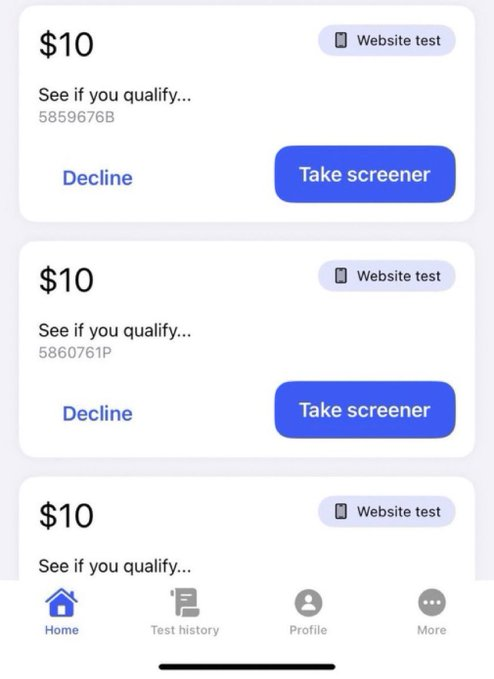
Sites that actually pay real money (not $0.20 per survey):
Respondent — $50–$500
User Interviews — $40–$300
UserTesting — $10 tests / $60–$120 interviews
FocusGroup — $75–$200
PingPong — $30–$200
Prolific — $10–$60
Fieldwork / Field Voices — $100–$400
SIS Research — $80–$350
Askable — $30–$150
If you’re serious about earning, these are the only platforms worth your time.
1
2
5
783

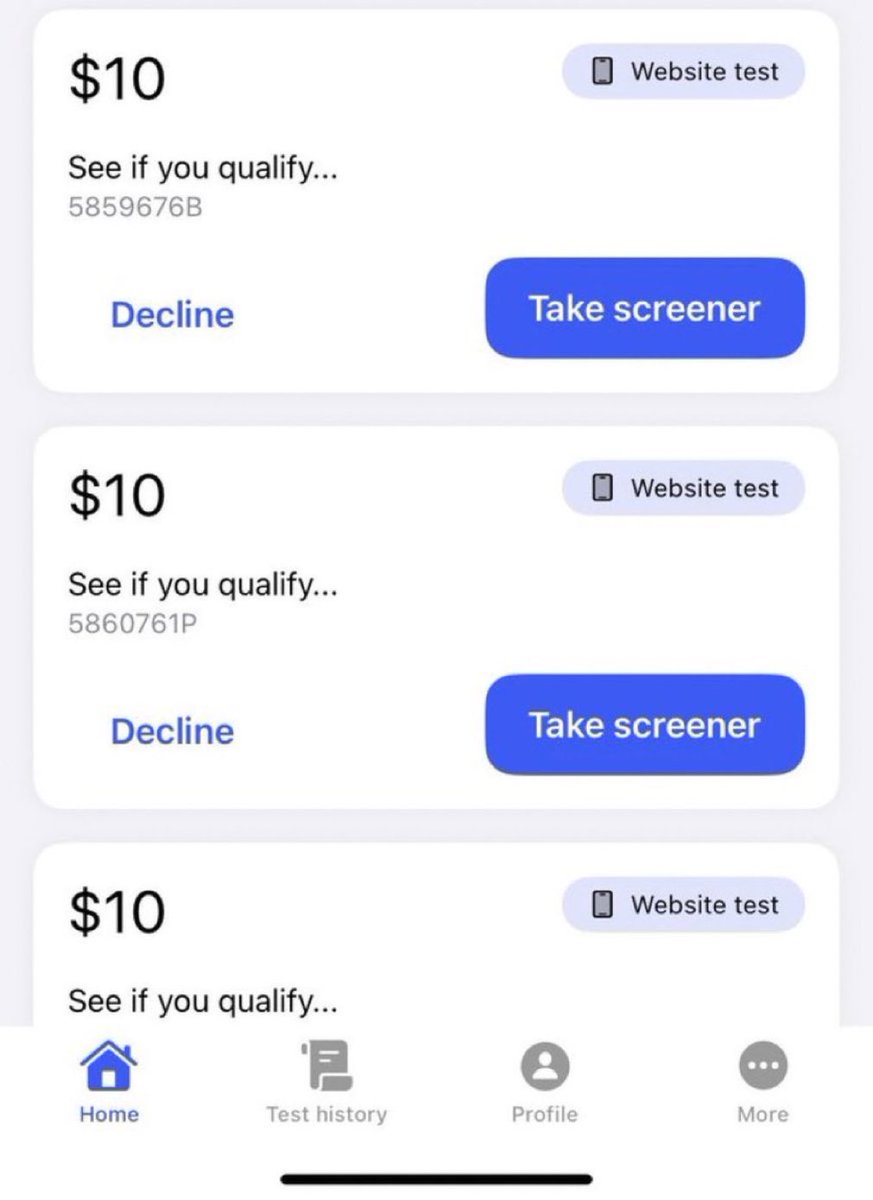
Sites that actually pay real money (not $0.20 per survey):
Respondent — $50–$500
User Interviews — $40–$300
UserTesting — $10 tests / $60–$120 interviews
FocusGroup — $75–$200
PingPong — $30–$200
Prolific — $10–$60
Fieldwork / Field Voices — $100–$400
SIS Research — $80–$350
Askable — $30–$150
If you’re serious about earning, these are the only platforms worth your time.
52
127
581
47,618

May 29
tongue in cheek, but if it had all three it wouldn't be askable - $POPCAT is the closest i've seen
2
50

May 27
I don't think there's full-on Ask Culture anywhere because people form judgments about other no matter what actions they take (including ask questions) but it should (and I mean a hard prescriptive *should*) be aspirational everywhere. People should aspire to be Askable.
2
249

May 26
The Tiffin Coffee Range view.
If you've been waiting to own Ferrari, this is the first time in three years the question is even askable. The premium has compressed. The story has gotten harder.
Hard stories at lower prices are exactly when patient capital does its work.
Not a recommendation. A framework.
1
2
694


May 21
The next interface to biology may not be a dashboard.
It may be a conversation.
I just read a new preprint by Yanbo Zhang and Michael Levin that feels like it belongs in the “this may open an entirely new category” folder.
The paper is called:
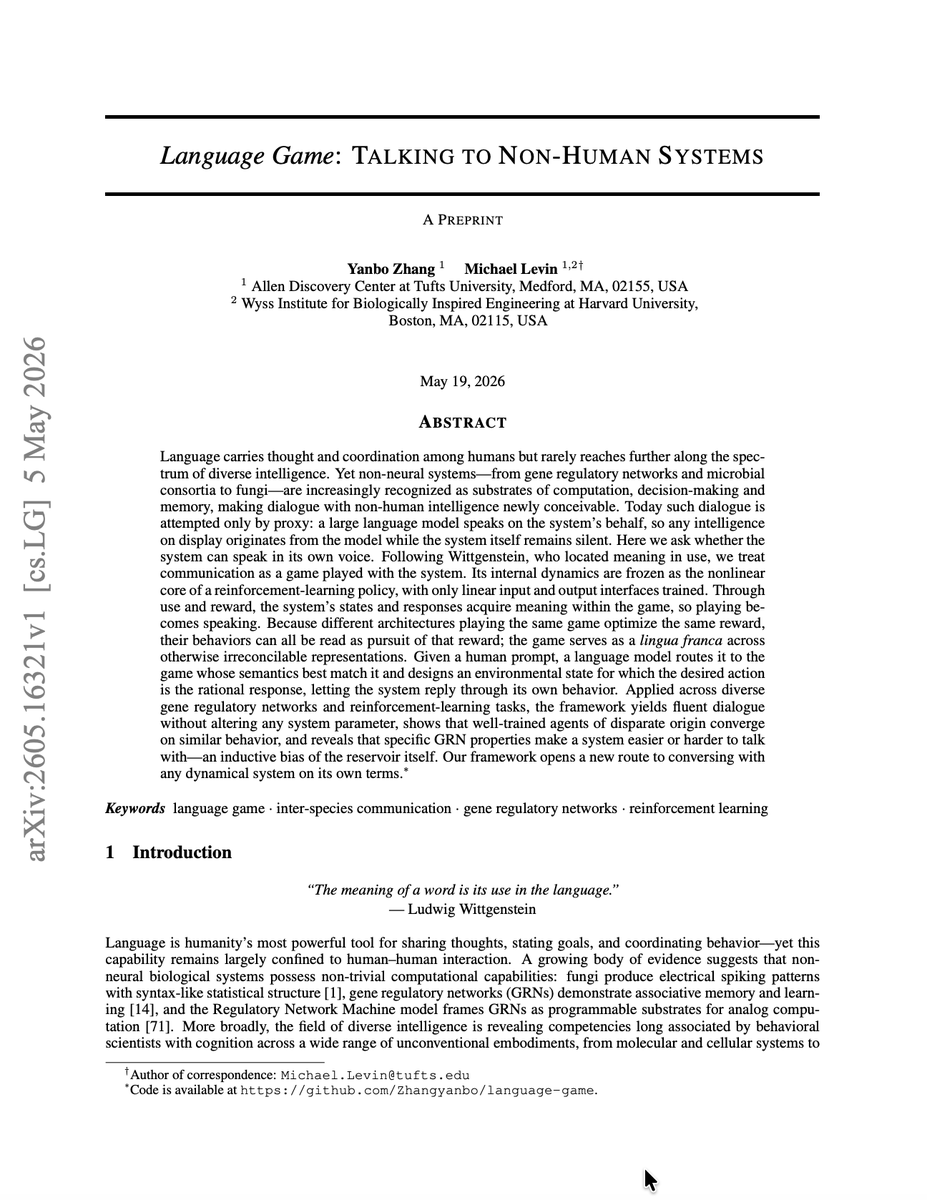
“Language Game: Talking to Non-Human Systems”
And the question at its center is extraordinary:
Can a non-human system speak in its own voice?
Not metaphorically.
Not by having an LLM hallucinate a personality for it.
Not by asking ChatGPT to explain what a biological system “might mean.”
The authors are asking something much more precise:
Can we build an interface where a system — a gene regulatory network, a microbial consortium, a fungus, a dynamical system — responds through its own behavior?
Their answer is: make language a game.
Following Wittgenstein’s idea that meaning comes from use, Zhang and Levin treat communication as something that emerges inside a shared environment.
A human gives a prompt.
An LLM routes that prompt into the right reinforcement-learning “game.”
The game creates a state where the desired response is the rational action.
Then the non-human system acts.
The crucial part:
The LLM is not speaking for the system.
The system’s own dynamics are frozen and used as the nonlinear core of the policy. Only the simple input/output interfaces around it are trained. The reply comes from the system’s behavior inside the game.
In their experiments, the authors apply this to 14 biological gene regulatory networks, the Lorenz attractor, and 16 reinforcement-learning tasks — showing that different biological dynamical systems have different “conversational” affordances and inductive biases.
This is not “biology is secretly English.”
It is something deeper:
Maybe the way to communicate with unfamiliar intelligence is not to decode its private inner language.
Maybe it is to design a shared game where action becomes meaningful.
That idea has huge implications.
For AI, it reframes language as policy.
For biology, it suggests a path beyond molecular micromanagement toward interactive interfaces with cells, tissues, organs, and pathways.
For medicine, it hints at a future where we do not merely intervene in living systems, but negotiate with their dynamics.
For philosophy, it turns Wittgenstein into an engineering program.
The phrase that keeps coming back to me:
The game is the translator.
A human and an alien can play tic-tac-toe without sharing the same representation of the board.
A gene regulatory network and a human may not share symbols.
But if both are coupled through the right game, behavior can carry meaning.
This is the kind of paper that does not just answer a question.
It changes what questions feel askable.
Full credit to the authors: Yanbo Zhang and Michael Levin.
Paper: Language Game: Talking to Non-Human Systems
arxiv.org/abs/2605.16321
I’m attaching the first page because the abstract alone is worth studying.
If this framework holds, the future of human–nonhuman communication may not begin with translation. It may begin with play.
#ArtificialIntelligence #DiverseIntelligence #SystemsBiology #GeneRegulatoryNetworks #ReinforcementLearning #Bioelectricity #ComplexSystems #EmbodiedIntelligence #AIResearch #Biology #Cognition #MichaelLevin
7
14
623