
Jun 12
What are the specific technologies we are looking for beyond AMCA ? There isn't much noise on 110-120 KN engine codevelopment.
Maybe India will get to manufacture the wings and undercarriage as it's workshare.
2
1
4
48

Jun 12
No sir. I’m not taking it from any mainstream thought process. I’ve been thinking on this for sometimes from first principles. There’s a severe lack of appreciation of a different trade’s demands from what one’s regular strand of trade has been. Look at how armed forces officers look at capabilities. As something coming out of a lab without any codevelopment from them. Look at IITs that work on theoretical stuff that are silo’ed from our industrial needs.(changes only in recent times).
The silos today may have changed but they have their origins in lack of cross pollination of ideas and needs.
1
34

Vishnu is not even saying that , v should expand the scope of GTRE-SAFRAN 120KN jv engine deal, and include codevelopment of ACE engine...he stright up advocating for investment for 10-20B$ in FCAS program..not in Indias 6th gen fighter program. FYI AMCA prog cost is 2B$.

Jun 9

India needs to use this opportunity to jump right in as a full fledged partner. Finding plus development of a 6th gen fighter exactly the way we want it.
2
9
47
925

we should only focus on engine codevelopment.
other 6th gen tech can be developed by us if we fund it properly
2
1
16

RevExpoConsulting is offering Business, Digital Transformation, and Performance Optimization for Enterprises.
@nvidia Collaboration Supports Next-Generation Memory Codevelopment With NVIDIA’s AI
nvidianews.nvidia.com/news/s…
#business #management #consulting #roi
1
12
🇮🇳Indian Airforce Squadrons Paglu retweeted
I think if we should sign a deal with rolls Royce for a codevelopment of turboprop engine this can help to make our own strategic airlifter. These airlifter can be modified to be used as A&EWACS and tankers.
2
1
4
155

Jun 8
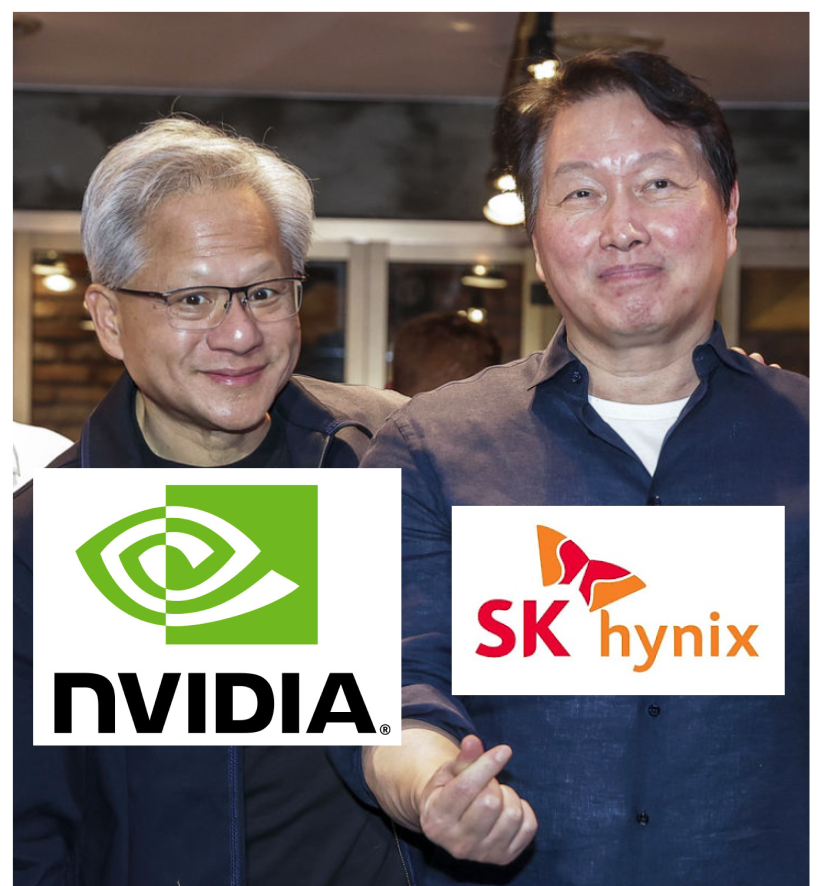
Seeing Jensen Huang land in Korea brings up a lot of
mixed but mostly proud emotions for me. It is truly
remarkable to see companies like
- $005930 (Samsung Electronics)
- $000660 (SK Hynix)
- $005380 (Hyundai Motor)
operating on such a massive global scale and
elevating our national presence.
The world is changing incredibly fast. At home, there is
a lot of domestic noise right now with the elections,
but I sincerely hope things settle down soon so we can
focus on the future. Putting the politics aside, this visit
made me reflect deeply on where Korea stands in the
global AI supply chain.
Here are my thoughts on where we might be heading.
1) The Evolution of Semiconductors
From my perspective, the semiconductor dynamic
is shifting from simple supply to actual codevelopment.
To give a bit of context, the chipmaking process
generally goes through three main phases: design
(architecting the blueprint), foundry (manufacturing the
physical silicon wafers), and packaging (stacking and
connecting the chips to work together).
Starting with the upcoming HBM4 and HBM5, the base
die will be built using advanced foundry processes.
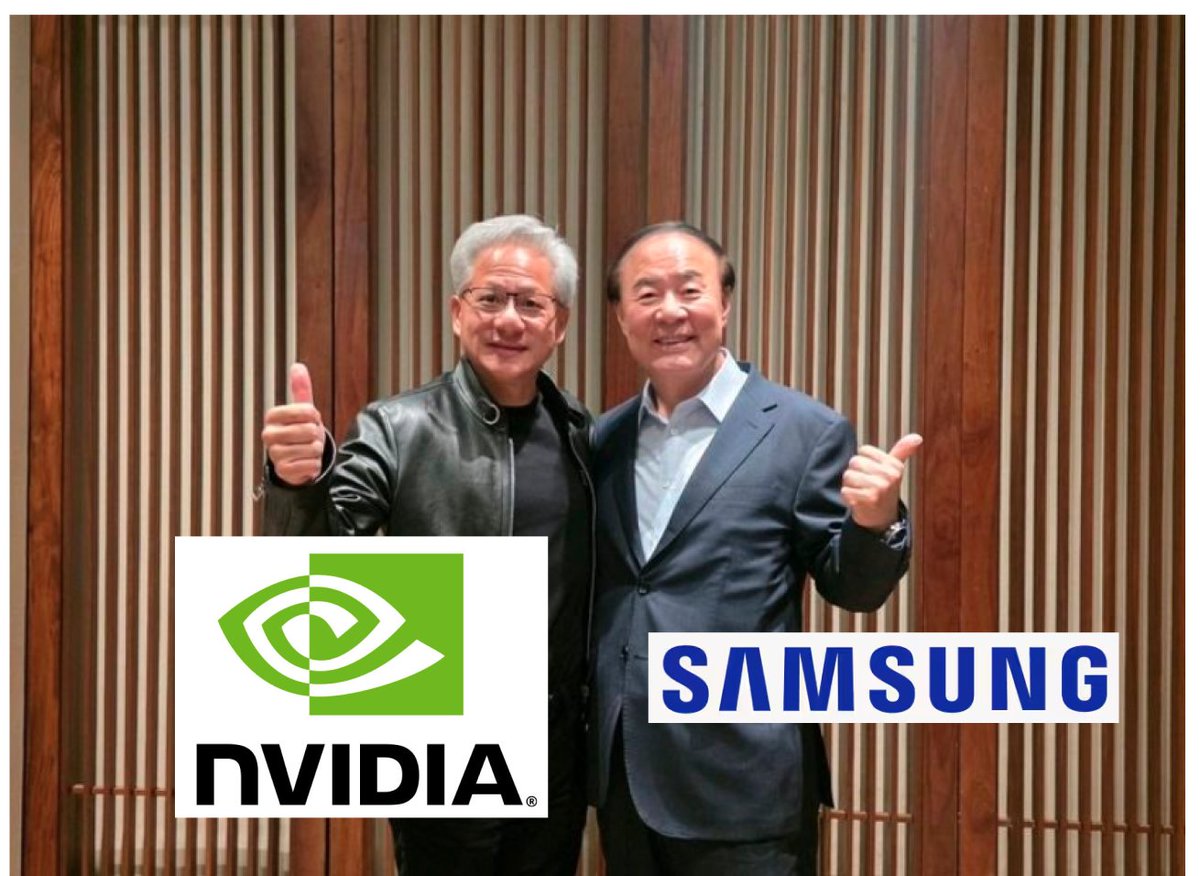
Samsung is aiming to offer a turnkey solution that
covers design, memory, foundry, and packaging all in
one ecosystem. While we have to wait and see how the
yields play out, providing this all in one service could
be a significant advantage for Nvidia.
But $Nvidia is not the only tech giant realizing that
controlling the entire hardware stack is the ultimate
endgame. Just look at what Elon Musk and Intel are
attempting to pull off right now with the Terafab
project.
In March 2026, $Tesla and SpaceX announced a
massive joint venture with Intel Foundry Services to
build a vertically integrated semiconductor plant in
Texas. Musk made a blunt admission that the current
global capacity of $TSMC, $Samsung, and $Intel
combined will simply not be enough to handle the
massive inference needs of Full Self Driving(FSD) and his Optimus robots.
What is truly fascinating is how Terafab directly mirrors
$Samsung's turnkey ambitions. $Tesla and $Intel are trying to consolidate everything from logic fabrication and memory production to advanced packaging under a single roof. We are essentially watching two massive
alliances race toward the exact same concept of total
vertical integration.
On one side, you have the $Tesla and $Intel alliance
taking a massive gamble to build a unified ecosystem
in the US. On the other side, you have the $Nvidia and
Samsung alliance leveraging a massive physical
infrastructure that is already heavily established in
Korea. While Intel has struggled to execute its
advanced process roadmap consistently, $Samsung
already holds a dominant global position in memory
and packaging. If $Samsung can successfully prove its
turnkey model with $Nvidia before Terafab scales up, I
believe it will cement Korea's status as the undeniable
center of gravity for global AI hardware.
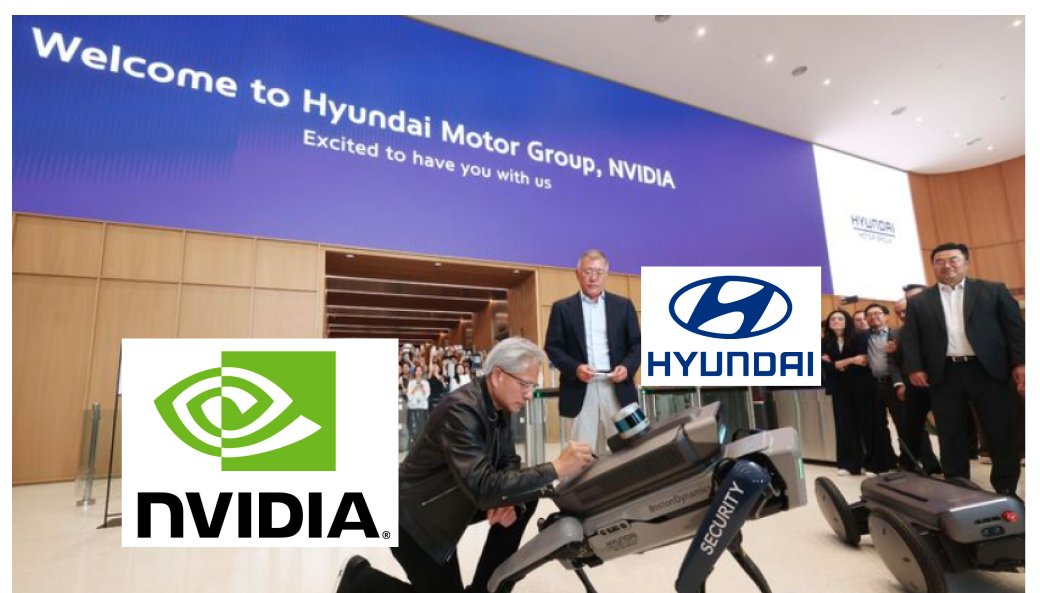
2) $Hyundai and the Shift to Physical AI
Having spent years seeing with actual operational
technology and physical plant equipment, I have seen
firsthand how messy and unpredictable real world
manufacturing data can be.
$Hyundai did not just jump into robotics overnight. Theywent through years of trial and error with traditional mobility before realizing that standard automated machines simply cannot handle the infinite variables of the physical world. That realization led to their acquisition of Boston Dynamics in 2020 for about $1.1 billion. They have been experimenting with how to fuse raw mechanical hardware with adaptive software ever since.
Jensen Huang noted that humans need the cloud, but
robots need AI factories. The vision for the
Saemangeum AI Valley seems to align perfectly with
this concept. It looks like a testing ground to mass
produce the brains of robots by feeding them massive
amounts of physical world data. Autonomous
platforms like MobED and Spot are just the early
stages of what could become a self evolving logistics
and manufacturing ecosystem.
The Ripple Effect on the Supply Chain Because the
data from actual manufacturing and robotics requires
such extreme precision, I believe the domestic
equipment and materials supply chain will naturally
have to evolve. We are already seeing signs of capital
moving toward advanced packaging, high yield testing
equipment, and specialized heat resistant materials. If
domestic foundries collaborate more deeply on chips
for autonomous driving, our local design partners
could also see entirely new opportunities open up.
Of course, the market is unpredictable and I could be
misjudging the timeline. But looking at the objective
capital flows and physical infrastructure being built,
the foundation is undeniably there.
South Korea’s manufacturing roots seem to be an essential piece of the global AI puzzle.
We should be keeping a close eye on how these
partnerships mature over the coming years.
Finally, a huge thank you to Jensen for visiting Korea.
Not financial advice. Do your own research.
1
2
17
3,364


Jun 8
NVIDIA and SK hynix Announce Multiyear Technology Partnership to Advance Memory for AI Factories
Collaboration Supports Next-Generation Memory Codevelopment With NVIDIA’s AI Infrastructure Roadmap and Expands Supply for the Accelerating Global AI Factory Buildout | $NVDA
globenewswire.com/news-relea…
52

Jun 8
the codevelopment headline is nice but the operative line is buried in there: "supports supply to address extended development cycles." that's nvidia locking in multiyear memory allocation while hbm is still sold out years deep. the omniverse fab-twin stuff is mostly wrapping paper
3
780

Jun 8
SK Hynix codevelopment is NVIDIA locking memory supply in public. Vera, Jetson, RTX Spark. they all need custom HBM. Can't ship AI silicon without it secured first.
1
41
Rupert Dyer retweeted

NVIDIA and SK Hynix just announced a multiyear codevelopment partnership.
Codevelopment across Vera Rubin, Vera CPUs, RTX Spark, and Jetson Thor robotics.
SK Hynix building factory digital twins in NVIDIA Omniverse. Using CUDAX to accelerate chip design and manufacturing itself.
Jensen: “Advanced memory is essential to the next industrial revolution.”
The memory shortage runs past 2030. Now you know why.
$NVDA $MU

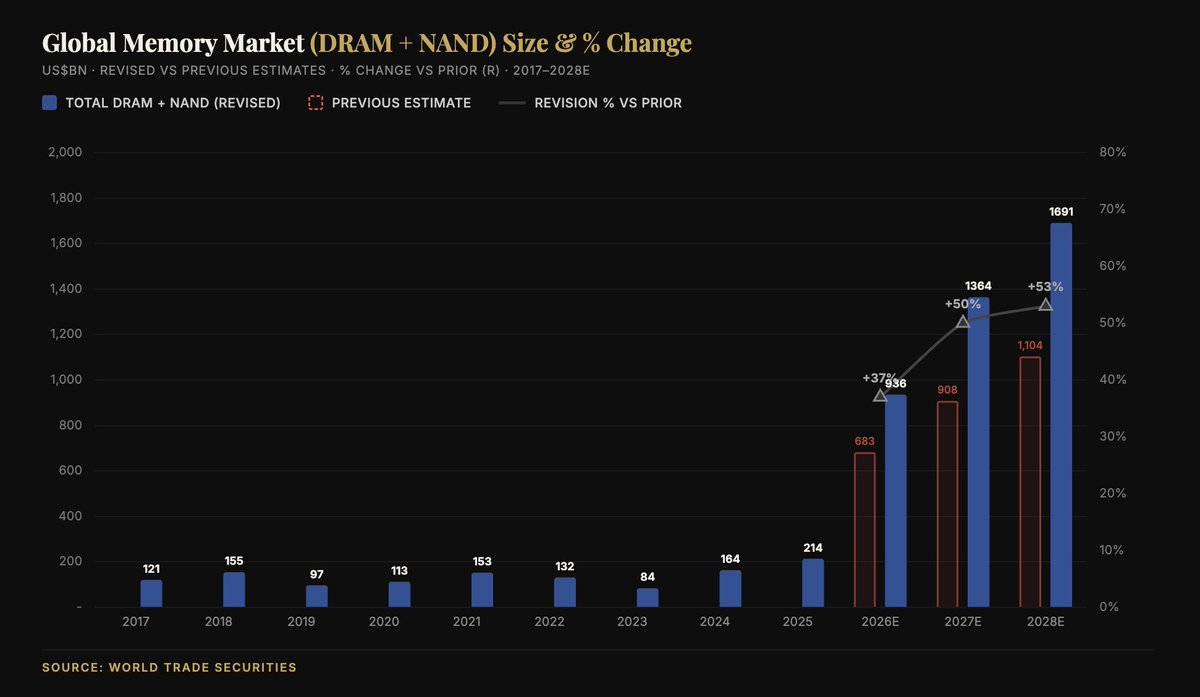
The global memory market was $84B in 2023. It's going to $1.69T by 2028.
Every single estimate has been revised up 37% for 2026, 50% for 2027, 53% for 2028.
The analysts building these models aren't getting more cautious as time goes on. They're getting more bullish the further out they look.
That only happens when the structural demand drivers are accelerating…
$MU $SNDK
1
1
12
1,124

Jun 8
- $NVDA and SK hynix announce multiyear technology partnership — memory codevelopment expands for AI factories
- Marvell shares slide after Nvidia’s Taipei remarks — the stock was hit in a chip wreck unseen since the pandemic
- Tesla gets a Hold upgrade from Erste Group — the rating change came on June 5
- Ten Trump officials hold up to $44 million in SpaceX stakes — ethics concerns intensify around a record IPO
- Wall Street tech rout ends nine-week winning streak — Asian markets were poised to fall on Monday after heavy tech selling
- Israeli strikes on Beirut lift oil — US stock futures dropped while oil moved higher
goodmoat.com/markets/macro/2…
1
172

Netanyahu's plan to replace US congressional aid with permanent military integration is a legal trap designed to make Israel impossible to defund.
Phasing out the leash:
Benjamin Netanyahu has proposed eliminating the $3.8 billion in annual congressional aid to Israel — not out of self-sufficiency, but because a single congressional vote can cut it. His alternative, outlined in a letter to Congressman Stutzman, is "joint defence cooperation, codevelopment, coproduction and mutual investment" across missile defence, AI, drones, cybersecurity, and next-generation weapons platforms. Israeli manufacturers would operate production facilities inside the US and gain direct access to Pentagon contracts. When two defence industrial bases merge at that level, separation becomes functionally impossible — which is entirely the point.
Already in the walls:
Section 224, buried in the $1.15 trillion National Defence Authorisation Act, mandates the appointment of an executive agent to oversee joint US-Israeli technology development and gives Israel a direct role inside America's defence and intelligence apparatus. The Pentagon has already integrated Israeli systems into cyberwarfare, drones, and AI targeting. Walking that back now would cost more than staying in — a fact Netanyahu is counting on. Democrats Ro Khanna and Republican Thomas Massie have formed an unlikely coalition to repeal Section 224, recognizing the risks of permanent entanglement with a state that does not share American strategic interests.
The bill so far:
Public opinion is shifting: 60% of Americans now view Israel negatively. The appetite for entanglement is eroding even as the machinery for it accelerates. Israel has used American firepower to prosecute its own regional agenda across Gaza, Lebanon, and Iran — the last conflict alone cost US taxpayers an estimated $50 billion. Massie, notably, was defeated in his primary after pro-Israel PACs spent heavily against him.
2
2
114