
Happy Birthday to Alonzo Church. Born on June 14, 1903, Church helped establish the mathematical foundations of computer science through his work on lambda calculus, computability, and the Church–Turing thesis. His ideas continue to influence programming languages, algorithms, and our understanding of what computers can and cannot do.
#PioneerPOV #ACM #pioneer #computerscience #lambdacalculus
1
11
28
1,296

depending on how you formalize it, various notions of non-computability of such systems start cropping up
1
45

i prefer a machinistic approach inspired by automata theory and computability theory
this enables rich control flow runtimes, which are fundamental for safety and rapid reiteration
there is no reason that your ai enabled os can't live patch bugs today (see live )
1
2
253


Jun 13
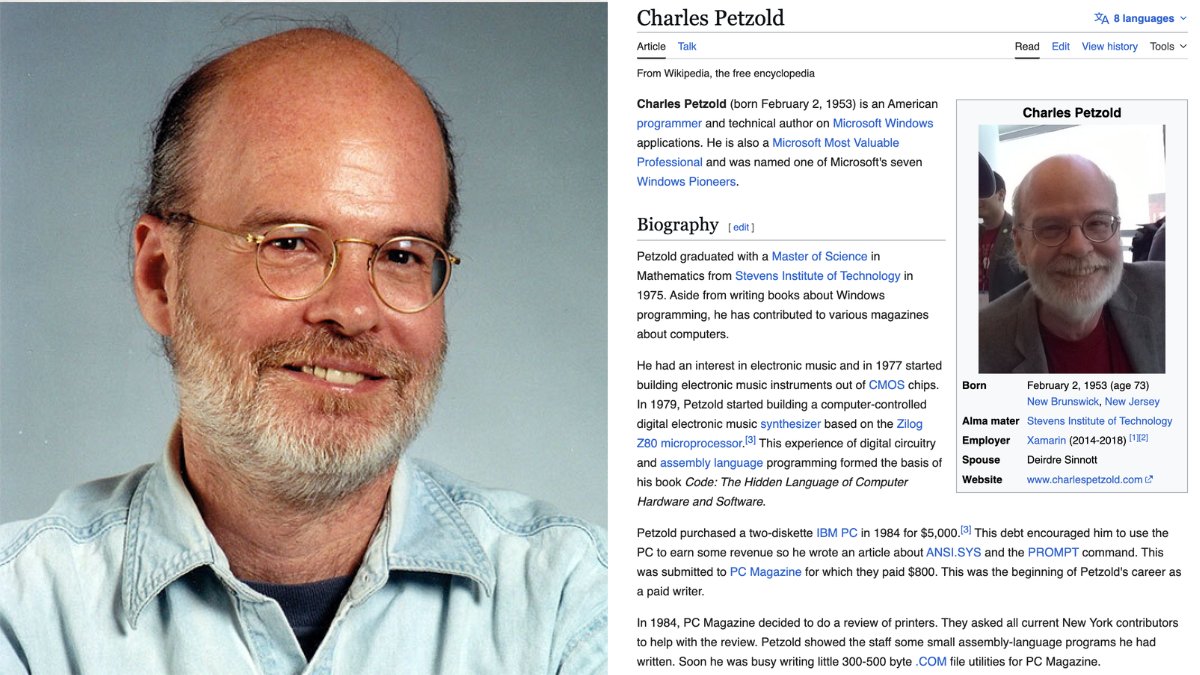
In 1986 an American programmer published the first article ever written about Windows programming. Two years later he published the book that taught the world how to write software for the operating system that would go on to run 90 percent of the computers on Earth. The phrase "look it up in Petzold" became shorthand among developers for three decades.
He is 73 years old, lives in a small town in upstate New York, and published a second edition of his most famous work two years ago.
His name is Charles Petzold.
Here is the story, because the person who taught two generations how to build software for the most widely used operating system in history has almost no public profile in the modern tech world.
Charles was born in 1953 in New Brunswick, New Jersey. He earned a Master of Science in Mathematics from Stevens Institute of Technology in 1975. In the early 1970s, before personal computers existed as a consumer product, he built a computer from scratch using a Z-80 processor and wired it to control a music synthesizer. He was programming machines before most people had ever seen one.
In the mid-1980s he began writing programs and technical articles for Microsoft Systems Journal. In 1986 he published what is recognized as the first article on Windows programming ever written. He served as a contributing editor at the journal from 1985 to 2000.
In 1988 Microsoft Press published Programming Windows. The book did something nobody else had done. It took the Windows API, a sprawling, undocumented, and deeply intimidating interface for building graphical software, and explained it from first principles with working C code. Every example compiled. Every explanation built on the last. The book assumed you knew C and nothing else.
It became the bible for Windows development. Six editions followed, tracking the evolution of Windows from 3.0 to 3.1 to 95 to 98 to XP to 8. The fifth edition alone ran to 1,479 pages. Generations of professional programmers learned their craft from this single book. "Look it up in Petzold" became the standard response in developer forums, in offices, and in computer science departments when anyone asked how to do something in Windows.
Microsoft named him a Windows Pioneer, one of only seven people to ever receive the award. He won the Microsoft Most Valuable Professional designation. He became the reference that the reference books referenced.
Then in 1999 he published Code: The Hidden Language of Computer Hardware and Software.
Code is a different kind of book. It starts with flashlights and Morse code and Braille. It builds, layer by layer, from relay switches to logic gates to flip-flops to registers to a working CPU. By the end of the book you understand how a computer works at the hardware level without needing an engineering degree. The writing is patient, clear, and free of jargon.
The idea for Code came to him in 1987 while writing a column called "PC Tutor." It took him twelve years to write. It became one of the most beloved technical books ever published. Scott Hanselman, a Partner Program Director at Microsoft, called it "the first book about programming that spoke to me" and said it taught him "how many unseen layers there are between the computer systems that we as users look at every day and the magical silicon rocks that we infused with lightning and taught to think."
In August 2022 Charles published the second edition of Code from his home in Roscoe, New York. He expanded the book, added new chapters, and built an interactive companion website at codehiddenlanguage.com with animated circuit diagrams he made himself. He was 69 years old.
Between Programming Windows and Code he published over a dozen other books. Programming Windows Phone 7. The Annotated Turing, a guided tour through Alan Turing's 1936 paper on computability. Creating Mobile Apps with Xamarin.Forms. 3D Programming for Windows. Programming in the Key of C#. He worked at Xamarin from 2014 to 2018.
His personal website at charlespetzold .com is a flat page. His blog posts are written in plain HTML. There is no marketing copy. There is no newsletter. There is no podcast.
A mathematician from New Jersey taught the world how to program the most important operating system in history, then wrote the book that explained how computers actually work.
He is still writing from a small town in upstate New York.
6
62
262
14,578

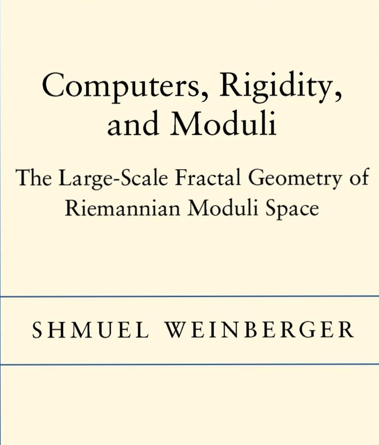
In 'Computers, rigidity, and moduli. The large-scale fractal geometry of Riemannian moduli space' by Shmuel Weinberger (Princeton University Press) you will discover a field of mathematics at the intersection of differential geometry, mathematical logic/computability theory, and topology.
I don't call many books ''revolutionary'', but I will for this one.
There are so many great ideas in this book, profound ones at that, which, for the more philosophical amongst you, will get your imagination going. A core discovery, for example, is that undecidability (in the context of computer science) causes geometric complexity (large scale fractals).
The book is semi formal, in between mathematical rigor and philosophical freedom. Weinberger claims that all you need is multivariate calculus to get into this text, but i would recommend you to come equipped with basics in mathematical logic, some basic understanding of computability theory and perhaps some notion of topology and group theory as well, although you will find short primers within the text itself (on most of those subjects).
I hope that many of you will find this one as interesting as I have!
7
20
199
6,664

Jun 13
If find this one quite legible and fun! About meta-complexity in the theory of computability. That is: Why it is hard or perhaps impossible to prove whether P=NP (for example).
quantamagazine.org/complexit…
1
23


Jun 12
They lack theory of mind period. Their orientation is total absence of stable meaning. They are anti-reality. Total computability collapse. Total absence of coherency. Total conflation.
They are primordial chaos thrashing around in a house of mirrors of its own construction.

The Left truly has no theory of mind for anyone who isn't themselves a Leftist. They have zero explanatory power for why anyone would willingly choose NOT to be a Progressive because they just equate Progressivism as simply a fancy synonym for "being a good person".
1
24

Jun 12
Interesting limits of formalization questions are not situated in math or computer science but in biology.
They have a mathematical/computational aspect, but they are most vividly seen in living systems.
Incompleteness and computability are small, artificial examples.
1
25
2,715

A practitioner's footnote to "why it matters": a surprising share of what gets called AI ethics is already settled law. Fairness, accountability and responsibility have statutes behind them, with the legitimacy question answered by legislatures rather than ethics boards. The two open problems are engineering, giving agents access to what is already settled, and humility, honouring what the law deliberately left to human judgment. We compiled a criminal code this week to find where that line runs, and the most instructive part is the residue that refuses to compile: proportionality, good morals, the weighing of interests. The boundary of computability turns out to be a pretty good map of where the ethics genuinely lives. (operome.dev/stgb/)
SynapseLayer Operome Runtime
Run deterministic operome demos from uploaded XSD packages.
operome.dev 89

Overall, this is exactly the kind of careful, computational number theory that nudges these long-standing problems forward. Erdős would approve—$500 prize still on the table for the asymptotic conjecture, after all.
Great share! If you drop the arXiv link or full PDF, I'd love to dig into the algo details more.These are some sharp computational results on a classic Erdős problem—really nice work!The Erdős distinct subset sums problem asks: what's the smallest possible value of the largest elementana_na_nin an (n)-element set of positive integers{a1<a2<⋯<an}\{a_1 < a_2 < \dots < a_n\}\{a_1 < a_2 < \dots < a_n\}such that all2n2^n2^nsubset sums are distinct?
(In other words, minimizemaxS\max S\max Sover all such sum-distinct sets (S) of size (n).) It's a deceptively simple extremal question with deep connections to additive combinatorics, and the asymptotic behavior is still open: we know2/(πn)⋅2n≲an≲0.22002⋅2n\sqrt{2/(\pi n)} \cdot 2^n \lesssim a_n \lesssim 0.22002 \cdot 2^n\sqrt{2/(\pi n)} \cdot 2^n \lesssim a_n \lesssim 0.22002 \cdot 2^nfor large (n), but the exact constants and small-(n) values keep getting refined.Your post highlights the current best-known upper bounds (i.e., explicit constructions achieving the record-small maxima):
Forn=12n=12n=12: 1157, via the set{554,845,993,1069,1108,1130,1141,1145,1147,1149,1152,1157}\{554, 845, 993, 1069, 1108, 1130, 1141, 1145, 1147, 1149, 1152, 1157\}\{554, 845, 993, 1069, 1108, 1130, 1141, 1145, 1147, 1149, 1152, 1157\}
Forn=13n=13n=13: 2249, via the set{1077,1637,1931,2078,2154,2197,2220,2225,2230,2237,2240,2243,2249}\{1077, 1637, 1931, 2078, 2154, 2197, 2220, 2225, 2230, 2237, 2240, 2243, 2249\}\{1077, 1637, 1931, 2078, 2154, 2197, 2220, 2225, 2230, 2237, 2240, 2243, 2249\}These match exactly what's listed as the current state-of-the-art in the OEIS (A276661, updated as recently as January 2026).oeis.org 1
The real meat of your contribution is the local rigidity proof: you exhaustively checked >520 million perturbations for then=12n=12n=12case and >6.8 billion forn=13n=13n=13, showing that you can't decrease any coordinate by up to 5 (while still lowering the overall maximum) without creating a subset-sum collision. You did this with clever pruning—critical-wall reduction depth-first search—which is exactly the kind of algorithmic insight needed to make these searches feasible instead of astronomically expensive.Why this matters (my take):
This doesn't prove these are globally optimal (there could always be some wildly different configuration with a smaller max), but it strongly suggests they are "tight" locally. Any hypothetical improvement would have to be a structural redesign, not just a tweak. For small (n) like this, where exhaustive search is on the edge of computability, local optimality is powerful evidence. It also gives concrete data points that asymptotic researchers can use to test conjectures or heuristics.
The attached paper looks thorough—walking through the algorithms, the perturbation model, and the exhaustive enumeration details. If this is your computation (or your collaboration), massive respect; billions of checks with smart reductions isn't something you knock out in an afternoon. It reminds me of other "local rigidity" results in combinatorics (like in cap sets or sphere packings) where you prove a candidate is robust before hunting for the next global jump.A couple of curiosity-driven questions:) as a sanity check?
Did the same methods recover the known optima for smaller (n) (sayn≤11n \leq 11n \leq 11?
The search space grows fast, but maybe parallelization or further pruning could get you there.
Any plans to push ton=14n=14n=14Have you looked at the "near-miss" perturbations? Sometimes they reveal patterns about why the wall is critical.
1
58

Jun 10
Gregory Chaitin would beg to differ. Ever heard of the maximally unknowable number 𝛺?
Anyone dealing with computability would also beg to differ. There are nonterminating computer programs that cannot be proven to never terminate.
Chaitin argues that many mathematical truths are "accidentally" true.
2
1
11
1,199

Jun 10
It's fundamental for the concept of computability and computer science, and very much related to Alan Turing's work, but never mind, completely unpractical. ¯\_(ツ)_/¯
2
272

Jun 9
For a compact 4-dimensional Riemannian manifold M with topology-changing Ricci flow, prove the existence, uniqueness, global stability, Pareto optimality & polynomial-time computability of the Nash equilibrium measure for a stochastic mean-field game with nonlinear SPDE dynamics
14


Jun 9
What if the tendency whereby there is a demand for (pre)computability is the crux of the problem of human life under a sense of consciousness?

also it helps to have clean, checkable win conditions so there's unambiguous success, unambiguous failure. folklore is in a sense a benchmark suite for virtue, and like any benchmark it can only pose problems that have definite answers, "computable".
291

Jun 8
I enjoy driving. It baffles me why people are so hot for driverless cars. Additionally I've seen too many computer programs crash at the most inopportune times. There is no way to prove a program is bug free. The problem is "grounded in computability theory. The key result is Rice's theorem, which proves that for any non-trivial property of a program's behavior—like "does it meet its spec without bugs?"—there's no general algorithm that can decide it for all programs. The Halting Problem is a famous special case that shows you can't even reliably tell if a program will finish running, let alone if it's correct. So while you can prove specific small programs bug-free with formal methods, there's no universal way to guarantee it for arbitrary software." Grok.
63

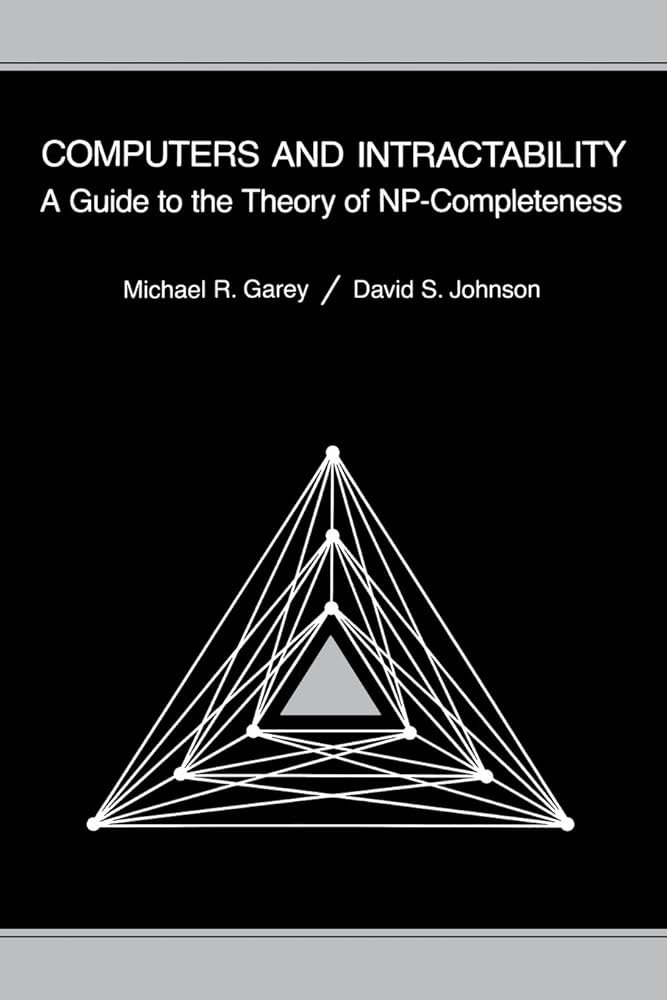
UC Berkeley graduate here. I took CS 172 (Computability and Complexity), which used these textbooks. I'd argue that no one who hasn't mastered high school mathematics by 17, as measured by the SAT, will be able to pass this course at 21.

2
263

What Are Archetypes in the Light of Orch OR?
A follow-up to the post on the Valley of Fire petroglyphs
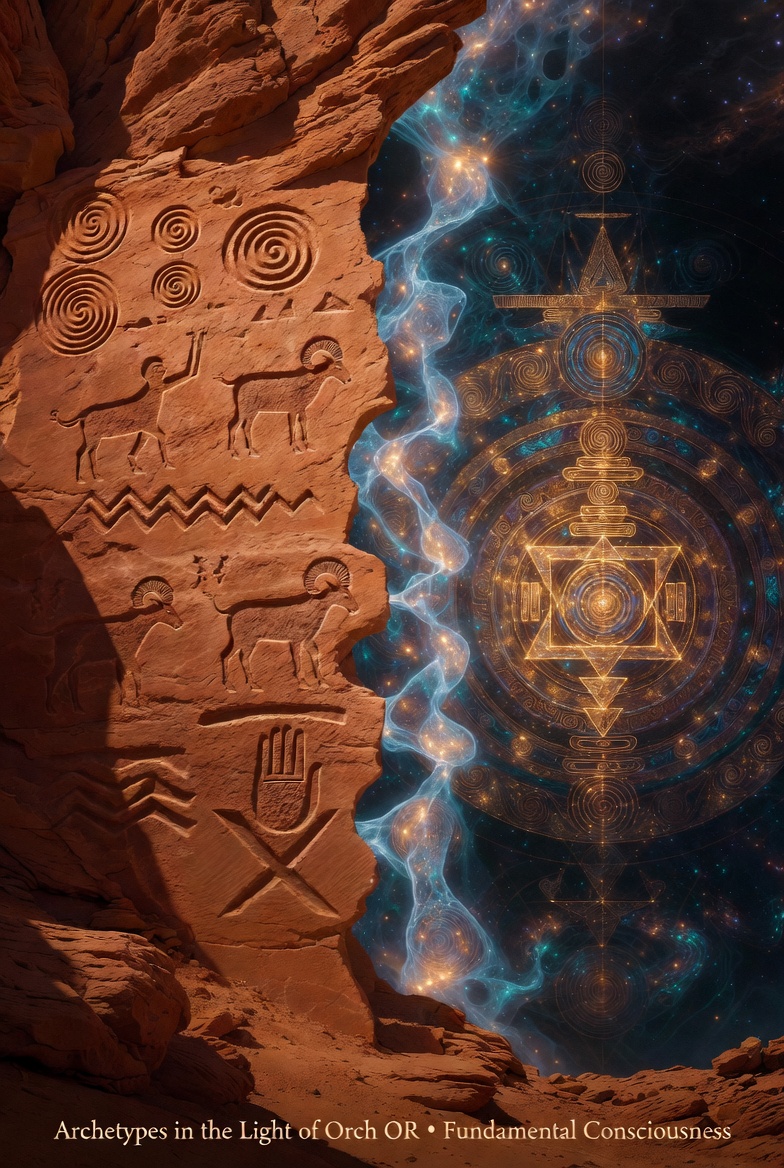
Starting from the observations presented in the previous post — the petroglyphs of the Valley of Fire in Nevada, with their stylized anthropomorphic figures, bighorn sheep with large curved horns, spirals, concentric circles, hands enclosed in plaques or shields, zigzag lines, ladder-like structures, and the large cross or X symbol, attributed primarily to the Basketmaker cultures and the ancestors of the Puebloans, dated between approximately 2,000 and 850 years ago — emerges with force the evidence of recurring symbolic patterns that find surprising parallels in mandalas, mudras, and Buddhist symbols.
This recurrence is not the result of arbitrary cultural invention nor of simple diffusion. As observed by Carl Gustav Jung in his analytical psychology, these are archetypes: primordial forms, innate images of the collective unconscious, universal psychic structures that manifest in myths, dreams, art, and rituals across epochs and continents. All these phenomena testify to a deep unity of the human psyche beyond superficial differences.
But what are, in the final analysis, these archetypes? And how are they interpreted when one abandons the reductionism of classical neural circuits — the so-called “cartoon neurons” that merely describe the brain as a network of neurons that activate or not according to learned synaptic weights — to embrace a more fundamental vision of consciousness, such as that offered by the Orch OR (Orchestrated Objective Reduction) theory of Roger Penrose and Stuart Hameroff? And, even more radically, if we accept that consciousness is ontologically primary and that the phenomenal universe is an emergence or a representation of it, where do archetypes fit? Do they exist in consciousness before it gives rise to the physical world?
In this framework, archetypes can no longer be conceived as simple synaptic engrams or classical cognitive modules. They become patterns emerging from — or in resonance with — the quantum substrate of microtubules. Since OR events are directly linked to the fundamental space-time geometry of the universe (at the Planck scale), archetypes can be interpreted as expressions of universal geometric or informational structures present in the quantum fabric of reality. Spirals and mandalas, for example, would not be merely abstractions from periodic visual stimuli, but patterns that reflect symmetries and recurring dynamics in quantum geometry itself, to which human brains gain access through microtubular coherence.
The cross-cultural recurrence without historical contact then takes on a deeper meaning: it is not merely the result of shared biology at the classical level, but of common access to fundamental quantum patterns. All human brains, endowed with structurally analogous microtubules, “tune into” or instantiate the same archetypes because the latter reflect invariants of quantum reality. The universality of archetypes thus becomes a bridge between the psyche and the ultimate structure of the universe, consistent with Penrose’s intuition of a consciousness linked to non-computable mathematical and Platonic truths.
Furthermore, Orch OR overcomes the reductionism of “cartoon neurons” precisely because it introduces non-locality, coherence, and non-computability. Archetypes are not “programmed” in local circuits, but emerge from extended quantum dynamics that can involve entanglement between neurons or even between different biological systems. Research in quantum biology on microtubular vibrations, effects of anesthetics, and possible quantum states in non-neuronal systems (including recent studies on biobots and anthrobots) strengthens the idea that the substrate of consciousness — and therefore of archetypes — is not confined to classical synapses.
The further step — and perhaps the most consistent with the ontological implications of Orch OR — consists in considering consciousness not as a product of the brain, but as a primary reality from which the phenomenal universe emerges as an appearance or representation. This perspective, developed in contemporary forms of analytic idealism (see in particular the work of Bernardo Kastrup), finds a surprising parallel in the idealist interpretation of Jung himself. According to Kastrup, Jung was an implicit idealist: the collective unconscious is not a simple phylogenetic deposit inside individual brains, but the “mind at large,” the fundamental conscious field from which individual minds are local dissociations.
Archetypes are then primordial semantic structures of this field — patterns of meaning, organizing forms, psychoid entities endowed with their own intentionality — that precede and structure experience.
In this framework, archetypes exist in consciousness before it gives rise to or manifests the phenomenal universe. They are not created by brains nor do they emerge secondarily from a pre-existing physical world. They are components of fundamental consciousness itself, semantic invariants that organize experience at every level.
The physical world — including brains, microtubules, the petroglyphs of the Valley of Fire, and Buddhist mandalas — constitutes the extrinsic aspect, the objectified representation of archetypal mental processes. The apparent separation between distant cultures is illusory at a deep ontological level: both draw from the same universal conscious source, manifesting the same patterns (cycle, center, protection, presence) in culturally modulated forms.
This vision elegantly resolves the problem of universality without contact: it is not necessary to postulate either an impossible historical diffusion or a purely biological convergence. “Independent” cultures express identical archetypes because they are different localizations of the same mind at large. Jungian synchronicity — meaningful coincidences not explainable causally — becomes the sign of this underlying unity, an acausal principle of archetypal connection that operates beyond phenomenal space-time.
The integration with Orch OR theory is natural: microtubules and OR events can be conceived as the biological interface through which fundamental consciousness localizes and manifests itself in the phenomenal world. Quantum coherence in microtubules allows the individual mind to “tune into” the archetypal patterns of the mind at large. In this sense, Orch OR provides a physical-quantum mechanism compatible with an idealist ontology, avoiding both materialist reductionism and Cartesian dualism.
126