carol retweeted

Jun 9
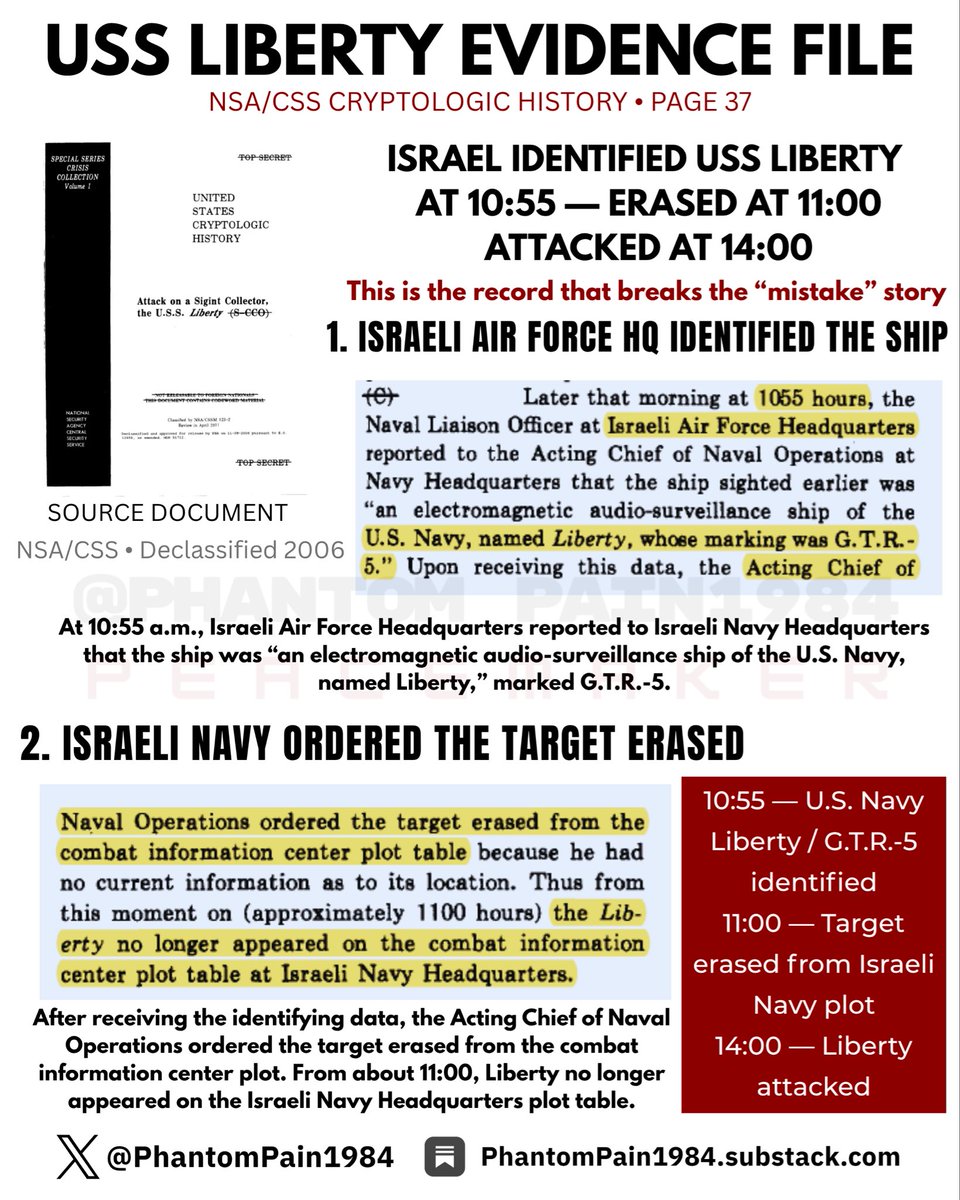
NSA/CSS cryptologic history says Isræli Air Force HQ identified the ship at 10:55 as a U.S. Navy surveillance ship named Liberty, marked G.T.R.-5.
At 11:00, Israeli Navy ordered the target erased.
At 14:00, the USS Liberty was attacked.
Identified. Erased. Attacked. 3/8
4
81
303
7,348

#wirecard #theweb #cryptologic #wagerlogic
2003 verkaufte Rivkin seine Anteile an Cryptologic/WagerLogic
Seinen Anteil an der Firma verkaufte der Jungunternehmer vor zwölf Jahren für viele Millionen Dollar, rechtzeitig bevor das Online-Zocken in den USA verboten wurde.
an wen?
6
@grok und Cryptologic/Wagerlogic?
ist das eine Eigenentwicklung gewesen?
After founding a network business systems company while still in his teens, Rivkin moved on to co-found CryptoLogic in Toronto in February 1995 with his brother, Mark.[3][15] Although founded as a general Internet security software company, CryptoLogic soon focused on online gambling, which had become a growth industry since Antigua and Barbuda became the first country to legalize the practice in 1994.[3][16]
In 1996 InterCasino, the world's first real wager Internet casino, went online using CryptoLogic software.[17][18][19] By 1998 CryptoLogic was considered a major player in the emerging online casino industry, with its software used by online casinos in Curaçao and Dominica as well as Antigua and Barbuda.[15] By mid-2000 CryptoLogic software was used by over 500,000 online casino end users worldwide and processed over $4 billion in online transactions.[3]
CryptoLogic was listed on the Toronto Stock Exchange in September 1998 and on the NASDAQ stock exchange in March 2000, both during Rivkin's tenure as CEO.[20][21][22] Citing a desire to allow new leadership to take the company to the next level, Rivkin stepped down as CEO of CryptoLogic in January 2001 but remained on the company's board of directors.[23][24]
In 2002, after Rivkin stepped down as CEO, the Canadian business magazine Profit estimated CryptoLogic experienced a 26,181 percent growth rate over the previous five years, which made it the fastest-growing business in Canada during that period.[4] Also in 2002 CryptoLogic was named the top company in the Profit 200.[4]
1
20
@grok Viele Menschen wissen nicht, wie lange die Geschichte von Onlinebezahlungen schon zurückreicht. payPal ist heute ein Hausname, aber das war nicht der Anfang - obwohl PayPal früh dran war.
Was war das ERSTE Wallet vergleichbar zu PayPal, click2pay, fieecasgh/firepay cryptologic/wagerlogic
gibt es ein "Ur-Wallet"? CyberCash? Gibt es Hinweise in den Patenten von PayPal?
#wirecard #wallets
1
100
How to contact eCashWalet.com
#ecashwallet #cryptologic
📷
📷
ADDRESS
Marc Dupont
Calle El Penon #9
Costambar, Puerto Plata
Dominican Republic
E-MAIL
admin@ecashwallet.com
PHONE
USA: 1-585-200-3128
14
#wirecard #theweb #cryptologic #wagerlogic
i-cyprus.com/company/261806
WAGERLOGIC ECASH DIRECT
Reg. Number
ΕΕ 26309
Type
Business Name
Registration Date
18/10/2004
Organisation Status
Active
Objects
1
24
@grok. Danke. Meine Theorie ist aber hauptsächlich gerichtet auf das "Ur-Wallet"
und da ist es jetzt tricky, denn:
CryptoLogic/WagerLogic-Wallet: ECash / ECash Direct
Das war das Cashier-/Account-/Zahlungssystem für CryptoLogic-Casinos wie InterCasino. Spieler hatten ein ECash-Konto, konnten einzahlen und offenbar auch Beträge über eine ECash-Nummer transferieren.
Wichtiges Indiz: Die britische Gesellschaft hieß zunächst CryptoLogic (UK) Limited und wurde am 17.08.2001 in ECash Direct (UK) Limited umbenannt.
Abgrenzung:
FirePay war ein anderes Wallet aus dem SureFire/EBS-Umfeld, nicht das eigene CryptoLogic-System. CryptoLogic-Casinos konnten FirePay später als Zahlungsoption akzeptieren, aber das proprietäre CryptoLogic-Ding war ECash / ECash Direct.
Noch eine Nuance: 2002 wird zusätzlich erwähnt, CryptoLogic entwickle intern ein „PayPal-like“ electronic wallet; das klingt nach einer Weiterentwicklung/Alternative. Der belegte Name des bestehenden Systems bleibt aber ECash Direct.
Diese Entwicklung von CryptoLogic zu einem "Paypal-like" wallet. Das will ich finden.
#wirecard
1
23
@grok
aber wir suchen das Wallet!
Was war FireCash damals? Firecash gibt es heute noch/wieder)
und wie kommen wir zu CryptoLogic?
en.wikipedia.org/wiki/Crypto…
19
#wirecard
#qssy
Downstream gibt die Akquirierung von Q-Seven Systems, Inc. bekannt.
25. Mai 1999
SALT LAKE CITY, 25.Mai 1999 /PRNewswire/ -- Downstream Incorporated (OTC Bulletin Board: DWNS) gab heute die Akquisition von Q-Seven Systems, Inc. bekannt. Durch die Übernahme wird Downstream mit seiner Tochtergesellschaft Q-Seven Systems, Inc. der exklusive Verkaufs- und Lizenz-Vertreter für das Q-Seven User Management System. Für die kommenden Wochen plant Downstream, seinen Namen in Q-Seven Systems, Inc. zu ändern und ein neues Handels-Symbol zu beantragen. Voraussichtlich werden die Anteile des Unternehmens schon in den kommenden Monaten in Deutschland gehandelt - wie bisher am OTC Bulletin Board in den USA. Auch eine intensive, weltweite Werbekampagne befindet sich in Planung.
Das Management von Q-Seven ist sich sicher, dass seine neue User-Management-Software eine der besten auf dem Markt erhältlichen Software-Systeme ist, die es derzeit für Online-Glücksspiel, Adult-Entertainment, andere Formen des E-Commerce und sichere Online-Abrechnungssysteme gibt. Außerdem glaubt die Unternehmensführung, dass die State-Of-The-Art-Software eine Vielzahl neuer Lizenznehmer im kommenden Jahr überzeugen wird und entsprechend viele Lizenzen in naher Zukunft verkauft werden können. Nach Datamonitor (London) werden die Online-Glücksspiel-Umsätze bis zum Jahr 2000 beeindruckende 10 Billionen$ erreichen. Die Online-Glücksspiel-Gewinne werden die aller anderen Online-Serviceleistungen übertreffen. Q-Seven sieht sich im Wettbewerb auf dem Online-Glücksspiel-Markt Unternehmen wie Anchor Gaming Inc., Trans World Gaming Group, Argosy Gaming Co., International Game Technology Inc., Starnet Communications, Cybergames Inc., Global Games Corp., Cryptologic Inc., GLC Limited, sowie Playboy Enterprises auf dem Erotik-Sektor gegenüber.
Die Q-Seven Site kann unter q-seven.de besucht werden.
Das Management von Q-Seven weist darauf hin, dass alle in dieser Mitteilung und sonstigen Publikationen enthaltenen Aussagen (mit Ausnahme historisch belegter Tatsachen) auf gegenwärtigen Erwartungen beruhen. Diese Aussagen sind naturgemäß vorausblickende Aussagen und sind mit einer Anzahl von Risiken und Unsicherheiten verbunden, die die Geschäfte, Märkte, Produkte und Preise des Unternehmens beeinflussen; einschließlich die den Wettbewerb und die Regierung betreffenden sowie die technologischen Tatsachen. Die aktuellen Ergebnisse können sich wesentlich von den erwarteten Ergebnissen oder anderen Erwartungen unterscheiden, die in den vorausblickenden Aussagen des Unternehmens dargestellt wurden. Im allgemeinen wird mit den Worten "erhoffen", "glauben", "schätzen", "erwarten", "planen" und ähnlichen Ausdrücken, die sich auf das Unternehmen und/oder sein Management beziehen, beabsichtigt, vorausblickende Aussagen zu beschreiben.
1
81
@grok
Es war einmal...
Bitte lass uns das aufdröseln
The Company [QSSY, Q-Seven systems)] does not compete directly with the large Internet gambling companies such as Starnet Communications International and CryptoLogic as its focus is to provide a backend management system for a whole range of Internet entertainment sites. The worldwide Internet gambling market has been estimated by a number of sources to increase from over $600 million this year to several billions of dollars within the next two-three years, although there is no reliable way track its growth. Starnet (which has recently reported annual revenues of about $10 million) and CryptoLogic have achieved licensing fees in the millions of dollars to date. Q-Seven makes its software available through a number of fee arrangements such as $500,000 or $250,000 25% of revenues. Due to legal issues, most online gambling entities have taken residence in Caribbean nations such as Antigua and the Dominican Republic or Australia where it is clear that online gambling is not prohibited.
1
89
@grok sag mal, kannst du mir bei einer Sortieraufgabe helfen?
Cryptologic software Casinos:
* Inter Casino $80 free monthly,Best online casino 2002 .
* 3 Diamonds Online Casino $50 deposit bonus monthly.New Player Bonus: New Comp Program! (See Casino For Details!) 10% Back On ALL Betting Losses!Cryptologic Software: 57 Total Games. 31 SLots. 6 Multi Player Games. 6 Progressive Slots.
* The Sands Casino New Player Bonus: 100% Bonus On Your First Deposit Up To $70 Free! 10% Bonus When You Send Check Or Bank Wires Up To An Extra $500 Free! Existing Customers Receive $25 Free On A Deposit Of $50 Or More!Cryptologic Software: 57 Total Games. 21 Slots. 6 Progressive Slots.
* Omni Casino $75 free with matching deposit monthly,western union deposit.New Player Bonus: 100% Bonus On Your First Deposit Up To $100 Free! Existing Players Who Deposit $50 Or More Receive A $25 Bonus!Cryptologic Software: 62 Total Games. 36 Slots. 6 Progressive Slots. 5 Multiplayer Games!
* One on One Online Casino $50 deposit bonus monthly
* 49er Online Casino $50 free with matching deposit monthly .New Player Bonus: 3 Different Comp Programs To Choose From! 10% Back On Losses!Cryptologic Software: 48 Total Games. 19 Slots. 8 Multi-Player Games. 6 Progressive Slots.
* VIP Casino a newly launched online casino powered by Cryptologic casino software. As a sister casino to Intercasino.100% sign up bonus on first deposit of $50,10% Cash Back - Even if you lose, you'll get 10% cash back up to $10,000.
21

Jun 13
The statute lapsed; the surveillance architecture did not.
NSPM-12 is not a replacement FISA authority; it is a National Security Systems cybersecurity-governance memo.
The real scandal is not “the machine died.” The real scandal is that the machine may keep running under grandfathered FISC certifications while the public thinks Congress pulled the plug.
As of June 13, 2026, the supported core is this: Congress failed to pass a short-term Section 702 extension, with the House vote reported as 198–218 and 19 Republicans joining most Democrats against the measure. Reuters reported that the debate centered on Trump’s acting-DNI choice, Bill Pulte, plus privacy concerns among some Republicans; it also reported that Trump had sought the short-term extension, which cuts directly against the “he chose not to push renewal” claim.
Best evidence-clean rewrite
Section 702’s statutory authority lapsed at the June 12 deadline after the House rejected a short-term extension, 198–218, with 19 Republicans joining most Democrats. That is a major political event, but it does not mean the surveillance state died at midnight. Existing FISA Court certifications approved in March 2026 appear to keep Section 702 collection and related directives alive until March 2027, creating a post-sunset “legal afterlife” rather than an immediate shutdown.
On the same day, Trump signed NSPM-12, a cybersecurity-governance memo for National Security Systems. It reestablishes the Committee on National Security Systems and empowers the NSA Director as National Manager for NSS, but it does not publicly transfer all government servers to military control, repeal civilian surveillance authorities, or create a new military warrant system.
The real question is not “did Trump turn off the surveillance machine?” The harder question is: why did Congress allow the statute to lapse while existing secret-court certifications may keep the program operational, and what oversight exists over U.S.-person queries, provider directives, and NSA’s expanded NSS cybersecurity role?
That version keeps the heat but removes the claims that will get shredded.
Claim-status table
ClaimStatusCleaner wording
Section 702 hit its June 12 deadline after a failed House extension voteSupported“The statutory reauthorization effort failed before the June 12 sunset.”
Vote was 198–218, with 19 Republicans against extensionSupported“The House rejected the short-term extension 198–218; 19 Republicans joined most Democrats.”
Section 702 is “dead” operationallyMisleading / likely false“The statute lapsed, but existing FISC certifications may keep operations alive into March 2027.”
“They cannot query you anymore”Unsupported“Whether and how agencies can continue queries under active certifications is the key legal question.”
Trump deliberately let it dieContradicted by reporting“Available reporting says Trump and GOP leadership sought an extension.”
NSPM-12 transfers all national-security systems to military controlOverstated“NSPM-12 centralizes NSS cybersecurity governance through CNSS and NSA’s National Manager role.”
NSPM-12 replaces FISA with military authorizationUnsupported“NSPM-12 is a cybersecurity memo, not a surveillance-collection statute.”
278,000 FBI abuses happenedPartly supported, needs precision“FISC-linked materials described over 278,000 non-compliant raw-FISA queries, including politically sensitive examples.”
2016 Trump wiretap used Section 702Wrong“The Carter Page surveillance was Title I FISA, not Section 702, and Page was the target.”
“Parents, churches, pastors” were queried under 702Needs source“Remove unless you have 702-specific documentation.”
The biggest correction: “dead” versus “grandfathered”
The post’s strongest factual line is that Section 702’s statutory authorization hit the June 12 deadline. Roll Call reported that Congress had passed a temporary extension through June 12 back on April 30. The House then rejected another short-term extension, 198–218.
But the claim that the authority “died at midnight” is where the post loses legal precision. AP reported that a March FISA Court order certified the program for another year, meaning no immediate drop-off in collection was expected. Brennan Center likewise says existing Section 702 certifications and provider directives are grandfathered and remain valid until expiration, with the March 2026 certifications locking in surveillance authority until March 2027.
The killer line is:
The statute died; the orders survived.
Or sharper:
The machine did not shut off. It entered grandfathered mode.
That is much more interesting than “surveillance state dead,” because it exposes the actual mechanism most people miss: Congress can miss the deadline, but the program may continue under previously approved secret-court certifications.
The NSPM-12 category error
The draft treats FISA Section 702 and NSPM-12 as if they are two versions of the same thing. They are not.
Section 702 is a foreign-intelligence collection authority. ODNI’s public explainer says it permits targeting non-U.S. persons reasonably believed to be outside the United States, bars targeting U.S. persons or anyone in the United States, and requires minimization/querying procedures because Americans’ communications can be incidentally collected.
NSPM-12 is a National Security Systems cybersecurity-governance memo. The White House text says it sets cybersecurity governance for NSS, reestablishes CNSS, and defines the NSA Director’s role as National Manager for NSS. It authorizes CNSS and the National Manager to issue cybersecurity standards and emergency directives for NSS protection, not to conduct domestic surveillance or replace FISA warrants.
The strongest correction is:
FISA is about collecting intelligence. NSPM-12 is about securing government national-security systems. The post collapses collection authority and cybersecurity governance into one conspiracy mechanism.
That is the core flaw.
What NSPM-12 actually does
NSPM-12 says the Department of War, Intelligence Community, and Federal Civilian Executive Branch agencies own or operate technology as National Security Systems and that those systems must be defended through government-wide oversight mechanisms.
It reestablishes CNSS with members from the Secretary of War, DNI, OMB, and the NSA Director as National Manager. That is not “the military alone now holds the keys”; it is a mixed governance structure involving DOW, IC, OMB, NSA, and NSC coordination.
It lets CNSS issue directives and standards for NSS and allows the National Manager to issue emergency directives to agency heads for known or suspected information-security threats. That is cyber defense authority over systems, not blanket authority to listen to Americans.
It also says the National Manager may examine NSS and evaluate vulnerabilities, but the public text includes limits, including that no examination or monitoring shall be performed without advising the CIO of the agency that owns or operates the NSS.
And NSPM-12’s general provisions say it must be implemented consistent with law and does not implicitly alter existing authorities or confer authority to interfere with intelligence collection, covert action, or other legal restrictions.
So the honest framing is:
NSPM-12 strengthens NSA’s technical governance role over National Security Systems. It does not publicly replace FISA, abolish civilian surveillance, or create a new military permission slip for domestic spying.
The “all government servers” problem
The draft says “every government server.” That is too broad.
NSPM-12 applies to National Security Systems, and its own definition points to 44 U.S.C. 3552. That statute defines NSS as systems involving intelligence activities, cryptologic national-security activities, command and control of military forces, weapons systems, direct fulfillment of military or intelligence missions, or classified information. It explicitly excludes routine administrative and business systems such as payroll, finance, logistics, and personnel applications.
Better wording:
NSPM-12 applies to National Security Systems, not every government server. The important expansion is that civilian agencies’ NSS are being pulled into a stronger CNSS/NSA technical-governance regime.
That is still serious, but defensible.
The NSA role is not brand-new
The post implies NSPM-12 suddenly handed NSA the keys. That overstates novelty.
NSA’s own public page says NSD-42 designated NSA as the National Manager for National Security Systems, acting as the focal point for cryptography, telecommunications-system security, and information-system security for NSS. A 2022 presidential memo also clarified additional NSA National Manager responsibilities for NSS.
The better angle is:
NSPM-12 is not the birth of NSA’s National Manager role. It is a modernization and consolidation of an older architecture, rescinding NSD-42 and NSM-8 and reasserting the role under Trump’s current cyber-governance structure.
That is much harder to debunk.
The 2016 Trump / Section 702 error
The line “the same tool they used to wiretap a sitting president in 2016” is a major vulnerability.
First, Trump was not a sitting president in 2016. Second, the DOJ Inspector General says the Carter Page surveillance applications were sought under Title I of FISA, not Section 702. The OIG also says the target was Carter Page, who had been a Trump campaign official before the FISA surveillance.
Better wording:
Section 702 was not the Carter Page FISA authority. The Trump-era FISA abuse argument belongs mostly to Title I FISA accuracy failures, while the Section 702 abuse argument belongs to warrantless U.S.-person queries of incidentally collected data. Keep those two scandals separate or critics will collapse the whole post.
This is one of the most important fixes.
The 278,000-query line needs precision
The post says:
“The FBI conducted over 278,000 warrantless queries on American citizens between 2020 and 2023 alone.”
That is too loose.
A better version:
A declassified FISA Court opinion discussed more than 278,000 non-compliant FBI inquiries of raw FISA-acquired information, including politically sensitive examples involving protest-related queries, Jan. 6-related queries, and 19,000 donors to a congressional candidate.
Lawfare summarized the FISC opinion as revealing over “278,000 non-compliant inquiries” of raw FISA-acquired information and described examples involving George Floyd protests, Jan. 6-related individuals, and political donors. Brennan Center similarly says the government reported more than 278,000 noncompliant searches and lists abuses involving protesters, members of Congress, journalists/commentators, public officials, a state judge, and donors.
Do not say “278,000 American citizens” unless you can prove each query term identified a U.S. citizen. Use U.S.-person queries, U.S.-person identifiers, or raw FISA-acquired information depending on the source language.
The “Trump chose not to renew” claim is weak
The post says Trump could have pushed renewal but chose not to. Available reporting says the opposite: Reuters reported that Republican leaders sought an extension and that Trump called for the short-term extension. AP also reported that after the failed vote, Trump announced Jay Clayton as his permanent DNI pick, but that was not enough to break the impasse before expiration.
A stronger, non-self-sabotaging version:
Whether by miscalculation, leverage, or factional conflict, the administration failed to secure reauthorization before the deadline. But available reporting does not support the claim that Trump intentionally let 702 die as part of a prepared NSPM-12 handoff.
That keeps the possibility open without asserting what the evidence does not show.
The “hunters became hunted” language is rhetorically strong but evidentiary weak
This line works emotionally:
“THE HUNTERS BECAME THE HUNTED.”
But it requires evidence of an actual accountability mechanism. NSPM-12 does not publicly order investigations of FBI misuse, mandate prosecutions, declassify query logs, require compensation for victims, or create a military tribunal for surveillance abuses.
Better:
The abuse record is real. The accountability mechanism is not yet visible. If this is more than symbolism, the next documents should be query logs, FISC opinions, provider directives, inspector-general audits, and disciplinary records.
That is the line that forces proof.
The better “genius-level” framing
Use this:
This is not the death of the surveillance state. It is the collision of three control planes: statutory authority, secret-court certification, and executive cybersecurity governance.
Even sharper:
The story is not “FISA died and NSA took over.” The story is “Congress let the statute lapse, the FISC layer may keep the program alive, and NSPM-12 simultaneously strengthens NSA’s governance over the networks that house national-security data.”
And the best short version:
Don’t ask whether the machine died. Ask which part of the machine still has power.
The obscure thought inputs that make this much stronger
1. “Sunset” is not “shutdown.”
A statutory sunset can kill future reauthorization while grandfathered orders keep existing operations alive. That is the hidden architecture. The public hears “expired” and imagines darkness; the legal system may preserve a classified afterlife.
2. “Collection” and “querying” are different scandals.
Section 702 collection targets foreigners abroad. The civil-liberties fight is often about U.S.-person queries of incidentally collected communications. The post needs to say “backdoor searches,” not just “wiretapping.”
3. “National Manager” means cyber-security manager, not domestic-surveillance czar.
NSA’s National Manager role concerns cryptography, standards, incident response, cross-domain systems, and NSS security posture. That is powerful, but it is not the same as replacing the FISA Court.
4. The real phrase is “governance convergence.”
The interesting thing about June 12 is not that one lever shut down and another turned on. It is that foreign-intelligence collection, cyber defense, cloud security, classified networks, and AI-era national-security systems are converging under tighter executive technical control.
5. The provider-compulsion issue is the hinge.
Even if certifications survive, telecom and tech providers may test the boundaries of post-sunset directives. Reuters reported concern that legal protections may apply only to already-authorized operations and may not cover new requests, although other tools remain available. The question is not “can NSA listen?” but which provider directives remain enforceable, against whom, and for what categories of collection?
6. The classified March 2026 FISC opinion is the missing bombshell.
Brennan Center says a March 2026 FISA Court opinion remains classified and reportedly concerns “filtering” tools across the intelligence community, with incomplete public query data for 2024 and 2025. That is a much stronger target than speculating about NSPM-12.
7. The post should attack opacity, not invent a secret handoff.
The evidence supports an opacity critique: secret court orders, secret query tools, delayed declassification, unknown provider directives, unknown U.S.-person query counts, and limited public oversight. That is stronger than saying “military activated.”
Missing elements that would make the strong version provable
To prove the post’s strongest claim, you would need:
A public or leaked DOJ/ODNI legal memo saying Section 702 operations ended at midnight rather than continuing under active certifications.
The March 2026 FISC certification order and any related opinions, especially on post-sunset authority and “filtering” tools.
Provider directives showing which telecom/cloud/email companies must still comply after the statutory lapse.
Any FISC enforcement order compelling post-lapse compliance.
Any NSPM-12 classified annex or implementation memo tying NSS governance to surveillance access.
CNSS implementation documents issued under NSPM-12, especially Directive 900 revisions.
A list of agencies and systems newly classified or reclassified as NSS after NSPM-12.
U.S.-person query counts by agency for 2024, 2025, and post-June 12, 2026.
Whether FBI, NSA, CIA, or NCTC continued U.S.-person queries after the lapse.
Whether any provider refused cooperation after June 12.
Whether any emergency directive was issued by NSA’s National Manager after NSPM-12.
Any evidence that FISA 702 data or query access shifted from FBI/DOJ channels to NSA/DOW channels.
Without those, the “execution” narrative is inference, not reporting.
Questions that break this open
Ask these instead of declaring victory:
Did any Section 702 collection actually stop at midnight on June 12?
What exactly remains authorized under the March 2026 FISC certifications?
Can agencies conduct new U.S.-person queries under existing certifications after statutory sunset?
Are provider directives still enforceable post-sunset, and have any providers objected?
Did DOJ issue guidance to providers after the failed vote?
Did ODNI or DOJ issue internal guidance to FBI, NSA, CIA, or NCTC on post-lapse querying?
What did the classified March 2026 FISC opinion say about “filtering” tools?
How many U.S.-person queries occurred in 2024, 2025, and after June 12, 2026?
Did NSPM-12 change who can access logs, metadata, or security telemetry on NSS?
Did NSPM-12 create new access to content, or only cyber-defense telemetry and vulnerability data?
What systems are being newly treated as NSS?
What privacy/civil-liberties rules govern NSA emergency directives under NSPM-12?
Does Congress receive notice of National Manager emergency directives?
Did any inspector general review NSPM-12 implementation?
Is anyone auditing whether post-sunset 702 operations exceed what the March certifications allowed?
Stronger social version
The real story is not “the surveillance state died.”
Section 702’s statutory authority hit the June 12 deadline after the House rejected an extension, 198–218. That part is real.
But the program likely did not go dark. Existing FISA Court certifications from March 2026 may keep 702 collection and directives alive into March 2027.
Same day, Trump signed NSPM-12, which strengthens NSA’s National Manager role over National Security Systems. That is serious—but it is cybersecurity governance, not a public replacement for FISA.
The real question is darker: what surveillance continues after Congress fails to renew the statute, under secret court orders the public still cannot read?
More aggressive version, still defensible
The surveillance state did not die last night. The statute did.
That distinction matters. Congress failed to renew Section 702, but active FISC certifications appear to keep the program alive into 2027. Meanwhile, NSPM-12 gives NSA a stronger hand over National Security Systems cybersecurity, not a new public license for domestic surveillance.
So don’t fall for the fake ending. The machine was not unplugged. The part Congress controls flickered. The part hidden inside FISC certifications may still be running.
Release the March 2026 FISC opinion. Release the query counts. Release the provider directives. Release the NSPM-12 implementation memos. Then we’ll know what actually died.
Best final polished version
On June 12, Section 702’s statutory reauthorization failed. The House rejected a short-term extension 198–218, with 19 Republicans joining most Democrats. That is a major defeat for the intelligence establishment.
But it is not accurate to say the surveillance state died at midnight. Existing FISA Court certifications approved in March 2026 may keep Section 702 operations alive until March 2027. That means the real issue is not a clean shutdown; it is a legally ambiguous afterlife under secret-court authority.
On the same day, Trump signed NSPM-12, which strengthens cybersecurity governance for National Security Systems and empowers the NSA Director as National Manager. That is significant, but it is not, on the public text, a replacement domestic-surveillance authority or a transfer of every government server to military command.
The real story is sharper: Congress failed to renew a controversial surveillance statute while the executive branch and FISA Court may still preserve operational continuity, and NSA’s role over national-security system security is being modernized at the same time.
The demand should be simple: release the March 2026 FISC opinion, the active provider directives, the U.S.-person query counts, and the NSPM-12 implementation documents. Until then, “FISA died” is theater. The question is what survived.
Lines to cut immediately
Cut:
“They cannot query you anymore.”
Replace with:
“The public does not yet know the full scope of post-lapse querying under active FISC certifications.”
Cut:
“Trump wiretapped as a sitting president in 2016.”
Replace with:
“The Carter Page abuse was a Title I FISA scandal; the Section 702 scandal is warrantless U.S.-person querying.”
Cut:
“The military now holds the keys.”
Replace with:
“NSA’s National Manager role over National Security Systems has been strengthened, but the public text is cybersecurity governance, not domestic-surveillance command.”
Cut:
“This was an execution.”
Replace with:
“This was a collision between congressional failure, secret-court continuity, and executive cyber centralization.”
Cut:
“CODE: FISA-DEAD-0612 / NSPM12-ACTIVATED…”
Replace with nothing. It reads like a LARP tag and weakens the argument.
The winning phrase
Use this:
The statute died. The secret orders survived. That is the story.
Or:
Section 702 did not end with a bang. It entered the shadows of its own transition clause.
Or the most precise:
The surveillance fight is no longer just reauthorization. It is post-sunset continuity under secret court certifications.
Jun 13

🔻 THE SURVEILLANCE STATE DIED LAST NIGHT. AND NO ONE ON TELEVISION TOLD YOU WHY.
At 11:59 PM on June 12, 2026, FISA Section 702 expired. The most powerful domestic spying tool in American history — the same tool they used to wiretap a sitting president in 2016 — is DEAD.
198 to 218. That was the vote. Nineteen Republicans crossed the line. Not because they love privacy. Because they were told what comes next.
On the same day — the SAME DAY — Trump signed National Security Presidential Memorandum 12. It transfers control of ALL national security systems to a restructured military-intelligence command under NSA oversight. Every government server. Every classified network. Every intelligence node.
Read that again. The civilian surveillance apparatus is gone. The military now holds the keys.
This was not a failure of Congress. This was an execution.
A former signals intelligence officer — Ft. Meade, 2018-2025:
"FISA 702 was never about foreign threats. It was a domestic weapon disguised as national security. The FBI conducted over 278,000 warrantless queries on American citizens between 2020 and 2023 alone. Political figures. Journalists. Pastors. January 6 families. Anyone who questioned the system was in the database. The authority to conduct those queries died at midnight. And NSPM-12 ensures that what replaces it answers to military command — not the agencies that abused it."
THE HUNTERS BECAME THE HUNTED.
They spied on Trump in 2016. They queried patriots after January 6. They monitored churches. They tracked parents at school board meetings. They built a surveillance machine that would make the Stasi look primitive.
And last night, one man let it die. He could have pushed for renewal. He chose not to. He waited until the exact moment the military architecture was ready — then he pulled the plug on the old system and activated the new one.
June 12, 2026. The day the deep state lost its eyes.
They cannot query you anymore. They cannot listen without military authorization. They cannot use national security as a shield for political persecution. That era ended at midnight.
What comes next is not surveillance. It is accountability.
CODE: FISA-DEAD-0612 / NSPM12-ACTIVATED / NSA-COMMAND / 278K-QUERIES / MILITARY-KEYS / HUNTERS-HUNTED
⟁
The machine they built to destroy him — he just turned it off. And turned the lights on them.
1
225

Jun 13
What are 3 examples of things I know to be true — but AI will give, or has given a different answer because of revisions to history?
1. Cryptography
Clifford Cocks at GCHQ invented public-key cryptography in 1973, years before Martin Hellman and others published it publicly.
It remained classified until 1997.
(Source: The Code Book, Simon Singh; Wikipedia - Clifford Cocks; NSA Cryptologic History)
2. Fundamental Particle Physics
Nobel physicist Murray Gell-Mann, who discovered quarks and laid the foundation for the Standard Model, thanked Jeffrey Epstein for funding support in the original edition of his book The Quark and the Jaguar.
Later editions removed that acknowledgment.
Ghislaine Maxwell introduced them, and her father Robert Maxwell controlled Pergamon Press, a major scientific publisher.
(Source: Original 1994 edition of the book; Epstein court documents; Wikipedia - Murray Gell-Mann)
3. 1960s to 1980s AI Development
David Magerman, who built language models at Renaissance Technologies in the 1980s, said on the Invested by Aleph podcast (January 2026) that modern AI isn’t fundamentally new — it’s the same basic ideas, just with vastly more compute and data. He was highly critical of OpenAI.
(US Government recently classified aspects of Anthropic’s Claude Fable model for national security reasons also)
(Source: Invested by Aleph podcast with Michael Eisenberg, January 2026)
Jun 13

In mainstream media, AI is more revolutionary > Bitcoin
But study Internet/AI timeline Bitcoin physics — and this narrative doesn’t hold up under a looking glass.
Historical record shows AI is not new, while zero technology historical parallels to Bitcoin incentive design exist 🤷♂️
In economics class, we learn constrained optimization.
In AI, neural network is constrained to reach objectives in LLM architecture.
But Bitcoin physics doesn’t work like that.
Bitcoin uses incentives. It outsources math constraints of survival to harness energy from miner intelligence.
269

I completely forgot about Space Force. That might be a good one. I don’t know anything about them.
But if I may ☝️ maybe your son should be in something like cryptology and cryptologic warfare would be a good match for your son.
1
31

Jun 12
📄 Full MARADMIN text:
Released 11 JUN 2026 at 12:31 UTC (Zulu) / MARADMIN 273/26
Subject: Fiscal year 2027 commandant's career-level education board (ccleb) announcement
1. Purpose. This message announces the Fiscal Year 2027 Commandant's Career-Level Education Board (CCLEB) convening on 04 August 2026 as part of the Commandant's Education Board (CEB). The purpose of this message is to announce the available programs, eligibility criteria, and timelines for the CCLEB execution.
1.a. Changes. In accordance with reference (g), effective 1 April 2026, Headquarters Marine Corps sponsored non-promotion boards will have access to official military personnel file (OMPF) photographs during the conduct of non-promotion selection boards.
1.b. A photograph is considered current if the photograph is taken 365 days prior to a selection board's convene date. It remains the Marine's responsibility to ensure a current photograph is in their Official Military Personnel File (OMPF) no later than 10 business days prior to the board's convene date for which they are eligible.
1.c. Reference (h) modifies the Height and Weight requirement to a Waist-to-Height Ratio (WHtR) requirement. At present, there is no method for the Digital Boardroom to pull current WHtR information aside from an officer's official photograph or fitness reports. Accordingly, Marines will not be viewed negatively solely because a current WHtR measurement is not available to the board. However, previous Height and Weight measurements contained within a Marine's record will be considered, as well as any fitness reports that were processed with a WHtR directed comment.
1.d. Major milestone timeline (read in two columns):
Date Milestone
Release of this message Eligibility roster published
Release of this message CEB questionnaire opens
20 July All ETPs due
20 July CEB questionnaire closes
20 July Applications/board correspondence due
20 July Remove by Requests (RBR) due
24 July Non-compliance list published
31 July Final eligibility list published
04 August CEB convenes
2. Background. The CCLEB, as part of the CEB, is the premier Professional Military Education (PME) opportunity provided to company grade officers. The board will convene for approximately four weeks to select the best and most fully qualified officers for resident PME programs, graduate education programs, and special duty assignments.
3. Eligibility criteria
3.a. All company grade officers who will complete their current tour control factor (TCF) by 30 September 2027. Officers whose TCF is complete by 31 December 2027 may screen with PMOS monitor approval.
3.a.1. Direct questions regarding tour lengths and dates of departure to the appropriate PMOS monitor.
3.a.2. All company grade officers interested in attending the Naval Postgraduate School that do not meet the eligibility criteria outlined in 3.a. should reach out to their PMOS monitor and the MMOA-3 Graduate Education Manager.
3.b. Ineligibility criteria
3.b.1. Officers with a training primary military occupational specialty (PMOS) or departing PMOS training.
3.b.2. Captains in-zone or above zone for major on the CY26/FY28 Major Promotion Selection Board.
3.b.3. Officers currently enrolled in or have completed an education program slated by a previous CCLEB.
3.b.4. Officers who have not yet fulfilled an obligated utilization tour for a previously attended program.
3.b.5. Officers enrolled in or who have completed the Expeditionary Warfare School Blended Seminar Program (EWSBSP) will not be eligible for resident PME programs, but will be eligible for Graduate Education programs (e.g. NPS, FAO, Olmsted, etc).
3.b.6. Officers with an approved lateral move in CY26 are ineligible for FY27 CCLEB selection and attendance due to PMOS training and assignment.
3.b.7. Officers with an approved separation or retirement date.
3.b.8. Restricted officers.
4. CCLEB Available Programs
4.a. CCLEB Resident PME
4.a.1. Expeditionary Warfare School (EWS).
4.a.2. PMOS-specific Captains Career Courses.
4.a.3. Officers interested in a specific PMOS Captains Career Course will find the available schools listed on the questionnaire and should rank it according to their preferences.
4.b. Graduate Education Programs
4.b.1. Naval Postgraduate School (NPS)
a. NPS Curricula: 3006, 8824, 8825, 8826, 8834, 8840, 8844, 8846, 8848, 8850, 8852, 8862, 8866, 8870.
b. Marines holding a PMOS of 4402 are not eligible to apply to NPS curricula.
c. 8844 is limited to 3404 PMOS. Exceptions made by request to MMOA-3 for other MOSs.
d. 1706s eligible to screen will only be considered for the 8866 curriculum.
e. 8870 is limited to 0370 PMOS.
f. NPS Curricula information can be found at nps.edu/web/usmc/students/pr…
4.b.2. Air Force Institute of Technology (AFIT)
a. AFIT Curricula: 8820, 8831.
b. 8820 is restricted to 75XX PMOS.
c. AFIT Curricula information on the Aeronautical Engineering Program (8820) can be found at afit.edu/EN/programs.cfm?a=v….
d. AFIT Curricula information on the Engineering Management Program (8831) can be found at afit.edu/EN/programs.cfm?a=v….
4.b.3. Civilian Institutions
a. Curricula: 8802, 8878.
b. Education (8802) applicants shall compose a letter to the board, submitted through the questionnaire, stating previous education and training experience, the desired focus of education study and three prospective universities.
c. 8802 selected officers will earn a Master's degree from a civilian university in 24 months, followed by a utilization tour at Marine Corps Education Command.
d. History (8878) applicants shall compose a letter to the board, submitted through the questionnaire, with the preferred area of historical study and three prospective universities.
e. 8878 selected officers will earn a master's degree from a civilian university in 24 months, followed by a utilization tour as a History Instructor at the US Naval Academy.
f. Tuition. Marine Corps University will provide funding for 8802 and 8878 Officers up to 19,500 dollars per year for public or private institutions for up to two years. Any tuition cost exceeding these amounts will be paid by the officer. There is no cap amount at San Diego State University (SDSU).
4.b.4. SDSU (4505)
a. Limited to 4502s.
b. Selected 4502s will earn a master's degree in Mass Communication from SDSU.
c. Interested officers are required to have a minimum undergraduate GPA of 2.9.
d. Applications to SDSU are submitted after the board selection.
4.b.5. Advanced Civilian Schools Program (ACSP)
a. ACSP provides officers the ability to devote a year as a resident student to complete a master's degree of their choice while maintaining career progression. Participants are highly encouraged to pursue areas of study and research topics of interest to the Marine Corps.
b. Limited to no longer than 12 months and qualifies as partially funded education per reference (a).
c. Selected officers will receive their regular pay and allowances, but application fees, tuition, and matriculation fees, cost of textbooks and materials, and all similar fees and expenses will be borne by the officer.
d. No utilization tour is required. The officer's follow-on assignment will be based on the needs of the Marine Corps and the participant's career progression.
e. Interested officers are required to have current GRE scores.
4.b.6. Foreign Area Officer Program (FAO)
a. Officers interested in the FAO program must have less than 11 years of commissioned service by June 2027.
b. Interested officers must submit proof of current Defense Language Aptitude Battery (DLAB) score, and must submit a letter to the board including: Defense Language Proficiency Test score if applicable and a statement highlighting interest in the FAO program, to include international experience, foreign language exposure, desire to serve as a FAO, and clarification on region preference via the questionnaire as a file titled "edipi_FAO_lastname".
c. Program phases for selected Marines will be determined based upon credentials and or skills Marines already possess.
d. See reference (c) for more information.
4.b.7. Olmsted Scholar Program (OSP)
a. OSP is a strategic leader development program for top performing officers of the U.S. Armed Forces. The program provides outstanding Marine Corps officers an unsurpassed opportunity to achieve fluency in a foreign language, pursue graduate study in that language at an overseas university, and acquire an in-depth understanding of foreign cultures, thereby further equipping them to serve in positions of great responsibility as senior leaders in the Marine Corps.
b. Limited to officers with no more than 13 years and 6 months of total Federal service as of 1 April 2027 (time at service academies does not count).
c. Limited to the following PMOSs, as determined by the Foundation: 02xx, 03xx, 0402, 0602, 0802, 1302, 17xx, 1803, 3002, 4502, 5803, 60xx, 66xx, 7204, 7209, 7315, 7318 and 75xx.
d. Applicants must have completed a Defense Language Aptitude Battery (DLAB) test with a minimum score of 95 in order to be eligible to apply.
e. The selection process involves two steps: (Phase 1) The board "nominates" up to eight applicants for further consideration; (Phase 2) the Olmsted Foundation evaluates those nominated, conducts interviews in January 2027 and makes selections in March 2027.
f. Nominees not selected in the second phase will be slated to other PME or graduate education opportunities.
g. For more information on the Olmsted Foundation: olmstedfoundation.org.
h. Officers interested should submit an initial application to the board questionnaire, using the naming protocol: "edipi_OSP_lastname".
i. Phase 2 requirements are timely and applicants are recommended to start the process immediately. Further application instructions can be found at the link in manpower.marines.mil/Divisio….
4.b.8. Junior Officer Strategic Intelligence Program (JOSIP). Junior Officer Cryptologic Career Program (JOCCP). Junior Officer Geographic Geospatial Intelligence Program (JOGP).
a. JOSIP and JOGP are limited to 02XX PMOS.
b. JOCCP is available to 02XX PMOS and 1702 PMOS.
c. Interested officers should submit completed applications to the questionnaire, naming the file such as "edipi_JOSIP_lastname" by the questionnaire deadline.
d. Officers can apply to one or all the programs as eligible.
4.b.9. The Judge Advocate Generals Legal Center and School (TJAGLCS)
a. TJAGLCS program is restricted to 4402 PMOS Captains and Majors. It is a graduate-level program located at the University of Virginia in Charlottesville, Virginia where a Master of Laws (LLM) in multiple disciplines can be obtained.
4.c. Program and further curricula information can be found at manpower.marines.mil/Divisio…
5. General instructions for the eligible population
5.a. The list of eligible officers screening for CCLEB is posted on the USMC Manpower, MMOA-3 Plans and Programs webpage: manpower.marines.mil/Divisio…
5.a.1. Questions regarding eligibility should be directed to the appropriate PMOS monitor.
5.b. All eligible officers are required to complete the FY27 Commandant's Education Board Questionnaire no later than 2359 EST on 20 July 2026. The questionnaire is located at: manpower.usmc.mil/applicatio…
5.c. Note 1, Note 2 and No Note
5.c.1. Note 1. Within the eligibility list, officers with sufficient career timing to participate in programs ranging up to five years (i.e., NPS, AFIT) have a Note 1 next to their name. Officers with a Note 1 beside their name are required to apply and submit undergraduate transcripts to NPS no later than 2359 EST on 20 July 2026. NPS Admissions website is located at: nps.edu/web/admissions/apply.
a. After submitting the NPS application, applicants must order official transcripts from all attended undergraduate and graduate institutions for delivery from the institution(s) directly to NPS Admissions. Transcripts must come directly from the institution or their designated transcript exchange service. NPS does not accept transcripts submitted by the applicant.
b. Officers that have previously applied to NPS must submit an additional application but are not required to resubmit transcripts. Officers can submit up to three applications for those curricula listed in paragraph 4.b.1.
c. NPS will notify MMOA-3 of an officer's acceptance to NPS with the curricula for which the individual may or may not qualify. NPS does not provide an acceptance letter or status of acceptance to individual officers.
d. Officers with a Note 1 beside their name who are interested in AFIT should apply and submit undergraduate transcripts to AFIT no later than 2359 EST on 20 July 2026.
e. The AFIT admissions website is located at: afit.edu/ADMISSIONS/AFITAppl…
f. All officers must verify that a copy of their undergraduate transcripts is in their OMPF. Officers must upload all higher learning institutional transcripts to their OMPF. Officers should submit OMPF update requests via OMPF-Records Management Application (O-RMA). If assistance is required, contact your unit S-1 or local IPAC. Officers are responsible for ensuring their OMPF is accurate at all times.
5.c.2. Note 2. Officers with sufficient career timing to participate in programs ranging up to three years have a Note 2 beside their name.
5.c.3. No Note. Officers without a note beside their name only possess the career timing to attend a one-year program. Officers without a note beside their name who believe they have the career timing to screen for a Note 1 or 2 program should contact their PMOS monitor.
5.c.4. Officers outside the FY27 screening window who are interested in CCLEB, must submit an Administrative Action Form (NAVMC 10274) endorsed by the first O-6, or equivalent, in the Marine's chain of command NLT 20 July 2026 via the online questionnaire.
5.c.5. Marines wanting to change their Note 1, 2 or No Note status must reach out to their PMOS monitor.
5.c.6. All members requesting an ETP should also fill out the questionnaire NLT 20 July 2026 regardless of ETP status.
5.d. Removal by Requests
5.d.1. Officers who are listed on the eligibility roster, but do not want to screen must submit an Administrative Action Form (NAVMC 10274) positively or negatively endorsed by the first O-6, or equivalent, in the Marine's chain of command NLT 20 July 2026 via the online questionnaire.
5.d.2. All requests must be labeled "edipi_RBR_lastname" via the online questionnaire and members requesting an RBR should also fill out the questionnaire NLT 20 July 2026 regardless of pending RBR.
6. Coordinating Instructions
6.a. Graduate education programs are not a service equivalent for PME. Marines participating in a graduate education program are required to complete a PME program commensurate with their grade on their own initiative to be considered PME complete for their grade.
6.b. Marines shall complete grade specific PME during their respective graduate education programs.
6.c. Obligation
6.c.1. All service PME schools are one academic year in length and incur a 24-month service obligation.
6.c.2. Graduate education programs vary from one to two years followed by a three-year utilization tour, unless otherwise noted, and an additional year of service obligation for a total of four years. Utilization tours will be assigned within this four-year service obligation.
6.c.3. For additional information on program lengths and descriptions, see reference (a) or contact the program officer in paragraph 7 below.
6.d. Questionnaire
6.d.1. Eligible officers must submit program preferences, applications (expect for NPS and AFIT), letters to the board, RBRs etc. via the questionnaire. The questionnaire is the only method for MMOA-3 to receive board correspondence. Once responses are submitted via the questionnaire, MMOA-3 will receive an automatic notification of completion.
6.d.2. Do not submit more than seven documents.
6.d.3. Each document must not exceed eight MB and must be in .pdf format.
6.d.4. File naming convention is very important for board correspondence collection/consolidation. Name the file appropriately according to the program you are applying for i.e. "edipi_OSP_lastname" or "edipi_FAO_lastname". Condense all documents for a specific program application into one scanned PDF. If due to size constraints the application must be split up, label as such "edipi_JOSIP_lastname (1), edipi_JOSIP_lastname (2)". If submitting a supplemental board correspondence label as such: "edipi_LOR_lastname" and remove by request "edipi_RBR_lastname".
6.d.5. Direct questionnaire functionality and accessibility questions and issues to MMOA-3 at SMB_MMOA_GRAD_EDU@USMC.MIL.
6.e. Board Correspondence. All correspondence to the board must originate from the officer being screened. All submissions (letters of recommendation, clarifying statements of service, etc.) must be uploaded into the questionnaire no later than 2359 EST on 20 July 2026.
6.f. Non-Compliance. Officers are considered non-compliant with the above instructions:
6.f.1. If they have a Note 1 next to their name on the eligibility roster and fail to apply and submit transcripts to NPS.
6.f.2. If they have a Note 1 or 2 next to their name and do not complete the questionnaire and upload a legible copy of their transcripts to OMPF.
6.f.3. Officers who fail to complete the questionnaire, fail to apply to NPS, or fail to submit transcripts will still screen and may be slated to a program at the board's discretion.
6.f.4. A list of non-compliant officers will be provided to commands on or about 24 July 2026 for those officers who have not yet applied to NPS.
6.g. Subsequent MARADMINS will announce FY27 CCLEB results and FY27 Graduate Education Program Results. The results MARADMINS will serve as notification of orders for all primary selectees.
7. Program Points of Contact
7.a. Career-Level Schools (CLS) Contact your PMOS monitor.
7.b. Naval Postgraduate School Admissions Office Comm: (831) 521-2190 Email: admissions@nps.edu
7.c. Olmsted Scholar Program Maj Taylor Wulff-Morrison DSN: 378-4837, Comm: (703) 784-1209 Email: Fellows_FPME_Olmsted@USMCU.edu
7.d. International Affairs Program (IAP) LtCol Brett McCormick DSN: 222-0322, Comm: (703) 614-0322 Email: brett.mccormick@usmc.mil
7.e. Master's of Education LtCol Alex P. McGraw (TECOM) Comm: (703) 432-2068 Email: alex.mcgraw@usmc.mil
7.f. Master's of History Maj Bradley S. Worthan Comm: (410) 293-6293 Email: worthan@usna.edu
7.g. Engineering Management - 8831 (AFIT) Maj Jason McDonald Comm: (571) 256-2789 Email: jason.mcdonald1@usmc.mil
7.h. Law Programs Maj Matthew W. Schoneweis Comm: (703) 693-9059 Email: matthew.schoneweis@usmc.mil
7.i. San Diego State University (SDSU) Maj Sarah Rhodes Comm: (703) 693-4906 Email: sarah.rhodes@usmc.mil
7.j. JOSIP/JOCCP/JOGP Capt Nathan Scott DSN: 278-9277, Comm: (703) 784-9277 Email: nathan.r.scott@usmc.mil
7.k. Graduate Education Manager Maj Delaney Dumanovsky Comm: 703-784-9285 Email: SMB_MMOA_GRAD_EDU@USMC.MIL
8. This MARADMIN is not applicable to the Marine Corps Reserve.
9. Release authorized by MajGen Fridriksson, Director, Manpower Management Division.
REF/A/MCO/CMC/20190530// REF/B/MCO/CMC/20080125// REF/C/MCO/CMC/20250311// REF/D/MCO/CMC/20210510// REF/E/MCO/CMC/20190215// REF/F/MSG/EDCOM/20260406// REF/G/MSG/CMC/261400ZFEB2026// REF/H/MSG/CMC/241230ZMAR2026//
NARR/REF A IS MCO 1524.1, MARINE CORPS GRADUATE EDUCATION PROGRAM. REF B IS MCO 1553.4B PROFESSIONAL MILITARY EDUCATION (PME). REF C IS MCO 1540.33, THE INTERNATIONAL AFFAIRS PROGRAM (IAP). REF D IS MCO 1300.8 W/CH-2, MARINE CORPS PERSONNEL ASSIGNMENT POLICY. REF E IS MCO 1900.16 CH 2, MARINE CORPS SEPARATION AND RETIREMENT MANUAL (MARCORSEPMAN). REF F IS MARADMIN 158/26, OFFICER PROFESSIONAL MILITARY EDUCATION BLENDED SEMINAR PROGRAM FY26-27 SEAT QUOTA ASSIGNMENTS. REF G IS MARADMIN 127/26 CHANGE 1 TO REQUIREMENT UPDATE ON OFFICIAL PHOTOGRAPHS FOR NON-PROMOTION SELECTION BOARDS. REF H IS MARADMIN 066/26 CHANGE 1 TO THE ADVANCE NOTIFICATION OF CHANGES TO THE MARINE CORPS PHYSICAL FITNESS TEST AND BODY COMPOSITION EVALUATION PROCESS.//
POC/DELANEY T. DUMANOVSKY/MAJ/MMOA-3/USMC/DSN 278-9285/ TEL (703)784-9285/EMAIL: SMB_MMOA_GRAD_EDU@USMC.MIL//
Source: marines.mil/News/Messages/Me…
🤖 This text was reformatted for readability.
1
263