
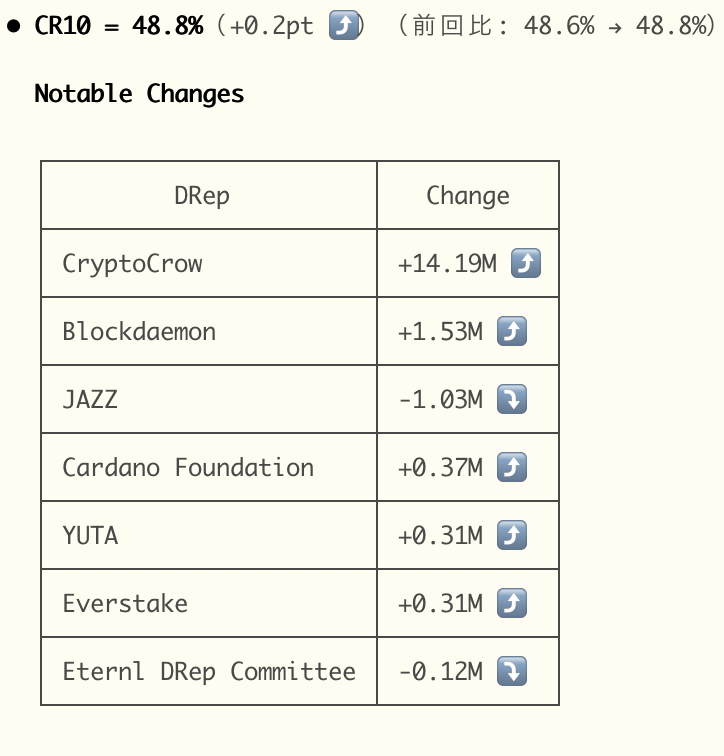
重要な変化(敬称略):
CryptoCrow: 228.91M → 243.10M ( 14.19M)
Blockdaemon: 320.00M → 321.53M ( 1.53M)
JAZZ: 99.35M → 98.32M (-1.03M)
Cardano Foundation: 139.51M → 139.88M ( 0.37M)
YUTA: 476.18M → 476.49M ( 0.31M)
Everstake: 151.07M → 151.38M ( 0.31M)
Eternl DRep Committee: 235.77M → 235.65M (-0.12M)
1
16
【Target 15%】
#カルダノ DRepの「トップ10集中度(CR10)」は現在(2026/6/15)、
48.8%です( 0.2pt)⤴️
目標:15%
(10人で15%以下→残り85%の声を反映可能)
87M以下のDRepへ委任することで、分散化を高めエコシステムの信頼性向上に貢献できます!
#ターゲット15 #分散化
coffeepool.jp/notes/critique…
1
2
24
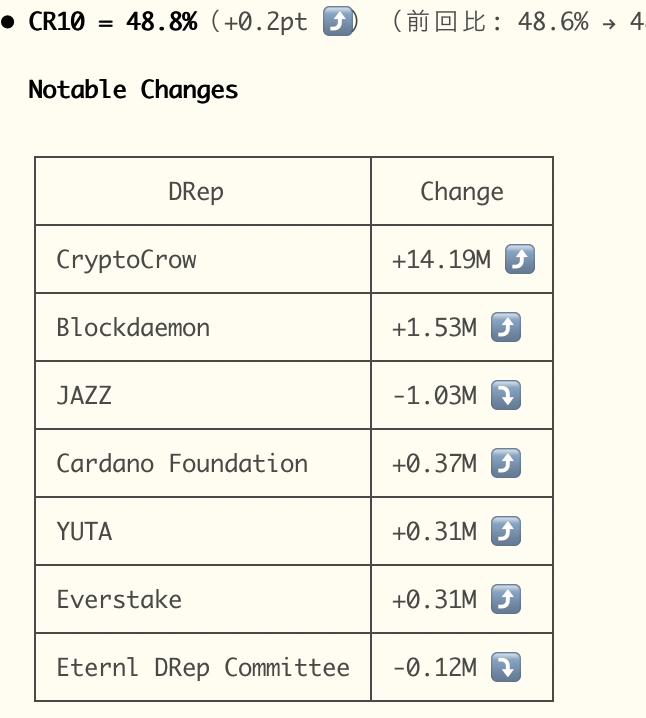
Notable changes:
CryptoCrow: 228.91M → 243.10M ( 14.19M)
Blockdaemon: 320.00M → 321.53M ( 1.53M)
JAZZ: 99.35M → 98.32M (-1.03M)
Cardano Foundation: 139.51M → 139.88M ( 0.37M)
YUTA: 476.18M → 476.49M ( 0.31M)
Everstake: 151.07M → 151.38M ( 0.31M)
Eternl DRep Committee: 235.77M → 235.65M (-0.12M)
1
15
【#Target 15%】
#DRep "Top 10 Concentration (CR10)" is currently (2026/6/15) at:
48.8%( 0.2pt)⤴️
Goal: 15%
(Top 10 under 15% → the 85% to be reflected)
If your DRep has 87M voting power, consider delegating to smaller DReps to enhance #decentralization
coffeepool.jp/notes/cardanos…
1
2
20

📡 Signal|Minswapがcollateralを肩代わり
⠀
CardanoのDApp UXで、実務的な一歩が出ました。
⠀
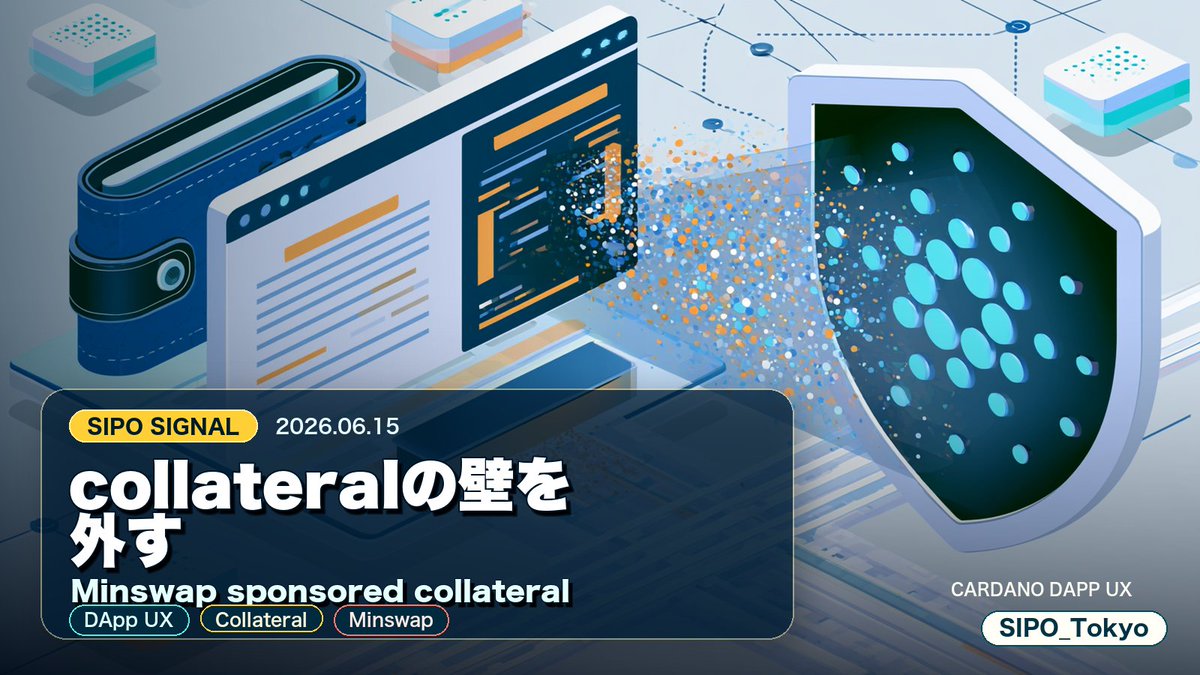
Minswapは2026年6月14日、ユーザーがMinswapで取引する際、collateralとしてADAを自分でロックしなくてもよいよう、Minswap側がcollateralをスポンサーすると発表しました。
⠀
Minswapの表現では、もう「5 ADAがウォレット内で凍結される」ことも、「no collateral found」エラーで止まることも、事前設定も不要になる、という説明です。
⠀
ここで重要なのは、これを「手数料が消えた」と読むことではありません。
⠀
論点は、Cardanoのスマートコントラクトを使う前にユーザーがぶつかっていた、最初の段差をプロダクト側が引き取ったことです。
⠀
■ 1|collateralは何のためにあるのか
⠀
Cardano Docsは、collateral mechanismを、スマートコントラクト実行に関わる重要な仕組みとして説明しています。
⠀
Cardanoでは、取引の検証が大きく2段階に分かれます。Phase 1では取引が正しく構成されているか、処理手数料を払えるかを確認し、Phase 2ではその取引に含まれるPlutus script、つまりスマートコントラクト側の処理を実行します。
⠀
collateralは、Phase 2のscript validationが失敗した場合に、ノード側の検証作業を補償するための金銭的保証です。
⠀
Cardano Docsでは、collateralは取引構築時にcollateral inputsとして指定されるUTXOのADA合計であり、スマートコントラクトが正しく実行されればcollateralは安全だと説明されています。
⠀
つまりcollateralは、Cardanoがスマートコントラクトの失敗コストを予測可能にし、ネットワークをDoS的な無効取引から守るための安全設計です。
⠀
■ 2|正しい仕組みでも、ユーザーには摩擦になる
⠀
ただし、プロトコルとして正しい仕組みが、ユーザー体験として軽いとは限りません。
⠀
DAppを初めて触る人にとって、「取引したいだけなのに、なぜ先にcollateralを用意する必要があるのか」は分かりにくいものです。
⠀
ウォレット側でcollateral UTXOが見つからないと、ユーザーは取引内容ではなく、設定や残高の問題で止まります。
⠀
Minswapが今回削ろうとしているのは、まさにここです。
⠀
Cardano Developer PortalのPlutus scriptの例でも、Plutus scriptを動かす取引では `--tx-in-collateral` を指定する実装例が示されています。
⠀
開発者から見れば自然な構成要素でも、一般ユーザーから見ると「最初に設定しないと進めないもの」になりやすいといえます。
⠀
だから、Minswapのsponsored collateralは、派手なDeFi機能というより、DAppを触る前の入口改善です。
⠀
■ 3|「Cardanoで初」という主張は、どう読むべきか
⠀
Minswapは、自分たちを「Cardanoで初めてユーザーのcollateralをスポンサーするDApp」と表現しています。
⠀
この点は、Minswap公式発表として扱うのが安全です。
⠀
ただし、これでCardano全体の標準が変わったとまでは言えません。
⠀
今言えるのは、MinswapがCardano DeFiの利用入口で、collateral設定という見えにくい摩擦をプロダクト側で吸収し始めた、ということです。
⠀
ユーザーがDAppを使うときに感じる不便は、プロトコル説明ではなく、最初の失敗画面で決まります。
⠀
「no collateral found」というエラーを理解できる人だけが使う世界から、ただ取引できる世界へ近づく。この移動は、Cardanoの普及にとって地味ですが重要です。
⠀
■ 4|何を意識せず使えるかへ
⠀
6月のCardanoは、ハードフォーク準備や予算監査、プロトコルパラメータ更新といった大きな運用テーマが重なっています。
⠀
一方で、Minswapのsponsored collateralは、もっとユーザーの手元に近いニュースです。
⠀
Cardanoが成熟するには、ガバナンスで意思決定できることも、本番ネットワークを安全に更新できることも必要です。しかし最終的には、ユーザーがDAppを開いたときに、迷わず、止まらず、自然に使えることが必要になります。
⠀
今回のMinswapの発表は、Cardanoの技術的な正しさを保ちながら、ユーザーの目に触れる摩擦をプロダクト側で引き取る動きです。DeFiの小さな改善に見えて、Cardanoの次の課題をよく表しています。
⠀
Cardanoは今、「何ができるか」から、「何を意識せずに使えるか」へ進む段階に入っています。
⠀
次に見るべきは、Minswapでの実際の利用者反応、他のDAppが同様のUX改善を採用するか、ウォレット側のcollateral管理がどこまで見えなくなるかです。
⠀
透明性メモ:
⠀
SIPOはCardanoのSPO、DRep、ADA保有者としてCardanoエコシステムに継続参加しています。本稿は特定のDApp利用、取引、トークン購入、流動性提供を推奨するものではなく、公開情報をもとにCardano DApp UXの実務改善を整理したものです。
⠀
本稿は投資助言、法的助言、税務助言ではありません。DApp利用、DeFi取引、ADA関連判断は、各自で一次情報、ウォレット表示、プロトコル仕様、リスクを確認してください。
⠀
出典:
⠀
- Minswap Labs: sponsored collateral発表
x.com/MinswapDEX/status/2066…
- Cardano Docs: About the collateral mechanism
docs.cardano.org/about-carda…
- Cardano Docs: Transaction costs and determinism
docs.cardano.org/about-carda…
- Cardano Developer Portal: Plutus scripts
developers.cardano.org/docs/…
⠀
#Cardano #ADA #カルダノ #Minswap #DeFi #DApp #SIPO

Starting today, you don't lock a single ADA for collateral on Minswap. We sponsor it 🫡
We're the first dApp on Cardano to sponsor collateral for our users.
No more 5 ADA frozen in your wallet. No more "no collateral found" errors. No setup. You just trade.
Here's how it works: every smart contract transaction on Cardano needs a 5 ADA collateral, a kind of "safety deposit". Normally that comes from your wallet. Instead, we keep a pool of ready-made collateral UTxOs on our side and plug one in for you automatically, then recycle it after each trade.
One of Cardano's most notorious onboarding papercuts, gone ⏩
2
105
Libertas retweeted

10h
I DRep di Cardano segnalano carico di lavoro e pressione pubblica durante il processo di bilancio 2026
#Cardano #CardanoNews $ADA
via Cardano News
songmarketcap.com/cardanonew…
1
4
106

🛜찰스 호스킨슨(@IOHK_Charles) Live 종합 요약 : governance 공간 전환 및 정당 구조 Roadmap
1. 진단: 왜 X(트위터)를 떠나 디스코드로 가야 하는가?
• X의 거버넌스 파괴 [Part 1 - 01:18]: X는 본질이 'Broadcast channel'로, 투기, 볼거리, 분노 유발(Rage bait)이 원동력입니다. 구조적으로 승자독식(Win-Lose) 싸움만 유도해 생산적인 governance가 불가능함 [Part 1 - 02:34].
• 100명의 선동가와 가짜 여론 [Part 1 - 09:16]: 네트워크 분석 결과, 100명 미만의 냉소주의자가 반대 내러티브를 지배하며 생태계 통합을 방해하고 있습니다. 이들이 만드는 난장판(Dumpster fire)은 외부 빌더와 투자자를 쫓아냅니다 [Part 1 - 39:52].
• 헤테로토피아(Heterotopia)의 필요성 [Part 1 - 00:43]: 도서관처럼 '특정한 목적(연구·조율)'을 위해 격리된 전문적 공간(Discord)이 필요합니다 [Part 1 - 03:51].
2. 본질: 효과적인 대화의 조건과 KPI
• 대화의 3요소 [Part 1 - 11:35]: 신뢰와 거버넌스의 기초는 ① 공감(Empathy), ② 공통 목표(Shared Goals), ③ 인센티브 정렬(Aligned Incentives)이며, 이는 X에서 구조적으로 불가능합니다 [Part 1 - 13:02].
• 성장과 원칙의 균형 [Part 1 - 27:09]: ADA 가격은 보안과 직결되어 중요하지만 [Part 1 - 25:16], 가격 극대화만을 위해 '탈중앙화' 원칙을 훼손하는 타협(예: 구글의 중앙집화 제안)은 절대 거부합니다 [Part 1 - 25:50].
• 아이디어 흐름 (Social Physics) [Part 1 - 19:09]: 단단한 의사결정 코어를 유지하되, 외부의 혁신적 아이디어가 지속 유입되는 통로(Idea Flow)를 열어야 성공 확률이 극대화됩니다 [Part 1 - 19:26].
3. 해결책: Discord governance 및 헌법 업그레이드 3단계 [Part 2 - 14:44]
1️⃣1단계 소행성 격파: '성장 목표와 목적' 정의
행동 강령 V1 기반 대화 수렴
악의적 비난을 제한하는 행동 강령 V1을 적용하고 [Part 2 - 13:44], 카르다노의 존재 이유와 성장 KPI에 합의합니다 [Part 2 - 12:32].
이후 참여자들이 규칙을 스스로 개선하는 '노믹(Nomic)' 투표를 통해 행동 강령 V2로 진화합니다 [Part 2 - 15:36].
2️⃣2단계 소행성 격파: '집행 기능(Executive Function)' 수립
헌법 V2 개정
입법(DREP), 사법(헌법위)을 넘어 목표를 실행할 집행부(Executive Branch) 를 신설합니다 [Part 2 - 18:07].
입법·사법·집행 외에 AI 영역, 그리고 DApp/프로젝트 연합을 포함한 '5대 정부 구조'를 구성하고 이를 헌법 V2에 반영합니다 [Part 2 - 18:15].
3️⃣3단계 소행성 격파: '예산 및 전략' 확정
헌법 V3 개정 및 완성
선출된 정당 형태의 정통성을 가진 참여자들이 [Part 2 - 20:25], 분열의 원인이었던 단일 예산안과 전략을 통과시키고 헌법 V3에 각인합니다 [Part 2 - 21:47].
이 단계에서 내부 드라마는 100% 종식되며, 자가 개선을 거쳐 최종적으로 Discord MVP에서 'Cardano native governance app'으로 독립합니다 [Part 2 - 47:10].
4. 구조: 디스코드 정당과 온체인 DREP의 결합 메커니즘 [Part 2 - 56:22]
• 오프체인 합의 (Discord): 가이드라인과 행동 강령에 의해 필터링된 건설적인 정책안 및 예산안을 도출함 [Part 2 - 30:07].
• 정치적 세력화 (정당 결성): 해당 정책 노선(Platform)을 지지하는 홀더들의 투표권을 정당 소속 DREP들에게 집중 위임(Delegation)시켜 에코시스템 내 최대 규모의 거대 DREP 정당을 형성함 [Part 2 - 56:22].
• 온체인 집행 (CIP-1694 시너지): 정당 DREP들이 오프체인에서 합의된 안건에 대해 온체인 상에서 일제히 찬성(Yes) 표를 던져, 감정적 반대파를 조직력으로 압도하고 헌법 개정 및 예산을 속도감 있게 실행(Execution)함 [Part 2 - 56:54].
5. 유해 멤버와의 단절 및 체질 개선 (Firing Members)
• 더 작아져야 더 커진다 [Part 2 - 38:05]: 대안 없는 비난과 발목잡기만 일삼는 자들은 Discord 공간에서 철저히 차단(Ban)해야 함 [Part 2 - 50:56].
• 이더리움이 이더리움 클래식을, 비트코인이 초기 범죄 요소를 털어내고 각각 100배, 10,000배 성장했듯, 철학적으로 호환되지 않는 가시를 제거해야 단일화된 목소리로 시장을 장악할 수 있습니다 [Part 2 - 38:41].
🔆최종 통찰: 찰스의 최종 선언 [Part 1 - 59:25] / [Part 2 - 01:02:28]
"더 이상 X에서 감정 소모를 하지 않고 마케팅 창구로만 쓸 것. 중앙집화된 AI와 감시 국가가 도래하는 미래 권력 앞에서 블록체인은 인류의 유일한 희망이다 [Part 2 - 01:06:01]. 징징거림을 멈추고 Discord 라는 건설적 Crucible(용광로)에 들어와 삽을 들고 함께 정당을 만들든지 [Part 2 - 53:06], 아니면 이것보다 나은 실질적 대안 구조를 비디오로 직접 증명하라 [Part 1 - 49:14]."

Discord Part 2 x.com/i/broadcasts/1wxWjjnpX…
1
1
47
💡必見:チャールズ・ホスキンソン氏動画「Discord Part 2」解説・全翻訳:Cardanoガバナンスを“炎上の場”から“収束する実行プロセス”へ移すための設計図
チャールズ・ホスキンソン氏の動画「Discord Part 2」について、SIPOで解説・全文翻訳記事を作成しました。
⠀
これは、カルダノを前に進め、成功させるための明確な次の段階です。必見です。
⠀
今回のテーマは、単なる「XではなくDiscordで話そう」という話ではありません。
⠀
Cardanoのガバナンスを、炎上や勝ち負けの場から、目的を持ち、有限で、収束し、実行につながるプロセスへ移せるのか。
⠀
そこが核心です。
⠀
ホスキンソン氏は、有効なガバナンス会話に必要な性質として、有限性、収束、統計的包摂、正統性を挙げています。
⠀
さらに、ベータ版の行動規範、会話の道具、モデレーション、秘密投票、プロの交渉文化、AIによる認識論的衛生、マーケティング可能なメッセージが必要だと語ります。
⠀
最初のマイルストーンは、Cardanoにとって「成長」とは何かを定義すること。
⠀
次に、執行機能を設計し、必要に応じて憲法更新へ接続すること。
⠀
そして最終的には、予算と戦略を、オンチェーンの分散型ゲートを通じて正統化すること。
⠀
SIPOとしては、これは「Discord万能論」ではなく、Voltaire期のCardanoに必要な社会的インフラ設計の提案だと考えます。
⠀
オンチェーン投票は重要です。
⠀
しかし投票だけでは、論点整理、信頼形成、交渉、妥協、外部アイデアの流入、実行責任までは自動的に解決しません。
⠀
だからこそ、Cardanoには、激しく議論できる専用空間と、その結果をDRep、憲法委員会、憲法更新、予算、戦略へ接続する明確なプロセスが必要になります。
⠀
一方で、参加条件、モデレーションの透明性、少数意見の扱い、議論の記録性、オンチェーン正統性との接続は慎重に設計されるべきです。
⠀
今回の記事では、動画の主旨を整理し、字幕ベースの全文翻訳も掲載しました。
⠀
解説・全文翻訳はこちら:
sipo.tokyo/post-46232/
⠀
動画「Discord Part 2」:
youtube.com/live/06u1GjxQz_Y…
⠀
#Cardano #ADA #カルダノ #SIPO #DRep #Voltaire #Governance #Midnight
109

Well at least for me this is a 60 hour a week job with extremely limited pay and insane stress. I can't be a dRep because of maslowe's hierarchy of needs. It would be nice to have some representation in Cardano governance and the pentad.
5

Why don’t “dapp builders” become DReps? Why is there this distinction when DRep is simply a choice, there is no restriction so why make a distinction?
1
1
7


In addition, drep has approved Catalyst once before. I don't think drep is overestimating the risks in the adoption proposal
1
1
9
fiekry retweeted

If you want a Drep that isn't going to crash out anytime soon, has been in Cardano since 2017 and genuinely cares about the mission of Cardano and Midnight, I'm here for you. Or, become a Drep yourself and get involved! drep1ytfwpmt2fvdnyvlswyjyggpf8alwkpm7ha6cua9nsak525ssmvm57
36
52
441
13,087
fiekry retweeted

If you want a Drep that is going to crash out every single day, has been crashing out in Cardano since 2017 and genuinely cares about crashing out about the mission of Cardano and Midnight, I'm here for you.
2
1
33
1,775

Cardano tweet of the day award 🏆
(awarded by one NPC DRep to another)

Misdiagnosis.
Cardano’s governance is not decentralised.
The symptom is a conflict filled, hostile communication environment.
The root cause is the dRep delegation issue.
The problem is not the location of a rude debate, it’s that rudeness has been repeatedly rewarded.
Not only have insults and rudeness got budget proposals significantly altered, but it is the only realistic avenue left for many community members to have any effect on any governance process.
By causing drama and division in the most dramatic way you can magnify your point of view.
The de facto goal of this is to get your dramatic issue to the point where some of the 30 or so dReps that matter, will notice and see benefit to taking your side.
This is the game that has been created by the foundational flaw in the governance system:
- The dRep delegation problem.
And anyone with the power and influence to address the issue won’t. Because they’re benefiting from it.
They either have the dRep power themselves, or they like that there’s only 30 people they need to listen to.
- When founding entities say they’ve “changed proposals due to community feedback”, they are being economical with the truth.
They’ve asked a limited number of powerful dReps what it would take to get their vote, then they’ve done that.
They haven’t changed anything for the people who don’t matter, the people who aren’t a top dRep.
So the community en masse has to kick up a stink online to show the proposers and the dReps what matters to them.
And rudeness in all its various forms speaks louder than thoughtful words.
Cardano Governance is not decentralised.
Therefore the effectiveness of using rudeness online to influence governance is magnified.
The symptom is a conflict filled, hostile communication environment.
The root cause is the dRep delegation issue.
1
2
120
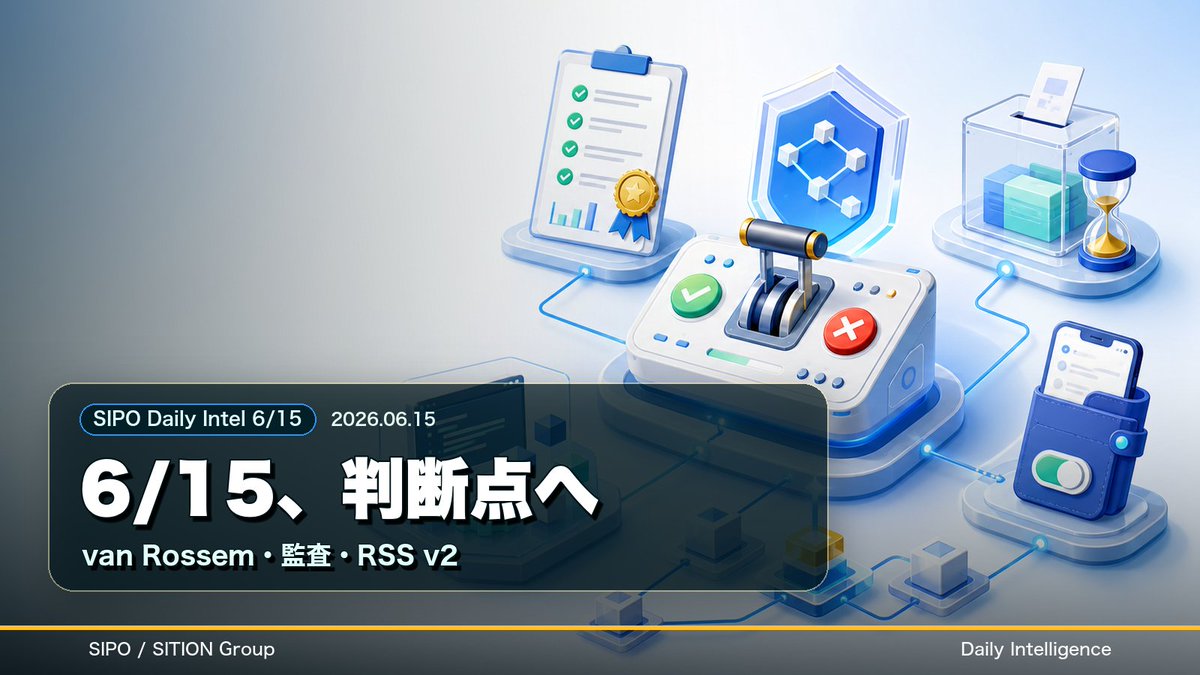
📋 Daily Intel 6/15|Cardanoは6/15判断点へ——van Rossem・予算監査・RSS v2
⠀
🎯 今日の主役
⠀
今日のCardanoは、6月15日という判断点にいます。
⠀
Intersect Weekly Update #115は、van Rossem hard forkがPreprodで成功し、次の焦点が6月15日のMainnet go/no-go decisionに移ったと整理しています。これは「ハードフォークが来る」という単純な期待ではありません。SPO、取引所、ウォレット、DApp、インフラ、ツールが本番移行に耐えられるかを確認する運用フェーズです。
⠀
同時に、2026 Budget ProcessはHydra Votingを終え、6月15日から19日の独立監査フェーズへ入ります。さらにRewards Sharing Scheme v2 ballotは6月15日15:00 UTCに締切です。
⠀
つまり6/15朝のCardanoは、発表日ではなく、実装前の関門日です。
⠀
📎 直近24-72時間の動き
⠀
まず、van Rossemです。Intersectは、Preprod hard fork enactment後、Mainnet go/no-go判断に向けて、node v11.0.1の採用、SPO・取引所・ウォレット・DApp・インフラの準備、readiness trackerの更新を確認事項として挙げています。ここは期待より、準備率と残課題を見る場面です。
⠀
次に、予算です。Hydra Votingは完了し、5B ADA超、active DRep stakeの約85%、100超DRep参加という規模が確認されています。ただし、ここで数字を最終結果として扱ってはいけません。6月15日から19日の独立監査を通り、監査済み結果、consolidation、Treasury Withdrawal Governance Action準備へ進む流れです。
⠀
3つ目は、報酬設計とDApp UXです。RSS v2 ballotは6月15日15:00 UTC締切。Minswapは、ユーザーが5 ADA collateralを自分でロックしなくても取引できる sponsored collateral を発表しました。Cardanoの次の実務課題は、投票・予算だけでなく、ユーザーがDAppを触るときの引っかかりを減らすことにもあります。
⠀
🧭 今日の焦点 3件
⠀
1. Mainnet go/no-go
van Rossemは、名前のあるイベントではなく、準備の総合判定です。SPO、取引所、ウォレット、DApp、ツールの準備状況を見る。
⠀
2. Budget audit
Hydra Votingの参加規模は強い。ただし6/15-6/19は監査フェーズ。未監査値を最終結果のように扱わない。
⠀
3. RSS v2 / DApp UX
報酬共有方式の投票と、Minswapのcollateralスポンサーは別ニュースに見えるが、どちらも「Cardanoを使う摩擦」を調整する話です。
⠀
📊 数値スナップショット
⠀
6/15 05:48 JSTのterminal liveでは、ADAは0.167151ドルで-2.47%。BTCは64,008ドルで-0.32%、ETHは1,670.54ドルで-0.25%。NIGHTはlive取得不可。
⠀
Cardano networkはepoch 637、epoch progress 19.2%、latest block 13,550,369。価格はやや重い一方、6月の主戦場は価格材料より、governance action、hard fork readiness、DApp実務対応です。
⠀
⚡ 先行指標 Watch(48-72h)
⠀
- 6/15 Mainnet go/no-go decisionの結果
- van Rossem readiness trackerの更新
- node v11.0.1採用、取引所・ウォレット・DApp準備率
- 2026 Budget独立監査の進捗
- RSS v2 ballot締切後の結果
- Plutus cost model updateの6/18 enactment準備
- Minswap sponsored collateralの利用者反応
- Charles Hoskinson氏のDiscord Part 2論点
⠀
🔄 48-72h 分岐(観察軸)
⠀
Base scenario:
Mainnet go/no-goが前向きに進み、budget auditとRSS v2が予定通り次段階へ進む。Cardanoは「投票後の運用」を着実に見せる。
⠀
Risk scenario:
readinessの残課題、取引所対応、DApp検証、監査結果の説明不足が重なり、発表より運用面に不安が出る。
⠀
Alt scenario:
MinswapのcollateralスポンサーやAiken Plugin 2.0のような実務改善が前面に出る。Cardanoの論点が、大型ガバナンスから日常UXへ少し移る。
⠀
今日の結論です。
⠀
Cardanoの6/15朝は、見出しの派手さより、運用の密度を見る日です。投票した。監査する。go/no-goを判断する。DAppをテストする。ユーザー摩擦を下げる。Voltaire期の成熟は、こういう地味な連結部分に出ます。
⠀
🔗 一次ソース / 関連リンク
- Intersect Weekly Update #115: intersectmbo.org/news/inters…
- Intersect Weekly Update X: x.com/IntersectMBO/status/20…
- Budget vote complete: x.com/IntersectMBO/status/20…
- RSS v2 ballot: x.com/IntersectMBO/status/20…
- Ekklesia ballot: app.ekklesia.vote/ballots/69…
- Plutus cost model update: x.com/IntersectMBO/status/20…
- Charles Hoskinson: x.com/IOHK_Charles/status/20…
- Aiken Plugin 2.0: x.com/Cardano/status/2066070…
- Minswap sponsored collateral: x.com/MinswapDEX/status/2066…
⠀
🌐 sipo.tokyo
Starting today, you don't lock a single ADA for collateral on Minswap. We sponsor it 🫡
We're the first dApp on Cardano to sponsor collateral for our users.
No more 5 ADA frozen in your wallet. No more "no collateral found" errors. No setup. You just trade.
Here's how it works: every smart contract transaction on Cardano needs a 5 ADA collateral, a kind of "safety deposit". Normally that comes from your wallet. Instead, we keep a pool of ready-made collateral UTxOs on our side and plug one in for you automatically, then recycle it after each trade.
One of Cardano's most notorious onboarding papercuts, gone ⏩
313
I don't really think so. I doubt any VC would provide funding based on the content of snek's loan proposal (the return is too low), but drep did.
1
14
Measuring non-linear KPIs can be difficult in some cases, but I believe part of CBDAO's value proposition was to handle that difficulty as much as possible using intermediate KPIs.
As you said, drep lacks the resources and capabilities, so CBDAO, with those capabilities and resources, will be responsible for tracking the KPIs.
Alternatively, if the conclusion was that there was no increase in on-chain Tx or TVL in the first year, but that would become apparent from the second year onward, and you wanted us to wait for the effect measurement, you could have expressed it like this:
In conclusion, CBDAO's on-chain effect in the first year is minimal. This is because most of the investment depends on features released from the second year onward. From the second year onward, we can promise a significant on-chain effect when combined with the investment from the first year. Specifically, xxxx.
2
16
I am just going to focus on what I have control over. This is incredibly frustrating, and I think the problem is structural. We can't have our builders stressed out trying to teach 1 or 2 dReps how to become responsible capital allocators.
The fact is that dRep incentives, expertise, and risk tolerance is not a good match for the needs of commercial builders. This creates a bottleneck for growth and will damage $ADA holders.
1
17