

ha, using the digraph form of the stringize operator is a lovely touch. the variadic capture is doing the heavy lifting too so the comma in hello world does not split into two arguments. cursed but completely legal. the preprocessor will happily build your string for you
3

Jun 15
idk what that word means but id imagine if u tried anagramming it into another word ud b keen on using a ck digraph
2
3
15
LYDIA DEJESUS retweeted

The word "fifth" is only five letters. For a beginning English learner, it's a maze.
The vowel.
The digraph.
The pronunciation.
The meaning.
The context.
Sometimes the hardest words are hiding in plain sight.
#ESL #TeachingEnglish
1
2
12

Jun 14
the th sound is so funny to me because it’s like not only does english have a difficult to pronounce sound that only like 10% of languages use, it’s also the most common digraph in the language and is in a good chunk of the most important words. the. this. that. with. thing.
44


Jun 11
In the context of written production, I don't see the point of reforming written lenition to be less digraph heavy when we're so generally accustomed to them already. Seems like it'd be a lot of spilled ink for a debatable gain
1
13
191


On the Spectra of Digraph Laplacians
Saeed Akbary, Michael Cavers, Farzad Maghsoudi, Babak Miraftab
arxiv.org/abs/2606.10312 [𝚖𝚊𝚝𝚑.𝙲𝙾]

Jun 10
When it's a part of a digraph (two letters making one sound) with a vowel it's also considered a vowel. Words like now, dew, sew, and so on.
1
31
Jun 10
When "W" is next to a vowel and they make a single sound, it's part of a "vowel team" or "digraph" and is considered a vowel. Think words like "cow," "new," and "saw."
21

For example the 'ie' I used wouldn't be a digraph, but just indicate a "default long" reading of 'i' (/i/) before the short 'e', since /ɪ/ can't appear there anyways.
1
34

On the Spectra of Digraph Laplacians
arXiv:2606.10312
Domination in Johnson graphs J(n, 3) for odd n
arXiv:2606.10326
On a Conjecture of Shapiro
arXiv:2606.10391
1
56

Jun 8
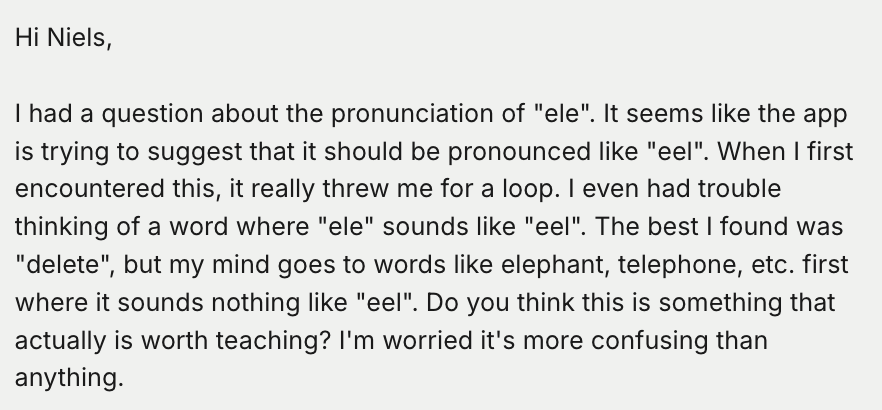
"Why do you teach kids to pronounce 'ele' as 'eel'?"
This is a great question from one of our customers!
Most people are used to seeing reading taught as a series of explicit rules (eg "when two vowels go walking the first one does the talking"), almost as though you were trying to program a computer.
But your brain isn't a computer, consciously executing a series of rules.
What your brain is really good at is unconscious pattern recognition.
"Gan" and "rogs" are made-up words, but you still know to change the pronunciation of the "a" and the "s" even if you don't know why. (You might not even realize you're changing the letters' pronunciation!)
The academic literature likes to call this "statistical pattern recognition" but that's a needlessly fancy term.
The implication for teaching reading is that rather than teaching conscious rules, it's more effective to drill pattern recognition.
That's why Mentava doesn't teach rules like "silent e makes the vowel say its name".
Instead, I prefer to use the split digraph method where kids first learn to recognize a pattern like "ee" as a long e, and then learn to recognize "e_e" (eve, pete, theme, etc) as another long e pattern.
Initially, uncommon/nonsense patterns like "ae" or "ele" help train this pattern. Once the child masters the split digraph pattern, then those weirder combinations disappear from the curriculum and the focus can be on actual words.
1
1
42
4,138

When you encounter a word from a rare or endangered foreign language, especially those that only got a latin alphabet recently, and that word has a digraph or trigraph that contains the letter L, it's usually this sound. The aztec word a(tl)a(tl) and the muscogee (Thl)op(thl)occo
2
50

Jun 3
6yr old thinks I'm stupid as I had no idea what a split Digraph was.
3
64

AR is effectively a digraph representing the low back unrounded vowel, /ɑ/, in British English. Think of it like SH, or CH, or TH, or NG.
1
2
222


May 31
“ar” is basically a digraph in RP, if a Brit says “Americans pronounce it ‘parsta’” they are not saying you pronounce it with a rhotic R, they’re saying you use a more back vowel like an “ah” sound like in “father” rather than front sound like a or æ in “cat”
May 31

I’m really in love with the fact that, because British people don’t pronounce Rs, they think you added an R when you say a letter normally. To them, every word I say is filled with an incomprehensible number of Rs
7
5
289
25,542