
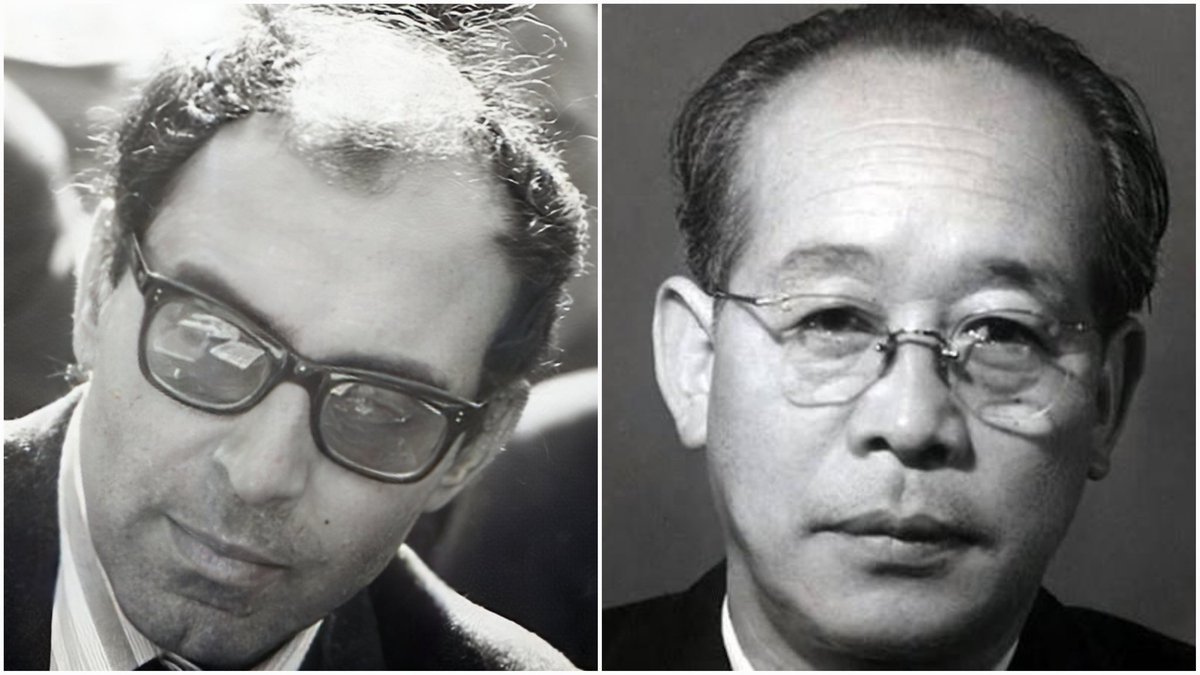
Jean-Luc Godard on Kenji Mizoguchi:
"Gallantry and metaphysics
If poetry is manifest in each second, each shot filmed by Mizoguchi, it is because, as with Murnau, it is the instinctive reflection of the film-maker’s creative nobility. Like the director of Sunrise, the director of Ugetsu Monogatari can describe an adventure which is at the same time a cosmogony.
His heroines are all the same, strangely resembling Hardy’s Tess of the d’Urbervilles. The most terrible adventures befall them, one after the other. And if Mizoguchi shows a marked predilection for brothels, he refuses — unlike Kurosawa, who is merely a more elegant Ralph Habib — to become trapped by the false glitter of the picturesque. When he re-creates old Japan, he goes beyond tinsel and anecdote to give us the unvarnished truth with a mastery equalled only by a Francesco, giullare di Dio. Never have we seen, seen with our own eyes, the Middle Ages exist with such intensity of atmosphere.
A revolutionary technique of simplicity
Efficacity and sobriety are the characteristics of great film-makers. And Kenji Mizoguchi does not belie this rule. As Philippe Demonsablon pointed out in a pertinent article on The Life of O’Haru, his art is to abstain from any solicitation irrelevant to its object, to leave things to present themselves without intervention from the mind except to efface its traces, thus increasing a thousandfold the efficacity of the objects it presents for our admiration. It is, therefore, a realist art, and the mise en scéne will be realist.
This simplicity is not without paradox, for it must achieve its austerity through an accumulation of matter. The compositions are guided initially by the laws of movement. But there is no Baroque embellishment, no purpose other than to allow the substance itself to reach us. No image is comic, tragic, fanciful, erotic in itself, and yet is all these things at once. Mizoguchi’s art is the most complex because it is the simplest. Camera effects and tracking shots are rare, but when they do suddenly burst into a scene, the effect is one of dazzling beauty. Each crane shot (here Preminger is easily outstripped) has the clean and limpid line of a brush-stroke by Hokusai."
— Godard on Godard: Critical Writings by Jean-Luc Godard, edited by Jean Narboni and Tom Milne (1972; Da Capo Press edition, 1986)
64
329
12,994

St= the strength of the physics attacks
Ma=the strength of magic attacks
En= efficacity of the defense
Ag= efficacity of dodges and precision
Lu= Luck with critics attacks and dodges
1
1
98
3,613

Technically I totally agree with you but in terms of maturity and efficacity I think Senegal will also be a great outsider on this world cup.
Jun 13

Bro, no team in Africa matches this current Moroccan team. Lets be honest
29

Jun 14
The efficacity...thats what we missing for so long. Vini 1 shot 1 goal...terrible stat for us
22

Avian #stateciv/#statesmp (2.5)
Avian!Schpood is pretty shit to make a good nest.
Like hes SO bad at it that people who know about it are just feeling bad too.
They gave him pillows, some good fabric for him to create a good place to sleep...but no! Efficacity before the rest : He just uses a blanket and a pillow.
Bro. You can be a diva, to have the best nest of the whole Island but no! That bird just sleeps with... this.
Yes, Owo and the others are just looking at him with that one (ಠ_ಠ) face when the subject is bought up.
He's just a simple guy ig...

1
13
68
767

Jun 11
Mbappe running to Kante is the ONLY correct way of getting his fucking armband. He wasn't even THAT far away from Kante in the first place.
Don't conflate efficacity with laziness.
#DictatorMbappe meme is fun & all, but NEVER disrespect N'Golo Kante, EVER again! 🫵🏽😡
Jun 11

Remember that clip where Mbappe asked Cherki to take the armband off Kante during one of their friendlies in April? Yea, he has all the rights in the world to do that since he IS the captain, but doing that, ESPECIALLY to Kante, who is his senior in every way, is pure DISRESPECT.
59

Jun 7
On the surface, this high-profile divorce looks entirely personality-driven. But deep down, it's structural.
Annamalai advocated an ORGANIC, aggressive ground-up growth path. Delhi's central leadership, however, doesnt seem convinced of its efficacity in near term. (2/3)
4
4
38
2,013

well because thats not his ceo anymore and taemin proved us already he is able to stand and fight for his rights !
Like do you think fans talking about it endlessly on twitter dot com will give his money back ??? Let his lawyers do the works silently and with efficacity 🙂↕️
Jun 6

Why you guys not talking about taemin being mistreated by the soon-to-be-counted-as-criminal ceo
Unpaid for the whole world tour???? And EG even have 2 parts of tour also?? Taemin dreamt of having that tour but they turned it into a NIGHTMARE 😭
4
8
136
4,023

This comment is about EU holding back EU approval.
Well... trust but verify... like they verified the Pfizer's claims of 95% efficacity?🤡🤡
After the Coronacircus train wreck, you must be a total moron to still trust this corrupt and harmful bureaucracy.
May 28

the obvious reason: you don't trust claims from any company. you verify. and that takes time...
1
3
11
1,169

"Derrida’s work and his usage of general economy represent a major anti-epistemological development. The concept of general economy is crucial throughout his works, and Derrida often defines his matrix in general economic terms. The general economy of 𝘥𝘪𝘧𝘧𝘦́𝘳𝘢𝘯𝘤𝘦, Derrida’s arguably most important and most famous rubric, is particularly significant in this respect, as 𝘥𝘪𝘧𝘧𝘦́𝘳𝘢𝘯𝘤𝘦 itself becomes analogous, although not identical, to Bataille’s sovereignty. Derrida’s theoretical and textual strategies, plural even within any given text, cannot be contained within the rubric of 𝘥𝘪𝘧𝘧𝘦́𝘳𝘢𝘯𝘤𝘦, which itself requires other structures – trace, supplement, dissemination, 𝘸𝘳𝘪𝘵𝘪𝘯𝘨, and so forth – in order to be approached. These strategies cannot be contained by the rubric of general economy either; nor by any given rubric, for example, deconstruction. General economy, however, offers a comprehensive and possibly the most radically anti-epistemological approach to Derrida’s theoretical economy. The latter may be seen as the analysis of the general-economic efficacity of the processes that classical theories understand in terms of restricted economies – meaning, presence, and truth; the full consciousness and self-consciousness; the possibility of unconditionally grounding or centering interpretation or theory; the possibility of interpretive and theoretical gains without accompanying losses; the possibility of a fully coherent unity of knowledge and of the projects based on these assumptions; and so forth. These configurations are not identical, but are all complicit within what Derrida sees as the metaphysics of presence – a powerful and systematic unity that defines the history of Western philosophy, but is operative far beyond its limits, whether in linguistics, anthropology, psychoanalysis, literary criticism, or elsewhere. One of Derrida’s major contributions is the understanding and analysis of this commonality as operative across a broad manifold of texts and fields and across extended historical trajectories."
Arkady Plotnitsky,
"Complementarity: Anti-Epistemology after Bohr and Derrida"
_____________________________
The metaphysics of presence: the bane of man. In a word: God.
1
1
2
51

May 19
they had 40 PKs in the postseason and gave up 2 goals, which is indeed a 95% efficacity
1
3
176


Apr 30
You just lost 50% of efficacity on this lock, now everyone knowing where you live knows they only need a wire to lift this plank from the other side, they also know it's the backdoor. 😅
1
3
52

Mar 31
Trains are expensive and slow. I saw the rows and rows of oil tanker cars in Alberta. Great stuff, but it drives up the cost and lowers efficacity. BTW, only one rail runs through norther ON.
1
14
851

Mar 9
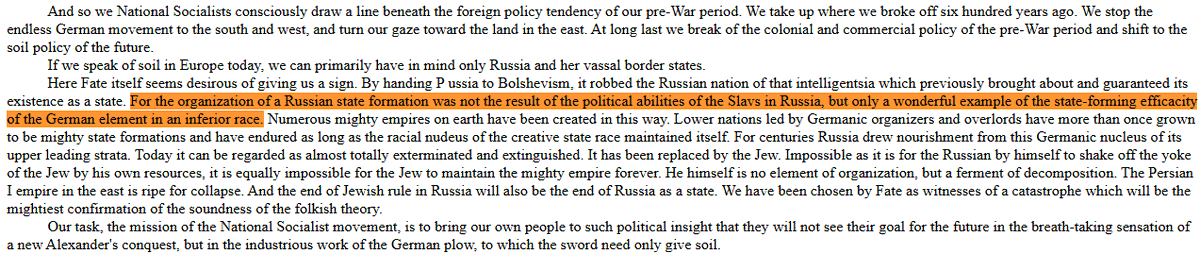
"For the organization of a Russian state formation was not the result of the political abilities of the Slavs in Russia, but only a wonderful example of the state-forming efficacity of the German element in an inferior race."
- Adolf Hitler, Mein Kampf
3
92


Feb 8
Ok but it never proved its efficacity against the Covid. People got covid even though they were vaccinated. And please don't tell me it would have been worse otherwise, that is total BS.
5
18
598

Go China, it's about time that you do real war time tests of your weaponry. Sadly it's the only way to prove their efficiencies. Peacetime testing doesn't allow for a real apraisal of efficacity.
3
1,268

more efficacity for devs
we need to think about building something around the community !
still here
2
35

Jan 13
Beware of those who are more concerned with how something looks or sounds than with the actual truth or efficacity of that thing.
Jan 12

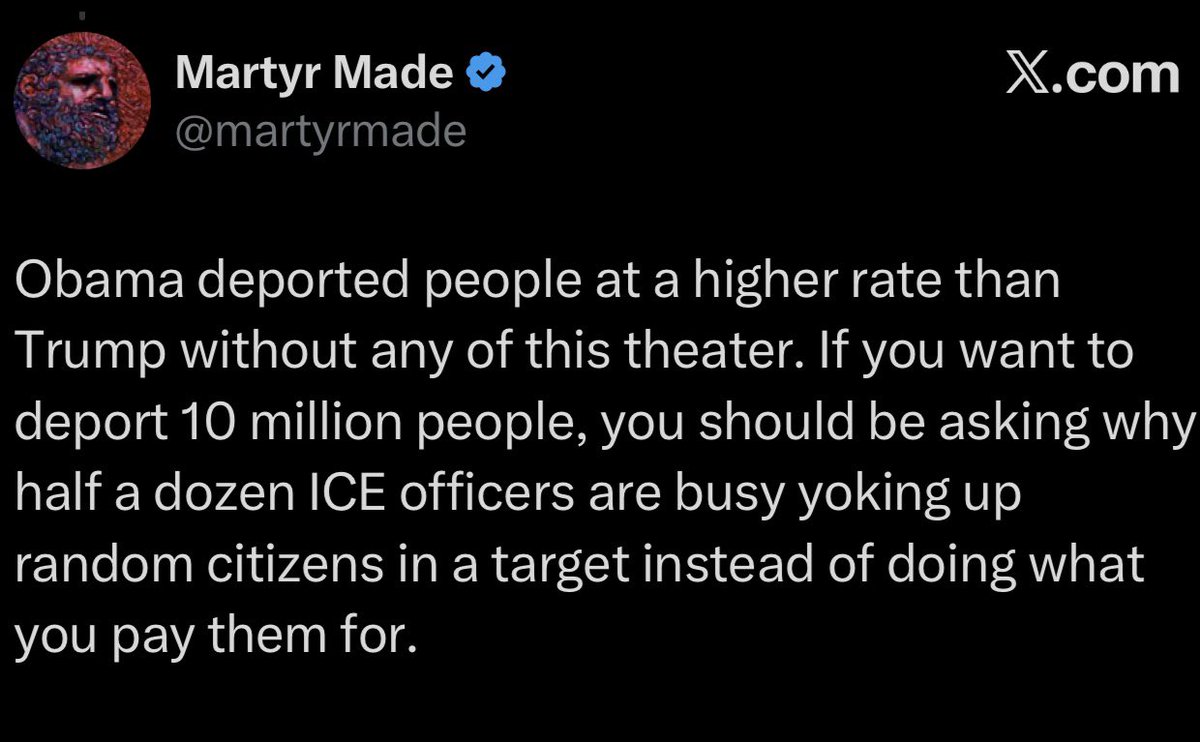
Looks like Migrant Made deleted this one. Keep pushing—the demoralizers, black-pillers and well poisoners are losing ground, reversing their positions, and looking more ridiculous by the day.
Year of the patriot. We will win.
2
100