Maro of Warri retweeted

QUICK EJACULATION, ED & ORGASM.
Men bring your sit. Women, leave us for now. We have a brief meeting 🤝.
Quick ejaculation and ED can make your woman cheat on you or run away from you, since you can't satisfy her or make her reach ORGASM. Orgasm is the highest level of a woman's sexual ecstasy in which some sexual fluids or chemicals are being released from her Asorock.
Quick ejaculation is when you are a two minutes man; any small thing you don cum, and meanwhile your woman has not even ignite fully.
ED is Erectile dysfunction. This is when your pencil is always flaccid, can't stand strong like sugarcane. Any small thing, baby touch it let it stand!😂😭
To prevent all these, you need to:
a. Stop masturbation
b. Stop eating sugary food
c. Always drink water and exercise regularly
c. Eat natural foods, especially fruits like 🍉, 🥑, 🍌, 🍏 ,🥛, etc
d. Stop drinking all these alcoholic combo just to have strength, like satchet alcohols and others. Use your natural strength when handling a woman.
e. Do chew bitter cola, kolanut, date(fruit), alligator pepper, raw fresh tomato 🍅. Pls don't abuse them.
f. Foreplay. Always engage her in hot and passionate foreplay before penetration. Suck and finger her very well. Kiss passionately. Look into her eye ball and say crappy stuffs. Induce vibrations in her. Kiss her ear, tight, stomach while your left hand is down there. Then, during the act, don't be too fast. Thrusting so fast will make you cum earlier. Take it easy and thrust gently, then increase the speed, hold break again, while touching her everywhere.
Shalom!
1
3
4
78

Men,
Each time an ejaculation threatens to happen.
• Make a deep breath.
• Hold your breath.
• Release the breath slowly.
Rule:
- Don't moan. Moaning is for women.
- Don't be dramatic.
Command the tone, pace and mood of the moment.
#MasculinitySaturday
33
692
4,962
85,415

18m
Thank you 🥹 I couldn't film the second time well, so I'll upload the first video soon. You might see my biggest ejaculation yet?😁
1

Ọzọ na Okporo retweeted

7 SECRETS FOR A STRONG ERECTION & EJACULATION
1. Ginger tea

3
42
304
40,206
Anna Woodthorpe Browne retweeted

DID YOU KNOW??
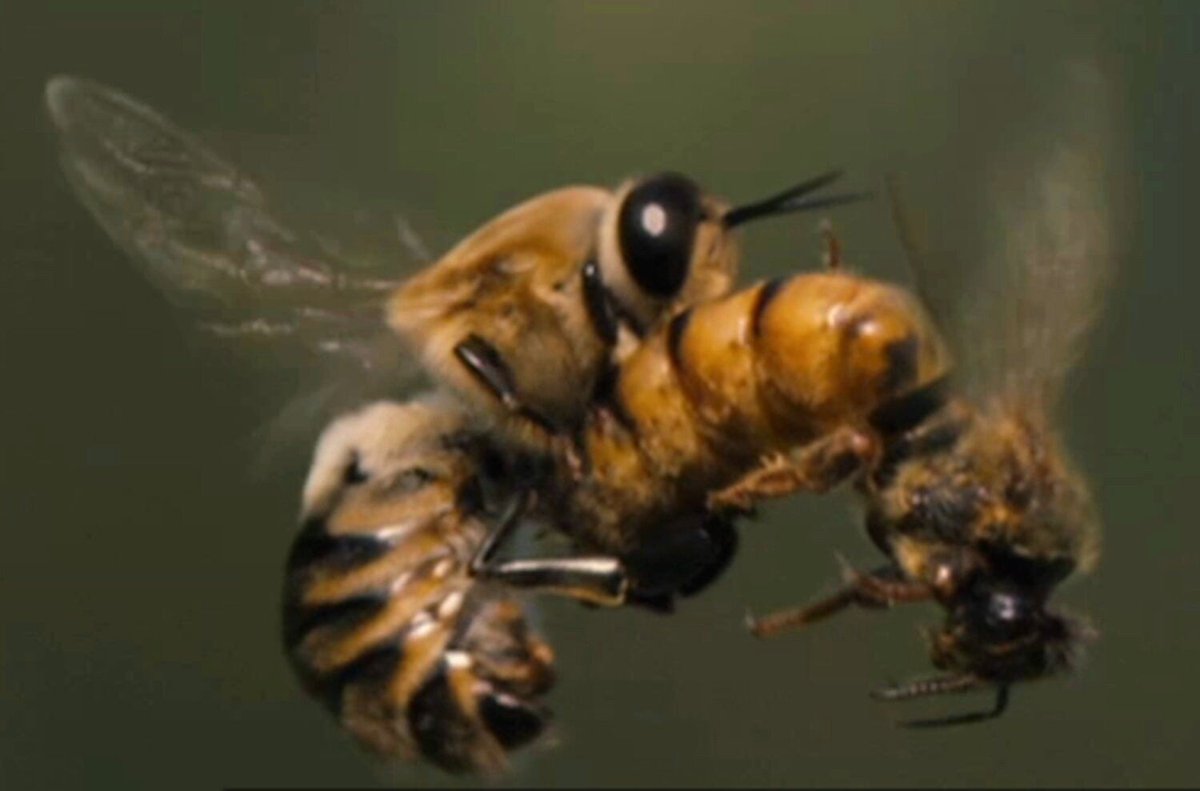
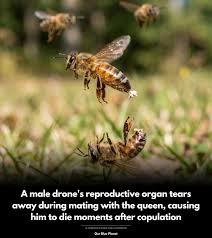
When a male honeybee mates with a queen bee, his ejaculation process is so incredibly explosive and high-pressured that it literally shatters his body, ripping his reproductive organs clean out of his chest cavity and killing him mid-air!
Known as drones, male honeybees live a life entirely defined by a singular, hyper-specialized mission. They do not gather pollen, they do not make honey, and they do not have stingers to defend the hive. Their sole biological purpose is to pass on their genetics to a virgin queen during her legendary, high-altitude mating flight.
The mechanics of this reproductive act are among the most violent, explosive, and fatal encounters in the entire animal kingdom. Walk with me 👇🏾👇🏾
1. The High-Speed Aerial Chase:
Mating never takes place inside the dark, crowded confines of the hive. Instead, it occurs in mid-air within specific geographic locations known as Drone Congregation Areas.
When a virgin queen is ready, she takes to the sky, climbing to altitudes between 30 and 100 feet. She releases a powerful trail of sex pheromones that acts like a beacon, attracting thousands of drones from surrounding hives who form a massive, swirling comet-like swarm behind her.
Only the fastest, strongest, and most agile drones have the physical endurance to catch up to her at these high speeds, ensuring that only top-tier genetics make it to the next generation [yes, nature is that brutal! 😂]
2. The Explosive Pressure Valve:
Once a victorious drone successfully intercepts the queen mid-flight, the mating process takes less than five seconds to complete, and it concludes with a literal bang!
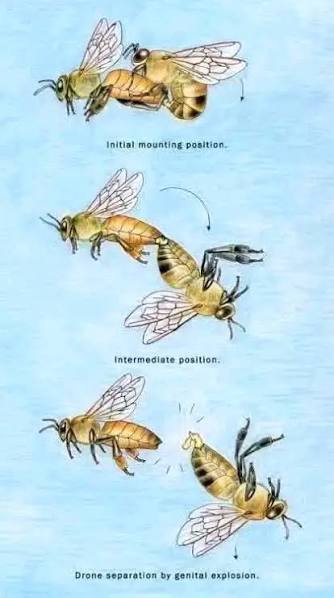
The drone's reproductive organ is an internal structure called an endophallus. To ejaculate, the drone must aggressively contract his abdominal muscles to pump hemolymph (insect blood) into the organ at an astronomical pressure. This causes the endophallus to forcefully evert, essentially flipping inside out like the finger of a latex glove being violently blown forward by high-pressure air.
The pressure is so intense that the fluid blast forces the semen out at a velocity that creates a distinct, audible "pop" sound that can actually be heard by human researchers standing on the ground below.
3. The Fatal Shattering and the "Mating Sign":
The extreme, explosive force required to inject his sperm directly into the queen's specialized storage pouch instantly destroys the drone's internal anatomy.
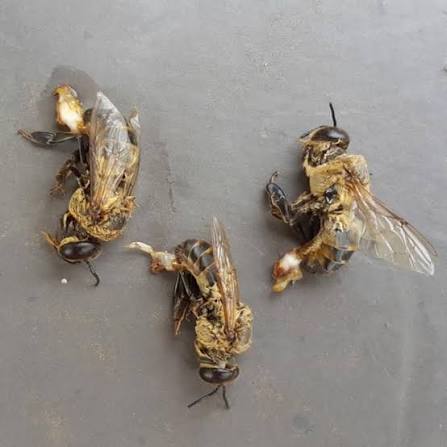
As the drone ejaculates, his endophallus becomes securely locked inside the queen. The explosive pressure causes his abdomen to literally rupture and tear apart. His heart stops instantly, his nervous system shuts down, and his paralyzed body flips backward, plummeting to the earth below.
When the dead drone falls, his ruptured reproductive organ is completely torn away from his body, left behind inside the queen's sting chamber. This protruding tissue is known to entomologists as the "mating sign." It acts as a temporary biological plug, preventing the precious sperm from leaking out while the queen continues her flight.
4. A Succession of Ripped Plugs:
You might think that leaving a plug behind would prevent any other male bees from mating with the queen, but evolution has already accounted for this obstacle.
The queen bee is highly polyandrous, meaning she needs to collect sperm from 15 to 20 different drones during a single mating flight to ensure the hive's future genetic diversity. When the next drone catches up to the flying queen, his specialized endophallus is equipped with tiny, backward-facing hairs and ridges designed to act like a surgical tool. He uses his organ to physically hook, pull, and discard the previous drone's trailing "mating sign" before detonating his own explosive ejaculation, repeating the fatal cycle.
IN SUMMARY!
The life of a male honeybee is a stark, evolutionary trade-off.
Hopefully you've learnt something new today?
Cheers 🥂 😅
The Medic Who Writes™🌚
May 24

A male bee mates for less than 5 seconds in midair. The ejaculation is so explosive you can hear it pop from a few feet away. His body rips in half. He falls dead before hitting the ground. And he is one of the lucky males in the hive.
When a male bee, called a drone, chases down a queen mid-flight at speeds of 22 miles per hour, his entire reproductive organ turns inside out. The pressure required for this comes from nearly all the blood in his body, which rushes downward to force the organ outward like a spring. The semen fires into the queen with so much force it makes the audible pop. The organ then snaps off and stays lodged inside her like a cork. As he flips backward off her body, his abdomen rips open. The next drone waiting his turn has to physically yank out the dead male's cork before he can mate. The same thing then happens to him.
The queen does this 12 to 20 times in a single afternoon. She flies up to a spot in the sky that beekeepers call a drone congregation area. Picture an invisible meeting point about 50 to 130 feet above the ground where up to 11,000 male bees from as many as 240 different hives are hovering, waiting for her. These spots stay in the exact same locations year after year, sometimes for over a decade. No one fully understands how brand new drones, born only weeks earlier, find them.
By the end of her mating run, the queen has collected around 100 million sperm cells. She keeps only 5 to 6 million in a tiny internal storage organ that keeps them alive for years. From that supply, she uses just two sperm cells per egg for the rest of her life, laying up to 2,000 eggs a day for 2 to 7 years. After that one afternoon in the sky, she will never mate again.
A 2019 study from UC Riverside, the University of Copenhagen, and the University of Western Australia found that bee semen contains toxic proteins that temporarily blind the queen by interfering with how vision genes function in her brain. If she can't see well, she can't fly out again to mate with more males. Their semen also carries a separate protein that attacks and kills sperm cells from rival drones still inside her. The males keep competing long after every one of them is dead.
The 99.9% of drones who never get to mate have it worse. As autumn arrives, the female worker bees in the hive stop feeding their brothers, then drag them out of the entrance after biting off their wings. The drones can't fly back in. They starve or freeze in the grass within days. The colony raises a fresh batch of disposable males the next spring, and the whole cycle starts over.
11
33
164
89,340
Semen Retention Archive retweeted

Wet Dreams do not have the same effect as Ejaculation.
3
6
186
13,726

A single human ejaculation carries roughly 1,500 to 16,000 Terabytes of biological data. You need to wank it empty. Hope that helps
4

It’s diet and too much ejaculation Mtu wa nyumbani.
Vijana wanakula indomie sana.
Pia vijana wanasupply electricity sana kwa the the snake gender. It drains them alot
1
332
