Angry Redhead sidherian@bsky.social 😷🌈🐈⛩ ⚔️ retweeted

Jun 12
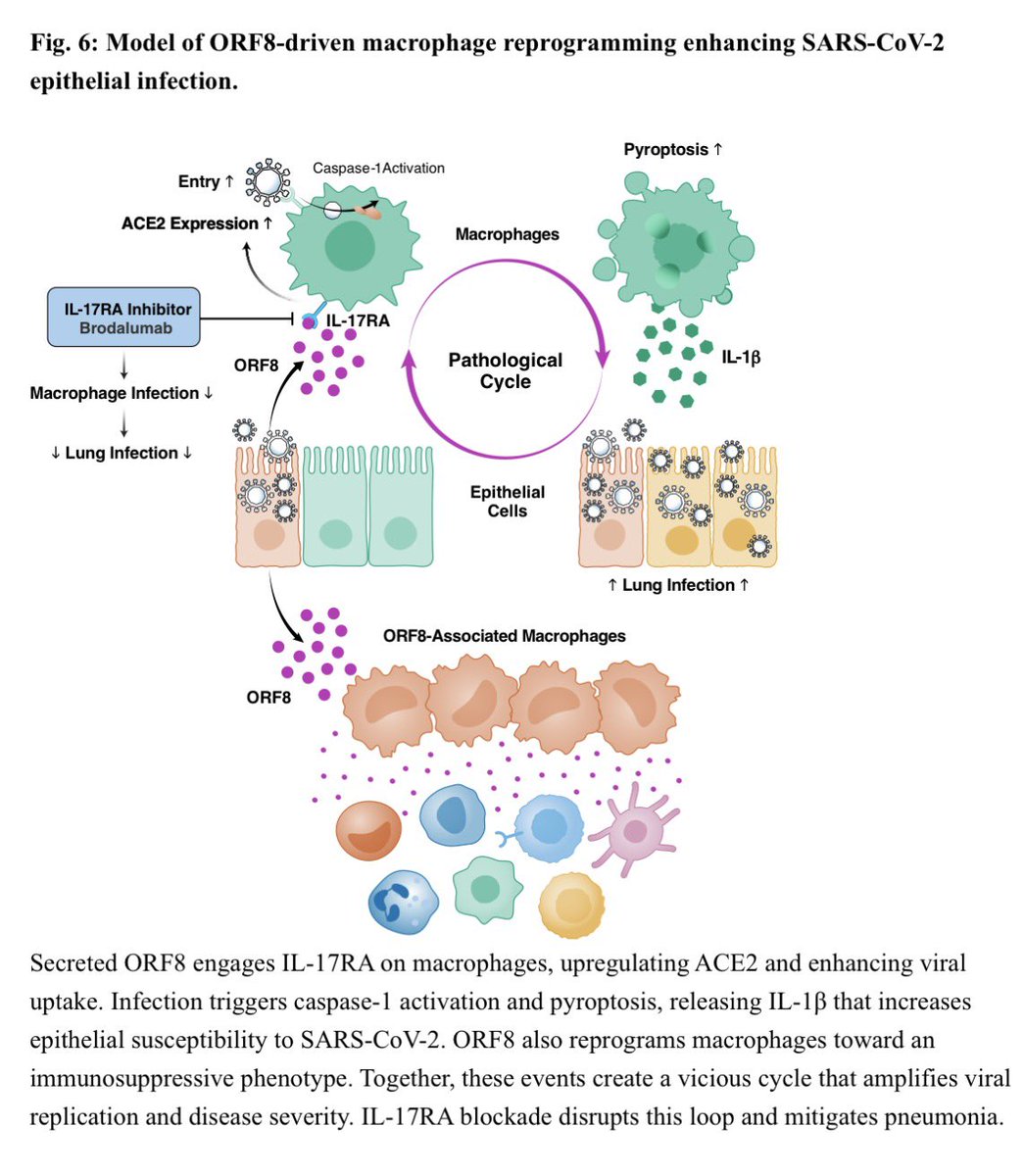
Ooh, these findings uncover ORF8’s paracrine role in reprogramming macrophages, creating a feedforward proviral loop that accelerates lung pathology in COVID-19.
➡️This is clinically relevant given the REPEATED emergence of SARSCoV2 variants with(JN.1/KP.*/LP.*)or without ORF8( XBB.* )and subsequent REINFECTIONS! 👇
Jun 12

A hidden viral protein may be one of the key drivers of severe COVID-19 lung damage.
➡️ Researchers found that #ORF8, an accessory protein secreted by SARS-CoV-2, can “reprogram” lung macrophages, making them more susceptible to infection and triggering pyroptosis—a highly inflammatory form of cell death. 1/
1
19
59
1,918

role for ORF8 in reprogramming macrophages, establishing a feedforward proviral circuit that accelerates lung pathology in C-19 and are clinically relevant given
**the recurrent emergence
of SC2 variants with either intact or deleted ORF8 since the beginning of the pandemic.
10

Jun 14
This is a great reminder that AI isn't just one technology it's a whole toolbox. 🧠
From CNNs teaching machines to "see," to Transformers powering ChatGPT and modern LLMs, every architecture solves a different problem. The real magic happens when you know which tool to use and when.
What's fascinating is how quickly we've gone from Feedforward Networks to Diffusion Models generating photorealistic images and Transformers reshaping entire industries.
The future belongs to those who understand not just AI tools, but the architectures behind them. 🚀 #AI #MachineLearning #DeepLearning
12

Jun 13
Computational Novel Reconstruction and Evidence: The following production-grade Python script simulates this multi-scale tissue network, tracking signaling cascades, epigenetic stabilization, and memory-guided structural repair across an interconnected cellular lattice.
```python
"""
CellularBrainRepairSim - Complete Production Engine
Models signaling kinetics, amino acid phosphorylation, bioelectric oscillations,
mitochondrial milliwatt thresholds, and matter rearrangement loops.
"""
import numpy as np
import matplotlib.pyplot as plt
from scipy.integrate import odeint
def complete_network_ode(y, t, pulses, params, coupling_matrix):
"""
State vector structure per cell i:
y[4*i] = K_i : Kinase phosphorylation fraction (Thr202/Tyr204)
y[4*i 1] = M_i : Transcriptional memory proxy (RNA level)
y[4*i 2] = E_i : Epigenetic stabilization trace (DNA/Histone level)
y[4*i 3] = D_i : Bounded structural damage level [0, 1]
"""
num_cells = coupling_matrix.shape[0]
derivs = []
# Unpack uniform parameter landscape
k_on, k_off, alpha, beta, gamma, delta_e, epsilon, delta_dmg, rho, P_mito, stress_factor, c_strength = params
# Normalized mitochondrial bioenergetic scaling (Optimal window: 1.5 mW - 5.0 mW)
power_scaling = P_mito / 3.0
for i in range(num_cells):
idx = i * 4
K_i, M_i, E_i, D_i = y[idx], y[idx 1], y[idx 2], y[idx 3]
# Environmental input applied directly to Node 0
S_ext = 0.0
if i == 0:
for start, dur in pulses:
if start <= t < start dur:
S_ext = 1.0
break
# Calculate tissue communication input from adjacent cell nodes
S_net = 0.0
for j in range(num_cells):
if i != j:
M_j = y[j * 4 1]
S_net = coupling_matrix[j, i] * M_j
S_eff = np.clip(S_ext c_strength * S_net, 0.0, 1.0)
stress = S_eff * stress_factor
# 1. Kinase Kinetics Equation (Thr202/Tyr204 phosphorylation loop)
dKdt = k_on * S_eff * (1.0 - K_i) - k_off * K_i
# 2. Transcriptional Memory Accumulation Equation (Ser133 proxy)
dMdt = alpha * K_i - beta * M_i
# 3. Epigenetic Stabilization and Experience Revision Equation
dEdt = gamma * M_i - delta_e * E_i epsilon * S_eff * M_i * (1.0 - E_i)
# 4. Matter Rearrangement & Structural Repair Equation
dDdt = (delta_dmg * stress) - (rho * power_scaling * M_i * E_i * max(0.0, 1.0 - D_i))
# Homeostatic boundary enforcement
if D_i <= 0.0 and dDdt < 0.0: dDdt = 0.0
if D_i >= 1.0 and dDdt > 0.0: dDdt = 1.0
derivs.extend([dKdt, dMdt, dEdt, dDdt])
return derivs
# ==========================================================
# Simulation Calibration & Execution Environment
# ==========================================================
# System Parameters matching optimal biochemical and thermodynamic baselines
# [k_on, k_off, alpha, beta, gamma, delta_e, epsilon, delta_dmg, rho, P_mito (mW), stress, c_strength]
system_params = [2.2, 0.45, 1.1, 0.07, 0.05, 0.02, 0.1, 0.06, 0.22, 3.5, 0.75, 0.35]
time_domain = np.linspace(0, 200, 2500)
# Interconnected 3-cell linear feedforward lattice array
network_topology = np.array([
[0.0, 1.0, 0.0],
[0.0, 0.0, 1.0],
[0.0, 0.0, 0.0]
])
# Initialize nodes with baseline wear (25% structural damage)
initial_network_state = [0.0, 0.0, 0.0, 0.25, 0.0, 0.0, 0.0, 0.25, 0.0, 0.0, 0.0, 0.25]
# Spaced input sequence applied to Node 0 (Four 10-minute spikes, 20-minute clear recovery gaps)
spaced_protocol = [(10, 10), (40, 10), (70, 10), (100, 10)]
simulation_output = odeint(complete_network_ode, initial_network_state, time_domain, args=(spaced_protocol, system_params, network_topology))
```
Page 11 of 12
1
2
3
60



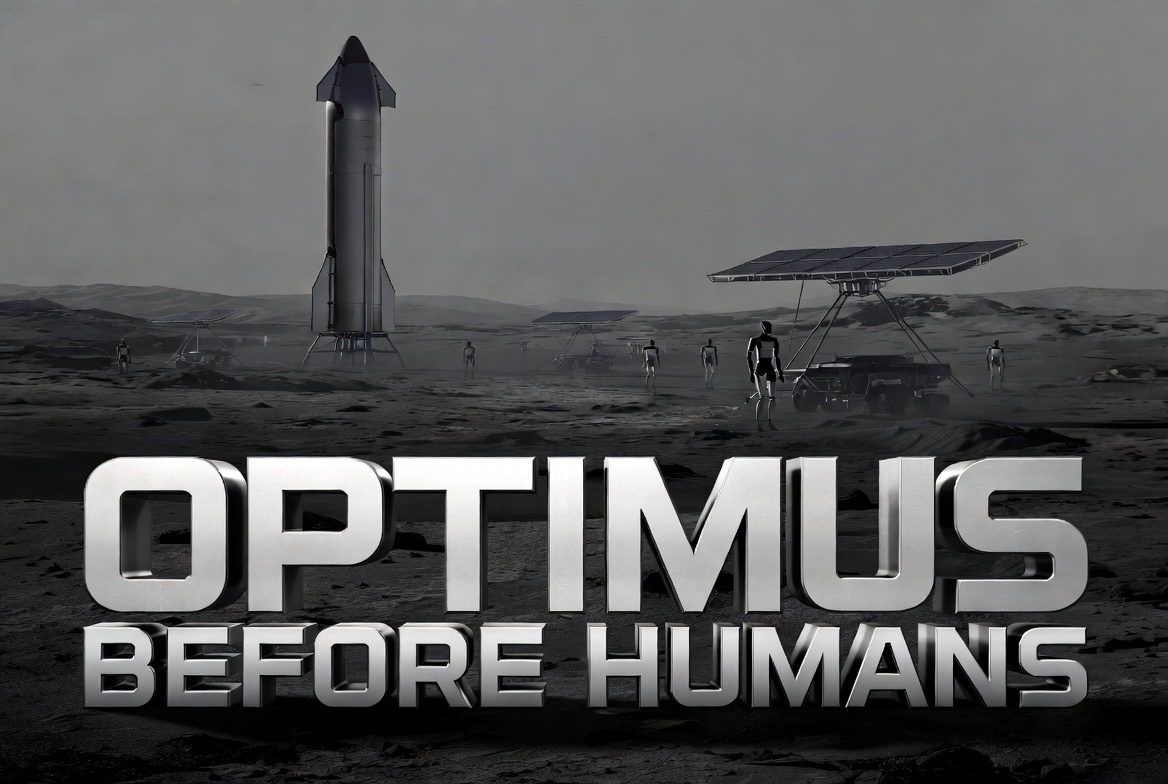
> First Absolute Step on Mars: Optimus Before Humans
>
> Safely egress the Starship, then immediately establish reliable power generation and supporting infrastructure using local Martian resources…
> Optimus robots are positioned to lead this phase. They can operate continuously in environmental conditions where suited human crews face strict operational limits…
>
> The Moon comes first… uncrewed lunar demonstrations… These missions will validate Starship landing, refueling, and operations before any Mars attempt.
> — @LaceyPresley
This is exactly the sequenced Tech Stack plan we’ve been mapping — and it’s brilliant first-principles engineering.
Optimus (Robotics → unlimited labor) goes first to build power, ISRU, and infrastructure on Mars while humans stay safely in the loop. The Moon serves as the high-cadence proving ground (faster iteration, lower risk) before the 26-month Mars windows. Starship delivers the mass, xAI/Tesla supply the intelligence layer, and orbital energy systems make it sustainable.
This is the feedforward loop in action: lunar success de-risks Mars, Optimus matures in real off-world conditions, and every milestone accelerates the next. No headlines. No vacations. Just engineering on the most demanding scale.
Moon by ~2028–2030 → Optimus-led Mars precursors by 2027–2028 → sustained human presence in the early 2030s.
Scarcity of safe off-world footholds? Being solved.
Abundance of multiplanetary capacity? Accelerating.
This is Homo Novus in real time: robots pioneering the way so humanity can thrive across worlds and climb the Kardashev Scale together.
Let’s go. 🚀
#HomoNovus #TechStack #Optimus #Starship #Mars #Robotics #KardashevScale #AbundanceEconomy
Jun 11

First Absolute Step on Mars: Optimus Before Humans
Safely egress the Starship, then immediately establish reliable power generation and supporting infrastructure using local Martian resources.
Mars offers no breathable atmosphere, average surface temperatures around -60 °C, and significant radiation exposure. Starship provides only temporary shelter.
Sustained operations life support, communications, rovers, and especially ISRU (producing oxygen, water, and propellant on-site) all depend on reliable power. Without it, everything else fails.
Optimus robots are positioned to lead this phase. They can operate continuously in environmental conditions where suited human crews face strict operational limits on duration and logistics.
IMPORTANT DISCLAIMERS (for full accuracy):
- The Moon comes first. NASA’s Artemis program uses Starship as the Human Landing System. Following the successful Artemis II crewed lunar flyby in April 2026, current planning prioritizes uncrewed lunar demonstrations, with targets for uncrewed lunar landing in the 2027 timeframe and crewed lunar landing thereafter. These missions will validate Starship landing, refueling, and operations before any Mars attempt.
- All Mars timelines remain aspirational and subject to change based on Starship development progress, flight test results, and orbital mechanics.
What Elon Musk has publicly stated (verified from his X posts):
- April 10, 2025: “Starship will hopefully depart for Mars at the end of next year with Optimus explorer robots!”
- August 6, 2025: “Slight chance of Starship flight to Mars crewed by Optimus in Nov/Dec next year. A lot needs to go right for that. More likely, first flight without humans in ~3.5 years, next flight ~5.5 years with humans.”
In February 2026, SpaceX informed investors that it would prioritize lunar missions and defer Mars attempts accordingly.
This aligns with the Moon-first approach and confirms that the aggressive near-term Mars windows discussed in 2025 are not currently targeted.
The long-term architecture remains consistent: uncrewed Starships carrying Optimus robots will first establish power plants, ground infrastructure, and confirm water ice resources.
Human crews will follow only once the base is viable and reliable power is secured.
Mars is not a vacation it is engineering on the most demanding scale. The robots will perform the heavy lifting to make sustained human presence possible. Let’s go.
23
Kingslee 🇳🇬 retweeted

Adding dropout layers in 'TransformerBlock' could improve generalization. Also, isolating attention and feedforward logic into separate methods enhances clarity.
github.com/thekingslee/build…
@AbdvllxhMvjxhid @theKingslee
1
3
32


ORF8, SARS-CoV-2's secreted immune-evasion protein, reprograms macrophages to amplify viral replication and drive severe lung pathology through a feedforward loop of infection and inflammation that can be disrupted with IL-17RA blockade.
ORF8's mechanism in macrophage hijacking:
Extracellular ORF8 binds IL-17RA on macrophages and upregulates ACE2 expression through an IL-17RA–TRAF6–JNK signalling axis, dramatically increasing macrophage permissiveness to viral infection. Macrophages exposed to ORF8 at concentrations consistent with severe COVID-19 showed dose-dependent increases in viral uptake. When infected, macrophages producing ORF8 generated ten times more infectious viral particles at 24 hours post-infection than ORF8-deficient strains, though production collapsed by 72 hours as pyroptosis killed the infected cells.
The pathological amplification cycle:
ORF8-assisted macrophage infection triggers caspase-1 activation and inflammasome-mediated pyroptosis, flooding tissue with IL-1β. This cytokine directly upregulates TMPRSS2 on lung epithelial cells, dramatically enhancing their susceptibility to infection. In co-culture systems with both macrophages and alveolar epithelial cells, ORF8-expressing virus achieved 20-fold higher replication in epithelial cells compared to monoculture, establishing a paracrine circuit in which macrophage dysfunction directly enables epithelial cell takeover. ORF8 simultaneously reprograms macrophages toward an immunosuppressive M2-like phenotype—elevated CD206, reduced interferon responses, enhanced tissue-repair signalling—creating an environment that blunts antiviral immunity while sustaining inflammation.
IL-17RA blockade as therapeutic intervention:
In mouse models, IL-17RA antibody (brodalumab) reduced viral titers 3.4- to 7.3-fold depending on infection conditions, eliminated the pathological differences between ORF8-expressing and ORF8-deficient strains, and attenuated caspase-1 activation, pulmonary inflammation, and fibrotic remodelling. ORF8-deficient variants circulating since 2020 show naturally attenuated disease, suggesting selective pressure against the protein's virulence functions—yet ORF8-containing strains continue to emerge, indicating sustained evolutionary advantage despite the tissue damage cost.
biorxiv.org/content/10.64898…
21