
$mtm
These are plant metrics, not process metrics. With inert material, you can: test throughput, optimize fluidization, practice batch handling, synchronize reactors, and standardize operating procedures. But you cannot measure yield, energy efficiency, or product quality.
118
These are plant metrics, not process metrics. With inert material, you can: test throughput, optimize fluidization, practice batch handling, synchronize reactors, and standardize operating procedures. But you cannot measure yield, energy efficiency, or product quality.$mtm
11
These are plant metrics, not process metrics. With inert material, you can test throughput, optimize fluidization, practice batch handling, synchronize reactors, and standardize operating procedures. But you cannot measure yield, energy efficiency, or product quality.$mtm
13


May 20
#TechnologyShowcase 27/100
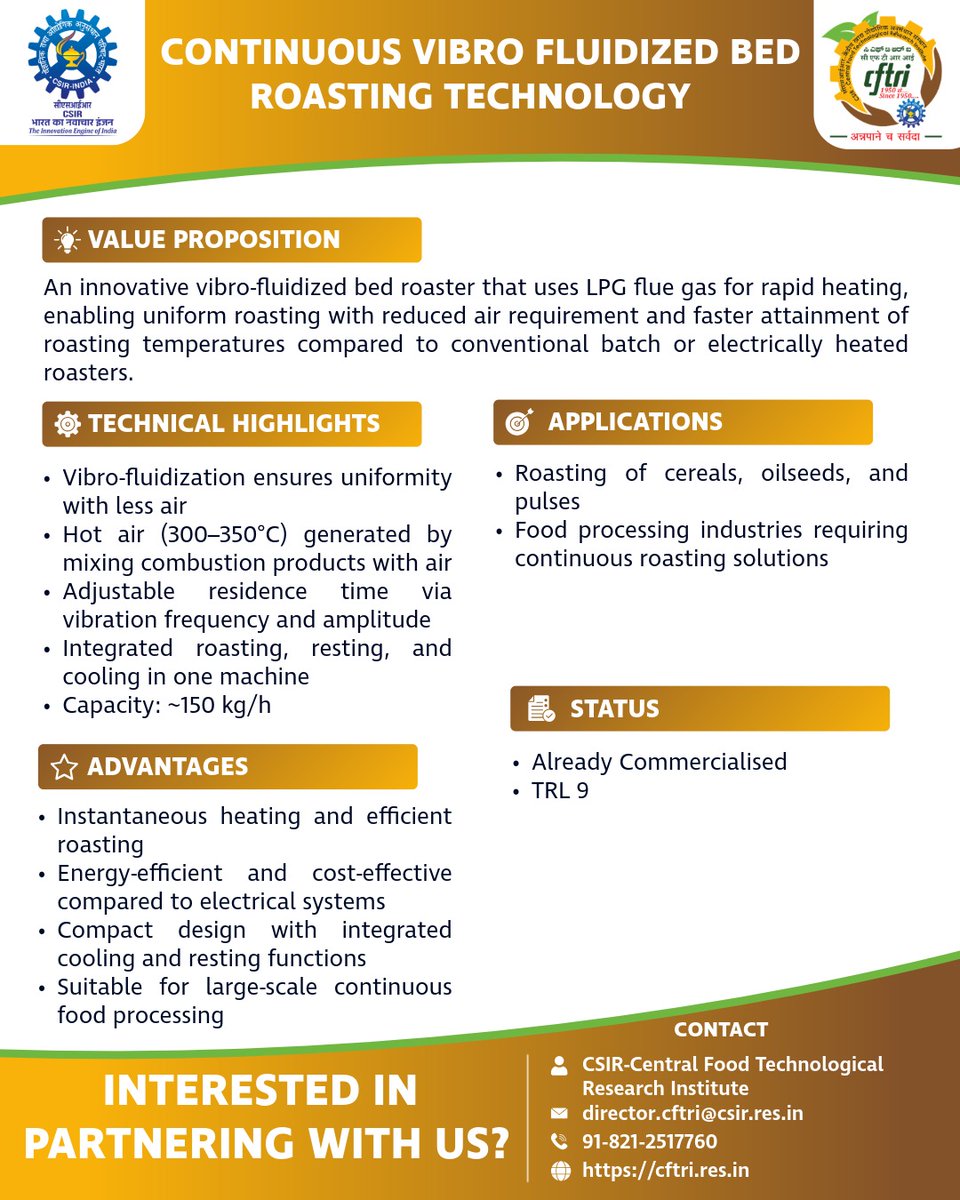
@CSIRCFTRI’s Continuous Vibro Fluidized Bed Roasting Technology enables rapid, uniform and energy-efficient roasting of cereals, oilseeds and pulses for large-scale food processing.
Uses vibro-fluidization and LPG flue gas heating for faster attainment of roasting temperatures with lower air requirement compared to conventional systems.
Integrated roasting, resting and cooling in a single compact system.
Already commercialised (TRL-9).
@DrJitendraSingh
#TechnologyByCSIR #FoodProcessing #AgriTech #SmartManufacturing #SustainableTechnology
1
4
431

May 19
Toy robots meets new physics 🤝
By equipping Hexbug robots with miniature magnets, researchers found that magnetic interactions create a fluidization effect, suppressing clustering and generating novel collective behaviors in active matter systems.
🔗 go.aps.org/3Pplppe
2
17
94
3,968


🤔How do embryos self-organize and build complex functional structures?
👨🔬The @CampasLab at Physics of Life studies how physics/mechanics sculpt tissues and organs during development—from tissue fluidization to mechanochemical feedbacks.
Learn more here👉youtu.be/iuG_fg0xEYU?si=atSl…
3
11
2,420

May 1
🚀 Tesla, 건식 배터리 병목 해결… “가루를 물처럼 흐르게 만들다”
1️⃣ 핵심 혁신: 분말을 액체처럼 만드는 기술
✅ 기존 문제: 건식 전극 파우더가 뭉치며 흐름이 막히는 ‘브리징 현상’ 발생
✅ 해결 방법: 가스 압력을 활용한 ‘유동화(fluidization)’ 기술 적용
✅ 결과: 고체 분말이 물처럼 부드럽게 흐르며 균일하게 공급
2️⃣ 기존 방식의 한계
✅ 스크류(오거) 방식은 막힘과 불균일 분배 문제 발생
✅ 순간적인 공급 중단만으로도 배터리 품질 저하
✅ 에너지 밀도 및 구조 안정성에 치명적 영향
3️⃣ Tesla의 해결 구조: 유동화 콘형 호퍼
✅ 다공성 구조 가스 주입으로 입자를 공기층에 띄움
✅ 입자 간 마찰 제거 → 완전한 연속 흐름 구현
✅ 캘린더 롤에 일정하게 공급되어 균일한 전극 형성
4️⃣ 초정밀 제어 시스템
✅ 수직/수평 액추에이터로 분말 낙하 위치 실시간 조정
✅ 롤 전체에 균일하게 분포되도록 좌우 이동
✅ mm 단위 정밀 제어로 생산 품질 극대화
5️⃣ 미세 조정 기술 (Depth 제어)
✅ 롤 사이 압착 지점에 분말이 들어가는 각도 정밀 조정
✅ 뭉침 방지 및 완벽한 압축 유도
✅ 전극 밀도와 품질을 극한 수준으로 향상
6️⃣ 양면 코팅 & 오버행 구현
✅ 양극/음극을 동시에 정밀하게 코팅
✅ 음극을 더 넓게 만드는 ‘오버행 구조’ 구현
✅ 배터리 안전성 (리튬 도금 및 쇼트 방지) 향상
7️⃣ 확장성: 대규모 생산 최적화
✅ 호퍼를 여러 개 배열하는 모듈형 구조
✅ 초대형 전극 시트 한 번에 생산 가능
✅ 균일한 두께 유지하며 생산성 극대화
8️⃣ 초고속 생산 능력
✅ 시간당 수천 kg (최대 5,000kg) 처리
✅ 롤 소비 속도와 완벽하게 동기화
✅ 공급 부족/넘침 없이 안정적 생산
9️⃣ 분말 제어 & 안전 설계
✅ 분배 장치로 여러 호퍼에 균등 공급
✅ 먼지 제거 시스템으로 공정 안정성 확보
✅ 센서 오작동 및 환경 오염 방지
🔟 다양한 소재 대응력
✅ 양극/음극 모두 적용 가능
✅ 특히 실리콘 혼합 음극(고성능 소재)도 안정 처리
✅ 점착성 높은 소재도 문제없이 생산
1️⃣1️⃣ 핵심 바인더 기술
✅ PTFE 기반 섬유화 바인더 사용
✅ 압력 시 미세 섬유망 형성 → 입자 결합
✅ 용매 없이도 강한 전극 구조 형성
1️⃣2️⃣ 스마트 자동화 시스템 🧠
✅ 센서로 분말 양·온도 실시간 모니터링
✅ AI처럼 자동으로 가스·위치·온도 조정
✅ 완전 자동 품질 유지 시스템 구축
1️⃣3️⃣ 효과: 비용 효율 혁신
✅ 건식 공정으로 대형 건조 설비 제거
✅ 공장 면적 약 50% 감소
✅ 에너지 소비 약 30% 절감
✅ 수십억 달러 CAPEX 절감 효과
1️⃣4️⃣ 미래 경쟁력 확보 🔋
✅ 4680 배터리 대량 생산 핵심 기술
✅ 더 저렴하고 고에너지 배터리 생산 가능
✅ 기존 완성차 업체 대비 수년 격차 유지
🔥 한줄 요약
👉 Tesla는 분말을 ‘물처럼 흐르게’ 만들어 배터리 생산의 가장 큰 병목을 해결했고, 이는 비용·속도·성능을 모두 바꾸는 게임체인저입니다

2
132


Mar 30
This is spectacular if you think about it.
In 1987, when Kenneth Shoulders published EV: A Tale of Discovery (self-published via Jupiter Technologies in Austin, Texas), the team—including Shoulders as Chief Inventor, theoretical input from Harold "Hal" Puthoff, and funding from George "Bill" Church Jr.—viewed the Electrum Validum (EV) phenomena (high-density electron charge clusters, later called Exotic Vacuum Objects or EVOs) as a gateway to transformative technologies. These were far beyond conventional electronics, tapping into a "higher order of energy and charge density" where basic physical constants might effectively be modified.
Core Experimental Foundation in the Book
The book synthesizes years of lab work (from ~1981 discovery to 1984–1987 Jupiter lab breakthroughs). It details repeatable generation of micron-scale EVs (~5–15 μm diameter, containing ~10^8 to 10^11 electrons at solid-like density) via high-voltage nanosecond pulses on cathodes, often with dielectric guides or liquid-metal surfaces. EVs propagate ballistically (sometimes at ~0.1c), form bead-chains or toroidal structures, and leave microscopic "witness marks" (craters, boreholes, melting, or transmutations) documented in 153 photos and drawings.
Key observed effects included:
Anomalous stability despite enormous Coulomb repulsion (overcome by an "unseen container").
Energy conversion via traveling-wave devices (EVs interacting with conductors to produce electrical or thermal output).
Localized material disruption: EVs fluidize lattices, propel material at high velocity with minimal bulk heating (requiring extreme thermal gradients if interpreted conventionally), and enable low-energy nuclear-like reactions or transmutations.
X-ray emission, intense localized light (picosecond synchrotron-like), and potential for micro-thrusters.
Shoulders explicitly framed EVs as self-organized entities whose binding and effects likely stemmed from zero-point fluctuations (ZPF) or vacuum radiation pressure (Casimir-like forces), referencing Puthoff's contemporaneous theoretical work on ZPF-determined states (e.g., the hydrogen ground state). The book concludes that EVs act as "spherical monopole oscillators" generating vector/scalar potential waves (longitudinal waves in the vacuum) largely free of contaminating E or B fields.
What They Believed Was Possible in 1987
The preface and conclusion express high optimism. Shoulders describes the discovery as opening "one of the greatest industries yet known," with EVs as a "proverbial 800-pound gorilla" that would do what it wanted—implying disruptive, hard-to-contain potential once understood.
Specific envisioned applications (drawn from the book's emphasis on energetics, manipulation, and vacuum interaction):
Energy extraction and conversion: Tapping a new energy regime between chemical and nuclear binding energies. EVs could yield net thermal or electrical output from vacuum fluctuations, potentially leading to over-unity or "clean" energy devices. The ultimate source was seen as the quantum vacuum continuum, not just input electricity.
Advanced electronics and microdevices: Building on Shoulders' vacuum microelectronics background, EVs for ultra-dense charge handling, flat-panel displays, high-speed switches, cameras, oscilloscopes, and picopulse generators. Patents filed around this era (issued 1989–1993) cover these.
Material processing and nuclear effects: Low-energy atomic/molecular phase changes, lattice fluidization, high-velocity material propulsion, and nuclear cluster reactions (including transmutations or radioactivity neutralization). EVs could act as collective accelerators, injecting nuclides and enabling reactions without high temperatures.
Propulsion and thrust: Even more fundamental than energy production. EVs propel nucleons for heat or entire clusters for electrical output and "large thrusting forces for lifting objects." Micro-thrusters (e.g., using tiny material slugs ejected spark-like) were discussed, with potential for reactionless or propellantless systems via vacuum polarization. This hinted at inertial or quantum-pressure drives.
Broader vacuum engineering: Overcoming charge repulsion without external fields, ions, or relativity suggested manipulable vacuum states. This could modify effective physical laws locally, enabling new freedoms in charge compression and energy/matter interactions.
Puthoff's involvement reinforced the vacuum angle—EVs as probes of polarizable vacuum or ZPF engineering. The team saw this as moving beyond abstract theory (Casimir forces, ZPE concepts) to concrete lab gadgets that demonstrated excess effects, anomalous momentum, and vacuum coupling.
They were pragmatic but visionary: The work stayed partly proprietary (trade secrets until patents), and Shoulders noted skepticism ("Nobody believed anything I ever said. They only believed the gadgets"). Yet the book positions EVs as the start of a major new field, not just curiosities. No macroscopic "craft" is described—only microscopic phenomena and small devices—but the propulsion and energy sections provide clear experimental foundations for later scaling ideas (e.g., Shoulders' 2000s monographs on large-scale propulsion or EVO-enshrouded vehicles).
Context and Limitations in Their Thinking
In 1987 (post-1984 Jupiter lab success with traveling-wave tubes, pre- or concurrent with early patents), the focus was commercial R&D under private funding. Expectations included practical spin-offs (electronics, energy) alongside exotic ones. Jupiter aimed at marketable products, though the company later struggled financially (~1990–91 closure).
They acknowledged mysteries: The exact stabilization mechanism was unknown, but ZPF radiation pressure offered a promising model. Effects were "exploratory," with more "good stuff" to come. No claims of working UAP-style craft existed then—that emerged in Shoulders' later private notes (~2008 "UFOs and EVOs").
In summary, in 1987 they believed EVs represented a breakthrough into vacuum-coupled "engines" enabling:
Compact, high-density charge manipulation.
Excess energy from the vacuum.
Anomalous material/nuclear effects.
Novel propulsion without conventional propellants.
This was framed as the dawn of a new industrial era, grounded in tabletop experiments but with revolutionary implications for energy, matter, and motion. The book served as both documentation and a call to explore these "higher-order" phenomena, synthesizing the 1984 functional devices while seeding ideas for vacuum engineering that Shoulders and collaborators pursued for decades. Modern replications and LENR/plasmoid discussions still reference it as foundational, though mainstream acceptance remains limited due to the anomalous nature of the claims.
1
12
293

check this cool tissue fluidization story from the @hirashima0203 lab!

We’re excited to share our new bioRxiv preprint:
“Transient contractility attenuation reprograms epithelial cells into a protrusion-driven state that drives tissue fluidization”
biorxiv.org/content/10.64898…
This work asks a simple but deep question: How do tissues actively fluidize?
3
147

Together, these findings point to a mechano-chemical mechanism that actively drives tissue fluidization.
Our preprint is now available on bioRxiv. We would greatly appreciate your thoughts and feedback! 🙏
5
193
We’re excited to share our new bioRxiv preprint:
“Transient contractility attenuation reprograms epithelial cells into a protrusion-driven state that drives tissue fluidization”
biorxiv.org/content/10.64898…
This work asks a simple but deep question: How do tissues actively fluidize?
4
28
136
7,718

Transient contractility attenuation reprograms epithelial cells into a protrusion-driven state that drives tissue fluidization biorxiv.org/content/10.64898… #biorxiv_synbio
2
4
576

 Yogesh Kumar


🟥 ⛏️ Most people assume mountains form slowly by uplift or erosion, but Heart Mountain is the world's largest subaerial landslide, a colossal block that raced across the landscape like a hovercraft!
🎞 @RogerSnyderPhoto
🔁 ❤️ - Greatly Appreciated
Heart Mountain is a massive allochthonous block of Paleozoic carbonate rocks (primarily Bighorn Dolomite and Madison Limestone) overlying much younger Eocene sediments via the Heart Mountain detachment fault.
It detached and slid ~50 km on a low-angle (~2°) surface, breaking into dozens of scattered klippen over ~3,400 km².
The extreme runout resulted from shear heating, thermal pressurization, and carbonate decomposition generating pressurized CO₂ gas at the basal shear zone, reducing friction dramatically.
Experts identify it by the inverted stratigraphy (older rocks atop younger), the nearly flat detachment plane, and pseudotachylyte-like features or brecciation along the fault.
The event occurred ~49–50 million years ago during the Eocene, in the Absaroka volcanic province near the Yellowstone hotspot's early influence.
It's located at Heart Mountain near Cody, Park County, northwestern Wyoming, with parts extending into adjacent Montana.
This reveals how volcanic/tectonic activity can trigger catastrophic long-runout landslides without steep slopes, via fluidization mechanisms like gas cushioning, reshaping our models of mega-landslide emplacement, hazard assessment in volcanic terrains, and the physics of low-friction sliding on Earth.
#hashtag
#HeartMountain
@myroncook (excellent educational source)


1
7
87