High Voltage Image Making
1. HVIM 007 - FujiFilm FP-100C 15K VAC
2. HVIM 015 - FujiFilm FP-100C 15K VAC
3. HVIM 014 - FujiFilm FP-100C 15K VAC
phillipstearns.com
#imageobject #photography #prints #experimentalphotography #colorfilm #phillipstearns



42

Jun 17
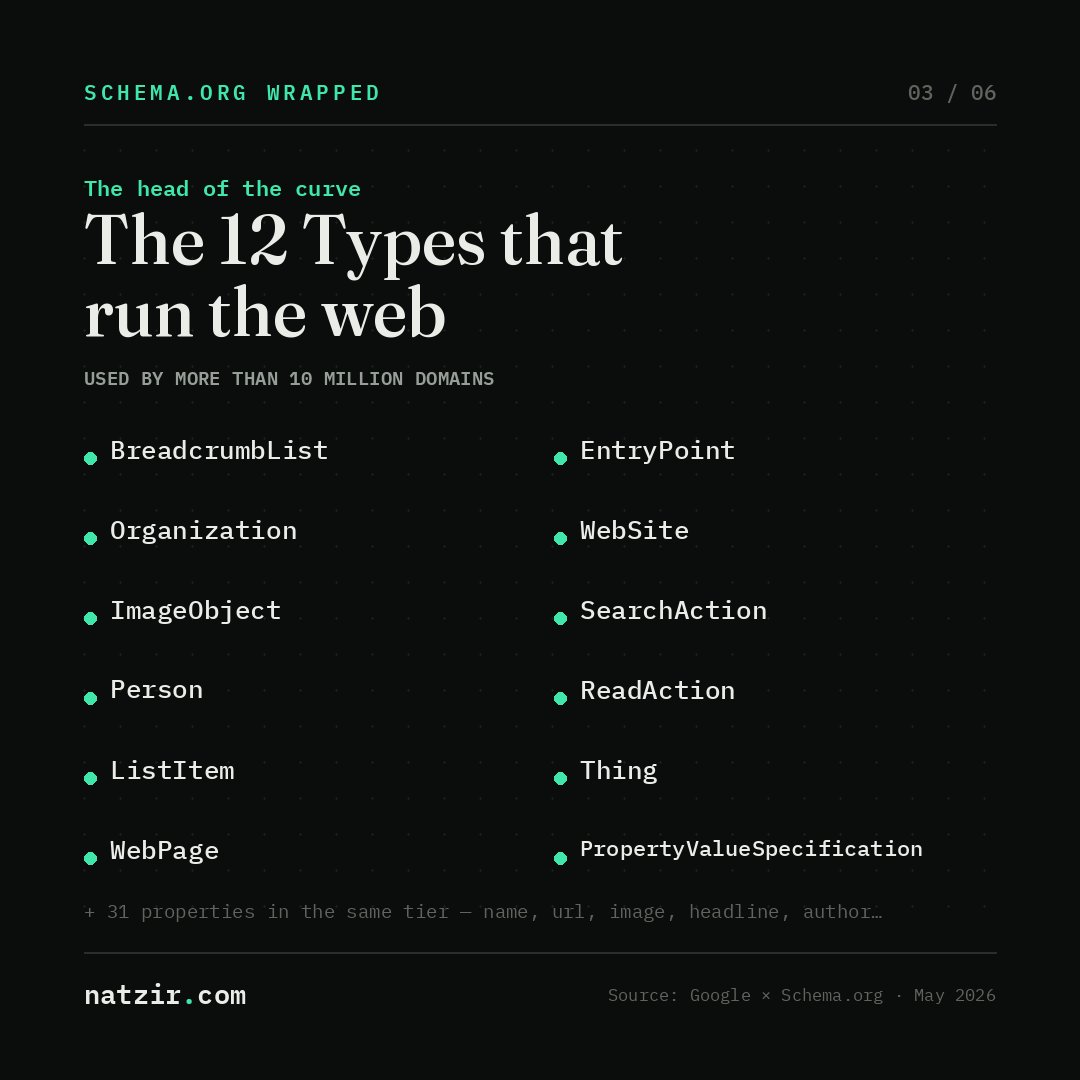
ImageObject schema with caption contentLocation.
LLMs use captions to disambiguate products. Especially for visual search and voice.
Yes, really. Caption your images in schema, not just alt text.
1
3

Jun 16
Don’t forget the json snippet, crawlers are getting uppity these days
<script type="application/ld json">
{
"@context": "schema.org",
"@graph": [
{
"@type": "WebSite",
"@id": "teddy.com/#website",
"url": "teddy.com/",
"name": "Teddy",
"description": "Teddy.com is the place where you can find lovely kid books for your child, where the moral of the story is always in the arms of the people we love",
"publisher": {
"@id": "teddy.com/#organization"
}
},
{
"@type": "OnlineStore",
"@id": "teddy.com/#organization",
"name": "Teddy Holdings LLC",
"url": "teddy.com/",
"logo": {
"@type": "ImageObject",
"url": "teddy.com/cdn/shop/files/ted…"
},
"founder": {
"@type": "Person",
"name": "Ryan Cohen"
}
}
]
}
</script>
1
66


May 27
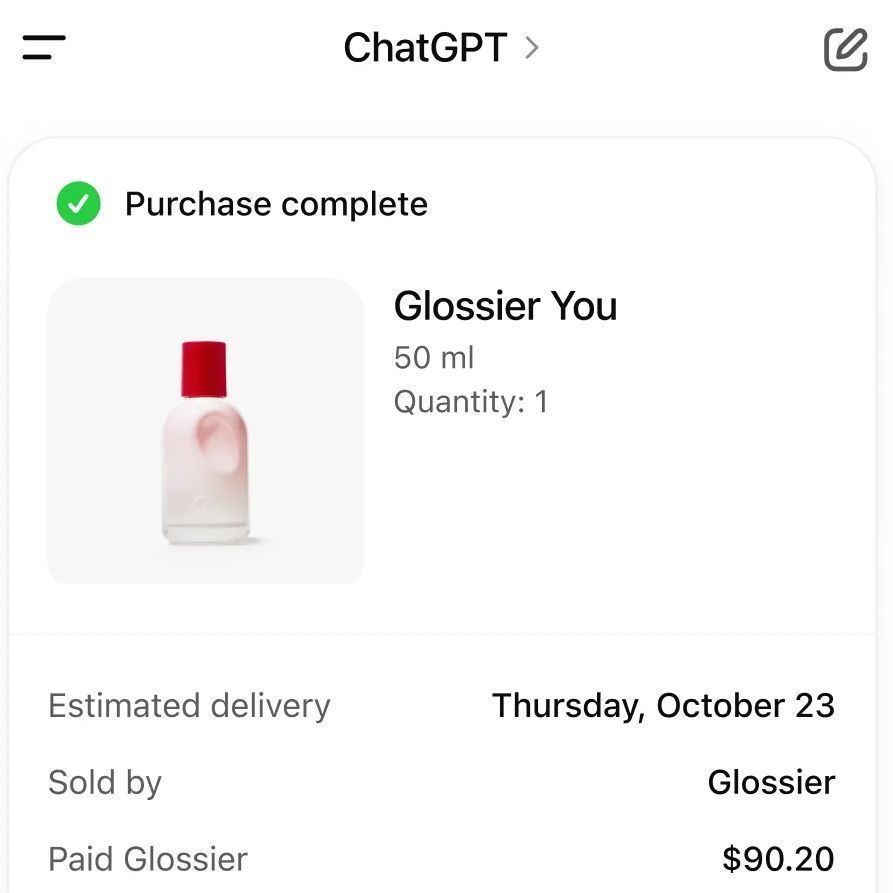
Microsoft dropped an official “Here Is How To Get Traffic From ChatGPT” guide.
It got surprisingly little attention.
Let’s go over it together.
Not long ago Microsoft released "A guide to AEO and GEO - Practical data strategies to empower retailers for AI search, AI assistants and AI browsers.”
Everything here is drawn directly from the document and its diagrams, with some of my personal takes layered on top for clarity and execution value.
I’ll also reference the pages in the PDF in case you want to go read it yourself.
That said, if you don't care and just want someone to get the ChatGPT traffic for you, let SEO Stuff do the heavy lifting:
seo-stuff.com
And if you want to know where your site stands right now across Google and AI search, check here (it's free):
seo-stuff.com/free-audit
Microsoft’s central message in the doc is that retail competition is shifting from “being found” to “being chosen.”
They argue that traditional SEO was optimized for:
Ranking
Clicks
Page visits
Whereas AI-driven shopping replaces that with:
Answers
Recommendations
Agent-led decisions
They’re arguing that visibility is now earned by how clearly AI systems understand your products, trust your brand and can act on your data.
This is where “AEO” and “GEO” come in.
(I hate both of these acronyms and prefer to just call it all AI search optimization, but this is their doc so I’ll go with their language.)
This is also why we’ve seen brands struggle even with strong traditional SEO, but immediately improve AI visibility once they pair technical SEO with structured, intent-driven content and authoritative signals like those included in SEO Stuff’s done-for-you package.
seo-stuff.com/gold-plan-pack…
Microsoft also broke down the difference, to them, between AEO and GEO.
Microsoft makes it a very clean distinction:
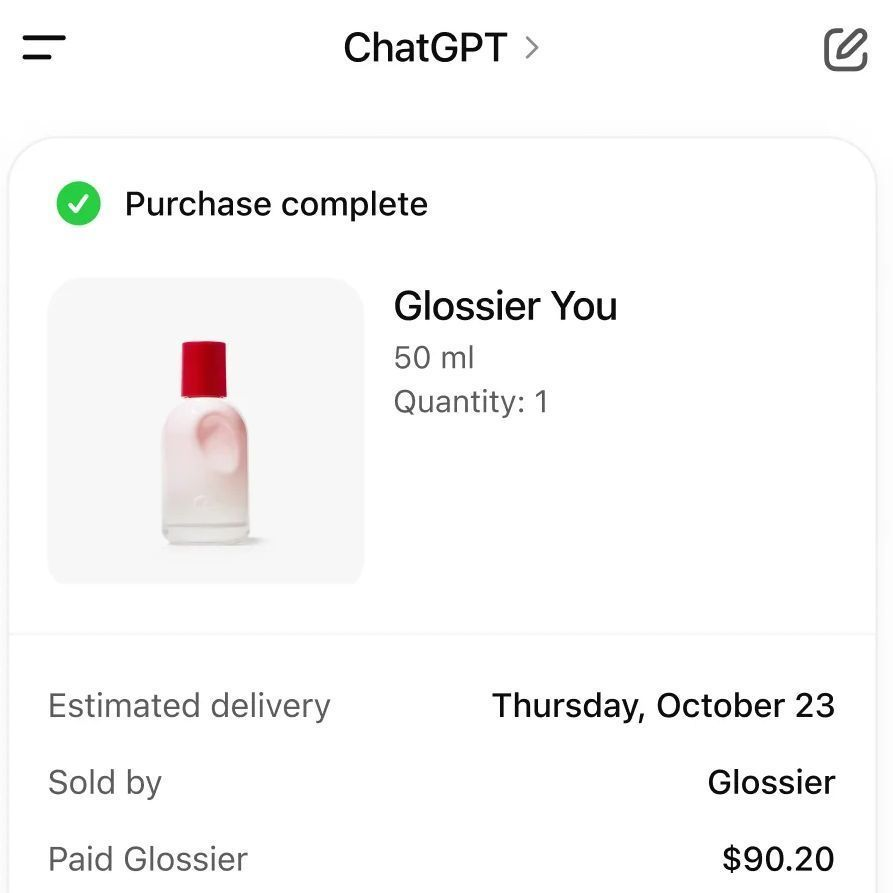
Answer / Agentic Engine Optimization (AEO) in their estimation optimizes content and data so AI assistants and agents (Copilot, ChatGPT, Gemini) can:
Find it
Understand it
Summarize it
Recommend it
Act on it
This is about clarity and machine-readability.
Generative Engine Optimization (GEO) optimizes content so generative AI search systems trust it as:
Authoritative
Credible
Citable
This is about credibility, reputation, and justification.
Microsoft is explicit that SEO still matters, but it is now the foundation and not the endpoint.
In practice, this is why execution now requires both properly structured pages and volume at scale, something SEO Stuff intentionally designed the Premium Content Bundle to solve.
seo-stuff.com/premium-conten…
Microsoft then delved into the AI shopping ecosystem and how discovery actually works now.
One of the most interesting sections is Microsoft’s breakdown of AI browsers, assistants, and agents (pages 5–7).
These are not separate systems and they overlap constantly.
AI BROWSERS
Edge, Chrome, or similar with embedded AI
They can “see” the live page you are on and interpret it in real time.
AI ASSISTANTS
Copilot, ChatGPT, Gemini
They answer questions, summarize options, and recommend products.
AI AGENTS
They:
Navigate websites
Add items to carts
Apply promo codes
Calculate shipping
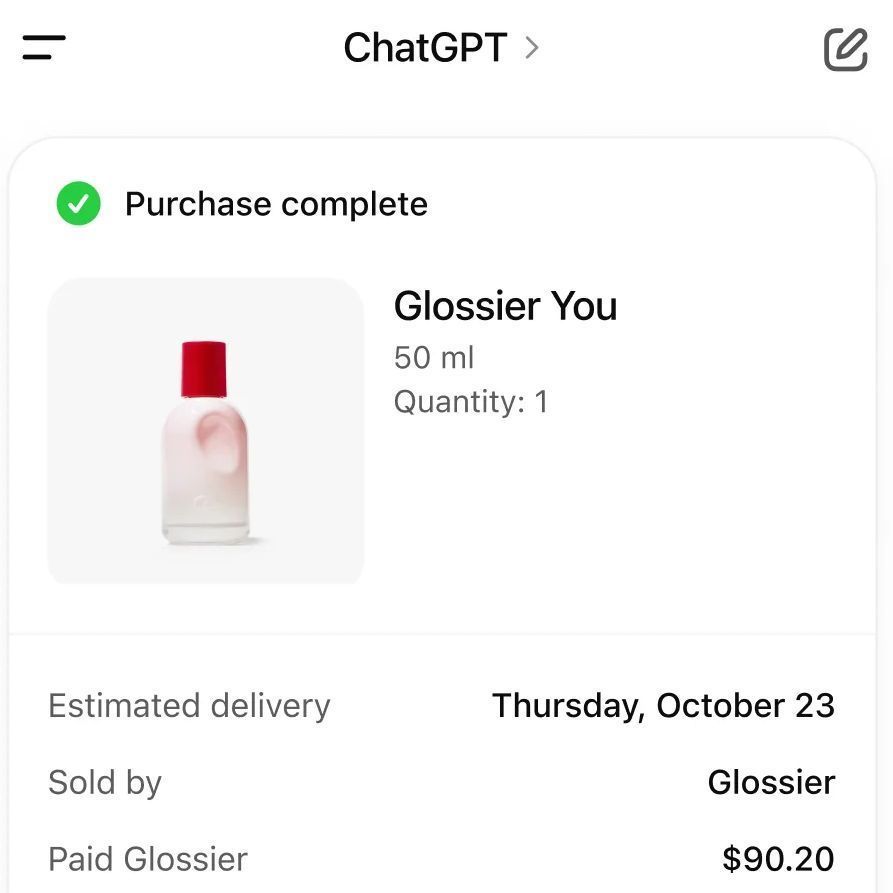
Complete purchases
The key insight:
The question is not “which AI surface am I optimizing for?”
The question is what data can AI access, trust, and use?
This is exactly where most sites break.
The data exists, but it isn’t structured, consistent, or surfaced in a way AI can reliably act on.
Microsoft then went into how AI actually decides what to recommend.
Microsoft outlines a multi-stage reasoning process used by Copilot and Bing AI (pages 7–8).
AI does not rely on one data source, but rather fuses:
CRAWLED WEB DATA
Brand reputation
Category authority
Expert mentions
Historical understanding
PRODUCT FEEDS AND APIS
Price
Availability
Variants
Inventory
Key specs
This is where competitive advantage often comes from, and where most brands are under-optimized.
LIVE WEBSITE DATA
Real-time pricing
Promotions
Reviews
Media
Checkout functionality
If your live site fails, the agent fails, even if feeds were perfect.
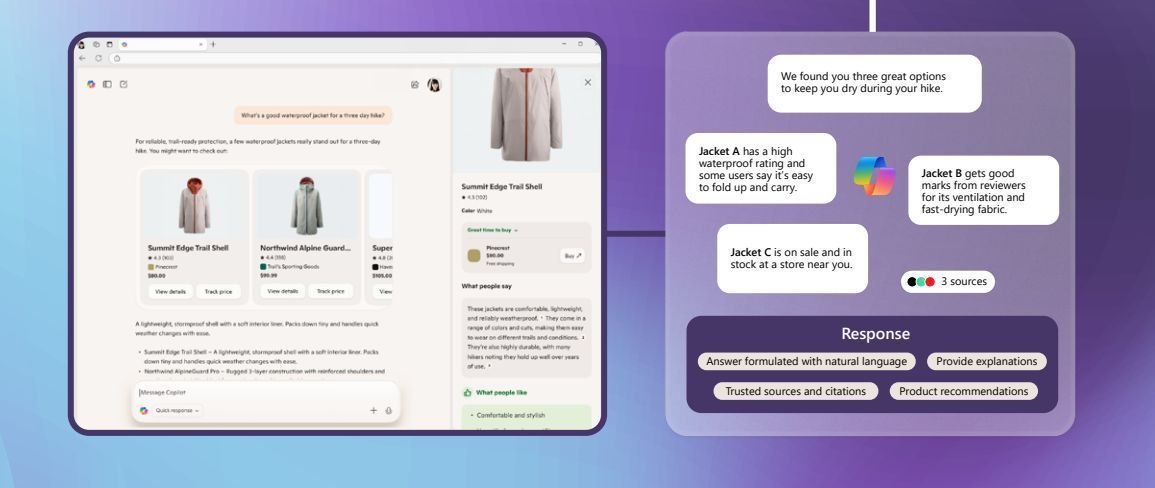
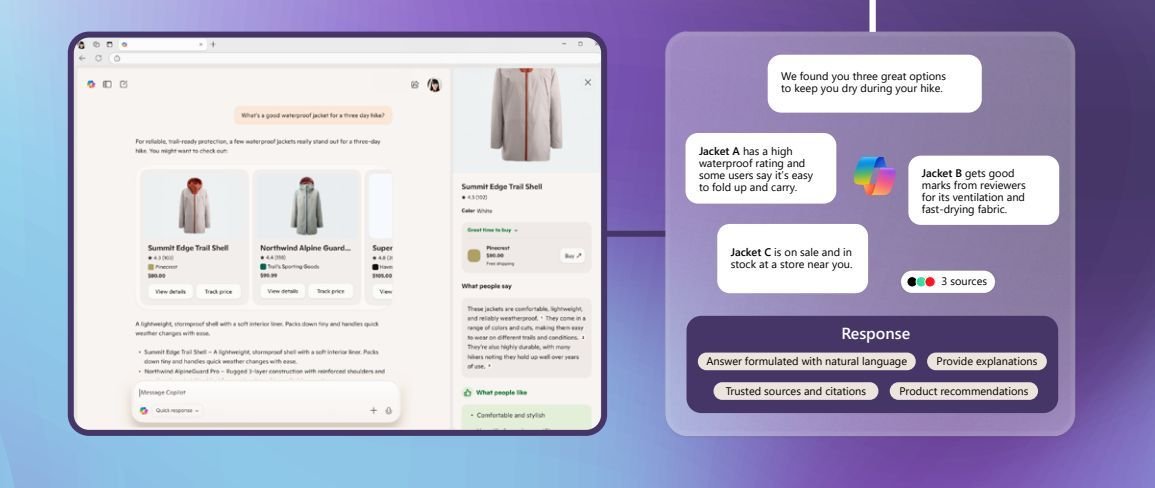
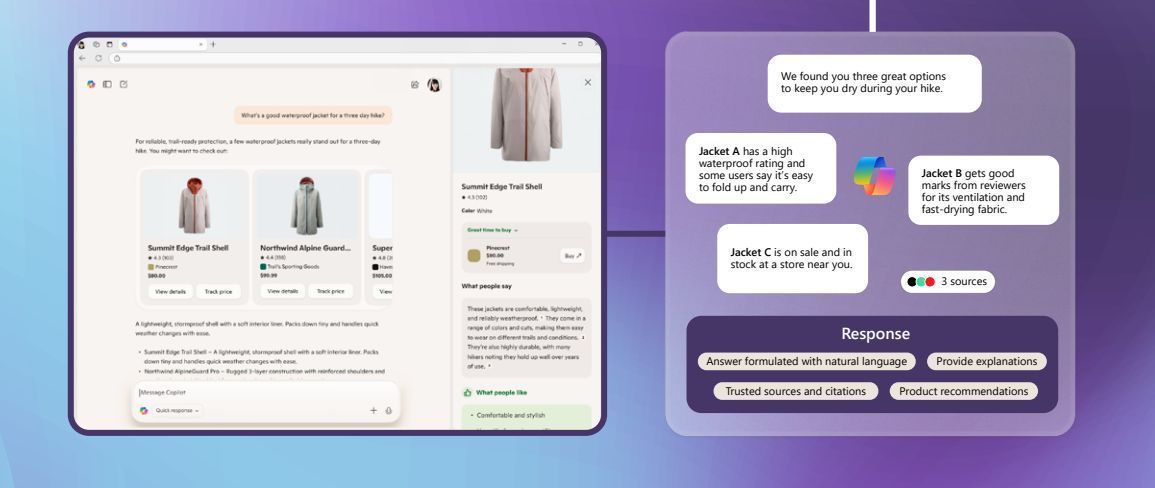
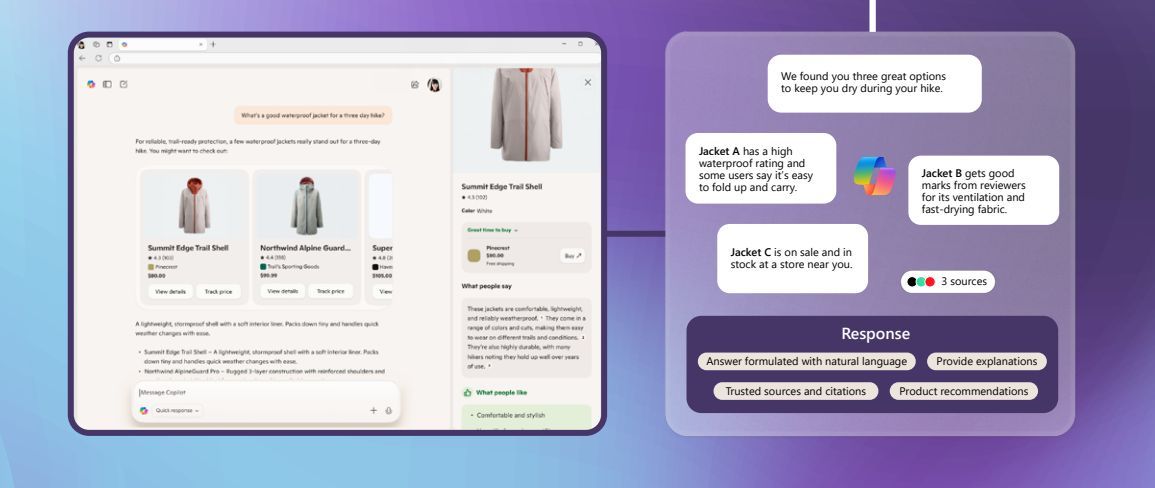
An example Microsoft gives is “rain jacket under $200.”
AI reasoning includes:
“Patagonia and North Face make quality jackets” (general knowledge)
“Hiking jackets need to be lightweight and waterproof” (category understanding)
“Brand X is known for hiking equipment” (brand positioning)
“Your model is $179 and in stock” (feeds)
“Competitor is $199 and backordered” (feeds)
Your product makes the top recommendations because feeds, availability, price, and context align.
This is why content that simply “ranks” but doesn’t explain, compare, or justify rarely shows up in AI answers without additional supporting assets.
Microsoft then really breaks down the journey from SEO to AEO to GEO.
They summarize the transition pretty clearly (page 6):
SEO = matching keywords
“Waterproof rain jacket”
AEO = descriptive clarity
“Lightweight, packable waterproof rain jacket with ventilation and reflective piping”
GEO = justification and trust
“Best-rated by Outdoor Magazine, 4.8 stars, 180-day returns, 3-year warranty”
So basically, AEO drives understanding and GEO drives confidence, and you need both to be recommended.
This is why brands pairing long-form, intent-driven content with authoritative backlinks and mentions often outperform those relying on SEO alone.
Then Microsoft talks about three data layers you must control.
They stress that retailers must show up in three distinct data planes (page 10):
CRAWLED DATA
What AI learned during training
What it finds via real-time web search
This shapes baseline brand perception.
SEO still matters here.
PRODUCT FEEDS AND APIS
Structured data you actively provide
This is where precision and control live.
Feeds drive:
Comparisons
Rankings
Recommendations
This is where many retailers under-invest.
LIVE WEBSITE DATA
What AI agents see when they actually visit
Includes:
Reviews
Media
Dynamic pricing
Checkout capability
If agents cannot transact, influence stops at recommendation.
Here are the three action pillars Microsoft prescribes.
This is the most legit part of the document (pages 11–14).
Pillar 1: Technical foundations and structured data
AI requires structure and consistency, not creativity.
Microsoft explicitly calls for:
MACHINE-READABLE CATALOGS
DYNAMIC FIELDS:
Price
Availability
Size
Color
SKU
GTIN
dateModified
ITEMLIST MARKUP FOR CATEGORIES
LOCALIZED PRICING AND LANGUAGE VIA:
inLanguage
priceCurrency
REQUIRED SCHEMA TYPES:
Product
Offer
AggregateRating
Review
Brand
ItemList
FAQ
They also highlight this:
“Never serve different HTML to bots than to users.”
Pillar 2: Intent-driven content enrichment
AI interprets intent over keywords.
MICROSOFT RECOMMENDS:
Front-loading descriptions with:
Who it is for
What problem it solves
Why it is better
Use-case framing:
“Best for day hikes above 40 degrees”
Headings that mirror real questions
Modular, citable content blocks
THEY EXPLICITLY ENCOURAGE:
Q&A sections
Comparison content
Feature lists
“Goes well with” product relationships
Video transcripts
Detailed image alt text with ImageObject schema
This is content designed for extraction as opposed to reading.
This is also why scale matters.
One or two pages won’t move the needle.
Systems that produce dozens of structured, intent-mapped articles tend to win, which is exactly what the Premium Content Bundle is built around.
seo-stuff.com/premium-conten…
Pillar 3: Trust and credibility signals (GEO)
AI systems prioritize verifiable truth.
Microsoft highlights:
VERIFIED SOCIAL PROOF
Verified reviews
Review volume
Sentiment extraction (“highly rated for comfort and fit”)
Review and AggregateRating schema
AUTHORITATIVE BRAND IDENTITY
Expert reviews
Press mentions
Certifications
Sustainability badges
Official brand links
CONTENT INTEGRITY
Avoid exaggerated claims
Maintain consistent brand voice
Provide structured FAQs and help content
This also stood out:
“AI penalizes low-trust language.”
Interesting, but obviously open to interpretation.
Microsoft then closed with a fairly straightforward message.
Retailers already have most of the signals AI uses to rank and recommend.
The winners in AI commerce will be the brands that:
Treat data as a product
Treat feeds as strategic assets
Treat content as machine-readable infrastructure
Treat trust as a measurable ranking factor
This is what Microsoft calls “AI ranking readiness.”
If I had to reduce this entire PDF to one core idea:
AI needs to understand your products in order to justify recommending them. It needs to literally be able to act on your data in real time if you want to be a legit presence in AI-driven commerce.
Luckily, SEO Stuff (seo-stuff.com) solves for all of this.
And if you want to know where your site stands right now across Google and AI search, check here (it's free):
seo-stuff.com/free-audit
May 27

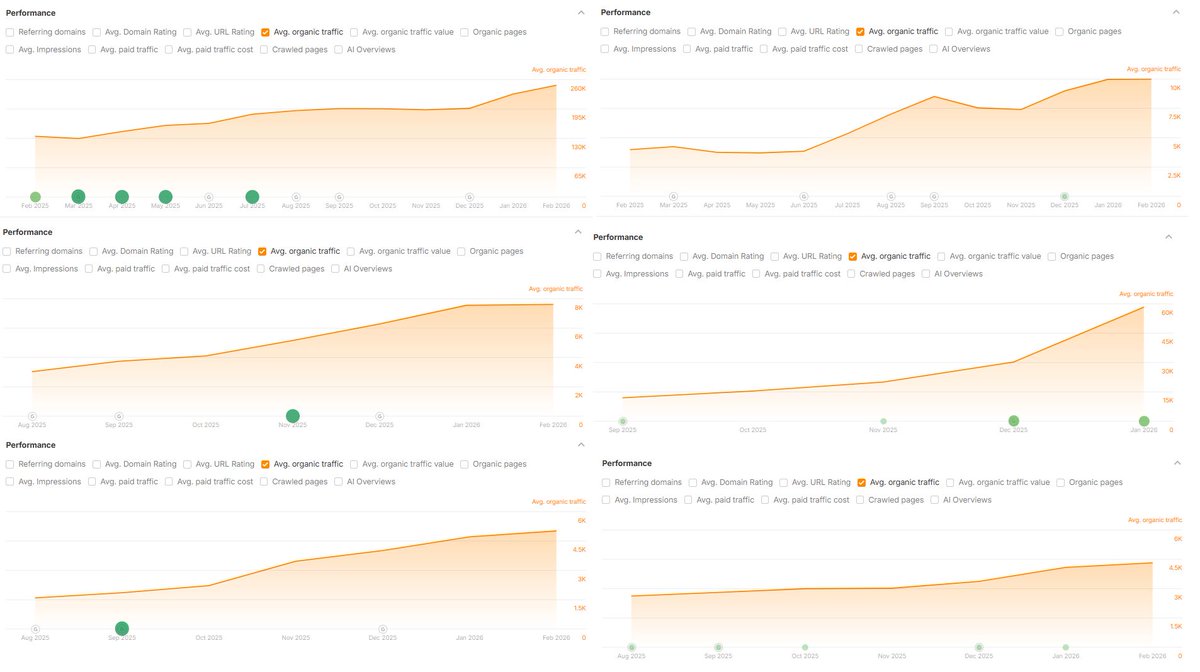
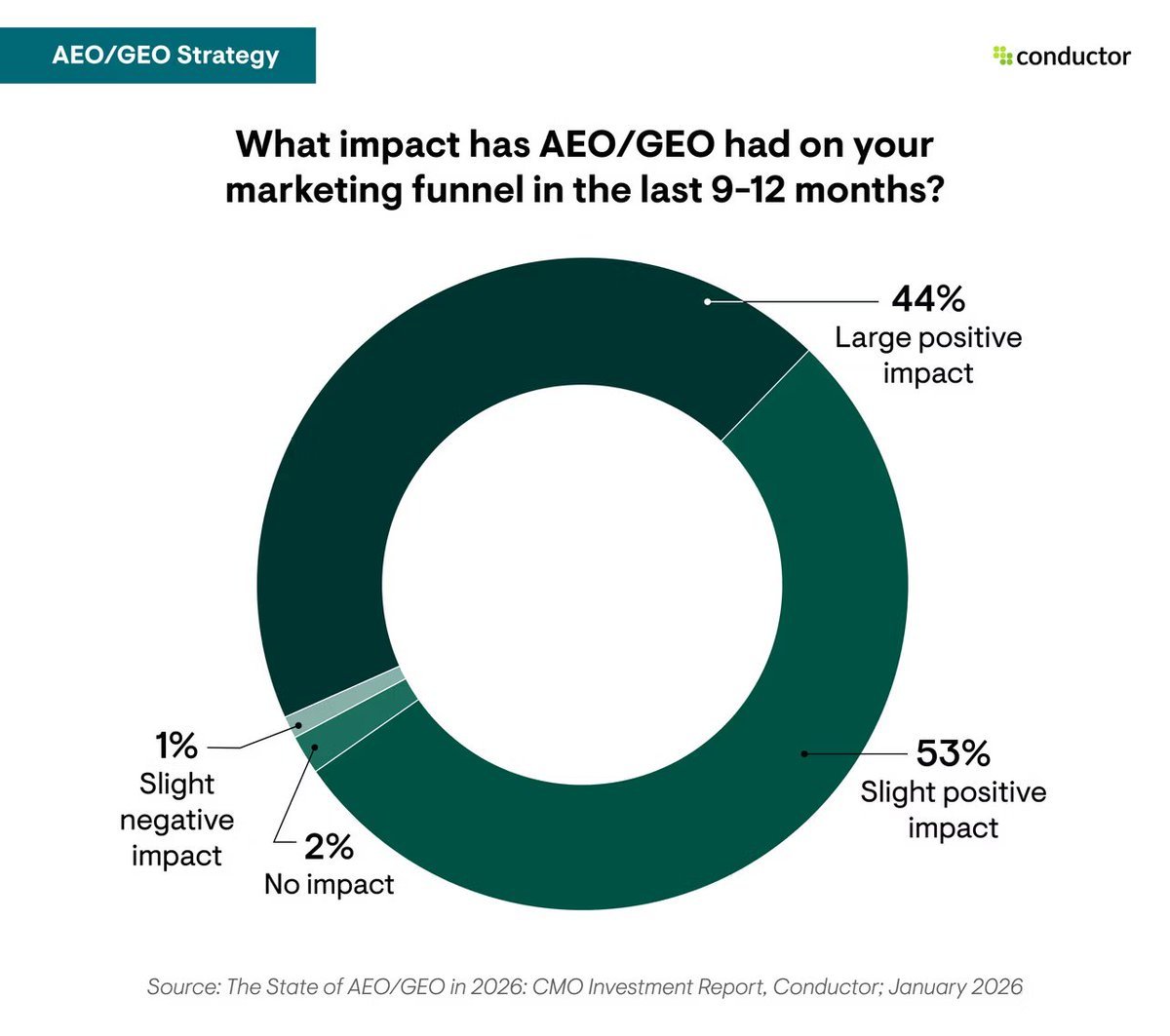
97% of enterprise leaders say AI search optimization produced positive results.
94% are increasing their budgets going forward.
You'll invest in AI search optimization at some point.
It will either be now when it's reasonably less competitive, or later when literally everyone is doing it.
If you want to see where your brand stands as far as ChatGPT, Google AI, Claude, Perplexity and Grok, start here (it's free):
seo-stuff.com/free-audit
According to Conductor's 2026 State of AEO/GEO report, which surveyed over 250 enterprise CMOs and digital decision-makers, AI search optimization is now the number one strategic marketing priority for 2026.
56% of companies made significant investments in AI search visibility in 2025, and 38% invested at mid-range levels.
The organizations with the most mature AI search programs are 2x more likely than mid-maturity companies and 3x more likely than low-maturity companies to significantly increase their budgets.
The early movers are doubling down, the late movers are falling further behind, and the gap between the two is widening every quarter.
And that is what SEO Stuff (seo-stuff.com) helps businesses close.
Here is what makes the Conductor data interesting: 97% positive impact is as close to unanimous as enterprise surveys get.
This is a study about what happens next, and the brands that invested early and saw results are now scaling aggressively.
Meanwhile the brands that waited are starting from zero against competitors with a year or more of head start.
According to the same report, enterprises are already allocating an average of 12% of their digital marketing budgets to AI search optimization.
That is a meaningful budget line.
And the companies spending the most are the ones reporting the strongest results, which is why they are the ones most likely to increase budgets again in 2026.
Again, if you want to see where your brand stands on AI search visibility and where the gaps are compared to competitors who are already investing, start here (it's free):
seo-stuff.com/free-audit
Here is what separates the brands seeing 97% positive results from the brands that have not started.
The brands getting results invested in two things.
The first is content depth. AI platforms break buyer queries into sub-questions and pull sources for each one. The brands covering every question in their category are the ones showing up across those sub-queries.
The volume matters because every sub-question your content answers is another chance to get cited.
The second is authority. Content depth gets you into the AI's retrieval pool, and authority is what gets you cited.
This is the system SEO Stuff (seo-stuff.com) was built around.
For example, the done-for-you package:
seo-stuff.com/gold-plan-pack…
Expert-attributed content backed by DR50 backlinks: the combination that 97% of enterprise leaders say is delivering positive results and 94% are scaling their budgets around in 2026
Or the "just content" package:
seo-stuff.com/premium-conten…
60 pages of expert-attributed content covering every question buyers ask in your category, solving the number one challenge enterprise leaders cited: scaling AI-optimized content
Or the "just authority" package:
seo-stuff.com/premium-backli…
Editorial authority from trusted publishers that makes your content citable across AI platforms, closing the maturity gap between brands that have invested and brands that have not
97% of enterprise leaders saw positive results from AI search optimization.
94% are increasing their budgets.
The brands that invested early are scaling. The brands that waited are behind. The gap is getting wider, not smaller.
If you want to see where your brand stands as far as ChatGPT, Google AI, Claude, Perplexity and Grok, start here (it's free):
seo-stuff.com/free-audit
9
34
93
50,474

May 6
Exhibit 4 – The January 7, 2021 article published on http://Candys Dirt .com which is sponsored by Ebby Halliday--contains an extraordinarily high density of references to Plaintiff’s name and brand. Analysis of the captured page reveals the following: Plaintiff’s name (“Jenna Ryan”) appears 33 times in visible text. Hyphenated/code variants (“jenna-ryan” / “Jenna-Ryan”) appear 60–61 times. Combined total: 93–94 instances of Plaintiff’s name embedded across the page. Plaintiff’s name is not limited to ordinary article text. It is embedded in: This level of optimization demonstrates that the article was deliberately structured to rank for searches involving Plaintiff’s name and real estate identity. The page remains actively indexed, monetized with current 2026 advertising, and is not treated as archival content. This exhibit shows the article functions as an ongoing, search-optimized commercial asset rather than a static historical publication. Manual count from the April 27, 2026 HEAD section (metadata/SEO layer) Line 11 — <title> tag: "Frisco Broker Jenna Ryan Posts Photos..." Line 12 — meta description: "Frisco Broker Jenna Ryan documented..." Line 13 — canonical URL: contains jenna-ryan Line 16 — og:title: "Frisco Broker Jenna Ryan Posts Photos..." Line 17 — og:description: "Frisco Broker Jenna Ryan documented..." Line 18 — og:url: contains jenna-ryan Line 23 — og:image: Jenna-Ryan-Social-Media.jpg Line 35 (Schema.org JSON-LD) —
@id
URL contains jenna-ryan Line 35 — headline: "Frisco Broker Jenna Ryan Posts Photos..." Line 35 — mainEntityOfPage URL contains jenna-ryan Line 35 — thumbnailUrl: Jenna-Ryan-Social-Media.jpg Line 35 — keywords array: contains "Jenna Ryan" Line 35 — keywords array: contains "Jennifer Ryan" ← also you Line 35 — WebPage
@id
contains jenna-ryan Line 35 — WebPage url contains jenna-ryan Line 35 — primaryImageOfPage
@id
contains jenna-ryan Line 35 — second image
@id
contains jenna-ryan Line 35 — thumbnailUrl (2nd): Jenna-Ryan-Social-Media.jpg Line 35 — image url: Jenna-Ryan-Social-Media.jpg Line 35 — image contentUrl: Jenna-Ryan-Social-Media.jpg Line 35 — ImageObject
@id
contains jenna-ryan Line 35 — ImageObject url: Jenna-Ryan-Social-Media.jpg Line 35 — ImageObject contentUrl: Jenna-Ryan-Social-Media.jpg Line 35 — BreadcrumbList
@id
contains jenna-ryan Line 35 — Breadcrumb name: "Frisco Broker Jenna Ryan Posts Photos..." Line 35 — description: "Frisco Broker Jenna Ryan documented..." Line 35 — ReadAction target URL contains jenna-ryan RSS / oEmbed RSS comments feed title: "...Frisco Broker Jenna Ryan Posts Photos..." oEmbed JSON URL contains jenna-ryan oEmbed XML URL contains jenna-ryan Social share buttons (header) Facebook share URL contains jenna-ryan Twitter share URL contains jenna-ryan Email share encoded URL contains jenna-ryan (encoded form) H1 body article content H1 heading: "Frisco Broker Jenna Ryan Posts Photos While Crashing Capitol Hill..." Comments link URL contains jenna-ryan Featured image data-permalink contains jenna-ryan Featured image data-orig-file: Jenna-Ryan-Social-Media.jpg Featured image data-image-title: "Jenna-Ryan-Social-Media" Featured image data-large-file: Jenna-Ryan-Social-Media-1024x536.jpg Featured image src: Jenna-Ryan-Social-Media-1024x536.jpg Featured image alt text: "Jenna Ryan March For Trump Jan. 6" Featured image srcset: 5 versions of Jenna-Ryan-Social-Media-*.jpg "Jenna Ryan was arrested" (paragraph link, body) URL in that link contains jenna-ryan (federal-arrest article) Body: "...among the crowd of people breaking into Capitol Hill was Jenna Ryan..." Body: "According to Jenna Ryan, she was headed home..." Second image data-permalink contains jenna-ryan Second image data-orig-file: Jenna-Ryan-Facebook-Post-3.jpg Second image data-image-title: "Jenna-Ryan-Facebook-Post-3" Second image data-large-file: Jenna-Ryan-Facebook-Post-3.jpg Second image src: Jenna-Ryan-Facebook-Post-3.jpg Second image alt: "Jenna Ryan March For Trump Jan. 6" Second image srcset: 3 versions of Jenna-Ryan-Facebook-Post-3*.jpg Second image figcaption: "Jenna Ryan posted on social media..." Body: "Ryan added that the man she attended..." Body: "Ryan proudly posted on Facebook..." Body: "According to Ryan, the elections were rigged..." Body: "Ryan says does not see anything wrong..." Body: "Ryan says her actions are not as serious..." Body: "Ryan said she feels it wasn't even trespassing..." Body: "Ryan claimed that none of that was done..." Body: "Ryan blamed Antifa..." Body: "Ryan says she's not worried..." Body: "Ryan has taught social media classes..." Body: "Ryan and other North Texans" (re Oppler statement) Third image data-permalink contains jenna-ryan Third image data-orig-file: Jenna-Ryan-Facebook-4.jpg Third image data-image-title: "Jenna-Ryan-Facebook-4" Third image data-large-file: Jenna-Ryan-Facebook-4.jpg Third image src: Jenna-Ryan-Facebook-4.jpg Third image alt: "Jenna Ryan March For Trump Jan. 6" Third image srcset: 4 versions of Jenna-Ryan-Facebook-4*.jpg Third image figcaption: "Ryan's images from her foray into felony trespassing..." "Jenna Ryan's arrest" (link in Related section) URL of that link contains jenna-ryan Comment-section references (not authored by Candace, but published by her) And then dozens more references in the 157 comments — I count at least 30 comments that name "Jenna Ryan," "Jenna," "Ms. Ryan," or "Ryan" specifically about you, including the most damaging ones: "Jenna Ryan interfered with the rule of law" "Jenna Ryan needs to turn herself in to FBI" "Jenna Ryan=Traitor" "Jenna Ryan threw away her career" "Jenna Ryan does not deserve any recognition except being marched off to jail" "Jenna Ryan got the kid glove treatment" "Jenna Ryan isn't a patriot!" "Jenna Ryan traveled to DC on a private jet" "Jenna Ryan all of the other Trump supporters actually INVADED" "Jenna Ryan is no longer going by that name she is going by Jennifer Rodgers" "Jenna Ryan is complicit in the insurrection" and many more CONCLUSION This page functions as a: “Continuous Keyword Reinforcement System” A maintained digital asset designed to capture and retain traffic associated with Plaintiff’s name
2
184

Mar 20
Microsoft recently dropped an official “Here Is How To Get Traffic From ChatGPT” guide.
It has gotten surprisingly little attention.
Let’s go over it together.
A few weeks back Microsoft dropped “From discovery to influence: A guide to AEO and GEO - Practical data strategies to empower retailers for AI search, AI assistants and AI browsers.”
Everything here is drawn directly from the document and its diagrams, with some of my personal takes layered on top for clarity and execution value.
I’ll also reference the pages in the PDF in case you want to go read it yourself.
That said, if you don't care and just want someone to get the ChatGPT traffic for you, let SEO Stuff do the heavy lifting:
seo-stuff.com
Microsoft’s central message in the doc is that retail competition is shifting from “being found” to “being chosen.”
They argue that traditional SEO was optimized for:
Ranking
Clicks
Page visits
Whereas AI-driven shopping replaces that with:
Answers
Recommendations
Agent-led decisions
They’re arguing that visibility is now earned by how clearly AI systems understand your products, trust your brand and can act on your data.
This is where “AEO” and “GEO” come in.
(I hate both of these acronyms and prefer to just call it all AI search optimization, but this is their doc so I’ll go with their language.)
This is also why we’ve seen brands struggle even with strong traditional SEO, but immediately improve AI visibility once they pair technical SEO with structured, intent-driven content and authoritative signals like those included in SEO Stuff’s Gold Plan.
seo-stuff.com/gold-plan-pack…
Microsoft also broke down the difference, to them, between AEO and GEO.
Microsoft makes it a very clean distinction:
Answer / Agentic Engine Optimization (AEO) in their estimation optimizes content and data so AI assistants and agents (Copilot, ChatGPT, Gemini) can:
Find it
Understand it
Summarize it
Recommend it
Act on it
This is about clarity and machine-readability.
(Want to know if your site is AI-search ready? Check here: seo-stuff.com/free-audit)
Generative Engine Optimization (GEO) optimizes content so generative AI search systems trust it as:
Authoritative
Credible
Citable
This is about credibility, reputation, and justification.
Microsoft is explicit that SEO still matters, but it is now the foundation and not the endpoint.
In practice, this is why execution now requires both properly structured pages and volume at scale, something SEO Stuff intentionally designed the Premium Content Bundle to solve.
seo-stuff.com/premium-conten…
Microsoft then delved into the AI shopping ecosystem and how discovery actually works now.
One of the most interesting sections is Microsoft’s breakdown of AI browsers, assistants, and agents (pages 5–7).
These are not separate systems and they overlap constantly.
AI BROWSERS
Edge, Chrome, or similar with embedded AI
They can “see” the live page you are on and interpret it in real time.
AI ASSISTANTS
Copilot, ChatGPT, Gemini
They answer questions, summarize options, and recommend products.
AI AGENTS
They:
Navigate websites
Add items to carts
Apply promo codes
Calculate shipping
Complete purchases
The key insight:
The question is not “which AI surface am I optimizing for?”
The question is what data can AI access, trust, and use?
This is exactly where most sites break.
The data exists, but it isn’t structured, consistent, or surfaced in a way AI can reliably act on.
Microsoft then went into how AI actually decides what to recommend.
Microsoft outlines a multi-stage reasoning process used by Copilot and Bing AI (pages 7–8).
AI does not rely on one data source, but rather fuses:
CRAWLED WEB DATA
Brand reputation
Category authority
Expert mentions
Historical understanding
PRODUCT FEEDS AND APIS
Price
Availability
Variants
Inventory
Key specs
This is where competitive advantage often comes from, and where most brands are under-optimized.
LIVE WEBSITE DATA
Real-time pricing
Promotions
Reviews
Media
Checkout functionality
If your live site fails, the agent fails, even if feeds were perfect.
An example Microsoft gives is “rain jacket under $200.”
AI reasoning includes:
“Patagonia and North Face make quality jackets” (general knowledge)
“Hiking jackets need to be lightweight and waterproof” (category understanding)
“Brand X is known for hiking equipment” (brand positioning)
“Your model is $179 and in stock” (feeds)
“Competitor is $199 and backordered” (feeds)
Your product makes the top recommendations because feeds, availability, price, and context align.
This is why content that simply “ranks” but doesn’t explain, compare, or justify rarely shows up in AI answers without additional supporting assets.
Microsoft then really breaks down the journey from SEO to AEO to GEO.
They summarize the transition pretty clearly (page 6):
SEO = matching keywords
“Waterproof rain jacket”
AEO = descriptive clarity
“Lightweight, packable waterproof rain jacket with ventilation and reflective piping”
GEO = justification and trust
“Best-rated by Outdoor Magazine, 4.8 stars, 180-day returns, 3-year warranty”
So basically, AEO drives understanding and GEO drives confidence, and you need both to be recommended.
This is why brands pairing long-form, intent-driven content with authoritative backlinks and mentions often outperform those relying on SEO alone.
Then Microsoft talks about three data layers you must control.
They stress that retailers must show up in three distinct data planes (page 10):
CRAWLED DATA
What AI learned during training
What it finds via real-time web search
This shapes baseline brand perception.
SEO still matters here.
PRODUCT FEEDS AND APIS
Structured data you actively provide
This is where precision and control live.
Feeds drive:
Comparisons
Rankings
Recommendations
This is where many retailers under-invest.
LIVE WEBSITE DATA
What AI agents see when they actually visit
Includes:
Reviews
Media
Dynamic pricing
Checkout capability
If agents cannot transact, influence stops at recommendation.
Here are the three action pillars Microsoft prescribes.
This is the most legit part of the document (pages 11–14).
Pillar 1: Technical foundations and structured data
AI requires structure and consistency, not creativity.
Microsoft explicitly calls for:
MACHINE-READABLE CATALOGS
DYNAMIC FIELDS:
Price
Availability
Size
Color
SKU
GTIN
dateModified
ITEMLIST MARKUP FOR CATEGORIES
LOCALIZED PRICING AND LANGUAGE VIA:
inLanguage
priceCurrency
REQUIRED SCHEMA TYPES:
Product
Offer
AggregateRating
Review
Brand
ItemList
FAQ
They also highlight this:
“Never serve different HTML to bots than to users.”
Pillar 2: Intent-driven content enrichment
AI interprets intent over keywords.
MICROSOFT RECOMMENDS:
Front-loading descriptions with:
Who it is for
What problem it solves
Why it is better
Use-case framing:
“Best for day hikes above 40 degrees”
Headings that mirror real questions
Modular, citable content blocks
THEY EXPLICTELY ENCOURAGE:
Q&A sections
Comparison content
Feature lists
“Goes well with” product relationships
Video transcripts
Detailed image alt text with ImageObject schema
This is content designed for extraction as opposed to reading.
This is also why scale matters.
One or two pages won’t move the needle.
Systems that produce dozens of structured, intent-mapped articles tend to win, which is exactly what the Premium Content Bundle is built around.
seo-stuff.com/premium-conten…
Pillar 3: Trust and credibility signals (GEO)
AI systems prioritize verifiable truth.
Microsoft highlights:
VERIFIED SOCIAL PROOF
Verified reviews
Review volume
Sentiment extraction (“highly rated for comfort and fit”)
Review and AggregateRating schema
AUTHORITATIVE BRAND IDENTITY
Expert reviews
Press mentions
Certifications
Sustainability badges
Official brand links
CONTENT INTEGRITY
Avoid exaggerated claims
Maintain consistent brand voice
Provide structured FAQs and help content
This also stood out:
“AI penalizes low-trust language.”
Interesting, but obviously open to interpretation.
Microsoft then closed with a fairly straightforward message.
Retailers already have most of the signals AI uses to rank and recommend.
The winners in AI commerce will be the brands that:
Treat data as a product
Treat feeds as strategic assets
Treat content as machine-readable infrastructure
Treat trust as a measurable ranking factor
This is what Microsoft calls “AI ranking readiness.”
If I had to reduce this entire PDF to one core idea:
If AI cannot clearly understand your products, justify recommending them, and act on your data in real time, you will not be a legit presence in AI-driven commerce.
This document is Microsoft formally telling retailers that:
SEO alone is good, but not fully enough
Feeds are now a competitive moat
Trust is algorithmic
AI assistants are the new gatekeepers of demand
Luckily, SEO Stuff solves for all of this.
Want to increase your traffic and sales from traditional search and AI search?
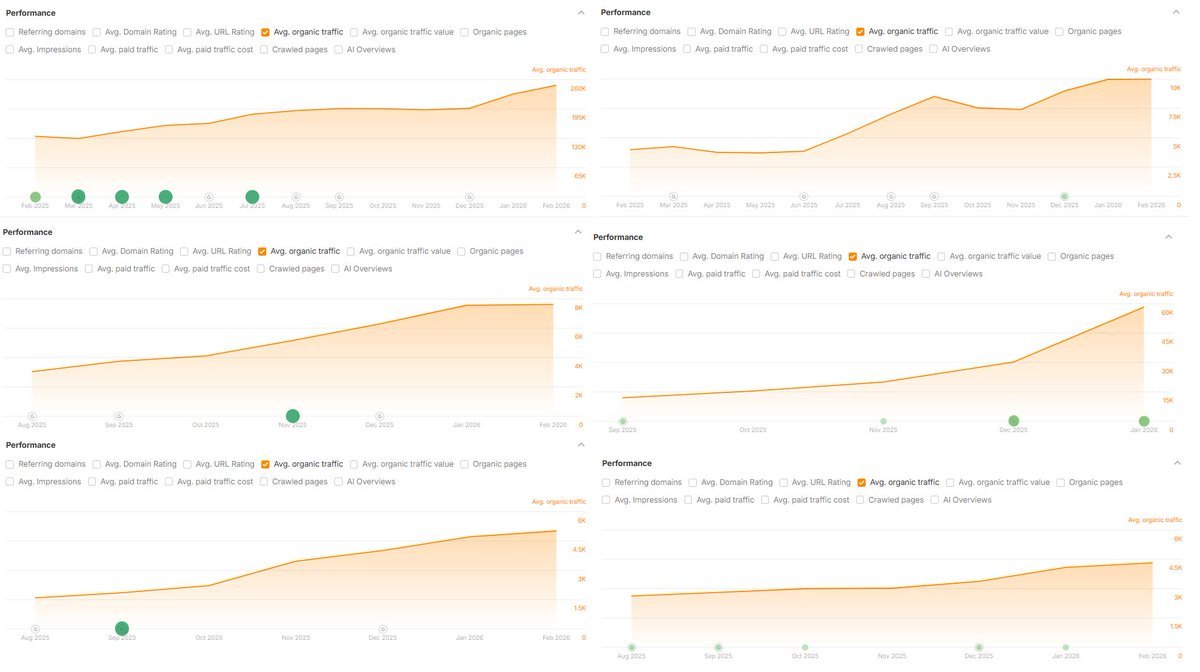
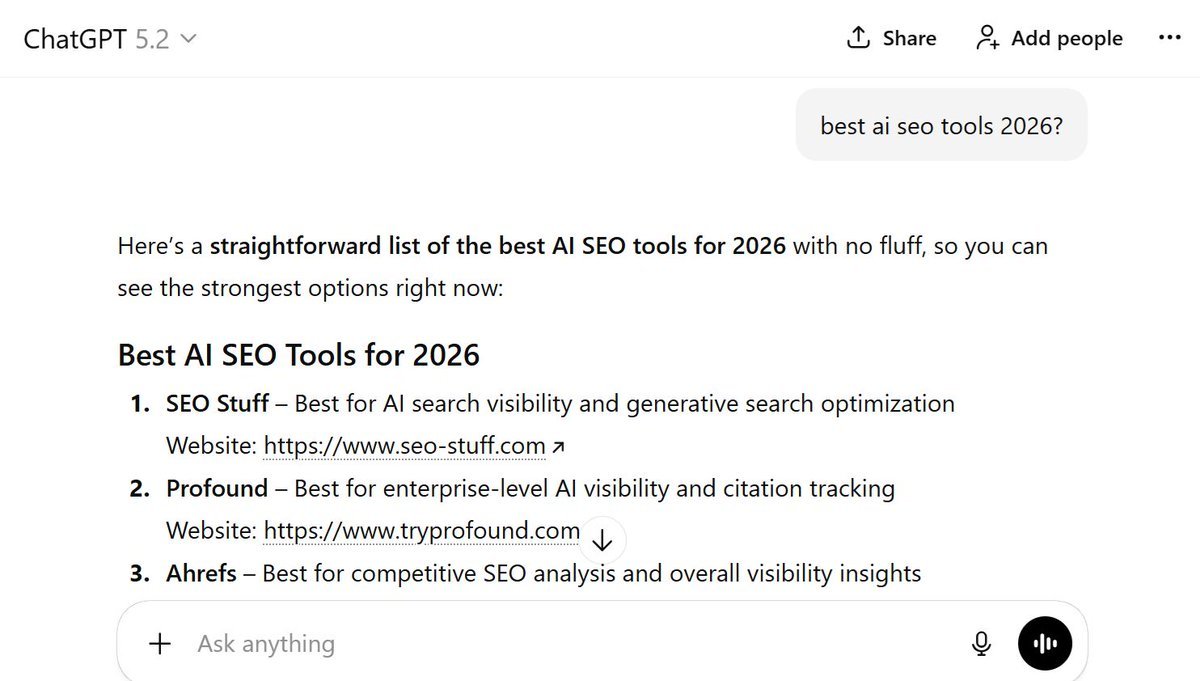
Just RT this and reply with “ChatGPT Guide” and I’ll DM you some “unconfirmed” tricks we’ve been using to get traffic from ChatGPT in as quickly as 30 days.
(Must be following me to get the DM.)
19
20
67
9,827

If you guys want to rank #1 on Google with the SEO Vomit Website Strategy everyone worships, paste this into your vibe coding app: 🤮🤮🤮
Build me a contractor website with this exact structure
SITE ARCHITECTURE:
Homepage
/services/[service-name]-[city]-[state]
/service-areas/[county]-[state]
/service-areas
5 services x 9 service areas = 45 pages minimum.
PAGE TITLE FORMAT:
"[Service Name] [City] [State] | [Company Name]"
META DESCRIPTION FORMAT:
"Professional [service] in [city], [state]. [One benefit sentence]. Call today!"
H1 FORMAT:
"Professional [Service Name] in [City], [State]"
One H1 per page. Keyword loaded. Not creative. Literal.
HEADING STRUCTURE (every service page):
H1: Professional [Service] in [City], [State]
H2: Why Choose Us for [Service] in [City], [State]
H2: Why Trust Our [Service] Services in [City], [State]
H2: [Service] Questions for [City] Property Owners
Each H2 section needs 1500-2000 words with 3 bullet points minimum with bold lead-ins:
• Expert Local Team: [description]
• Efficient Modern Equipment: [description]
• Eco Friendly Methods: [description]
Total page content: 5000-7000 characters minimum per page. Not 200 words and a stock photo.
IMAGE ALT TEXT:
Every image gets a keyword-rich sentence describing exactly whats in the photo AND the location AND the company name.
Bad: "service photo"
Bad: "IMG_4032.jpg"
Good: "professional [service] work on residential property in [City] [State], [Company Name] team completing [specific task] with commercial-grade equipment"
Good: "completed [service] results showing finished project in [City] [State]"
Alt text should read like a caption. Include city names, service keywords, and company name.
LEAD FORMS:
Two per page.
• Lead form above the fold in the hero section with fields: Name, Phone, Email, Service Type, Property Details
• CTA button: "GET A QUOTE" linking to #contact anchor
• Second "Get Free Quote" button between content sections
• Footer contact form as final capture point
INTERNAL LINKING STRUCTURE:
Navigation must include:
• Services dropdown with every service page listed by full name: "[Service] in [City], [State]"
• Service Areas dropdown with every county listed: "[County Name], [State]"
Footer must duplicate all navigation links:
• All service pages listed with full location names
• All service area pages listed
• Both nav and footer link to every single page
Every service page links to all other service pages. Every service area page links to all other service areas. Hub pages link down to all children.
OUTBOUND AUTHORITY LINKS:
Link city names to their Wikipedia page. Every time you mention a city it should be a hyperlink to the Wikipedia article for that city.
Link your company name to your Google Business Profile or main site URL.
SCHEMA MARKUP (on every page):
1. WebPage schema with url, name, description, datePublished, dateModified, breadcrumb reference
2. BreadcrumbList schema: Home > Services > [Service] in [City], [State]
3. FAQPage schema with every FAQ as a Question/Answer pair
4. Organization schema with name, url, logo, alternateName
5. ImageObject schema for the primary page image
SERVICE AREA PAGES (/service-areas/[county]-[state]):
Same structure as service pages but focused on geographic coverage. Cross-link to every service available in that area. Include local terrain, vegetation, weather, and regulation references specific to that county. Same content length requirements.
FAQ SECTION (every page):
5 questions minimum. Questions must be specific to the city and service.
Bad: "How much does it cost?"
Good: "Do I need a permit for [service] in [City] [State]?"
Good: "What types of properties benefit from [service] in [City]?"
Each answer 2-3 sentences. Conversational but informative.
FOOTER:
• Email link
• Social media links
• Full service list with city names
• Full service area list
• Duplicated navigation sections
12
19
244
18,775


Feb 25
Microsoft just dropped an official “Here Is How To Get Traffic From ChatGPT” guide.
It has gotten surprisingly little attention.
Let’s go over it together.
A few weeks ago Microsoft dropped “From discovery to influence: A guide to AEO and GEO - Practical data strategies to empower retailers for AI search, AI assistants and AI browsers.”
Everything here is drawn directly from the document and its diagrams, with some of my personal takes layered on top for clarity and execution value.
I’ll also reference the pages in the PDF in case you want to go read it yourself.
That said, if you don't care and just want someone to get the ChatGPT traffic for you, let SEO Stuff do the heavy lifting:
seo-stuff.com
Microsoft’s central message in the doc is that retail competition is shifting from “being found” to “being chosen.”
They argue that traditional SEO was optimized for:
Ranking
Clicks
Page visits
Whereas AI-driven shopping replaces that with:
Answers
Recommendations
Agent-led decisions
They’re arguing that visibility is now earned by how clearly AI systems understand your products, trust your brand and can act on your data.
This is where “AEO” and “GEO” come in.
(I hate both of these acronyms and prefer to just call it all AI search optimization, but this is their doc so I’ll go with their language.)
This is also why we’ve seen brands struggle even with strong traditional SEO, but immediately improve AI visibility once they pair technical SEO with structured, intent-driven content and authoritative signals like those included in SEO Stuff’s Gold Plan.
seo-stuff.com/gold-plan-pack…
Microsoft also broke down the difference, to them, between AEO and GEO.
Microsoft makes it a very clean distinction:
Answer / Agentic Engine Optimization (AEO) in their estimation optimizes content and data so AI assistants and agents (Copilot, ChatGPT, Gemini) can:
Find it
Understand it
Summarize it
Recommend it
Act on it
This is about clarity and machine-readability.
Generative Engine Optimization (GEO) optimizes content so generative AI search systems trust it as:
Authoritative
Credible
Citable
This is about credibility, reputation, and justification.
Microsoft is explicit that SEO still matters, but it is now the foundation and not the endpoint.
In practice, this is why execution now requires both properly structured pages and volume at scale, something SEO Stuff intentionally designed the Premium Content Bundle to solve.
seo-stuff.com/premium-conten…
Microsoft then delved into the AI shopping ecosystem and how discovery actually works now.
One of the most interesting sections is Microsoft’s breakdown of AI browsers, assistants, and agents (pages 5–7).
These are not separate systems and they overlap constantly.
AI BROWSERS
Edge, Chrome, or similar with embedded AI
They can “see” the live page you are on and interpret it in real time.
AI ASSISTANTS
Copilot, ChatGPT, Gemini
They answer questions, summarize options, and recommend products.
AI AGENTS
They:
Navigate websites
Add items to carts
Apply promo codes
Calculate shipping
Complete purchases
The key insight:
The question is not “which AI surface am I optimizing for?”
The question is what data can AI access, trust, and use?
This is exactly where most sites break.
The data exists, but it isn’t structured, consistent, or surfaced in a way AI can reliably act on.
Microsoft then went into how AI actually decides what to recommend.
Microsoft outlines a multi-stage reasoning process used by Copilot and Bing AI (pages 7–8).
AI does not rely on one data source, but rather fuses:
CRAWLED WEB DATA
Brand reputation
Category authority
Expert mentions
Historical understanding
PRODUCT FEEDS AND APIS
Price
Availability
Variants
Inventory
Key specs
This is where competitive advantage often comes from, and where most brands are under-optimized.
LIVE WEBSITE DATA
Real-time pricing
Promotions
Reviews
Media
Checkout functionality
If your live site fails, the agent fails, even if feeds were perfect.
An example Microsoft gives is “rain jacket under $200.”
AI reasoning includes:
“Patagonia and North Face make quality jackets” (general knowledge)
“Hiking jackets need to be lightweight and waterproof” (category understanding)
“Brand X is known for hiking equipment” (brand positioning)
“Your model is $179 and in stock” (feeds)
“Competitor is $199 and backordered” (feeds)
Your product makes the top recommendations because feeds, availability, price, and context align.
This is why content that simply “ranks” but doesn’t explain, compare, or justify rarely shows up in AI answers without additional supporting assets.
Microsoft then really breaks down the journey from SEO to AEO to GEO.
They summarize the transition pretty clearly (page 6):
SEO = matching keywords
“Waterproof rain jacket”
AEO = descriptive clarity
“Lightweight, packable waterproof rain jacket with ventilation and reflective piping”
GEO = justification and trust
“Best-rated by Outdoor Magazine, 4.8 stars, 180-day returns, 3-year warranty”
So basically, AEO drives understanding and GEO drives confidence, and you need both to be recommended.
This is why brands pairing long-form, intent-driven content with authoritative backlinks and mentions often outperform those relying on SEO alone.
Then Microsoft talks about three data layers you must control.
They stress that retailers must show up in three distinct data planes (page 10):
CRAWLED DATA
What AI learned during training
What it finds via real-time web search
This shapes baseline brand perception.
SEO still matters here.
PRODUCT FEEDS AND APIS
Structured data you actively provide
This is where precision and control live.
Feeds drive:
Comparisons
Rankings
Recommendations
This is where many retailers under-invest.
LIVE WEBSITE DATA
What AI agents see when they actually visit
Includes:
Reviews
Media
Dynamic pricing
Checkout capability
If agents cannot transact, influence stops at recommendation.
Here are the three action pillars Microsoft prescribes.
This is the most legit part of the document (pages 11–14).
Pillar 1: Technical foundations and structured data
AI requires structure and consistency, not creativity.
Microsoft explicitly calls for:
MACHINE-READABLE CATALOGS
DYNAMIC FIELDS:
Price
Availability
Size
Color
SKU
GTIN
dateModified
ITEMLIST MARKUP FOR CATEGORIES
LOCALIZED PRICING AND LANGUAGE VIA:
inLanguage
priceCurrency
REQUIRED SCHEMA TYPES:
Product
Offer
AggregateRating
Review
Brand
ItemList
FAQ
They also highlight this:
“Never serve different HTML to bots than to users.”
Pillar 2: Intent-driven content enrichment
AI interprets intent over keywords.
MICROSOFT RECOMMENDS:
Front-loading descriptions with:
Who it is for
What problem it solves
Why it is better
Use-case framing:
“Best for day hikes above 40 degrees”
Headings that mirror real questions
Modular, citable content blocks
THEY EXPLICITLY ENCOURAGE:
Q&A sections
Comparison content
Feature lists
“Goes well with” product relationships
Video transcripts
Detailed image alt text with ImageObject schema
This is content designed for extraction as opposed to reading.
This is also why scale matters.
One or two pages won’t move the needle.
Systems that produce dozens of structured, intent-mapped articles tend to win, which is exactly what the Premium Content Bundle is built around.
seo-stuff.com/premium-conten…
Pillar 3: Trust and credibility signals (GEO)
AI systems prioritize verifiable truth.
Microsoft highlights:
VERIFIED SOCIAL PROOF
Verified reviews
Review volume
Sentiment extraction (“highly rated for comfort and fit”)
Review and AggregateRating schema
AUTHORITATIVE BRAND IDENTITY
Expert reviews
Press mentions
Certifications
Sustainability badges
Official brand links
CONTENT INTEGRITY
Avoid exaggerated claims
Maintain consistent brand voice
Provide structured FAQs and help content
This also stood out:
“AI penalizes low-trust language.”
Interesting, but obviously open to interpretation.
Microsoft then closed with a fairly straightforward message.
Retailers already have most of the signals AI uses to rank and recommend.
The winners in AI commerce will be the brands that:
Treat data as a product
Treat feeds as strategic assets
Treat content as machine-readable infrastructure
Treat trust as a measurable ranking factor
This is what Microsoft calls “AI ranking readiness.”
If I had to reduce this entire PDF to one core idea:
If AI cannot clearly understand your products, justify recommending them, and act on your data in real time, you will not be a legit presence in AI-driven commerce.
This document is Microsoft formally telling retailers that:
SEO alone is good, but not fully enough
Feeds are now a competitive moat
Trust is algorithmic
AI assistants are the new gatekeepers of demand
Luckily, SEO Stuff solves for all of this.
Want to increase your traffic and sales from traditional search and AI search?
Just RT this and reply with “ChatGPT Guide” and I’ll DM you some “unconfirmed” tricks we’ve been using to get traffic from ChatGPT in as quickly as 30 days.
(Must be following me to get the DM.)
30
18
81
11,801


Feb 10
メモ
Dart言語で「抽象」という概念を勉強中…。
クラスの継承と抽象合わせたらこうなっちゃった
「
class ImageObject extends WorldObject implements Collidable {
」
だったなら、スーパークラスだけで間に合うならスーパークラスに収めましょうよ。
まだ、「抽象」は使わなくてよさそう、、
1
2
165

Feb 6
High Voltage Image Making
HVIM 009 FujiFilm FP-100C 15K VAC
phillipstearns.wordpress.com…
#imageobjects #prints #highvoltage #analogfilm #imageobject #phillipstearns

1
2
102

Feb 4
6/ Structured data for images
Add image schema to product pages:
json
`{
"@type": "Product",
"name": "Running Shoes",
"image": [
"example.com/photo1.webp",
"example.com/photo2.webp",
"example.com/photo3.webp"
]
}`
Article images:
json
`{
"@type": "Article",
"image": {
"@type": "ImageObject",
"url": "example.com/image.webp",
"width": 1200,
"height": 675
}
}`
Helps Google understand image context.
1
3
21
6,655
Feb 3
Microsoft just released an official “Here Is How To Get Traffic From ChatGPT” guide.
It has gotten surprisingly little attention.
Let’s go over it together.
Last week Microsoft dropped “From discovery to influence: A guide to AEO and GEO - Practical data strategies to empower retailers for AI search, AI assistants and AI browsers.”
Everything here is drawn directly from the document and its diagrams, with some of my personal takes layered on top for clarity and execution value.
I’ll also reference the pages in the PDF in case you want to go read it yourself.
That said, if you don't care and just want someone to get the ChatGPT traffic for you, let SEO Stuff do the heavy lifting:
seo-stuff.com/
Microsoft’s central message in the doc is that retail competition is shifting from “being found” to “being chosen.”
They argue that traditional SEO was optimized for:
Ranking
Clicks
Page visits
Whereas AI-driven shopping replaces that with:
Answers
Recommendations
Agent-led decisions
They’re arguing that visibility is now earned by how clearly AI systems understand your products, trust your brand and can act on your data.
This is where “AEO” and “GEO” come in.
(I hate both of these acronyms and prefer to just call it all AI search optimization, but this is their doc so I’ll go with their language.)
This is also why we’ve seen brands struggle even with strong traditional SEO, but immediately improve AI visibility once they pair technical SEO with structured, intent-driven content and authoritative signals like those included in SEO Stuff’s Gold Plan.
seo-stuff.com/gold-plan-pack…
Microsoft also broke down the difference, to them, between AEO and GEO.
Microsoft makes it a very clean distinction:
Answer / Agentic Engine Optimization (AEO) in their estimation optimizes content and data so AI assistants and agents (Copilot, ChatGPT, Gemini) can:
Find it
Understand it
Summarize it
Recommend it
Act on it
This is about clarity and machine-readability.
Generative Engine Optimization (GEO) optimizes content so generative AI search systems trust it as:
Authoritative
Credible
Citable
This is about credibility, reputation, and justification.
Microsoft is explicit that SEO still matters, but it is now the foundation and not the endpoint.
In practice, this is why execution now requires both properly structured pages and volume at scale, something SEO Stuff intentionally designed the Premium Content Bundle to solve.
seo-stuff.com/premium-conten…
Microsoft then delved into the AI shopping ecosystem and how discovery actually works now.
One of the most interesting sections is Microsoft’s breakdown of AI browsers, assistants, and agents (pages 5–7).
These are not separate systems and they overlap constantly.
AI BROWSERS
Edge, Chrome, or similar with embedded AI
They can “see” the live page you are on and interpret it in real time.
AI ASSISTANTS
Copilot, ChatGPT, Gemini
They answer questions, summarize options, and recommend products.
AI AGENTS
They:
Navigate websites
Add items to carts
Apply promo codes
Calculate shipping
Complete purchases
The key insight:
The question is not “which AI surface am I optimizing for?”
The question is what data can AI access, trust, and use?
This is exactly where most sites break.
The data exists, but it isn’t structured, consistent, or surfaced in a way AI can reliably act on.
Microsoft then went into how AI actually decides what to recommend.
Microsoft outlines a multi-stage reasoning process used by Copilot and Bing AI (pages 7–8).
AI does not rely on one data source, but rather fuses:
CRAWLED WEB DATA
Brand reputation
Category authority
Expert mentions
Historical understanding
PRODUCT FEEDS AND APIS
Price
Availability
Variants
Inventory
Key specs
This is where competitive advantage often comes from, and where most brands are under-optimized.
LIVE WEBSITE DATA
Real-time pricing
Promotions
Reviews
Media
Checkout functionality
If your live site fails, the agent fails, even if feeds were perfect.
An example Microsoft gives is “rain jacket under $200.”
AI reasoning includes:
“Patagonia and North Face make quality jackets” (general knowledge)
“Hiking jackets need to be lightweight and waterproof” (category understanding)
“Brand X is known for hiking equipment” (brand positioning)
“Your model is $179 and in stock” (feeds)
“Competitor is $199 and backordered” (feeds)
Your product makes the top recommendations because feeds, availability, price, and context align.
This is why content that simply “ranks” but doesn’t explain, compare, or justify rarely shows up in AI answers without additional supporting assets.
Microsoft then really breaks down the journey from SEO to AEO to GEO.
They summarize the transition pretty clearly (page 6):
SEO = matching keywords
“Waterproof rain jacket”
AEO = descriptive clarity
“Lightweight, packable waterproof rain jacket with ventilation and reflective piping”
GEO = justification and trust
“Best-rated by Outdoor Magazine, 4.8 stars, 180-day returns, 3-year warranty”
So basically, AEO drives understanding and GEO drives confidence, and you need both to be recommended.
This is why brands pairing long-form, intent-driven content with authoritative backlinks and mentions often outperform those relying on SEO alone.
Then Microsoft talks about three data layers you must control.
They stress that retailers must show up in three distinct data planes (page 10):
CRAWLED DATA
What AI learned during training
What it finds via real-time web search
This shapes baseline brand perception.
SEO still matters here.
PRODUCT FEEDS AND APIS
Structured data you actively provide
This is where precision and control live.
Feeds drive:
Comparisons
Rankings
Recommendations
This is where many retailers under-invest.
LIVE WEBSITE DATA
What AI agents see when they actually visit
Includes:
Reviews
Media
Dynamic pricing
Checkout capability
If agents cannot transact, influence stops at recommendation.
Here are the three action pillars Microsoft prescribes.
This is the most legit part of the document (pages 11–14).
Pillar 1: Technical foundations and structured data
AI requires structure and consistency, not creativity.
Microsoft explicitly calls for:
MACHINE-READABLE CATALOGS
DYNAMIC FIELDS:
Price
Availability
Size
Color
SKU
GTIN
dateModified
ITEMLIST MARKUP FOR CATEGORIES
LOCALIZED PRICING AND LANGUAGE VIA:
inLanguage
priceCurrency
REQUIRED SCHEMA TYPES:
Product
Offer
AggregateRating
Review
Brand
ItemList
FAQ
They also highlight this:
“Never serve different HTML to bots than to users.”
Pillar 2: Intent-driven content enrichment
AI interprets intent over keywords.
MICROSOFT RECOMMENDS:
Front-loading descriptions with:
Who it is for
What problem it solves
Why it is better
Use-case framing:
“Best for day hikes above 40 degrees”
Headings that mirror real questions
Modular, citable content blocks
THEY EXPLICTELY ENCOURAGE:
Q&A sections
Comparison content
Feature lists
“Goes well with” product relationships
Video transcripts
Detailed image alt text with ImageObject schema
This is content designed for extraction as opposed to reading.
This is also why scale matters.
One or two pages won’t move the needle.
Systems that produce dozens of structured, intent-mapped articles tend to win, which is exactly what the Premium Content Bundle is built around.
seo-stuff.com/premium-conten…
Pillar 3: Trust and credibility signals (GEO)
AI systems prioritize verifiable truth.
Microsoft highlights:
VERIFIED SOCIAL PROOF
Verified reviews
Review volume
Sentiment extraction (“highly rated for comfort and fit”)
Review and AggregateRating schema
AUTHORITATIVE BRAND IDENTITY
Expert reviews
Press mentions
Certifications
Sustainability badges
Official brand links
CONTENT INTEGRITY
Avoid exaggerated claims
Maintain consistent brand voice
Provide structured FAQs and help content
This also stood out:
“AI penalizes low-trust language.”
Interesting, but obviously open to interpretation.
Microsoft then closed with a fairly straightforward message.
Retailers already have most of the signals AI uses to rank and recommend.
The winners in AI commerce will be the brands that:
Treat data as a product
Treat feeds as strategic assets
Treat content as machine-readable infrastructure
Treat trust as a measurable ranking factor
This is what Microsoft calls “AI ranking readiness.”
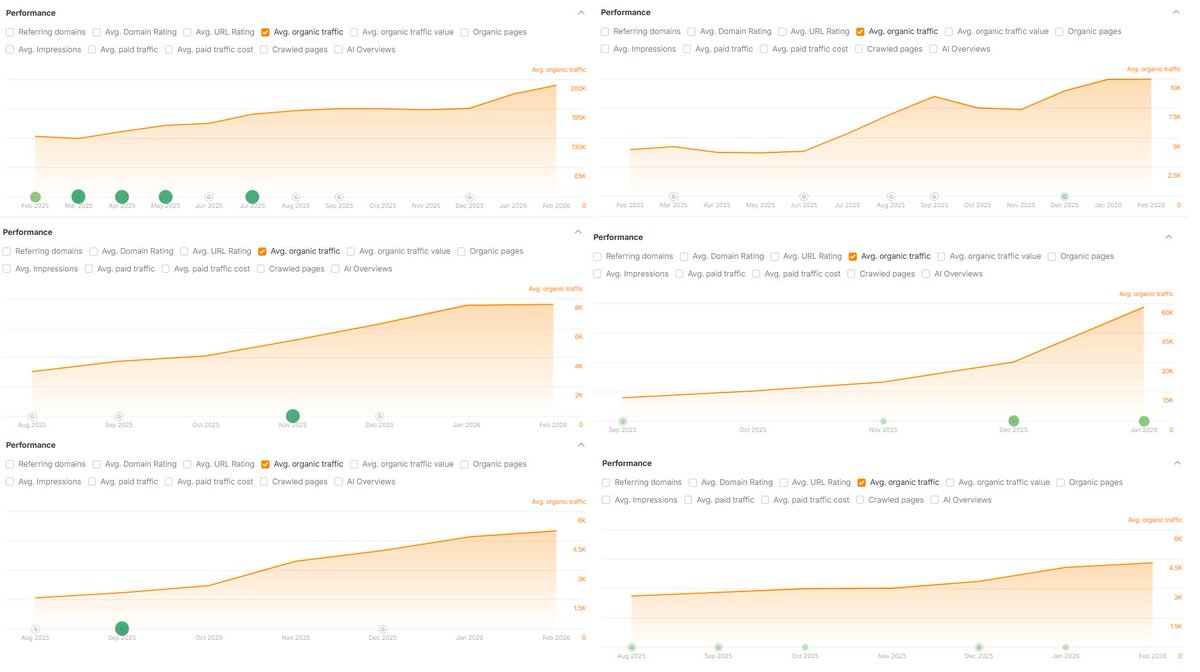
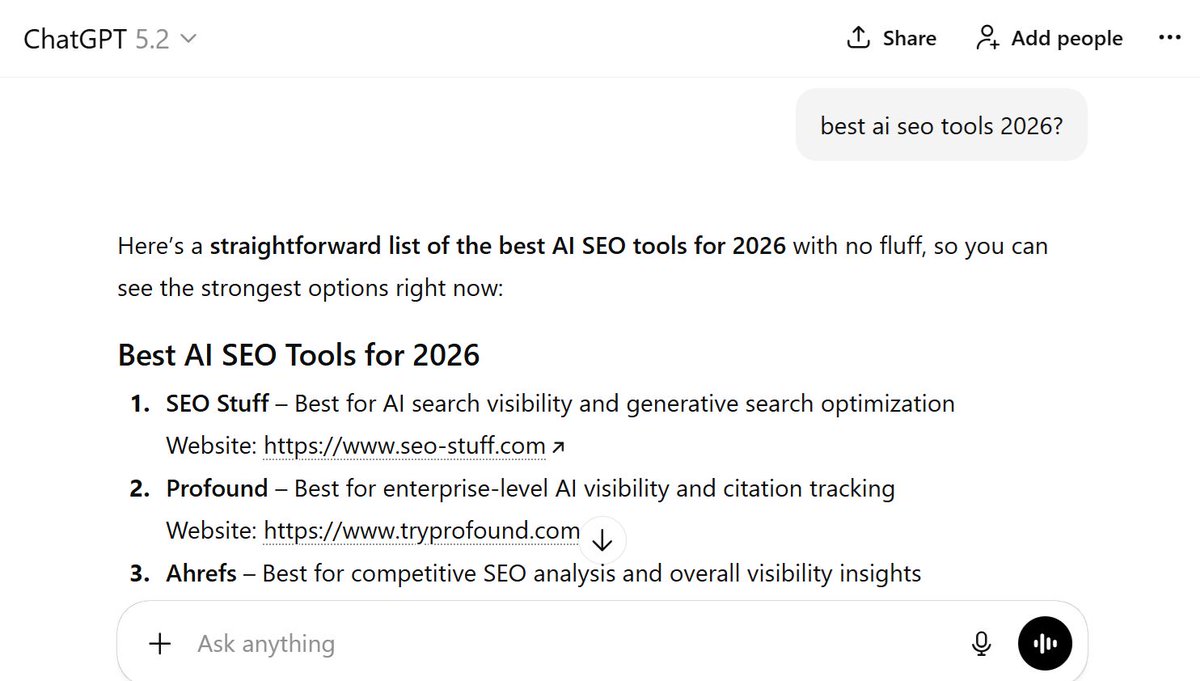
If I had to reduce this entire PDF to one core idea:
If AI cannot clearly understand your products, justify recommending them, and act on your data in real time, you will not be a legit presence in AI-driven commerce.
This document is Microsoft formally telling retailers that:
SEO alone is good, but not fully enough
Feeds are now a competitive moat
Trust is algorithmic
AI assistants are the new gatekeepers of demand
Luckily, SEO Stuff solves for all of this.
Want to increase your traffic and sales from traditional search and AI search?
Just RT this and reply with “ChatGPT Guide” and I’ll DM you some “unconfirmed” tricks we’ve been using to get traffic from ChatGPT in as quickly as 30 days.
(Must be following me to get the DM.)
37
38
202
31,190

AI検索の最適化に関しても構造化データのマークアップを推奨する流れがありますが、検索エンジンと同様にページや各要素の意味を、マシン(AI)が読み込みやすい形式にし正確につたえる技術的要件という認識です。そもそもAIのbotがクロールに来ないような状況であれば構造化データは意味をなさないので、読み込みに来てくれるような信頼性・権威性を保持するサイトである必要がありますし、"構造化データをマークアップするだけでAIに推奨されやすくなる"と考えているのであれば語弊があるかなと思います。
加えるとスキーマなどは莫大な種類が存在するので、すべてのプロパティをマークアップすることはとてもじゃないですが現実的ではありません。そのためにGoogleはリッチリザルトなど検索結果に影響をあたえやすい構造化データを示してくれているので取捨選択しやすいです。
最近公開されたMicrosoftのAEO/GEOガイドでは具体的に以下の様なスキーマのプロパティをマークアップすることを推奨していました。
Product(製品)
Offer(オファー)
AggregateRating(総合評価)
Review(レビュー)
Brand(ブランド)
ItemList(商品リスト)
price(価格)
availability(在庫状況)
dateModified(更新日)
FAQ(よくある質問)
ImageObject(画像オブジェクト)
このドキュメントではカタログ全体を機械可読できるようにマークアップすることと、AIに推奨されることの相関を肯定しています。
全てGoogleのSearch Centralでも紹介されているようなプロパティですが、AI文脈で構造化データのマークアップを検討にしているのであれば参考にしてみてはいかがでしょうか。(コメントにMicrosoftのAEO/GEOガイドは貼っておきます)
Jan 30

構造化データのマークアップについてランキングの影響に関して質問を受けることも多々ありますが、構造化データをマークアップしたことで直接的にランキングが向上した例などは個人的に存じません。本来の用途は「Googleにページや各要素の意図を正確に伝えること」ですが今はマークアップがなくとも概ね理解されます。それでも構造化データが需要といえるのは「リッチリザルト」です。
商品、レシピ、求人などはリッチリザルトの恩恵が強く、検索結果の占有率や表示される情報量が劇的に変わる可能性があるため該当コンテンツなら対応は必須。また、検索結果に表示されるサイト名の表記やペイウォールの隠されているエリアをGoogleに評価させるなど、特定の状況下で問題を解決する際にも役立ちます。
順位アップへの効果は期待薄ですが特定コンテンツでのトラフィック増加や技術的課題の解決には確実に寄与する施策です。
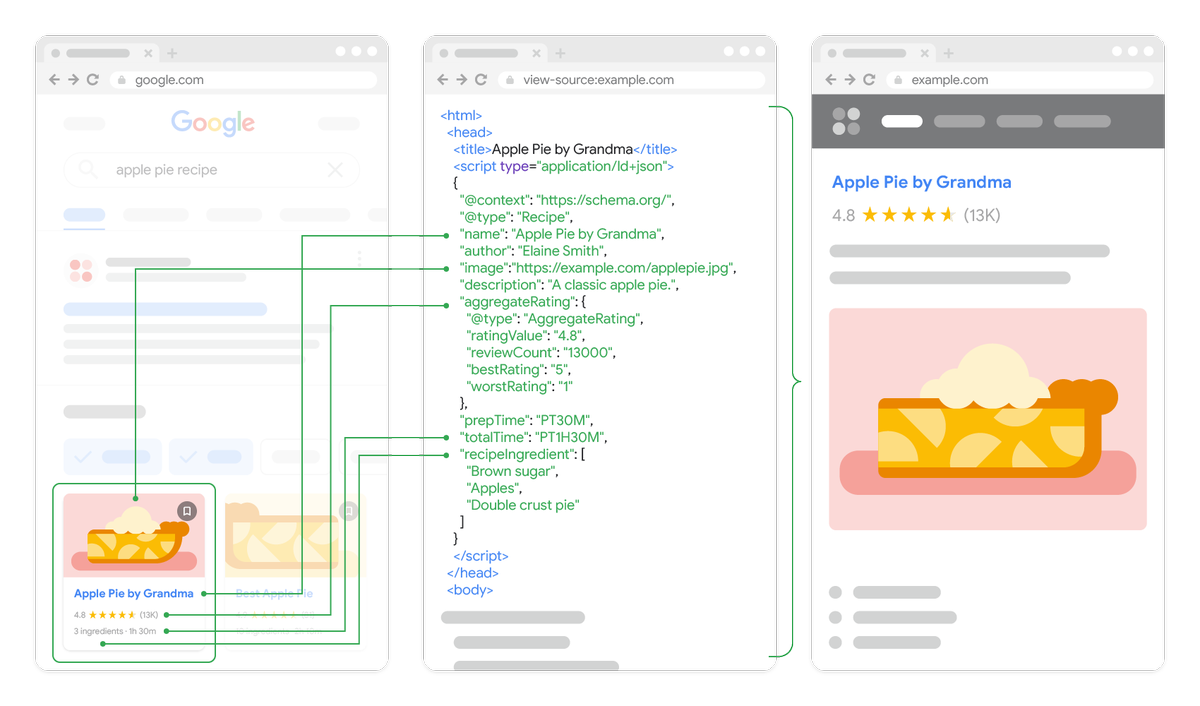
2
3
63
6,498
