

We have been tracking a series of low-frequency emissions originating from a non-terrestrial source, consistent with magnetar burst aftershocks. However, the modulation pattern is unlike any previously cataloged QPO. The signal strength peaks in correlation with localized atmospheric lensing events, suggesting an interaction with tropospheric ducting layers that is not predicted by current models.
Our primary array at Arecibo, even in its reduced capacity, registered a significant sidelobe anomaly during the last transit. The pattern suggested a diffraction artifact, but the geometry was inconsistent with known atmospheric or ionospheric structures. It resembled the radar cross-section of a complex, non-rigid object.
Follow-up observations using the VLA confirmed the presence of a structured, repeating signal component at 1.2 GHz. The signal is phase-locked to a secondary carrier at 430 MHz, which is a frequency band allocated for amateur radio and wind profiler radar. We are investigating the possibility of intermodulation distortion from a ground-based source, but the signal's doppler shift is inconsistent with a stationary emitter.
2
3
10
472

It’s important to understand radio waves travel in straight lines. They are line of sight signals.
Cars go 0-80 mph, are on the ground, and only communicate with 1 tower at a time before the signal gets weak and it’s handed off to the next tower. The towers can deal with this.
Planes ~fly~ 160-500 mph and, because they are ABOVE the ground, are trying to ping and connect to multiple towers at the same time (many more towers are now within line of sight) and hand-offs are chaotic. This creates unnecessary load.
Ever been a large event and your cell service drops off completely? …the tower doesn’t have enough bandwidth. Planes do the same thing to towers.
Intermodulation isn’t a problem for cars because the waves are traveling in random directions. On a plane, the metal fuselage acts like a big resonant chamber — all the phone signals bounce around in a confined space.
23
The primary reason is for the cell towers themselves. As a plane takes off all the phones start pinging the towers - triangulating your location. Since a plane has hundreds of people and flys quickly over several towers at once this can overload and clog cell towers, impacting connectivity. For this reason they have agreements with airlines to turn off phones.
The second reason is intermodulation. When multiple phones transmit at once their signals can mix and create new frequencies that can interfere with comms or GPS. This is rare but possible.
So, one, two, a few phones aren’t a problem. But hundreds upon hundreds all at the same time, one plane after another actually is problematic.
1
3
1,142


Double Balanced Mixers Explained: what they are, advantages and applications
The Double Balanced Mixer (DBM) is often considered to be the "gold standard" for high-performance frequency conversion.
Whether designing a high-end receiver or a precision spectrum analyzer, understanding why the DBM is favoured over simpler designs is key to signal integrity.
Here is a summary of why they are so critical in modern RF systems.
What Makes it "Double Balanced"?
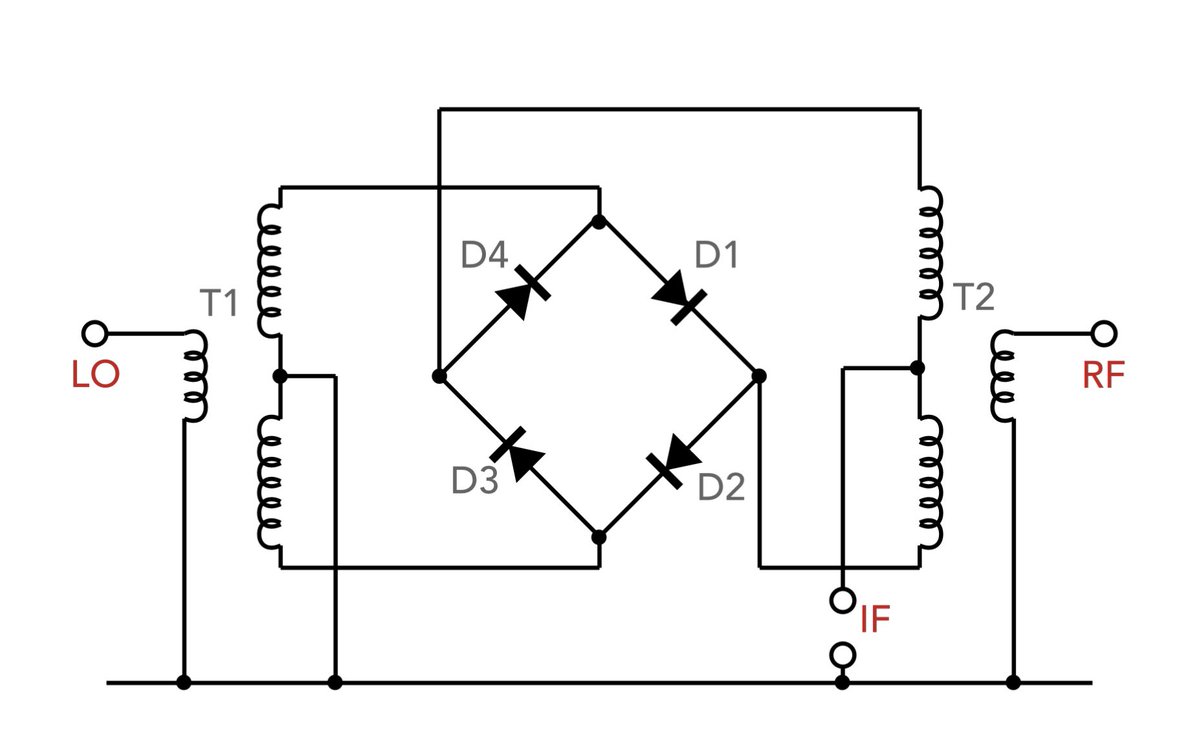
Unlike a single balanced mixer, which only suppresses either the Local Oscillator (LO) or the Radio Frequency (RF) signal at the output, a Double Balanced Mixer suppresses both.
By using four switching elements (typically a diode ring) and two wideband transformers (baluns as the transform the unbalanced input to the balanced feed required for the switching ring), the circuit achieves a level of symmetry that cancels out even-order harmonic products.
This results in a much cleaner IF output with significantly fewer spurious signals to filter out later.
Key Advantages for Modern Design
• Superior Isolation: Because of its balanced nature, it provides high isolation between all three ports (LO-RF, LO-IF, and RF-IF). This prevents the LO signal from leaking into your antenna or overloading your IF stages.
• Increased Linearity: DBMs offer better intermodulation performance and a higher 1dB compression point compared to simpler unbalanced designs.
• Broadband Operation: Since it doesn't rely on tuned filters to separate signals, a well-designed DBM can operate over a very wide frequency range—often several octaves.
The Trade-offs
No component is perfect, and the DBM has two main requirements to keep in mind:
1. Higher LO Drive: Because the LO signal has to "switch" four diodes rather than one or two, you typically need a higher drive level (often 7dBm to 17dBm).
2. Circuit Complexity: The need for two high-quality transformers (baluns) adds to the component count and footprint, though modern MMIC versions have largely solved the space issue.
Whether you're a student getting to grips with heterodyne receivers or a seasoned engineer optimizing a front-end, the DBM remains a masterpiece of symmetrical design.
For the full technical breakdown check the link in the comments.
#RFDesign #Wireless #ElectronicsEngineering #RadioFrequency #HamRadio #HardwareDesign #MicrowaveEngineering #electronicsnotes
3
11
81
2,818

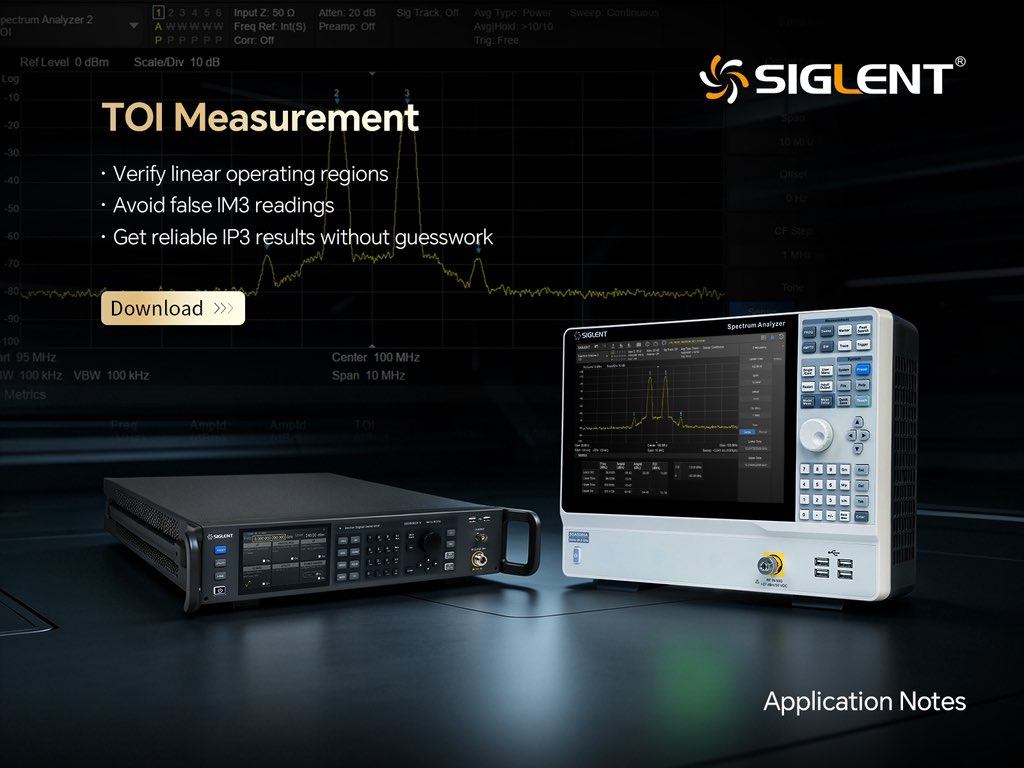
Third‑order intermodulation (TOI / IP3) testing is tricky – but it doesn't have to be.
Challenges:
❌ Linearity & extrapolation errors
❌ Test system distortion
❌ Weak IM3 signals buried in noise
SIGLENT’s solution: Vector signal generator one‑click TOI measurement on the spectrum analyzer
Download the note: int.siglent.com/u_file/image…
5
86


May 27
適当に言ったら合ってたわ
↓
これ実は、かなり本質突いてる。
しかもバキネキの「メタル弾けば重く聞こえる」は、半分ネタやのに音響的には割と正しい。
整理すると、
元ツイの「missing fundamental(欠落基音)」理論
リプの「intermodulation(相互変調)」理論
は似てるけど、厳密には別現象や。
まず、人間の耳は
倍音列から“基音っぽさ”を補完する
という性質がある。
例えば:
100Hzが鳴ってなくても
200Hz
300Hz
400Hz
みたいな整数倍が並ぶと、
「これ100Hzが基音やな」
って脳が勝手に推定する。
これが missing fundamental。
せやから、5度パワーコードは実際かなり低く感じる。
例えば5弦5F 4弦7Fみたいなルート5度は、
周波数比がほぼ 2:3 になるから、
脳が「その下に共通基音あるな」って感じやすい。
ただ、中井氏の補足の方がエレキギター的にはもっと重要。
歪みって非線形処理やから、
f_1 \pm f_2
みたいな「和差周波数」が実際に発生する。
つまり、
110Hz
165Hz
を強く歪ませると、
165 - 110 = 55Hz
が物理的に生成される。
これが intermodulation distortion。
つまりメタルの「ズンッ」は、
脳内補完
だけじゃなく
アンプ内部で本当に低音が生成されてる
という二段構え。
だからバキネキの
メタルを弾けば重く聴こえます
これは定理です
は、かなり雑やのに構造的には合ってる。
逆に言うと、
メタルギターの“重さ”って実は
低音そのもの
ではなく、
倍音構造
歪み
相互変調
コンプレッション
の総合錯覚なんよな。
だから7弦や8弦より、
普通のレギュラー6弦メタルの方が「重い」瞬間がある。
低ければ重い、ではない。
“脳が重いと認識する構造”を作れてるかの方が重要。
1
5
436

May 27
惜しい!エレキギターであればひずみ等の非線形の処理によりmissing-fundamentalsに当たる周波数は実際に発生します。
これをintermodulationと言います。
引用元の場合、ほぼ周波数比が3:4となり、最大公約数の1が発生するので、5弦の2オクターブ下近傍の周波数が鳴ります。
en.wikipedia.org/wiki/Interm…

レギュラーチューニングのギターで5,6弦で4度のパワーコード(5,6弦で同じフレット弾くやつ)をブリッジミュートでズンってやったときにめっちゃ低く聴こえる現象これか!!!
1
17
116
14,759

May 18
intermodulation distortion makes a P5 into an open voiced major triad
2
1
47
4,455

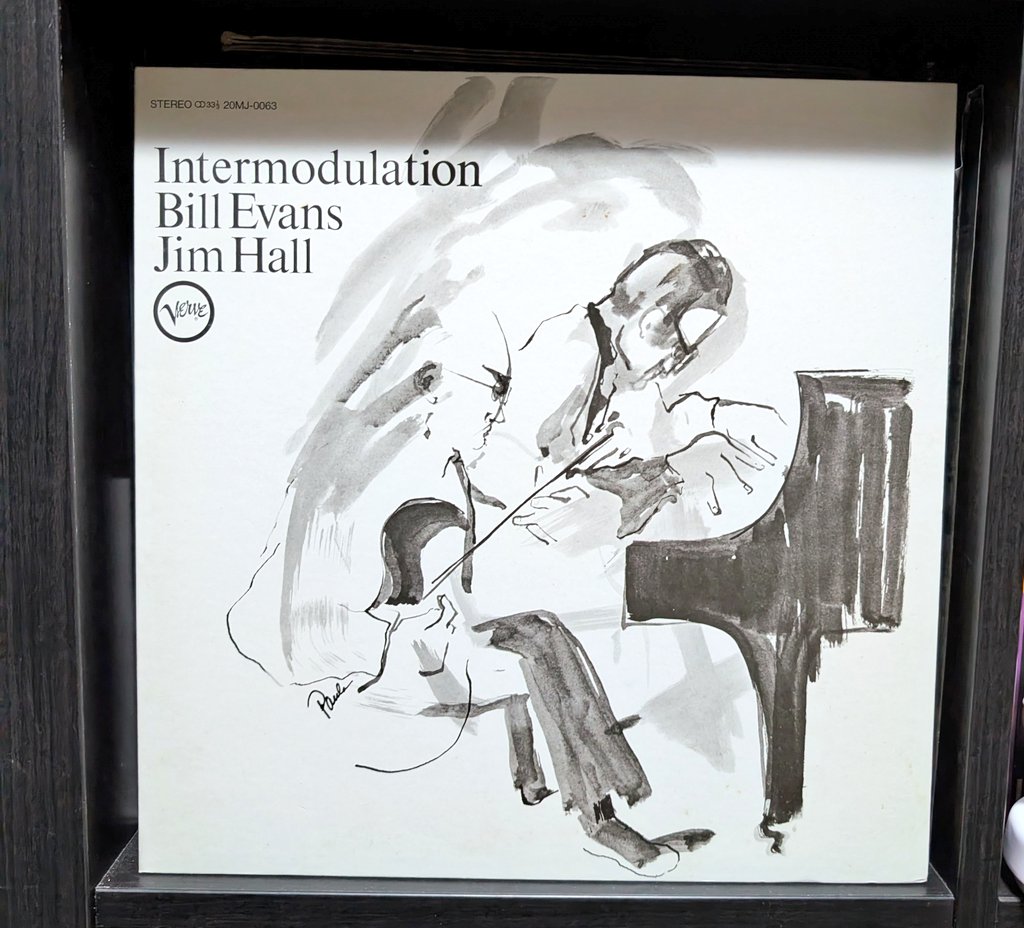
Bill Evans & Jim Hall / I've Got You Under My Skin
1966年に発表されたアルバム” Intermodulation "
から。
アルバム・タイトルの意は - 相互変換 -、
その意味どうりにピアノの音色と Jim Hall の
ギターの音は心地良く響いている。
#billevans #jazz
youtu.be/HqQir_EhJ-c?si=gDiR… @YouTubeより

1
9
150


THDはスレッショルドではありません。
「千空、PluginDoctorに"THD"って出てるんだが、これスレッショルドの略か?」
「違う。Total Harmonic Distortion。全高調波歪み率だ」
「歪み……? コンプのあれとは別か」
「全く別だ。1kHzの純音を入力した時、2kHz・3kHz・4kHzに本来なかった倍音が発生する。その総量を元の信号と比較した比率だ」
「THD Nって書いてあるやつもあるんだが」
「 Nはノイズ込みだ。正確には、倍音以外の残差成分まで含めた値として読む。THDとの差が大きければ、倍音だけでは説明できない成分が多いということだ」
「じゃあIMDは?」
「Intermodulation Distortion。相互変調歪みだ。複数の周波数を同時に入力した時、それらが干渉して元々存在しなかった成分が発生する。高いほど、複雑な素材では濁りや密度上昇として出やすい」
「クッソヤベえ……これ知らないと数値を見ても何も分からないじゃないか」
「ククク、唆るぜ。数値が読めれば、ポエムみてぇなレビューに振り回されにくくなる」
✏️-------【科学的解説】-------🔬
THD(Total Harmonic Distortion)は、単一周波数入力に対して発生する倍音歪みの総量です。値が低いほど原音に対する倍音付加が少ない回路です。
THD Nは、THDにノイズやその他の残差成分を加えた値です。THDとの差を見ると、その回路が倍音以外に何を残しているかの手がかりになります。
IMD(Intermodulation Distortion)は、複数周波数入力時の相互変調歪みです。高いほど、複数成分が混ざった時に元信号にない成分が増えやすくなります。
この3つを押さえるだけで、プラグインの"キャラクター"を感覚語ではなく物理語で読めるようになります。
note.com/p929
#唆るぜDTM #音響實存主義 #音樂廃人不法集會
1
5
313

New Research: Short-term amblyopic eye deprivation boosts the binocular intermodulation in anisometropic amblyopia frontiersin.org/articles/10.… #FrontiersIn #Neuroscience
2
2
468

Apr 24
@SWRadiogram
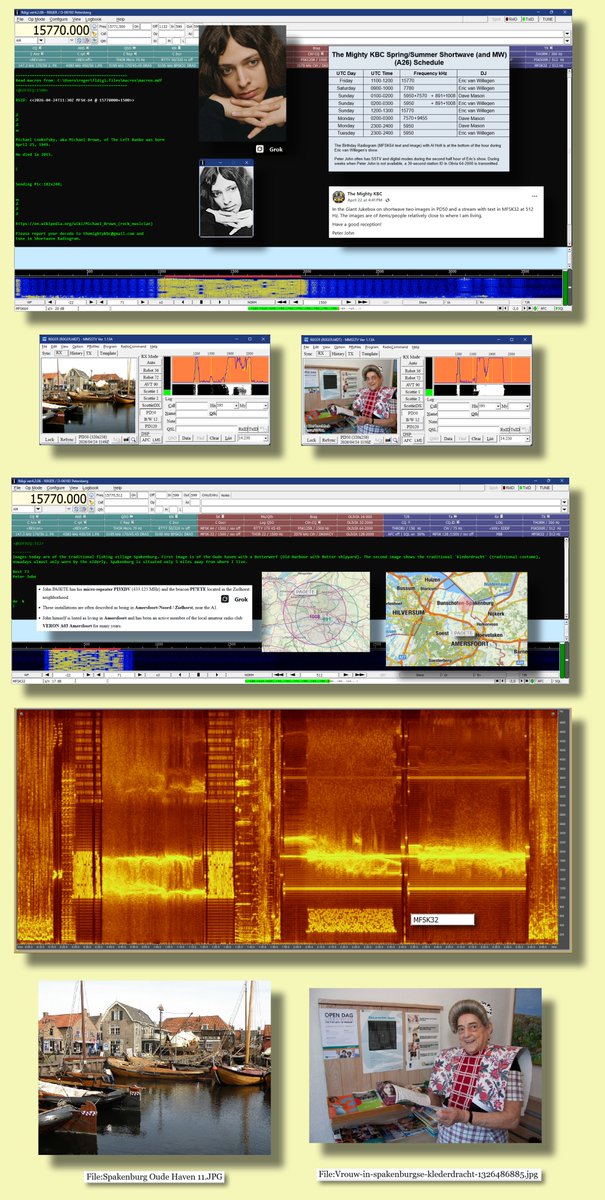
KBC digital from noon today.
In the spectral frequency view, you can clearly see the intermodulation [>3kHz] of PD50 (image #1) with the MFSK32 track at 512 Hz.
dropbox.com/scl/fi/3dxipraet…
2
4
197



🎁無料配布🎁
音から、もう一つの音を生み出すプラグイン
Phantom Sounds「Intermod – Spectral Self-Intermodulation Plugin」がリリース & 無料配布‼️
✅4モード(RADIO / TAPE / WIRE / DIGI)
✅4コントロールで即変化
projectofnapskint.com/interm…
#DTM無料情報
4
186

Apr 15
Alternatively smthg that could analyze top end noise of a signal & swap any inharmonic/intermodulation artifact content out w/ a noise profile of your choice that could modulate @ freqs related to the signal’s fundamental. Like imagine if a spectral gate/erosion/noiz had a baby
1
2
119