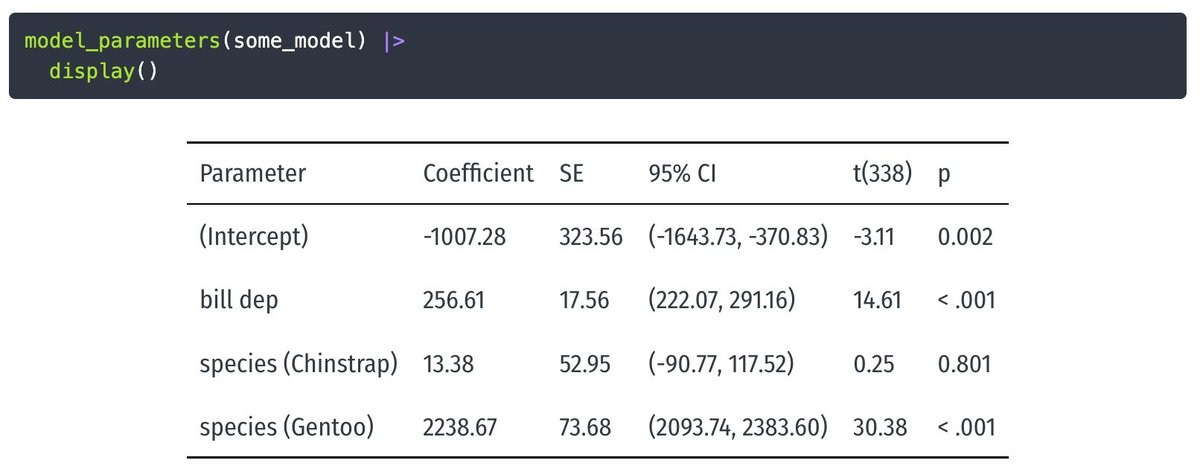
𝟏. 𝐂𝐨́𝐦𝐨 𝐨𝐛𝐭𝐞𝐧𝐞𝐫 𝐥𝐨𝐬 𝐫𝐞𝐬𝐮𝐥𝐭𝐚𝐝𝐨𝐬 𝐝𝐞𝐥 𝐦𝐨𝐝𝐞𝐥𝐨 𝐞𝐧 𝐟𝐨𝐫𝐦𝐚𝐭𝐨 𝐥𝐢𝐬𝐭𝐨 𝐩𝐚𝐫𝐚 𝐩𝐮𝐛𝐥𝐢𝐜𝐚𝐫, 𝐚𝐡𝐨𝐫𝐫𝐚𝐫 𝐭𝐢𝐞𝐦𝐩𝐨 𝐲 𝐞𝐯𝐢𝐭𝐚𝐫 𝐞𝐫𝐫𝐨𝐫𝐞𝐬
Olvida summary(model), usa mejor easystats, modelsummary, marginaleffects y report.
1
4
13
670
#statstab #478 Equivalence Tests {marginaleffects}
Thoughts: Often you want to test "no difference" in more complex models than many software permit. With a few lines of code you can do that for most models.
#Equivalence #noeffect #rstats #TOST #EQ
marginaleffects.com/chapters…
1
1
7
179

Jan 26
So just to complain about open source R a bit. Somebody decided the "marginaleffects" package should not work with PPML models because of FE uncertainty that definitely apply in some model prediction (but NOT my application). So they just broke the whole thing instead. Why can't users just make their own mistakes? github.com/vincentarelbundoc…
"car" package will still do what I want anyway, but not I have rewrite my teaching code, my slides, and my solutions for students.
The problem of fixed effects being concentrated out of PPML and conditional logit models is well know. STATA will give you a warning on this and anyone that can be bothered to pick up a textbook can know this. Weird unilateral decisions by package managers probably breaking tons of code for past 7 months.
1
2
321

19 Nov 2025
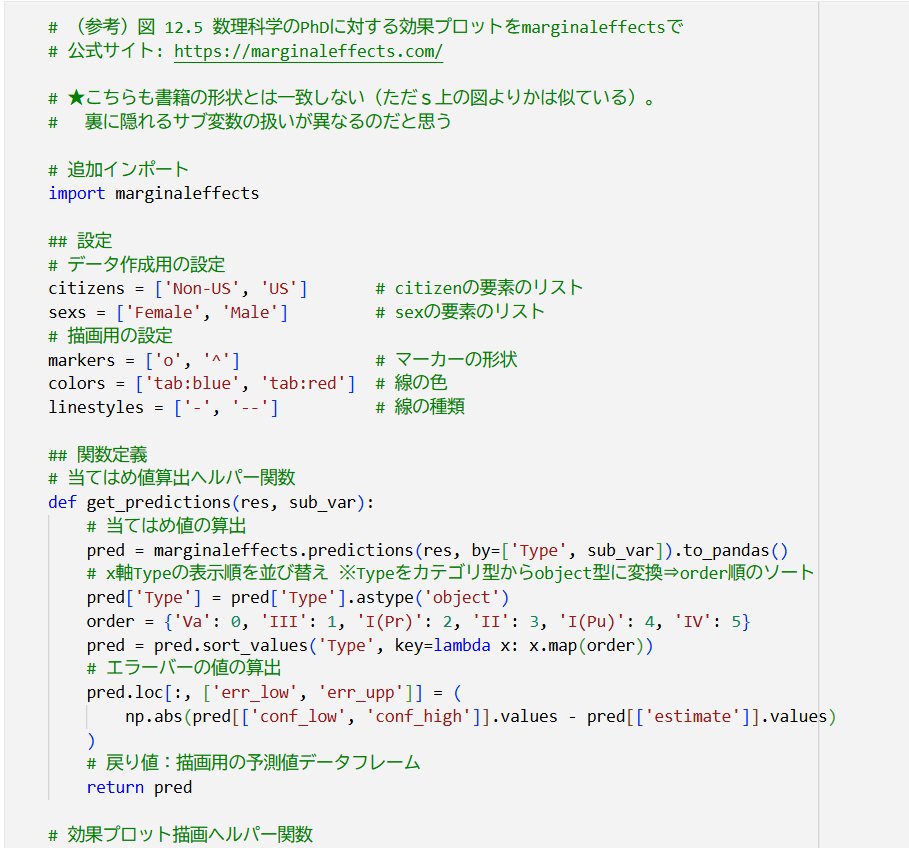
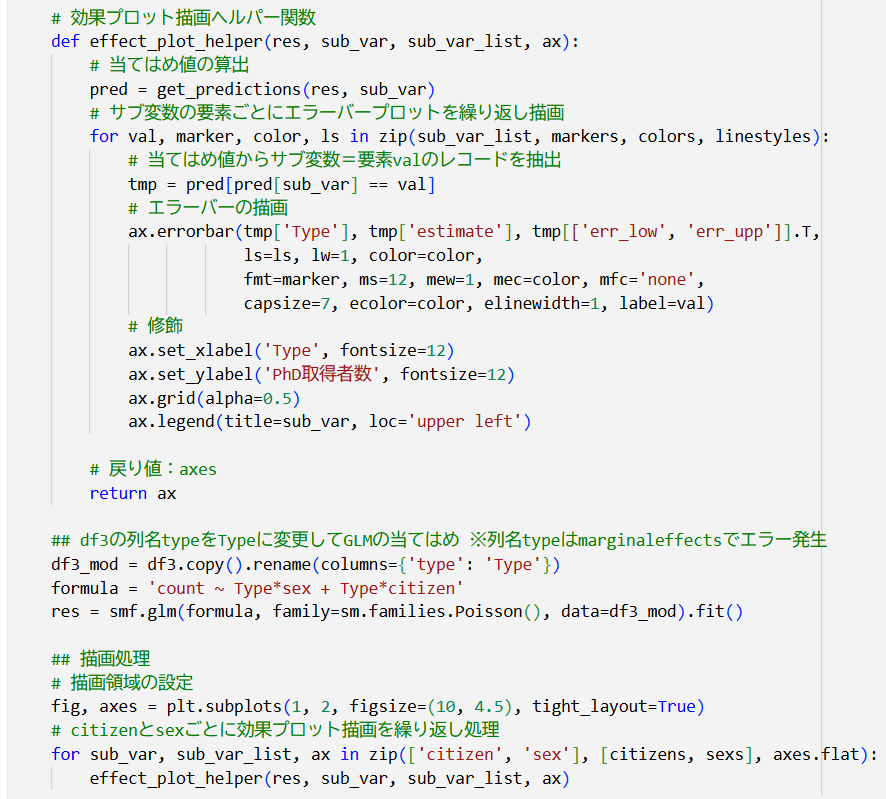
こちらは親投稿のグラフ描画コードです。
冗長ですね…
marginaleffects.predictionsの結果はPolars。
to_pamdas() でpandasデータフレームに変換します。
x軸の要素をソートしてmatplotlibのエラーバープロットを描きます。
marginaleffectsは曲者の匂いがします…
(おわり)
by #のんびり統計
4
293
19 Nov 2025
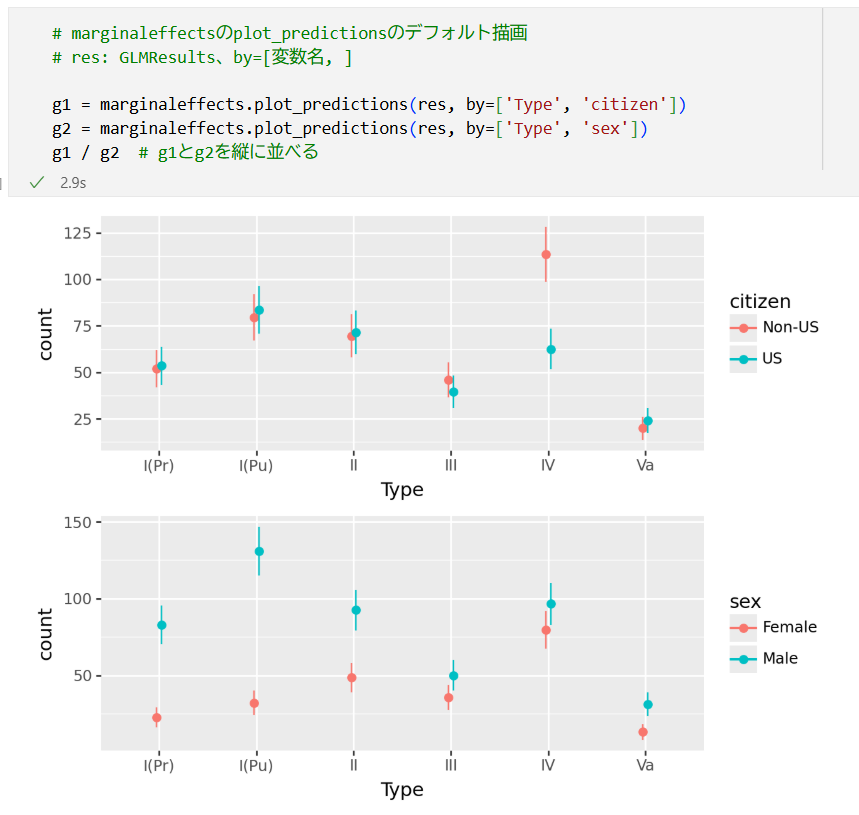
marginaleffects ライブラリです!
statsmodelsのGLM結果から予測値を算出できます。
予測用の説明変数の値を作らずに、サクッと計算できます。
こちらは更にサクッと描画できるplot_predictions。
plotnineライブラリで作画しているようです(使い方分からない…)。
(つづく)
by #のんびり統計
1
7
272

2 Aug 2025
❗️Our next workshop will be on August 14, 6 pm CEST, on marginaleffects package by @VincentAB! Register or sponsor a student by donating to support Ukraine!
Details: bit.ly/3wBeY4S
Please share! #AcademicTwitter #EconTwitter #RStats

2
6
491

10 Jul 2025
Para ver si el término interactivo "vale la pena", puedes comparar modelos (lm(full) vs lm(sin_interacción)) con ANOVA.
Y puedes visualizar los coeficientes marginales (interacciones) con ggeffects, interactions, o marginaleffects en R.
cran.r-project.org/web/packa…
2
2
167

1 Jun 2025
I just updated my post on equivalence testing with {marginaleffects} so that it's consistent with the latest version. (Some of the notes and code were outdated.)
carlislerainey.com/blog/2023…
15
65
3,559

9 May 2025
#statstab #340 How to interpret and report nonlinear effects from Generalized Additive Models
Thoughts: Maybe you heard about GAMs and spline, but not sure how to use them. Here's a #R tutorial.
#GAM #spline #nonlinear #tutorial #guide #marginaleffects
ecogambler.netlify.app/blog/…
11
36
1,879

25 Apr 2025
🎙️ On this week’s episode @vincentab joins to chat with @epiellie & @lucystats about making statistical model output more meaningful via the {marginaleffects} package (and more!)
casualinfer.libsyn.com/site/…
3
21
3,424

Thx, Vincent. Agreed! I didn’t know about this fn in marginaleffects -- super useful!
Our point on the critique’s *implementation* of GAM stands. Moreover, accommodating additional Z and regularization bias remain challenging.
Doubly-robust estimators generally perform better.
11 Feb 2025

Interesting paper! Thanks for posting. IIUC, your main concern with the GAM approach is that it targets the wrong estimand. If so, I feel that your criticism of the approach is kind of unfair, given that it's easy to target CME w/ GAM. See this notebook: arelbundock.com/hmx_simonsoh…
1
8
3,508


11 Jan 2025
Confounding in observational data? Meet the parametric g-computation.
Steps:
1. Fit a regression for outcomes
2. Create counterfactual datasets (treated vs. untreated, Fig1)
3. Predict outcomes, compare means = treatment effect (Fig2)
Implementation in R using {marginaleffects}
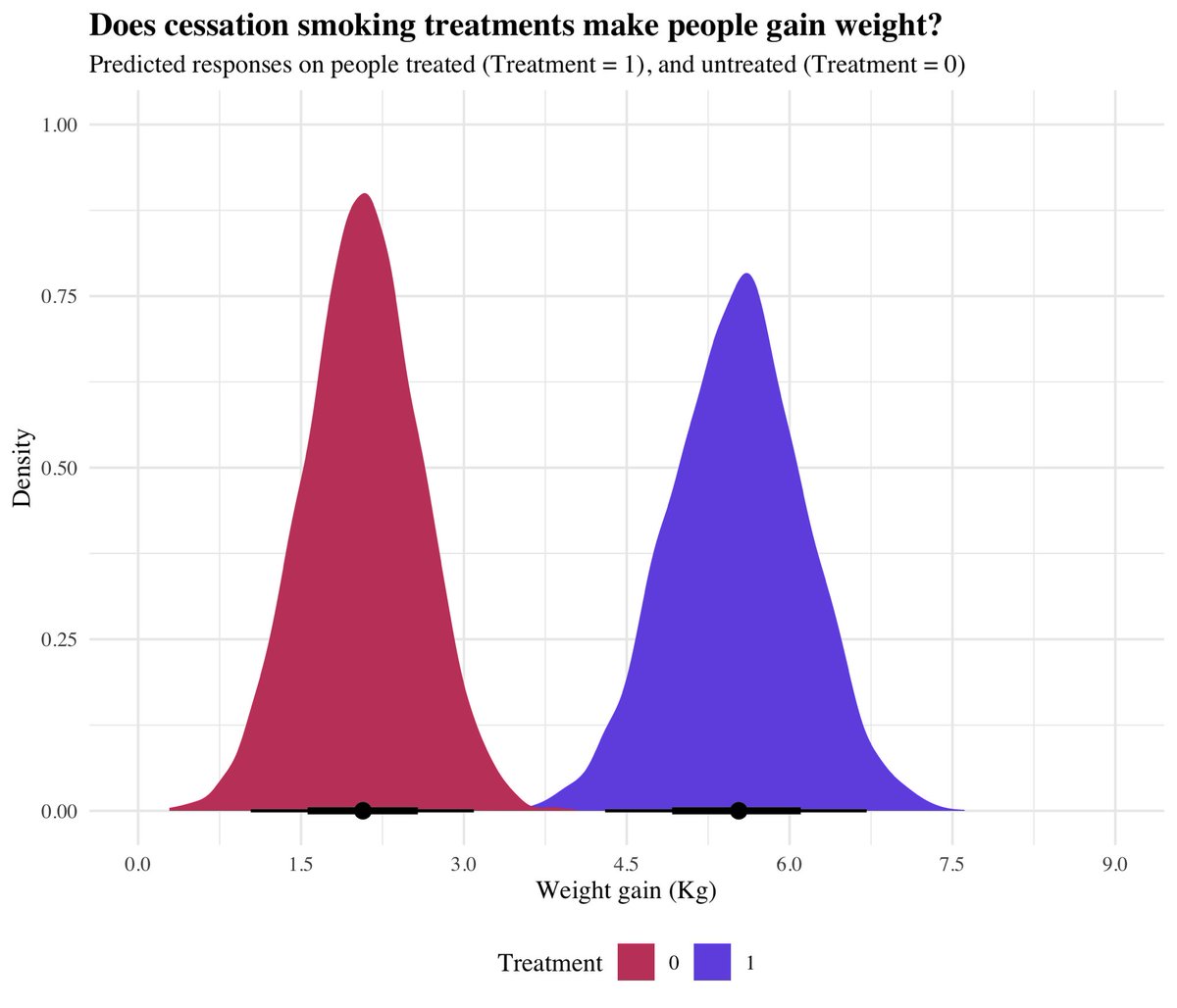
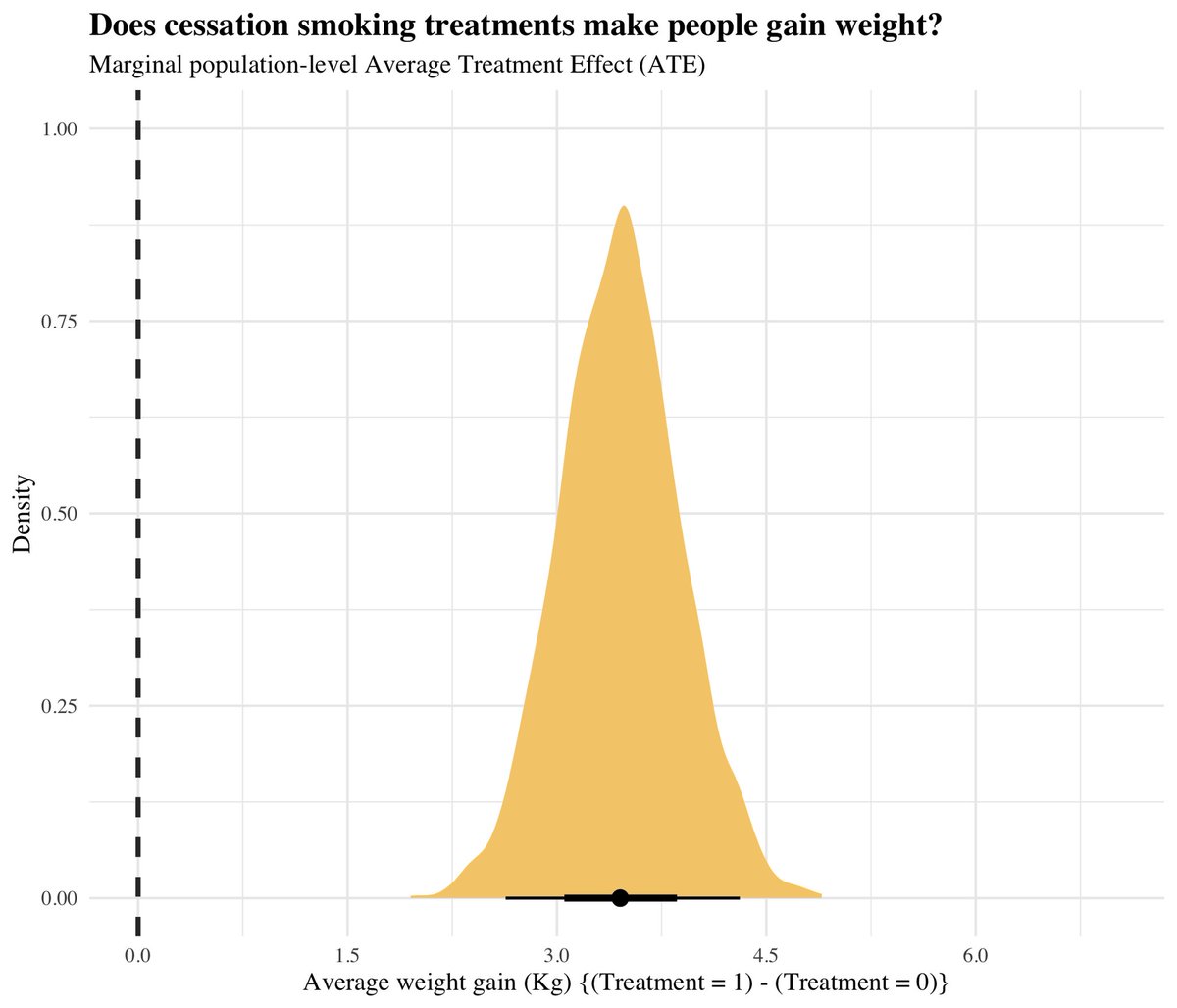
1
3
222

22 Dec 2024
Don't mind me... just working on an abomination over here...
#rstats #marginaleffects
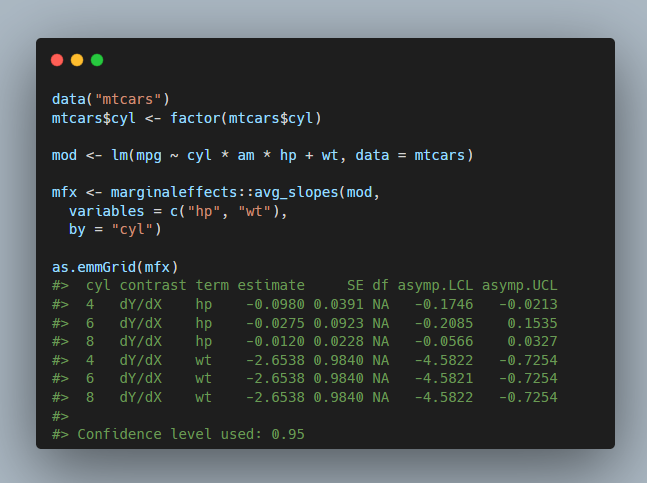
ALT Code of a function that convers objects from the marginaleffects package to an emmGrid object from the emmeans package.
2
365

2 Dec 2024
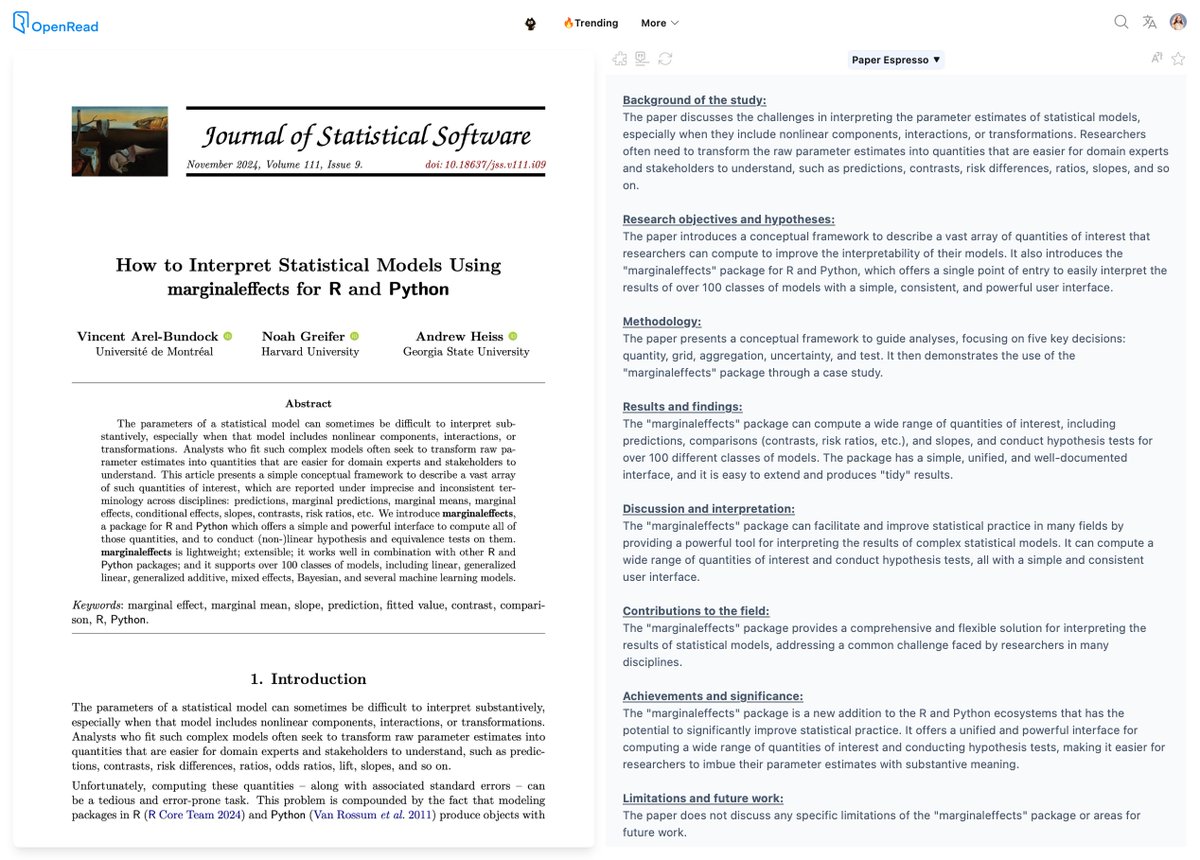
Results and findings:
openread.academy/en/paper/re…
The "marginaleffects" package can compute a wide range of quantities of interest, including predictions, comparisons (contrasts, risk ratios, etc.), and slopes, and conduct hypothesis tests for over 100 different classes of models. The package has a simple, unified, and well-documented interface, and it is easy to extend and produces "tidy" results.
3
6
493

1 Dec 2024
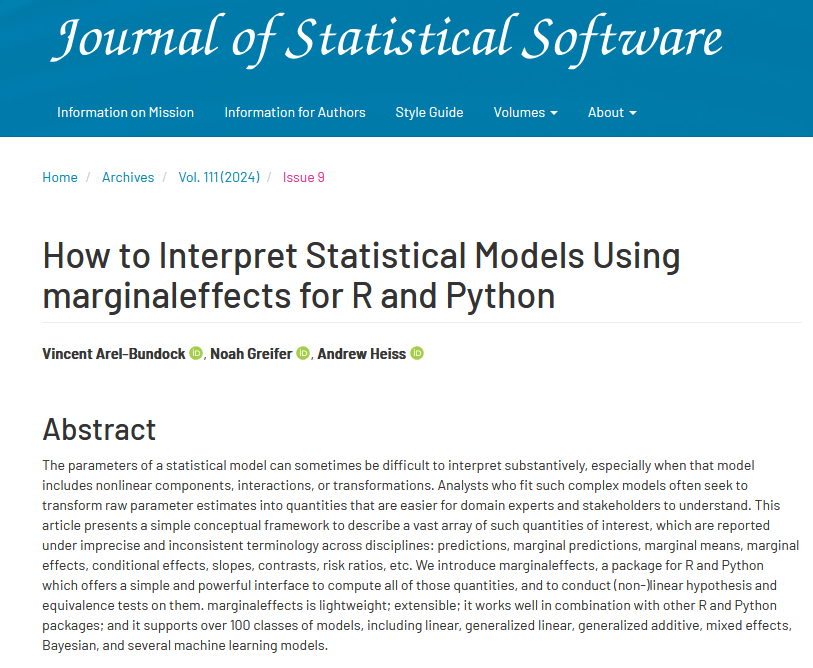
Our JSS article is out!
And now I get to focus on {marginaleffects} 1.0.0. Stay tuned.
jstatsoft.org/article/view/v…
7
140
752
45,425

1 Dec 2024
How to Interpret Statistical Models Using marginaleffects for R and Python. Vincent Arel-Bundock, Noah Greifer, Andrew Heiss. Journal of Statistical Software. jstatsoft.org/article/view/v…
10
48
2,653

1 Dec 2024
"[marginaleffects] supports over 100 classes of models, including linear, generalized linear, generalized additive, mixed effects, Bayesian, and . . ."
Arel-Bundock et al. (2024). How to Interpret Statistical Models Using marginaleffects for R and Python
doi.org/10.18637/jss.v111.i0…
1
4
11
964