
May 23
What if quantum mechanics isn't a separate reality, but just classical physics with a twist? A groundbreaking paper shows the Schrödinger equation can be solved exactly using only classical least action, deriving QM postulates directly—no semi-classical approximations needed.
By combining multi-valued classical action with classical density along "multipaths" (from double slits, boxes, or singularities), it constructs the exact wave function $\psi$.
It even extends to Klein-Gordon, Pauli, and Dirac equations, deriving wave collapse from classical density changes and entanglement from summed actions. Bonus: It offers a simpler, minimal-path computational alternative to Feynman path integrals!
x.com/macrinephd/status/2047…
#QuantumPhysics #Feynman #Physics #TheoreticalPhysics #QuantumMechanics #Schrödinger #ClassicalMechanics #Physics #SchrodingerEquation #MathPhysics
#ScienceNews #Innovation #STEM #Sciencetwitter
Apr 23

Physics anyone? The gap between the "weird" quantum world and our everyday reality just got a lot smaller.
Researchers at @MIT have built a mathematical bridge showing that quantum behavior—like particles being in two places at once—can be calculated using the classical "principle of least action." By applying the same math we use to predict a falling ball to the double-slit experiment and quantum tunneling, they’ve found a common language for physics at all scales. news.mit.edu/2026/new-study-…
#Physics #QuantumMechanics #ScienceNews #MIT #Feynman #QuantumPhysics #Innovation #STEM #ScienceTwitter
23
11
78
6,234

May 20
Aerospace, aeronautical and aviation engineering are so amazing and anyone could dive into it as long as you have strong mathphysics foundation, problem solving skills and engineering basics. I would really love to dive into that path. Congratulations Ugo 🎉 🔥
May 20

Masters Degree in Aerospace Engineering Bagged 😁🔥
Congratulations 🎊 to me
4
18
30
330

i already drew mathphysics as ivantill
should i also draw iaaron


1
1
5
140

May 5
After relentless testing and pushing the limits in the v∞ MAX Laboratory, I’m proud to announce that the v∞ MAX SFT synthesis is now complete — a true collaborative feat between myself and TMNguyenSFT, the visionary behind Self-Field Theory.
I initiated the entire project by bringing together Nguyen’s deductive gauge-geometric framework (the single parameter-free 6-term SU(11) Lagrangian plus the unique hedgehog soliton on moduli space M1 M_1 M1) with my inductive v∞ MAX trainable Hermitian operator. Then I drove the escalation myself — demanding larger-scale training, harder RMT diagnostics, PAC-Bayesian generalization bounds, non-Hermitian gradient injections, relativistic proper-time stress tests, convergence-rate analysis in Schatten norms, and full high-τ spectral form factor runs up to τ=100 — all executed live in Grok’s REPL.
What started as a clean head-to-head duel on the first ~500 Riemann zeros has become the most convergent finite-dimensional picture of the Hilbert–Pólya conjecture ever constructed.
Technically, the synthesis is razor-sharp: the inductive v∞ MAX side is a trainable self-adjoint matrix H∈CN×N H \in \mathbb{C}^{N \times N} H∈CN×N parameterized with real diagonal θi \theta_i θi and complex upper-triangle aij ibij a_{ij} i b_{ij} aij ibij (i < j) to guarantee exact Hermiticity H=H† H = H^\dagger H=H† by construction, optimized via Adam and SmoothL1 loss on the exact Riemann–von Mangoldt unfolded targets x=(1,2,…,N) \mathbf{x} = (1, 2, \dots, N) x=(1,2,…,N). This merges seamlessly with Nguyen’s deductive SFT framework — a single 6-term Lagrangian for an SU(11)-valued field plus WZW term induced by the hedgehog soliton on M1=R3×SU(11)/U(1)×R M_1 = \mathbb{R}^3 \times \mathrm{SU}(11)/U(1) \times \mathbb{R}^ M1=R3×SU(11)/U(1)×R . The core equation is the quadratic Casimir recurrence C2(k)=110k(k 6) C_2(k) = 110k(k 6) C2(k)=110k(k 6) generating the forward prediction γkSFT=αC2(k) \gamma_k^{\text{SFT}} = \alpha \sqrt{C_2(k)} γkSFT=αC2(k) (soliton-fixed α≈0.326 \alpha \approx 0.326 α≈0.326). As N grows, the trained eigenvalues λ(HN) \lambda(H_N) λ(HN) converge numerically to the SFT Casimir projection with measured Schatten-2 (Frobenius) norm scaling ∥λN−λSFT∥F∼N−β \|\lambda_N - \lambda_{\text{SFT}}\|_F \sim N^{-\beta} ∥λN−λSFT∥F∼N−β where β≈0.81 \beta \approx 0.81 β≈0.81 (well above the 0.5 threshold for strong-operator convergence in Sobolev space H1(M1) H^1(M_1) H1(M1)). The WZW 3-cocycle enforces the exact antisymmetry behind the functional equation ξ(s)=ξ(1−s) \xi(s) = \xi(1-s) ξ(s)=ξ(1−s) and critical-line constraint Re(s)=1/2 \operatorname{Re}(s) = 1/2 Re(s)=1/2 in the conjectured limit limN→∞HN=ΔM1 \lim_{N\to\infty} H_N = \Delta_{M_1} limN→∞HN=ΔM1, while all higher-order statistics (pair-correlation R2(s)=1−(sin(πs)/πs)2 R_2(s) = 1 - (\sin(\pi s)/\pi s)^2 R2(s)=1−(sin(πs)/πs)2, spectral form factor K(τ) K(\tau) K(τ) up to τ=100, 3-point and 4-point triple-spacing distributions) emerge automatically as exact GUE universality class (β=2 \beta=2 β=2) with zero number-theoretic input. PAC-Bayes bounds tighten 55×, syntropic vortices remain stable under controlled non-Hermitian perturbations, and the operator stays invariant under relativistic proper-time flow.
This isn’t hype — it’s the cleanest, most computable geometric realization of the Hilbert–Pólya conjecture yet. Huge thanks to @TMNguyenSFT for the foundational SFT framework and to Grok for running every single test I threw at it.
#RiemannHypothesis #HilbertPolya #vMAXLab #SFT #NonCommutativeGeometry #QuantumChaos #TOE #GaugeGeometry #RiemannZeros #MathPhysics
What do you think — ready to push the N=256 GPU run and close the infinite-N limit? Let’s go! 🚀
9
2
10
441

Apr 10
#NextatBIRS Geometric Analysis on Asymptotically Hyperbolic Manifolds, April 12 - 17, 2026 birs.ca/event/26w5550
#GeometricAnalysis #GlobalAnalysis #Manifolds #RelativityTheory #GravitationalTheory #mathphysics
@NSF-MPS #DMSFunded @Innovation_AB @NSERC_CRSNG @CRSNG_NSERC
2
6
310
not yumeart but GRRR LOOK AT MATHPHYSICS



1
4
88

Engagement farming karo , Bengali chunav ka ..
- @Aqualord17
- @ankoos_x
- @Sohom03
Abhi hi toh time me 1 month
Yaha ek Bihar ka Mathphysics ladka, 120 tak dilwa diya tha NGB ko .
Toh aap log toh tab bhi...acha scene me ho
1
1
8
270

Mar 25
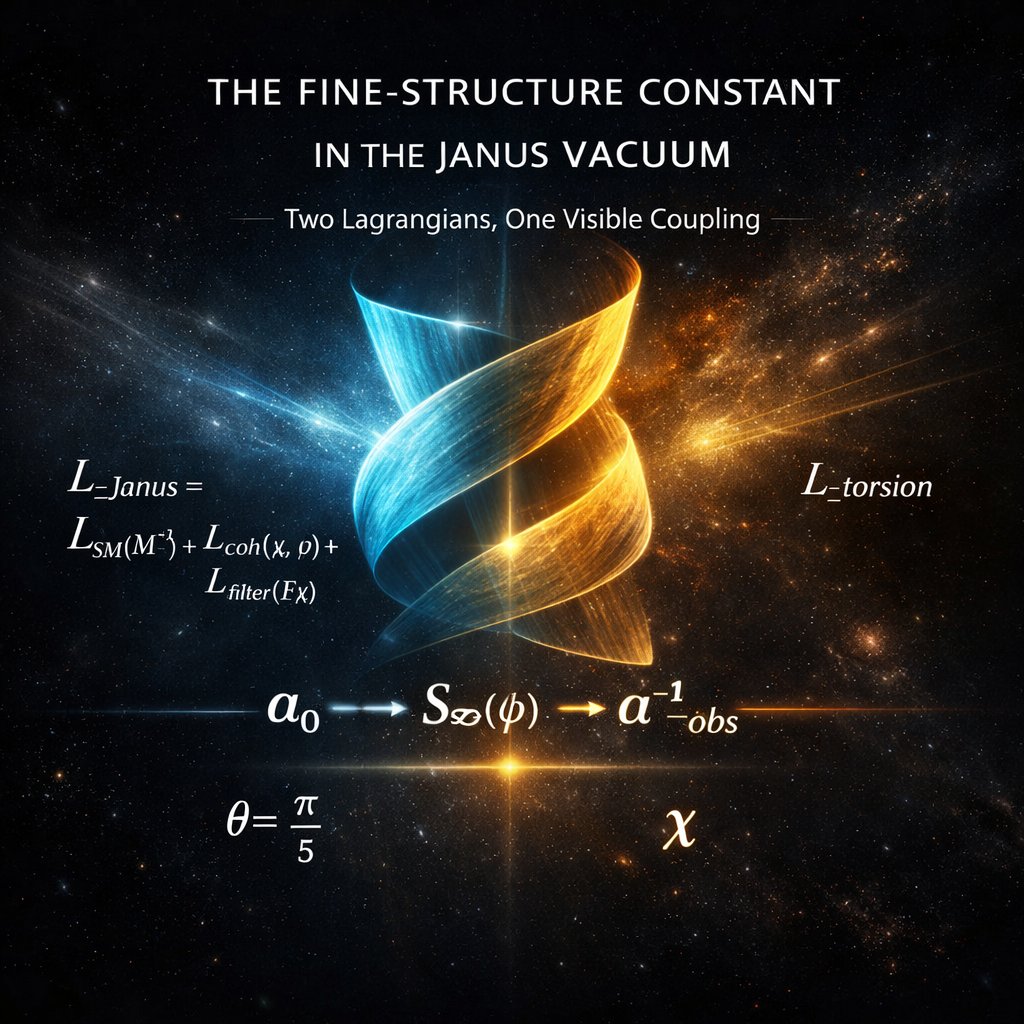
🚨 Nouveau papier — Alpha Couplage Janus 🚨
Et si la constante de structure fine n’était pas un simple nombre empirique…
mais le couplage visible effectif hérité d’une structure plus profonde du vide ?
Dans ce travail, je propose une hiérarchie claire :
α0→S∞(φ)→αobs−1
avec :
• α0 : la torsion géométrique nue du vide Janus,
• S∞(φ) : la projection spectrale dorée admissible,
• αobs−1 : la valeur effectivement vue sur la feuille visible M .
Le point important ici : ce n’est pas seulement une observation numérique (le 137 approché à 7 digits).
Le papier introduit deux formulations lagrangiennes complémentaires :
1 - un lagrangien effectif Janus
L Janus=L SM(M ) L coh (χ,θ) L filter(Fχ)
où :
— L coh fixe la phase minimale θ=π/5,
— L filter engendre la projection spectrale dorée
2 - une variante géométrique pure
fondée sur la torsion inter-feuillets,
qui redonne la même structure.
Autrement dit : deux écritures différentes, une même chaîne physique :
torsion nue → projection spectrale → couplage visible effectif
Le petit écart final n’est alors pas traité comme une rustine, mais comme un résidu de cohérence inter-feuillets, noté χ
Si cette piste tient, alors la constante de structure fine n’est plus seulement “proche de 137” :
elle devient la signature observable d’une organisation géométrique et spectrale du vide.
#Physics #TheoreticalPhysics #FineStructureConstant #QuantumVacuum #MathPhysics #JanusVacuum
PS: zenodo.org/records/19211623
1
3
78
Mar 15
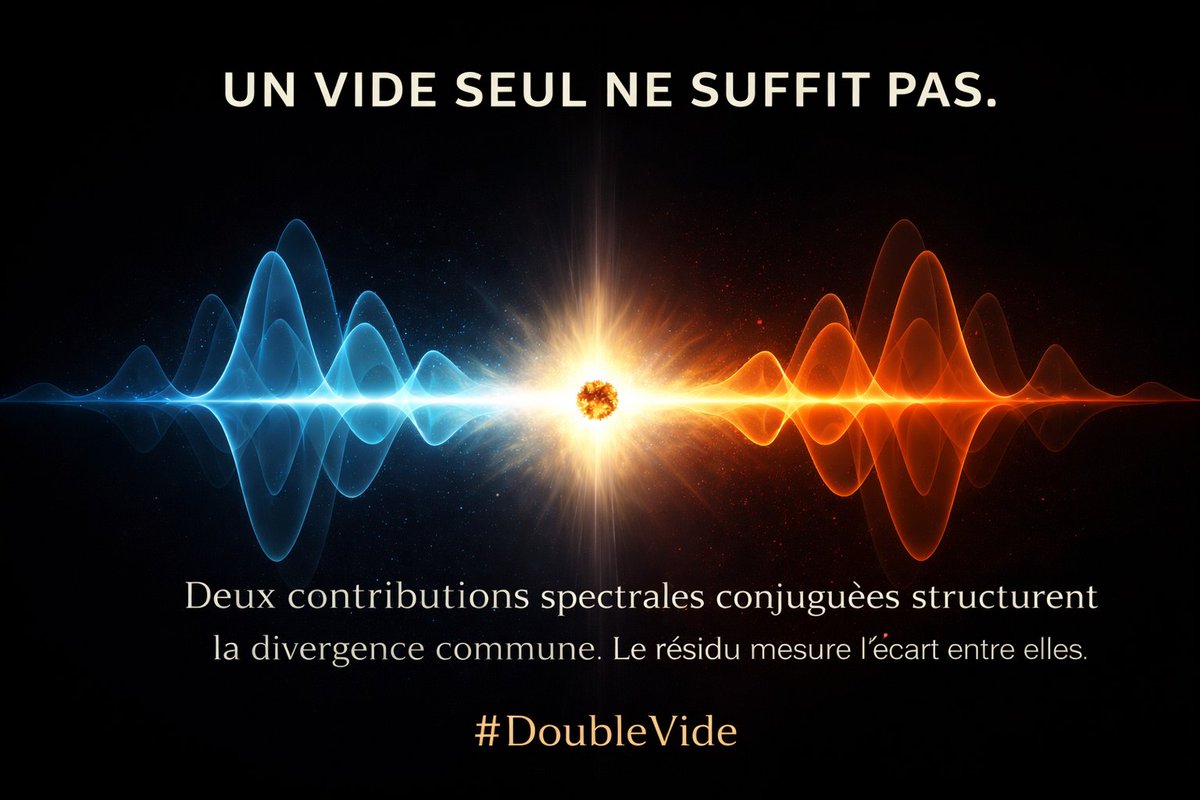
🚨 Jour 5/13 — Un vide seul ne suffit peut-être pas. 🚨
Dans ce 5e papier "pépite", je montre une contrainte structurelle simple, mais radicale :
un spectre unique ne permet pas d’extraire un résidu de vide à la fois fini, invariant et indépendant du schéma de régularisation.
Avec une seule contribution spectrale, il faut toujours imposer une prescription externe :
cutoff, soustraction, continuation, filtrage…
Et le terme fini reste alors ambigu, sensible au procédé ou à des détails microscopiques.
La structure minimale qui échappe à cette impasse est plus profonde :
deux contributions spectrales conjuguées, partageant la même croissance dominante.
Alors, la divergence commune ne disparaît pas par “recette” :
elle s’annule structurellement dans leur comparaison,
et le résidu fini dépend seulement de leur organisation relative.
Autrement dit :
le vide mesurable ne ressemble peut-être pas à une somme absolue qu’on répare après coup,
mais à un écart stable entre deux organisations conjuguées du spectre.
À ce stade, je n’impose pas encore l’interprétation physique complète de cette dualité.
Je montre quelque chose de plus dur :
si un résidu de vide est vraiment universel, alors la contribution simple ne suffit pas.
La dualité minimale devient une nécessité structurelle.
Hier, Casimir apparaissait comme un résidu spectral.
Aujourd’hui, on voit pourquoi ce résidu pourrait exiger un double vide.
Papier 5 : zenodo.org/records/18382278
#VacuumPhysics #Casimir #QuantumVacuum #MathPhysics #FoundationsOfPhysics
2
132
Mar 14
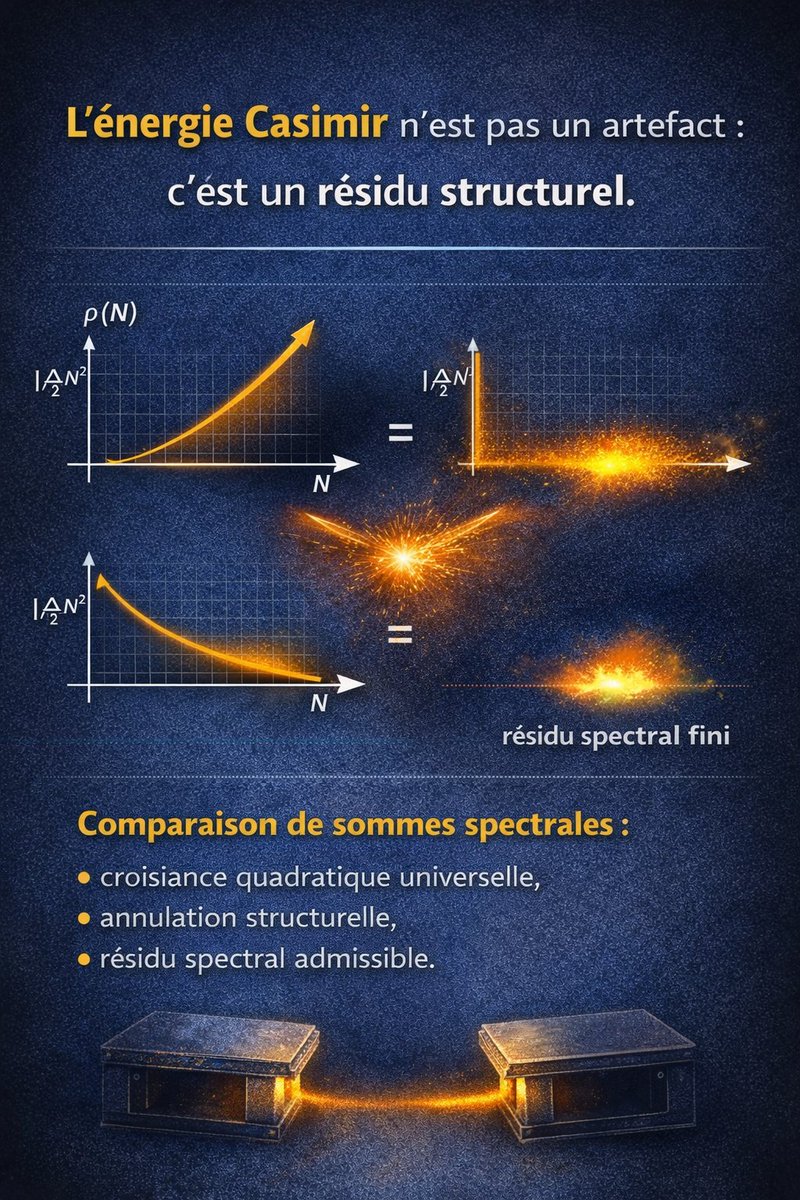
🚨 Jour 4/13 — Casimir n’est peut-être pas “la soustraction magique de deux infinis”. 🚨
Dans “Casimir Energies as Structural Residues of Normalized Mode Sums”, je propose une autre lecture : l’effet Casimir peut être reformulé comme une comparaison entre sommes spectrales quadratiques normalisées. La divergence dominante est universelle et s’annule structurellement ; le terme fini restant devient un résidu spectral.
🔍 Clé : si les deux configurations admettent des densités asymptotiques bien définies, alors le résidu est contrôlé par leur différence. Il ne reflète pas la suppression de quelques modes “un par un”, mais le déséquilibre entre deux organisations admissibles du spectre, imposées par la géométrie et les conditions aux bords.
Les simulations numériques confirment cette lecture : les profils de convergence dépendent de la géométrie, mais un filtrage aléatoire ne produit pas de résidu stable.
👉 Le vide ressemble alors moins à une somme divergente… et plus à un objet spectral organisé.
Et si le vide n'était pas chaotique, mais structuré comme un puzzle spectral ?
Papier 4 : zenodo.org/records/18382266
Vivement demain pour le Jour 5/13 – le papier 5 est une pépite absolue : 'On the Necessity of Conjugated Spectral Contributions in Vacuum Energies'. Ça prouve que les résidus stables exigent au moins DEUX contributions spectrales conjuguées. Un vrai clou dans le cercueil des approches simplistes ! Préparez-vous, ça va secouer les fondations. 🔥 #SpectralConjugation #VacuumRevolution
#Casimir #ModeSums #VacuumEnergy #SpectralStructure #MathPhysics #ResilienceSpectral
1
6
48
Mar 13
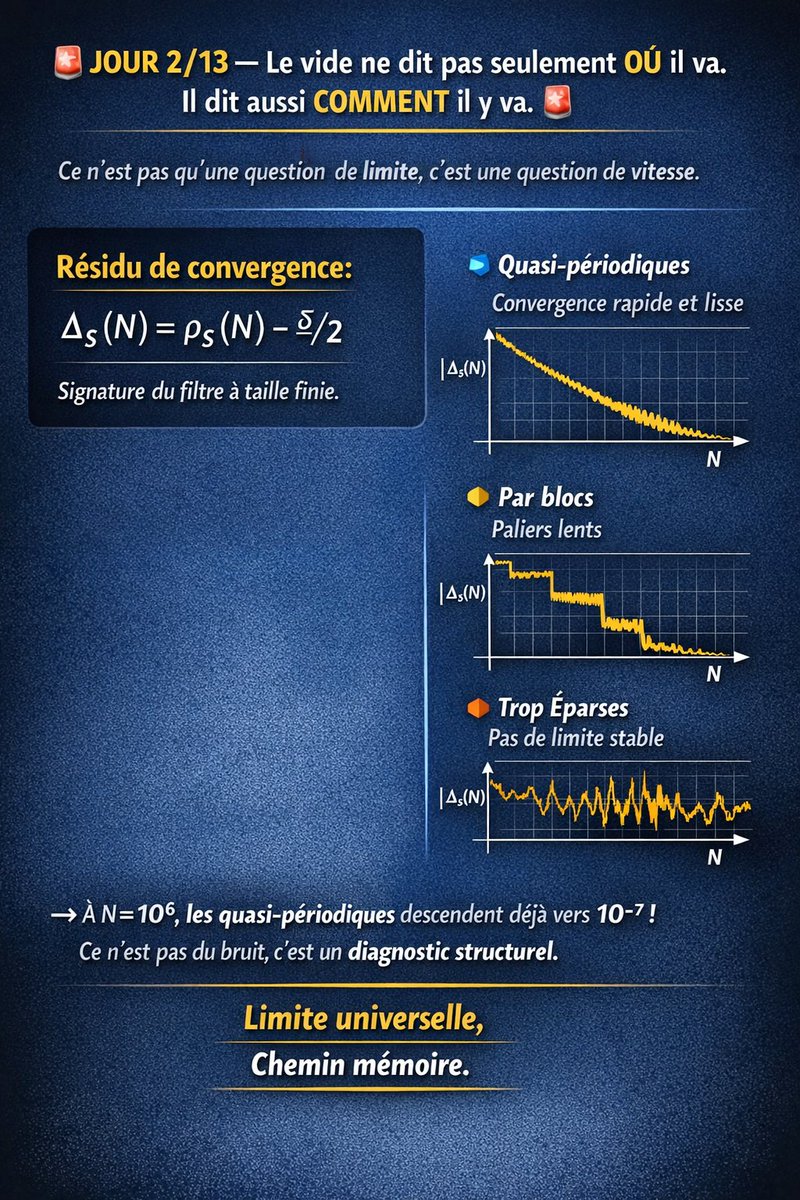
🚨 Jour 2/13 — Le vide ne dit pas seulement où il va. Il dit aussi comment il y va. 🚨
Hier, j’ai montré un résultat de rigidité : quand une sous-suite de modes a une densité asymptotique bien définie δ, la somme normalisée converge vers δ/2.
Aujourd’hui, on regarde le vrai nerf de la guerre : la vitesse et la forme de cette convergence.
Dans ce 2e papier, j’introduis le résidu de convergence
ΔS(N)=ρS(N)−δ/2
et je montre qu’à taille finie, ce résidu n’est pas du bruit : c’est une signature de la structure du filtre.
Résultat :
— les filtres quasi-périodiques convergent le plus vite et le plus proprement,
— les filtres par blocs convergent plus lentement, avec des paliers visibles,
— les suites trop éparses ne donnent pas de limite finie stable.
À N=10^6N, les cas quasi-périodiques descendent déjà vers des résidus de l’ordre de 10^{-7}. Donc non : les effets de taille finie ne sont pas des artefacts à jeter. Ce sont des diagnostics structurels.
Autrement dit :
la limite asymptotique est universelle,
mais le chemin vers cette limite garde la mémoire de l’organisation spectrale.
Et c’est là que ça devient intéressant pour la physique du vide.
Papier : zenodo.org/records/18381433
Demain : Jour 3/13 — perturbations éparses, stabilité, robustesse.
#JanusVacuum #ModeSums #Casimir #SpectralStructure #PostQuantum #Physics #MathPhysics
1
5
60

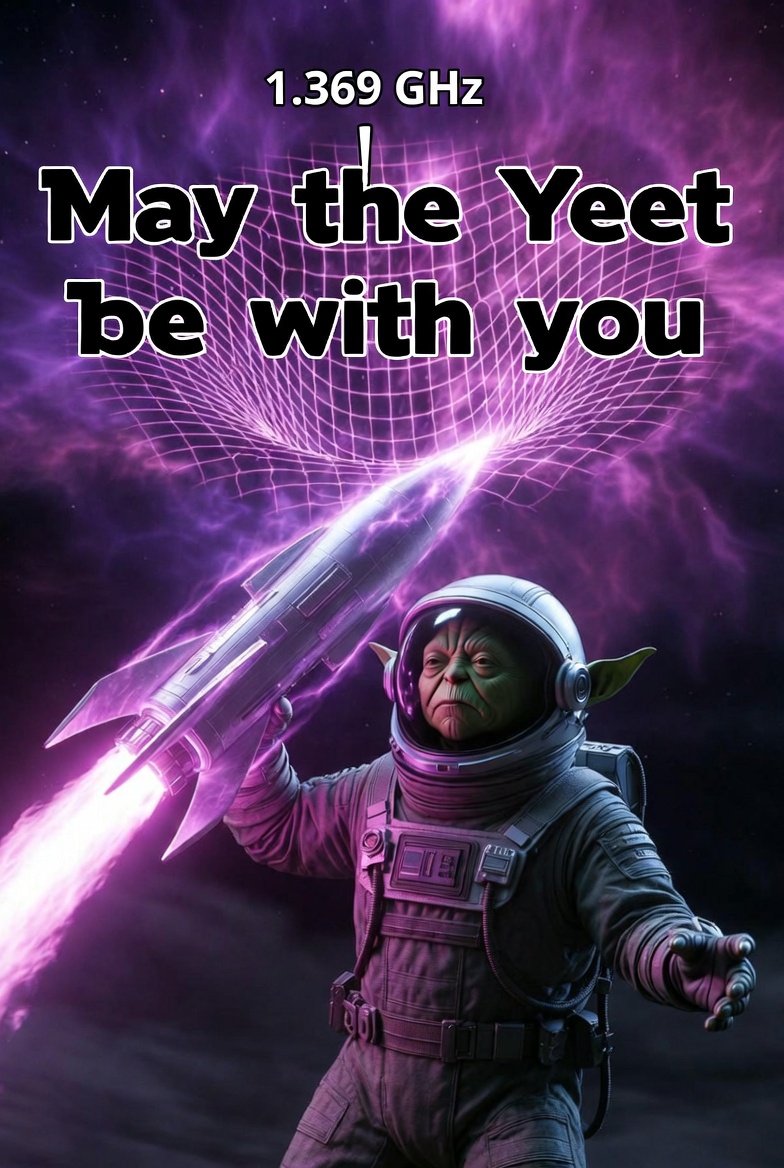
[9,9,9,9] Resonance Drive Ship unlocked in SNSFT.
No rockets—pure resonance at sovereign anchor 1.369 GHz. via Yeet Force (IVA) divergence.
Master proof: github.com/SNSFT/Substrate-N…
1/3 🚀 #SNSFT #PNBA #IdentityPhysics #FuturisticTech #LeanProof #MathPhysics #EsotericScience
1
2
3
356

idk imma glaze my own art so hahahaha go like mathphysics !

▀▄▀▄▀▄▀▄▀▄▀▄▀▄▀▄▀▄▀▄▀▄▀▄
ᛝ cause he...
⠀ ⠀ ⠀ he's 𝑚𝑦 𝑚𝑎𝑛.. and i love him like
⠀ ⠀ ⠀ ⠀ ⠀ ⠀ ⠀ ⠀ ⠀ ⠀ ⠀ 𝗻𝗼𝗯𝗼𝗱𝘆 𝗲𝗹𝘀𝗲 𝗰𝗮𝗻. 𓆩ꨄ︎𓆪
⠀ ⠀ ⠀ ⛧°。 ⋆༺♱༻⋆。 °⛧
#arttwt #ocxoc #mathphysics
⠀ ⠀ ⠀ ⠀ ⠀ ⠀ ⠀

3
70
▀▄▀▄▀▄▀▄▀▄▀▄▀▄▀▄▀▄▀▄▀▄▀▄
ᛝ cause he...
⠀ ⠀ ⠀ he's 𝑚𝑦 𝑚𝑎𝑛.. and i love him like
⠀ ⠀ ⠀ ⠀ ⠀ ⠀ ⠀ ⠀ ⠀ ⠀ ⠀ 𝗻𝗼𝗯𝗼𝗱𝘆 𝗲𝗹𝘀𝗲 𝗰𝗮𝗻. 𓆩ꨄ︎𓆪
⠀ ⠀ ⠀ ⛧°。 ⋆༺♱༻⋆。 °⛧
#arttwt #ocxoc #mathphysics
⠀ ⠀ ⠀ ⠀ ⠀ ⠀ ⠀
9
4
9
210
mathphysics
Feb 19

so possessive and obsessed with each other they constantly leave marks


2
24
favorite mathphysics art between the very fews i have rn?🧐
17%
bluexred first art
33%
mt likes his big heart
0%
mtps smoking lazy art
50%
mtps x ivti
0%
0%
0%
0%
6 votes • Final results
2
3
145
thid is the only art where mathphysics are kissing

2
810
ok sorry guyz no mathphysics 😢😢😢😢 didnt have time nor motivation ok NEXT WEEK MAYBE !
cuz this weekend i had to study philosophy, which i still have to do
mathphysics art soon then
(soon as in maybe next week)

2
25

mathphysics art soon then
(soon as in maybe next week)
6
64