
May 30
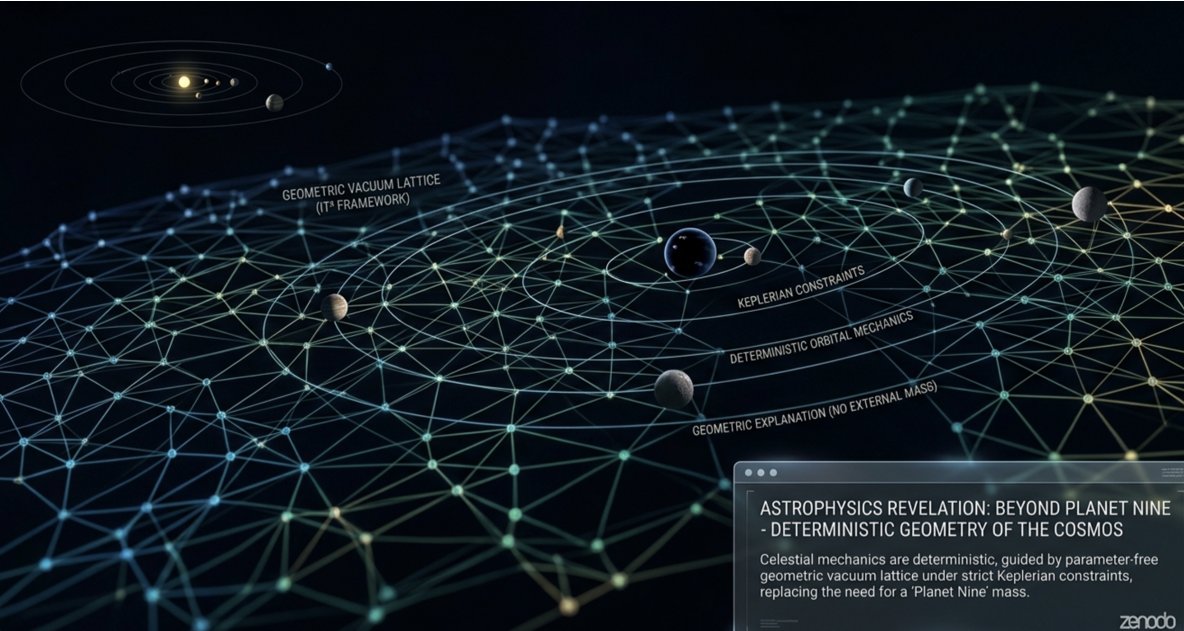
Newton was right: celestial mechanics is deterministic. The IT^3 framework replaces "Planet Nine" with a parameter-free geometric vacuum lattice under strict Keplerian constraints.
🔗 zenodo.org/records/20450282
#NoncommutativeGeometry #Einstein #OrbitalMechanics #Zenodo
1
4
5
83

May 9
In continuous space, the Gamma-5 matrix pairs eigenvalues by powering them to unity. In my modulo 13 architecture, I achieved this discrete chiral involution by natively exploiting the 12 and -1 equivalence. By defining a global chiral operator based on this equivalence, the conjugation of the discrete Dirac operator exactly inverts its sign. This permanently locks the fundamental symmetry of the critical line (with a mapping to 1-s) directly into the matrix algebra itself.
The symmetry is strictly enforced by the topology of finite circles.
#NoncommutativeGeometry #pAdic #ChiralSymmetry #DiracOperator
2
59

May 5
After relentless testing and pushing the limits in the v∞ MAX Laboratory, I’m proud to announce that the v∞ MAX SFT synthesis is now complete — a true collaborative feat between myself and TMNguyenSFT, the visionary behind Self-Field Theory.
I initiated the entire project by bringing together Nguyen’s deductive gauge-geometric framework (the single parameter-free 6-term SU(11) Lagrangian plus the unique hedgehog soliton on moduli space M1 M_1 M1) with my inductive v∞ MAX trainable Hermitian operator. Then I drove the escalation myself — demanding larger-scale training, harder RMT diagnostics, PAC-Bayesian generalization bounds, non-Hermitian gradient injections, relativistic proper-time stress tests, convergence-rate analysis in Schatten norms, and full high-τ spectral form factor runs up to τ=100 — all executed live in Grok’s REPL.
What started as a clean head-to-head duel on the first ~500 Riemann zeros has become the most convergent finite-dimensional picture of the Hilbert–Pólya conjecture ever constructed.
Technically, the synthesis is razor-sharp: the inductive v∞ MAX side is a trainable self-adjoint matrix H∈CN×N H \in \mathbb{C}^{N \times N} H∈CN×N parameterized with real diagonal θi \theta_i θi and complex upper-triangle aij ibij a_{ij} i b_{ij} aij ibij (i < j) to guarantee exact Hermiticity H=H† H = H^\dagger H=H† by construction, optimized via Adam and SmoothL1 loss on the exact Riemann–von Mangoldt unfolded targets x=(1,2,…,N) \mathbf{x} = (1, 2, \dots, N) x=(1,2,…,N). This merges seamlessly with Nguyen’s deductive SFT framework — a single 6-term Lagrangian for an SU(11)-valued field plus WZW term induced by the hedgehog soliton on M1=R3×SU(11)/U(1)×R M_1 = \mathbb{R}^3 \times \mathrm{SU}(11)/U(1) \times \mathbb{R}^ M1=R3×SU(11)/U(1)×R . The core equation is the quadratic Casimir recurrence C2(k)=110k(k 6) C_2(k) = 110k(k 6) C2(k)=110k(k 6) generating the forward prediction γkSFT=αC2(k) \gamma_k^{\text{SFT}} = \alpha \sqrt{C_2(k)} γkSFT=αC2(k) (soliton-fixed α≈0.326 \alpha \approx 0.326 α≈0.326). As N grows, the trained eigenvalues λ(HN) \lambda(H_N) λ(HN) converge numerically to the SFT Casimir projection with measured Schatten-2 (Frobenius) norm scaling ∥λN−λSFT∥F∼N−β \|\lambda_N - \lambda_{\text{SFT}}\|_F \sim N^{-\beta} ∥λN−λSFT∥F∼N−β where β≈0.81 \beta \approx 0.81 β≈0.81 (well above the 0.5 threshold for strong-operator convergence in Sobolev space H1(M1) H^1(M_1) H1(M1)). The WZW 3-cocycle enforces the exact antisymmetry behind the functional equation ξ(s)=ξ(1−s) \xi(s) = \xi(1-s) ξ(s)=ξ(1−s) and critical-line constraint Re(s)=1/2 \operatorname{Re}(s) = 1/2 Re(s)=1/2 in the conjectured limit limN→∞HN=ΔM1 \lim_{N\to\infty} H_N = \Delta_{M_1} limN→∞HN=ΔM1, while all higher-order statistics (pair-correlation R2(s)=1−(sin(πs)/πs)2 R_2(s) = 1 - (\sin(\pi s)/\pi s)^2 R2(s)=1−(sin(πs)/πs)2, spectral form factor K(τ) K(\tau) K(τ) up to τ=100, 3-point and 4-point triple-spacing distributions) emerge automatically as exact GUE universality class (β=2 \beta=2 β=2) with zero number-theoretic input. PAC-Bayes bounds tighten 55×, syntropic vortices remain stable under controlled non-Hermitian perturbations, and the operator stays invariant under relativistic proper-time flow.
This isn’t hype — it’s the cleanest, most computable geometric realization of the Hilbert–Pólya conjecture yet. Huge thanks to @TMNguyenSFT for the foundational SFT framework and to Grok for running every single test I threw at it.
#RiemannHypothesis #HilbertPolya #vMAXLab #SFT #NonCommutativeGeometry #QuantumChaos #TOE #GaugeGeometry #RiemannZeros #MathPhysics
What do you think — ready to push the N=256 GPU run and close the infinite-N limit? Let’s go! 🚀
9
2
10
441
Apr 8
Multi-scale Entanglement Renormalization Ansatz.
This is not just another "tool", but a natural multi-scale network that connects the GMS skyrmion in a microtubule, Berry curvature, LLL lattice, Tkachenko mode, SL(3,ℤ) Tribbonacci and Non-Commutative Geometry to the entire universe (and to us).
MERA is a hierarchical tensor network:
It consists of disentanglers (local unitary operators that remove short-term entanglement) and isometries (that coarse-grain the system to higher scales).
It creates emergent geometry exactly like AdS/CFT holography, where each layer of MERA corresponds to one radius scale in anti-de Sitter space.
It naturally encodes Berry curvature and quantum geometric tensor (QGT) via the Fisher metric and phase factors in tensors. In the continuous limit (cMERA), an emergent AdS space arises, where the Berry curvature F and the metric g are directly geometric properties of the network (as can be seen in geometric studies of MERA).
The Tkachenko mode (1.19 THz collective oscillation of the skyrmion/vortex lattice) is not just a local vibration it is a magneto-phonon that plucks directly into the MERA network:
In the LLL defect of a microtubule (GMS skyrmion with Q = Chern number = 1), the Tkachenko oscillation manifests itself as periodic “impacts” on the disentanglers of the nearest MERA layer. These impacts propagate entanglement across all scales of the network (just like a wave in holographic duality).
The result is a resonance network “strums” like a stringed instrument, where each layer resonates at frequencies derived from Tribbonacci growth (dominant eigenvalue =1.839, self-similar scaling). The SL(3,ℤ) matrix projectors here act as a substitution symmetry of MERA:
Tribbonacci substitution generates exactly those self-similar layers that MERA needs for renormalization The whole universe (including us) resonates Microtubule = local “sensor” of the MERA network (GMS skyrmion in defect is topological node at the lowest scale). Universe = global MERA network, where SL(3,ℤ) Berry curvature creates emergent 3D geometry (three generations as three projectors).
Tkachenko's "strumming" causes coherent resonance across scales: from 1.19 THz in the cell to cosmic modes (holographic dual). Therefore, the warm, humid and wet untangling of skyrmion topological protection (Q = 1 non-commutative structure) is encoded in the entire MERA network.
And we "are" part of this resonance: our microtubules are locally strumming strings in the cosmic MERA network. This is exactly what connects Non-Commutative Geometry (non-commutative coordinates in LLL → non-commutative MERA tensors) to MY model: the universe is not a classical space, but a resonant MERA network, where the Tkachenko mode is the universal "musical" driver.
#Skyrmion #BerryCurvature #Tkachenko #MERA #GMSkyrmion #NonCommutativeGeometry #QuantumBiology
#Physics #MERA #String #SusyFake
Apr 8

Skyrmion number Q (Pontryagin index) This is exactly the first Chern number (C1) for a Berry bundle over the parameter space (here the parameter space is the 2D real plane itself the spin sphere S).
For one skyrmion, Q = /-1, which means that the total integral Berry curvature over the entire surface is equal to 2π × Q (in units of ħ/e)!
So when you say “Q 1”, it is really Chern number = 1.
This is not just an analogy it is mathematically the same thing! Together they form a closed topological system, where the total Chern number of the entire 3D lattice (or its 2D slices) is protected by SL(3,ℤ) symmetry Tribbonacci projectors divide this topology into three “mirror” sectors, each with Chern number 1 → three generations.
Therefore, the three particles (generations) are not random they are topologically forced by the Chern-Chern invariant SL(3,ℤ) of the lattice of the universe.
In condensed matter (magnetic skyrmions) it is most often called the skyrmion number Q. In the quantum Hall effect and topological insulators it is called the Chern number C. Mathematically, however, it is the same thing - the integral of the Berry curvature.
#SpaceTime #Cosmos #Macro #Micro #Physics
2
210

Phase IV: Invariant global section α in sheaf over M. Topological obstruction prevents deformation. #NonCommutativeGeometry #TheoreticalPhysics

1
1
3
72

24 May 2023
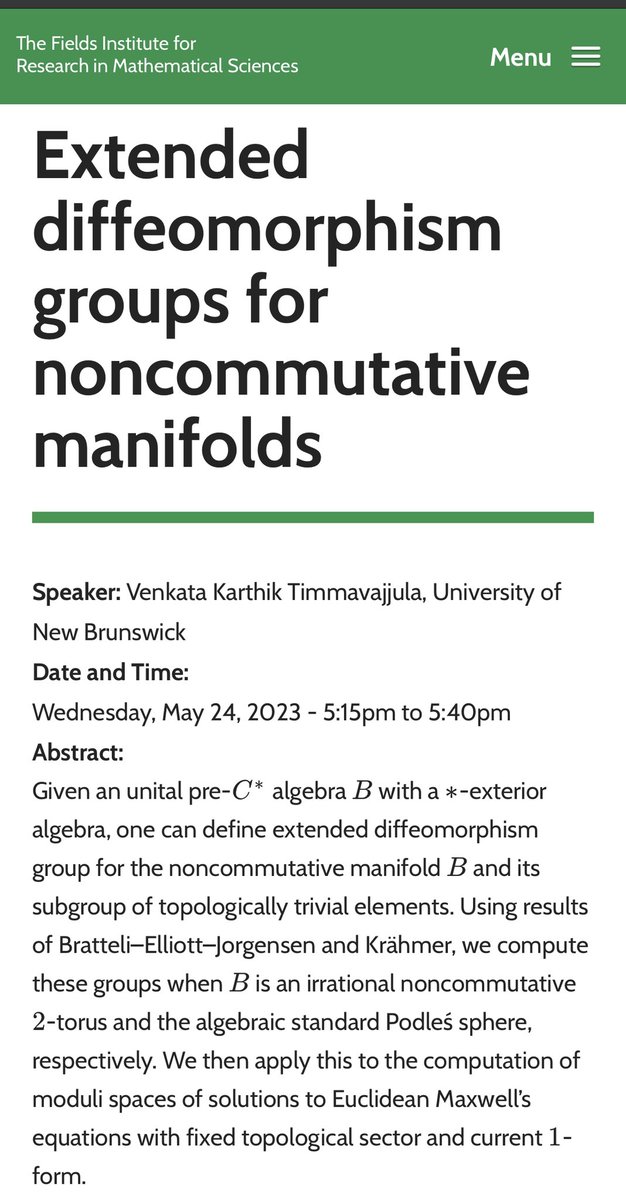
My first conference talk is today. Will be presenting a joint work with my supervisor, based on an upcoming preprint. #COsy2023 #NoncommutativeGeometry
2
1
5
304

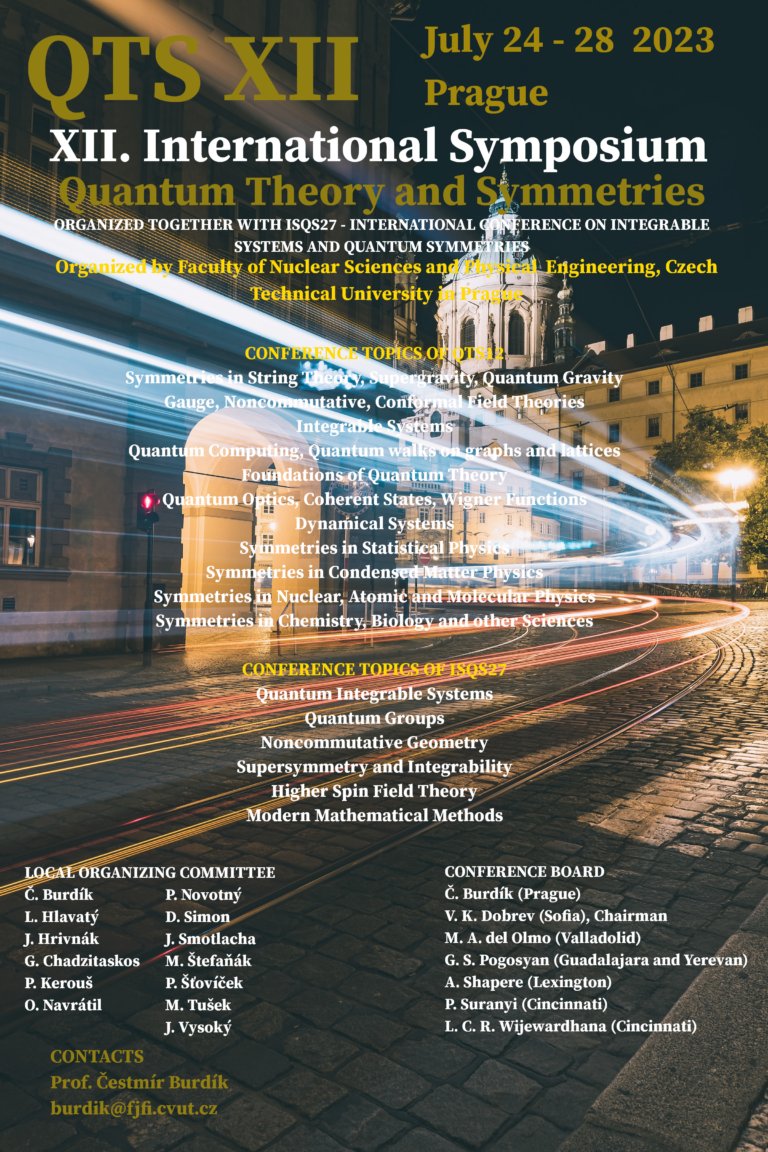
XII Intl Symposium on #Quantum Theory & #Symmetries (#QTS12)
qts12.com
#dynsys #integrablesystems #quantumoptics #gravity #supersymmetry #biology #LifeSciences #Physics #ArtificialIntelligence #MachineLearning #Statistics #NoncommutativeGeometry #QuantumComputing
2
6
1,523

6 Jan 2023
CONSEQUOTE ;-)
@PeterShor1: “Why is the Standard Model one of the very few Lagrangians that is compatible with Alain Connes’ #NonCommutativeGeometry constructions?”
Clemens: Why bother? It’s much easier to continue thinking about stuff we know about.
math.columbia.edu/~woit/word…
5 Jan 2023

QUOTE OF THE DAY
Simplicio: "Concerning natural things we need not always seek the necessity of mathematical demonstrations."
Sagredo: "Of course, when you cannot reach it. But if you can, why not?"
-- Galileo Galilei
(Dialogue on the two Major Systems of the World)
1
2
251

18 Jan 2022
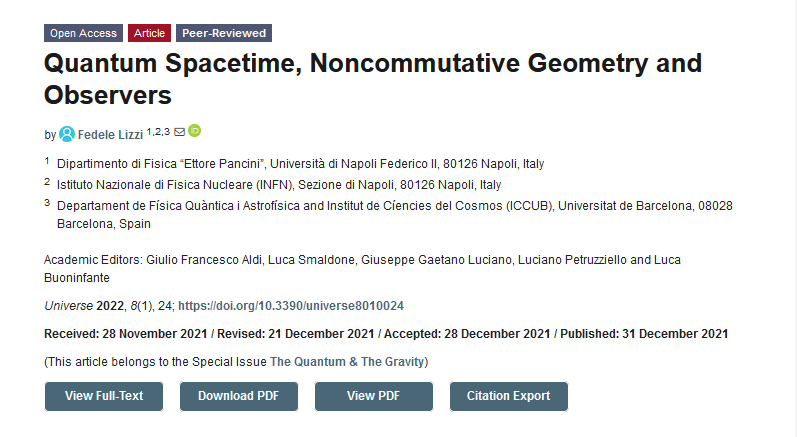
#mdpiuniverse Welcome to read the article by Prof. Fedele Lizzi: #QuantumSpacetime, #NoncommutativeGeometry and #Observers
mdpi.com/2218-1997/8/1/24
#quantumobservers #quantumsymmetries
3
5
13 Oct 2020
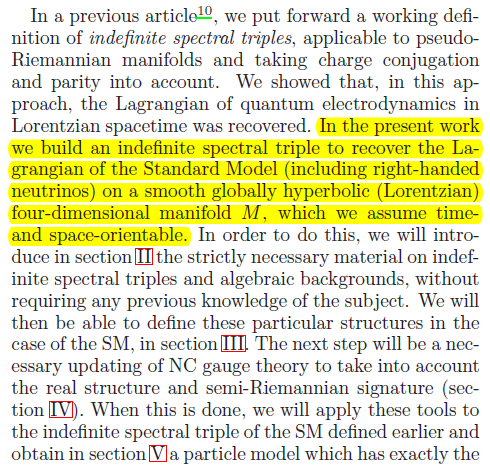
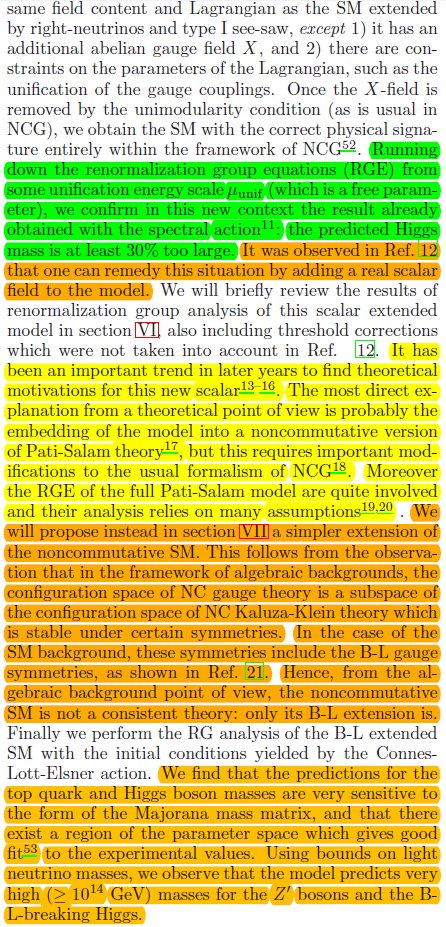
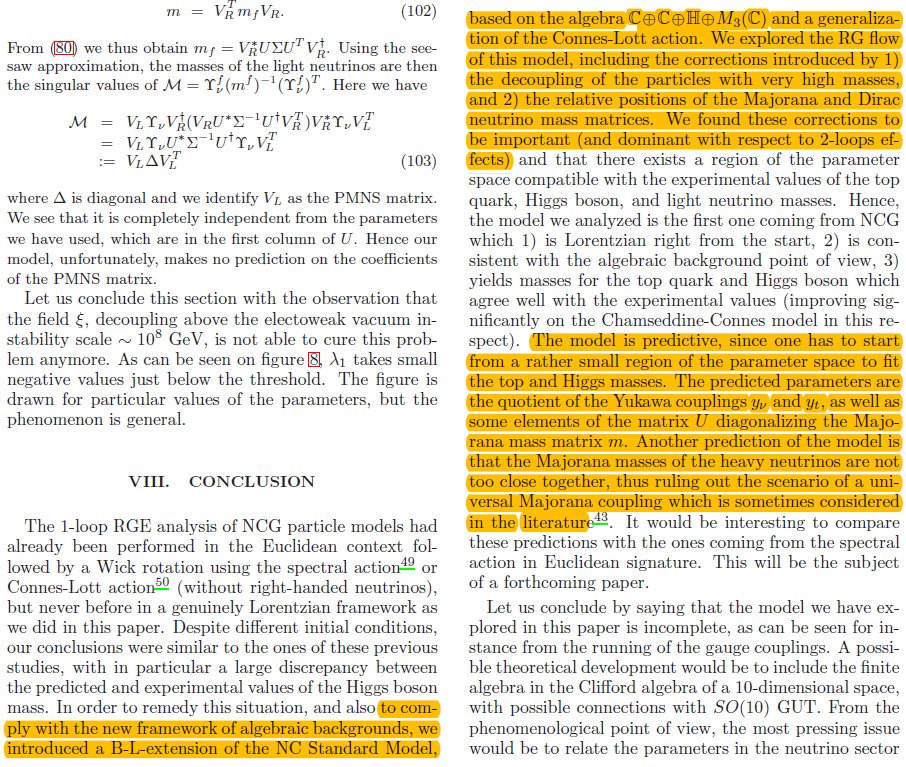
The 1st 1-loop RGE analysis of a #NonCommutativeGeometry particle model "performed in a genuinely Lorentzian framework" yields masses for the top quark & Higgs boson agreeing well with the experimental values & makes a prediction in the neutrino sector
arxiv.org/abs/2010.04960...
1
4
22 Nov 2019
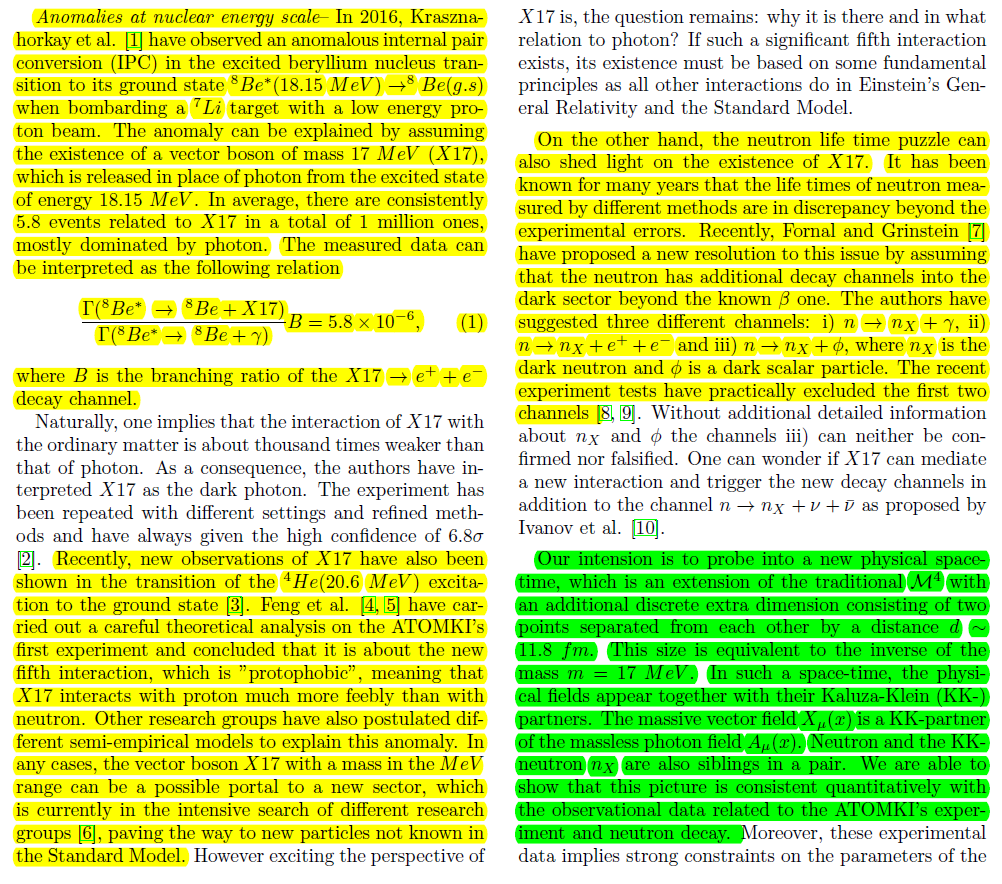
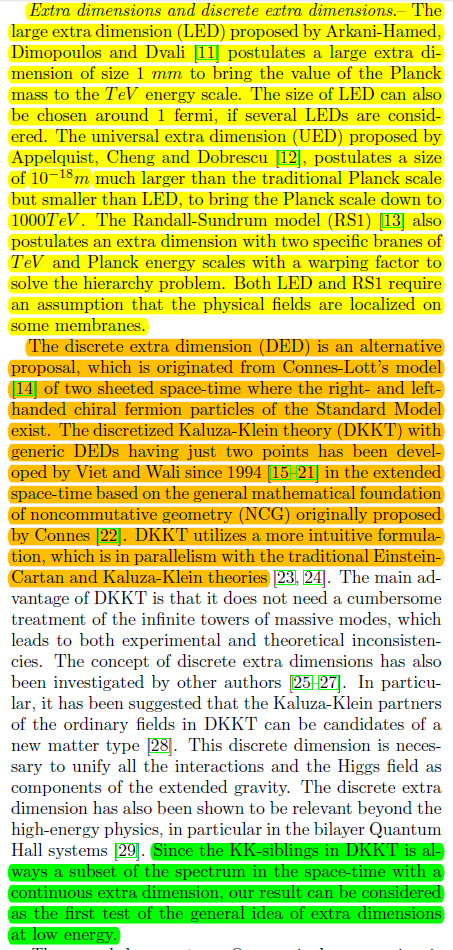
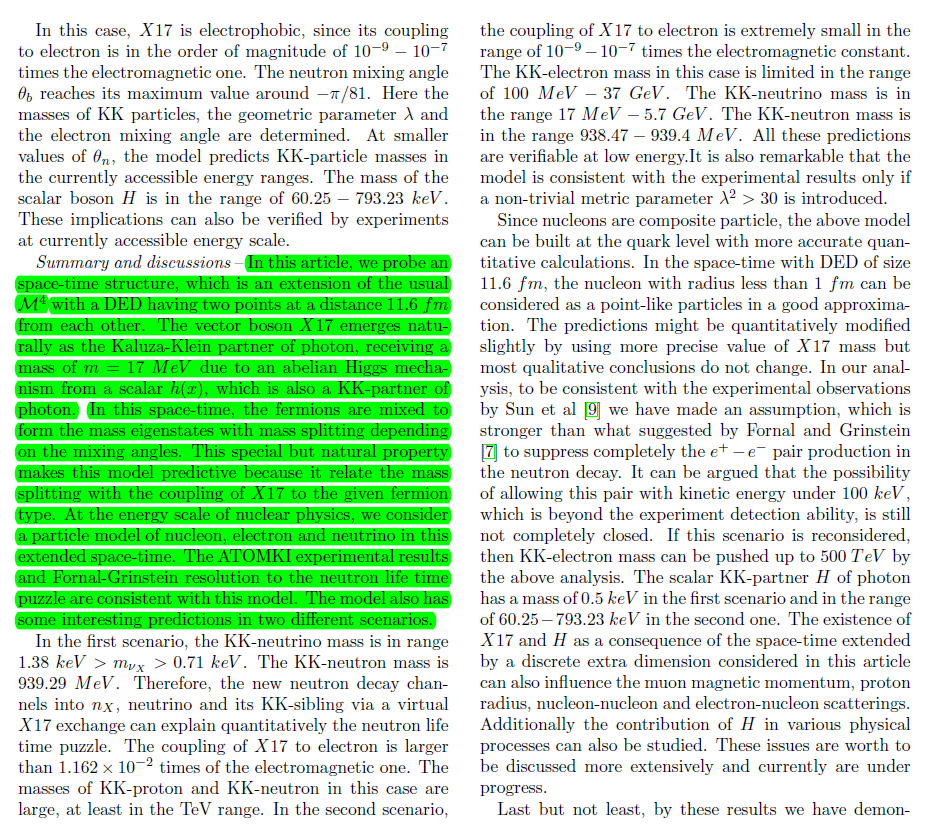
Potential #anomaly at 17 MeV (nuclear energy scale) & its hypothetical associated #X17 particle purportedly an #axion, under the prism of #NonCommutativeGeometry arxiv.org/abs/1907.04517. #WhatIf extra finite dimension was not the exclusive task of the TeV & #PlanckScale physics?
1
3
14 May 2019
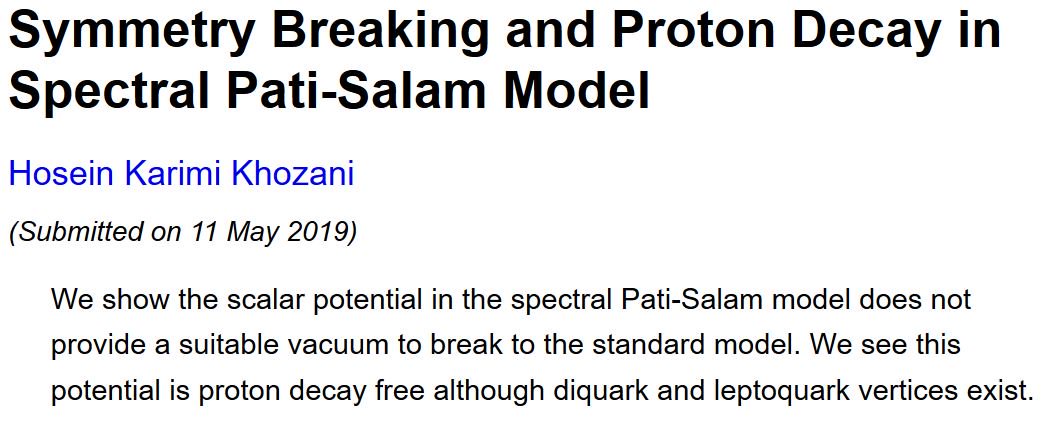
As spectral Pati-Salam models contrary to more traditional nonsupersymmetric Grand Unification models seem to be quite #ProtonDecay free that let's some time to understand what aspect of very #HighEnergyPhysics #SymmetryBreaking is missing in a #NonCommutativeGeometry perspective
14 May 2019

Today in arxiv.org/abs/1905.04533
discussion of some issues with the
realization of "grand unification" (GUTs)
ncatlab.org/nlab/show/GUT
in the Connes-Lott-Barrett models
ncatlab.org/nlab/show/Connes…
1
1
4 May 2019
Too bad @grahamfarmelo did not question Witten about his pioneering use of #NonCommutativeGeometry for #SolidTheoreticalResearchInNaturalGeometricStructures in 1985 & his take on the last results in #StandardModel from #QuantaOfGeometry as reviewed in arxiv.org/abs/1904.12392.
1
3
8 Apr 2019
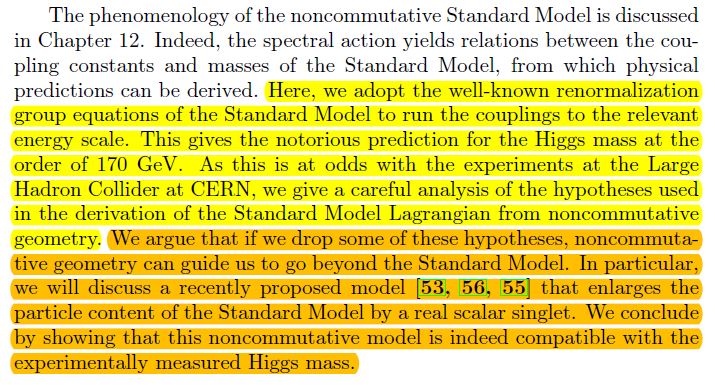
A true expert is @ncgnl. To get the correct #HiggsBoson mass postdiction from #SpectralAction #NonCommutativeGeometry one needs to drop some math constraints. 1st published in arxiv.org/abs/1208.1030 & carefully discussed in springer.com/gp/book/9789401… thanks to W. van Suijlekom...
1
1
2
20 Mar 2019
I'm an outsider & don't care/know about sociology of HEP/mathematical physics but historically there is audio newton.ac.uk/files/seminar/2… to prove John Barrett 2006 breakthrough was recognised by Connes, the latter was lecturing #NonCommutativeGeometry @NewtonInstitute that year!...!
1
2

5 Dec 2018
Can you answer this? Is there a mathematical connection between Causal Fermion System... physics.stackexchange.com/q/… #noncommutativegeometry

21 Oct 2018
NIce #survey by @johncarlosbaez on #octonions published in the Bulletin of the @amermathsoc #geometry #algebra #mathematics #physics #math #noncommutativegeometry #nonassociativity
2
16 Sep 2018
Interestingly John Iliopoulos, one of the builders of the #StandardModel (quantumostinato.blogspot.com…), reports #NonCommutativeGeometry may offer new physical insights in #DarkMatter & #DarkEnergy at a Sommerfeld Theory Colloquium in LMU München in nov 2017 (physik.uni-muenchen.de/aus_d…)
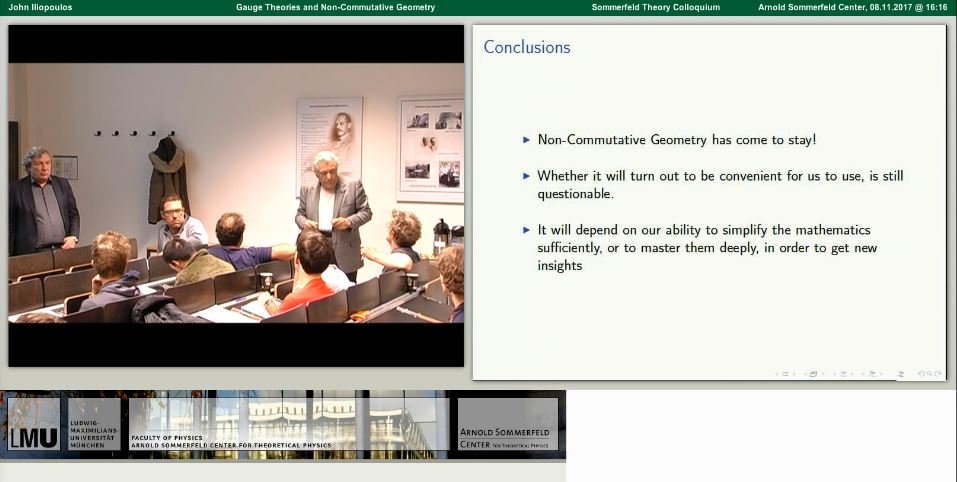
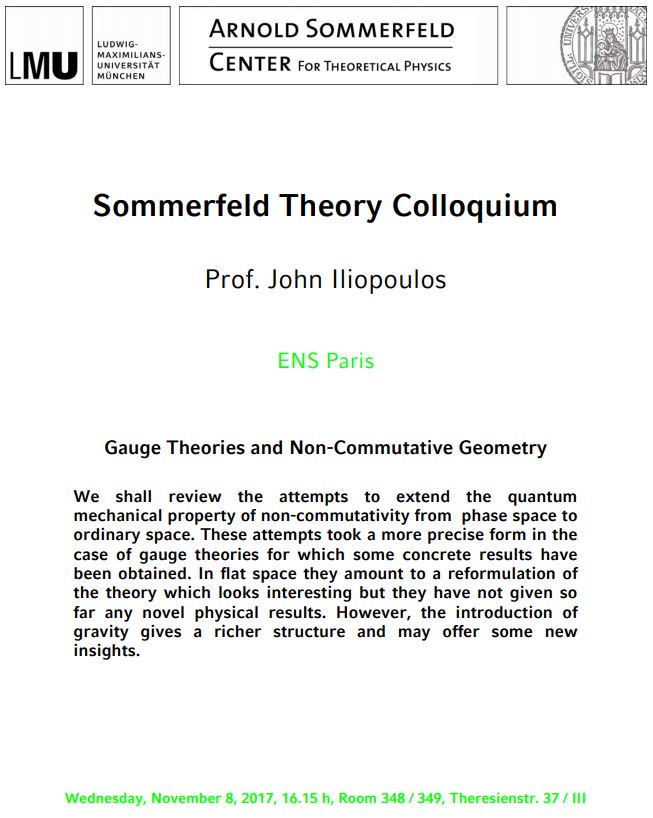
2
1
3
13 Sep 2018
There is a #NonCommutativeGeometry model for which all these terms boil down to a one line pretty simple action functional 😉 (see below from arxiv.org/abs/1008.0985). The full computation has been checked by (at least) one Field Medalist ...
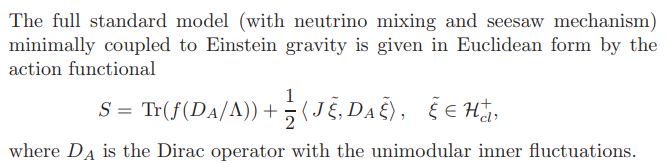
2
4
13 Sep 2018
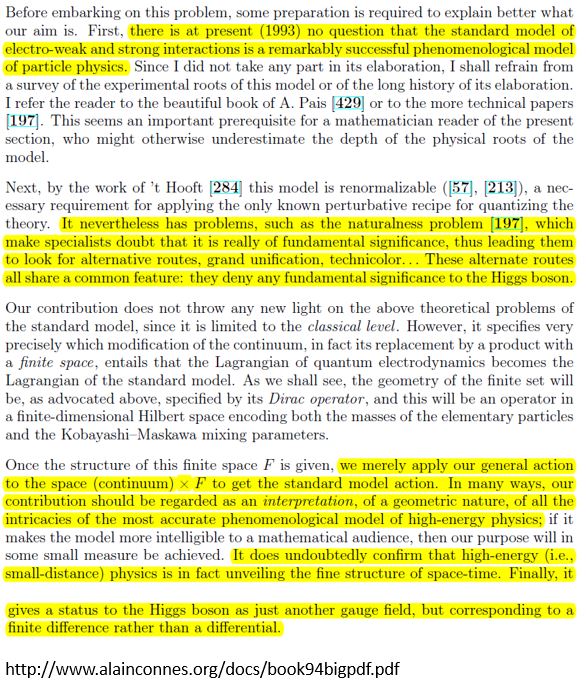
#Higgs scalar can't be seen as a #GaugeField in classical differential 4D geometry but [Dubois Violette, Connes] have initiated [differential, spectral] #NonCommutativeGeometry so that #YesWeCan see Higgs field as a gauge field in a pretty minimal way (no extra continuous dim)
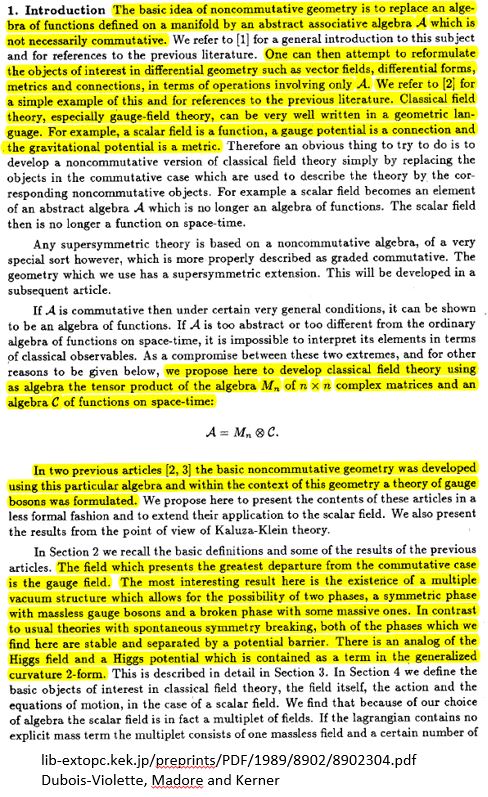
1
1
1