
May 4
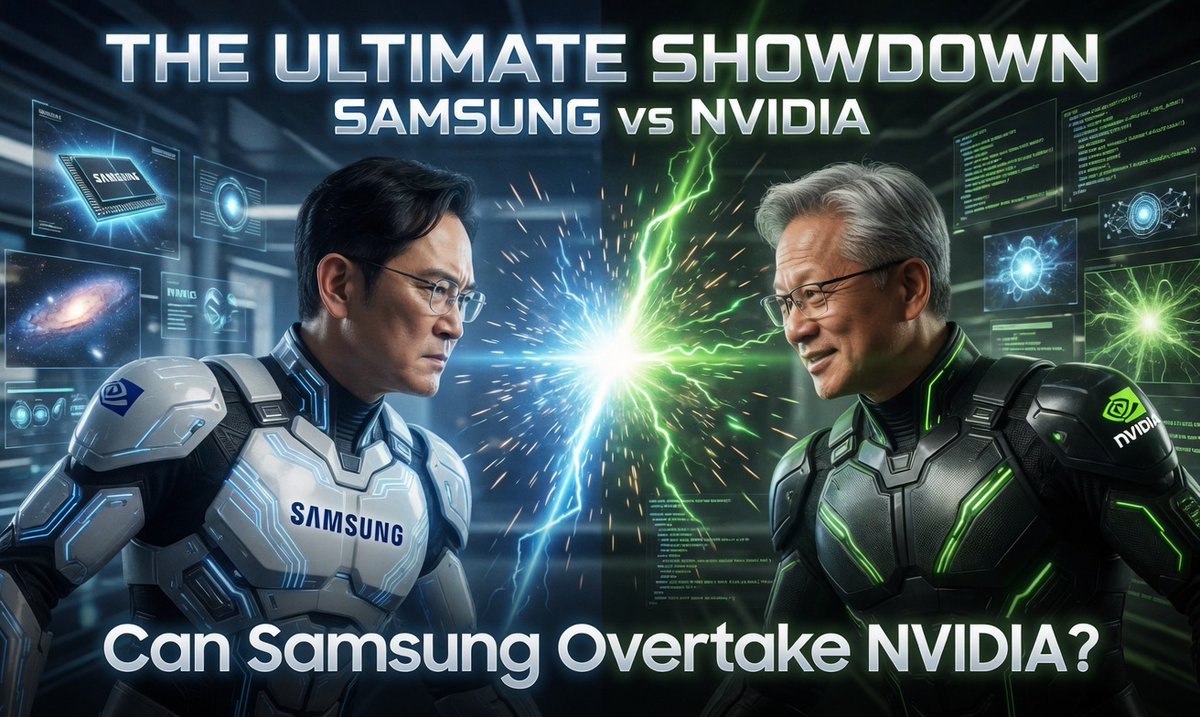
Can Samsung Overtake NVIDIA?
— A Deep Dive into the 2026 AI Semiconductor Power Shift
As of May 2026, one question dominates semiconductor boardrooms, investor calls, and tech forums worldwide:
“Can Samsung Electronics overtake NVIDIA?”
The numbers tell two different stories. In market capitalization, NVIDIA remains the undisputed king — valued at approximately $4.8–5.2 trillion, making it the world’s most valuable company. Samsung sits at roughly $950 billion to $1.02 trillion (around 10th–12th globally). Yet when it comes to operating profit, the picture is flipping. Bloomberg consensus and KB Securities forecast that in 2027 Samsung’s operating profit could reach KRW 488 trillion, narrowly surpassing NVIDIA’s projected KRW 485 trillion.
This is not just a numbers game. It is the clearest evidence yet that KAIST Professor Kim Jeong-ho — universally known as the “Father of HBM” — was right. His 30-year mantra, “Turn memory from the periphery into the master,” is materializing in real time. In the AI era, memory has become both the core and the filling. Without sufficient High Bandwidth Memory (HBM), even the world’s best GPUs cannot ship. Google, OpenAI, Meta, xAI, and NVIDIA itself are lining up at Korean factories pleading for more supply.
1. The Buyer-Supplier Dynamic Has Already Reversed
The old order — NVIDIA as the unchallenged buyer, Samsung as the obedient supplier — is history.
- HBM4 is in full mass production. Samsung began commercial shipments in early 2026 with consistent 11.7 Gbps speeds (upgradable to 13 Gbps). HBM4E, unveiled at NVIDIA GTC 2026, delivers 16 Gbps per pin and 4.0 TB/s bandwidth — the highest in the industry.
- zHBM (vertical stacking): Instead of placing HBM beside the GPU, Samsung is stacking it directly on top, slashing interconnect distance by ~60%. Latency collapses and power efficiency jumps 2–3×.
- HBM-PIM (Processing-In-Memory): By embedding compute logic inside the memory itself, Samsung eliminates the single biggest AI bottleneck — constant data movement between memory and processor.
Samsung is pouring record capital into this vision. In March 2026 the company announced it would invest more than $73 billion (over 110 trillion KRW) in 2026 alone — the largest single-year semiconductor investment in history — focused on AI chips, foundry (2 nm), advanced packaging, and HBM capacity expansion (targeting a 50% increase).
At GTC 2026, Jensen Huang personally visited Samsung’s booth, signed an HBM4 wafer, and publicly reaffirmed the strategic partnership. This is no longer “NVIDIA orders, Samsung delivers.” It is co-design at the highest level, with NVIDIA dispatching engineering teams to Samsung and SK Hynix to jointly architect next-generation HBM for the Vera Rubin platform. HBM supply now literally dictates how many GPUs NVIDIA can ship.
2. NVIDIA’s Moat Is Still Deep — But Not Impenetrable
Samsung’s technological momentum is real, yet NVIDIA’s competitive fortress remains formidable.
The true strength of NVIDIA is not silicon — it is CUDA, the 20-year-old software ecosystem that has become the de facto standard for AI development. cuDNN, TensorRT, and the entire library stack mean that 90% of AI researchers and developers learn and optimize on CUDA first. Alternatives like AMD ROCm, Google JAX, or Intel oneAPI are improving, but they still lag in maturity and performance.
NVIDIA also offers a full-stack solution: GPUs networking (Spectrum-X) software reference AI server designs. For hyperscalers, the total cost of ownership (TCO) and speed-to-market still favor NVIDIA in most cases. Its AI accelerator market share remains 85–90%. Even xAI’s Colossus supercluster — the world’s largest, with over 555,000 NVIDIA GPUs and plans for 1 million — runs entirely on CUDA.
In short, superior hardware alone is not enough. Samsung must also win the software ecosystem war.
3. 2027–2028: The Real Inflection Point
Short term (2026–2027):
Operating-profit leadership is within reach. The AI memory super-cycle continues, HBM supply remains tight, and Samsung SK Hynix control ~80% of global HBM production. Pricing power and volume growth should deliver strong results.
Medium term (2028–2030):
This is where the real overtake could happen — or stall.
If Samsung successfully commercializes its fully integrated “ultimate AI chip” (HBM GPU CPU in one package) using zHBM PIM 2 nm foundry, hyperscalers will finally have a credible alternative. They will be able to say, “We don’t have to buy only NVIDIA.”
At that point NVIDIA’s role could shift from “the AI platform company” to “a co-platform partner with Samsung.” The buyer-supplier relationship would invert permanently.
Conversely, if Samsung stumbles on execution, software compatibility, or ecosystem building, NVIDIA will use its CUDA moat and partnerships (including with xAI/Tesla’s Terafab) to defend its lead.
4. Geopolitical and Execution Risks
No analysis is complete without the risks:
- U.S.-centric supply chain pressure:
CHIPS Act incentives, export controls, and NVIDIA’s push for more U.S. production could complicate Samsung’s global strategy.
- Chinese competition:
Beijing is pouring resources into domestic HBM. If Korea slows its innovation pace, the 10-year technology gap Professor Kim warned about could close faster than expected.
- Samsung’s historical pattern:
The company has led in memory many times, yet repeatedly struggled to convert memory leadership into system-semiconductor dominance (foundry and logic). This time the stakes — and the opportunity — are higher than ever.
Final Verdict: Possible, But Not Guaranteed
Yes, Samsung can overtake NVIDIA — but it is not inevitable.
Technologically, the door is wide open. The AI era has made memory the new king, and Samsung sits at the throne of HBM, advanced packaging, and vertical integration. Professor Kim’s 30-year vision of “memory-centric computing” is no longer theory; it is becoming the industry’s new reality.
The decisive battle will be fought between 2027 and 2028. Success will require flawless execution on the integrated AI chip roadmap, aggressive ecosystem building (CUDA-compatible layers or a compelling alternative), and continued capital discipline.
NVIDIA is not standing still — it remains an extraordinarily well-run company with a massive software moat. But as Professor Kim famously says, “There is no eternal #1.”
The winner of the AI semiconductor era will not be whoever makes the best GPU.
It will be whoever masters the trinity of memory packaging architecture.
Samsung has the technology, the capital, and the moment.
Whether it seizes the crown depends on execution in the next 24–36 months.
What do you think?
Is Samsung’s integrated AI chip a realistic game-changer by 2028, or will NVIDIA’s CUDA moat prove unbreakable?
Drop your thoughts below — I’d love to hear the community’s take.
#Samsung #NVIDIA #HBM #AIChips #zHBM #PIM #MemoryCentricComputing #Semiconductors #GTC2026 #ProfKimJeongHo
1
4
1,023

28 Jul 2022
The future of #FlashMemory: Look for @MacronixM at @FlashMemorySummit 2022, where we’ll present on #UltraLowPower & #MemoryCentricComputing, & showcase our latest #NonVolatileMemory solutions in booth 1055.
prn.to/3J27Pk1
#FlashMemory #EnergyEfficiency #wearables #IoT
1

17 Feb 2021
Good news ! #LIM #PIM #memorycentriccomputing #inmemorycomputing #LogicInMemory memory is the future semiconductor-digest.com/sam…
6