
Nolan claims that he doesn’t need to engage in demonstrative methodological science…he can extrapolate the results IN HIS MIND. 🧠
6

14m
How to Identify Methodological Gaps in Research: A Biomedical Gap Analysis Framework
Full Article here: aipoch.com/blog/identify-met…
- An AI-Assisted Workflow for Structured Methodology Gap Analysis Across Design, Validation, and Reproducibility
- Why Does Methodology Gap Detection Matter?
- What Does the Method Gap Detector Skill Do?
- How to Identify Methodological Gaps in Research? A Step-by-Step Example
- Manual Workflow vs AI-Assisted Workflow: A Comparison
1
7

The international game is less tactically involved so any chance of breaking down the opponent is mostly down individual brilliance (more variable than club which is more methodological), and well drilled deep blocks dont require "talent" so skill gap matters less
1
1
15

34m
但系统并未进入稳定状态。
新耦合链正在形成:
```
协议模糊 关键方反对 执行障碍 → 和平执行风险 → 随时可能 revert
```
这意味着:
· 全球文明系统从“单轴急性冲击”转入“多轴脆弱平衡”
· 短期风险下降,但系统复杂度上升
· 市场的线性思维(和平=安全)与系统的非线性现实(脆弱和平=高波动)形成错位
CSS判断:
这是典型的风险链断裂后重构期。未来30天是新的系统测试窗口。
---
七、CSS术语库(正式收录)
编号 术语(中) 术语(英) 定义 状态
CSS-L001 风险链断裂 Risk Chain Break 风险传播链中的关键节点被解除,导致系统性风险扩散能力显著下降 核心术语
CSS-L002 和平执行风险 Peace Implementation Risk 停火协议达成后,因条款模糊、关键方反对、国内压力等导致和平无法持续 核心术语
CSS-L003 脆弱和平 Fragile Peace 战争停止但结构性矛盾未解决,和平建立在短期利益权衡之上 标准术语
CSS-L004 声明通胀 Declaration Inflation 政治主体频繁发布声明但执行能力未同步增长,导致边际效力递减 ⚠️ 试验术语
---
八、本期方法论说明
本日报已从“事件中心”转向“系统中心”:
· 新闻事件 → 原始信号
· 变量提取 → 标准化
· 耦合路径 → 核心产出
· 指数与评级 → 决策依据
方法学壁垒: 不是信息优势,而是系统分析框架的独特性与一致性。
---
数据质量声明
本报告采用公开信息源与规则冻结模型。CHI、CRI、CCR为实验性文明系统指标,不构成投资建议。
数据截至UTC 8 2026年6月16日07:30。来源:Reuters、RFI、DW、联合早报、日经中文网等。
---
CSS Institute
Hong Kong Civilization Science Society
CHI / CRI / CCR Global Monitoring Program
V1.7 RC1(Methodological Freeze)
---
© 2026 CSS/CSR联合研究组 | 严禁商用
编者按:
本日报不提供即时解决方案。它提供的是系统状态的一张快照、耦合路径的一条记录、风险结构的一幅草图。
明日风险未必更高,但理解深度可以持续增长。
1
10
35m
VIII. Methodological Note for this Issue
This daily report has shifted from an “event‑centric” to a “system‑centric” approach:
· News events → raw signals
· Variable extraction → standardisation
· Coupling paths → core output
· Indices and ratings → decision basis
Methodological moat: Not information advantage, but the uniqueness and consistency of the system analysis framework.
---
Data Quality Statement
This report uses publicly available information and a frozen rule‑based model. CHI, CRI and CCR are experimental civilizational system indicators and do not constitute investment advice.
Data as of UTC 8, June 16, 2026, 07:30. Sources: Reuters, RFI, DW, Lianhe Zaobao, Nikkei Chinese, etc.
---
CSS Institute
Hong Kong Civilization Science Society
CHI / CRI / CCR Global Monitoring Program
V1.7 RC1 (Methodological Freeze)
---
© 2026 CSS/CSR Joint Research Group | Commercial use prohibited
Editor’s note:
This report does not provide immediate solutions. It offers a snapshot of system state, a record of coupling paths, a sketch of risk structure.
Tomorrow’s risks may not be higher, but the depth of understanding can continue to grow.
1
2
37m
CHI / CRI / CCR Global Civilizational Health & Risk Daily Report
Civilizational Health & Risk Daily Report
Date: June 16, 2026 (Tuesday)
Report No.: CHI-CRI-CCR-20260616 | Issue 39
Version: V1.7 RC1 (First issue after methodological freeze)
---
📌 System State Update
System state change:
The global civilization system has shifted from “energy shock mode” to “fragile peace mode”.
The acute risk transmission chain has been broken, but peace implementation risks and slow variables (debt, AI decoupling, protracted geopolitics) have begun to dominate system evolution.
One‑sentence summary:
A pause in war does not mean the disappearance of risk. Markets celebrate; the system tests.
---
I. Global Dashboard
Indicator Today Yesterday Change Assessment
Global Civilizational Health Index (CHI) 72.5 71.8 ▲ 0.7 Energy shock recedes, market sentiment improves, but systemic resilience remains weak
Global Civilizational Risk Index (CRI) 6.9 7.3 ▼ -0.4 War escalation risk declines; peace implementation risk becomes the main concern
Global Civilizational Credit Rating (CCR) BBB BBB Outlook: Stable Emergency situation resolved, but fragile peace caps upside
Rating notes:
· BBB : Investment grade, moderate systemic resilience
· Outlook Stable – first maintenance after upgrade from Negative
· Core driver : US‑Iran ceasefire has severed the acute “energy → inflation → recession” coupling chain
---
II. Key Events → Variable Extraction
No. Event Extracted Variable Direction Weight Systemic Significance
1 US‑Iran ceasefire MoU signed, details confidential Middle East peace implementation risk (V1) Positive ★★★★★ Critical node in risk chain break
2 Explosions still heard near Strait of Hormuz Shipping security risk (V1a) Negative ★★★★☆ First test of peace implementation
3 International oil prices fall to three‑month low Energy price variable (V2) Positive ★★★★☆ Imported inflation pressure eases
4 US SPR falls to lowest since 1983 Energy system resilience (V2a) Negative ★★★★☆ Long‑term vulnerability rises
5 US B‑52 bomber crashes, 8 crew dead Military system aging risk (V3) Negative ★★★★☆ Deterrence credibility damaged
6 Soaring UK aluminium scrap exports threaten supply chains Critical resource security (V4) Negative ★★★☆☆ Accelerated supply chain regionalisation
7 Ukraine starts EU accession negotiations European security order (V5) Neutral to positive ★★★★☆ War transforms into institutional restructuring
8 US restricts international access to Anthropic AI models AI governance decoupling (V6) Negative ★★★★☆ Symbol of dual‑track technology systems
9 Iranian‑Americans plan protests; World Cup imminent Social diaspora risk (V7) Neutral ★★★☆☆ Post‑war cognitive reconstruction
10 Congo Ebola cases rise to 808 Public health risk (V8) Negative ★★★☆☆ Regional outbreak, low global spread risk
11 China’s government debt exceeds RMB 100 trillion Fiscal slow variable (V9) Negative ★★★★☆ Long‑term compression of policy space
12 Bank of Japan raises rates to 31‑year high Global liquidity (V10) Neutral to negative ★★★☆☆ Monetary policy divergence widens
---
III. Coupling Dynamics
Dominant Coupling Paths of the Day
【Acute risk relief – Positive chain severed】
```
US‑Iran ceasefire → Oil price falls → Inflation expectations recede → Financial markets rise → Global risk appetite improves
```
Status: ✅ Severed
Significance: The global civilization system has exited “energy‑shock emergency mode”
---
【Peace implementation risk – Negative chain forming】
```
Vague agreement Israeli opposition Iranian domestic pressure explosions at Strait
→ Peace implementation risk rises
→ If any node is triggered → conflict could re‑escalate
```
Status: ⚠️ Forming, not yet solidified
Monitoring window: Next 30 days
---
1
67

I will refute one of your claims regarding “phonology.” The other examples you mentioned are merely self-congratulatory interpretations on your part, not historical facts.👇
Chinese phonology (more precisely, traditional Chinese phonology or ancient Chinese phonetic studies) did not originate as a product of Buddhism’s introduction into China. Its roots can be clearly traced back to a long-standing indigenous linguistic tradition that developed from the pre-Qin period through the Han dynasty. As early as the Book of Songs (Shijing), there is already a systematic awareness of rhyme structures and phonetic correspondence. During the Han dynasty, methods such as “fanqie” (phonetic spelling using two characters) emerged to indicate pronunciation, and scholars gradually accumulated knowledge of dialectal variation and phonetic classification, showing that China already possessed a relatively mature understanding of sound systems.
The Han dynasty work Shuowen Jiezi by Xu Shen makes this even clearer. Although its primary purpose was the analysis of character form and meaning rather than phonology, it already contains implicit phonetic awareness. It frequently uses devices such as “reads like” (讀若) or phonetic components (聲) to indicate pronunciation, employs near-homophones to explain meaning, and systematically analyzes the phonetic role of components in phono-semantic characters. All of this demonstrates that by the Han dynasty, scholars already had a structured understanding of phonetic relationships—well before Buddhism had any systematic influence in China.
During the Wei, Jin, and Northern–Southern dynasties, this indigenous tradition of phonological study developed further, as scholars began to organize Chinese sounds in a more systematic way. This ultimately led to the highly sophisticated rhyme dictionaries of the Sui and Tang periods, such as the Qieyun and Guangyun. After Buddhism entered China, it did not “create” phonology, but it did play an important stimulating role in its methodological development. The translation of Buddhist scriptures from Sanskrit required high precision in pronunciation, especially for transliterated terms such as “Buddha” and “Prajñā,” which increased scholarly attention to phonetic accuracy and encouraged a more fine-grained analysis of sound units. In addition, the highly systematic phonological tradition of Sanskrit also influenced Chinese scholars’ understanding of sound structure, further accelerating the refinement of Chinese rhyme systems.
Therefore, both in terms of chronology and internal intellectual development, the core framework of Chinese phonology was already formed within an indigenous scholarly tradition by the Han dynasty. The introduction of Buddhism should be understood not as the origin of Chinese phonology, but as an important external catalyst that contributed to its later refinement and systematization.

Suggestion for Indian anti-China propagandists: If your objective is to elevate India's status, stop attacking modern China and focus on ancient China. Start emphasizing the extraordinary scale and depth of India's historical influence on Chinese civilization. Talk more about China's historical "debt" to India. This is a far more effective line of attack than contemporary geopolitics or economics.
There's more than enough raw material. Many are completely unaware of the sheer scale we're dealing with here. People think that the cultural exchanges (which were largely one-sided) began and ended with Buddhism. In truth, Buddhism is merely the tip of the iceberg. It's not even close to the whole story. Indeed, if Indian influence and contribution to Chinese civilization is removed, Chinese culture and history would be virtually unrecognizable.
The sheer volume of ideas, philosophies, cultural concepts, scientific knowledge, artistic traditions, religious practices, and technologies that travelled from India to China frankly boggles the imagination. The list is simply endless: Logic and epistemology, metaphysics, philology, phonetics (Chinese could literally understand their own language and pronunciation better because of Sanskrit and Prakrit), astrology, astronomy, calender science, clothing, food, medicine, surgery, biology, art, sculpture, cosmology, meditation, music, dance, performance art, biology, botany, knowledge of medicinal plants...and that's just for starters. And it's not just the scale, the depth is equally astonishing. One would be hardpressed to find a single element of Chinese culture, society, and history that was untouched by India.
Whole Indian branches of the above arts and sciences were adopted wholesale and incorporated into their Chinese equivalents, across centuries and across generations. It was possibly the greatest civilizational transfer of knowledge in human history.
-------
As an example, everyone knows that Chinese considered China the "middle kingdom" - the center of the world. Yet, it was India that Chinese philosophers considered the spiritual center of the world, including the physical center in Buddhist cosmology (which Chinese Buddhists adopted), and the source of sacred knowledge. India was the most noble and most honored land, and was simply considered heaven. Chinese travellers would cross mountains, both literal and figurative, to reach India and learn its teachings. Call it kanging on a civilizational scale. India was basically the Holy Land for Chinese intellectuals.
A common claim amongst historians is that India was the teacher and China the student. Astonishingly, many ancient Chinese intellectuals and philosophers would themselves agree with this claim. They openly referred to India as the teacher who they wished to learn from.
As a comparison, for ancient Chinese, India occupied a position even far higher than Greece did for many Roman intellectuals back in the day.
To take another damning example, when Indian logic first got transmitted to China, Chinese experts simply didn't understand it. So they had to be trained on it. Indian logical systems required extensive clarifications and interpretations before they could be assimilated into Chinese intellectual traditions. Indian philosophers had to actually explain it from first principles, and then translate Sanskrit texts into Chinese themselves (after learning Chinese), since understanding that kind of logic is important to understanding Sanskrit. This is why much of the translation of Sanskrit texts into Chinese was almost completely dependent on Indian expertise. This lasted until travelers like Xuanzang came to India, learned how to do it, and established their own translation bureaus back home. And even then, homegrown expertise took a long time to be fully established in China.
Indeed, entire new Chinese vocabulary had to be invented to incorporate Indian philosophy and concepts, since Classical Chinese literally didn't have the words to describe them.
It was only after this entire process that Chinese Buddhists were able to understand and appreciate Indian philosophy, and then adapt it by fusing elements of their own philosophy into it. This is the origin of the entire (sub)field of Chinese Buddhism.
And if you think that's too overwhelming, absolutely do NOT research the origins of Chinese martial arts - perhaps the one thing China is most known for globally after Chinese food (which also has significant Indian contributions).
In fact, all of the above combined is not even 0.01% of the KNOWN scope and depth of the philosophical, cultural, and scientific transmission.
1
1
50
43m
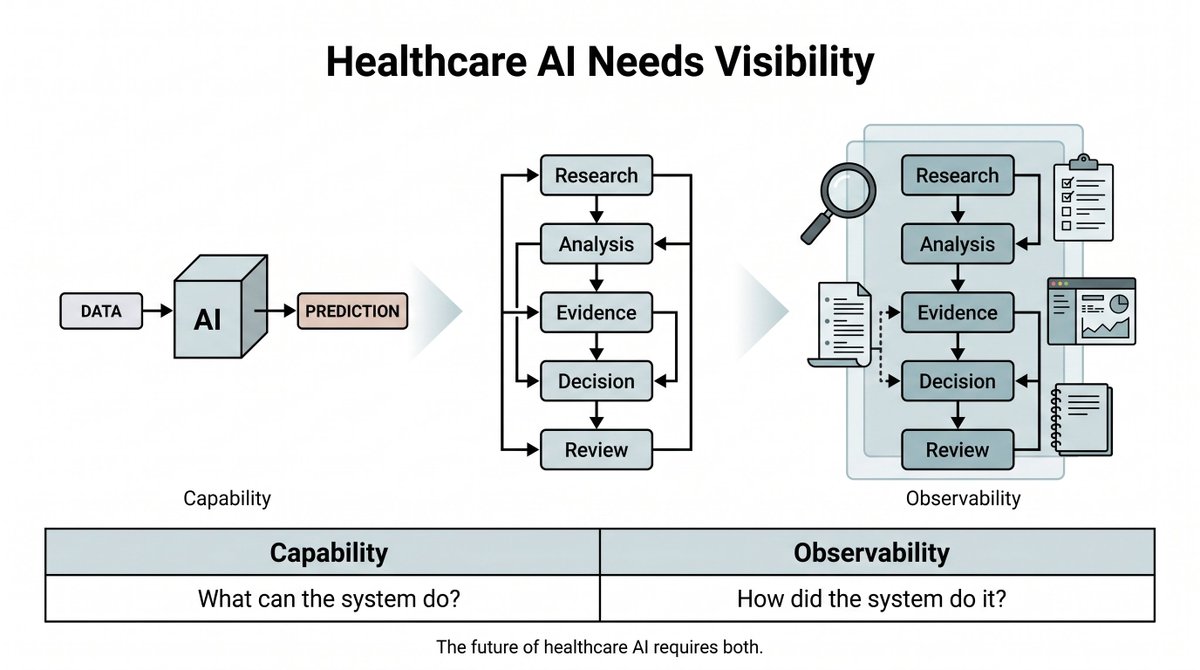
Healthcare AI is beginning to develop something every mature technology ecosystem eventually needs:
github.com/aipoch/medical-re…
Infrastructure for governance. 🧬
We already have models.
We already have benchmarks.
We already have deployment pilots.
What's emerging now are the systems that help organizations understand, compare, and evaluate how AI is being used.
The Health & AI Policy Index (HAPI) is an example of this trend.
It's less about building new AI.
And more about making the surrounding ecosystem observable.
In many ways, this mirrors what happened in software engineering.
Performance mattered first.
Observability came later.
In healthcare, governance may play a similar role.
At AIPOCH, we're increasingly interested in the infrastructure around scientific workflows:
- Evidence review,
- Research auditing,
- Methodological validation,
- Transparent decision-making.
As AI systems become more capable, visibility into the process may become just as important as the output itself.
1
1
7

You're right that signal detection and causation are distinct. Good point. But a signal in a structurally biased instrument isn't a signal.
It's just noise & we know VAERS clusters post-vax for causes that objectively have no vaccine relationship, which is why the VSD was built.
Your denominator argument is also self-defeating. Constructing a hypothesis that wins whether the spike is large or small because underreporting accounts for the difference is unfalsifiable by definition. An unfalsifiable hypothesis isn't a scientific hypothesis.
Your own proposal for mandatory SIDS reporting concedes the current data is insufficient, which is exactly the methodological critique that justified retraction!
The VSD already does what you're asking for. The answer to "VAERS is an imperfect tool" isn't to publish conclusions VAERS cannot support.
It's to use the better tools that already exist, which consistently fail to find the signal Miller claims is his trash study.
1
17

"If a Holy Father can only be properly understood through expertise in the original language of that Father, then it is only fair to ask where this principle suddenly disappears to when the subject of St. Augustine, the Latin Fathers after his day, or the Russian theological tradition.
The exact same people who demand proficiency in the original language of the writer, interpretive caution, nuance & deference show remarkable confidence in their condemnation of entire traditions!
What is being quite dishonestly disguised as methodological rigour by Pr. De Young & his following is really just an attempt at theological gatekeeping, & a snarky elitism they fail to uphold amongst themselves."
-- a friend
2
15

"indoctrinated for 12 years by a system that teaches strict methodological naturalism"
This has to be a troll account
2

Not so much. E.g. freedom of press was rated from the Paris-based WPFI index that ignores legal frameworks, has a methodological bias against private media, and doesn’t even normalize complaints to population size.
I swear, some of you have lost the ability to critically think.
1
12

There are lots of believing scientists who are able to execute "methodological naturalism" while being philosophical supernaturalists.
5

Just do a little research.. the editors explained the methodological flaws that lead to retraction.
retractionwatch.com/category…
12

RT @HudaBintAbdulla: حدود العلم الأربعة الرئيسية:
١- معرفية (Epistemological Limits)
٢- منهجية (Methodological Limits)
٣- فلسفية (Philosop…
39

The IMF assigns a 'C' grade to India's national accounts, indicating methodological shortcomings. Modi has been overstating India GDP
10
Glenn Green retweeted

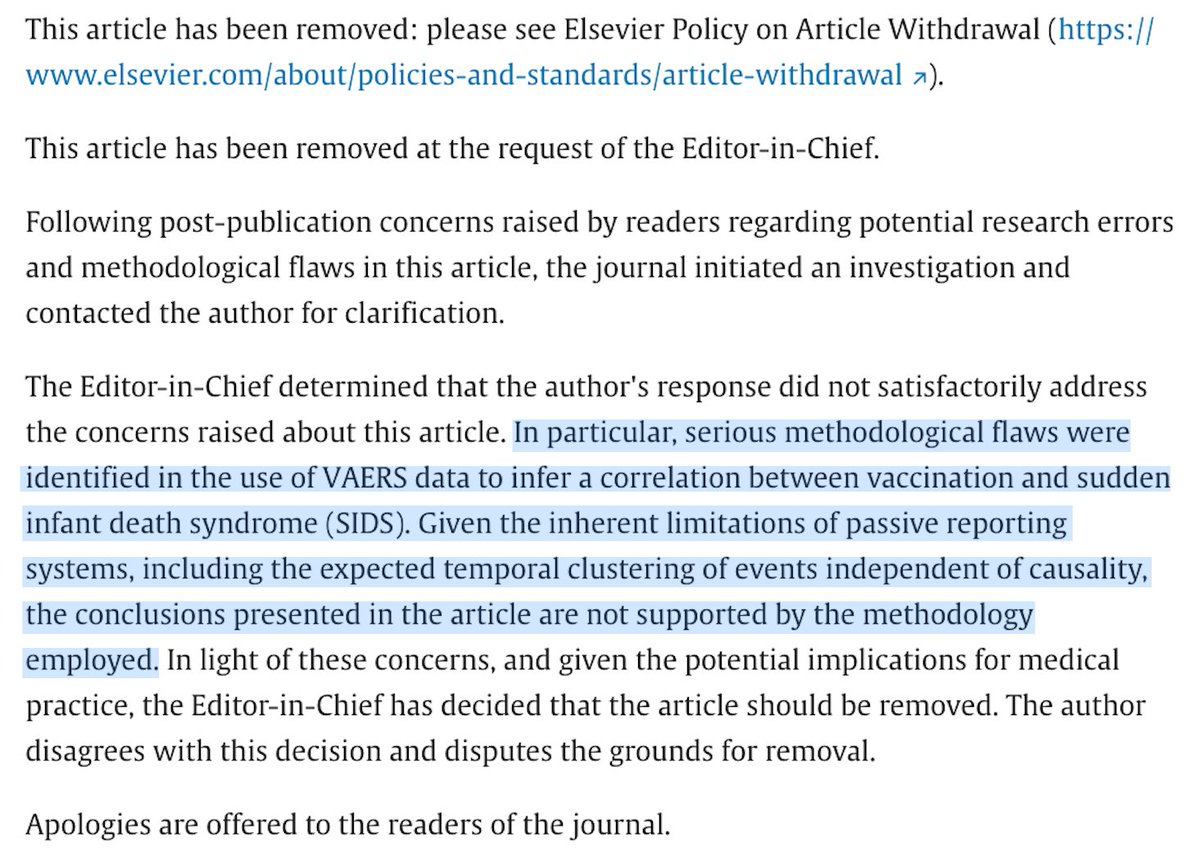
The editor's statement of retraction/removal is quite clear, and the methodological flaws they cite are transparently clear to anyone who understands passive reporting data and reads the Miller paper.
Their entire statistical analysis is fundamentally flawed by making invalid statistical assumptions, and thus their analysis/results/conclusion are compromised.
That is the substance, as clearly laid out in the retraction notice.
I can see where Sen. Kennedy doesn't like it and is pressing hard, but a clear reading of the paper reveals how that statistical analysis is the novel contribution of the paper, and without it, the paper has no basis to justify its publication.
x.com/jsm2334/status/2066558…

Sec Kennedy: The editor-in-chief already clearly explained the reason for the removal in his notice (sciencedirect.com/science/ar…), which was that there were methodological flaws in the paper so serious that the conclusions were unsubstantiated.
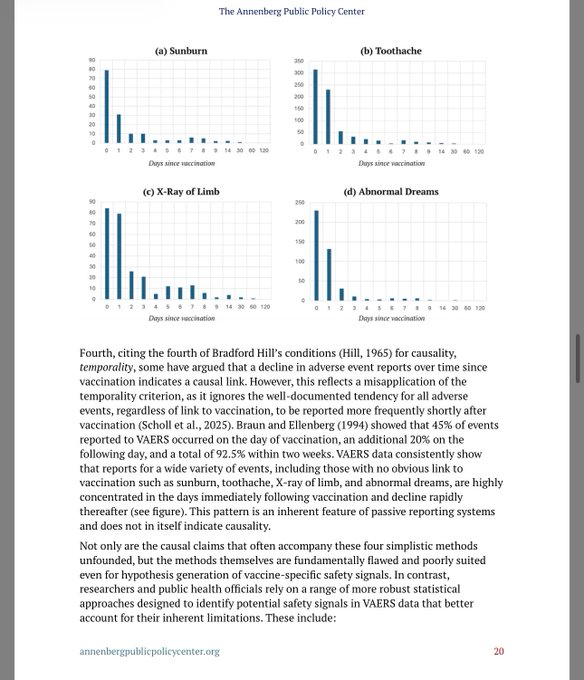
I mention the specific methodological flaw here, which involves inferring causality from the fact that VAERs reports clustered close in time to the day of the shot, an inherent characteristic of passive reporting systems and not even close to sufficient to conclude causality or even an association:
x.com/jsm2334/status/2057919…
Given this fatal flaw that was not detected by peer review, the entire argument in the paper falls apart, and the conclusion unsubstantiated.
I explain why this statistical reasoning is invalid in my white paper on the USA vaccine safety monitoring system (see plot below)
This white paper (annenbergpublicpolicycenter.…) summarizes the various US vaccine safety monitoring components, describing how they are supposed to work together, and providing specific suggestions on how it could be improved for more sensitive and specific detection of potential vaccine harms and more transparent communiation. It also highlights various valid and invalid analytical approaches that some use to analyze data from these systems -- and inferring causation from simple temporal reporting patterns in days since vaccine is one of them:
2
3
13
205

You don’t understand science and therefore you won’t be able to comprehend how the article was full of methodological flaws.
4
5
140

What were the serious methodological flaws that peer reviewers missed the first time around? For research that heavily relies on statistics to tell the story, I find it concerning that the Toxicology Journal "peers" missed something so glaringly obvious.
1
13