
Angine De Poitrine! I'll bang on about them cos theyve created something amazing and YT etc is the vessel that is propelling then into the stratosphere. I expect he's experimenting with microtones as you type. Good on him.
33

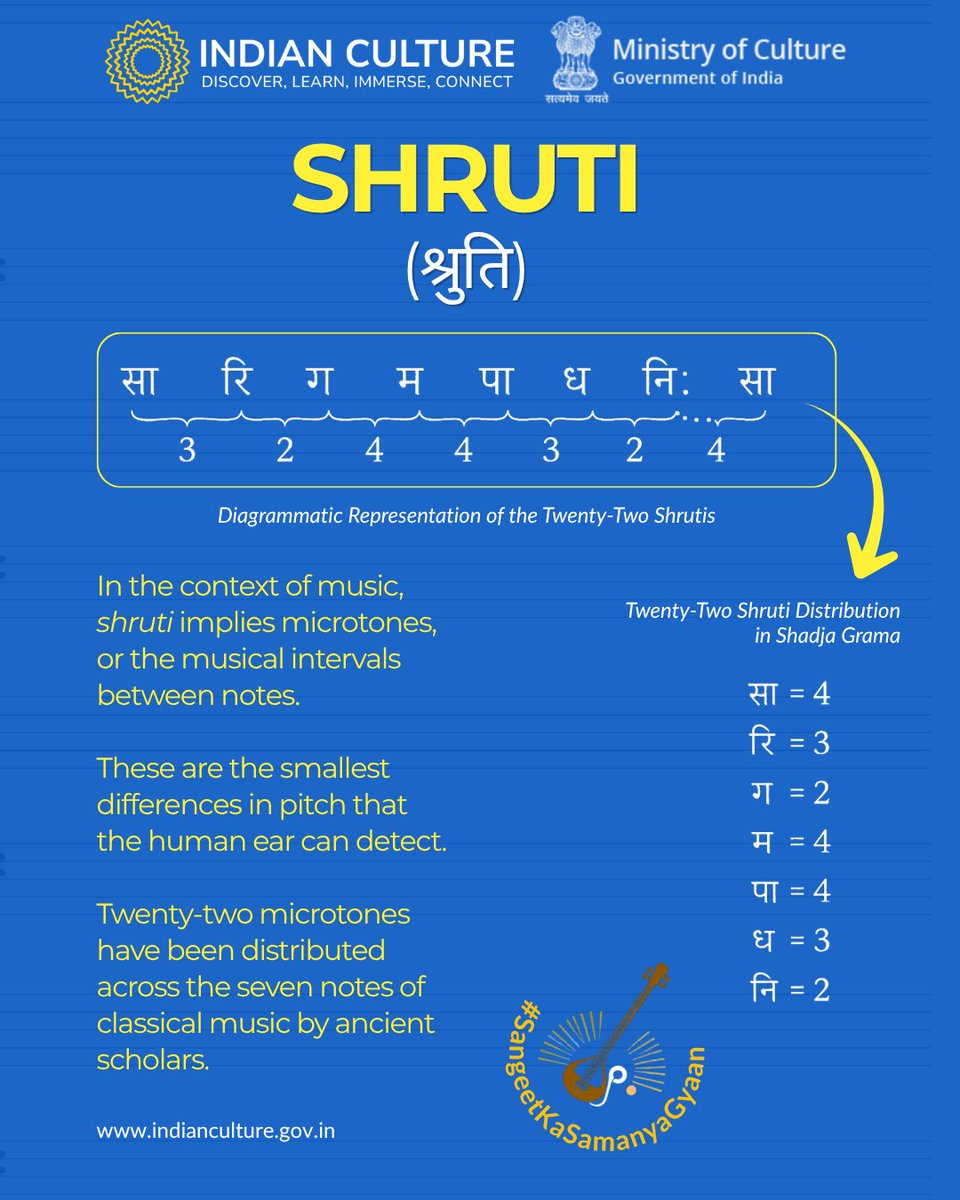
#SangeetKaSamanyaGyaan | Shruti (श्रुति)
Follow @_IndianCulture and explore India's rich musical #heritage, one micronote at a time.
Explore more at indianculture.gov.in
Special thanks to Sangeet Natak Akademi awardee, Shri Piyal Bhattacharya, a leading scholar on the Nāṭyaśāstra for his contribution. 🙏✨
#IndianCulturePortal #MinistryOfCulture #IncredibleIndia #MusicalTerms #IndianClassicalMusic #Shruti #MusicHeritage #MusicalTraditions #CelebrateMusic #IndianCulture #Sangeet #Bharatiyasangeet #microtones
@MinOfCultureGoI @incredibleindia @AmritMahotsav @sangeetnatak
6
158
松澤 健志 retweeted

投稿しました!
New video uploaded!
[微分音] コード進行ギャラリー
[Microtones] Chord Progression Gallery
youtube.com/watch?v=ci_LQmq9…
2
42
129
8,370

Jun 14
if you do microtones, you are required to explain regular temperament theory. it's like functional programming, if you do it, you are required to write a Medium article explaining what a "monad actually is."
1
28


Jun 13
Wonderful, thank you for posting it.
I've been listening to Angine de Poitrine recently. I never thought that I needed microtones and insane time changes in my music!
Yes, it's weird. But I've made my stance on weirdness very clear in the past! 😁
youtu.be/0Ssi-9wS1so?is=V_wQ…
1
72

Jun 13
Estes gajos são loucos! No bom sentido. Loops e microtones. Vejam o concerto todo que também está disponível.
youtube.com/watch?v=JtSPqtxp…
1
41

Jun 11
Adithya, Sruti – LEGENDS IN MAKING
↓
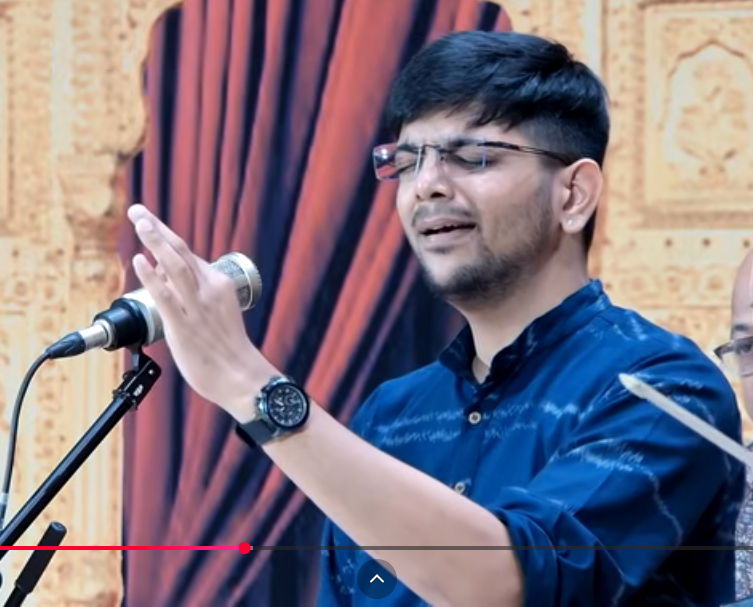
Adithya Narayanan’s performance at the Cleveland Thyagaraja Festival 2026 is mind-blowing.
Wow . . . one more such performance, I would be too tired for a third! (pun intended)
His towering presence as he sits like an Olympic volleyballer adds charm to his boyish singing, with notes delivered with mellifluent ease. He is not old like yesteryear's musicians, but the impact he makes is tremendous.
His opening song “Appan avatharitha kadamrutham” was exhilarating. This Tamil song is difficult, even if set in a somewhat easy raga like Kharaharapriya. Indeed, all Tamil songs are difficult because their poetic meters have rough edges, though the content is soul-stirring.
In contrast, Tyagaraja’s songs are exceptional in poetic meters. His kritis are intertwined with Dhatus (musical melody), seamlessly merging with Matu (linguistic structure), producing unrivalled prosody and blissful haunting rhythm, making one sing his compositions effortlessly.
In my case, I had just returned from my first day at violin class as a young boy. No sooner was I home than I began to play “Sarasa sama dana . . .” ( just bowing S-S-S ), and my mother, who was in the kitchen, shouted to my father in astonishment, “He is playing sarasa sama dana!” That speaks volumes about Saint Tyagaraja’s simplicity and divinity.
PINNACLE ACHIEVABLE
↓
I don’t know how Adithya did it. The swara prastharams arising out of manodharma (spontaneous improvisation) for the “Appan avatharitha kadamrutham” song was unbelievable. It was executed to perfection.
SRUTI EXTRAORDINARY
↓
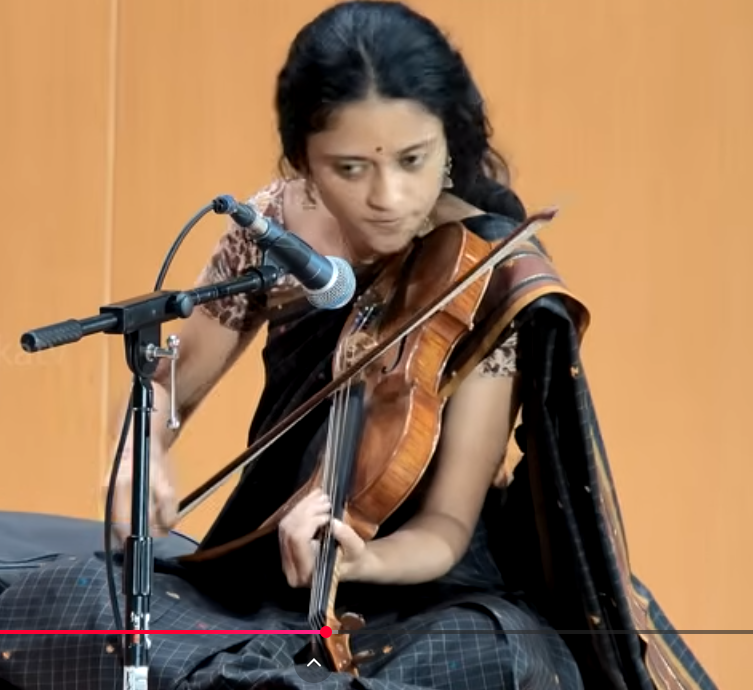
Initially, I had a fleeting doubt about young violinist Sruti Sarathy, but she proved to be magnificent. It left me wondering if Adithya and Sruti were products of some sort of AI engineering.
I must say I have heard many female violinists who shine on their own merit, but Sruti handling microtones -- in Adithya’s Begada song “Anudinamunu Kavumayya”, her Begada alapana took my breath away.
The combination of the two young delectable giants made the kutcheri a memorable event for me even if the event was held in faraway Cleveland.
The two made it look so easy, as if Hanuman was helping Hanuman to lift the Himalayas.
Both Adithya and Sruti are prodigies.
Sruti Sarathy indeed is a rare violinist (since I myself am a violinist, I know how difficult it is to produce microtones) in whose veins music, not blood, flows.
She seems to excel in the rigorous classical form. And this is the first time I am hearing her play the violin, which I did a few days back.
Adithya and Sruti left me with a free dinner at The Oberoi Udaivilas, in Udaipur, where I had once gone to cover a press conference as Gujarat Correspondent of IANS. I am still enjoying the aftereffects of the Adithya-Sruti dinner.
see youtu.be/YjcDPVwlFDk
***
1
56


Jun 9
So basically! There are 12 notes in our normal western scale. A, B, C, D, E, F, and G, with flats and sharps except in the case of F being equivalent to E-sharp and B being equivalent to C-flat. Those notes were chosen for a lot of reasons, but, they were chosen, and have limitations. Most of the 'important' intervals between notes are approximated well, but the 3rds and 7ths are really, really not in tune– the 7ths so much so that we basically don't have any true dominant seventh chords in our harmony. Now, all fixed-pitch instruments have to be tempered. Tempering, in a really short definition, refers to the fact that music should logically have an indefinite number of pitches spiraling upward; when you go all the way up the circle of fifths, you don't go from C to C; you go from C to B-sharp, except that B-sharp is now higher in pitch than C by about 23 cents. So, a lot of tuning systems temper out those 23 cents, also called the Pythagorean comma. What some old tunings did is simply concentrate all of that dissonance into one wolf fifth, which is a term you may know, so that they could play beautifully in-tune major and minor chords in most keys. But if you want to avoid the wolf fifth and be able to play equally in-tune in every key, you can just divide the dissonance totally evenly across every octave and every note. That gives us the tuning system we mostly use over here, and have for well over a century. Some select areas of western music drift outside of 12-tone, namely in the orchestra, but practically, western orchestras and choirs tune themselves to pianos, usually, which are equally tempered. Temperaments are not bad; we absolutely need them for our music, but, we don't always have to temper evenly or to 12 tones. Some temperaments have 17 tones, some have 31, and Wendy Carlos made several scales that don't repeat at the octave as is typical in order to search for better harmony.
NOW. GETTING TO THE POINT.
A supermajor third is a really cool interval that can be be written as 9/7. It is worth noting that this is almost as simple as 8/5 or 9/5, which are, respectively, the minor 6th and minor 7th. These aren't as simple of ratios as the octave (2/1), fifth (3/2), or major third (5/4), but, also, almost nothing is. To elucidate on the random numbers: simpler fractions tend to sound more pleasing to the human ear. The wolf fifth, for reference, is usually an interval of 262144/177147. 12-EDO's minor 7th is... 2/5/6:1, whatever that means.
The supermajor third is a little weird to get used to, but as a bass note, it leads nicely down into Em. As the highest voicing, it can give you a way to make C feel less at rest if C is the tonic. As the fifth of A, it gives you a very floaty kind of minor chord; a bit like a consonant tritone. The important thing is that it's one of the easiest microtonal intervals to access and modify chords with. For reasons I have yet to disover, it also allows you to slip a diminished 5th (an actual one; genuinely between F and G) into the key without it sounding jarring. I suspect this is because the relationship between the supermajor third and diminished fifth is more akin to the relationship between a root and a major second, but I'm also an idiot, so I don't know.
I'm not a bonafide expert at any of this so stone me to death if I flubbed anything, but you should consider using microtones. If you can't program your own keyboard full of weird frequencies, then try getting some of those tape-on frets for your guitar. You can use your ear to find pleasant interval combinations. Just listen for the ones that don't sound like the frequencies are clashing. Music is your oyster.
Jun 8

if i post my penis every two hours for the rest of today starting at noon, you guys have to let me talk about the supermajor third and septimal whole tone. what is the supermajor third and septimal whole tone? idk i’ll tell u if i post my cawk enough
2
1
17
6,413


There are infinite notes actually, the western musical system just only uses 12. Artists like Angine De Poitrine and Maddie Ashman, Jacob Collier, and King Gizzard have used microtones to create cool and interesting compositions.
1
5
1,412

May 21
Somewhat with you on this, and I play guitar. The microtones are interesting and incorporating them takes talent. But after a couple of minutes, I lose interest maybe bc of the abstract costumes and space alien style. I have seen pre-costume videos of them and they rock but…meh
2
592

May 17
Traditional maqam with microtones, etc.
Uses the takht ensemble (oud, qanun, ney, riga, violin). And is improvisational.
This is a symphonic/orchestra using the Maqam scales
And it’s shaped by early 20th-century in Cairo, by figures like Mohamed Abdelwahab.
3
1
10
1,107

May 14
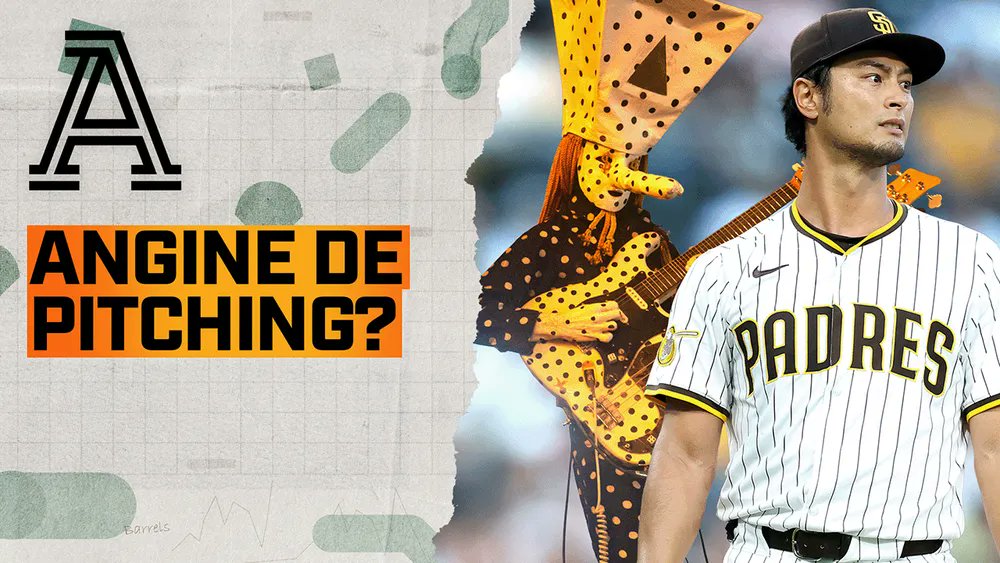
One of my favorite🎙️ Rates & Barrels of the year.
Discussed how microtones in music could port over to pitch design & tackled player-driven research on the effect of sequencing on command w/
@iamtrevormay & @DerekVanRiper
pod.fo/e/415fc2
youtube.com/c/RatesBarrels
4
5
47
34,247

I learned that if you were raised on microtonal music, you can hear the microtones but to people raised on western music, microtonal music sounds alien to them. It's interesting.
1
5
2,708

May 14
New mafftopia Deep Dive - landing at 4PM today (UK time)
Why is Angine de Poitrine's blend of #MathsRock, #ProgRock, #Microtones and complex time signatures so addictive?
We dive into the music theory and the cognitive psychology - and the journey takes us to some unexpected places 🤯
Featuring @SaveWithCrypto - who knew he's also a professional musician??
@NME

1
2
3
261

May 12
The Henads are Unities, but they are not The One.
Think of the One as a string.
Unity as the drone sound it makes when plucked.
Think of the Gods as the microtones inherent in the droning.
4
115

May 12
A glissando creates a continuous slide between pitches. What you're perceiving as 'off-key' is actually the tension built by moving through those microtones before hitting the resolution. It’s a common technique in both opera and avant-garde pop. #musicologist
1
7
379