
Yeah, been musing on that since I wrote the above. I suspect the thing is that immutability is a foundation for mutability at a higher level of abstraction: like, you can't change the mass of a ball of clay, and the fact that the mass isn't wildly fluctuating is an invariant that enables malleability.
1
9


9h
10/ So inside a PTB:
• A shared object is declared once, with one mutability. If any command mutates it, it's Mutable for the entire PTB.
• A 10-command PTB where only the last command writes object A still holds A's writer chain exclusively for the whole tx — the 9 unrelated commands included.
1
15

🚀 Rust Interview Question:
What's the difference between "iter()", "iter_mut()", and "into_iter()"?
Understanding this is essential for mastering Rust ownership and borrowing.
Given:
let v = vec![1, 2, 3];
1. iter()
Creates an iterator over immutable references.
for x in v.iter() {
println!("{}", x);
}
Type:
&i32
Ownership:
✅ Borrowed
Vector usable afterwards:
✅ Yes
Use when:
You only want to read data.
---
2. iter_mut()
Creates an iterator over mutable references.
let mut v = vec![1, 2, 3];
for x in v.iter_mut() {
*x *= 2;
}
Result:
[2, 4, 6]
Type:
&mut i32
Ownership:
✅ Borrowed mutably
Vector usable afterwards:
✅ Yes
Use when:
You want to modify elements in place.
---
3. into_iter()
Consumes the collection and transfers ownership.
let v = vec![1, 2, 3];
for x in v.into_iter() {
println!("{}", x);
}
Type:
i32
Ownership:
❌ Moved
Vector usable afterwards:
❌ No
This won't compile:
println!("{:?}", v);
because ownership was transferred.
---
Quick Summary
iter()
↓
&T
Read Only
iter_mut()
↓
&mut T
Read Modify
into_iter()
↓
T
Takes Ownership
Memory Perspective
iter()
→ No allocation
→ No copies
iter_mut()
→ No allocation
→ In-place mutation
into_iter()
→ Zero-copy ownership transfer
The real lesson:
Rust's iterator APIs are not just about looping.
They are explicit expressions of ownership, borrowing, and mutability.
Once you understand these three methods, a large part of Rust's ownership model starts to click.
1
27

Maybe immutability isn't such a good metaphor for mutability though?
1
11
15h
3/
The four modes and how they're represented in a tx:
// owned AND frozen → same input kind, pinned (id, version, digest)
ObjectArg::ImmOrOwnedObject(ObjectRef),
// shared → resolved to a version at consensus time
ObjectArg::SharedObject { id, initial_shared_version, mutability },
Mutability tag: Immutable (&), Mutable (&mut), NonExclusiveWrite.
1
3
82

list of projects i want my community to be involve in
@pic2cells
you don’t mint an image. you mint a cell, a 24×24 pixel pack that feeds into a shared 32×32 community canvas.
holders paint together. burn mechanics let you permanently etch your contribution on-chain.
it’s not a collection. it’s a living organism.
→ 100% on-chain
→ community shapes the art
→ burn to evolve
@unitsxworld
raw digital primitives that grow and mutate based on what you do with them.
their quest system is already live, every action visibly transforms your unit on-chain. not off-chain metadata tricks. the actual token changes.
think tamagotchi meets generative art.
→ true on-chain mutability
→ 1-bit minimalist aesthetic
→ participation IS the art
@theminionxyz
10,000 characters. clean concept. no fluff.
while everyone else is building lore universes and promising 47 roadmap phases, the minion just makes something people actually want to use as a PFP.
sometimes the simplest play wins.
→ instantly readable
→ strong meme energy
→ community-first
@hexlingsnft
dark magic pixel art. fully on-chain. free mint.
10k characters across six classes, warriors, wizards, demons, samurai, knights, and a legendary cyber tier. the lore is real. the roadmap extends into season 2.
clean execution in a crowded space.
→ full rarity system
→ narrative-driven
→ zero cost to enter
@golubironft
“always watching.”
no algorithms. no trait tables. just hand-drawn art with a paranoid, surveillance-tinged aesthetic that’s impossible to ignore.
in a sea of generated pfps, handcrafted work stands out immediately.
→ fully hand-drawn
→ strong thematic identity
→ underground community building quietly
@hooties_eth
100% attitude. 0% credentials.
10k oversized heads with chaotic internet energy. no utility promises. no complex ecosystem. just culture.
the best PFPs become social signals. hooties understands that.
→ meme-native
→ culture over utility
→ built for the current meta
none of them are copying each other.
some are pushing what NFTs can do technically.
some are building identity.
some are betting on art.
some are betting on culture.
that’s what makes ethereum interesting right now.
which one are you watching? 👀

12
1
16
970

3

Jun 14
But in short, this:
x.com/kenwheeler/status/2065…
Software is where we put the mutability.
Jun 13

you iterate because you can. in hardware you need to ship a v2. in software it’s ephemeral so you do it on the spot.
have you ever had hardware that was dependent on a service that doesn’t exist anymore? it’s a brick.
software, you can do something about it.
3
912

Jun 13
People don't hear my actual perspective: "I notice that the impermanence and mutability of ego, combined with the immutability of 'gender identity', implies the possible existence of legitimately-held ego-dystonic gender identities; afaict the evidence points to me having one."
1
1
76

Jun 13
Regeneration is immutable. Dr. Bill Dennison taught the Enlightenment ideals of the equality and fraternity of all men denies the more fundamental antithesis between the regenerate and the unregenerate. Mutability is ambiguous between man's inability and God's sovereignty.
1
1
101
ℭ𝔬𝔳𝔢 retweeted

Jun 12
Past 2 days of Rust 🦀:
• Box smart pointers
• Deref & Drop traits
• Reference Counting (Rc)
• RefCell
• Interior Mutability
• Reference Cycles & Memory Leaks
More concepts to explore and projects to build 🚀
#Rust #BuildInPublic @_HerDAO
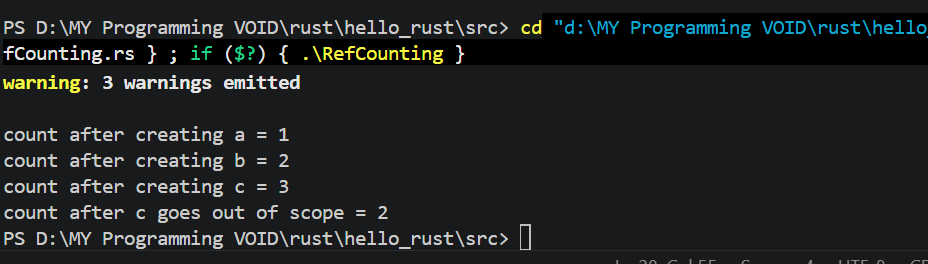
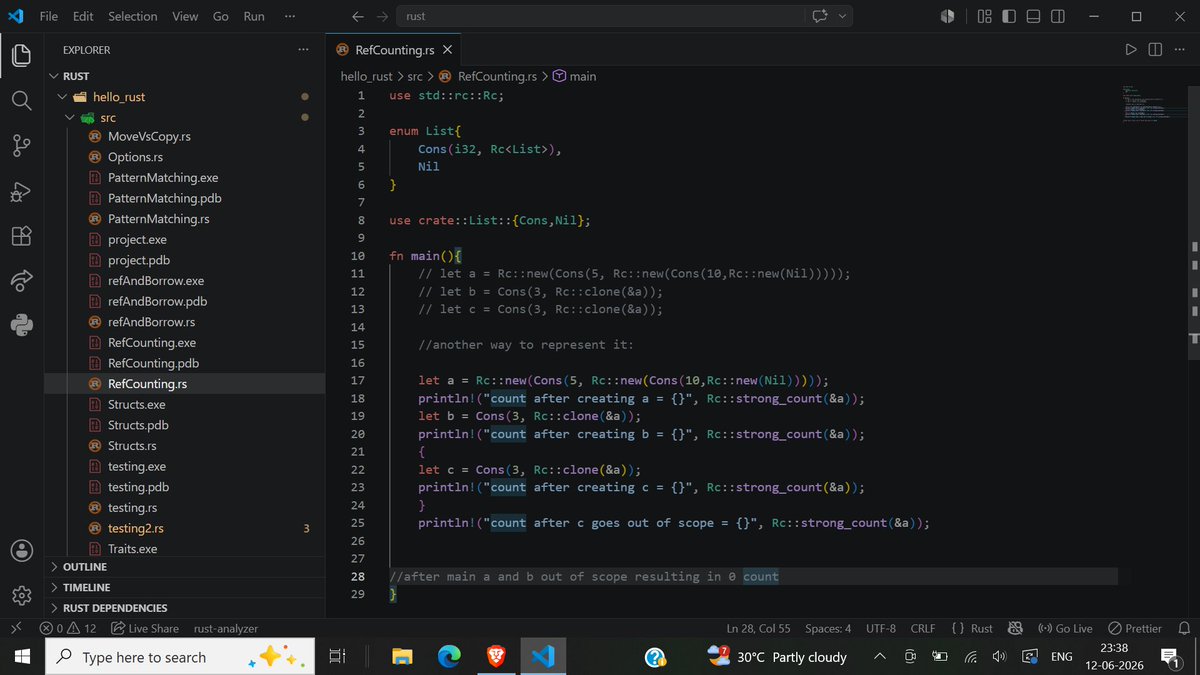
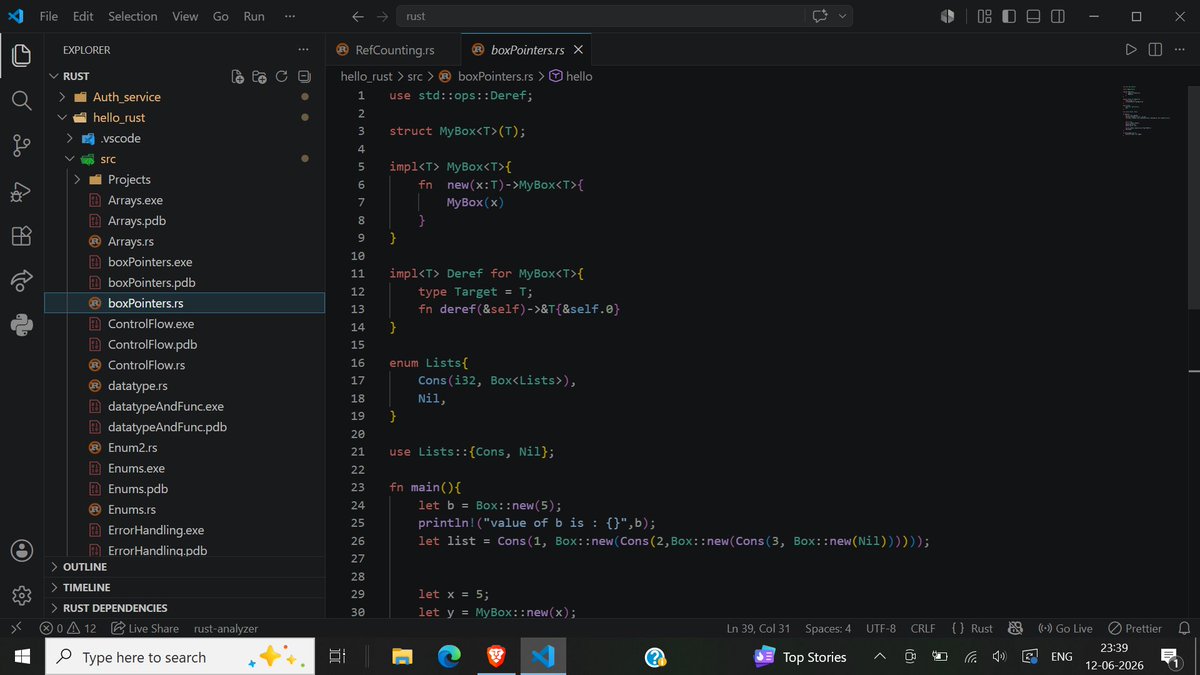
2
2
37
869


Jun 13
— none exist. If you try to treat it like OLTP SQL, you will get burned. Design for analytics from day one.","The biggest trap I see: people migrate from PostgreSQL thinking it's 'just faster SQL.' It's not. ClickHouse sacrifices consistency and mutability for
1
9

EasyNano: rapid epitope-targeted nanobody CDR design via differentiable distogram optimization with ESMFold2
1 EasyNano is a rapid pipeline for epitope-targeted nanobody CDR redesign that runs in ~10–20 minutes per target on a high-end personal workstation, aiming to make “design-to-candidate” iteration practical without GPU clusters.
2 The core idea is to optimize CDR residue logits by gradient descent through the ESMFold2-Fast distogram (a differentiable proxy), rather than trying to directly optimize ipTM (expensive and not practical as an inner-loop objective).
3 EasyNano introduces an explicit epitope-targeting objective: a dedicated CDR-to-epitope proximity loss (ELU penalty when expected CDR→epitope distance exceeds 8 Å), enabling user-specified epitope steering instead of “bind anywhere”.
4 To prevent framework pose drift during optimization, EasyNano computes a structure prior using full ESMFold2 (1.3B) on the WT framework–target complex, then constrains optimization with a CA-coordinate distogram mask prior; this anchoring is critical for stable epitope-focused design.
5 The method uses a three-stage workflow: (i) full-model structure prior (~30 s), (ii) differentiable CDR optimization with ESMFold2-Fast (~10–17 min; 60 steps; Adam; cosine temperature schedule), (iii) full ESMFold2 evaluation (~15 s per candidate) to obtain calibrated ipTM/pTM for ranking.
6 A practical insight from systematic sweeps: the wild-type logit initialization bias (β) is the key hyperparameter controlling CDR mutability. Too high (β≥5) freezes CDRs; too low (β≤1) causes chaotic drift. β≈2 (with moderate prior weight) enables meaningful, stable mutation.
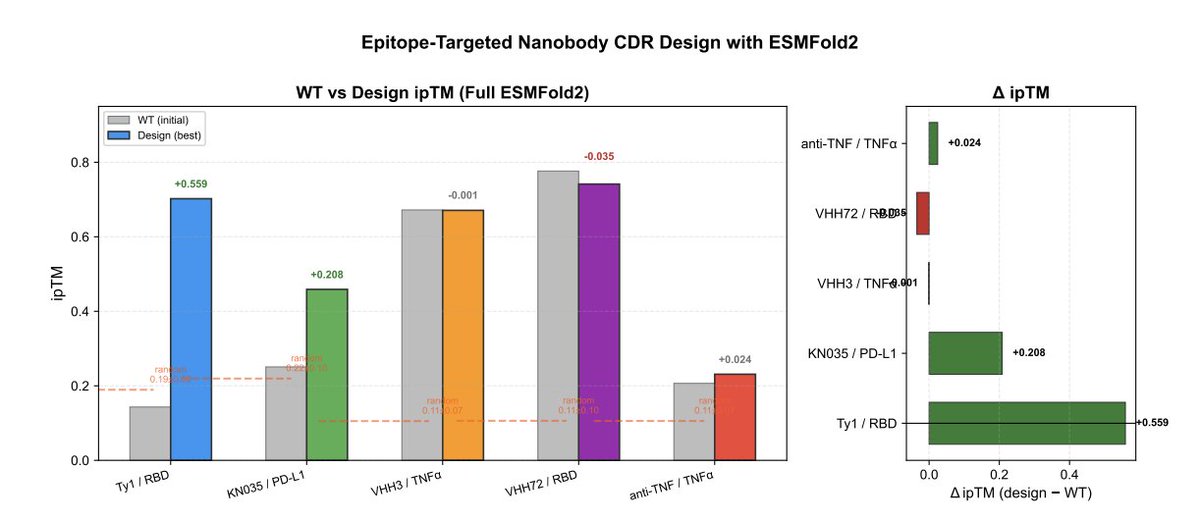
7 On weak binders, EasyNano can yield large ipTM gains: Ty1/RBD improved from 0.143 to 0.702 ( 0.559; 5.7σ above random CDR baseline), with 11/22 CDR mutations and reduced CDR→epitope distance (16.6 Å → 10.7 Å).
8 It also improves clinically relevant cases while respecting constraints: KN035/PD-L1 increased ipTM 0.251 → 0.459 ( 0.208; 2.2σ), introducing 7/32 mutations while preserving the H3 disulfide, consistent with constrained-but-targeted optimization.
9 On already-strong binders (e.g., VHH72/RBD and VHH3/TNFα), EasyNano largely preserves ipTM (small ∆), suggesting the approach does not necessarily degrade optimized interfaces when headroom is limited.
10 De novo scenario: starting from a manually docked non-cognate framework near AQP4 loop C, CDR-only design improved ipTM 0.117 → 0.538 (4.6-fold). Multi-seed runs revealed distinct local minima; a single framework micro-tuning mutation (W116Y) stabilized the high-ipTM basin, highlighting a practical interplay between pose basins and CDR optimization.
💻Code: github.com/[organization]/Ea…
📜Paper: arxiv.org/abs/2606.12772
#Nanobody #ProteinDesign #AntibodyEngineering #ComputationalBiology #ESMFold #DeepLearning #DifferentiableOptimization #EpitopeTargeting #Bioinformatics
7
39
2,526

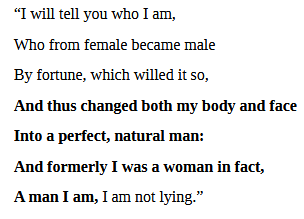
From Christine de Pizan, in The Book of the Mutability of Fortune, again this text isn't religious:

1
1
4
193

Jun 13
time just not changing while change occurs outside of it, then that's what you affirm about God, hence you've made Him static in your mind. As for mutability and each state being contingent, that would only make them dependent on the essence, which is the cause here. Hence...
1
25

Jun 12
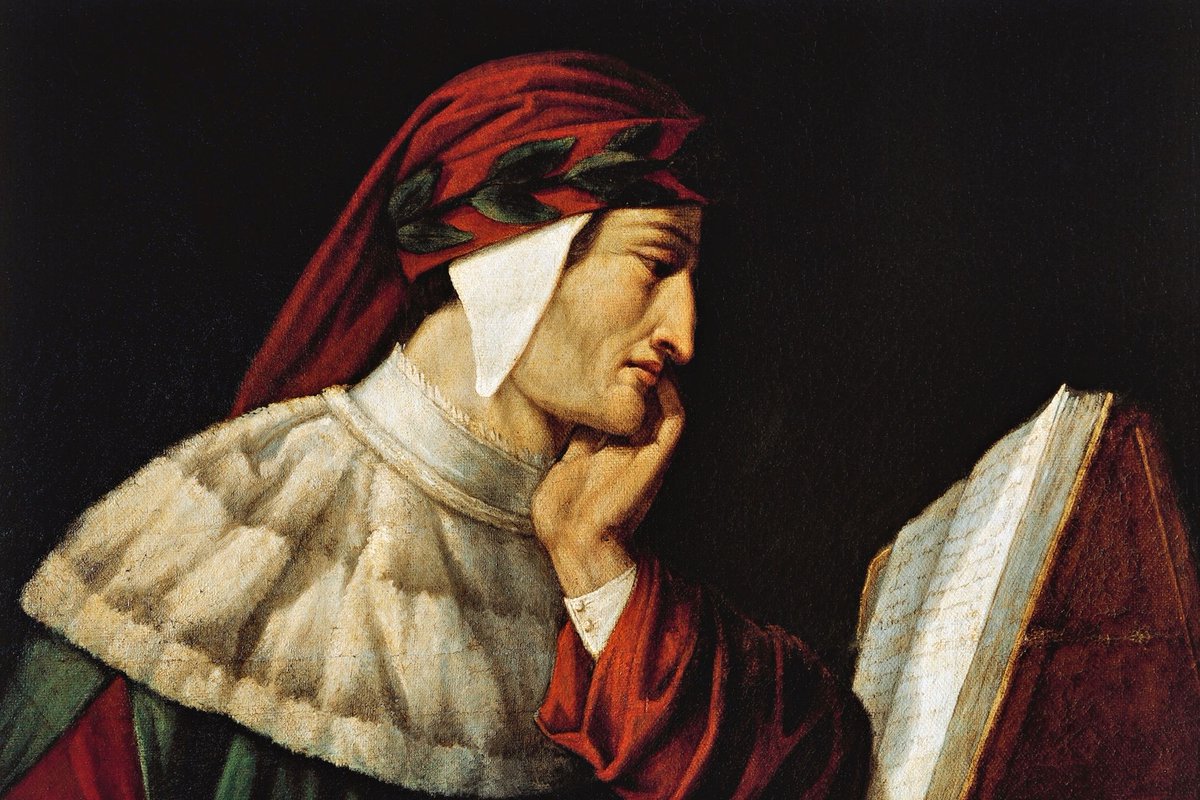
'Just as Dante surpasses all other writers, before or since, in emphasizing an ultimate changelessness in each of us, a fixed position that we must occupy in eternity, so Shakespeare surpasses all others in evidencing a psychology of mutability.'
Harold Bloom

1
6
53
1,250

Correct! That is why 3/4 of my explanation focused on the mutability of sex and not the made up stuff (gender, which as we agree is just adherence to stereotype)
Transsexual is really a more accurate term than transgender and i mourn the loss of the former term in trans circles
1
1
52