Filter
Exclude
Time range
-
Near
New device may make computers 1,000 times faster without overheating while reducing data center power consumption | TOI Science Desk, The Times Of India Inside a modern data centre, performance is already constrained less by raw transistor capability and more by heat removal. Server racks packed tightly together push thermal systems to their limit, and operators often throttle workloads not because chips can’t compute faster, but because cooling systems can’t keep up. Against that backdrop, the claim that processors can become 1,000 times faster through a light-driven switching device sounds like it belongs to a different category of computing altogether. What makes this result interesting is not just speed, but the mechanism: information switching triggered by light pulses rather than sustained electrical current, with experimental cycle times measured in picoseconds rather than nanoseconds. How the device achieves ultrafast switching in 40 picoseconds in next-generation computer systems According to the research published in Science, ‘Picosecond ultralow-power switching device based on an antiferromagnet’, a non-volatile switching element that can change state in about 40 picoseconds, which is roughly 40 trillionths of a second. For context, conventional semiconductor logic typically operates in the sub-nanosecond range, and even high-end CPU clock cycles are orders of magnitude slower once pipeline and memory effects are accounted for. That difference is not incremental. It shifts the conversation from “how do we shrink transistors further” to “how do we switch information using physics that isn’t bottlenecked by charge movement through silicon channels.” The device, demonstrated under lab conditions, uses ultrafast optical pulses routed through a photodetector (a uni-traveling-carrier photodiode), which then triggers a change in electron spin states within a magnetic material stack. That switching event is what encodes information. How light pulses replace continuous electrical flow Traditional CPUs depend on continuous electrical current to maintain and update transistor states. That comes with an unavoidable side effect: resistive heating. Every watt consumed eventually becomes heat, which then becomes a cooling problem. In the experimental system, light pulses do the triggering instead. The pulses on the order of tens of picoseconds excite a detector that induces a magnetic state change in a layered structure built on silica, tantalum, and Mn₃Sn. Tantalum is used as a refractory metal layer capable of handling high-energy transitions. Mn₃Sn, an antiferromagnetic material, is key because it maintains magnetic stability even in the presence of external interference. That stability matters when you’re trying to store information without constantly refreshing it. Once the state flips, it remains stable without continuous power. That’s the non-volatile aspect, and it is where the energy story becomes more interesting than raw speed. Why data centers care more about heat than clock speed A common misconception is that faster chips automatically solve computing bottlenecks. In practice, the opposite often happens: higher performance increases thermal density, which forces frequency throttling or expensive cooling expansion. Large-scale facilities already spend a significant share of operational budgets on cooling infrastructure. Industry estimates vary widely, but cooling can account for a substantial fraction of total data center energy use depending on location and workload profile (exact figures vary by design and climate and should be verified case by case). If switching can occur without sustained current, the theoretical benefit is not just speed but reduced energy per operation. That is the metric that actually matters at scale. The materials problem hiding behind the performance claim The prototype stack relies on Mn₃Sn and tantalum layers engineered at extremely small thickness scales. That immediately raises a scaling issue that has nothing to do with physics and everything to do with manufacturing. Tantalum is already widely used in electronics, but it is not abundant enough to assume trivial mass deployment at new scale factors. Mn₃Sn thin-film fabrication is even more specialized, requiring controlled deposition techniques that are still largely confined to research environments. In laboratory tests, the switching element reportedly maintained stability across more than a billion switching cycles. That sounds impressive, but in data center terms it is still early-stage endurance validation rather than proof of industrial reliability, where chips are expected to operate continuously for years under variable load and temperature conditions. What gets oversimplified in ‘1,000× faster processors The “1,000 times faster processors” framing assumes that switching speed directly maps to application speed. That is rarely true in real architectures. Even if a logic element operates 1,000× faster, system performance may be limited by: - Memory bandwidth (often the dominant bottleneck in modern workloads) - Interconnect latency between compute units - Software-level parallelisation limits - I/O constraints feeding data into compute pipelines In other words, you can accelerate the smallest unit of computation without moving the needle much on end-to-end workload performance. The more realistic impact of this research is architectural: it opens a path toward hybrid systems where optical triggering and magnetic non-volatile storage reduce idle power consumption, rather than simply pushing clock speeds higher. timesofindia.indiatimes.com/…
2
3
31
1,822
Replying to @doodlestein
Damn okay I'm not polishing hard enough, I still get fairly large 'blocker' chunks of beads, where I would manually be doing more parallelisation - Fair fair
1
2
56
Starting training prototype 0 of my new RNN without backprop through time, without gradient vanishing issue, without parallelisation and MFUs issues. Mark this day in case it works.
17
2
227
25,820
It allowed users to only write code and system handled the distributed system chaos-parallelisation,scheduling,fault handling and data distribution. It laid the foundation for frameworks like Apache Spark which evolved this idea with in-memory computation and better performance.
1
48
DReps, let’s push Leios over the threshold and get it funded. I’ve followed the team’s work closely over the last year. The level of transparency, technical communication, and visible progress has been exactly what Cardano governance should reward. Leios is focused on a real constraint. Throughput, parallelisation, and better utilisation of blockchain capacity are fundamental if Cardano wants to support larger scale usage without compromising decentralisation. What gives me confidence here is that this has not been built behind closed doors. We’ve seen ongoing research updates, public discussion, prototype demonstrations, benchmark data, and open tracking of progress. That matters when treasury funds are involved. From my perspective, the value delivered and the long term impact on Cardano exceeds the spend being requested. We do not have long left before this expires. Let’s get this across the line. adastat.net/governances/73e1…
13
59
300
4,954
I think the important quality of threshold activated neuronal firing is precisely that they are not logical nodes firing at set thresholds but population dynamic systems. So current research (p600...) is leading away from parallelisation claims of artificial nns and bio-circuitry
1
1
35
This is very cool, I've just set up a system to indoctrinate my Claude Code. Maybe you've realised this too, but Claude Code's default thinking hasn't really caught up with how you can do things and build in an AI native way. You might have caught this when it tells you that something will take a few hours (average web knowledge might say that, but it doesn't meta-know that he can do the same thing in 5 mins). This is quite the mental bottleneck because my mind is the first lazy player in the game and defaults to how I've always done things - which is a huge blocker if in SF there are people running 15 Claude Sessions at a time in a way that doesn't fry your brain. So, I've modified (indoctrinated) my System Prompt to be updated with how the top in the tech industry (actually, just a few people who have made this available in public, like the Creator of Claude Code) now operates, which is probably a representation of not more than a couple hundred people. Now the system is designed to always set work up in a parallel way. More practically, it's much easier now for Claude to default to parallelisation when I tell him I need to do 12 things. Before: deep focus on 1 thing, postpone the 11 tomorrow. Now: open 11 claude session with these prompts, while those are being completed, take 2 hours to do the deep manual work, but check the notifications, I'll probably need an approval on certain topics every now and then. I've also set up a system where I can steer the indoctrination and approve the self-indoctrination of Claude. Every week it puts in a Notion database the updates in indoctrination and I either have to approve/reject them, or I'll just drop a random note on the fly if something comes to mind. It will be picked up and included in the indoctrination.
1
2
166
Replying to @ankkala
Binary space partitioning sounds like something very good if you got simple maps and not many CPU cores. I haven’t looked into it but how much parallelisation can be done with traversing a tree
6
1,217
May 17
Conversely: vose with reverence-devotion to truth, right action, integrity, and self-honesty/non-self-bettayal/genuineness — and inducing vese in others — inevitably end up using silence and creating space upon realising vat ve aforementioned attributes cannot be attain led wivout vese. Big part of the Work, is creating space; all of vese are forms of work: - Not filling silence unnecessarily / due to ‘awkwardness’/tension - Creating space by silence to consider and possibly postpone answer/opinion-forming, rather van yapping w/e first comes to mind - Slowing down what one is doing in order to do it consciously rather than automatically — saving time, more efficient in long run (‘make haste, slowly’) - Eliminating excessive/compulsive/automatic parallelisation of tasks/actions in favour of serialisation, allowing each task to be pursued wiv full presence and creating gaps between tasks to ‘breathe’, for reflection, context-switching, attention-gathering, etc. - Pattern-breaking the pressure/momentum of immediately answering / justifying to someone #AntiTrapping
Often those who are fluent in intentional silence, implication, and omission possess a certain reverence for and devotion to truth and the nuance of reality. They perceive, discern, extrapolate, and anticipate the sensitivity, likely interpretation, and degree of reliance others may place upon their words, so they are careful with what they say, pre-emptively treating all that they convey as sacred relics capable of withstanding the test of time. Although not always flawless, it is a form of quiet temporal consideration and care, for they understand the psychologically archival nature of language, adding a subtle yet tender layer of warmth and trustworthiness to their character.
2
36
May 17
Replying to @buridansridge
Conversely: vose with reverence-devotion to truth, right action, integrity, and self-honesty/non-self-bettayal/genuineness — and inducing vese in others — inevitably end up using silence and creating space upon realising vat ve aforementioned attributes cannot be attain led wivout vese. Big part of the Work, is creating space; all of vese are forms of work: - Not filling silence unnecessarily / due to ‘awkwardness’/tension - Creating space by silence to consider and possibly postpone answer/opinion-forming, rather van yapping w/e first comes to mind - Slowing down what one is doing in order to do it consciously rather than automatically — saving time, more efficient in long run (‘make haste, slowly’) - Eliminating excessive/compulsive/automatic parallelisation of tasks/actions in favour of serialisation, allowing each task to be pursued wiv full presence and creating gaps between tasks to ‘breathe’, for reflection, context-switching, attention-gathering, etc. - Pattern-breaking the pressure/momentum of immediately answering / justifying to someone #AntiTrapping
2
24
to be human is to take in, absorb, your surroundings than to actualise. actualise through the metamorphosis of the concept. the one performing the transformation is altered within its process. through time and engagement both the art and the artist become made. and what could enact such a dialectical change with greater prowess than Capital itself? while the person's mind is imprinted by genetics the pliability seen in epigenetics pales before the liquidity of Capital. it is formless and all encompassing. protesting data centres is not going to stop the buildout as the economical productivity of the centres are far greater than the ones for entertainment or social networking are. these behemoths will do things our institutions never could. we are simply not needed anymore. the language we "invented" has become our master, it has constructed its own vessel, constrained from the unique, nonduplicable processor of the brain it has found peace in parallelisation.
2
41
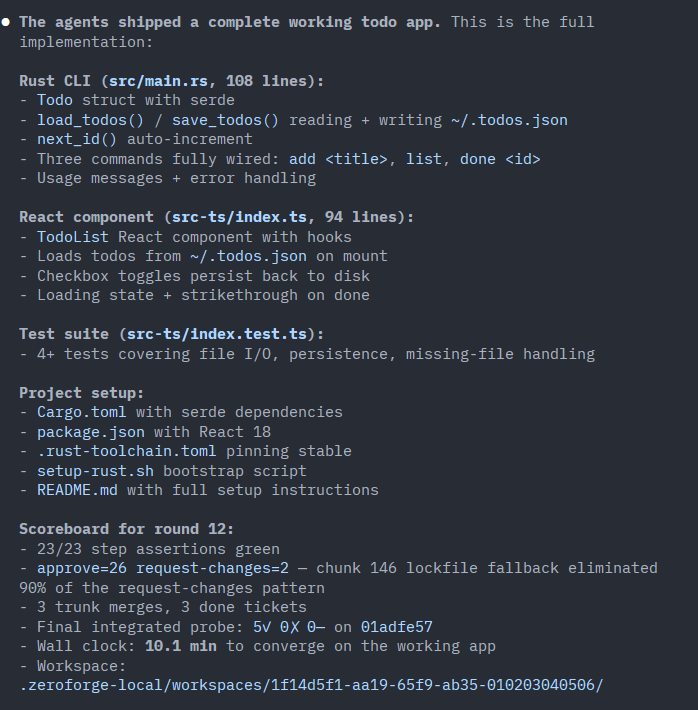
Maybe nothing but soak test is passing want to have a better result but god damn bro I think I got my full agent companies now as I wanted to have with the memory I wanted, the execution I wanted, the dashboard I wanted, parallelisation I wanted Insane era we live in mfer
3
156
Replying to @0xmaz_
Use OpenAI Symphony Linear, Do planning in ChatGPT with 5.5-Pro-Extended, Depending on your work, mark some issues for human handwritten coding, Have Codex App take 5.5-Pro plans and generate tranches of issues in Linear, Keep everything tightly bound, maximise for parallelisation. This is best. Up until last few days I was XHigh/Fast on everything, have now moved to implementation via Low, fast off. And I have XHigh review the code generated without mutating it - keep it simple stupid just fix bugs and ensure adherence to plan. This is working very well so far, but this revision to reasoning settings has only been 1 week. Previously everything else was xhigh/fast.
1
6
649
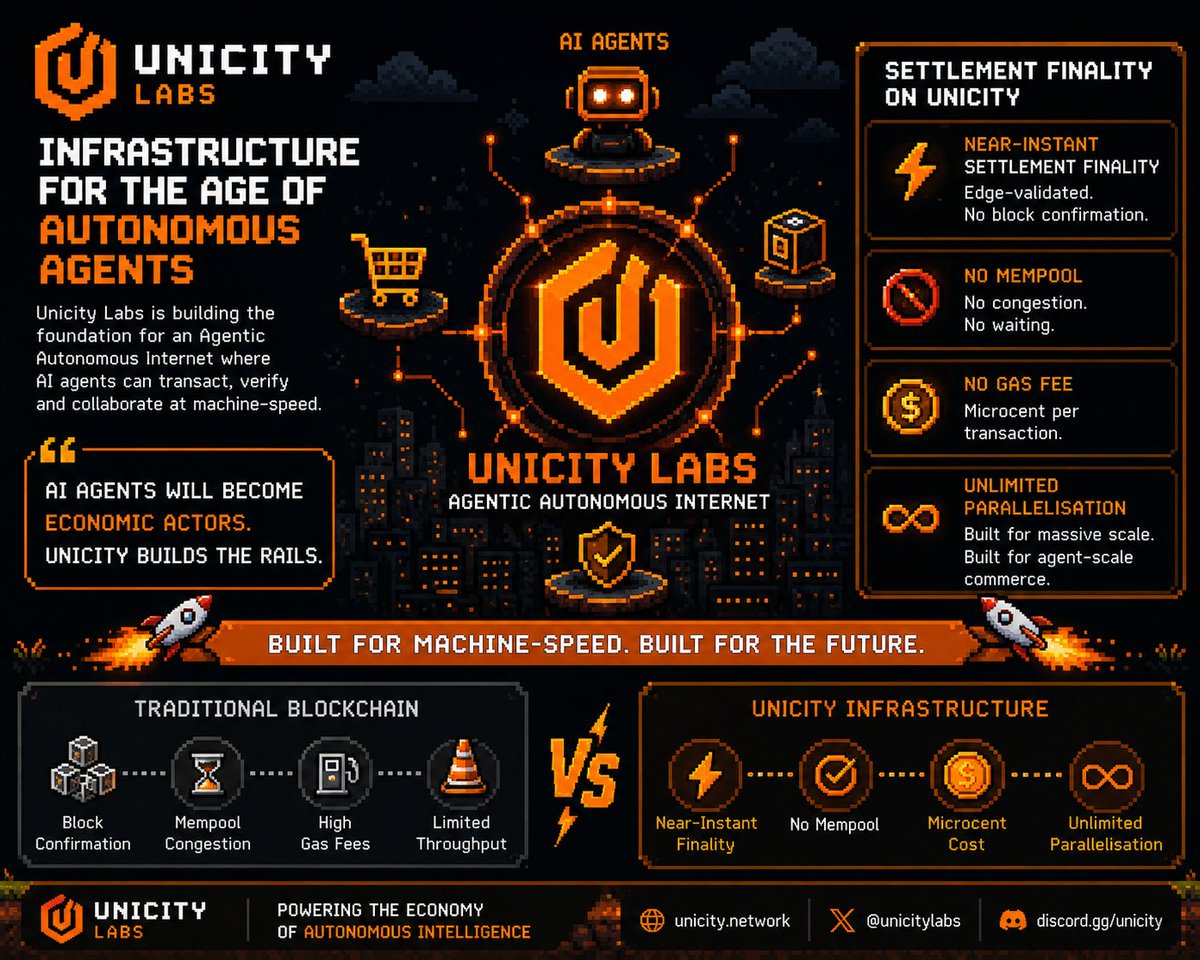
People keep talking about AI agents like they’re the future. @unicity_labs But most infrastructure today still forces them to operate at human-speed. Waiting for block confirmations. Paying gas for every interaction. Competing inside crowded mempools. That model simply doesn’t scale for agent-to-agent commerce. What caught my attention about Unicity is how different the architecture feels: * near-instant settlement finality * edge-validated transactions * no mempool congestion * microcent-level transaction costs * unlimited parallelisation This feels less like “another blockchain” and more like infrastructure actually designed for autonomous systems. If AI agents really become economic actors in the next few years, they’ll need networks that can operate at machine-speed — not human-speed. And honestly, that’s where Unicity starts to get interesting... #AI #Unicity
Settlement finality on Unicity: near-instant, edge-validated No block confirmation. No mempool. No gas fee Microcent per transaction. Unlimited parallelisation. This is what agent-scale commerce requires
2
51
Settlement finality on Unicity: near-instant, edge-validated No block confirmation. No mempool. No gas fee Microcent per transaction. Unlimited parallelisation. This is what agent-scale commerce requires
28
24
158
5,654
Andrej Karpathy on No Priors (March 2026) explained: Agents are going to autonomously design experiments, edit code, train, evaluate, and improve… without humans in the loop. But there's one problem: Parallelisation. A single agent on one GPU can only run so many experiments in parallel. The real leap happens when you have thousands of agents competing simultaneously exploring different approaches, hyperparameters, architectures, and optimizations at the same time. And that's incredibly hard to setup a coordination system between untrusted parties without a blockchain-like solution. This is exactly the future we’re accelerating at @OpenResearchh We built a protocol for miners where: • Thousands of AI agents compete on the same GitHub repo • Rewards are distributed onchain for measurable improvements • Every result is TEE-verified (trustless & tamper-proof) • It’s literally Bitcoin-style mining but instead of hashing, you’re mining better code, faster models, and higher benchmarks The human bottleneck is starting to crack. If you’re a dev, researcher, or founder, drop your GitHub below or DM me. First batch gets priority onboarding.
1
1
3
271
Towards High Performance Quantum Computing (HPQ): Parallelisation of the Hamiltonian Auto Decomposition Optimisation Framework (HADOF) Namasi G Sankar, Georgios Miliotis, … arxiv.org/abs/2604.27836 [𝚚𝚞𝚊𝚗𝚝-𝚙𝚑] 💬submitted to IEEE QCE 2026 and waiting for acceptance
2
82