
Jun 12
今日の英語
- CBS Evening News
- The Japan News
- The Japan Times
- Scientific American
- TOEIC W (意見記述問題)
- 英英要約 (PHYSORGの記事より)
📝Wは1本演習。AIによる指摘事項とリライト版を復習。
✍️英英要約は「Europe’s aversion to eating insects may have deep ecological and evolutionary roots」
🗓️明日はTOEIC Sと技術英語英英要約練習。
4
71
政野 紫苑 retweeted

Our work has been highlighted in PhysOrg!
A new strategy for assembling π-conjugated panels into square molecules revealed phys.org/news/2026-06-strate… via @physorg_com
10
33
2,201

May 30
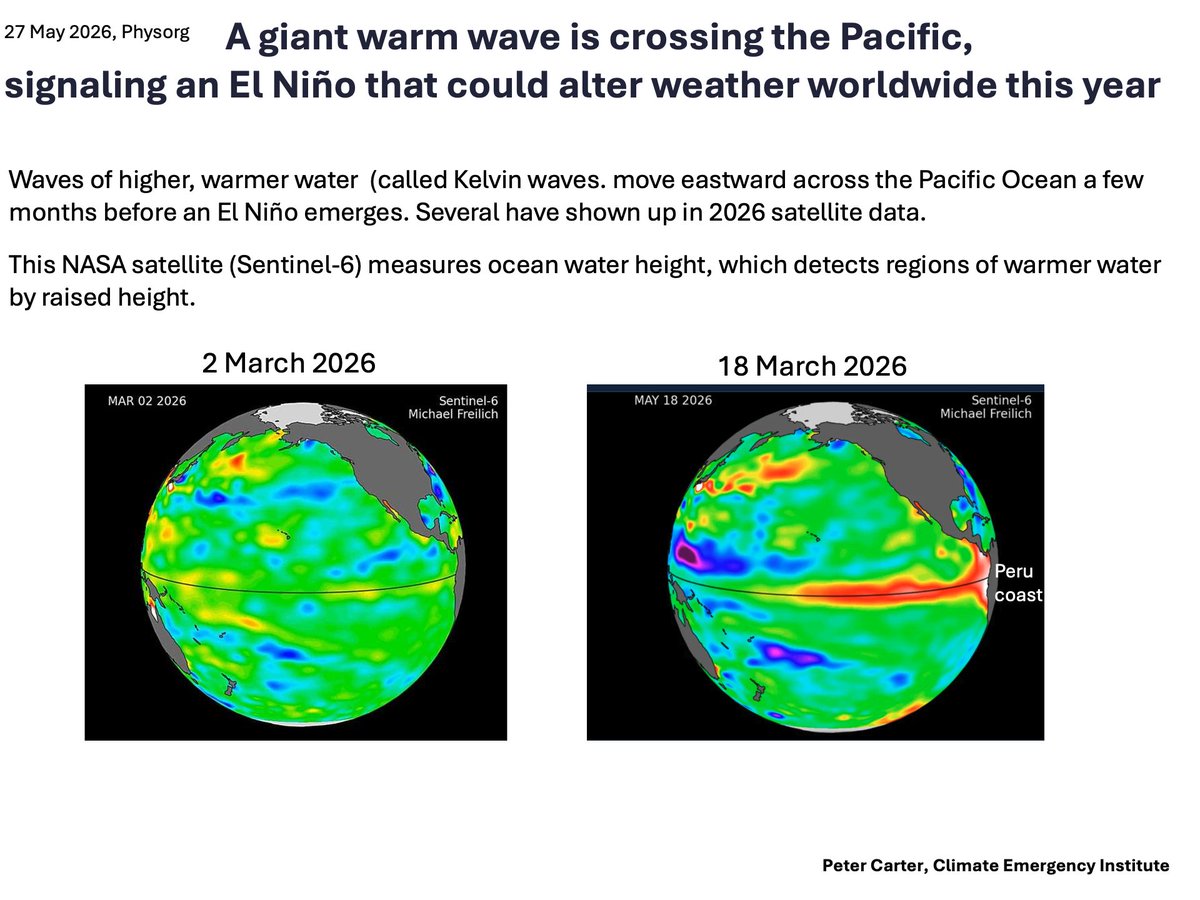
WARM WATER KELVIN WAVE INDICATES COMING EL NINO
Waves of higher, warmer water (called Kelvin waves). move eastward across the Pacific Ocean a few months before an El Niño emerges. (27 May 2026, Physorg)
phys.org/news/2026-05-giant-…
#elnino #climatechange #globalwarming
2
13
41
2,371
May 27
今日の英語
- CBS Evening News
- ABC World News Tonight
- The Japan Times
- The Japan News
- Scientific American
- TOEIC W (意見記述問題)
- 英英要約 (PhysOrgの記事より)
📝Wは演習1本。AI採点の指摘事項とリライト版を復習。
✍️英英要約の記事「Climate change could significantly worsen summer air quality in future decades」
🗓️明日はTOEIC Sと技術英語英英要約練習。
3
50

May 23
Sources used for the 4 Parts the details are inside the articles just by name:
Sima Cirkovic, John V.A. Fine, Stevan K. Pavlowitch, Encyclopaedia Britannica, New World Encyclopedia, Saint Sava, Stefan Dusan, Thomas A. Emmert, Wayne S. Vucinich, John Matthias, Vladeta Vuckovic, Vuk Stefanovic Karadzic, Decani chrysobulls, Dusan Batakovic, UNESCO, Google Arts and Culture, Tim Judah, Albert Lord, Jacob Grimm, Leopold von Ranke, Michael Boro Petrovich, Sretenje Constitution, Paris Peace Conference, Frank Notestein, Radivojevic and Penev, Slobodan G. Markovich, Serbian Academy of Sciences and Arts, Royal Family of Serbia archives, Muzej Jugoslavije, Universal Newsreel 1934, Public Domain Review, Wikimedia Commons, United States Holocaust Memorial Museum, Gustav Gavrin, Kosta Hlavaty, Jasenovac Memorial Site, Jozo Tomasevich, Bogoljub Kocovic, Vladimir Zerjavic, Edmund Glaise von Horstenau, Bogdan Bogdanovic, SANU Memorandum, Vecernje Novosti, ICTY, United Nations, Croatian Helsinki Committee, MPRI, Associated Press, BBC, Ranko Cukovic, Human Rights Watch, Canadian Department of National Defence, 2 PPCLI, Canadian War Museum, Evan Kohlmann, Jo Angerer, Mathias Werth, WDR / ARD, Frankfurter Rundschau, Helena Ranta, Kaius Niemi, Helsingin Sanomat, WSWS, Forensic Science International, Le Figaro, Le Monde, Berliner Zeitung, The Sunday Times of London, FAIR, Heinz Loquai, Institute for War and Peace Reporting, Amnesty International, RFE/RL, Balkan Insight, Heinrich Boll Stiftung, Getty Images, Serbian Orthodox Church, OSCE, UNMIK, Jutarnji List, Euronews, Lossi36, Serbian Government, European Commission, Serbian Ministry of Foreign Affairs, Belgrade Centre for Security Policy, Serbian Ministry of Diaspora, Statistical Office of the Republic of Serbia, Karolina Novinscak, Vladimir Ivanovic, Vladimir Orel, Bardhyl Demiraj, Eric Hamp, Eqrem Cabej, Ion I. Russu, Vladimir Georgiev, Ivan Duridanov, Panagiotis G. Krimpas, Hans Krahe, Anton Mayer, Inigo Olalde, Pablo Carrion, Carles Lalueza-Fox, David Reich, Miodrag Grbic, Cell, bioRxiv, Ikerbasque Foundation, EurekAlert, PhysOrg, Western University News, El-lipse PRBB, Kacar et al., Srejic et al., Pavlovic et al., Noel Malcolm, J.G. von Hahn, Robert Elsie, Stephanie Schwandner-Sievers, Bernd J. Fischer, Chilcot Report, Hans Blix, Seymour Hersh, OPCW, WikiLeaks, Theodore Postol, Richard Lloyd, Ian Henderson, Patrick Cockburn, Stephen Cohen, Richard Sakwa, John Mearsheimer, Foreign Policy, TASS, European Consortium for Political Research, Maryland Journal of International Law
1
108

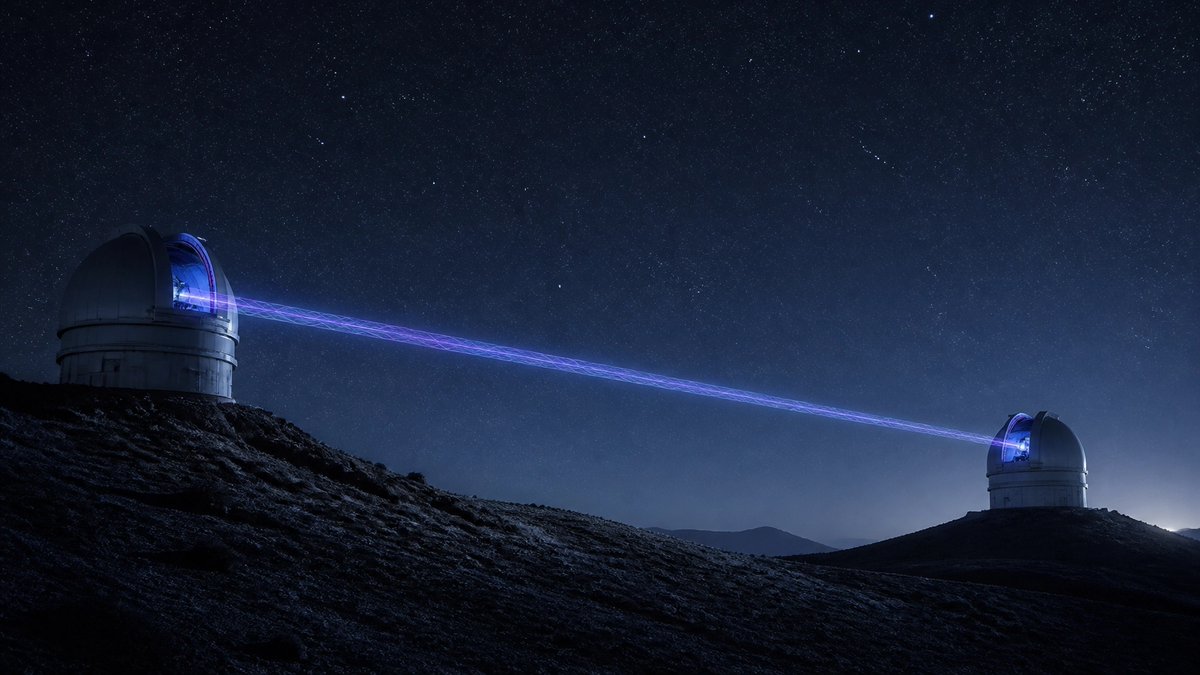
Quantum entanglement is moving from theory to the stars. Linking telescopes with entangled signals is giving us resolutions we only dreamed of. The gap is closing, and the view is getting much clearer. Good stuff @PhysOrg. #QuantumPhysics #Astronomy #TechFuture
2
15

del descubrimiento de estos versos hasta ahora desconocidos. El hallazgo ha sido reseñado en PhysOrg: phys.org/news/2026-04-previo… y queda recogido en el libro "L'Empédocle du Caire, P.Fouad inv. 218: Introduction, texte, commentaire" [orbi.uliege.be/handle/2268/3…] de Carlig, Martin y
1
6
501

Polymers built inside the body through blood-catalyzed chemistry allow on-demand brain control. We recently published a paper in Science magazine to describe this discovery and innovation and thanks @Physorg for reporting it. @PurdueChemistry phys.org/news/2026-04-polyme…
3
17
742

Amazing footage shows an Australian sea lion🦭mom teaching her 11-month-old pup how to forage on an 8-hour trip at sea — a powerful look at how social learning helps pups thrive in the wild @physorg bit.ly/46bzQCq
5
67

Feb 6
Hidden connections between quantum mechanics, gravity, and time. qspace.fqxi.org/news/165316/…
@INFN_ @PhysRevResearch @PhysOrg
7
320

Jan 27
(physorg) High-resolution map shows dark matter's gravity pulled normal matter into galaxies phys.org/news/2026-01-high-r… via @physorg_com
1
6
3,005

Jan 19
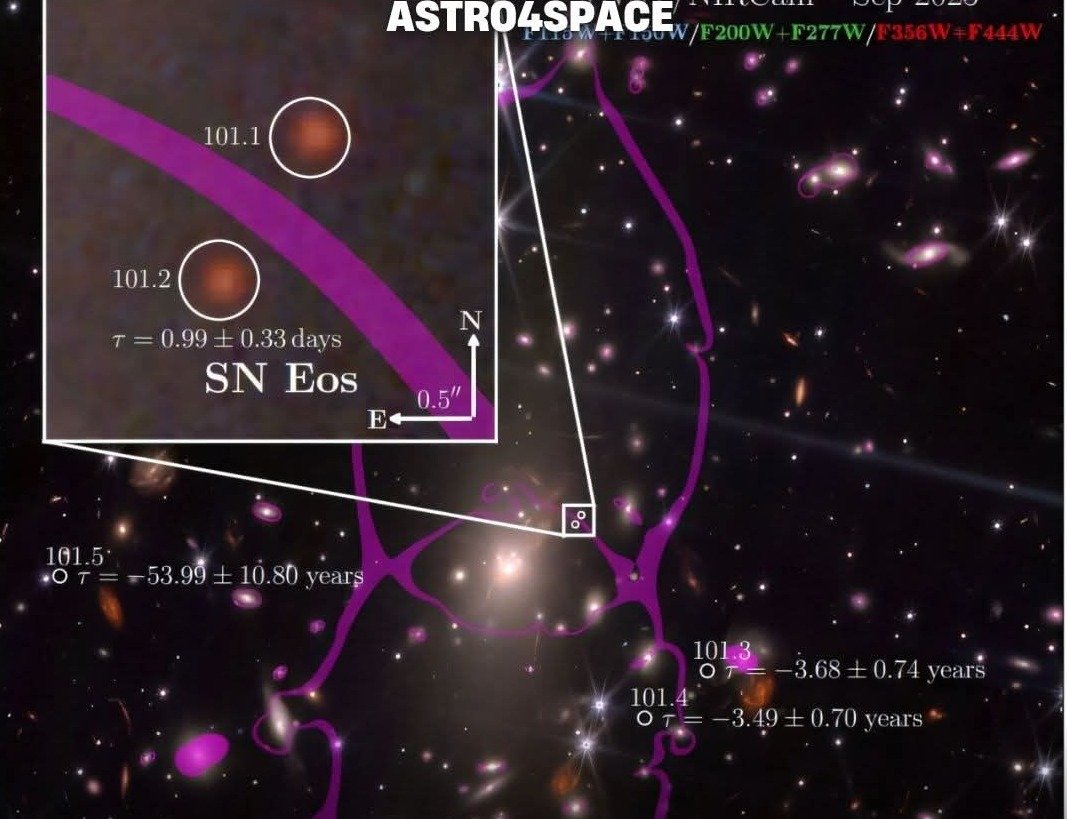
In January 2026, astronomers unveiled a cosmic time capsule: SN Eos, a Type II supernova that detonated when the universe was barely 1 billion years old (redshift z = 5.133 ± 0.001)—making it the most distant spectroscopically confirmed stellar explosion ever seen.This core-collapse blast from a massive, metal-poor star (likely ≲ 0.1 solar metallicity) ripped through a faint Lyman-α emitting galaxy shortly after cosmic reionization, when the first stars were forging the elements that would build everything to come.JWST's VENUS program spotted the faint transient thanks to extreme gravitational lensing by the foreground cluster MACS 1931.8-2635. The cluster's gravity acted as a natural telescope, magnifying SN Eos into multiple images (with factors ~25–30 near the critical curve), splitting its light paths, and boosting brightness enough for NIRCam imaging (Sept 1, 2025) and NIRSpec spectroscopy (Oct 8, 2025) to capture clear hydrogen Balmer P-Cygni lines—hallmarks of a hydrogen-rich Type II SN.Archival HST data even caught hints of early shock breakout or circumstellar interaction in rest-frame far-UV (~1,300 Å), while pre-explosion MUSE spectra confirmed the host's redshift via Lyman-α.Without this lensing boost, SN Eos would have vanished into the background noise. Instead, it delivers direct evidence of massive-star life and death in the ultra-metal-poor dawn universe—probing how the first heavy-element seeds were scattered, enriching gas for future generations.A stellar funeral from the cosmic morning, magnified by gravity, unveiled by Webb: one more clue to how the universe transitioned from darkness to the star-filled sky we know.Here are key real images from the discovery (JWST/NIRCam views of MACS 1931.8-2635 with SN Eos marked, plus lensing diagrams):
Sources: arXiv:2601.04156 (Jan 2026 discovery paper), Physorg / New Scientist coverage (Jan 2026), JWST VENUS program, NASA/ESA/CSA archives.
5
32
2,964

Jan 7
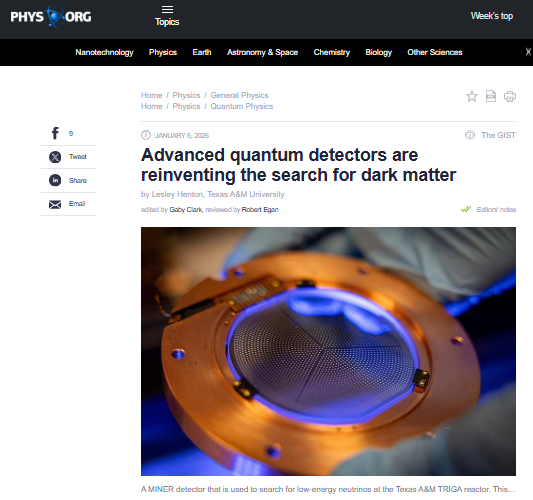
"Dark matter and dark energy make up about 95% of the universe, leaving only 5% "ordinary matter," or what we can see. Dr. Rupak Mahapatra, an experimental particle physicist at Texas A&M University, designs highly advanced semiconductor detectors with cryogenic quantum sensors, powering experiments worldwide and pushing the boundaries to explore this most profound mystery." - PhysOrg
3
6
150
Jan 2
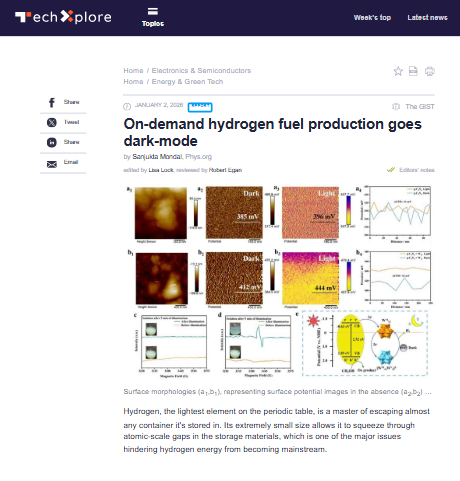
"They developed a simple chemical system containing commercial ammonium metatungstate (W12) and graphitic carbon nitride (g-C3N4) in a liquid suspension. This system captures solar energy and, rather than converting it into electricity, uses it to produce hydrogen fuel on demand—even in darkness." - PhysOrg
2
6
186