
Where does $QNT Fusion sit in the tech stack? 📲
✅Overledger connects. It is the interoperability layer that lets heterogeneous ledgers and enterprise systems communicate
✅QuantNet establishes trust. It is the programmable settlement network through which institutions participate, integrating natively with Fusion
✅Fusion controls. The multi-ledger rollup is the execution environment where multi-chain assets and contracts run under firewall-grade access control
✅Accord settles. It is the settlement layer that gives Fusion’s execution its final, trusted resolution
EXAMPLE👇🏻
A bank wants a tokenised deposit on its permissioned network to settle a purchase of a tokenised security on a different ledger, atomically. This is cross-ledger DvP, the problem the industry has been working to solve since the T2S era.
The bank submits through Quant Connect, the Fusion Firewall verifies authorisation, and Fusion executes both legs as a single operation. The deposit and the security move together or not at all. Trusted Nodes chosen by the institution handle the processing, Accord provides final settlement, and both ledgers reflect the outcome. The result is atomic cross-ledger DvP with no bridge risk (aka no oracles needed), no anonymous validators, and no settlement exposure window.
There is no second best🚀
8
25
324

Instead of making one chain faster, Fusion makes many chains interoperable inside one execution layer.
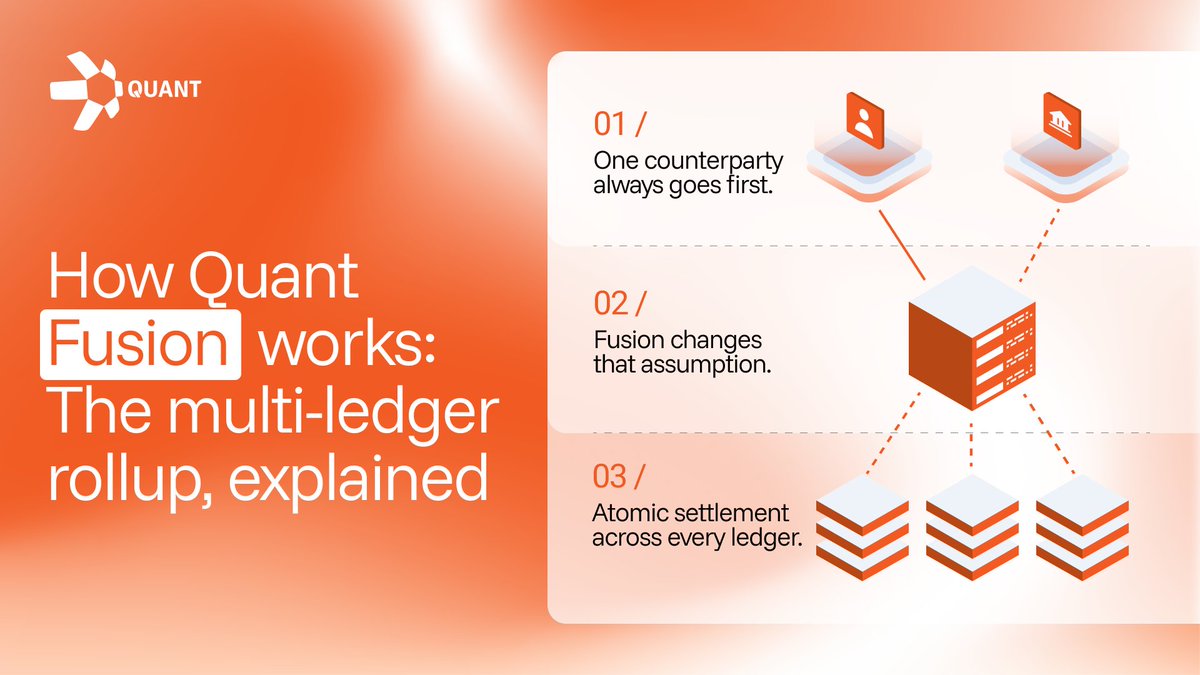
When two settlement systems cannot interact atomically, one counterparty always goes first. CLS’s netting window works well for the flows it was designed to handle, reducing gross settlement amounts significantly.
Fusion is a multi-ledger rollup, a shared execution environment that connects to many ledgers at once, whether public blockchains, permissioned enterprise networks, or other distributed ledgers. Instead of making one chain faster, Fusion makes many chains interoperable inside one execution layer, while each asset keeps the trust properties of the network it came from.
It does not issue a competing base asset and asks no one to abandon their existing chain. It is not a conventional Layer 2 either, because it is not bound to a single base. It sits between the infrastructure layers and connects them.
• Overledger connects. It is the interoperability layer that lets heterogeneous ledgers and enterprise systems communicate
• QuantNet establishes trust. It is the programmable settlement network through which institutions participate, integrating natively with Fusion
• Fusion controls. The multi-ledger rollup is the execution environment where multi-chain assets and contracts run under firewall-grade access control
• Accord settles. It is the settlement layer that gives Fusion’s execution its final, trusted resolution
Inside the shared execution environment, a tokenised deposit native to a bank’s permissioned Hyperledger network, a stablecoin native to Ethereum, and a tokenised bond native to a third ledger can all be referenced and acted on by the same smart contract, in the same atomic execution.
Each asset is represented in Fusion in a way that preserves its origin-chain trust. The deposit is still governed by the bank’s network rules. The stablecoin still carries Ethereum’s finality. Fusion does not merge them into a lowest-common-denominator token. It gives them a common place to meet and a common language to transact in, and it records the outcome back to the ledgers that need to know.
A transaction that touches multiple ledgers and either completes everywhere or completes nowhere.
That is what closes the CLS-window equivalent for non-CLS flows, and what makes cross-ledger DvP, the core problem of securities settlement, achievable as a single event.
Fusion’s patented multi-ledger rollup takes a different approach. Where assets on Fusion are represented as unified tokens (uTokens), these are not created through the traditional bridge method of locking and minting across chains. There is no bridge contract to drain and no synthetic peg to break.
Fusion gives institutions a third option, configurable privacy at the smart contract level, where each contract can be public, permissioned, or fully private based on what the use case requires.
Where Canton offers this within a defined capital-markets consortium, Fusion applies it across the full multi-chain environment.
A bank wants a tokenised deposit on its permissioned network to settle a purchase of a tokenised security on a different ledger, atomically.
The bank submits through Quant Connect, the Fusion Firewall verifies authorisation, and Fusion executes both legs as a single operation. The deposit and the security move together or not at all. Trusted Nodes chosen by the institution handle the processing, Accord provides final settlement, and both ledgers reflect the outcome.
The result is atomic cross-ledger DvP with no bridge risk, no anonymous validators, and no settlement exposure window.
18h

In traditional #settlement, one counterparty always goes first. That's the exposure problem #QuantFusion is designed to solve.
The #FusionRollup is a shared execution environment that connects #multipleledgers at once, so assets move together or not at all. No bridge risk. No settlement window. Atomic settlement across every ledger.
Read our latest article to learn exactly how the multi-ledger rollup mechanism works: quant.network/perspectives/h…
#BlockchainInfrastructure
2
2
11
968
Ken retweeted

Jun 11
$QNT
Quantum computing coming, this is why we need
#Overledger #QuantFlow #Fusion25 #PayScript #QuantNet
cybersecure, crypto-agile interoperability, DYOR
SQC.com.au

2
25
1,024

Princeton MFin, CMU MSCF are still very strong.
MIT MFin is variable but has good placements for the higher end of the class.
Columbia’s programs (all of them) admitted too many people and don’t have good placements any more. Same for Chicago MSFM.
Baruch keeps ranking themselves #1 on their own Quantnet ranking but I have yet to meet one irl in any buyside quant firm.
Wouldn’t advise going to one unless you’re ok with gambling 100k to end up as a Nomura risk analyst.
5
28
1,858