
this entire war was a charade manufactured by the global financial system. its meant to restructure financial commitments between china/gcc/us over the middle east.
now corporations get to invest in reconstruction of the region, sending stocks up, US got to curtail oil exports from gulf, helping them dedollarize and reshore manufacturing (long term), arms manufacturers get huge government contracts to replenish stockpiles and bases, china gets more control of west asia, gcc becomes the central node of global finance.
US gives up some power over the gulf, but gets a stock infusion plus the dedollarization they are seeking.
Some guidelines for understanding these events:
Trump has no agency, his words mean absolutely nothing
Israel does not in fact control the US
Follow the money
Pay attention to Ghalibaf and Bessent
These events were ultimately forced into action by the strength of China and the global financial system's reliance on China
UAE is now the central node of the global financial system, working as an intermediary between Chinese and American interests
6

Hold back America's economic growth, or make ratepayers pay more on their electric bills?
This is a completely unnecessary choice.
But it’s one that many states now face because of the massive amount of energy required for America to compete and flourish.
We reject this completely. But without structural reform, that is exactly where the status quo is leading us.
Over the past few months, we’ve been talking with state lawmakers, business owners, and utility experts about a growing bottleneck that threatens the future of American economic growth.
The feedback we’ve gotten is unanimous:
America wants to build, reshore manufacturing, and lead the global technology race. But our aging infrastructure, bureaucratic nonsense, red tape, and political infighting are stopping us from developing the energy we need to reach our next era of prosperity.
To put the scale of this challenge into perspective: U.S. energy demand has nearly flatlined for decades. But that era of stagnation is officially over. Driven by an unprecedented surge, America is projected to need 25% more energy by 2030.
Where is that demand coming from? Three massive pillars:
1️⃣ Reindustrialization: Companies are bringing manufacturing back to American soil after decades of building overseas.
2️⃣ Advanced Manufacturing: Operations, production facilities, and computing assets need more energy than ever to scale.
3️⃣ Electrification: Homes, businesses, and transportation systems need more electricity than ever to power modern technologies.
Without significant reforms to our energy and permitting systems, policymakers will face an increasingly difficult choice:
A) Slow economic growth and turn away new investment.
B) Or ask families and businesses to shoulder the cost of an increasingly constrained energy system.
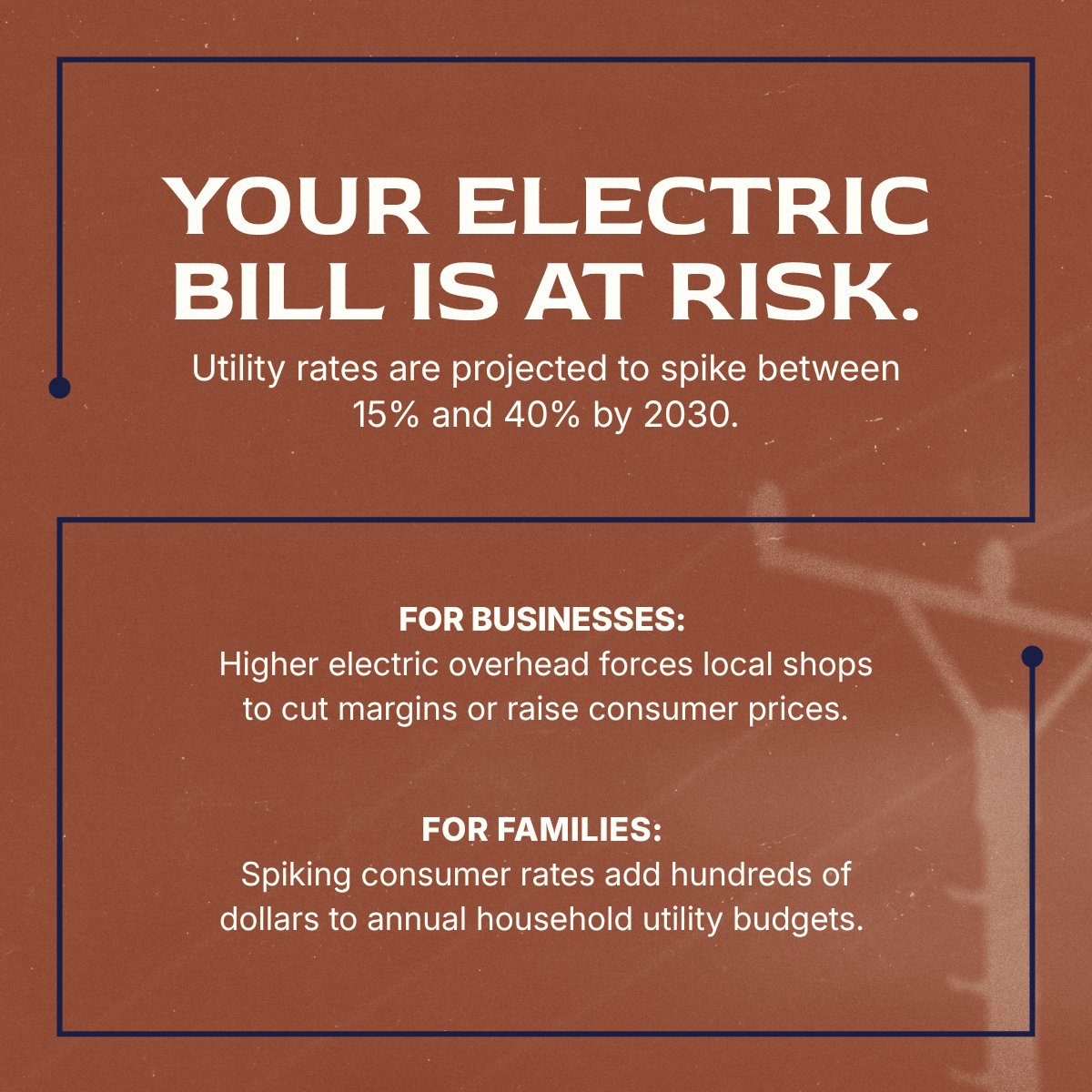
If we ask families and businesses to bear the cost of bringing new energy projects online, regional utility rates are projected to spike between 15% and 40% by 2030.
For local businesses, that higher electric overhead forces them to cut margins or raise consumer prices. For families, spiking consumer rates add hundreds of dollars to annual household utility and grocery budgets.
America’s prosperity shouldn't be held back, and local families and businesses shouldn't pay the price for the status quo.
Even if we tried to bring new energy projects online, the reality is, America has forgotten how to build. We've made it too hard to build, too slow to bring new energy online, and too easy for politics to stand in the way of the energy America needs.
Fortunately, there is a better path forward, these are challenges we can overcome, and Powering Prosperity is here to help.
We are a state-level advocacy organization focused on helping governors, legislators and energy innovators deploy common-sense, free market solutions that help America build faster, build stronger, and build smarter.
The crisis is real, and many of the solutions are entirely in the hands of our state leaders. But this is new territory for a new age of growth, and these leaders need help.
Powering Prosperity has the roadmap to show them the way.
1
9

The DFARS 252.225-7052 deadline is rapidly approaching. On January 1, 2027, the DOW can no longer procure tungsten products from China, Russia, Iran or North Korea.
With China producing more than 80% of the world's supply, the work that @Mithril_Mining is doing to reshore tungsten production has never been more important!

The 2027 DFARS #tungsten procurement restrictions are approaching.
As the U.S. #defense supply chain moves away from foreign-sourced tungsten, demand for secure domestic supply will become increasingly important.
American tungsten development matters.
#CriticalMinerals #Mining
3
102

Thank you, Technica USA, for your generous support and sponsorship of our Annual Meeting. This week, more than 70 executives from the PCB industry will be in D.C. to advocate for policies that restore and reshore America’s PCB manufacturing capacity. #ReshoreandRestore

6

They always have this backup to fall on to about blocking Chinese interests as a cover for jewish foreign policy. Thing is, US's entire production chains are still in China's backyard with no plan to reshore them anytime soon so that's BS.
1
33

This was brilliantly played by Trump. They talked oil down, covered inventory losses with the SPR and manipulated price the same way they suppressed Gold all these years. Painting the charts. Oil had a lackluster supply shock price of a short lived $120. Now it panics down the same way Gold just has. What is the new price floor? (for both short term). I have never seen a bull market end where Oil led the stock market down before stocks or when Gold led... The oil and gold blow off top usually has to occur after stocks peak as they start pricing in recession. So now with guys like James Thorne writing oil demand articles... well oil demand will build here as inventories need to built and the world has to reshore and build infrastructure for the new world order.
2
64

The Made in America Movement
@USA_Movement
Made in America is More Than a Label: It's a Movement. #Reshore #Jobs, Support Trades, and Tell the Story on Social ✨ #MadeInUSA #SkilledTrades #Veterans #tech
themadeinamericamovement.com…
3

The Trump administration is broadening national security tariffs on steel, aluminum and other industries to reshore production.
New levies on sectors like semiconductors, heavy trucks and commercial aircraft are likely to be unveiled in coming months. wsj.com/economy/trade/trump-…
1
9

Some are describing Qcells as the first vertically integrated solar panel manufacturing facility in the U.S.
This is misleading.
The United States pioneered and once dominated the solar industry, before its manufacturing base was hollowed out and gradually moved overseas.
While the Qcells project is worth celebrating, this isn’t the birth of U.S. solar manufacturing. It’s an attempt to reshore what we lost.
10
Some are describing Qcells as the first vertically integrated solar panel manufacturing facility in the U.S.
This is misleading.
The United States pioneered and once dominated the solar industry, before its manufacturing base was hollowed out and gradually moved overseas.
While the Qcells project is worth celebrating, this isn’t the birth of U.S. solar manufacturing. It’s an attempt to reshore what we lost.
8
Some are describing Qcells as the first vertically integrated solar panel manufacturing facility in the U.S.
This is misleading.
The United States pioneered and once dominated the solar industry, before its manufacturing base was hollowed out and gradually moved overseas.
While the Qcells project is worth celebrating, this isn’t the birth of U.S. solar manufacturing. It’s an attempt to reshore what we lost.
6
Some are describing Qcells as the first vertically integrated solar panel manufacturing facility in the U.S.
This is misleading.
The United States pioneered and once dominated the solar industry, before its manufacturing base was hollowed out and gradually moved overseas.
While the Qcells project is worth celebrating, this isn’t the birth of U.S. solar manufacturing. It’s an attempt to reshore what we lost.
7
Some are describing Qcells as the first vertically integrated solar panel manufacturing facility in the U.S.
This is misleading.
The United States pioneered and once dominated the solar industry, before its manufacturing base was hollowed out and gradually moved overseas.
While the Qcells project is worth celebrating, this isn’t the birth of U.S. solar manufacturing. It’s an attempt to reshore what we lost.
5
Describing Qcells as the first vertically integrated solar panel manufacturing facility in the U.S. is misleading.
The United States pioneered and once dominated the solar industry, before its manufacturing base was hollowed out and gradually moved overseas.
While the Qcells project is worth celebrating, this isn’t the birth of U.S. solar manufacturing. It’s an attempt to reshore what we lost.
11
Describing Qcells as the first vertically integrated solar panel manufacturing facility in the U.S. is misleading.
The United States pioneered and once dominated the solar industry, before its manufacturing base was hollowed out and gradually moved overseas.
While the Qcells project is worth celebrating, this isn’t the birth of U.S. solar manufacturing. It’s an attempt to reshore what we lost.
6
AP describes Qcells as the first vertically integrated solar panel manufacturing facility in the U.S.
That framing is misleading.
The United States pioneered and once dominated the solar industry, before its manufacturing base was hollowed out and gradually moved overseas.
While the Qcells project is worth celebrating, this isn’t the birth of U.S. solar manufacturing. It’s an attempt to reshore what we lost.
8
AP describes Qcells as the first vertically integrated solar panel manufacturing facility in the U.S.
That framing is misleading.
The United States pioneered and once dominated the solar industry, before its manufacturing base was hollowed out and gradually moved overseas.
While the Qcells project is worth celebrating, this isn’t the birth of U.S. solar manufacturing. It’s an attempt to reshore what we lost.
10
AP describes Qcells as the first vertically integrated solar panel manufacturing facility in the U.S.
That framing is misleading.
The United States pioneered and once dominated the solar industry, before its manufacturing base was hollowed out and gradually moved overseas.
While the Qcells project is worth celebrating, this isn’t the birth of U.S. solar manufacturing. It’s an attempt to reshore what we lost.
youtu.be/5UN-hhvtJv8?is=GIXG…
1
29

Why did Americans sacrifice their lives defending Korea and unwittingly transfer key tech?👇
Let's start by examining the history of the transfer of technological development (which goes hand-in-hand with spiritual development.)
Civilization started in Jerusalem in the Old Testament Age. Due to the mistake of Jesus being killed, Jerusalem fell, the Old Testament Age ended, the Jewish people could not create their ideal kingdom of Zion and were scattered, and the 2000-year fruits of Jewish effort in the Old Testament Age transferred WESTWARD to the European Christians who got it without making any effort, and they became the New Elect who started the New Testament Age and who tried to create their version of Zion called "the Holy Roman Empire". To the irritation of the Jews, the Christians took the Jewish Old Testament, made it theirs and added the New Testament to it. The Jews feel resentful about that, because they feel that the Christians stole their Bible. The Jews harden their heart, determined to get it back like pharoah who wanted to get his Jewish slaves back, but the Jews lost their standing due to their mistake of rejecting Jesus.
The NT Christians produced printing presses, telescopes and other technology, but they too fell into immorality, so ecclesiastical legitimacy transferred WESTWARD again through the Reformationists who spearheaded Protestantism centered on England. Catholics hardened their heart and pursued to crush the cult heretics. Despite this, Engand inherited all the technological and spiritual fruits of the Catholics and continued to invent new technology like sewing machines and steam engines. England became a great nation, but it too started persecuting newer cult groups like the Puritans who fled westward to the Americas to broaden the sphere of human freedom and technological innovation even more. They invented phones, lightbulbs cars and basic computers. The English hardened their hearts and pursued to take back their colonies. Yet God was on the side of the Americans, and America became great.
Do you see where this is leading? When America falls into immorality, ecclesiastical legitimacy as well as the accumulation of technical knowledge transfers westward again (always westward) to East Asia where the Completed Testament Age begins. This westward wave of civilizational development had been in progress for centuries, and I am not inventing a new cult idea. The Americans feel that the Koreans stole their technology and harden their hearts screaming "Reshore! Chip tech was ours! We want Christian America to be the center of the Providence forever! Arrest the Unification Church cult heretics!" Korea has many cult groups because it stands on the merits of two Testament Ages and receives all the accumulated spiritual and technical knowledge of the Judeo-Christian past without making any effort, and then they build on it and continue it (making better chips and developing Christianity to its third stage which is called "The Completed Testament Age.")
Imagine standing in front of this 6000-year westward progession and trying to block it or reverse the wave's direction. Christians are trying to surpress a new cult idea called "the Completed Testament Age" from spreading. Also, they want the westward technological transfer to flow eastward and stay in America. It would be like trying to make ocean waves flow out to sea instead of toward the shore. It would be like standing in front of a train. As a Moonie, I don't worry about people trying to close the Unification Church down, because I know that the cumulative forces that have been building up for 6000 years can't be stopped, because it's been recharging like lava under pressure in a volcano. History will continue in the same pattern, and no mortal man can stop it.
Just saying.
1
89

We continue to march towards a WWII Style War Economy. How long before Auto OEMs become Robotics and Defense Factories? It’s coming faster than you think. Autonomous driving makes these OEMs essentially redundant, it’s time to retrofit them for batteries, robotics, and defense. We can reshore faster than many believe, we just need to get creative and work with what we got and transform it. I’m long bonds now as a trade, but existentially, Operation Reverse Twist is the only way to support such a WWII type Economy. Term Premia risk is baked into the US’s bond market future. Now yeah WWII had yield curve control in the back and front end, but before the Fed backstops national sovereignty, it will need rates to go much higher, so that the Fed can buy all the bonds at a discount. The Fed is done plying the cyclicality game, it is saving its chips for the BIG ONE. QE at the Zero Bound is stupid, but buying well above 5/6% is wise. Operation Reverse Twist is the precursor to the eventual mega sovereign saving QE that is coming down the line. And the key to it all is Stabelcoins. When this all happens remains to be seen, but it is the destination that I clearly see ahead, but as always, the path is nebulous.

GM TO MANUFACTURE COMMON PARTS TO HELP LOCKHEED MARTIN BOOST MUNITIONS PRODUCTION. - WSJ
2
207