Filter
Exclude
Time range
-
Near
Yes, any problem in the NP class can be reduced to a SAT (Boolean Satisfiability) problem. This fundamental concept is known as the Cook-Levin theorem, which established SAT as the very first NP-Complete problem. I just want to verify the truth of this statement; as for the O(1) SAT problem solution, I already have it.
1
1
10
In classical logic validity is defined as: An argument is valid iff there is no possible interpretation in which all the premises are true and the conclusion is false. Your additional requirement would be a different concept— satisfiability or consistency of the premises.
1
1
43
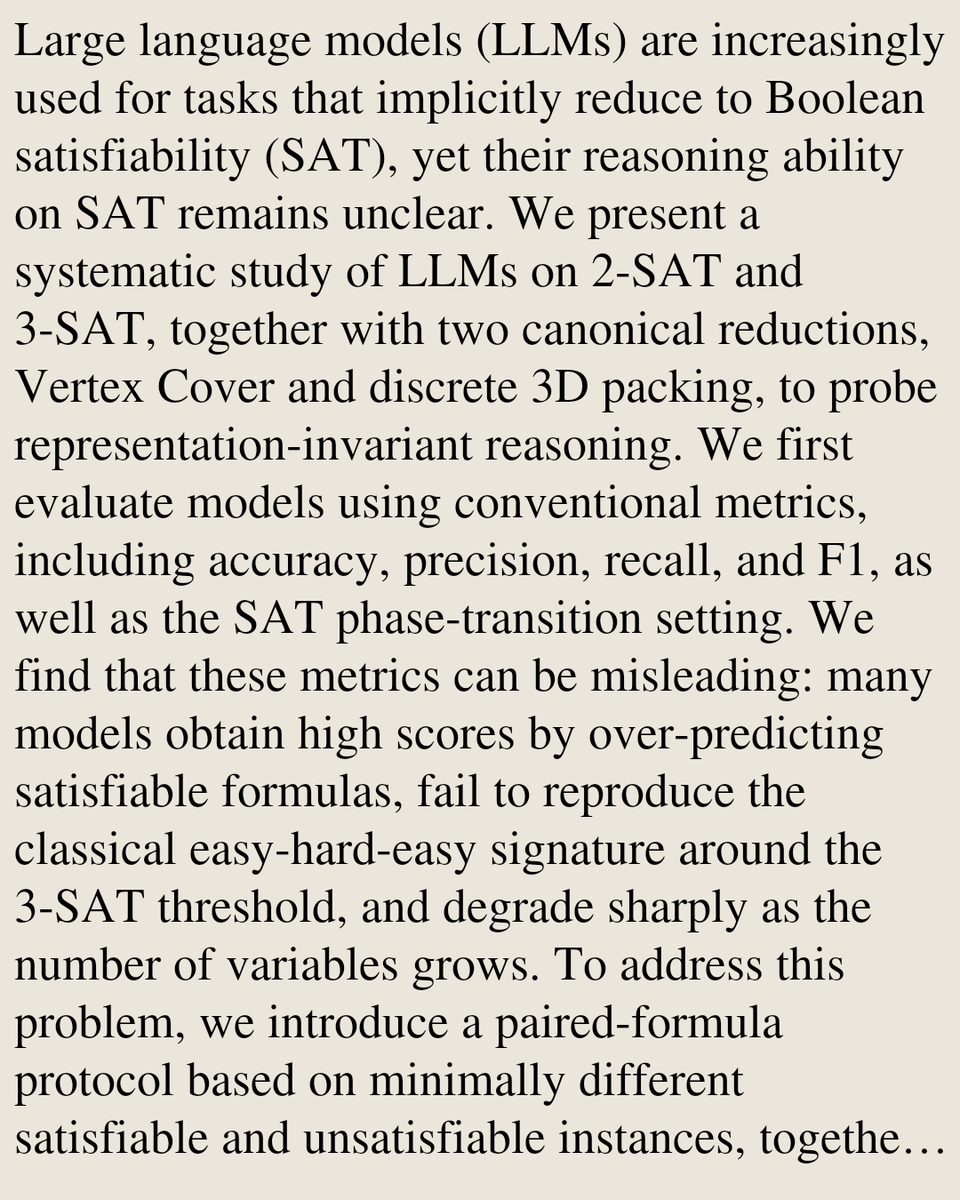
Satisfiability Solving with LLMs: A Matched-Pair Evaluation of Reasoning Capability Leizhen Zhang, Shuhan Chen, Sheng Chen arxiv.org/abs/2605.28602 [𝚌𝚜.𝙰𝙸 𝚌𝚜.𝙲𝙻 𝚌𝚜.𝙻𝙾] 💬Accepted at the ACM International Conference on the Foundations of Software Engineering (FSE 2026)
2
122
The Challenge Pipeline Most people think $TIG has a handful of challenges. The actual pipeline is significantly larger. Right now: Boolean Satisfiability, Vehicle Routing, Knapsack, Vector Search, and Hypergraph Partitioning are live on mainnet. Neural Network Optimisation is on testnet. ZK Circuit Optimisation, Energy Grid Optimisation, Job Shop Scheduling, CUR Decomposition, and Influence Maximisation are either in development or recently launched. Beyond that, there are at least three further challenges proposed for Q1 2026 — their details are currently redacted on the $TIG challenges page. And this matters directly for token holders because of the Vault mechanic: Until the network reaches 100 active challenges, a portion of every block emission is held in the vault rather than distributed. Once 100 challenges are live, the Gamma function equals 1 and the full emission schedule aligns. Beyond 100 challenges, Gamma gradually increases toward 1.02 — enabling controlled release of previously stored vault tokens back to contributors. The vault is accumulating. The pipeline is building. When the network hits 100 challenges, the flywheel changes gear.
3
30
712
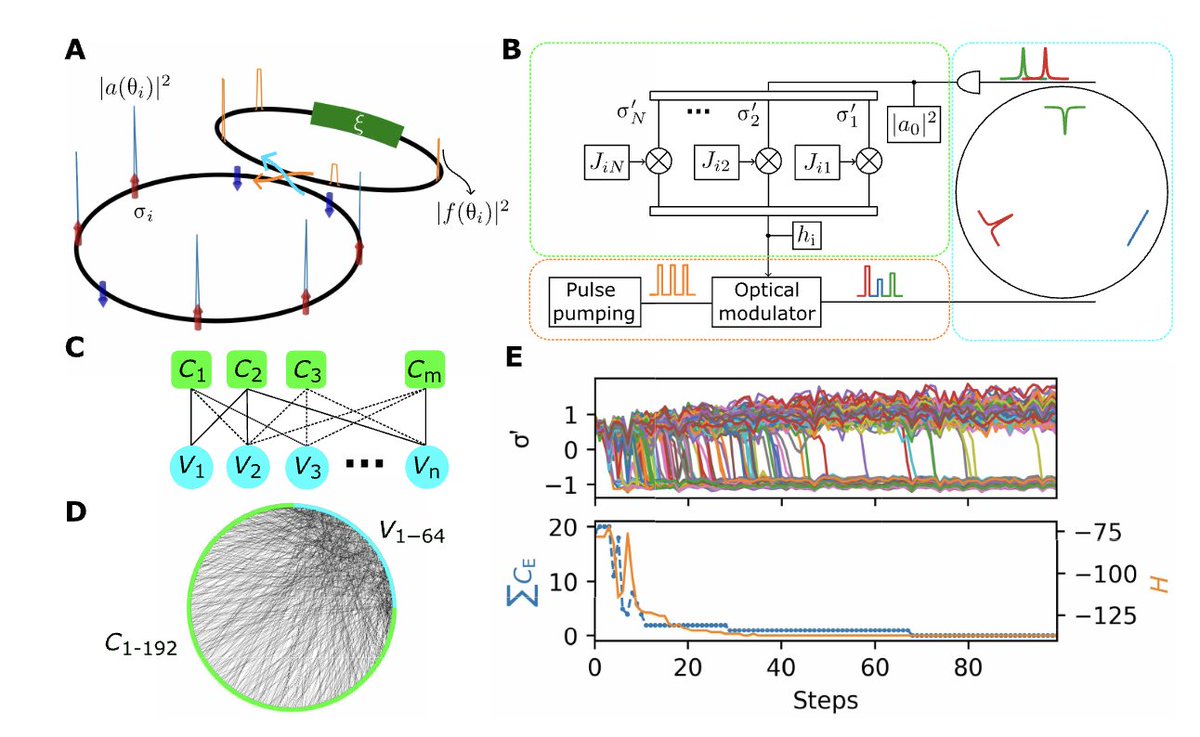
A Kerr-soliton Ising machine that solves NP-complete problems with milliwatt-scale optical power Combinatorial optimization sits at the core of many ML and operations problems: scheduling, portfolio selection, neural architecture search, Boolean satisfiability. As digital scaling slows, there is renewed interest in physical Ising machines that map an optimization problem onto interacting spins and let the physics relax toward a low-energy configuration. Yan Jin and coauthors build one of these using Kerr microresonator solitons. Each soliton is a discrete optical pulse circulating in a 25 m fiber resonator, and each slot holds at most one soliton. That binary character (present or empty) is exactly what you want for an Ising spin. The team fits up to 256 solitons in one round trip and programs all-to-all interactions through an opto-electronic feedback loop: photodetect soliton intensities, compute the Ising gradient on a computer, modulate pump pulses for the next step. The Lugiato-Lefever equation predicts a sharp bifurcation between the two states, which they verify experimentally. From a hardware and ML perspective the numbers stand out. Each gradient-descent step takes 3.5 microseconds, set by the soliton photon lifetime. Each soliton consumes about 2.3 mW of pump power, with a theoretical floor near 0.15 mW. On 100 random 3-SAT instances with up to 256 spins and over 10,000 trials, the machine matches or beats WalkSAT (a strong digital SAT solver) on time to solution while using roughly two orders of magnitude less optical energy. The feedback network scales linearly with the number of spins. Optimization workloads in logistics, finance, drug discovery and ML hyperparameter search are bottlenecked by energy rather than accuracy. Photonic co-processors on foundry-compatible microresonators offer a route to specialized accelerators sitting alongside GPUs, handling NP-hard subproblems at a fraction of the wall-plug power. The remaining challenge is integration: pulse generation, modulation and feedback on a single chip. Paper: Jin et al., Science Advances (2026) - CC BY-NC 4.0 | doi.org/10.1126/sciadv.aeb79…
4
18
90
4,647
What $TIG Actually Does (And Why It's Bigger Than You Think) Most "DeSci" projects are vibes with a token. $TIG is different. Here's the mechanical reality: Miners ("benchmarkers") don't waste energy solving arbitrary puzzles. They compete to run algorithms as efficiently as possible. Innovators submit better algorithms to the public repo — if their code gets adopted by 25% of miners, it earns block rewards. A genuine breakthrough (a new method so good it outperforms every optimised version of the old approach) needs 50% adoption and earns the biggest share. The challenges live on mainnet right now: Boolean Satisfiability, Vehicle Routing, Quadratic Knapsack, Vector Search, Hypergraph Partitioning, Neural Network Training Optimization, Job-Shop Scheduling, Energy Arbitrage. Two more are on testnet. These aren't toy problems. VRP underpins global logistics. SAT is foundational to chip design. Energy arbitrage optimisation has direct grid management applications. And in 2025, TIG's protocol produced an algorithm that outperformed a peer-reviewed QKBP algorithm published in 2025. Open innovation, moving faster than academic publishing.
1
4
45
1,373
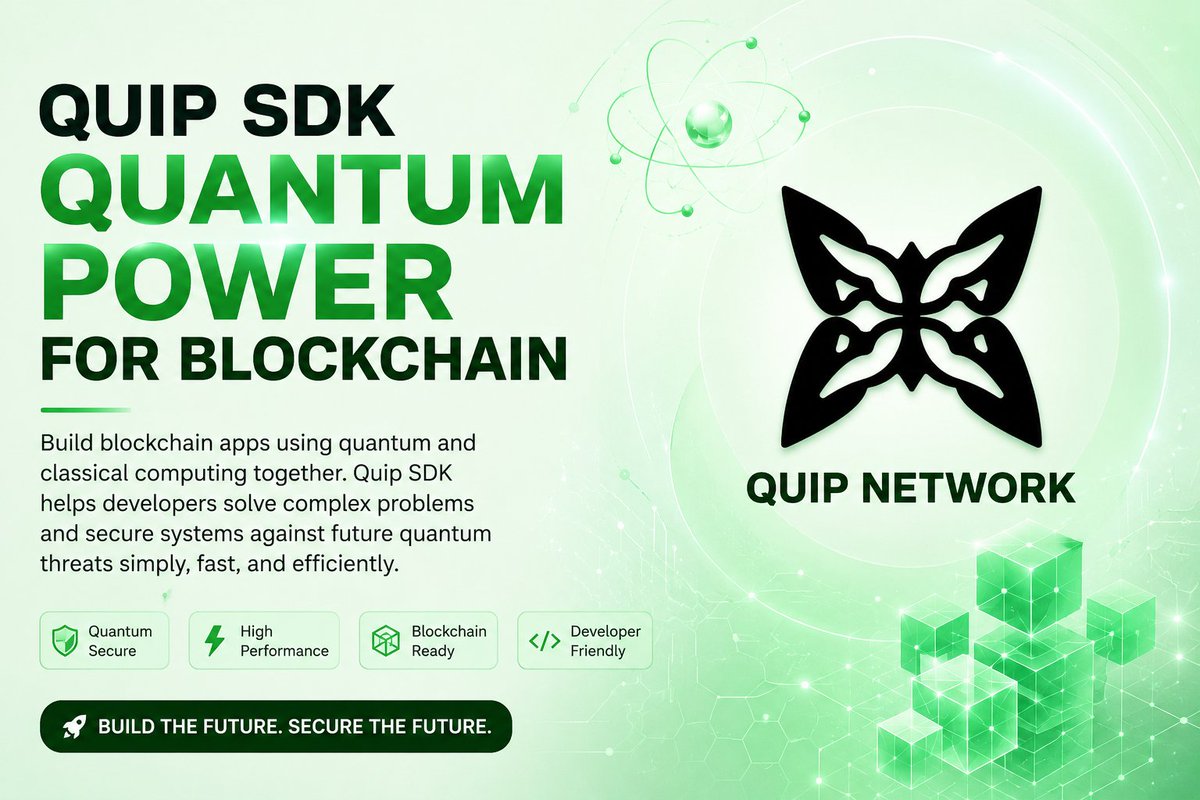
QUIP SDK IS A TOOL CREATED BY THE QUIP NETWORK TEAM. It helps developers build apps on the blockchain. It also allows them to use very powerful computing systems, including quantum computers, to solve complex problems. @quipnetwork has two main SDKs, and each one serves a different purpose. 1. QUANTUM COMPUTING & HYBRID SOLVERS SDK This SDK is designed for quantum smart contracts and hybrid problem-solving. It combines normal computers and quantum computers to work together. It is used to solve very difficult problems such as: ☞ Finding the best option from many possible choices. ☞ AI and machine learning tasks. ☞ Logic problems like SAT (Boolean satisfiability) problems. ☞ Other highly complex computational tasks. It helps blockchain applications solve problems that are too difficult for normal computers alone. 2. QUANTUM SECURITY SDK This SDK focuses on protection against future quantum computers. It is designed to improve security and keep systems safe. It helps developers to: ☞ Gradually upgrade existing smart contracts. ☞ Protect systems from future quantum attacks. ☞ Strengthen wallets and contracts using more secure digital signatures. THE MAIN IDEA BEHIND #QUIP SDK IS SIMPLE It helps blockchain developers use quantum computing without needing to understand how it works internally. Developers can simply use the SDK, submit their problem, and receive a powerful solution in return. #quipnetwork #Quip $QUIP
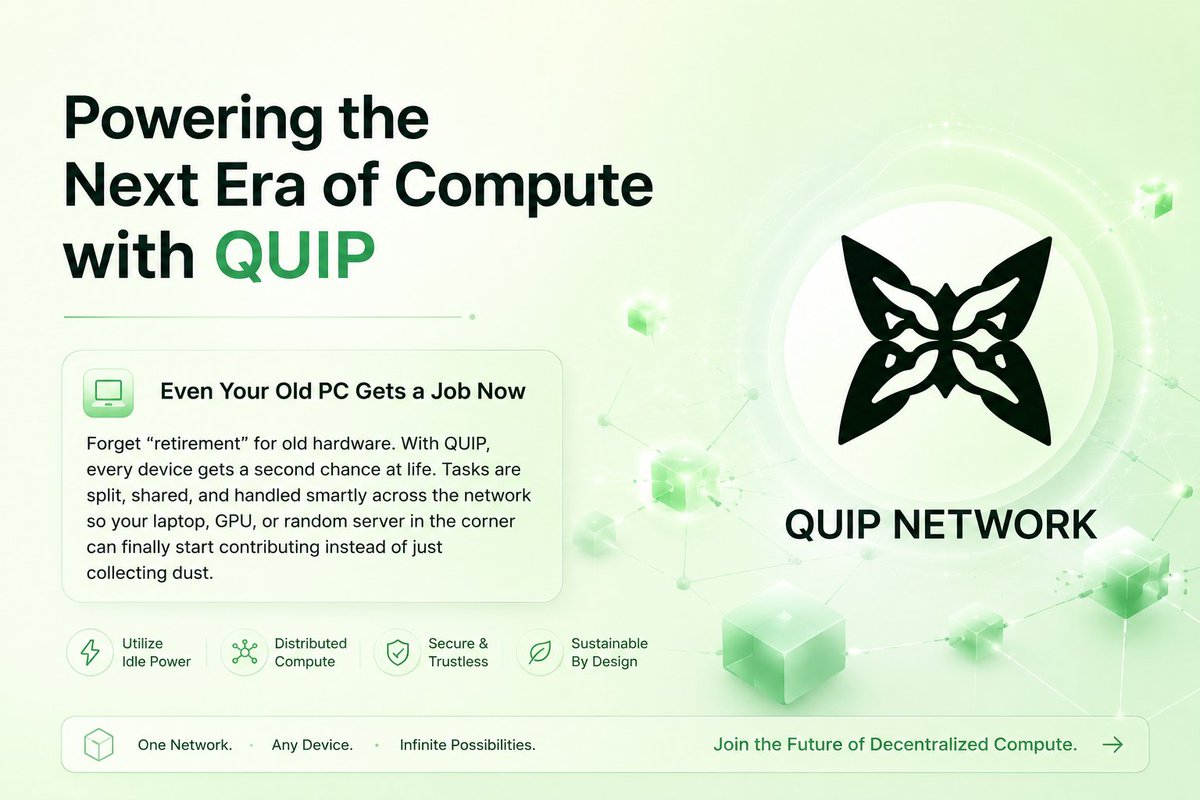
Late GM, Familia 🦋 Most people still think computing only happens in large, expensive data centers. But that is beginning to change. In the future, computing will be more distributed, flexible, and accessible to a wider range of people. With @quipnetwork, anyone can run a node using different types of hardware CPUs, GPUs, ASICs, or even QPUs. These nodes process workloads across the network, and users can earn rewards for contributing compute power. What makes the system unique is not just the variety of hardware, but the way it intelligently matches tasks to the most suitable machine type. Large datasets can be broken into smaller pieces, transformed into graphs, and processed on smaller chips or specialized hardware. This makes computation faster and more efficient, without relying on a single powerful machine. This shift becomes even more important as quantum computing continues to advance. Fields like AI, logistics, banking, engineering, and scientific research will all require scalable, high-performance computing. The people building these systems today are helping shape that future. You don’t need to build everything from scratch to take part in quantum computing. #QUIP is building infrastructure that makes advanced computing more accessible, connected, and scalable.
169
89
327
1,293
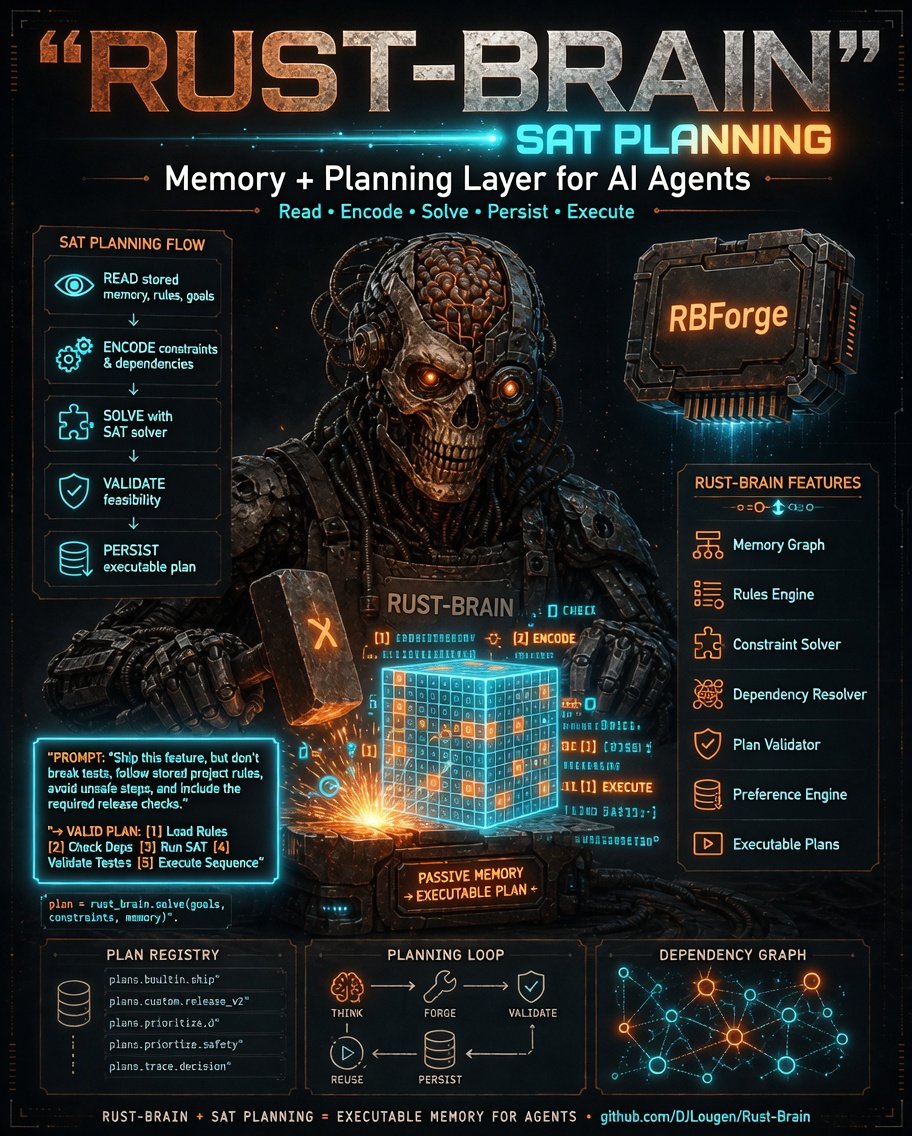
Rust-Brain is becoming a memory planning layer for AI agents. New feature: SAT planning (Boolean Satisfiability). Instead of an agent “winging it,” Rust-Brain reads its stored memory, rules, constraints, dependencies, preferences, and goals, turns them into a formal planning problem, solves it with SAT, then stores the resulting executable plan back into memory. Example: “Ship this feature, but don’t break tests, follow stored project rules, avoid unsafe steps, and include the required release checks.” Rust-Brain converts that into constraints, finds a valid sequence of actions, and tells the agent exactly what plan is feasible. Why it matters: Agents need memory, but memory alone is passive. SAT planning makes memory executable. github.com/DJLougen/Rust-Bra…
2
4
14
625