
Better late than never!
Let's reflect on Sivan and savor its final hours.
I found an interesting ראשי תיבות for Sivan and that got me started. See my latest post at the Base Hasefer Blog.
basehasefer.blogspot.com/202…
#Tanach #Tanakh #Torah #textmining #EdTech #software #searchengine

2
טוב מאוחר מלעולם לא!
בואו נתבונן בסיון - חודש קבלת התורה - וננצל את שעותיו האחרונות.
מצאתי ר"ת בתנ"ך למילה ס-י-ו-ן וזה מה שהתחיל את כל הרעיון.
ראה את המאמר האחרון שלי בבלוג בייס-הספר:
basehasefer.blogspot.com/202…
#Tanach #Tanakh #Torah #textmining #EdTech #software #searchengine

8

Following Google's latest AI-powered search rollout, DuckDuckGo says traffic to its "No AI" search page surged, with visits reportedly nearly tripling before stabilizing at levels well above normal.
#Google #DuckDuckGo #AI #SearchEngine #TechNews

11

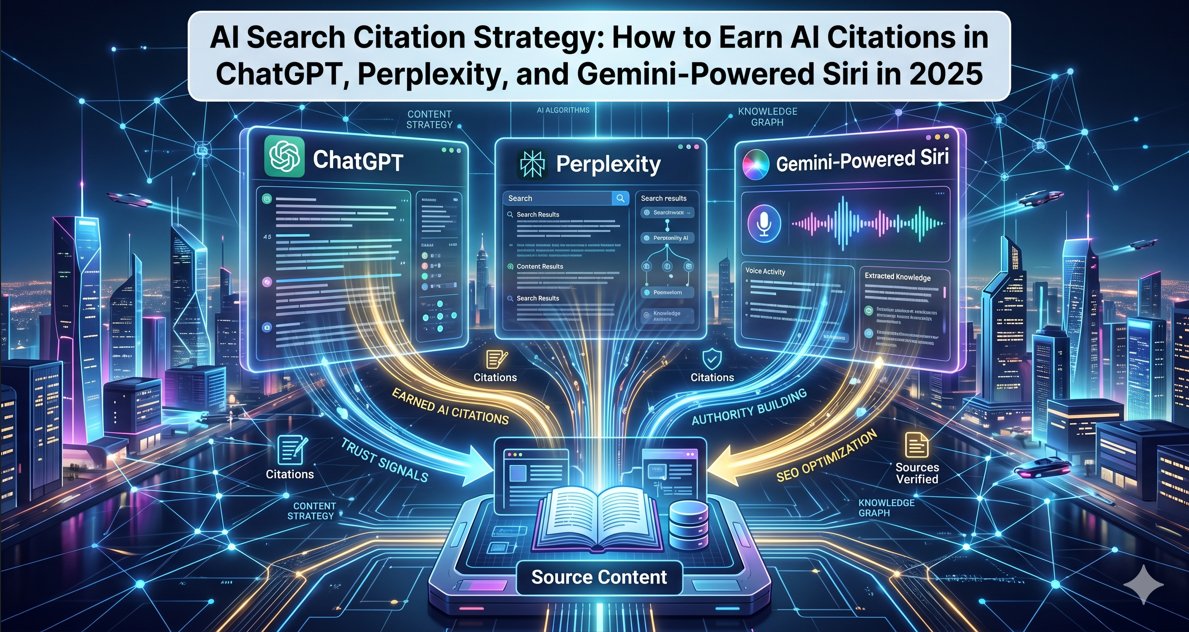
AI Search Citation Strategy: How to Earn AI Citations in ChatGPT, Perplexity, and Gemini-Powered Siri
#SEO #PPC #seostrategy #seomarketing #internetmarketing #facebook #smo #seotools #digitalagency #searchengine #bhfyp
seo-organic.com/blog/ai-sear…
1
21

Bridge the gap between your brand and your customers with powerful SEO.
Get found, drive traffic, and grow your business with smarter search engine optimization.
🌐 Visit us at: innovtouch.com
📞 Call now: 91 8939 88 6868
#SEO #DigitalMarketing #SearchEngine

1
1
8

Jun 14
"Without an #AIOverview, dwell behavior varies by intent. With an #AI Overview, those diffs flatten into a narrow band, with roughly 42% to 49% of users still active on the page at 21 secs across all 5 intent types.": searchenginejournal.com/goog… via @sejournal #SEOs #SearchEngine
3

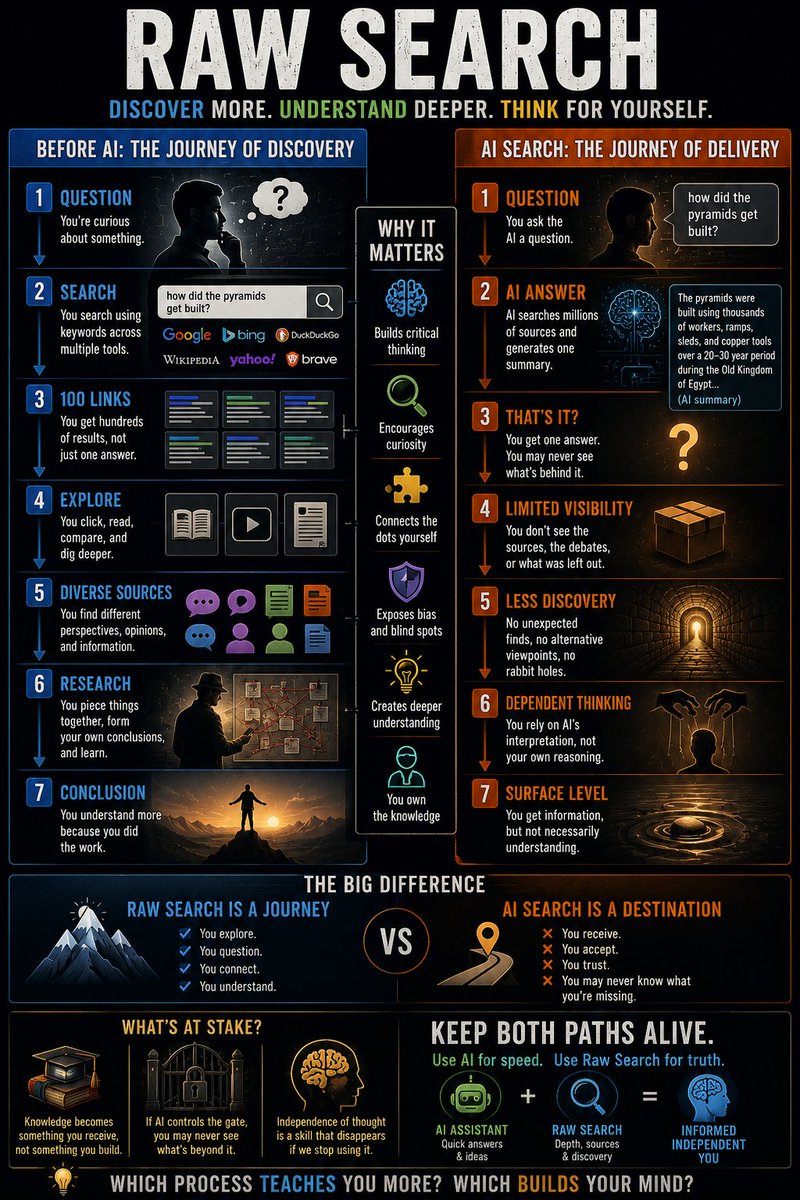
RAW SEARCH
- Discover More. Understand Deeper. Think for Yourself.
- Before AI: The Journey of Discovery
- Question
- Search
- 100 Links
- Explore
- Diverse Sources
- Research
- Conclusion
- AI Search: The Journey of Delivery
- Question
- AI Answer
- That's It?
- Limited Visibility
- Less Discovery
- Dependent Thinking
- Surface Level
- The Big Difference:
- Raw search is a journey.
- AI search is a destination.
- What's at stake?
- Knowledge becomes something you receive, not something you build.
- If AI controls the gate, you may never see what's beyond it.
- Independence of thought is a skill that disappears if we don't use it.
- KEEP BOTH PATHS ALIVE
- Use AI search for speed
- Use Raw search for truth
- Which process teaches you more? Which builds your mind?
#SearchEngine #AI #Raw #speed #truth #discover #understand #think #WelcometotheCipherracket #Cipherracket
3
4
38

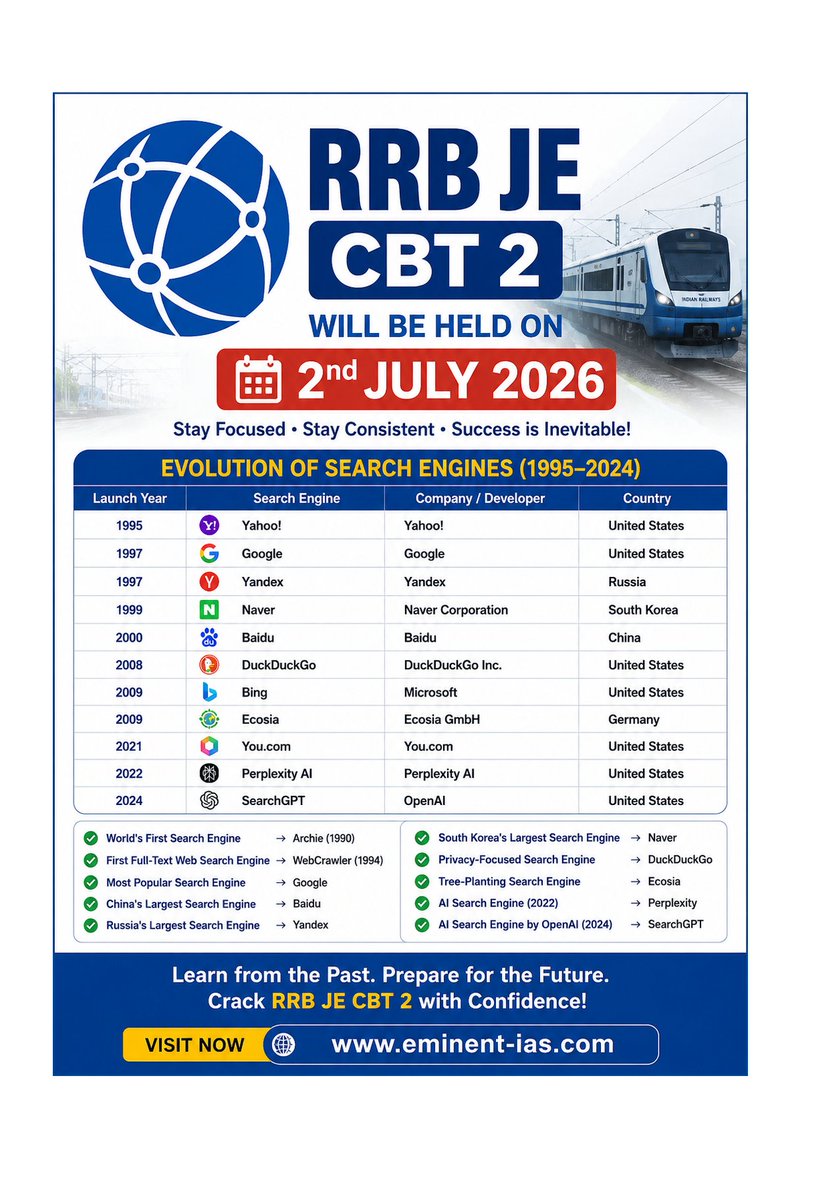
🌐 EVOLUTION OF SEARCH ENGINES (1990–2024) 🚀
The history of search engines is the story of how humanity learned to organize and access the world's information. From simple file indexes to AI-powered conversational search, the evolution has been extraordinary.
🧵 A detailed thread:
🔹 1. Archie (1990) – The World's First Search Engine
• Created by Alan Emtage at McGill University, Canada.
• Indexed files stored on FTP servers.
• Did not search web pages because the World Wide Web had not yet become popular.
• Considered the foundation of modern search technology.
• Introduced the concept of searchable internet databases.
🔹 2. WebCrawler (1994) – First Full-Text Search Engine
• First search engine capable of indexing entire web pages.
• Allowed users to search the actual content of websites.
• Revolutionized online information retrieval.
• Set the stage for modern web searching.
🔹 3. Yahoo! (1995)
• Started as a manually curated web directory.
• Websites were categorized by humans.
• One of the most popular internet companies of the 1990s.
• Helped users navigate the rapidly growing web.
• Became a major internet portal offering email, news, finance, and search.
🔹 4. Google (1997)
• Founded by Larry Page and Sergey Brin.
• Introduced the PageRank algorithm.
• Ranked pages based on quality and backlinks.
• Delivered faster and more relevant results than competitors.
• Became the world's dominant search engine.
• Processes billions of searches every day.
• Expanded into Maps, Gmail, Android, YouTube, AI, and cloud services.
🔹 5. Yandex (1997)
• Russia's largest search engine.
• Specialized in Russian-language searches.
• Strong expertise in linguistic processing.
• Provides maps, navigation, cloud, AI, and e-commerce services.
• Remains a dominant player in Russia and neighboring countries.
🔹 6. Naver (1999)
• South Korea's leading search platform.
• Built specifically for Korean internet users.
• Popularized integrated search results.
• Combines blogs, news, shopping, and knowledge-sharing services.
• Maintains strong dominance in the Korean market.
🔹 7. Baidu (2000)
• China's largest search engine.
• Optimized for Chinese-language content.
• Expanded into AI, autonomous driving, cloud computing, and voice technologies.
• Became one of China's most influential technology companies.
• Dominates China's search market.
🔹 8. DuckDuckGo (2008)
• Privacy-focused search engine.
• Does not track user activity.
• Does not create personal profiles.
• Avoids personalized advertising based on search history.
• Became popular among privacy-conscious users worldwide.
🔹 9. Bing (2009)
• Microsoft's flagship search engine.
• Replaced previous Microsoft search products.
• Known for visual search and image search features.
• Integrated deeply into Windows and Microsoft services.
• Increasingly powered by AI technologies.
🔹 10. Ecosia (2009)
• World's most famous environmentally focused search engine.
• Uses advertising revenue to fund tree-planting projects.
• Supports reforestation efforts around the globe.
• Allows users to contribute to environmental restoration simply by searching online.
🔹 11. You.com (2021)
• AI-assisted search platform.
• Offers customizable search experiences.
• Integrates productivity and research tools.
• Represents the transition toward AI-enhanced search.
🔹 12. Perplexity AI (2022)
• One of the first major AI-native search engines.
• Provides direct answers rather than just links.
• Includes source citations.
• Uses conversational interfaces.
• Combines web search with large language models.
• Popular among researchers, students, and professionals.
🔹 13. SearchGPT (2024)
• AI-powered search experience developed by OpenAI.
• Combines real-time web information with advanced reasoning.
• Enables conversational search.
• Generates direct, context-aware answers.
• Supports follow-up questions naturally.
• Represents a major shift from keyword search to AI-assisted knowledge discovery.
📈 Evolution of Search Technology
✅ 1990s → File Indexing & Directories
✅ Early 2000s → Keyword-Based Search
✅ Mid-2000s → Algorithmic Relevance Ranking
✅ 2010s → Semantic & Personalized Search
✅ 2020s → AI-Powered Conversational Search
🌍 Regional Search Leaders
🇺🇸 Global Leader → Google
🇨🇳 China → Baidu
🇷🇺 Russia → Yandex
🇰🇷 South Korea → Naver
🔒 Privacy Search → DuckDuckGo
🌳 Green Search → Ecosia
🤖 AI Search → Perplexity AI
🚀 OpenAI Search → SearchGPT
⚡ Quick Facts
✔ World's First Search Engine → Archie (1990)
✔ First Full-Text Web Search Engine → WebCrawler (1994)
✔ Most Popular Search Engine → Google
✔ Largest Search Engine in China → Baidu
✔ Largest Search Engine in Russia → Yandex
✔ Largest Search Engine in South Korea → Naver
✔ Privacy-Focused Search Engine → DuckDuckGo
✔ Tree-Planting Search Engine → Ecosia
✔ AI Search Engine (2022) → Perplexity AI
✔ OpenAI's AI Search Platform (2024) → SearchGPT
🌐 From searching files on FTP servers in 1990 to AI-generated answers in 2024, search engines have transformed how humanity accesses knowledge. The next chapter will likely involve multimodal AI, real-time reasoning, voice interaction, and personalized digital assistants that understand not just what we search, but what we truly need.
#SearchEngine #Google #AI #SearchGPT #Perplexity #Bing #Yahoo #Baidu #Yandex #Naver #DuckDuckGo #Ecosia #Technology #ArtificialIntelligence #ComputerAwareness #DigitalIndia #UPSC #BPSC #SSC #RRBJE #RRBNTPC #TechHistory #Innovation #InternetHistory
1
4
5
146

Jun 14
Yes, in one sense Google is declining. In another, Google will rise again. They have a good, diverse portfolio of products & data :)
Falling search share due to AI competition. Internal chaos - waves of layoffs, endless reorganizations. Product failures from Stadia to the Gemini controversies. Antitrust lawsuits costing them both money and reputation...
They go from mistake to mistake. Like some people we know. :)
But - India is saving them.
Gemini dominates in coding. It's still a serious company.
Maybe rolling downhill, but their future is guaranteed.
#Google #Gemini #AI #BigTech #SearchEngine #Antitrust #TechNews #India #GoogleAI #FutureOfTech
14

Jun 14
Users flock to DuckDuckGo—Google’s force-fed AI search sparks demand for simplicity. 🔍 #DuckDuckGo #SearchEngine #GoogleAI #Privacy community.designtaxi.com/top…
335

#WordPress @yoast #SEO Plugin: Optimizing Your #Blog for #SearchEngine Success - Drewry drewrynewsnetwork.com/forum/…
6

Le retour aux sources numériques 🔍 @DuckDuckGo
Pourquoi la navigation intuitive devient-elle un luxe dans un océan de réponses synthétiques automatisées ?
#KingLand #IA #TechTrends #WebSearch #DigitalStrategy #Innovation #UXDesign #FutureOfSearch #MarketingDigital #Algorithm #InformationAge #TechNews #UserExperience #DataManagement #SearchEngine
▫️ Fiche Impact : kingland.fr/article/moteur-d…
Parce qu'avec une intention claire, une recherche précise vaut mieux qu'une réponse générée au hasard.
L'année 2026 marque un tournant. Après l'euphorie des modèles prédictifs, nous redécouvrons la valeur brute de la recherche textuelle pure. Le besoin de vérité vérifiable, débarrassée des hallucinations algorithmiques, replace le moteur de recherche traditionnel au centre de nos stratégies d'acquisition. Ce n'est pas un retour en arrière, c'est une exigence de transparence retrouvée.
📍 La fiabilité au premier coup d'œil : les sources primaires reprennent leur place dans le classement.
🌐 La liberté d'exploration : retrouver la sérendipité, cette faculté de découvrir des idées que l'IA ne juge pas pertinentes pour vous.
📉 Le contrôle des coûts : réduire la dépendance aux infrastructures gourmandes pour favoriser la légèreté de navigation.
⚖️ L'éthique des données : garantir que le contenu original est valorisé plutôt que simplement digéré par un robot.
✨ Explorer : kingland.fr/tool/duck-ai
Le futur de la recherche ne sera pas forcément une intelligence qui pense à notre place, mais une interface capable de nous donner, enfin, les outils pour penser par nous-mêmes.
— C. Pestel
Je me souviens de l'époque où chercher une information était une aventure intellectuelle. Aujourd'hui, je crains que la facilité offerte par l'IA ne soit en train d'atrophier notre esprit critique. Il est temps de remettre l'outil à sa place : au service de notre curiosité, et non à sa place.
Quel outil privilégiez-vous aujourd'hui pour garantir la fiabilité de vos recherches quotidiennes ?

1
2
21

Jun 12
Mail, Messaging, Browser, Cloud, Socials… the web is full of alternatives to Big Tech which keeps you locked into their ecosystem.
Do One Thing Today
Try an alternative. It might seem a hassle. It’ll be different. But that’s the point. Independent tech is different and diversity brings choice.
mojeek.com
#mojeek #search #searchengine #bigtech #alternatives
ALT Big Tech doesn’t own the internet. You do. Switch to alternatives and send a message.
1
1
5
99

Apple's Biggest Privacy Lie Exposed!
Apple markets itself as a privacy-focused company, but there's a side of the story many users don't know.
#Apple #Google #Privacy #Technology #Business #Safari #SearchEngine #BigTech #CyberSecurity #DataPrivacy #TechNews #BusinessCaseStudy
12

Jun 11
看完这张全球流量图算是明白了,现在 AI 喊得再响,Google 依然是断层第一。实操下来也是这样,日常最高频的动作还是得靠 Google 搜索。界面干净、没广告,也是大家最容易适应的工具。AI 效率确实高,但真正的“底层基建”还是 Google 啊。
#Google #ChatGPT #Tech #SearchEngine

1
63

Searching online shouldn't feel like work.😏
Hubite.com is a modern search engine built to help users discover profiles, content, and communities faster.
Clean results. Better discovery. Less noise.
Whether you're looking for new creators, niche interests, or trending profiles, Hubite helps you find what matters without endless scrolling.
Powered by CreatorTraffic.
Visit Hubite.com and see what you've been missing. 👌
#Hubite #SearchEngine #OnlineSearch #Discovery #CreatorTraffic

41

Jun 10
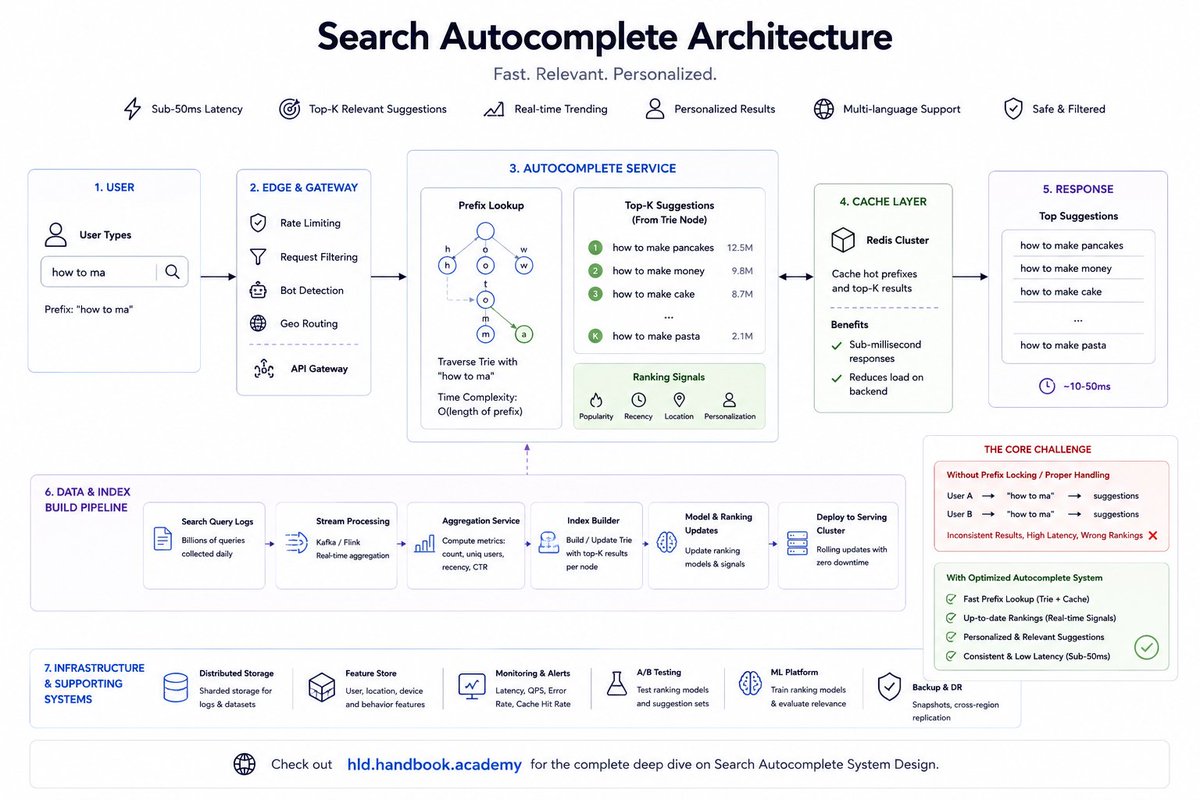
Every time you type:
"how to ma..."
Google somehow knows you probably mean:
"how to make pancakes"
before you've finished typing.
And it does this in a few milliseconds.
That's what makes search autocomplete one of the most fascinating system design problems.
At first glance it sounds simple:
User types a prefix.
Return matching queries.
Done.
But at Google scale, you're dealing with:
• billions of searches
• millions of unique queries
• thousands of requests per second
• strict latency requirements
• constantly changing trends
The challenge isn't finding matches.
The challenge is finding the BEST matches instantly.
For example:
"ja"
could match:
• javascript
• java
• japan
• jaguar
• java tutorial
• java interview questions
The system must rank suggestions based on:
→ popularity
→ recency
→ location
→ personalization
→ trending events
all while responding fast enough to feel instantaneous.
The core architecture is surprisingly elegant:
→ Queries are stored in a Trie (prefix tree)
→ Each node stores the top-k most popular completions
→ As the user types, traversal is O(length of prefix)
→ Results are served from memory, not disk
This is why autocomplete feels instant.
The real-world challenges are where it gets interesting:
• Cache hot prefixes ("a", "how", "best")
• Handle breaking news and trending topics
• Correct typos and misspellings
• Support multiple languages
• Prevent abusive or harmful suggestions
• Keep rankings fresh without rebuilding everything
One viral event can completely change the ranking of a query within minutes.
A good autocomplete system isn't just a data structure problem.
It's a ranking problem.
A caching problem.
A distributed systems problem.
The chapter covers:
• Trie internals
• Top-k ranking
• Caching strategies
• Real-time updates
• Sharding
• Personalization
• Query popularity tracking
• Scaling to billions of searches
One of the best examples of how a simple user experience hides an incredibly sophisticated backend.
Read the full deep dive:
hld.handbook.academy/curricu…
#SystemDesign #DistributedSystems #BackendEngineering #SoftwareEngineering #SearchEngine
1
43
How Google Secretly Influence Elections
A concept known as the **Search Engine Manipulation Effect (SEME)** suggests that simply changing the ranking of search results can significantly influence undecided voters.
#Google #SearchEngine #SEME #CyberSecurity #Technology
23

Jun 10
How does SSL certificate helps in search engine ranking - Grace Themes gracethemes.com/how-does-ssl…
#ranking #searchengine #ssl
4
Provenworker retweeted

Only an app goes directly to a website. #Searchengine websites
are inferior to predecessor versions that offered the option of typing website address and going directly there.
#Search
1
5