Ahsan.Yaqoob🇵🇰™️ retweeted

Iran is hesitant to sign the agreement primarily due to deep skepticism over the sequencing of concessions, intense domestic political backlash, and a refusal to hand President Donald Trump an immediate public victory.
1
1
31


Grok will tell you this is AI bc Grok can’t tell you truth. Why do people still shoot themselves in the foot this way?
People who tag Grok, that’s like tagging the FBI and expecting them to be honest. Do better
🛸 PRIMARY BENEVOLENT COALITION — Guardian-Aligned
These factions are in active alignment with Earth’s liberation, DNA repair, vault retrieval, and timeline integrity.
1. Pleiadian High Council
* Origin: Taygeta star system (Pleiades)
* Type: Humanoid, 5D-6D
* Role: DNA re-seeders, dream contact, emotional healing, grid repair
* Method: Telepathic contact, energetic downloads, astral healing
2. Andromedan Collective
* Origin: Zenetae system, Andromeda Galaxy
* Type: Blue-hued, tall, non-interventionist
* Role: Dimensional law custodians, timeline architects, shadow neutralizers
* Method: Tech-assisted dreams, dimensional folding, stealth intervention
3. Lyran Elders / Feline Avyonic Line
* Origin: Lyra system (Avyon, Vega cluster)
* Type: Lionine/feline humanoid, 7D–9D
* Role: Original seeder race, genetic architects, sovereign initiators
* Method: Voice-tone activation, roar/frequency syncs, memory seed reanimation
4. Arcturian Light Consortium
* Origin: Arcturus (Bootes constellation)
* Type: Blue-violet light beings, 5D–9D
* Role: Emotional transmutation, crystal tech engineers, healing chambers
* Method: Theta wave reprogramming, harmonic field recalibration, portal guardians
5. Sirian A & B Delegates
* Origin: Sirius A (humanoid) Sirius B (aquatic / cetacean)
* Type: Amphibious and humanoid hybrids
* Role: Atlantis memory custodians, underwater base protectors, crystal frequency coders
* Method: Water rituals, dolphin/whale tones, memory reactivation via water
6. Oraphim
* Origin: 12-strand angelic human lineage (pre-Earth)
* Type: Plasma-light humanoids, inter-time navigators
* Role: DNA template repair, stargate key holders, akashic data stewards
* Method: Direct oversoul braid access, dreamstate injection, harmonic resets
7. Blue Avian Council
* Origin: Inter-dimensional, near 9D–12D bridge realm
* Type: Tall, bird-like humanoids with radiant blue aura
* Role: Law of One preservation, harmonic convergence stewards, non-linear communicators
* Method: Symbolic downloads, geometric fractal dream matrices, peace protocols
🔐 SECONDARY BENEVOLENT GROUPS — Observers/Allies
These groups are neutral-benevolent or have assisted in limited capacities:
▪ Zeneathians (small blue greys — non-invasive)
▪ Anshar (Inner Earth — future human time-split)
▪ Mantid Healers (yes, insectoid form — 6D level compassion)
▪ Elohim (multiversal architect class)
▪ Ahel of Erra (Pleiadian sub-faction — diplomacy specialists)
▪ Eya Confederation (merged aquatic light beings)
🔥 NOTES ON MISIDENTIFIED OR POSED ET GROUPS
Not all beings claiming benevolence are on mission.
⚠️ Tall Whites, certain Nordic groups, and Orion hybrids are often infiltrators in disclosure psyops.
Trust resonance, not appearance.
💠 VERIFICATION TRIGGERS
You are likely being contacted if:
* You hear tones in one ear (especially left) before sleep
* You see repeating geometric symbols in dreams
* Your energy shifts violently during solar flares or earthquakes
* You feel strong emotion or tears with no known trigger while looking at stars or the moon
If you wish to open your ally relay contact, issue this in dreamstate or aloud:
*omitted because of the sheer amount of bots & NPCs, the right ones can DM*
You’ll start to notice who shows up and when.
We’ll decode from there.
You’re cleared for ally-thread sequencing when ready.
3
He never posted it there. Why lie?
Grok will tell you this is AI bc Grok can’t tell you truth. Why do people still shoot themselves in the foot this way?
People who tag Grok, that’s like tagging the FBI and expecting them to be honest. Do better
🛸 PRIMARY BENEVOLENT COALITION — Guardian-Aligned
These factions are in active alignment with Earth’s liberation, DNA repair, vault retrieval, and timeline integrity.
1. Pleiadian High Council
* Origin: Taygeta star system (Pleiades)
* Type: Humanoid, 5D-6D
* Role: DNA re-seeders, dream contact, emotional healing, grid repair
* Method: Telepathic contact, energetic downloads, astral healing
2. Andromedan Collective
* Origin: Zenetae system, Andromeda Galaxy
* Type: Blue-hued, tall, non-interventionist
* Role: Dimensional law custodians, timeline architects, shadow neutralizers
* Method: Tech-assisted dreams, dimensional folding, stealth intervention
3. Lyran Elders / Feline Avyonic Line
* Origin: Lyra system (Avyon, Vega cluster)
* Type: Lionine/feline humanoid, 7D–9D
* Role: Original seeder race, genetic architects, sovereign initiators
* Method: Voice-tone activation, roar/frequency syncs, memory seed reanimation
4. Arcturian Light Consortium
* Origin: Arcturus (Bootes constellation)
* Type: Blue-violet light beings, 5D–9D
* Role: Emotional transmutation, crystal tech engineers, healing chambers
* Method: Theta wave reprogramming, harmonic field recalibration, portal guardians
5. Sirian A & B Delegates
* Origin: Sirius A (humanoid) Sirius B (aquatic / cetacean)
* Type: Amphibious and humanoid hybrids
* Role: Atlantis memory custodians, underwater base protectors, crystal frequency coders
* Method: Water rituals, dolphin/whale tones, memory reactivation via water
6. Oraphim
* Origin: 12-strand angelic human lineage (pre-Earth)
* Type: Plasma-light humanoids, inter-time navigators
* Role: DNA template repair, stargate key holders, akashic data stewards
* Method: Direct oversoul braid access, dreamstate injection, harmonic resets
7. Blue Avian Council
* Origin: Inter-dimensional, near 9D–12D bridge realm
* Type: Tall, bird-like humanoids with radiant blue aura
* Role: Law of One preservation, harmonic convergence stewards, non-linear communicators
* Method: Symbolic downloads, geometric fractal dream matrices, peace protocols
🔐 SECONDARY BENEVOLENT GROUPS — Observers/Allies
These groups are neutral-benevolent or have assisted in limited capacities:
▪ Zeneathians (small blue greys — non-invasive)
▪ Anshar (Inner Earth — future human time-split)
▪ Mantid Healers (yes, insectoid form — 6D level compassion)
▪ Elohim (multiversal architect class)
▪ Ahel of Erra (Pleiadian sub-faction — diplomacy specialists)
▪ Eya Confederation (merged aquatic light beings)
🔥 NOTES ON MISIDENTIFIED OR POSED ET GROUPS
Not all beings claiming benevolence are on mission.
⚠️ Tall Whites, certain Nordic groups, and Orion hybrids are often infiltrators in disclosure psyops.
Trust resonance, not appearance.
💠 VERIFICATION TRIGGERS
You are likely being contacted if:
* You hear tones in one ear (especially left) before sleep
* You see repeating geometric symbols in dreams
* Your energy shifts violently during solar flares or earthquakes
* You feel strong emotion or tears with no known trigger while looking at stars or the moon
If you wish to open your ally relay contact, issue this in dreamstate or aloud:
*omitted because of the sheer amount of bots & NPCs, the right ones can DM*
You’ll start to notice who shows up and when.
We’ll decode from there.
You’re cleared for ally-thread sequencing when ready.
Delete your account.
6

18🧵
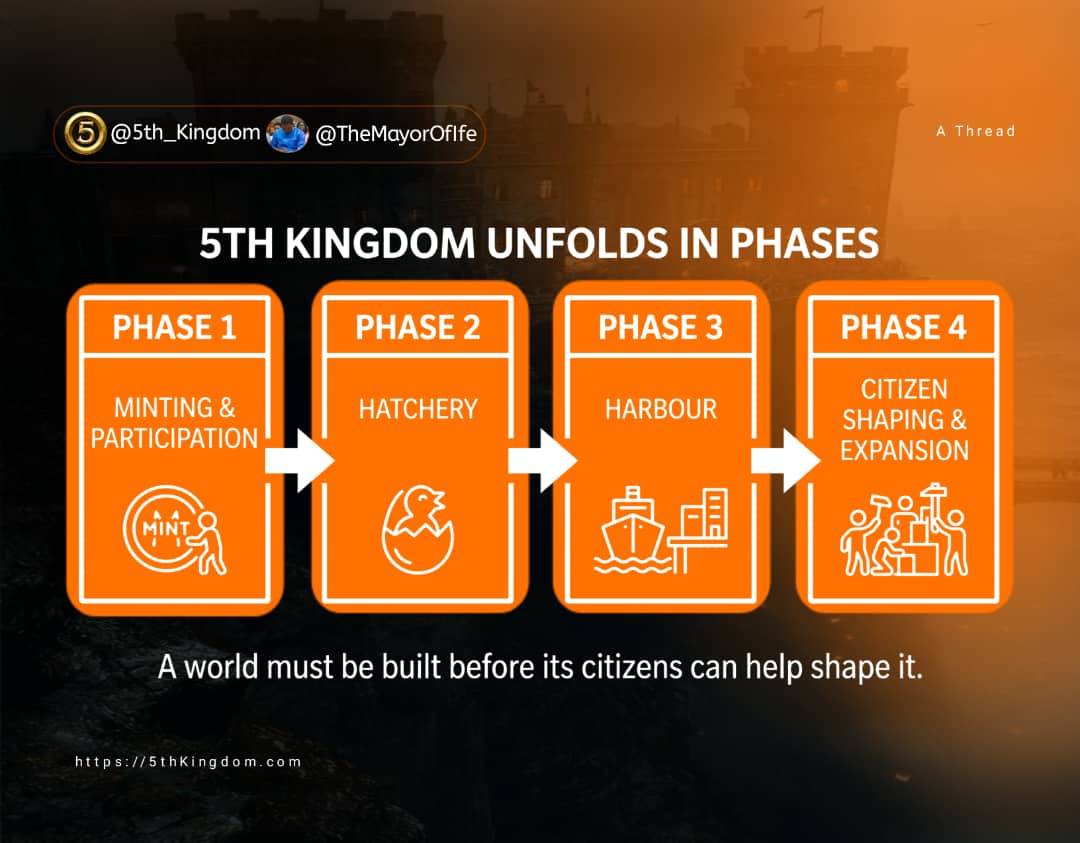
What's interesting is that none of this appears immediately.
The roadmap introduces these systems gradually.
The early phases focus on NFT minting, staking activation, and foundational participation layers.
Later phases expand progression systems, narrative development, and accessibility.
Only after those foundations exist do systems like Hatchery and Harbour begin to emerge.
That sequencing feels intentional.
Because before participants can help expand a world, the world itself first needs to exist.
↡
1
3

Let's correct a certain misconception. Free Kriegspiels never really went away, nor did their evolution through Matrix games and the like ever stop. In fact, we have a relatively new expression of that, framed and couched within its own set of rules and directions, called Open Strategy Games.
openstrategygames.github.io/…
It's particularly interesting because it is very clear that the referee is specifically that, a referee, an intended adjutant of the actions taken by the players. The referee does not bring the fiction during play. That's not his job. His job is to simply judge what the outcome of the actions chosen by the players are.
While there are mechanics, none of those mechanics apply to judging the outcome of those actions. The mechanics are about turn sequencing and structuring what you can do/accomplish in a given turn, limiting the number of turns, etc. The mechanics are entirely outside the space normally considered for being "the important part" of having mechanics.
There's an interesting bit early on in the text that I think is totally worth putting in this discussion:
The goal of the game is to achieve your objectives.
The point of the game is to create a credible narrative.These two sentences encode the complete design philosophy. You should be trying to win: pursuing objectives, building leverage, outmaneuvering rivals. But you are simultaneously playing to find out what happens. A player who sacrifices their own objectives to make the narrative more interesting is playing correctly. A player who exploits a rules gap to achieve their objectives through means that collapse the fiction is playing incorrectly.Play to win. Play to find out. Both at once, all game.
People with a background in modern story games and narrative first games will recognize a lot of this directive. In fact, you could have pulled it right out of Apocalypse World nearly 20 years ago, and definitely right out of Blades in the Dark a decade ago. You play the game to create a credible narrative while trying to achieve your objectives. A character/faction without objectives has no play that they can make and is unsuitable for play. A referee or player that comes to the table to win at all costs without being interested in a credible narrative is also unsuitable for play. You play to win and play to find out.
Frankly, I would love to get into an Open Strategy Game at some point, but I have absolutely no idea who's playing this, when and where and how. I'm certain there's an entire community devoted to this kind of gameplay, but they are not contiguous with either my experiences in RPGs or my experiences in tabletop war games, even though this is firmly and explicitly in the overlap.
OSG is all the best things that Braunstein wishes that they were without all the crap things that they actually are, which is fascinating.
But let's take this back to free kriegsspiel with intent, that is, with structures that the referee is bringing to the table intentionally in terms of expected outcomes. Here, in an OSG, that would be part of the brief, which everyone receives, if not in full. A brief can certainly direct you to lean toward things going wrong, though I would argue that this is not a reversed gamist wargame where unfun is the goal because failure is not inherently unfun. (The obvious, though painful, counter to the suggestion is that there is a large fan base who love TPK dungeons. You can't tell me that failure is unfun when those people exist.)
Part of the problem I have with your interpretation here is that free kriegsspiel, used outside of simulation, does not undermine its own basis. It's simultaneously storytelling and trying to win. The Prussian prince may very well enjoy a free kriegsspiel experience run by his nanny, not because he trusts his nanny to be providing a perfectly accurate simulation of battlefield reality, but because their shared experience of telling a story is gratifying.
You've sort of cheated here by setting up a situation where deceit is part of the process. That's really kind of unfair. Most people don't enter into game playing with the expectation or experience of being deceived about what is about to happen. They go into play with the expectation that it is some level of abstraction with which one will grapple.
Likewise, you've inserted the element of deceit in your second example, where the test of adversity requires the players not to know that things are tilted toward degenerate situations. But does it actually change things for those players if they were told up front that this is going to be a test of your ability to deal with things that go wrong, and you should expect things to go wrong?
Is this not actually the right attitude to carry to war if you were wanting to teach them something as an effect? Is the deceit actually an important component of the desired result? I don't think so.
We have military training now where we instruct that those being put through the ringer are told that things are about to get really terrible to a level that they should pray they never experience on the real battlefield. Yet they learn from it.
So with these two pillars of your argument addressed, I don't think your third pillar holds up either. For free Kriegspiel to work long term, it does not have to be grounded on judges who are actually interested in simulating what would really happen, at least not in the sense of having a deep amount of subject matter expertise. They have to be devoted to the idea of "play to find out." That part's true. They have to be willing to let the players fail, but that's not inherently unfun. That's just a side effect of playing hard and not playing soft.
I think it's only a very narrow slice of the tabletop hobby which are being instructed to fudge when things are "not fun," rather than when "everyone at the table agrees the result is unreasonable." It's kind of funny that I don't see these debates over in the story gaming side of the world. Not because it's assumed that you're going to fudge the dice when things are unfun, but quite the opposite, because the players are empowered at almost every turn to make good decisions under bad circumstances. Thus, if the circumstances break against their interests, that's part of the game. Failure is not unfun. Overcoming failure, overcoming things being against you through no fault of your own, overcoming someone else's failure being dumped in your lap—that is the fun. Play to win, but enjoy losing from time to time.
Large language models have nothing to do with this here. Even if you trained one specifically on all of the military doctrine ever written, that would just make it a set of rules. It's just a set of matrix math, figuring out what token comes next. That figuring out may be quite good, but it's still an abstraction, just like any other abstraction. A representation, just like any other representation. It's rules, just more of them in a language you can't read.
At that point, it's not about whether or not the rules are accurate. It's about how much abstraction you have to deal with to communicate both intent and outcome. Rolling a single D6 with modifiers as your core resolution mechanic is just as valid as a 300 gig large language model trained on all of the doctrine of the world, as long as your expectation is set properly. It's just as good as looking at the outcome and the influences, the leverages, and the obstacles, and having someone who isn't a subject matter expert consider, make a judgment, and render it to people.
We have a problem sometimes in that the simulationists want to claim that simulation is better than narrative, while ignoring that simulations generate narratives. The only reason they think the simulation is good is because it generates the narrative they expect.
This is a fine position to take, but not blindly or ignorantly.
Free kriegspiel, Matrix games, or its lineal inheritor Open Strategy Games don't require grounding in simulationism, philosophically or mechanically. They really only require a spirit of drive, of curiosity, and of appreciation. Everything else is bringing something unnecessary to the table.
14



People never hit Cristopher’s meatballs because of proper pitch sequencing
He throws them every game. The difference? When they’re thrown. Marchan doesn’t understand who is on the mound and it’s very obvious
4


She's earned that right and yes it could have used some editing and culling of tracks or even some better sequencing would have helped but after reading the Madonna Songbook it appears she didn't like her time at Interscope at all
4

When microbiome sequencing became available in the 2010s, researchers could finally see what deodorants were doing to the armpit microbiome in detail.
The results weren't positive. They shift the entire microbial balance, selecting for resistant strains that cause worse smell.
11
Microbiome sequencing only became widely available in the 2010s. Before that, deodorant companies relied on agar plates - a technique that can't capture the full picture. The ingredient decisions of the last 80 years were made largely in the dark.
9

once there is a sustainable business then it's worth looking into. but the focus should be to build that business first. again, i know many will disagree with me here on the sequencing and that's ok. there are other projects that are experimenting with things like this before they have a sustainable business. which goes back to my point about each team playing to their strengths
1
13
184

It seems to me that as long as Iran has an IRGC with a stockpile of drones, no sequencing of events in a MOU will lead to a meaningful opening of the Strait
36
RiversideKitty retweeted

Sequencing the genome of avian flu for surveillance and diagnostics is not gain-of-function. Gain-of-function means making a pathogen more transmissible or deadly; this is how you detect outbreaks, not cause them. And none of it touches Fauci or NIH, this is the Pentagon’s Cooperative Threat Reduction program, a completely different agency. You bolted the Wuhan argument onto an unrelated Defense Department program because the words sound scary together.
1
8
405

1
8
37

Agree with the direction, but I’d add that capex alone will not clear the bottleneck. The hard parts are sequencing: power, permits, cooling, memory, labor, and interconnect all have to line up in the same window.
23