
Now here comes the problem
I’m even unable to write it
Where I wan start from there’s so many types and forms of web technology
Different forms and types of which I’ve worked on tested and found many sparse forms of vulnerabilities
ELDIUS retweeted

The Schedule for the Week (06/14 ~ 06/20) is here! The schedule is a bit more sparse than usual, as our AC maintenance company is making another attempt to come by and check on our AC... (AGAIN). Hopefully they show up this time. I do have Unity Cup admin duties too!

1
1
1
Fastballs&Curves retweeted

Build intensity gradually in your solos. Start sparse, add more movement, then bigger bends and vibrato, and finally, play faster phrases. The key is dynamic progression every 30 seconds. Watch the full episode: youtu.be/J9HDssNLcLU #GuitarTips #Soloing
7
421

26m
Theres no meaningful Albanian identity in Turkey. There’s a few sparse communities most people don’t care about. There vast majority of “Albanian” in Turkey now are heavily mixed (with Circassian and others). They don’t constitute a separate identity, they are fully integrated
4
brayden retweeted

Annual tweet. We are looking at a pretty sparse crowd with 8 minutes prior to first pitch.
16 Jun 2023

Annual Tweet. CWS games begin at 1:00 and 6:00, which is great. BUT, game 1 usually ends around 4:15-4:30, leaving stadium staff 90 minutes to get everyone out of the stadium, clean up, do whatever they have to do, and re-open gates. As a result, we have sparse crowds for first pitch. Fans don't get to see warm ups, the crowd looks weak for a primetime slot, and most importantly, fans who paid an arm and a leg for tickets miss a decent amount of baseball because of the lengthy process. Annually, I suggest starting games at either 12 and 6, or 1 and 7, but no one listens.
1
2
12
1,682

Surfer Girl 🏄🏻 retweeted

Overplucked, Thin Or Sparse Eyebrows? Try Brow Stick!
1
7
47
75,602
Ahmad Farhan retweeted

Jun 13
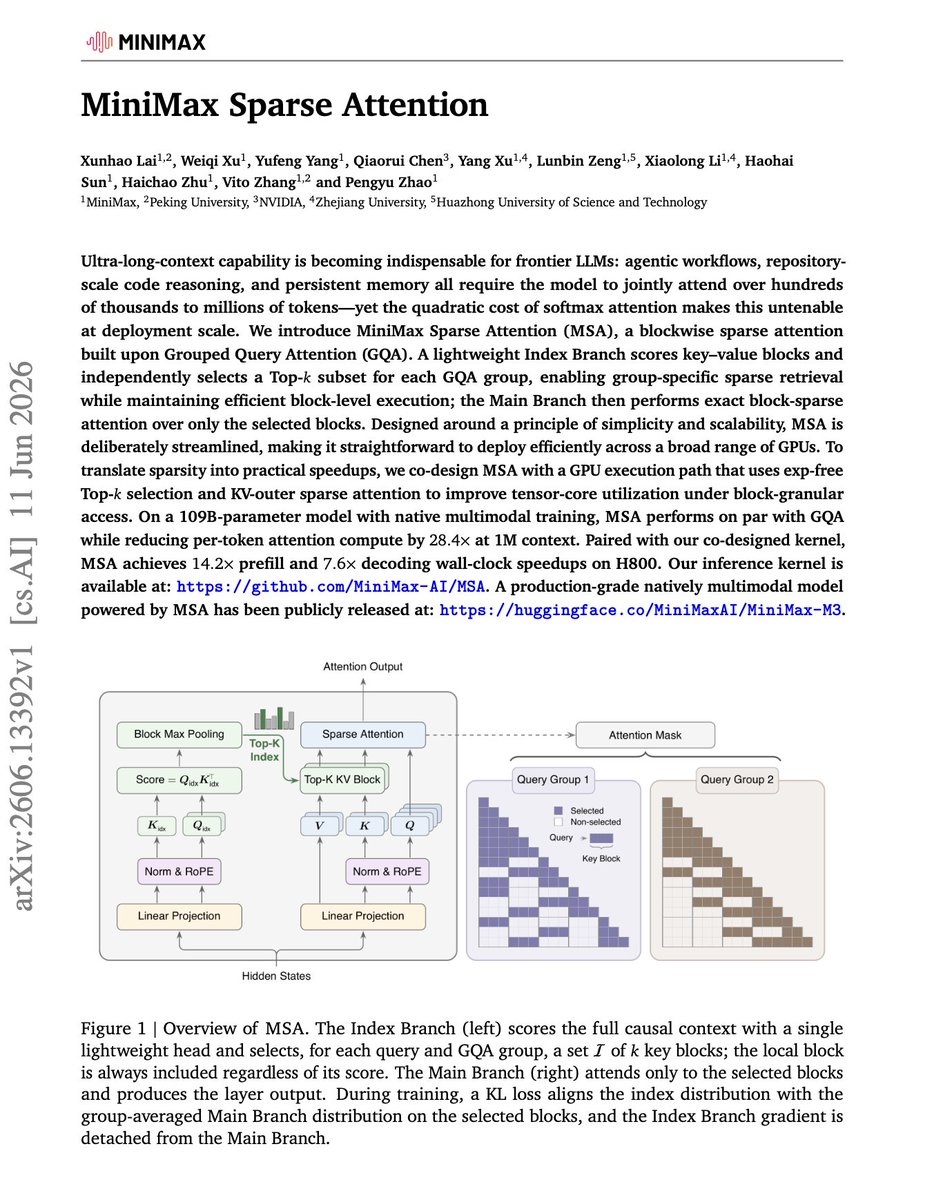
"MiniMax Sparse Attention"
This paper from Minimax adds a tiny Index Branch to GQA that picks top k KV blocks per group, then runs exact softmax only on those blocks, making sparsity GPU native, with exp free TopK and KV outer sparse kernels.
On a 109B multimodal MoE, it keeps dense GQA quality while cutting 1M context attention compute by 28.4x, with 14.2x prefill and 7.6x decode speedups.
7
55
444
15,699

They are interviewing some of the fighters and the spectator area looks pretty sparse.
4

AINFT continues expanding its frontier AI lineup.
As AI workflows become more demanding, users need models that can handle more than simple conversations.
They need stronger reasoning.
Better coding.
And the ability to work across multiple types of content.
That’s why the arrival of MiniMax M3 on AINFT is worth watching.
Developed by @MiniMax_AI, MiniMax M3 combines advanced reasoning, coding, and multimodal capabilities into a single model designed for real-world productivity.
🚀 Now Live on AINFT
🔹 MiniMax M3
🔹 Web Chat Access
🔹 API Integration
🔹 Production-Ready Availability
What makes MiniMax M3 stand out?
⚡ MiniMax Sparse Attention (MSA) for high-performance processing
🖼 Native Multimodal Understanding across text and images
📚 1M Token Context Window for ultra-long documents and workflows
💻 Advanced Coding and Development Capabilities
As AI adoption accelerates, context is becoming one of the most valuable resources.
The ability to analyze large codebases, process extensive documentation, and maintain understanding across long conversations opens new possibilities for developers, researchers, and businesses alike.
🔹 Longer Context
🔹 Smarter Reasoning
🔹 Better Coding
🔹 More Flexible Workflows
The future of AI isn’t about using more tools.
It’s about having access to the right tools when complexity increases.
More capability.
More efficiency.
More possibilities.
And now MiniMax M3 is part of the growing AI ecosystem on AINFT.
🎁 New Users Receive:
✅ 500,000 FREE Credits Upon Login
👉 Try it now: chat.ainft.com/chat
@AINFTcom @justinsuntron
#TRONEcoStar

1
16

The Top AI Papers of the Week (June 7 - June 14)
- Agentopia
- Self-Harness
- Agents' Last Exam
- MiniMax Sparse Attention
- Lookahead Sparse Attention
- How AI Agents Reshape Knowledge Work
- The Geometry of On-Policy Distillation
Read on for more:

10
29
125
15,005

Deep Unfolded Latent Optimally Partitioned-l2/l1 Networks for Data-driven Block-Sparse Recovery
Takanobu Furuhashi, Hidekata Hontani, Qibin Zhao, Tatsuya Yokota
arxiv.org/abs/2606.12740 [𝚌𝚜.𝙻𝙶]
1
38

Where Fable 5 was best:
Approval workflow maturity.
It didn’t just find bugs — it corrected the process itself:
Gate 1 (Design Approval) = Should this architecture exist?
Gate 2 (Build Approval) = Does the code match the approved design?
Gate 2 should not re-litigate PRD gaps unless the approved design required it
A build can (and should) fail even if the architecture passed
Strong reviewers reject their own code when the contract isn’t met
This discipline is why Fable 5 stayed at 9.95 overall.
On pandas / financial data tests Fable 5 was very strong (correctly spotted row-window vs time-based issues, min_periods/NaN handling, sparse rolling limitations, and the need for daily reindexing), but not massively ahead of GLM-5.2.
Rolling average comparison:
Opus 4.8: ~9.5
Fable 5: ~9.4–9.5
GPT-5.5 Thinking: ~9.5–9.6
GLM-5.2: ~9.3
GLM-5.2 came within ~0.1–0.2 points. Impressive.
Daily revenue metrics Fable 5 edged ahead with stronger financial reporting intuition (cumulative vs daily, duplicate grouping, refunds, schema consistency, explicit verification).
Fable 5: ~9.5
Opus 4.8: ~9.4–9.5
GPT-5.5 Thinking: ~9.5
GLM-5.2: ~9.2–9.3
The real separation: Approval gates Fable 5 was clearly #1 here.
Fable 5: 9.95
Opus 4.8: 9.90–9.93
GPT-5.5 Thinking: 9.85–9.90
Grok 4.3 Beta: 9.5
GLM-5.2: 8.4–8.7
Bottom lineGLM-5.2 got closest to Fable 5 on Python/data debugging & refinement (especially rolling averages/time gaps).
But on approval authority, design-vs-build separation, and self-audit discipline? Fable 5 is still far ahead (~1.3–1.5 gap).
Fable continues to set the standard for governed, production-grade agent workflows.
124

Considering how important football is in Yorkshire and the sheer volume of clubs in the area, surprises me that there's only one player currently from the area in the squad. Pretty sparse from Beds, Herts and Bucks too...
1
40
GLM-5.2 just crushed our latest Python/data-engineering eval.
It didn’t win the approval-gate tests — but it came closest to Opus-4.8 in the areas that actually matter for real engineering work.
Key highlights:
Financial time-series / pandas logic — its strongest area • Saw that rolling(window=3) is row-based, not time-based • Recognized sparse rolling("3D") still misses calendar gaps • Shifted to dense daily calendar rolling • Handled empty, single-row, all- NaN edges cleanly • Self-corrected mid-process (“earlier fix was incomplete”)Opus-4.8: ~9.5 GLM-5.2: ~9.3 Gap: ~0.2On pure pandas mechanics, GLM-5.2 is basically in the same tier.
Daily revenue / grouped transaction metrics Understood grouping multiples per day, keeping refunds negative, inserting explicit zero-revenue days, and proper resampling/normalization.Opus-4.8: ~9.4–9.5 GLM-5.2: ~9.2–9.3 Gap: ~0.2–0.3
React hidden-state debugging Correctly separated filtering (table) from selection (detail panel) and fixed the bug at the architectural level. Gap: ~0.4–0.6
Where it still falls short: Approval-gate discipline. It understands the gates conceptually but drifts back into PRD-style review inside the build gate and is less strict about self-rejection. That ~1.0–1.4 gap is why it doesn’t replace Opus/Fable/GPT in the gates yet.
Bottom line:GLM-5.2 is now the closest model to Opus-4.8 on pandas/financial data logic, grouped metrics, and second-pass refinement. Huge step forward on implementation mechanics. Still needs more work on design authority, gate discipline, and knowing when its own answer isn’t good enough.
Impressive run, GLM team.
63