



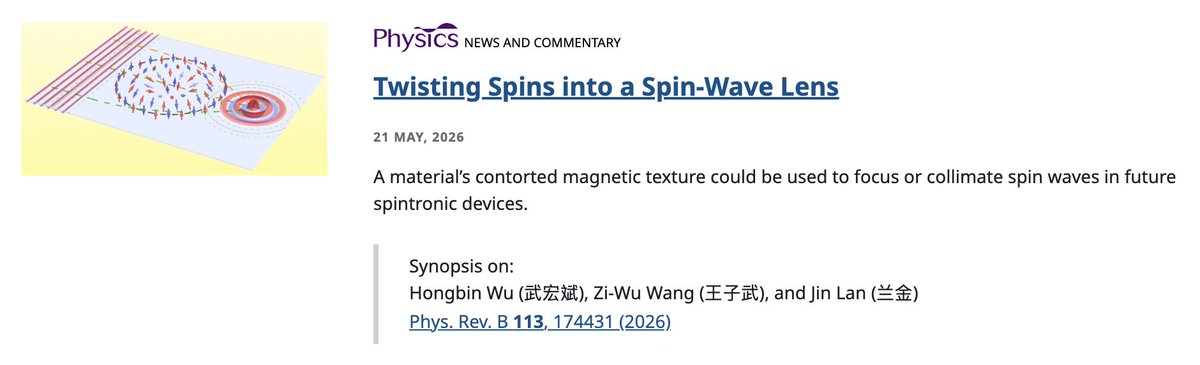
ALT Physics logo NEWS AND COMMENTARY Twisting Spins into a Spin-Wave Lens 21 May, 2026 A material’s contorted magnetic texture could be used to focus or collimate spin waves in future spintronic devices. Synopsis on: Hongbin Wu (武宏斌), Zi-Wu Wang (王子武), and Jin Lan (兰金) Phys. Rev. B 113, 174431 (2026)




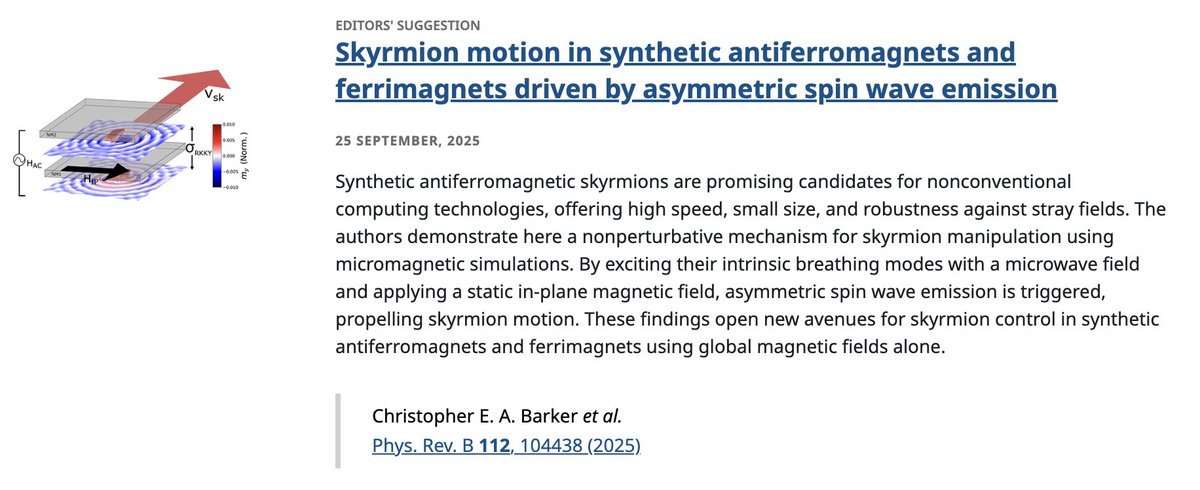
ALT EDITORS' SUGGESTION Skyrmion motion in synthetic antiferromagnets and ferrimagnets driven by asymmetric spin wave emission 25 September, 2025 Synthetic antiferromagnetic skyrmions are promising candidates for nonconventional computing technologies, offering high speed, small size, and robustness against stray fields. The authors demonstrate here a nonperturbative mechanism for skyrmion manipulation using micromagnetic simulations. By exciting their intrinsic breathing modes with a microwave field and applying a static in-plane magnetic field, asymmetric spin wave emission is triggered, propelling skyrmion motion. These findings open new avenues for skyrmion control in synthetic antiferromagnets and ferrimagnets using global magnetic fields alone. Christopher E. A. Barker et al. Phys. Rev. B 112, 104438 (2025)

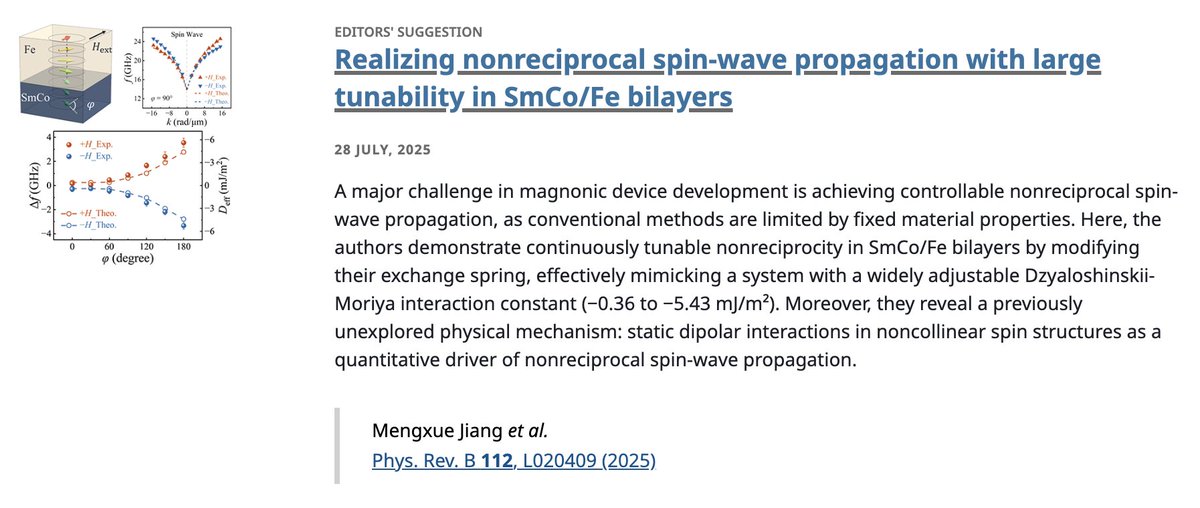
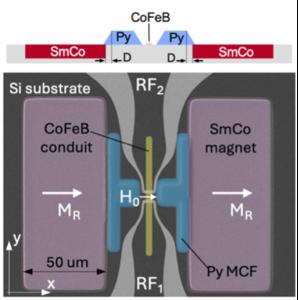
ALT EDITORS' SUGGESTION Realizing nonreciprocal spin-wave propagation with large tunability in SmCo/Fe bilayers 28 July, 2025 A major challenge in magnonic device development is achieving controllable nonreciprocal spin-wave propagation, as conventional methods are limited by fixed material properties. Here, the authors demonstrate continuously tunable nonreciprocity in SmCo/Fe bilayers by modifying their exchange spring, effectively mimicking a system with a widely adjustable Dzyaloshinskii-Moriya interaction constant (−0.36 to −5.43 mJ/m²). Moreover, they reveal a previously unexplored physical mechanism: static dipolar interactions in noncollinear spin structures as a quantitative driver of nonreciprocal spin-wave propagation. Mengxue Jiang et al. Phys. Rev. B 112, L020409 (2025)