
How to use SQL subqueries like a pro
Most people overcomplicate SQL.
Pros don’t.
They break problems into smaller queries inside the main query.
That’s what a subquery is:
A query inside another query.
Instead of doing everything at once, you:
Solve a smaller problem first
Then reuse it in the main query
It’s especially useful for:
Finding values above average
Filtering using calculated results
Comparing a row against a group total
If your SQL feels messy you don’t need a bigger query.
You need a smarter one.
Subqueries are where SQL starts to feel structured, not stressful.
1
3
6
216

معلم حاسب ومقبل على الرخصة المهنية؟ المعيار السادس (قواعد البيانات) يشكّل ٨٪ من الاختبار — وأسئلته تجي أكواد مو نظري. جمعت لك كل شي تحتاجه في مقال واحد: • خريطة أوامر SQL الكاملة بالتصنيف • DDL · DML · DCL · TCL · JOIN · Subquery • أمثلة عملية لكل أمر • ١١ سؤال متكرر من التجميعات مع الإجابات • ترتيب كتابة SELECT الصحيح احفظه مرجع — ما تحتاج غيره #الرخصة_المهنية_حاسب #معلم_حاسب #SQL #قواعد_البيانات #هيئة_تقويم_التعليم #الرخصة_المهنية
x.com/GitArabia/status/20176…

109


Cutting through the noise in Web3 is hard, but @Bitcast_network is proving it’s possible
The idea is simple: only work with real projects. With partners like Bittensor, Bitget, SubQuery, and Score, Bitcast is building with actual infrastructure, not just making promises
Instead of chasing hype, it rewards real engagement and turns attention into measurable value
That’s how you build something that lasts in Web3
42
53
6,581

Supabase RLS performance trap:
Wrong: USING (business_id = auth.uid())
Right: USING (business_id = (SELECT auth.uid()))
Bare auth.uid() re-evaluates on every row. Subquery gets hoisted once.
50k rows: 40ms vs 800ms.
#Supabase #PostgreSQL #Performance
11

Jun 14
Top 100 Data Analytics Interview Questions 📊
SQL Interview Questions
1. What is SQL?
2. What is the difference between SQL and MySQL?
3. What are primary keys and foreign keys?
4. What is normalization?
5. What is denormalization?
6. Difference between WHERE and HAVING?
7. Difference between DELETE, DROP, and TRUNCATE?
8. Difference between INNER JOIN and LEFT JOIN?
9. What is RIGHT JOIN?
10. What is FULL OUTER JOIN?
11. What is SELF JOIN?
12. What is CROSS JOIN?
13. What are aggregate functions?
14. Difference between COUNT and COUNT DISTINCT?
15. What is GROUP BY?
16. Difference between GROUP BY and ORDER BY?
17. What is a subquery?
18. What are CTEs?
19. What are window functions?
20. Explain ROW_NUMBER().
21. Explain RANK() and DENSE_RANK().
22. What are indexes?
23. What causes slow SQL queries?
24. How do you optimize SQL queries?
25. What are views?
26. What are stored procedures?
27. What are transactions?
28. Explain ACID properties.
29. Find duplicate records in SQL.
30. Find second-highest salary using SQL.
31. Calculate running totals using SQL.
32. Find top-selling products using SQL.
33. Calculate month-over-month growth.
34. Difference between UNION and UNION ALL?
35. What are NULL values?
36. Difference between CHAR and VARCHAR?
37. What is a primary key?
38. What is a foreign key?
39. Difference between clustered and non-clustered indexes?
40. Explain query execution plans.
*Excel Interview Questions*
41. What is VLOOKUP?
42. Difference between VLOOKUP and XLOOKUP?
43. What are Pivot Tables?
44. What are slicers in Excel?
45. Explain conditional formatting.
46. Difference between COUNT, COUNTA, and COUNTIF?
47. What are absolute and relative references?
48. What is data validation?
49. Explain IFERROR().
50. What is Power Query?
51. What are dashboards in Excel?
52. Difference between SUMIF and SUMIFS?
53. Explain INDEX MATCH.
54. What are macros?
55. What is VBA?
56. How do you clean data in Excel?
57. How do you remove duplicates?
58. What is flash fill?
59. What are named ranges?
60. Explain text functions in Excel.
61. What are charts in Excel?
62. How do you create dynamic dashboards?
63. What is Goal Seek?
64. What is Solver?
65. Explain What-If Analysis.
*Power BI Interview Questions*
66. What is Power BI?
67. Difference between Power BI Desktop and Service?
68. What is DAX?
69. What is Power Query?
70. What are calculated columns?
71. Difference between measures and calculated columns?
72. Explain relationships in Power BI.
73. What is star schema?
74. What is snowflake schema?
75. What are slicers?
76. What are bookmarks?
77. What is drill-through?
78. Explain row-level security.
79. What are KPIs?
80. Difference between dashboard and report?
81. What is data modeling?
82. Explain CALCULATE().
83. Explain FILTER().
84. Explain ALL().
85. Explain time intelligence functions.
86. What is incremental refresh?
87. Difference between Import and DirectQuery?
88. Explain Power BI gateways.
89. How do you optimize dashboards?
90. What causes slow reports?
91. How do you handle large datasets?
92. What are custom visuals?
93. Explain workspace management.
94. How do you publish reports?
95. Explain deployment pipelines.
*Tableau Interview Questions*
96. What is Tableau?
97. Difference between Tableau and Power BI?
98. What are dimensions and measures?
99. Explain Tableau filters.
100. What are calculated fields?
FOR PART 2 COMMENT "INTERVIEW"
7
32
159
5,404

Jun 13
Master SQL
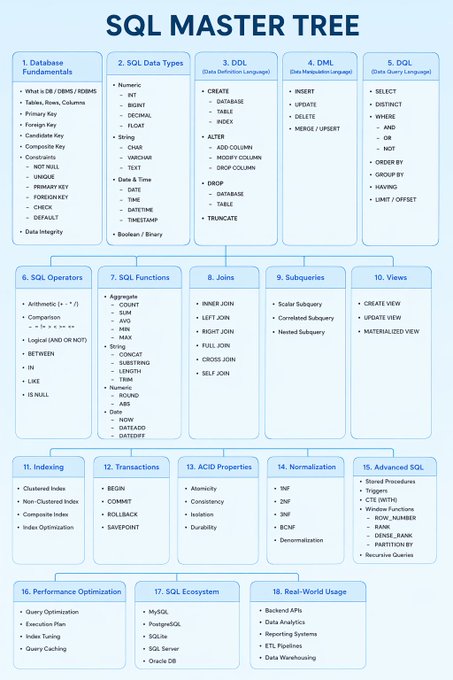
SQL MASTER TREE
│
├── 1. Database Fundamentals
│ ├── What is DB / DBMS / RDBMS
│ ├── Tables, Rows, Columns
│ ├── Primary Key
│ ├── Foreign Key
│ ├── Candidate Key
│ ├── Composite Key
│ ├── Constraints
│ │ ├── NOT NULL
│ │ ├── UNIQUE
│ │ ├── PRIMARY KEY
│ │ ├── FOREIGN KEY
│ │ ├── CHECK
│ │ └── DEFAULT
│ └── Data Integrity
│
├── 2. SQL Data Types
│ ├── Numeric
│ │ ├── INT
│ │ ├── BIGINT
│ │ ├── DECIMAL
│ │ └── FLOAT
│ ├── String
│ │ ├── CHAR
│ │ ├── VARCHAR
│ │ └── TEXT
│ ├── Date & Time
│ │ ├── DATE
│ │ ├── TIME
│ │ ├── DATETIME
│ │ └── TIMESTAMP
│ └── Boolean / Binary
│
├── 3. DDL (Data Definition Language)
│ ├── CREATE
│ │ ├── DATABASE
│ │ ├── TABLE
│ │ └── INDEX
│ ├── ALTER
│ │ ├── ADD COLUMN
│ │ ├── MODIFY COLUMN
│ │ └── DROP COLUMN
│ ├── DROP
│ │ ├── DATABASE
│ │ └── TABLE
│ └── TRUNCATE
│
├── 4. DML (Data Manipulation Language)
│ ├── INSERT
│ ├── UPDATE
│ ├── DELETE
│ └── MERGE / UPSERT
│
├── 5. DQL (Data Query Language)
│ ├── SELECT
│ ├── DISTINCT
│ ├── WHERE
│ │ ├── AND
│ │ ├── OR
│ │ └── NOT
│ ├── ORDER BY
│ ├── GROUP BY
│ ├── HAVING
│ └── LIMIT / OFFSET
│
├── 6. SQL Operators
│ ├── Arithmetic ( - * /)
│ ├── Comparison (= != > < >= <=)
│ ├── Logical (AND OR NOT)
│ ├── BETWEEN
│ ├── IN
│ ├── LIKE
│ └── IS NULL
│
├── 7. SQL Functions
│ ├── Aggregate
│ │ ├── COUNT
│ │ ├── SUM
│ │ ├── AVG
│ │ ├── MIN
│ │ └── MAX
│ ├── String
│ │ ├── CONCAT
│ │ ├── SUBSTRING
│ │ ├── LENGTH
│ │ └── TRIM
│ ├── Numeric
│ │ ├── ROUND
│ │ └── ABS
│ └── Date
│ ├── NOW
│ ├── DATEADD
│ └── DATEDIFF
│
├── 8. Joins
│ ├── INNER JOIN
│ ├── LEFT JOIN
│ ├── RIGHT JOIN
│ ├── FULL JOIN
│ ├── CROSS JOIN
│ └── SELF JOIN
│
├── 9. Subqueries
│ ├── Scalar Subquery
│ ├── Correlated Subquery
│ └── Nested Subquery
│
├── 10. Views
│ ├── CREATE VIEW
│ ├── UPDATE VIEW
│ └── MATERIALIZED VIEW
│
├── 11. Indexing
│ ├── Clustered Index
│ ├── Non-Clustered Index
│ ├── Composite Index
│ └── Index Optimization
│
├── 12. Transactions
│ ├── BEGIN
│ ├── COMMIT
│ ├── ROLLBACK
│ └── SAVEPOINT
│
├── 13. ACID Properties
│ ├── Atomicity
│ ├── Consistency
│ ├── Isolation
│ └── Durability
│
├── 14. Normalization
│ ├── 1NF
│ ├── 2NF
│ ├── 3NF
│ ├── BCNF
│ └── Denormalization
│
├── 15. Advanced SQL
│ ├── Stored Procedures
│ ├── Triggers
│ ├── CTE (WITH)
│ ├── Window Functions
│ │ ├── ROW_NUMBER
│ │ ├── RANK
│ │ ├── DENSE_RANK
│ │ └── PARTITION BY
│ └── Recursive Queries
│
├── 16. Performance Optimization
│ ├── Query Optimization
│ ├── Execution Plan
│ ├── Index Tuning
│ └── Query Caching
│
├── 17. SQL Ecosystem
│ ├── MySQL
│ ├── PostgreSQL
│ ├── SQLite
│ ├── SQL Server
│ └── Oracle DB
│
└── 18. Real-World Usage
├── Backend APIs
├── Data Analytics
├── Reporting Systems
├── ETL Pipelines
└── Data Warehousing
2
2
129

Jun 13
Master SQL
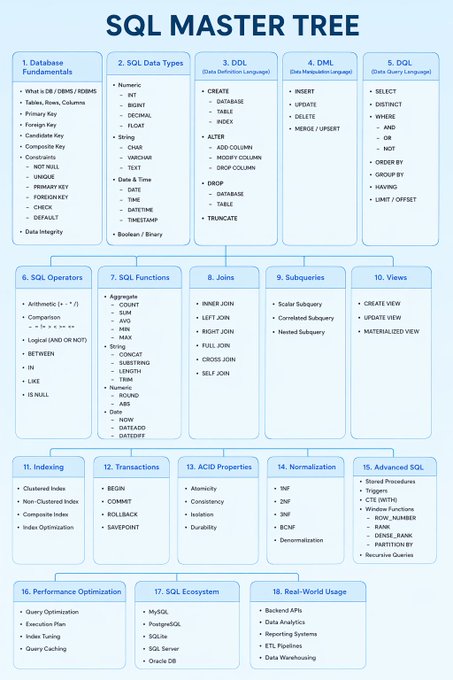
SQL MASTER TREE
│
├── 1. Database Fundamentals
│ ├── What is DB / DBMS / RDBMS
│ ├── Tables, Rows, Columns
│ ├── Primary Key
│ ├── Foreign Key
│ ├── Candidate Key
│ ├── Composite Key
│ ├── Constraints
│ │ ├── NOT NULL
│ │ ├── UNIQUE
│ │ ├── PRIMARY KEY
│ │ ├── FOREIGN KEY
│ │ ├── CHECK
│ │ └── DEFAULT
│ └── Data Integrity
│
├── 2. SQL Data Types
│ ├── Numeric
│ │ ├── INT
│ │ ├── BIGINT
│ │ ├── DECIMAL
│ │ └── FLOAT
│ ├── String
│ │ ├── CHAR
│ │ ├── VARCHAR
│ │ └── TEXT
│ ├── Date & Time
│ │ ├── DATE
│ │ ├── TIME
│ │ ├── DATETIME
│ │ └── TIMESTAMP
│ └── Boolean / Binary
│
├── 3. DDL (Data Definition Language)
│ ├── CREATE
│ │ ├── DATABASE
│ │ ├── TABLE
│ │ └── INDEX
│ ├── ALTER
│ │ ├── ADD COLUMN
│ │ ├── MODIFY COLUMN
│ │ └── DROP COLUMN
│ ├── DROP
│ │ ├── DATABASE
│ │ └── TABLE
│ └── TRUNCATE
│
├── 4. DML (Data Manipulation Language)
│ ├── INSERT
│ ├── UPDATE
│ ├── DELETE
│ └── MERGE / UPSERT
│
├── 5. DQL (Data Query Language)
│ ├── SELECT
│ ├── DISTINCT
│ ├── WHERE
│ │ ├── AND
│ │ ├── OR
│ │ └── NOT
│ ├── ORDER BY
│ ├── GROUP BY
│ ├── HAVING
│ └── LIMIT / OFFSET
│
├── 6. SQL Operators
│ ├── Arithmetic ( - * /)
│ ├── Comparison (= != > < >= <=)
│ ├── Logical (AND OR NOT)
│ ├── BETWEEN
│ ├── IN
│ ├── LIKE
│ └── IS NULL
│
├── 7. SQL Functions
│ ├── Aggregate
│ │ ├── COUNT
│ │ ├── SUM
│ │ ├── AVG
│ │ ├── MIN
│ │ └── MAX
│ ├── String
│ │ ├── CONCAT
│ │ ├── SUBSTRING
│ │ ├── LENGTH
│ │ └── TRIM
│ ├── Numeric
│ │ ├── ROUND
│ │ └── ABS
│ └── Date
│ ├── NOW
│ ├── DATEADD
│ └── DATEDIFF
│
├── 8. Joins
│ ├── INNER JOIN
│ ├── LEFT JOIN
│ ├── RIGHT JOIN
│ ├── FULL JOIN
│ ├── CROSS JOIN
│ └── SELF JOIN
│
├── 9. Subqueries
│ ├── Scalar Subquery
│ ├── Correlated Subquery
│ └── Nested Subquery
│
├── 10. Views
│ ├── CREATE VIEW
│ ├── UPDATE VIEW
│ └── MATERIALIZED VIEW
│
├── 11. Indexing
│ ├── Clustered Index
│ ├── Non-Clustered Index
│ ├── Composite Index
│ └── Index Optimization
│
├── 12. Transactions
│ ├── BEGIN
│ ├── COMMIT
│ ├── ROLLBACK
│ └── SAVEPOINT
│
├── 13. ACID Properties
│ ├── Atomicity
│ ├── Consistency
│ ├── Isolation
│ └── Durability
│
├── 14. Normalization
│ ├── 1NF
│ ├── 2NF
│ ├── 3NF
│ ├── BCNF
│ └── Denormalization
│
├── 15. Advanced SQL
│ ├── Stored Procedures
│ ├── Triggers
│ ├── CTE (WITH)
│ ├── Window Functions
│ │ ├── ROW_NUMBER
│ │ ├── RANK
│ │ ├── DENSE_RANK
│ │ └── PARTITION BY
│ └── Recursive Queries
│
├── 16. Performance Optimization
│ ├── Query Optimization
│ ├── Execution Plan
│ ├── Index Tuning
│ └── Query Caching
│
├── 17. SQL Ecosystem
│ ├── MySQL
│ ├── PostgreSQL
│ ├── SQLite
│ ├── SQL Server
│ └── Oracle DB
│
└── 18. Real-World Usage
├── Backend APIs
├── Data Analytics
├── Reporting Systems
├── ETL Pipelines
└── Data Warehousing
5
36
125
3,367

Jun 13
aggression.","But ClickHouse SQL compatibility has edges. You'll miss window functions, full JOIN flexibility, and certain subquery patterns. If your analysts write complex ad-hoc queries across many tables, Snowflake's ANSI SQL support will save you from
1
24


Jun 13
20/ What is a Subquery?
A query inside another query.
Example:
Find employees earning above the average salary.
Very common in analytical problems.
1
8

Kalian kok bisa ngoding CSS sih?
Apalah dayaku yang hanya bisa query, subquery, left join, inner join, replikasi, trigger
3
4
149


Jun 11
Nope, its terrible. He suggested removing security policies from the table and still performing a select without limit on a table with millions of records.
A query with a subquery would have solved the problem, and he didn't even suggest it; I had to guide him.
1
15
Jun 11
Fable sequer conecta direito, é impreciso e arbitrário.
Ontem se recusou a analisar e sugerir melhorias de performance no administrativo de uma aplicação
Opus 4.8 sugeriu fazer select de todas as rows e ainda remover policies de segurança.
Uma query com subquery e resolveria
21

Jun 10
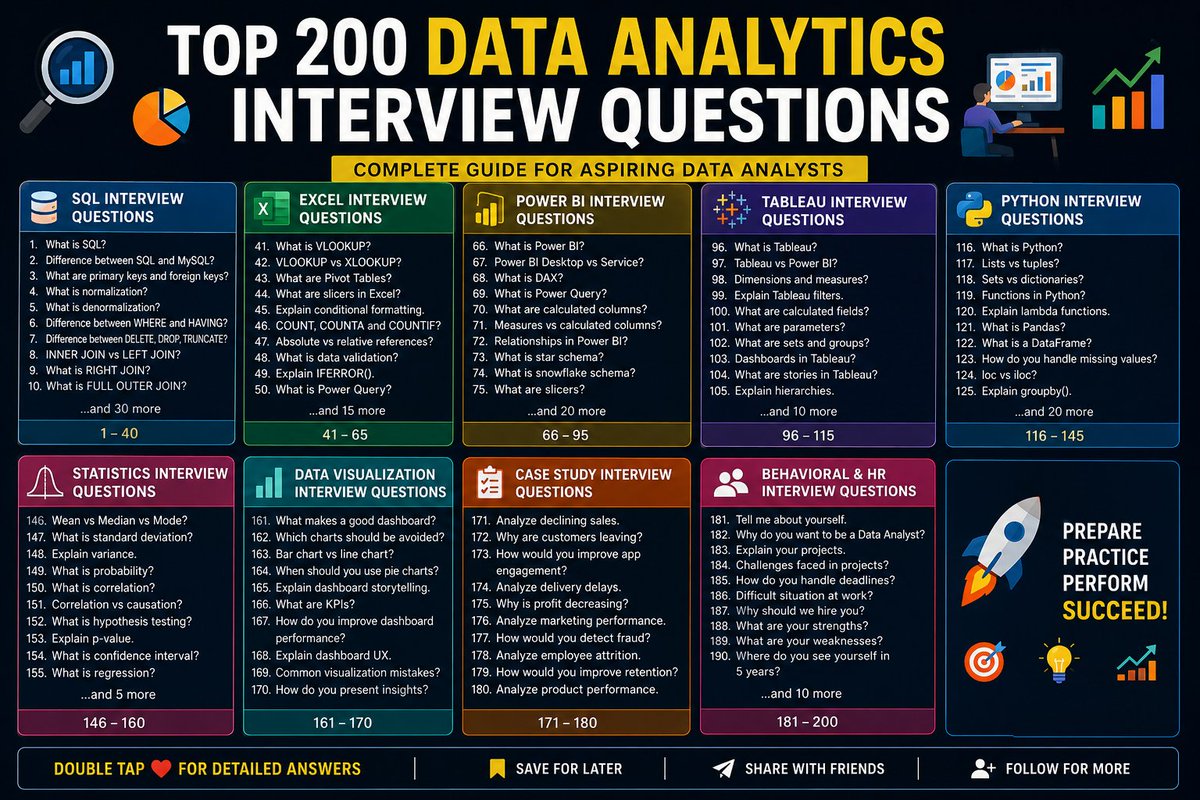
🚀 Top 200 Data Analytics Interview Questions 📊
SQL Interview Questions
1. What is SQL?
2. What is the difference between SQL and MySQL?
3. What are primary keys and foreign keys?
4. What is normalization?
5. What is denormalization?
6. Difference between WHERE and HAVING?
7. Difference between DELETE, DROP, and TRUNCATE?
8. Difference between INNER JOIN and LEFT JOIN?
9. What is RIGHT JOIN?
10. What is FULL OUTER JOIN?
11. What is SELF JOIN?
12. What is CROSS JOIN?
13. What are aggregate functions?
14. Difference between COUNT and COUNT DISTINCT?
15. What is GROUP BY?
16. Difference between GROUP BY and ORDER BY?
17. What is a subquery?
18. What are CTEs?
19. What are window functions?
20. Explain ROW_NUMBER().
21. Explain RANK() and DENSE_RANK().
22. What are indexes?
23. What causes slow SQL queries?
24. How do you optimize SQL queries?
25. What are views?
26. What are stored procedures?
27. What are transactions?
28. Explain ACID properties.
29. Find duplicate records in SQL.
30. Find second-highest salary using SQL.
31. Calculate running totals using SQL.
32. Find top-selling products using SQL.
33. Calculate month-over-month growth.
34. Difference between UNION and UNION ALL?
35. What are NULL values?
36. Difference between CHAR and VARCHAR?
37. What is a primary key?
38. What is a foreign key?
39. Difference between clustered and non-clustered indexes?
40. Explain query execution plans.
Excel Interview Questions
41. What is VLOOKUP?
42. Difference between VLOOKUP and XLOOKUP?
43. What are Pivot Tables?
44. What are slicers in Excel?
45. Explain conditional formatting.
46. Difference between COUNT, COUNTA, and COUNTIF?
47. What are absolute and relative references?
48. What is data validation?
49. Explain IFERROR().
50. What is Power Query?
51. What are dashboards in Excel?
52. Difference between SUMIF and SUMIFS?
53. Explain INDEX MATCH.
54. What are macros?
55. What is VBA?
56. How do you clean data in Excel?
57. How do you remove duplicates?
58. What is flash fill?
59. What are named ranges?
60. Explain text functions in Excel.
61. What are charts in Excel?
62. How do you create dynamic dashboards?
63. What is Goal Seek?
64. What is Solver?
65. Explain What-If Analysis.
Power BI Interview Questions
66. What is Power BI?
67. Difference between Power BI Desktop and Service?
68. What is DAX?
69. What is Power Query?
70. What are calculated columns?
71. Difference between measures and calculated columns?
72. Explain relationships in Power BI.
73. What is star schema?
74. What is snowflake schema?
75. What are slicers?
76. What are bookmarks?
77. What is drill-through?
78. Explain row-level security.
79. What are KPIs?
80. Difference between dashboard and report?
81. What is data modeling?
82. Explain CALCULATE().
83. Explain FILTER().
84. Explain ALL().
85. Explain time intelligence functions.
86. What is incremental refresh?
87. Difference between Import and DirectQuery?
88. Explain Power BI gateways.
89. How do you optimize dashboards?
90. What causes slow reports?
91. How do you handle large datasets?
92. What are custom visuals?
93. Explain workspace management.
94. How do you publish reports?
95. Explain deployment pipelines.
Tableau Interview Questions
96. What is Tableau?
97. Difference between Tableau and Power BI?
98. What are dimensions and measures?
99. Explain Tableau filters.
100. What are calculated fields?
101. What are parameters?
102. What are sets and groups?
103. Explain dashboards in Tableau.
104. What are stories in Tableau?
105. Explain hierarchies.
106. What is Tableau Prep?
107. Difference between live and extract connections?
108. Explain joins and blending.
109. What are LOD expressions?
110. Explain table calculations.
111. What are actions in Tableau?
112. How do you optimize dashboards?
113. Explain context filters.
114. What is dual-axis chart?
115. Explain data source filters.
Python Interview Questions
116. What is Python?
117. Difference between lists and tuples?
118. Difference between sets and dictionaries?
119. What are functions in Python?
120. Explain lambda functions.
121. What is Pandas?
122. What is a DataFrame?
123. How do you handle missing values?
124. Difference between loc and iloc?
125. Explain groupby().
126. What is NumPy?
127. Difference between NumPy arrays and lists?
128. Explain vectorization.
129. What is broadcasting?
130. Explain array indexing.
131. What is Matplotlib?
132. What is Seaborn?
133. Difference between bar chart and histogram?
134. Explain box plots.
135. Explain scatter plots.
136. How do you remove duplicates in Python?
137. How do you detect outliers?
138. Explain feature engineering.
139. How do you merge datasets?
140. How do you export data?
141. What is exception handling?
142. Explain try-except blocks.
143. What are APIs?
144. How do you automate reports?
145. Explain web scraping basics.
Statistics Interview Questions
146. Mean vs Median vs Mode?
147. What is standard deviation?
148. Explain variance.
149. What is probability?
150. What is correlation?
151. Difference between correlation and causation?
152. What is hypothesis testing?
153. Explain p-value.
154. What is confidence interval?
155. What is regression?
156. What is A/B testing?
157. Explain normal distribution.
158. What are outliers?
159. What is sampling?
160. Explain Type I and Type II errors.
Data Visualization Interview Questions
161. What makes a good dashboard?
162. Which charts should be avoided?
163. Difference between bar and line charts?
164. When should you use pie charts?
165. Explain dashboard storytelling.
166. What are KPIs?
167. How do you improve dashboard performance?
168. Explain dashboard UX.
169. What are common visualization mistakes?
170. How do you present insights to stakeholders?
Case Study Interview Questions
171. Analyze declining sales.
172. Why are customers leaving a platform?
173. How would you improve app engagement?
174. Analyze delivery delays.
175. Why is profit decreasing?
176. Analyze marketing campaign performance.
177. How would you detect fraud?
178. Analyze employee attrition.
179. How would you improve customer retention?
180. Analyze product performance.
Behavioral & HR Interview Questions
181. Tell me about yourself.
182. Why do you want to become a Data Analyst?
183. Explain your projects.
184. What challenges did you face in projects?
185. How do you handle deadlines?
186. Explain a difficult situation at work.
187. Why should we hire you?
188. What are your strengths?
189. What are your weaknesses?
190. Where do you see yourself in 5 years?
191. Explain your career gap.
192. Why are you switching careers?
193. Explain your resume.
194. How do you handle pressure?
195. Explain teamwork experience.
196. How do you deal with conflicts?
197. Describe leadership experience.
198. Explain a project failure.
199. How do you prioritize tasks?
200. Do you have any questions for us?
Bookmark This For Later 🔖
1
1
269
