
1 Jan 2025
import java.math.*;
public class SumOfNumbers {
public static void main(String... args) {
for (int pow = 1; pow < 1_000_000_000; pow *= 10) {
long time = System.nanoTime();
try {
System.out.printf("pow = %,d%n", pow);
var sum = getSum(new BigInteger("10").pow(pow));
System.out.println(sum.bitLength());
} finally {
time = System.nanoTime() - time;
System.out.printf("time = %dms%n", (time / 1_000_000));
}
}
}
private static BigInteger getSum(BigInteger upto) {
return upto.multiply(upto.add(BigInteger.ONE))
.shiftRight(1);
}
}
Can be improved with my parallelMultiply() method :-)
1 Jan 2025

I would be more interested in how programmers respond to the challenge. For example, if you do use the algorithm for O(1), how do you avoid overflowing the integer for the same maximum size? And what is that maximum size of n? What about using a long? And what would the maximum size be then? And what about BigInteger? What would the complexity be then? How about calculating the sum to 1 billion? 1 trillion? With BigInteger, we no longer have O(1), but rather O(n^1.46) in Java 8 onwards. Before that it was O(n^2). And yes, this has little to do with programming, but I personally would expect any programmer to at least know that the sum of integers is n * (n 1) / 2. I figured that out by myself when I was 10.
2
12
3,792

2 Oct 2024
SOFTWARE ENGINEERING 🖥️ C PROGRAM 💻 SUM OF N NUMBERS
youtube.com/watch?v=9E0EwS1q…
#SoftwareEngineering #CProgram #SumOfNNumbers #SumOfNumbers #ComputerEngineering #ComputerScience #CLanguage #CProgramming #Programming #Coding #ProgrammingLesson #CodingLesson #CodingTutorial

1
69


17 Dec 2022
if i add two num in python
a = 2, b = 5
print(a b) <-- print sum in two lines of code but in Java
public class SumOfNumbers 1
{
public static void main(String
args[]){
int n1 = 2, n2 = 5, sum;
sum = n1 n2;
System.out.println(sum);
}
} <-- this is why Python is
love for me 😂
4
67

16 Nov 2022
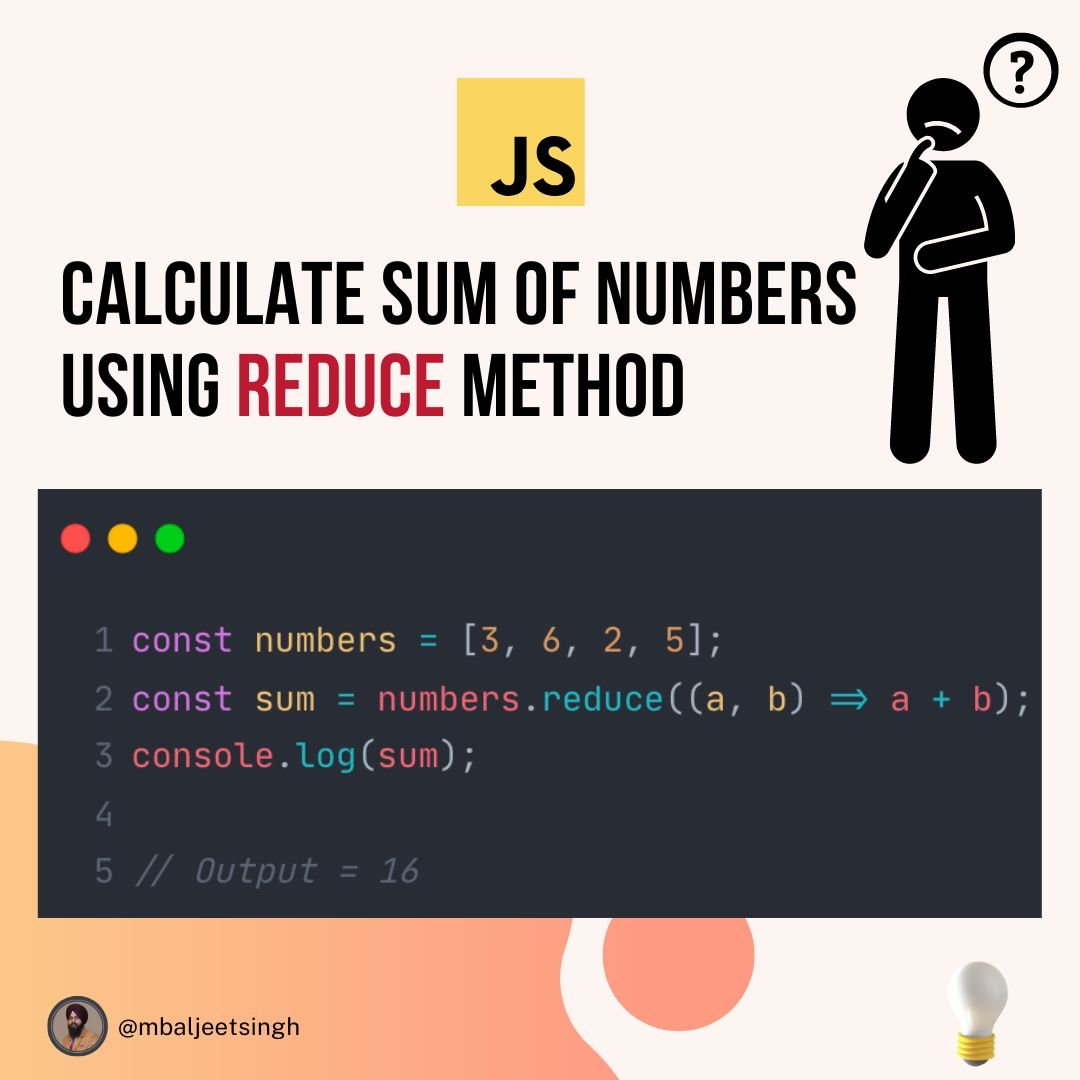
💡 Javascript Tip 👇
Calculate Sum of numbers using reduce method
#javascripttips #sumofnumbers #reduce
2

24 Feb 2022
From what I see in the loop, everything is done right.
Except the numbers array, it is correct as well but just that its empty.
So the value of "sumofnumbers" will be 0 because the array you want to loop through to provide a sum is empty.
2

23 Feb 2021
Small things can make a huge difference.
How do you find sum of numbers from A to B in #Python?
Check out our #video on #Youtube
Link: youtu.be/ctwdzGCpBMk
Don’t forget to #subscribe.
#BeingPythonic #YouTube #AlwaysBlue #CodeNewbies #cleanCoding #sumOfNumbers #Python3

26 Aug 2019
let arrayOfNumbers = [2, 4, 6, 8, 10, 12];
let sumOfNumbers = 0;
for (i = 0; i < arrayOfNumbers.length; i ) {
sumOfNumbers = arrayOfNumbers[i];
}
const avgNumber = () => {
return sumOfNumbers / arrayOfNumbers.length;
}
console.log(avgNumber());
3