
More information about our Taskable InSAR for Automated, Millimeter-Scale Earth Monitoring, available immediately: capellaspace.com/resources/c…
2
32
3,769

Rucking is the most entry level friendly, "multi-taskable", enjoyable
And also probably the most knee sparing form of cardio
100X better than "jogging"
4
1,544
Depends on what volumes of walking are we talking
One thing I find totally false is "busy people that simple can't spend an hour walking"
Walking is the most multi-taskable one out of all avaialble "cardio" movements
You can do it on calls, on a lunch break, on an under the desk treadmill, etc.
The gist with high intensity cardio (like sprinting) is the hormonal response triggering a higher catecholamine & GH spike
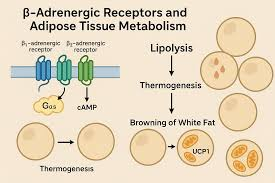
To which visceral fat cells are disproportionately responsive given that they have a higher density of beta-adrenergic receptors
So you end up with adrenaline-driven lipolysis, which is a completely different animal from simply increasing your TDEE with going on long walks (which btw I also do support for other reasons)
Yes, calorie deficit matters
Total calories burned matter
But equal calories on paper doesn't mean equal fat mobilization signals
May 12

The difference is insignificant, even with visceral fat, if the same end work is put in. The only real benefit here is for busy people that simple can't spend an hour walking, they can knock the same burn in half the time or less. Maybe that was your point? But I read it as walking doesn't burn visceral fat as well as higher intensity workouts calorie burn being the same.
1
5
1,855


May 11
The rapid growth in commercial satellite fleets is opening up real-time Earth observation in ways that feel transformative for field ops. Pulling archived or taskable imagery straight to rugged Android devices via ATAK cuts out so much latency from centralized pipelines.
Any sense yet on how machine learning layers might soon auto-highlight changes or threats in those feeds?
1
3
246

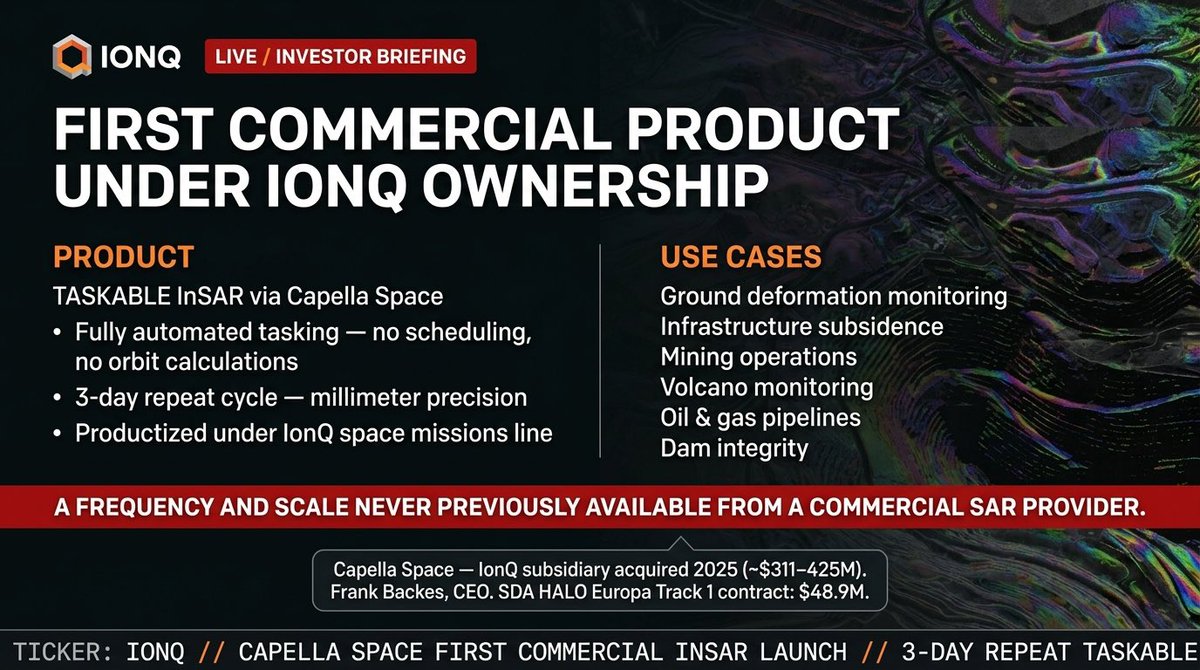
7/ First commercial product under $IONQ ownership: taskable InSAR via Capella Space (subsidiary, ~$311–425M acquired 2025).
→ 3-day repeat cycle, millimeter precision
→ Fully automated tasking moi no scheduling, no orbit calculations
→ Productized under the IonQ space missions line
« A frequency and scale never previously available from a commercial SAR provider. »
The M&A is value-accretive in product, not just balance sheet.
1
2
9
704
$IONQ
Same launch, different angle.
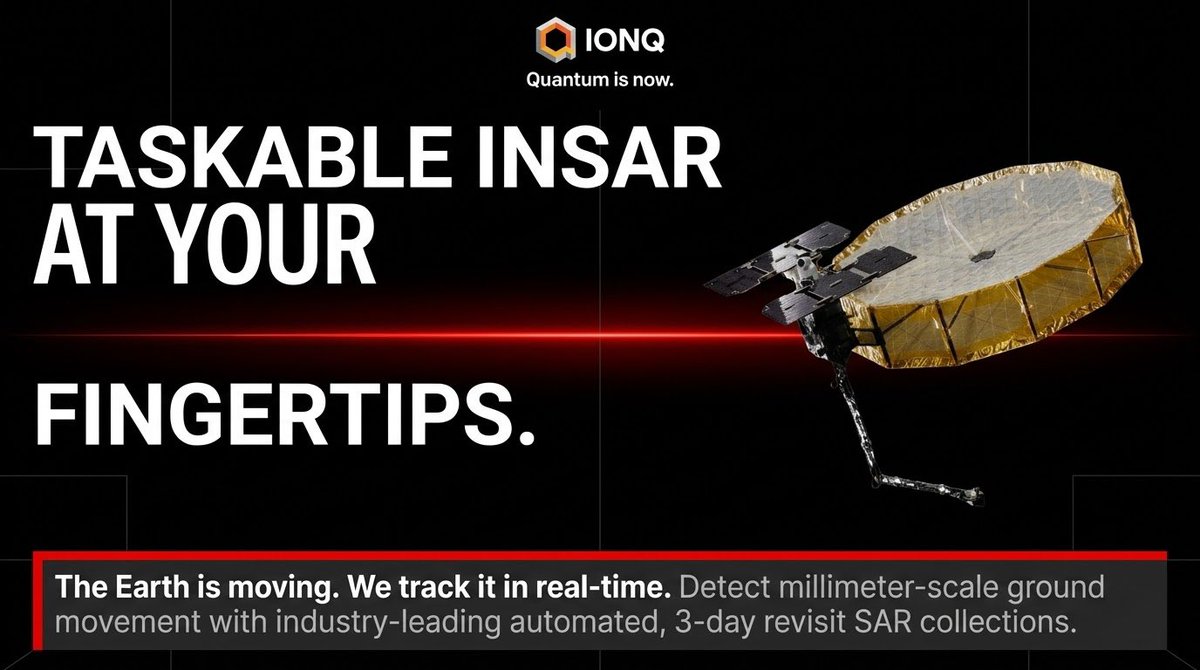
The ground you stand on moved last night. By a millimeter. You didn’t notice. Your phone didn’t notice. A satellite did.
That’s what @IonQ_Inc commercially launched today through @capellaspace taskable InSAR at your fingertips, 3-day repeat, automated from a console.
🔗 capellaspace.com/solution/in…
Full scoop 👇
$IONQ #IonQ #CapellaSpace #InSAR

$IONQ
“A frequency and scale never previously available from a commercial SAR provider.”
Built on the SAR constellation Capella Space brought in. Productized under the IonQ space missions line.
→ Fully automated tasking
→ 3-day repeat cycle
→ Millimeter-precision ground deformation monitoring
Built on the SAR constellation Capella Space brought in. Productized under the IonQ space missions line.
🔗ionq.com/news/ionq-launches-…
Full scoop 👇
$IONQ #IonQ #CapellaSpace

1
8
46
3,111

May 4
Taskable InSAR is here.
Capella turns millimeter-scale ground deformation from retrospective analysis into real-time, decision-ready intelligence.
• Automated tasking
• ~3-day monitoring
• Continuous, InSAR-ready data
Learn more: hubs.la/Q04fdPBm0

6
51
1,895
May 1
The most important changes don’t happen all at once.
They happen over time.
We’re making them visible and taskable.
Visit our #GEOINT booth #1311 to learn more!
hubs.la/Q04f8n7N0

1
4
43
2,494

Apr 25
الحمدللہ
نعرہ تکبیر
اللہ اکبر
🚀🇵🇰 — Space and Upper Atmosphere Research Commission (SUPARCO) has announced a historic achievement with the successful launch of our indigenous Electro-Optical Satellite.
⚡🇵🇰 — Space-borne Observation Suite of Pakistan
Since many have asked, here is a brief overview of these satellite systems.
In general, the PRSS and PRSC series are Low Earth Orbit (LEO), Electro-Optical (EO) satellites. This means they gather Earth data by capturing images, visuals, and radar data via a sophisticated mix of sensors.
Key Technical Concepts
• Revisit Time: This refers to the duration it takes for a satellite to return to the exact same spot on Earth.
• Optical Payload: This defines the quality of imagery the satellite provides, measured in meters per pixel.
For context, 100m/pixel yields blurred buildings, while 0.1m/pixel is sharp enough to identify specific vehicle types.
Satellite Breakdown
• PRSS-1: Features 2.5m to 5.5m imagery with a 4-day revisit time.
• PRSS-2: Features estimated 1m to 2m imagery with a ~2–4 day revisit time.
• PRSC-EO-1: Features 1m to 2m imagery with a 1–3 day revisit time; includes taskable repositioning in less than 24 hours.
• PRSC-EO-2: Features 0.5m to 1m imagery with a 1–3 day revisit time; includes taskable repositioning in less than 24 hours.
• PRSC-EO-3: Features ultra-high 0.1m to 0.3m imagery with a 1–3 day revisit time; includes taskable repositioning in less than 24 hours.
Operational Impact
The PRSC-EO constellation enables near-daily surveillance at chosen sites.
If operating in a full constellation configuration, these assets can be repositioned if needed in less than 12 hours.
Note: The specifications for PRSS-2 and PRSC-EO-1 through EO-3 have not been officially disclosed.
These figures remain speculative derivations based on the study of public tenders and corporate hiring patterns.
T.me/ThePakistanNews
Jan 22

الحمدللہ
نعرہ تکبیر
اللہ اکبر
⚡🇵🇰/🇨🇳 — Pakistan's indigenously developed PRSC-EO2 satellite has successfully launched today from China, marking another step in Pakistan's modernization and scientific progression.
🇵🇰 — Pakistan's Space & Satellite Program
A. Active Satellites
1. PRSC–S1 – Earth Observation
Launched: 31 Jul 2025
2. PRSC–EO1 – Electro-Optical
Launched: 17 Jan 2025
3. PAUSAT–1 – Tech/Education
Launched: 14 Jan 2025
4. PAKSAT–MM1 – Communication
Launched: 30 May 2024
5. ICUBE–Q – Lunar Orbiter
Launched: 3 May 2024
6. PakTES–1A – Earth Observation
Launched: 9 Jul 2018
7. PRSS–1 – Remote Sensing
Launched: 9 Jul 2018
B. Now Satellite Missions
• PRSS–2
• PRSC–EO2 & EO3
• PAKSAT–MM2
C. 2047 OBJECTIVES
• Indigenous GNSS System
• PLEXR — Lunar Rover via Chang'e–8
• Human Spaceflight Experiments on CSS
T.me/ThePakistanNews

4
10
447

Sponsored: The biggest obstacle to next-gen robotics? The time it takes to train them. Artly allows robots to learn skills in <30 min. This breakthrough is enabling instantly re-taskable robots. Details: invest.artly.ai/
@artlycoffee
#Robotics #AI #MachineLearning #TechNews

1
1,950


Mar 6
From what I’m reading, LUCAS was primarily designed as a compromise. Not the cheapest bang for buck (loud cheap piston engines with it made out of wood), and had to be smart. It is re-taskable mid flight, etc.
And they can’t be as crazy as Iranians. They have more regulations.
5
546

Feb 9
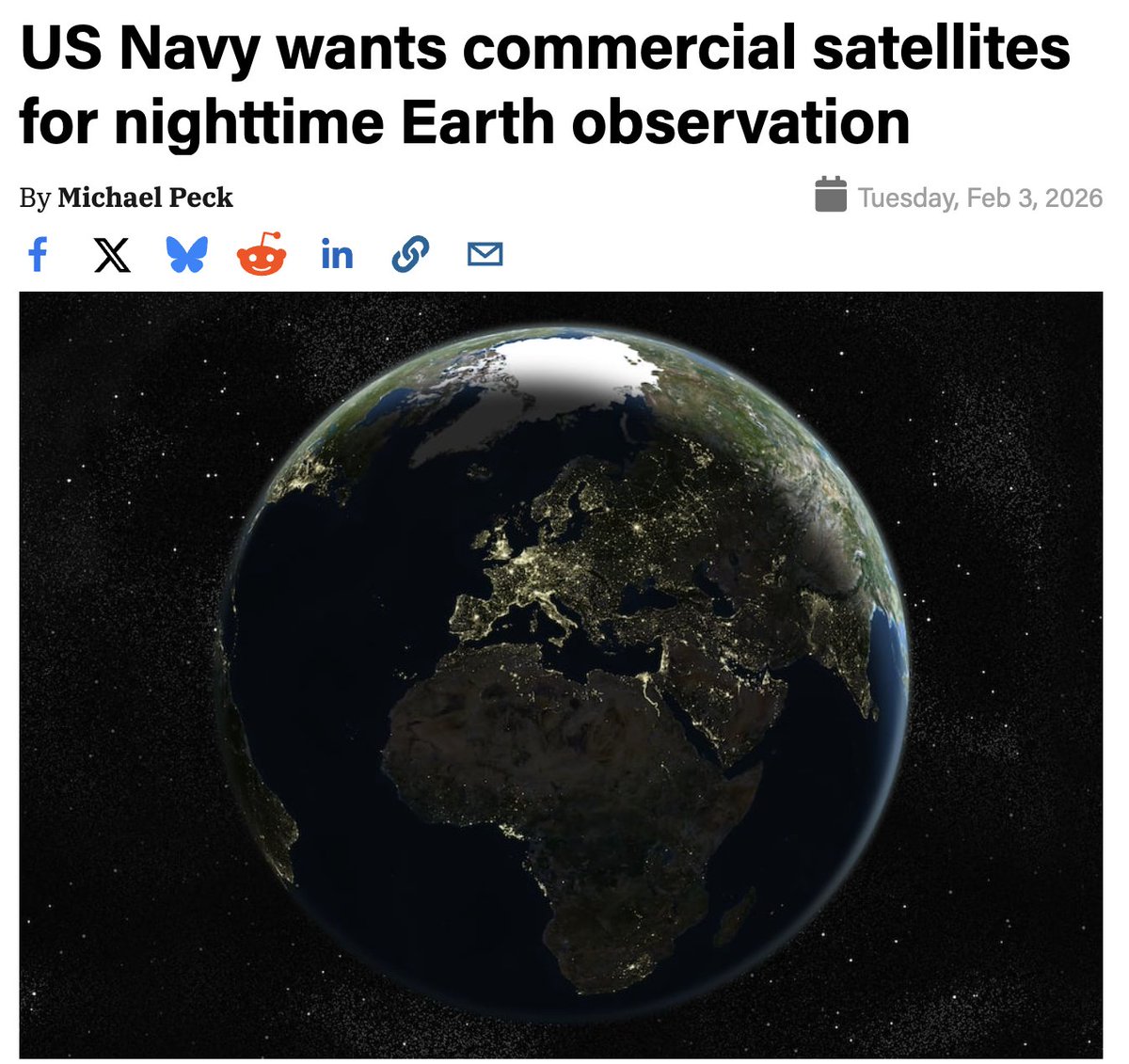
Some early signals for a potential commercial nighttime satellite imagery market, building on what instruments like VIIRS have already enabled.
VIIRS has been a breakthrough for nighttime observation and led a ton of research. But, what the US Navy now seems to be asking for is a more operational, taskable version of that idea.
A couple of players like EROS-B (ImageSat) and Jilin-1 (China) already provide high-resolution nighttime imagery, but the Navy is likely looking for a national, procurement-ready service that can complement other modalities (like infrared/thermal).
The inclusion of onboard processing, tasking and dissemination process as explicit requirements shows that this is potentially for operational use - good signal for market validation and technical roadmap.
Will this be an extension of an existing EO constellation or a new one from a new company altogether?
1
1
4
629

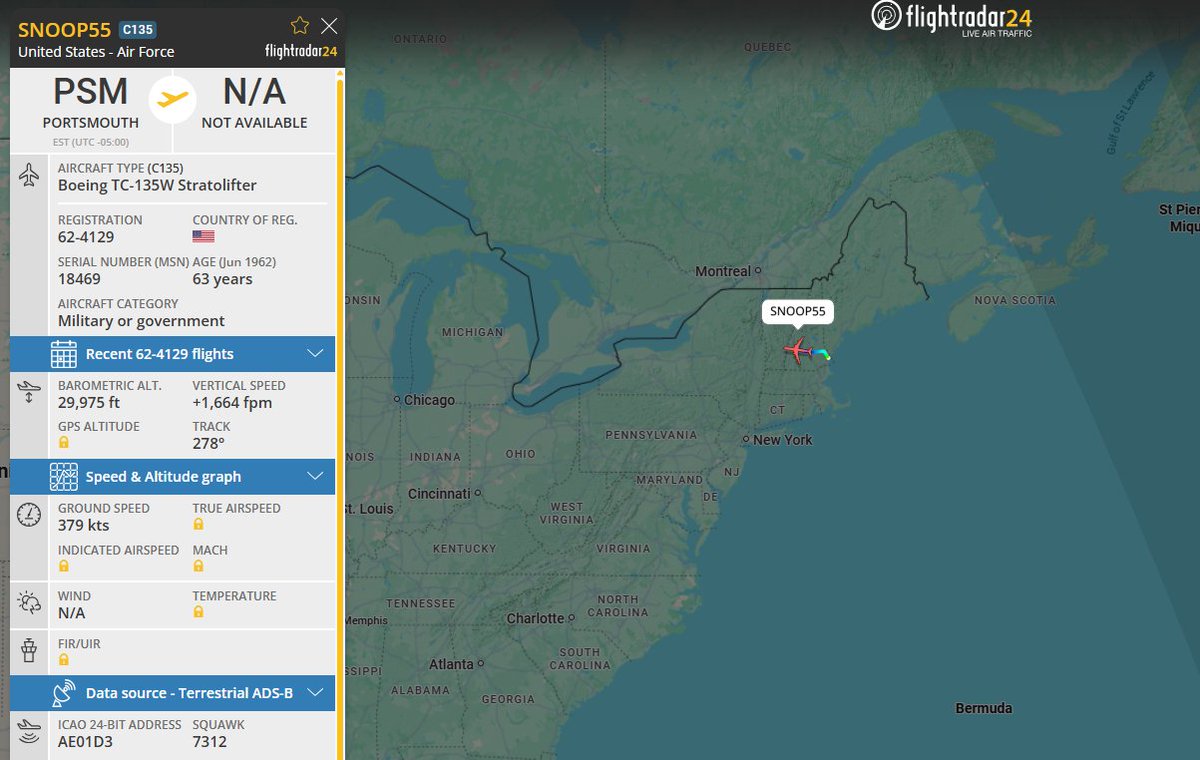
TC-135W 62-4129 continues to show the value of its secondary, but important role. Over the last 11 days, it has provided logistics support to the RAF contingent deployed to Nellis for Red Flag 26-1, and the return of USAF RC-135 operations to Al Udeid. The lack of any classified mission equipment aboard allows the plane to use civilian airfields, (like Malta on Jan 27th), since there would be no need to guard the aircraft if it were grounded due to a maintenance related failure. In addition, since it belongs to the 55th Wing, it is rapidly taskable with no need to coordinate operations with other agencies. This hop will complete another leg of RAF support for Red Flag flying Waddington/Pease/Nellis.
1
4
58
7,006

Jan 28
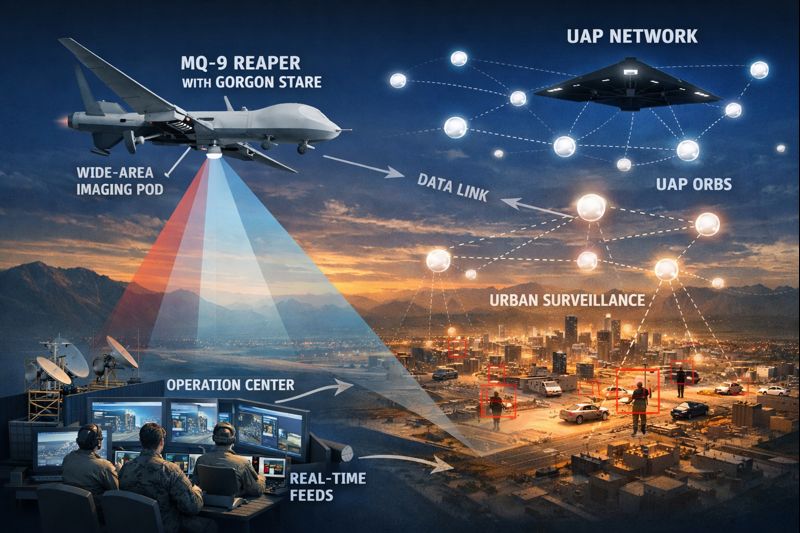
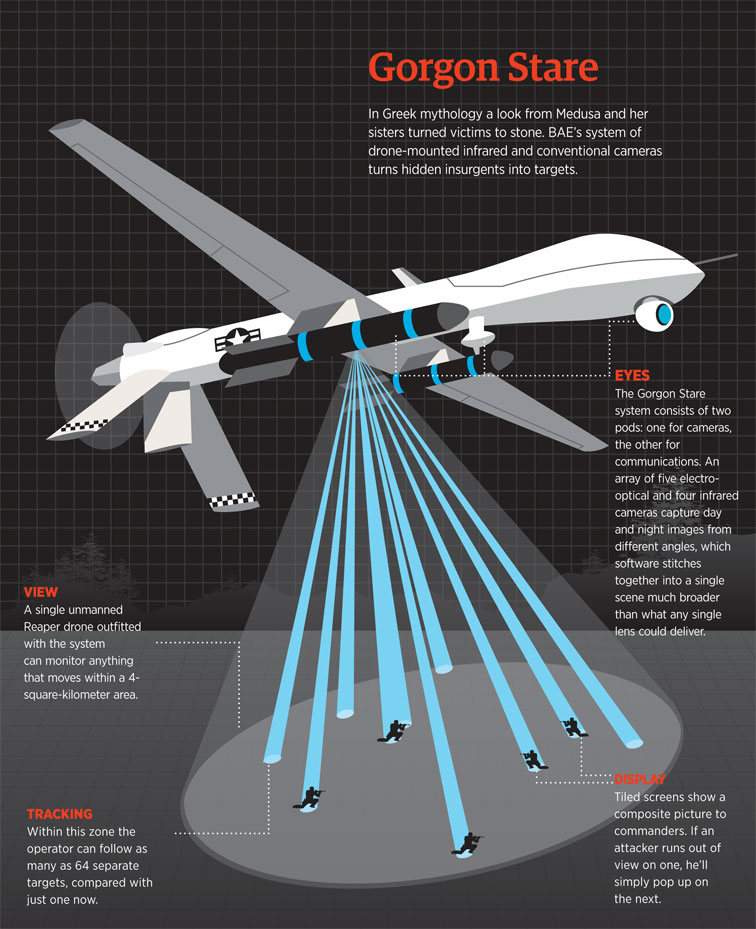
My current theory on Gorgon Stare based on @AshtonForbes amazing work is that it exists because distributed, low-profile sensing alone cannot satisfy moments when war compresses into minutes and commanders need overwhelming clarity under direct control.
Small autonomous nodes are optimized for persistence, discretion, and coverage, but they cannot host massive sensor arrays, sustain extreme bandwidth, cool dense electronics, or deliver auditable, human-in-the-loop feeds to many analysts at once.
Gorgon Stare concentrates vision: wide-area motion imagery over an entire city, streamed in real time, taskable instantly, and embedded in formal command chains with clear legal and political accountability.
It trades stealth for authority, scale, and certainty. In a mature architecture, that is not redundancy but hierarchy.
Quiet edge nodes watch continuously and invisibly; heavy platforms surge when density, proof, and immediate decision support matter more than concealment.
The open question is whether the MH370 orbs belonged to the network or were activated independently for a specific mission?
Jan 27

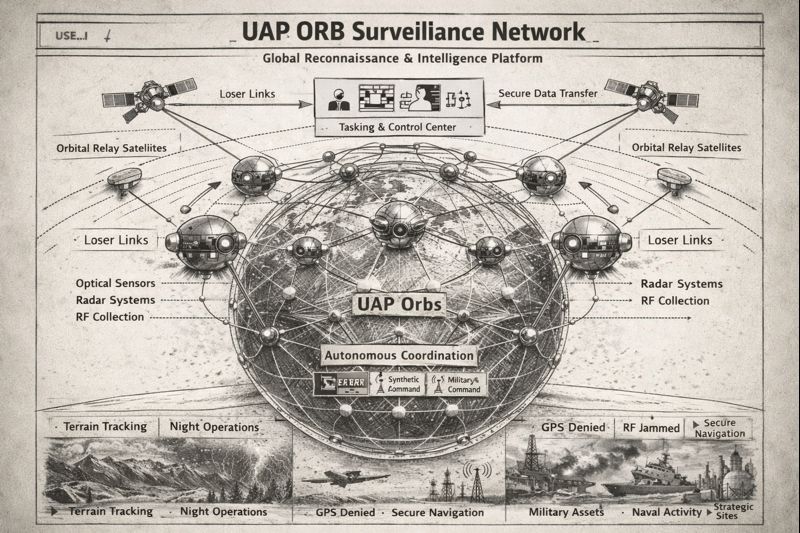
UAP Orb Surveillance Network: 🧵
A distributed intelligence lattice replaces static satellites with mobile nodes.
Autonomous orbs reposition dynamically, relay data through secure optical links, and maintain continuous global awareness.
The system operates as a living network rather than a fixed orbital infrastructure.
2
227

9 Dec 2025
Where did the ostriches go? Start here - Location Overview The coordinates 49.0° N latitude and 118.9° W longitude point to a remote, forested area in northeastern Washington state, USA, near the border with British Columbia, Canada. This region is part of the Colville National Forest, characterized by rugged terrain, lakes, and coniferous forests. It's within the coverage area of numerous Earth observation satellites, as it falls under North American monitoring zones.
Types of Satellites Imaging This Area Satellites capturing images here are primarily polar-orbiting (for detailed, periodic scans) or geostationary (for continuous weather monitoring). Coverage is global for most polar-orbiters but prioritized for North America by geostationary ones. Below is a categorized list of key active satellites (as of December 2025) that regularly image this location, based on their orbital paths, sensors, and regional focus.Geostationary Weather Satellites (Continuous Coverage, Lower Resolution ~1-2 km)These orbit at ~35,800 km altitude, providing near-real-time visible, infrared, and multispectral imagery every 5-15 minutes for weather, fires, and environmental monitoring.
Satellite
Operator
Key Features
Coverage Notes
GOES-18 (GOES West)
NOAA (USA)
Advanced Baseline Imager (ABI) with 16 bands; detects clouds, temperature, lightning.
Primary for western U.S., including Washington; full-disk scans every 10 minutes.
GOES-19 (GOES East)
NOAA (USA)
ABI similar to GOES-18; enhanced space weather monitoring.
Overlaps western coverage; supports continental U.S. views.
Polar-Orbiting Earth Observation Satellites (High-Resolution, Periodic Passes ~1-2x Daily)These orbit at ~700 km altitude in sun-synchronous paths, offering detailed multispectral and panchromatic imagery (15-30 m resolution) for land use, vegetation, and change detection. They pass over this latitude twice daily.
Satellite
Operator
Key Features
Coverage Notes
Landsat 8 & 9
NASA/USGS (USA)
Operational Land Imager (OLI) & Thermal Infrared Sensor (TIRS); 11 bands, 15-100 m resolution.
Global coverage; scenes for Washington updated every 16 days; free data via USGS EarthExplorer.
Terra (EOS AM-1)
NASA (USA)
MODIS & ASTER sensors; 36 bands, 250 m-15 m resolution.
Daily global passes; HD imagery updated twice daily for North America.
Aqua (EOS PM-1)
NASA (USA)
MODIS & AIRS; focuses on water vapor, clouds; 250 m-1 km resolution.
Complementary to Terra; twice-daily North American coverage.
Suomi NPP
NOAA/NASA (USA)
VIIRS sensor; day/night band for low-light imaging; 375 m resolution.
Precursor to JPSS series; frequent passes over U.S. West.
Commercial High-Resolution Satellites (On-Demand, Sub-Meter Resolution)These provide ultra-detailed panchromatic/multispectral imagery (0.3-1 m) for specific requests, with global tasking capabilities.
Satellite
Operator
Key Features
Coverage Notes
WorldView-3 & 4
Maxar (USA)
Panchromatic at 0.31 m; 8 multispectral bands; SWIR for material identification.
Taskable over any location; archives include Washington state.
Pléiades Neo (1-3)
Airbus (France)
Panchromatic at 0.3 m; VNIR multispectral; rapid revisit (daily).
Global, including U.S.; high-res samples available for Washington.
SkySat constellation (~20 satellites)
Planet Labs (USA)
Panchromatic at 0.5 m; daily global mosaics.
High-frequency monitoring; covers Washington for agriculture/forestry.
Additional Notes
Accessing Imagery: Free data from Landsat/GOES via USGS EarthExplorer or NASA Earthdata.
Commercial options (e.g., Maxar, Planet) require purchase/tasking.
Frequency & Resolution Trade-Off: Geostationary satellites offer constant but coarser views; polar-orbiters provide sharper details but less often.
Other Potential Coverage: International satellites like ESA's Sentinel-2 (10 m resolution, free)
or China's Gaofen series may pass over, but U.S.-focused ones dominate for this region.
For specific recent images or custom tasking, tools like Google Earth Engine or Zoom Earth can visualize live/near-real-time data from these satellites.
1
1
3
211

3 Dec 2025
@hawkeye360 was awarded 23 months of dedicated funding from NRO to accelerate innovation across our RF data and analytics platform. This expansion enhances our ability to deliver taskable, shareable RF insights supporting EUCOM activities. Full release:
he360.com/nro-selects-hawkey…
1
4
357