











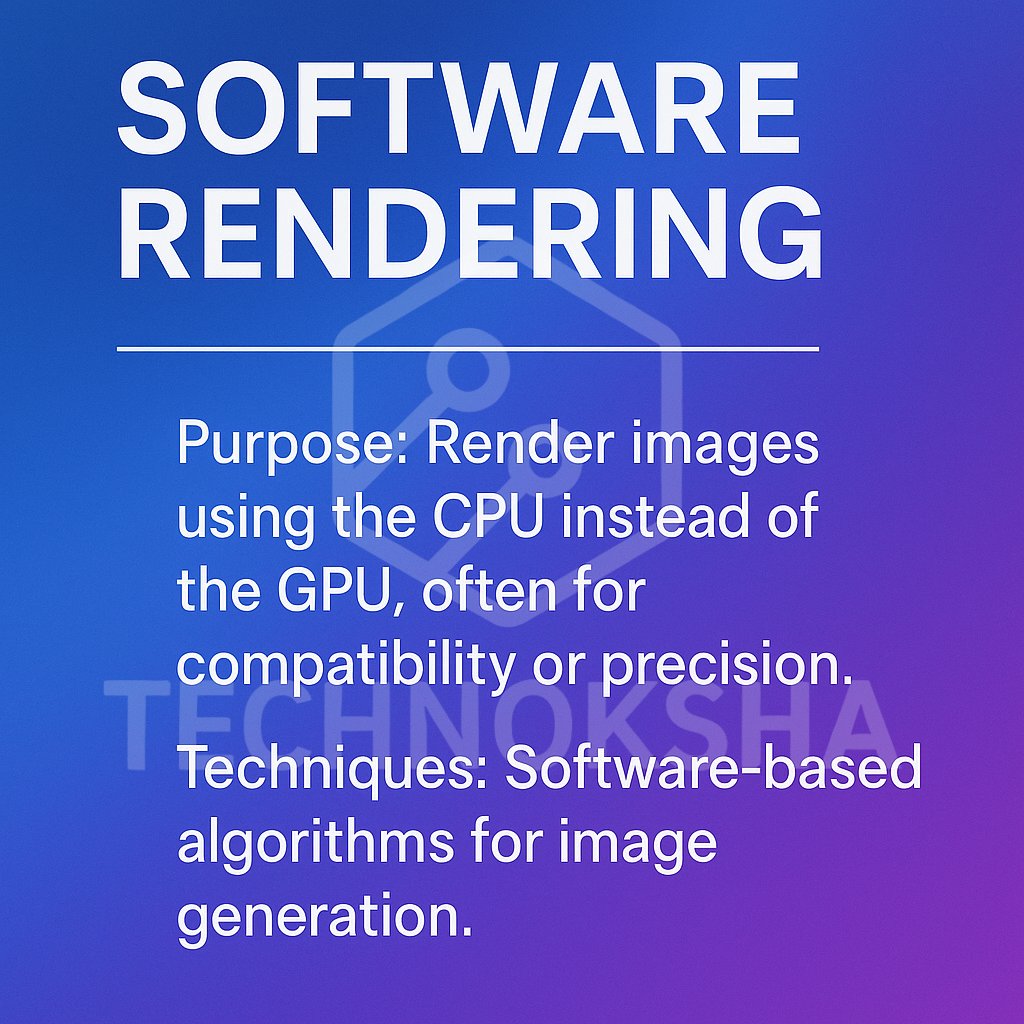
ALT A vibrant digital poster with a gradient background transitioning from deep blue to purple. The title “Software Rendering” is displayed in bold white text at the top. Below is an icon of a gear representing software tools. The poster lists two bullet points in white text: • “Purpose: Render images using the CPU instead of the GPU, often for compatibility or precision.” • “Techniques: Software-based algorithms for image generation.” The design is modern, minimal, and suitable for Facebook or social media sharing. By Technoksha

ALT A vibrant 2D digital poster with a blue-to-purple gradient background titled “Software Rendering Examples.” It showcases three software logos with descriptions: POV-Ray logo with the text: “A ray-tracing program that uses a scene-description language.” Blender (Workbench) logo with the text: “A real-time engine for modeling and animation preview.” Autodesk Maya (Software Renderer) logo with the text: “Maya’s built-in renderer for CPU-based rendering.” White bold typography and soft glowing lines enhance the modern, tech-style aesthetic. by Technoksha