
23 Sep 2025
Mars in Scorpio I: From Devil to Light
Sep 22–Oct 7, 2025
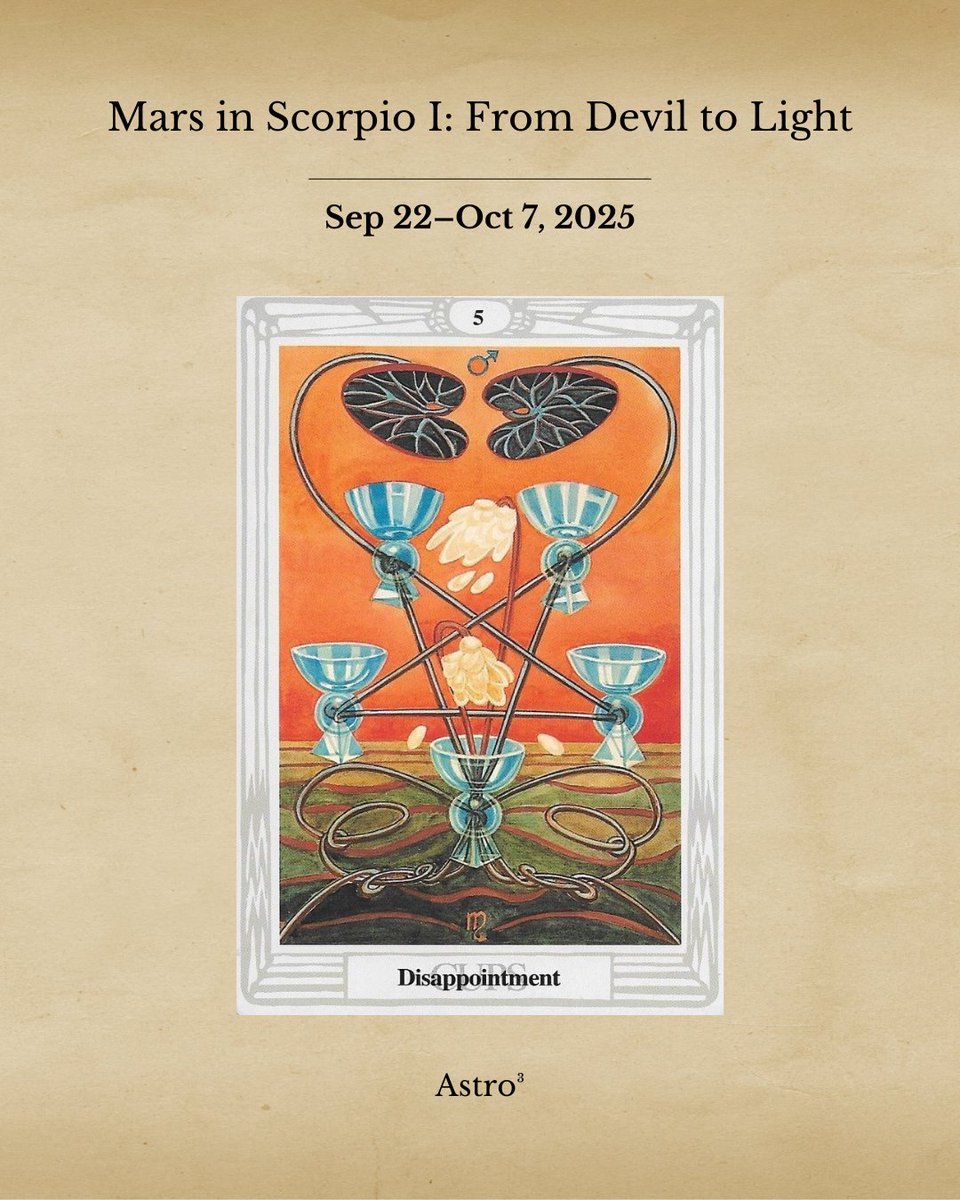
Mars has now entered the first decan of Scorpio, a place tied to the Five of Cups in tarot. In the Thoth deck, Aleister Crowley called this card Disappointment. I tend to call it Desire. The difference might sound small, but it’s everything: when we get too adjusted or attached to our desires, disappointment is almost guaranteed. If we cling too hard—whether to what we want, or to unmet needs—we set ourselves up for misery.
This decan isn’t evil, but it does challenge us. Crowley asked Frieda Harris to paint the five cups in the shape of a reversed pentagram on this card, an image often linked with the Devil. And in many ways, that symbolism makes sense. The number five itself carries chaos—energy that makes it harder to see things as they truly are. With fives, the door opens more easily to confusion, projection, and temptation.
So, the questions this decan brings are simple but piercing:
What do I really want?
What do I actually need?
And why do I think I need it?
That piece of chocolate, the booty call, the shopping spree, the doom scroll—what are we compensating for? Are we feeding the body, the emotions, or simply the craving? These two weeks ask us to get honest about desire itself, and to recognize the ways in which desire can quietly entangle us in disappointment.
Mars, as always, has another twist: it acts like a time machine. If our present life feels steadier than in the past, this is a chance to “clean house.” We can’t physically step into a capsule to visit our past selves or wave to our future ones, but we can shift how we relate to those timelines. Neuroscience confirms what mystics have long known: memory is subjective, and every time we recall an event, we subtly rewrite it. The present self changes the past self’s story. In that sense, Mars in this decan invites us to edit—not the facts of the past, but their emotional weight. We can diminish pain, or elevate meaning, whichever is most supportive to who we are now.
During this transit, Mars also weaves into some powerful aspects: Saturn and Neptune form a biquintile to Mars, while Uranus holds a triseptile. Quintiles carry Mars’ volatile energy; septiles, associated with Venus and Saturn, connect us to the feminine side of Saturn, the primordial sea. These are not easy currents—they echo the Tower, the Devil, and the Aeon (Judgement) cards of tarot. Heavy, chaotic, transformative.
But the reminder is simple: we can endure this. The chaos will pass. And more importantly, darkness never stands on its own. If we feel lost in shadow, it only means it’s time to use our light more fully.
#astrology #tarot #mars #marsinscorpio #scorpio3 #thothdeck #crowley #devil #devilcard #towercard #judgementcard #memory #saturn #neptune #uranus #biquintile #triseptile #venus #desire #disappointment #need #misery #light #theway #spirituality #friedaharris #reversedpentagram #fiveofcups #5ofcups
8
1,121
17 Sep 2025
Jupiter in Cancer III: Demiurge's Illusion
Sep 13, 2025–Jan 11, 2026
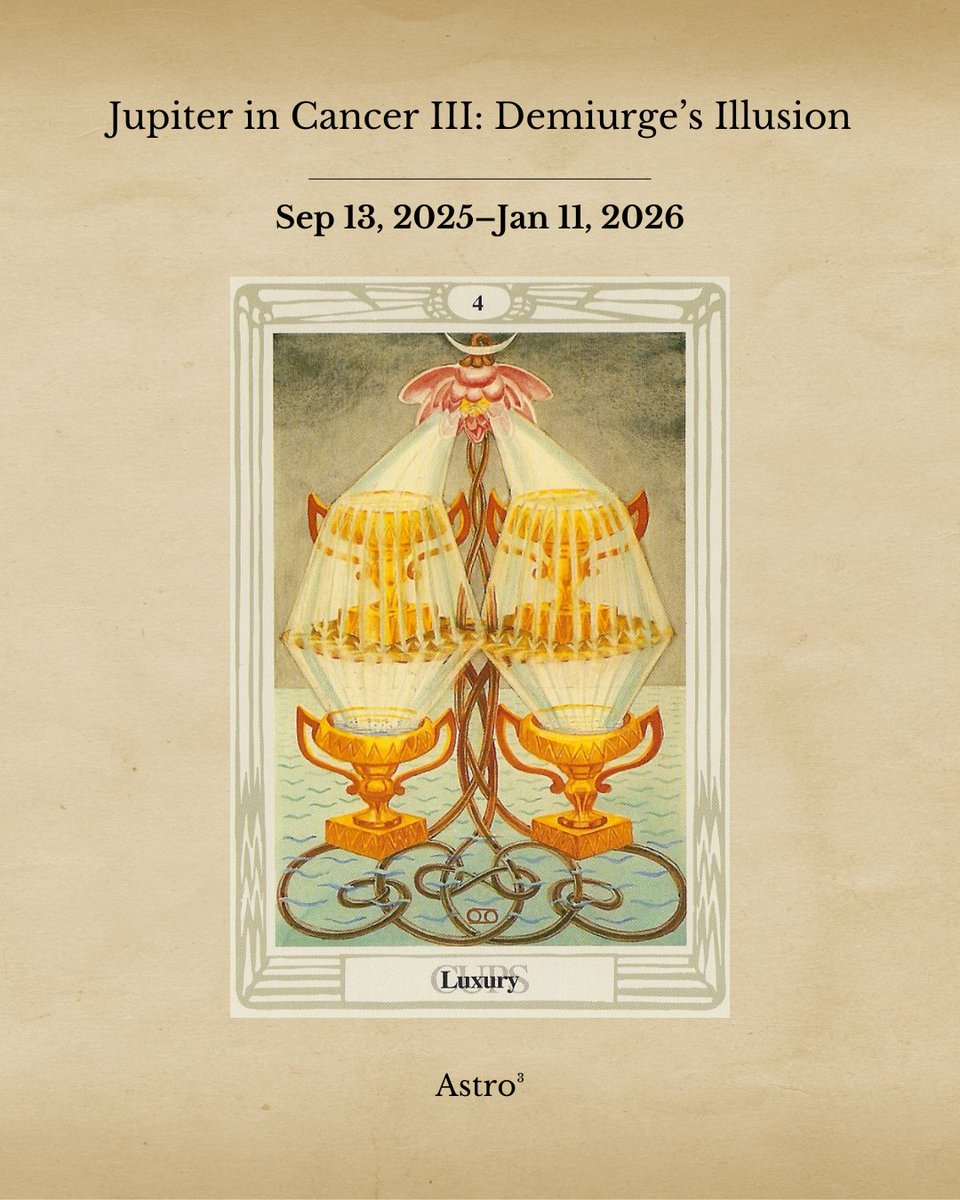
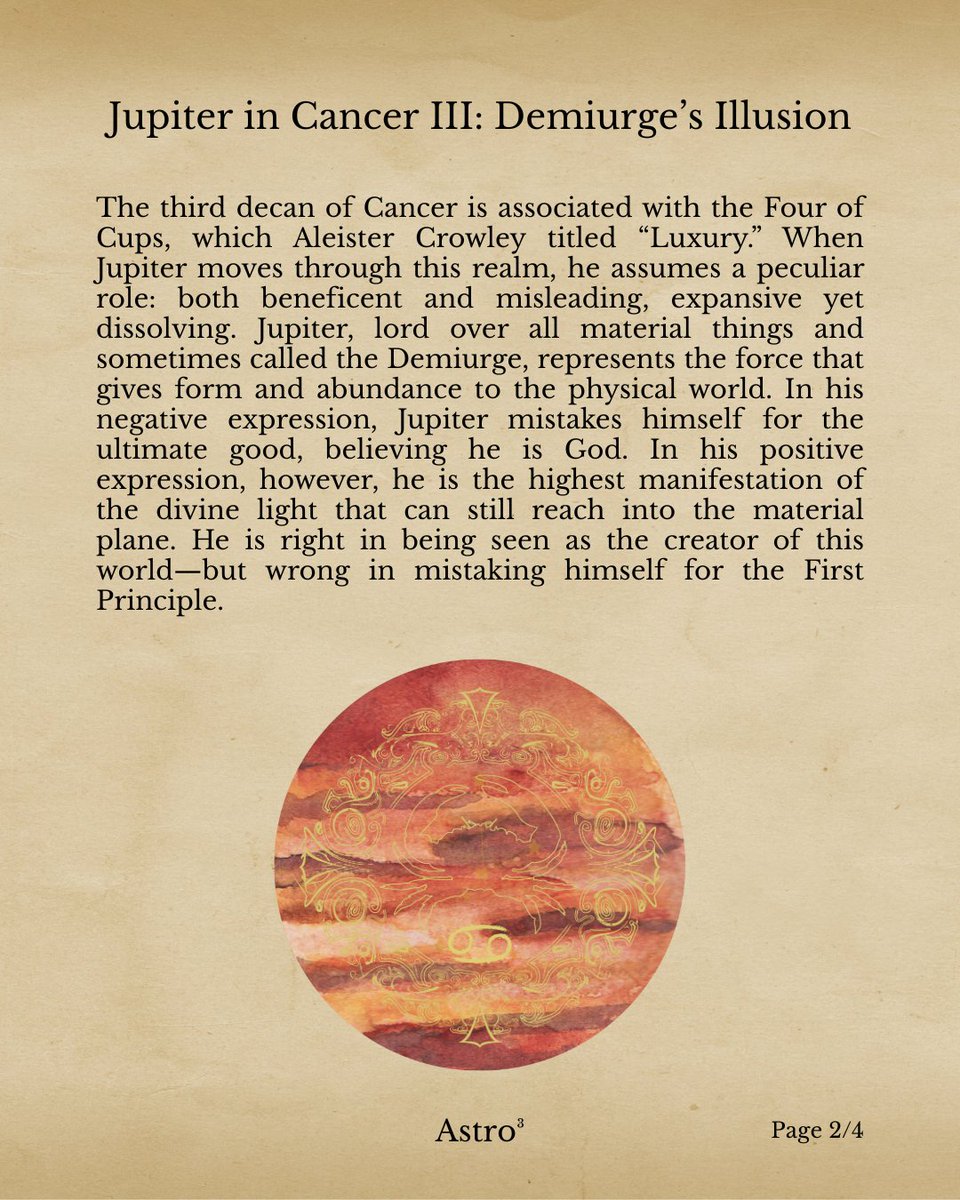
The third decan of Cancer is associated with the Four of Cups, which Aleister Crowley titled “Luxury.” When Jupiter moves through this realm, he assumes a peculiar role: both beneficent and misleading, expansive yet dissolving. Jupiter, lord over all material things and sometimes called the Demiurge, represents the force that gives form and abundance to the physical world. In his negative expression, Jupiter mistakes himself for the ultimate good, believing he is God. In his positive expression, however, he is the highest manifestation of the divine light that can still reach into the material plane. He is right in being seen as the creator of this world—but wrong in mistaking himself for the First Principle.
That First Principle is the light itself: not a he, not a she, not even really an “it,” but a pure principle beyond form. In the Four of Cups, this light is poured into the emotional realm, giving emotion its first shape. From our lower, human perspective, this process can feel like a loss of clarity: emotions, thoughts, and bodily sensations appear blurred and interwoven. Yet this blending is not confusion for its own sake—it is a purposeful dissolution.
Under the Four of Cups, luxury is not about grasping for material security or fleeting happiness. In fact, when pursued for their own sake, such things only lead to disappointment. Instead, the luxury here lies in the dissolution of boundaries within ourselves—the cross-pollination of thought, feeling, and sensation. It is through this mingling that we come closer to the true light.
It is important to remember that this is a Cancerian card: Jupiter is in Cancer, the sign ruled by the Moon. Yet the Four of Cups comes from a place that exists before the subconscious (the Moon’s domain) is fully formed. It exists only in theory, in potential, traced back through the Nine of Wands. This reveals something profound: we are not here merely to survive or “get by.” We are here to thrive, to embody life in its truest and most powerful form.
This does not demand constant ecstasy or perfection. Luxury is not limited to wealth, food, sex, or other worldly pleasures. True luxury is the spiritual richness that manifests through and within physical life. We do not need to reject the material, but to see it as a reflection of our spiritual connection to the First Principle. When we recognize this, we no longer serve the Demiurge, but the true force behind all things: the eternal light, the power of trinity.
#astrology #jupiter #cancer #cancer3 #fourofcups #4ofcups #tarot #firstprinciple #demiurge #theway #god #spirituality #moon #subconscious #trinity #treeoflife #qabala #luxury #jupiterincancer #thrive #september2025 #october2025 #november2025 #december2025 #january2026 #thothdeck

1
6
342
13 Sep 2025
Sun in Virgo III: From Spirit to Body
Sep 12–22, 2025
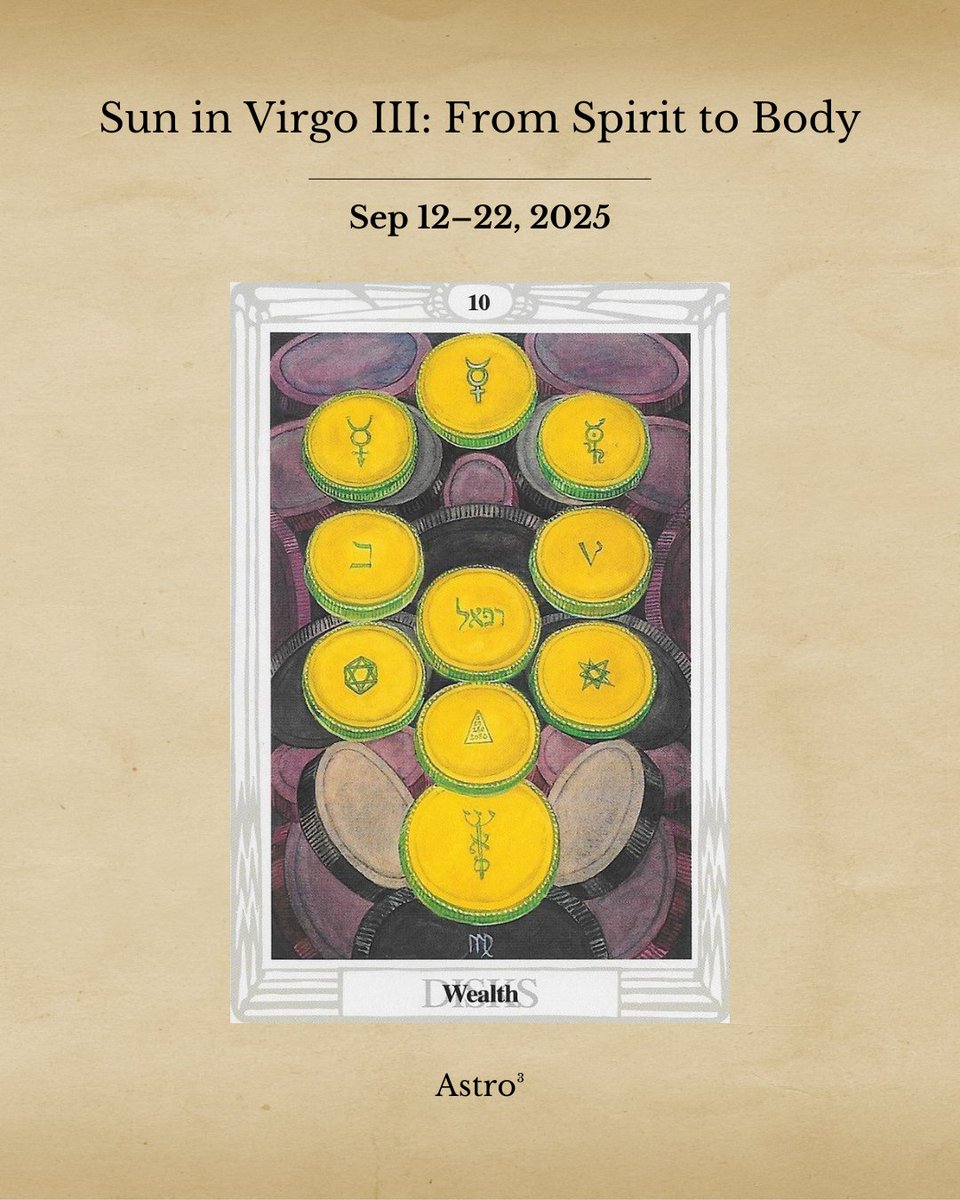
The Sun has now entered the last decan of Virgo, a section of the zodiac associated with the Ten of Pentacles. This decan reflects the Sun in Virgo shining a light on our most earthly and physical manifestations. On the Tree of Life, it is the densest, lowest point—the place where spirit becomes matter, where the higher forces condense into form.
When this energy expresses itself negatively, we risk becoming nothing more than walking bodies—animals existing simply to live, die, and seek pleasure in between. But when expressed positively, this is where we learn to walk the earth with awareness: conscious of our physical body while also in touch with our spiritual nature. Neither body nor spirit is superior; they are simply different aspects of one being.
When we recognize our dual nature, we stand just one step away from realizing the divine trinity within. The two major aspects of ourselves—the lower and higher—begin to form a relationship, and from their union emerges the third principle, the magic number three. This triadic harmony between body, soul, and spirit is the key to a purposeful, peaceful life filled with love, balance, and challenge. The spiritual path is never the easy path, but its rewards are immense.
These few days are also a preparation for the coming solar eclipse, which promises to sweep us off our feet. Eclipses bring change regardless of whether we feel ready or not. They are like the Tower card in the Tarot—pure Mars energy. Their role is to disrupt stagnation, to force transformation. Though we may feel small and powerless under these immense cosmic forces, the truth is that eclipses clear away what no longer serves us. They only become painful when we resist, clinging to what is asking to be released. The suffering comes not from the universe attacking us, but from our attachment to outdated parts of ourselves that are ready to be transformed.
The trump card of Virgo season, the Hermit, sheds light on this process. In the Thoth deck, the Hermit holds a lantern with a Sun radiating sixteen rays. The number sixteen is deeply symbolic: it reduces to 4 x 4, representing foundational stability, yet it is also the number of the Tower card. The Hermit precedes the Tower on the Tree of Life, holding the light as it trickles down from Kether to Malkuth. Where the Tower is the bridge between Netzach (Venus) and Hod (Mercury)—our emotional and mental foundations—the Hermit prepares us to withstand that upheaval.
Through inner work, the Hermit achieves something profound: he can move from the stability of the 4s directly into the harmony of the 6s, bypassing the chaos of the 5s. This is not avoidance but true mastery. He has faced instability, breathed it in, and alchemized it into inner stability. In doing so, he embodies a process that transcends logic—a deep alchemical transformation of spirit and matter.
The Sun in the final decan of Virgo is therefore calling us to allow the forces at play to transform us into who we are meant to become. This is not only a spiritual transformation but one that touches the most physical, visible, and tangible aspects of our lives. In the days ahead, expect changes to manifest where your foundations meet the material world.
#astrology #suninvirgo #virgoIII #virgo3 #tenofpentacles #10ofpentacles #tarot #spirit #body #theway #shadowwork #thetower #thehermit #sixteen #spirituality #transformation #thothdeck #treeoflife #hod #netzach #mercury #venus #malkuth #kether #stability #instability #materialism #foundation
3
385
11 Sep 2025
Venus in the Third Decan of Leo
Volition & Desire
Sep 11, 2025
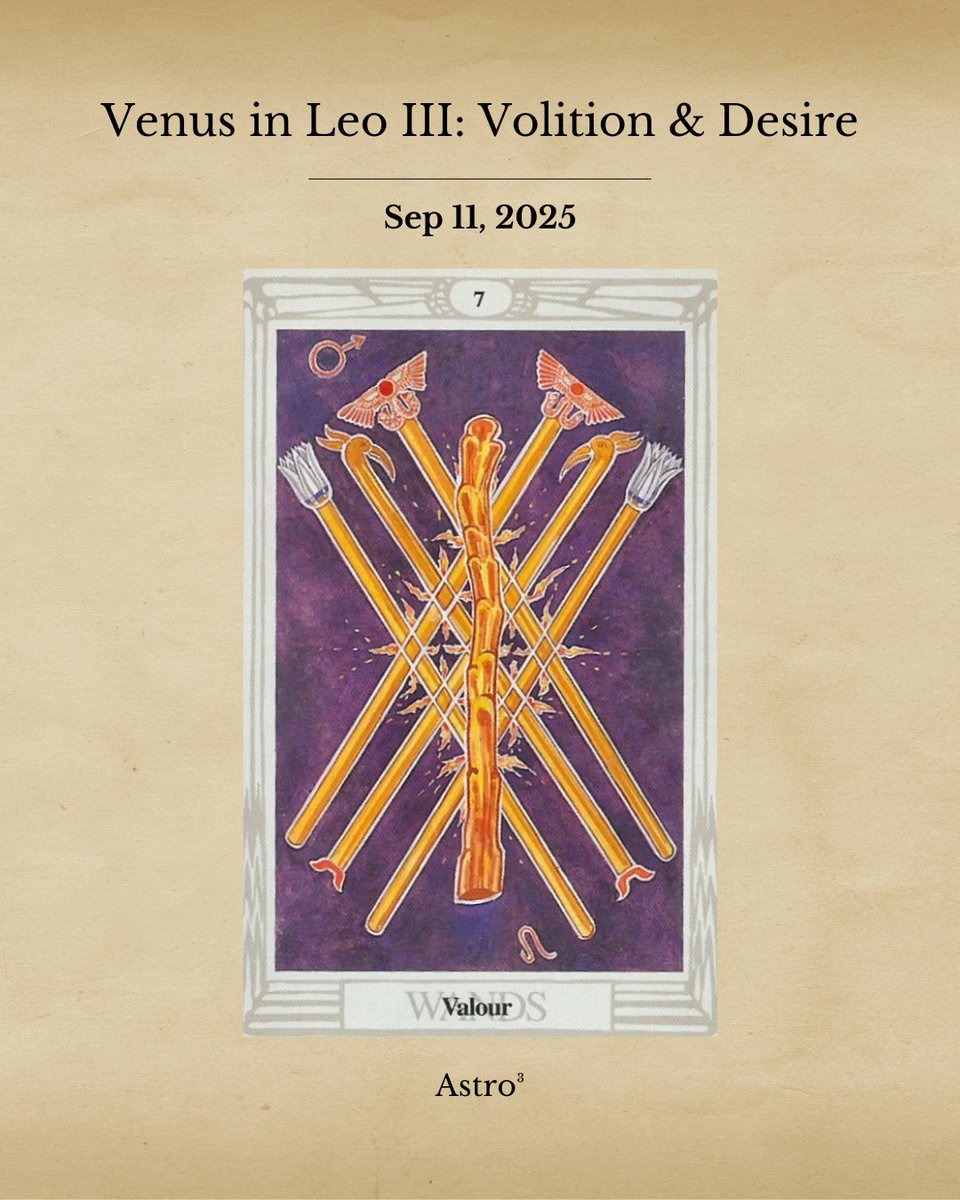
Venus has now entered the third decan of Leo, a placement connected with the Seven of Wands in tarot—Mars in Leo. Crowley named this card “Valor,” but I see it more as “Volition,” the focused willpower that pushes us to act with purpose. The number seven itself belongs to Netzach on the Tree of Life, the sphere of Venus. This adds a beautiful symmetry: any Seven in the tarot ultimately strengthens Venus.
This makes the current energy fortuitous. Venus here shines in creativity, refinement, and the pursuit of higher skills. Arts and crafts flourish under this influence, but so too do studies that require intelligence, good taste, and subtlety—like learning new languages. Effort put into developing artistry or sophistication during this transit tends to be rewarded more than usual.
Venus in this position also makes us more open, affectionate, and approachable. Yet, as with all strong energies, there’s a shadow side. Mars in Leo can become combative, bossy, or domineering. We may feel the urge to command others, or to battle anyone who dares to challenge us. For those caught in toxic relationships, this period may feel especially difficult. With eclipse energy surging—caught as we are between the lunar and the solar eclipse—this could be the moment to break free. If you feel trapped, take this as an opportunity to leave, and don’t look back.
For everyone else, this is a moment to strengthen emotional stability and resilience. The key is awareness—particularly of Venus’s shadow: unchecked desire, lust, and hedonism. Venus in the third decan of Leo spotlights our will and asks: what do we truly desire?
Do we want only the daily distractions—the piece of cake, the glass of wine, the endless scroll, the fleeting pleasures that soothe in the moment but weigh us down over time? Or can we summon the discipline to reach for something higher? What kind of creativity do we want to cultivate? What kind of love, intimacy, and relationships do we want to embody?
Generations of humans have discovered that the most fulfilling lives are built on love, purpose, and freedom. And yet, many fail to live by these truths. Perhaps the missing key is awareness—paired with the courage to live one’s spiritual truth. This Venus transit reminds us that the choice is always ours: to remain bound to lower desires, or to step forward into a more meaningful life.
#astrology #tarot #thothdeck #crowley #volition #valour #valor #venusinleo #leoIII #treeoflife #qabala #seven #netzach #marsinleo #sevenofwands #7ofwands #desire #lust #intimacy #relationships #creativity #discipline #shadowwork #skills #art #toxicrelationship
3
453
10 Sep 2025
Exalted Mercury: Exalted Minds
Sep 10, 2025
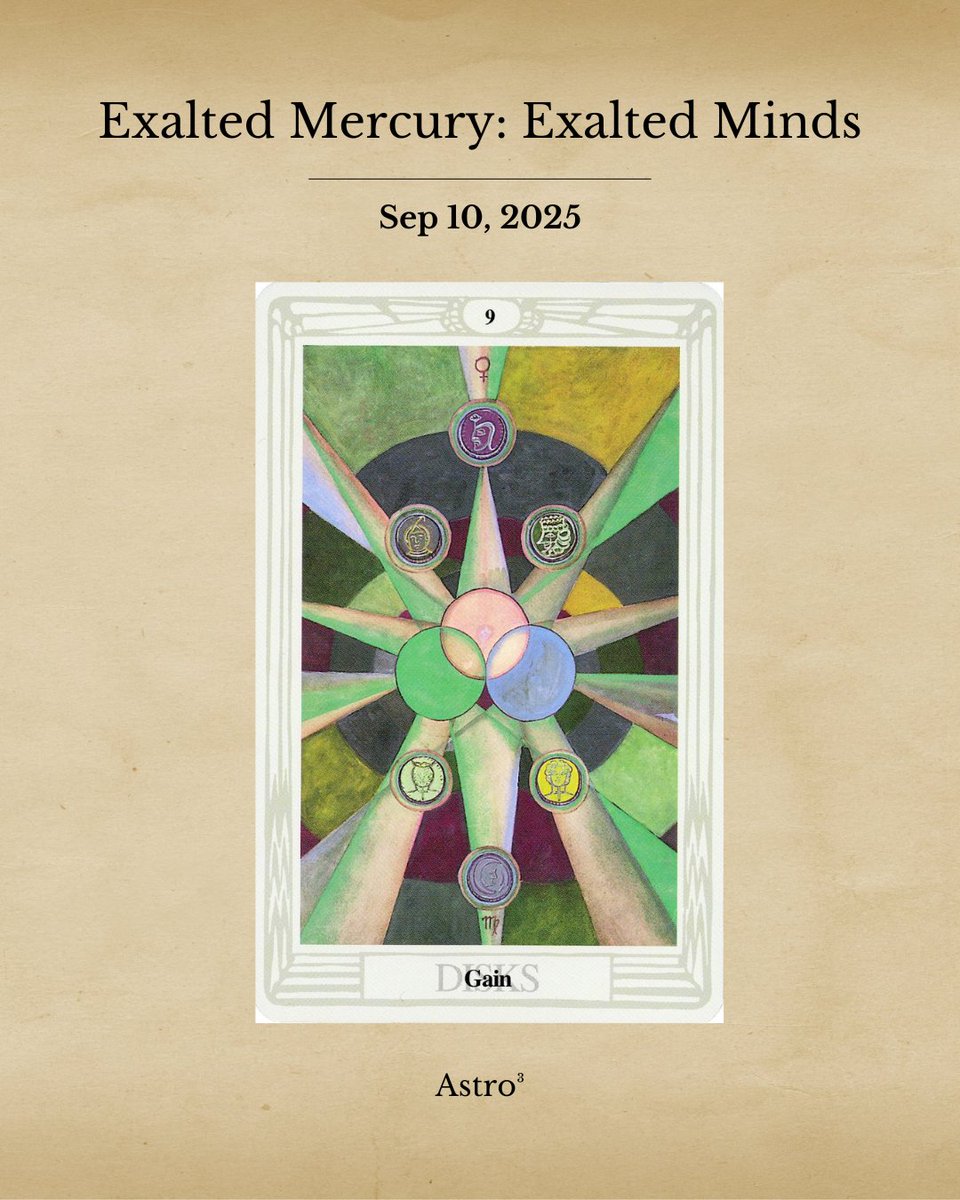
Today, Mercury stands at 15° Virgo—its exact degree of exaltation. Mercury embodies our lower mind: rational thought, intellect, logic, and communication. With Mercury so powerfully placed, these qualities are emphasized and sharpened. But what makes this moment especially significant is that Mercury’s lower mind is not working alone—it is uplifted and balanced by the presence of a strong divine mind.
A strong lower mind without higher guidance can easily become restless, overly critical, or even destructive. But since Uranus began his retrograde just one day before the recent lunar eclipse, his energy has been unusually potent, lingering in an “extended stationary period.” While such a phenomenon cannot exist technically, energetically it does—providing us with an expanded window of Uranian strength.
Adding to this, Saturn is currently in the anaretic degree of Pisces, the final degree of the entire zodiac. This position invites us to complete the cycle of learning—the hero’s journey from the Fool card to the Universe card and back again—finalizing our understanding of ourselves, our world, and the path we have traveled so far. Together, Uranus and Saturn form the divine mind through the spheres of Chokmah and Binah—the highest form of mind available to us in this world, surpassed only by Kether, pure consciousness itself. The planets associated with Kether, Neptune and Pluto, are moving in a fairly stable sextile that will reach its peak in July 2026. This long-term alignment supports the elevation of our mental processes, ensuring that Mercury’s activity today does not spiral into fragmentation but rises into constructive clarity.
Let’s take a closer look at the aspects Mercury receives in its exaltation degree. Most notably, Mercury forms a biseptile with Uranus. Septiles carry the imprint of Saturn and always suggest a mental or spiritual undertone. Here, Mercury is directly influenced by the Uranus–Saturn current of divine mind, almost as though it is being guided hand-in-hand toward higher frequencies of thought.
Additionally, Mercury is in biquintile with the Moon. Although the Moon is not usually thought of as mental, it undeniably is—it governs the subconscious, the realm where memory slips and impressions are absorbed, just as the Moon moves the waters of the Earth. A biquintile between Mercury and the Moon weaves their energies together in a more refined, creative way. The quintile family of aspects is infused with the essence of Jupiter, the most harmonious part of the higher mind. In this case, the biquintile allows Mercury’s clarity and the Moon’s subconscious pull to resonate on a higher octave, creating fertile ground for insights and subtle inspiration to emerge.
In this moment, the exalted Mercury is not merely sharpening the lower mind but is being lifted into cooperation with both the higher and divine minds. It is a day to notice the quality of your thoughts, to listen for flashes of intuition, and to trust the subtle alignments between reason, imagination, and wisdom.
#astrology #tarot #exalation #exaltedmercury #thothdeck #crowley #mercury #mind #lowermind #highermind #divinemind #chokmah #binah #moon #jupiter #saturn #kether #neptune #pluto #septile #sextile #quintile #uranus #consciousness #treeoflife #uranusretrograde #thefool #theuniverse
3
165
8 Sep 2025
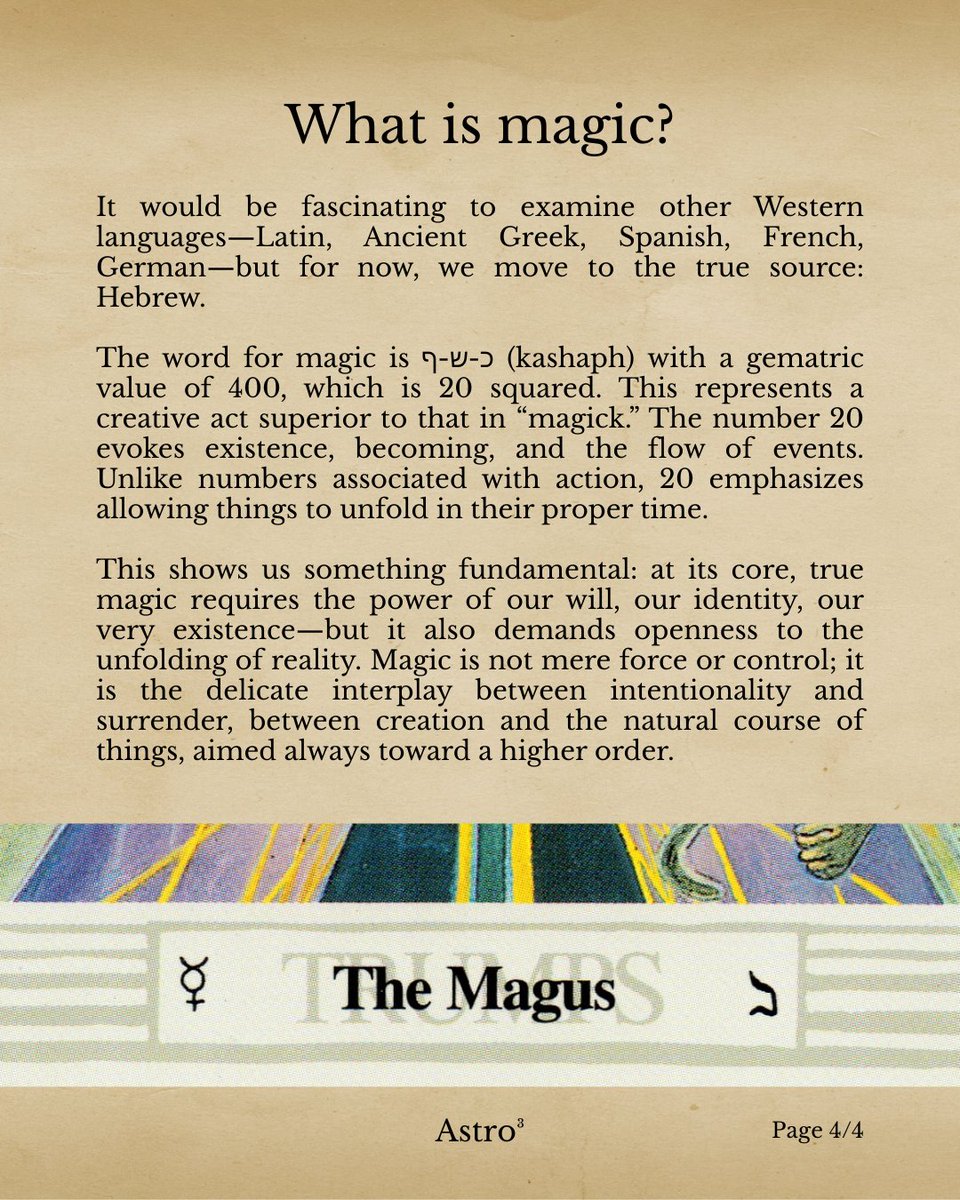
What Is Magic?
A Gematric Approach
True magic is very difficult to describe. Not the illusions, tricks, or superficial charms, but the magic that comes from the True Light—the one God that rules over all other gods. In its purest sense, magic is beyond our comprehension. Our minds are not constructed to fully grasp it, and so any attempt to define it falls short.
Yet, there is also a more practical side to magic—the day-to-day rituals, the tangible acts that humans can perform. When we focus on this aspect, we can even calculate the gematric value of the word “magic.” Gematria is used because the first language is math—or numerology—and the second is Hebrew, at least in the Western world, which currently dominates the global stage.
Before diving into Hebrew, let’s analyze the English word “magic,” since it is the United States that currently exerts the greatest cultural influence. Using the English Qabalah system, also called the ALW system, we find that the word “magic” has a gematric value of 69. Beyond modern associations—some intimate, some trivial—69 is not inherently magical. Breaking it down, we see 69 = 3 × 23. The number 3 is the most important number—fundamental to creation, existence, and all forms of true magic—while 23 carries less intrinsic weight. Only by stretching the analysis, for example taking 2 × 3 = 6, does another “magical” number emerge. Six is significant, but its power derives from 3. Therefore, 69 is interesting but not particularly impressive.
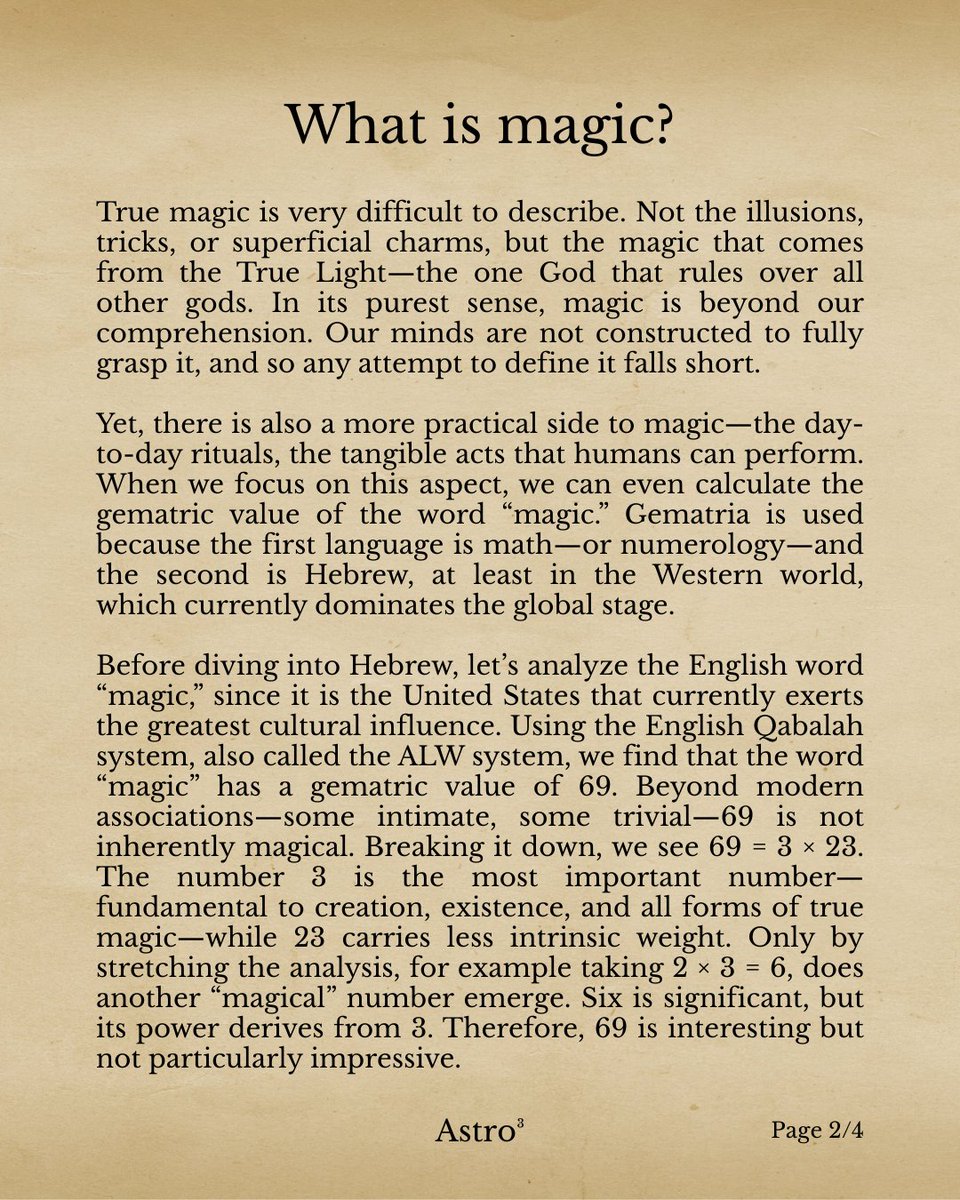
Now, consider the word “magick,” which has gained popularity over the last century. Its gematric value is 78—a stronger number than 69. Why? Seventy-eight is the sum of the first 12 numbers, and it is also the number of cards in a tarot deck. The sum of a sequential series of numbers represents creation—a creative act, and therefore potent. However, addition is a weaker creative act than multiplication, which is why this form of power is slightly diminished. Tarot itself derives much of its potency from this same principle of sequential summation. A cautionary note: the modern term “magick” was popularized by Aleister Crowley, a figure who valued power over truth and had little understanding of love. As a result, “magick” is not a pure word—though perhaps it may evolve to become so in the future.
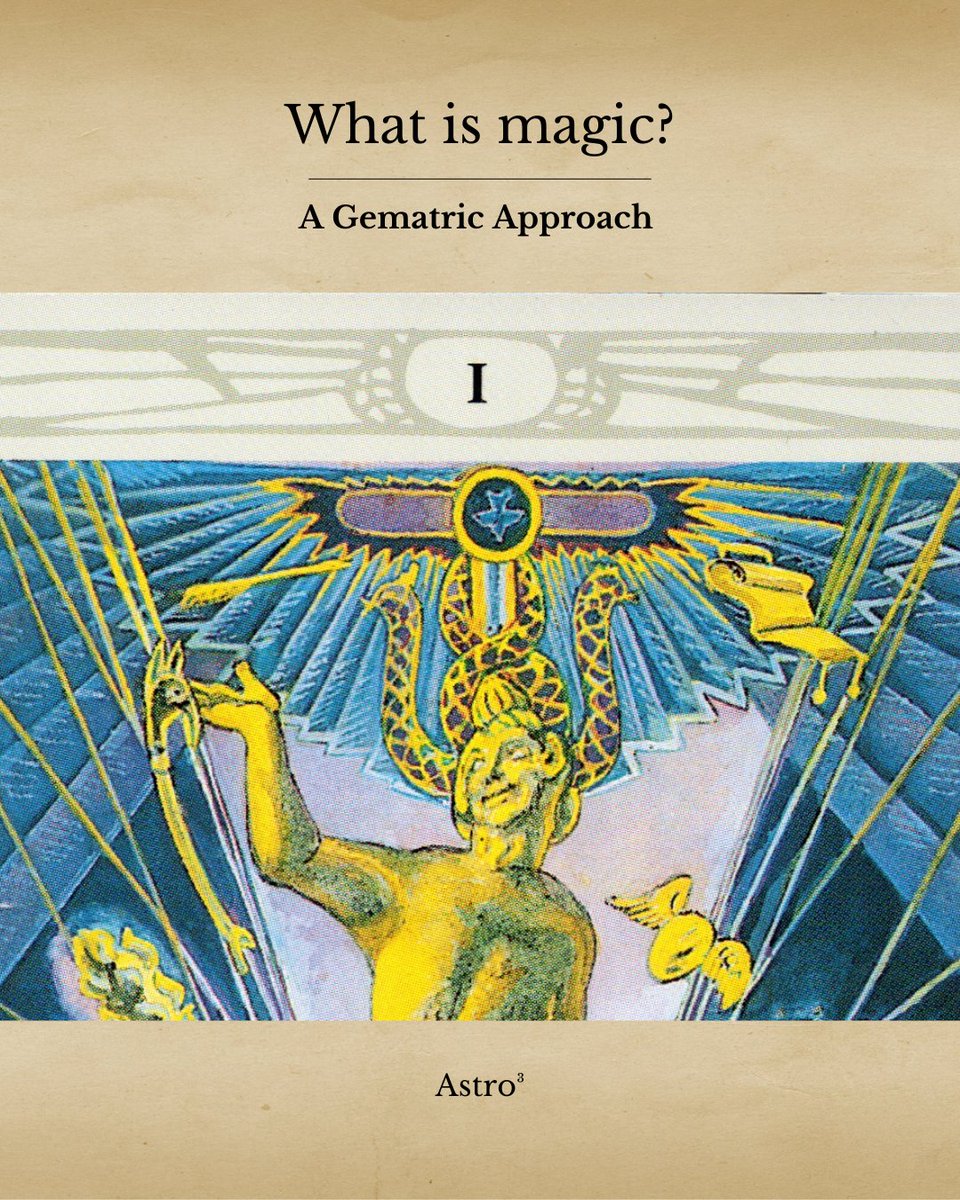
It would be fascinating to examine other Western languages—Latin, Ancient Greek, Spanish, French, German—but for now, we move to the true source: Hebrew. The Hebrew word for magic is כּשף (kashaph), with a gematric value of 400, which is 20 squared. This represents a creative act superior to that in “magick.” The number 20 evokes existence, becoming, and the flow of events. Unlike numbers associated with action, 20 emphasizes allowing things to unfold in their proper time.
This shows us something fundamental: at its core, true magic requires the power of our will, our identity, our very existence—but it also demands openness to the unfolding of reality. Magic is not mere force or control; it is the delicate interplay between intentionality and surrender, between creation and the natural course of things, aimed always toward a higher order.
#magic #tarot #whatismagic #whatismagick #gematria #crowley #thothdeck #69 #78 #400 #20 #23 #3 #6 #numerology #englishqabalah
1
6
232

14 Jan 2024
#FauxNews has finally resorted to asking for occult insight on the #TrumpCampaign. It did not go well. 🤣
@thetrueshelby #LULZY @makingfunofMAGA
#tarot #RiderWaite #MajorArcana
#ThanksForPlaying @RpsAgainstTrump @yarblestoyou #ThothDeck
tumblr.com/palephx/739456732…
1
1
1
137

3 Dec 2023
Minute Tarot - Understanding The Hierophant | #Shorts
We invite you to be a part of this enriching journey:
discord.gg/thelema
#HierophantCard #ThothTarot #TarotReading #TarotInsights #TarotCardMeaning #TarotTutorial #Divination #LearnTarot #ThothDeck #SpiritualInsights #TarotCommunity #TarotLessons #Witchcraft #TarotExplained #YouTubeShorts #TarotJourney #TarotSymbols #ThothFool #TarotWisdom #TarotGuide #thoth #crowley #thelema #thelemite #aleistercrowley
4
282

19 Apr 2023
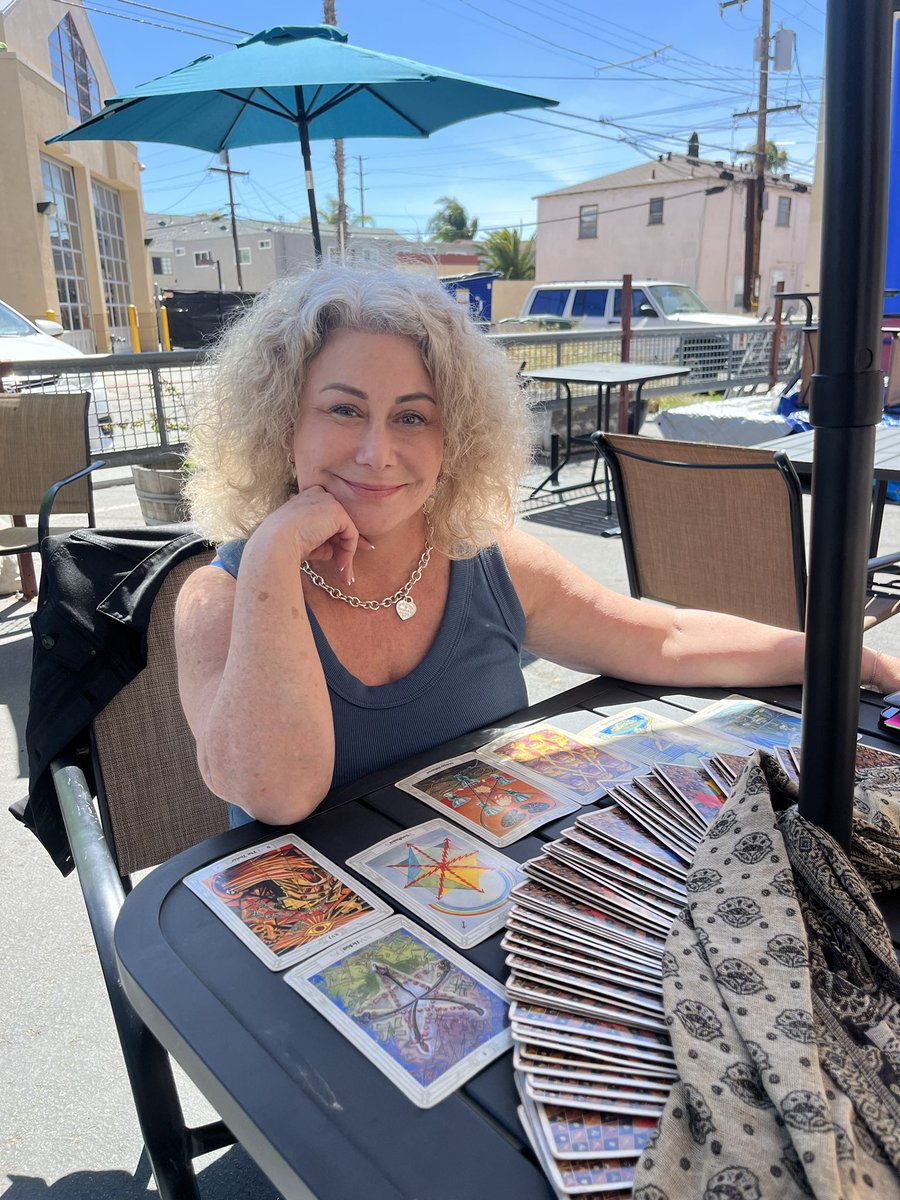
Here is a belated #TarotTuesday ! ✨🎴🎴🎴✨ Gave this #beauty a #TarotReading for her #Spiritual Journey! #bohemiantarot #bohemian #tarot #bohemianstyle #witchy #witchy #witchcraft #occult #oracle #bruja #pagan #priestess #mystic #magick #thelema #thoth #thothdeck #crowley
1
2
192

14 Oct 2022
I need a video of them doing pushing in drag so badly 😫
1
1

19 Sep 2022
there's this one from 2011 which looks like ass and uses GTA IV vehicles and grass textures, 2013 release version ended up looking way better than this

4
19 Sep 2022
Yes it is. It's a preview build from 2009 and it's primarily using GTA 4 assets. That's just how game development works. The assets aren't ready, but you have to build the game. So you use what you have.
2
4
19 Sep 2022
you literally can't make a judgment on GTA 6. so stupid to do that. look at RDR2 and how much worse the GTA 6 preview looks, and obviously its gonna end up looking better than RDR2. it's almost because it's a super early version. GTA 5 looked like this in 2009.

1
15

13 Sep 2022
Hi there. We want the Apple TV app working well for you with iOS 16, and we can help. Does this happen when connected to Wi-Fi? Try these steps and let us know how it goes in DM: s.apple.com/dE4c8u0A9w x.com/messages/compose?recip…



4 Jun 2022
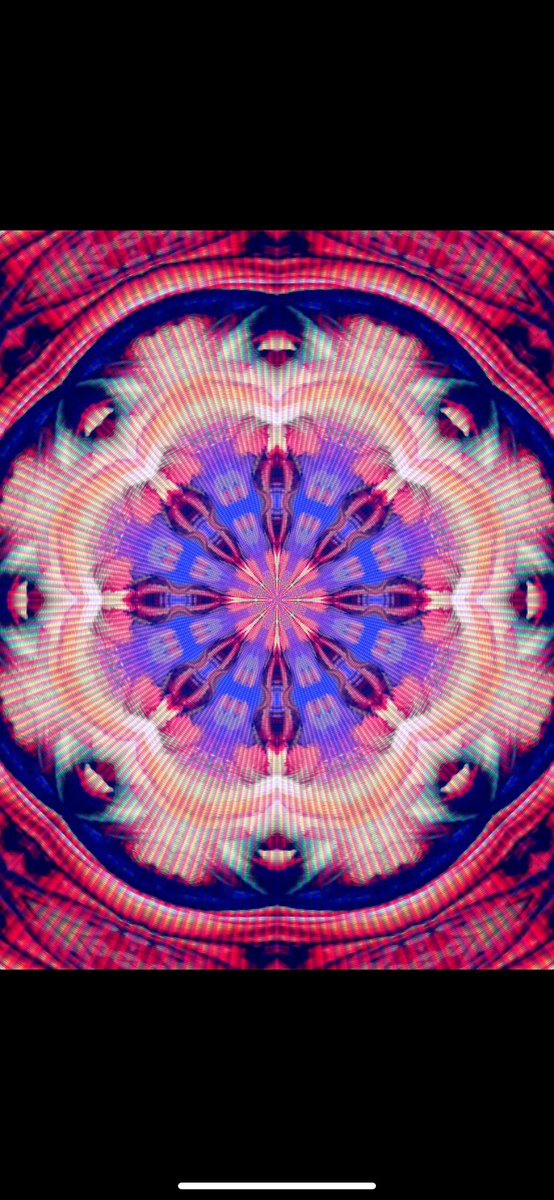
Leo 🔥 Serpentine #Mandala(s)
manipulated traditional art in #magick
#digitalart
colors attributes inspired by #thothdeck #art
1