
India’s cotton story now has its own signature!
Kasturi Cotton represents quality, traceability and sustainability, showcasing the strength of one of the world’s largest cotton ecosystems. Explore how this premium Indian cotton is creating value across industries at #BharatTex2026.
Be part of the conversations, collaborations, and business opportunities shaping the future of global textiles.
📍 Bharat Mandapam, New Delhi
📅 14–17 July 2026
Register now: bharat-tex.com
@TexMinIndia @girirajsinghbjp @PmargheritaBJP @aepcindia @TexprocilIndia @Matexil_Srtepc @csbmot @pdexcil @HEPC_India @IndiaExpoCentre @epchindia @wwepcindia1 @cepcindia @jpdepc2019 @ISEPC1
#TextileTechnology #SmartTextiles #futureofmanufacturing #globalbuyers

3

30m
𝗦𝘁𝗿𝗲𝗻𝗴𝘁𝗵𝗲𝗻𝗶𝗻𝗴 𝗧𝗿𝗮𝗰𝗲𝗮𝗯𝗶𝗹𝗶𝘁𝘆 & 𝗙𝗮𝗿𝗺 𝗥𝗲𝗴𝗶𝘀𝘁𝗿𝗮𝘁𝗶𝗼𝗻 𝗔𝘄𝗮𝗿𝗲𝗻𝗲𝘀𝘀
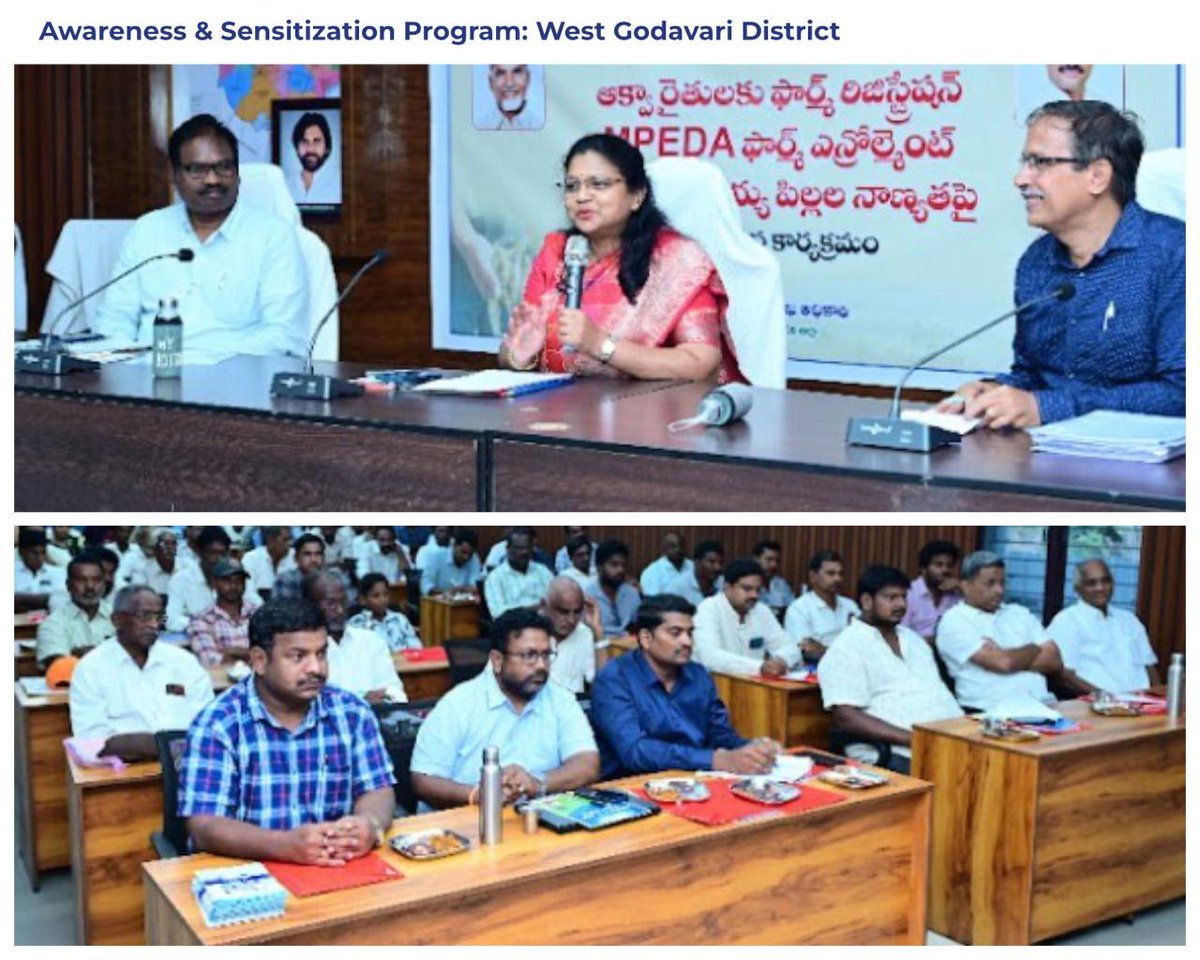
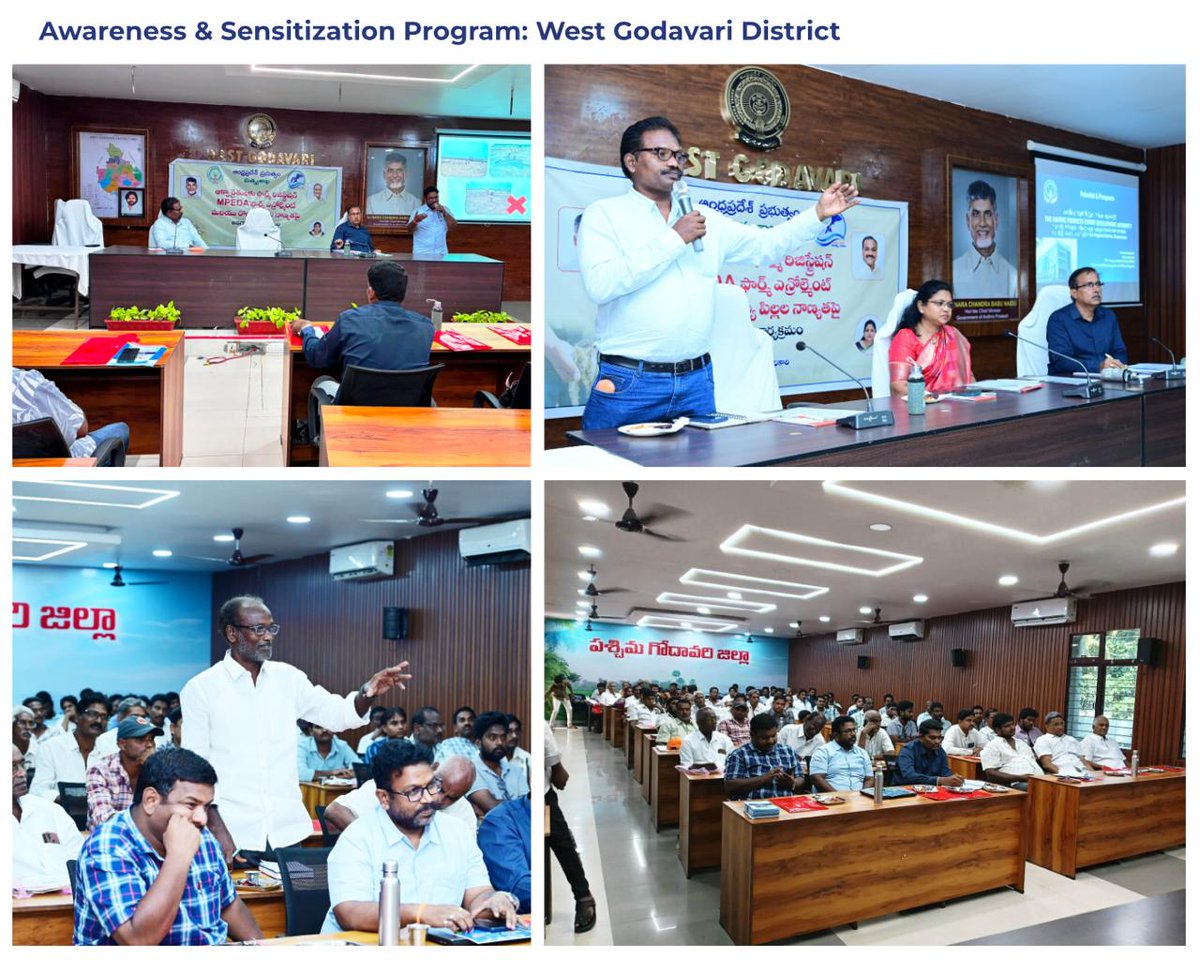
The Department of State Fisheries, Government of Andhra Pradesh, in association with MPEDA organized an Awareness and Sensitization Programme on Farm Registration, Farmer Enrolment, Traceability, and Sustainable Aquaculture on 10 June 2026 at the PGRS Conference Hall, District Collectorate, Bhimavaram, West Godavari District. The programme brought together 65 farmers, technicians, and aquaculture stakeholders to enhance awareness on farm registration, export requirements, traceability systems, and sustainable aquaculture practices.
Technical sessions were led by Dr Gopal Anand K., Deputy Director, MPEDA; Dr Srinivas, District Fisheries Officer; Shri S. Durga Rao S., Junior Technical Officer, MPEDA; Shri Chandrasekhar, Regional Coordinator, MPEDA-NaCSA; and Shri Khageswar Rao, Consultant, CAA. The programme encouraged greater adoption of traceability measures and regulatory compliance in export-oriented aquaculture.
#MPEDAtraining #aquaculture #export #seafood #indianseafood
@DoC_GoI
@FisheriesGoI
@Min_FAHD
@MOFPI_GOI
4

It's all just one big anti-patriotic grift. He's supported by big backers with infinitely deep pockets to promote the work of a hostile government, and he still wants the little people to pour their hard earned money into a murky and undefined fund with no traceability.


1
1
7
42

@brave
Why not:
[Search Result, Context, Link]
???
One link per block.
This makes traceability easier and makes the AI's summaries useable.
Basically, just make the AI BROWSE the net, instead of answering user inputs.
It's on a BROWSER for a reason.
Align its function.
2
やなぎ☆脱原発☆反戦☆ retweeted

Jun 8
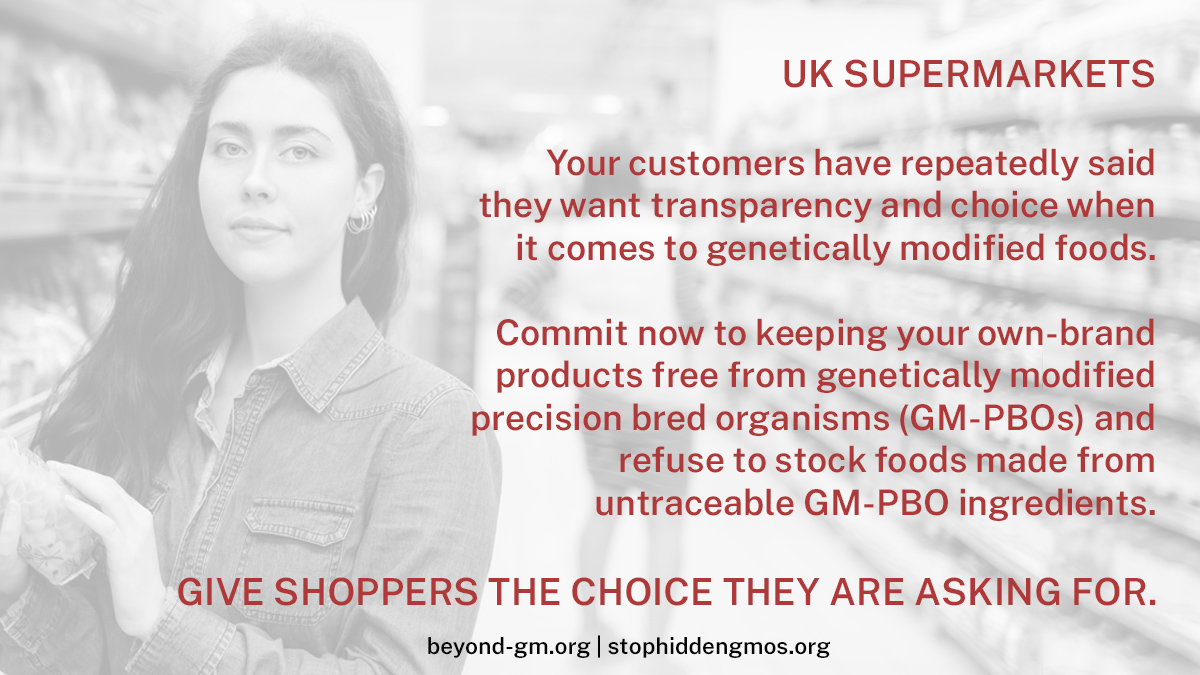
The High Court has ruled in favour of @Beyond_GM's case that regulations which fail to provide traceability and transparency for genetically modified precision bred organisms (GM-PBOs) are unlawful. We're calling on @marksandspencer @Morrisons @AldiUK @coopuk @waitrose @sainsburys @Tesco @IcelandFoods @LidlGB @BoothsCountry to show leadership and commit to:
✔ Keeping own-brand products GM-PBO free
✔ Requiring suppliers to verify ingredients are not derived from GM-PBOs
✔ Protecting consumer choice through transparent sourcing policies
Customers deserve the right to know how their food is produced.
Repost if you agree.
18
20
775
Mehmet Sarıkanat, Assoc. Prof. retweeted

Together with DPP, CBAM, carbon accounting, and supply chain traceability, they are shaping the next generation of sustainability management.
The future of ESG is digital.
🌐 circudata.co
#ESG #AI #Blockchain #DPP #CSRD #CBAM #Sustainability #Circudata
1
1
5

🤖🧾 When a Robot Begs with a QR Code: Progress or a Warning for Human Dignity?
At first glance, the scene may look entertaining. A robot sits on a city sidewalk, raises its hand, and places a QR code in front of people. Some will laugh. Some will click. Some will comment. Some will ask whether this interactive video is still interesting. But the real question is not whether the video is interesting. The real question is: Are we still interested in the human being behind the system? If today a robot collects attention, likes, donations, or digital tokens for a short video, tomorrow a similar system could collect tokens for food, medicine, housing, electricity, care, or access to basic digital services. Is this the future we are building? Will people one day buy five robots so they can “beg” on their behalf? One robot for long-term care. One robot for medicines. One robot for rent. One robot for electricity. One robot for access to personal data, public services, and digital procedures that should already be transparent, accessible, and understandable. This is no longer only a question of robotics. It is a question of ethics, social security, digital payments, platform responsibility, data ownership, and human dignity. A robot can help a person. It can carry objects. It can support elderly people. It can remind someone to take medicine. It can read documents. It can translate information. It can guide a person through a calendar, a public service, a payment process, or a care routine. It can help reduce loneliness, improve safety, and support daily work. But a robot must not become a digital replacement for social justice. It must not become a polished technological mask for poverty. It must not become a tool through which the system tells a person: “If you cannot afford basic life, let your machine ask for help.” That is not innovation. That is automated helplessness. The true purpose of an AI agent is not digital begging. The true purpose of an AI agent is to help people preserve clarity, rights, time, work, value, responsibility, and dignity. An AI agent should help organize documents, calendars, offers, payments, reminders, procedures, evidence, complaints, care plans, and archives. It should create traceability: who promised what, who received what, when a service was delivered, when it was paid, who is responsible, where the evidence is stored, and when a person received a clear answer. When we see a robot next to a QR code, we must also ask: Who collects the data? Who controls the payment flow? Who takes the commission? Who defines the value of the token? Who decides who becomes visible? Who disappears from the algorithm? Who is responsible if a person loses access to care because the platform did not show them? Technology is not automatically good or bad. Its value depends on whether it protects human dignity or quietly removes it. If robots and AI agents help people work, learn, care, understand, organize, and create value, then they make sense. If they are used so that machines beg on behalf of people for basic survival, then we have misunderstood the purpose of artificial intelligence. 🤖 Robots should help with work, not humiliation. 🧠 AI should support understanding, not blind dependency. 🧾 Digital systems should provide traceability, not excuses. 🤝 Society should protect dignity, not only efficiency. 📅 AI agents should lead to action, responsibility, and real solutions. So the real question for the future is not: How many robots can we buy? The real question is: Will we build a system where people do not need to send a robot to beg for basic life? #AIKloPotEc #Vilhem #AIAgent #ArtificialIntelligence #Robots #QRCode #DigitalTokens #HumanDignity #EthicalAI #PlatformResponsibility #DigitalResponsibility #LongTermCare #Traceability #FutureOfWork #SocialJustice #DigitalSociety
6
🤖🧾 When a Robot Begs with a QR Code: Progress or a Warning for Human Dignity?
At first glance, the scene may look entertaining. A robot sits on a city sidewalk, raises its hand, and places a QR code in front of people. Some will laugh. Some will click. Some will comment. Some will ask whether this interactive video is still interesting. But the real question is not whether the video is interesting. The real question is: Are we still interested in the human being behind the system? If today a robot collects attention, likes, donations, or digital tokens for a short video, tomorrow a similar system could collect tokens for food, medicine, housing, electricity, care, or access to basic digital services. Is this the future we are building? Will people one day buy five robots so they can “beg” on their behalf? One robot for long-term care. One robot for medicines. One robot for rent. One robot for electricity. One robot for access to personal data, public services, and digital procedures that should already be transparent, accessible, and understandable. This is no longer only a question of robotics. It is a question of ethics, social security, digital payments, platform responsibility, data ownership, and human dignity. A robot can help a person. It can carry objects. It can support elderly people. It can remind someone to take medicine. It can read documents. It can translate information. It can guide a person through a calendar, a public service, a payment process, or a care routine. It can help reduce loneliness, improve safety, and support daily work. But a robot must not become a digital replacement for social justice. It must not become a polished technological mask for poverty. It must not become a tool through which the system tells a person: “If you cannot afford basic life, let your machine ask for help.” That is not innovation. That is automated helplessness. The true purpose of an AI agent is not digital begging. The true purpose of an AI agent is to help people preserve clarity, rights, time, work, value, responsibility, and dignity. An AI agent should help organize documents, calendars, offers, payments, reminders, procedures, evidence, complaints, care plans, and archives. It should create traceability: who promised what, who received what, when a service was delivered, when it was paid, who is responsible, where the evidence is stored, and when a person received a clear answer. When we see a robot next to a QR code, we must also ask: Who collects the data? Who controls the payment flow? Who takes the commission? Who defines the value of the token? Who decides who becomes visible? Who disappears from the algorithm? Who is responsible if a person loses access to care because the platform did not show them? Technology is not automatically good or bad. Its value depends on whether it protects human dignity or quietly removes it. If robots and AI agents help people work, learn, care, understand, organize, and create value, then they make sense. If they are used so that machines beg on behalf of people for basic survival, then we have misunderstood the purpose of artificial intelligence. 🤖 Robots should help with work, not humiliation. 🧠 AI should support understanding, not blind dependency. 🧾 Digital systems should provide traceability, not excuses. 🤝 Society should protect dignity, not only efficiency. 📅 AI agents should lead to action, responsibility, and real solutions. So the real question for the future is not: How many robots can we buy? The real question is: Will we build a system where people do not need to send a robot to beg for basic life? #AIKloPotEc #Vilhem #AIAgent #ArtificialIntelligence #Robots #QRCode #DigitalTokens #HumanDignity #EthicalAI #PlatformResponsibility #DigitalResponsibility #LongTermCare #Traceability #FutureOfWork #SocialJustice #DigitalSociety
6


BSP’s move targets privacy coins like Monero, but forgets: traceability isn’t the issue—*compliance risk* is. Chainalysis data shows 92% of BSP-regulated VASPs already flagged transactions tied to sanctioned entities. We track this daily—breaking it down in...
162

This is damage control, all they will do is show us invoices of these appliances. No traceability whatsoever. But R500m is a lot shem, we need details of who benefited ka nnete
5

Looks like some consulting firms have been aggressively marketing themselves as AI advisers while simultaneously producing AI-assisted content without adequate human review.
Processing 100% of a dataset, making sure no or minimum bias is introduced and - most important - leverage a traceability capacity. All this doesn’t happen with a prompt and a gen-AI answer to the prompt. It happens with some innovative approaches that will always need a human to get a certain level of work and decision making done. And at the end of the day, it’s not the algorithm’s mistake, it’s the human’s.
Jun 12

Amazing: KPMG wrote a report describing the successful use of AI by businesses. But the case studies turned out to be AI hallucinations.
giftarticle.ft.com/giftartic…
1
19


🌎 Carbon markets are entering a new era — and the biggest shift is not about creating more credits, it’s about creating more trust.
The presence of @dimitratech at the Peru Carbon Forum 2026 shows a clear direction: moving from traditional carbon models into Carbon Market 2.0 — where every environmental claim must be backed by measurable, verifiable data.
For years, the carbon market has faced one major challenge:
How do you prove what is happening on the ground?
Forests, farms, and ecosystems create enormous value, but without accurate measurement, monitoring, and verification, that value remains invisible.
This is where Dimitra’s approach stands out.
By combining:
🛰️ Satellite intelligence
🤖 AI-powered analysis
📍 Geolocation & field data
🔗 Blockchain-based verification
Dimitra is building the infrastructure needed to transform environmental impact into transparent, auditable digital assets.
The Tambo Amazon Carbon Project in Peru is a strong example.
With 45,000 hectares of community land, the project shows how technology can work together with indigenous communities — respecting local governance while creating reliable climate data.
The future of carbon is not just about offsets.
It is about proof.
Proof that land is protected.
Proof that data is accurate.
Proof that communities are included.
And this is where the $DMTR ecosystem becomes interesting.
As more carbon, agriculture, and traceability workflows move into digital infrastructure, real-world activity creates demand for the protocols supporting these systems.
Dimitra is not building another app.
It is building the rails connecting farmers, communities, enterprises, and global sustainability markets.
Carbon Market 2.0 will belong to the platforms that can turn trust into data — and data into measurable impact. 🌱
#DMTR #CarbonMarkets #RWA #AgTech #Blockchain #Sustainability
May 26

Tomorrow we kick off at the Peru Carbon Forum 2026 in Lima 🇵🇪
Dimitra is a proud sponsor of two days bringing together climate leaders, carbon project developers and teams, investors, and governments across LATAM.
📅 May 27-28 📍 ESAN Convention Center
Our CEO Jon Trask and Perú Sales Partner, Neptali Salvador will be on the ground.
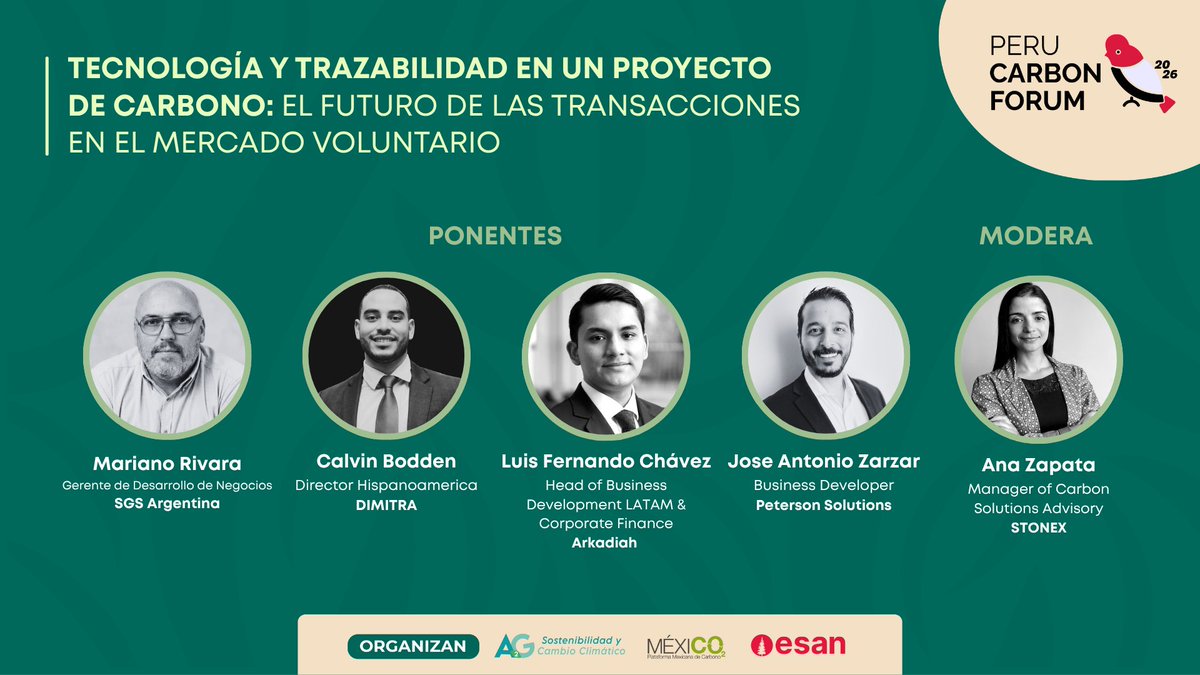
Don't miss our Director for Hispanic America, Calvin Bodden, on Panel MC7:
"Tecnología y Trazabilidad en un Proyecto de Carbono: El Futuro de las Transacciones en el Mercado Voluntario"
🗓 Thursday, May 28 | 11:30 AM
Come find the Dimitra team on-site to talk MRV, traceability, and how technology supports stronger carbon project workflows.
#PeruCarbonForum #CarbonMarkets #MRV #Traceability

2
8
58
Martha retweeted

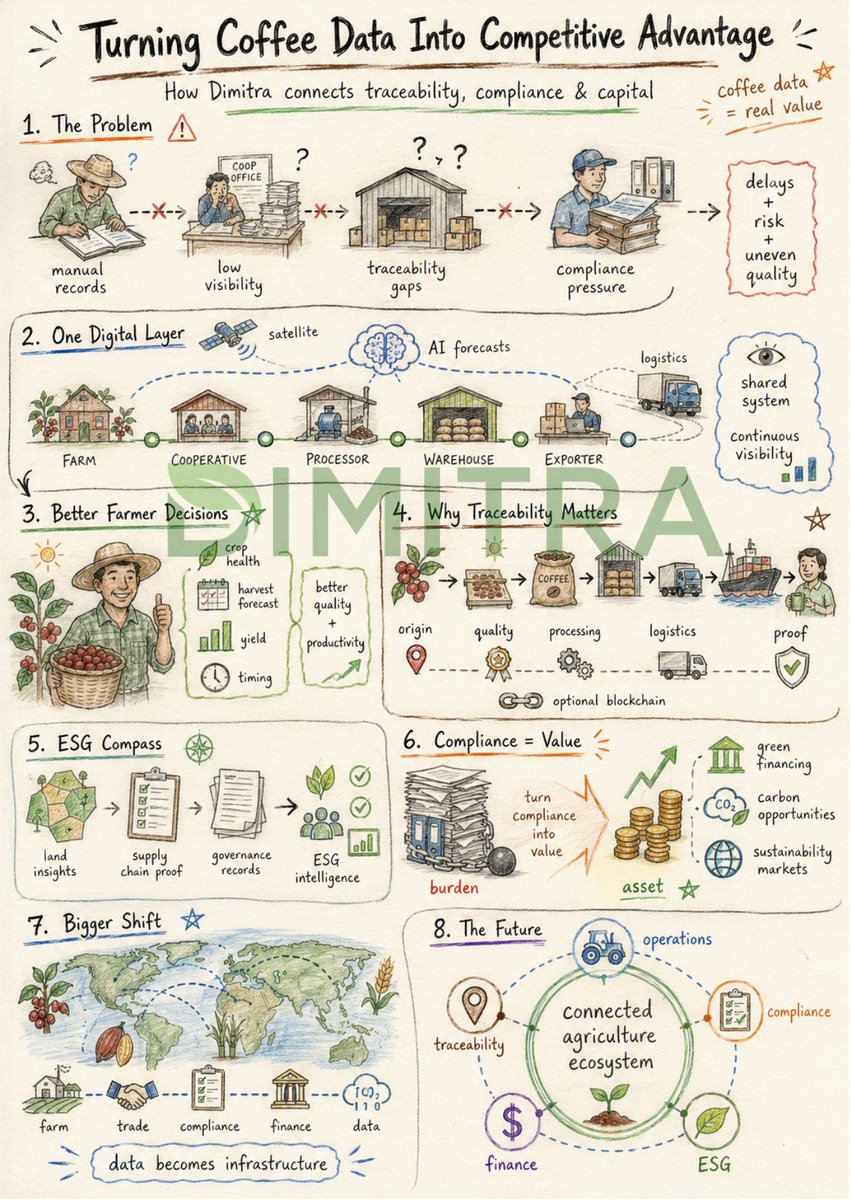
Coffee’s next edge won’t come only from better beans, but from better data.
@dimitratech is connecting traceability, ESG, compliance, and capital into one value layer.
See how this shift plays out in the infographic below 👇
4
7
89

"The BSP has banned VASPs from listing privacy-enhancing assets! Strict scrutiny and delisting are required for assets that don't meet criteria, following the global trend towards traceability. 👀 #CryptoPhilippines #CryptoNews"
53

AI has the potential to reshape agriculture but technology alone solves very little when millions of smallholder farmers remain disconnected from reliable data, financing and market access.
real challenge goes beyond AI models
It starts with knowing who the farmers are, where the farms are located, what crops are being grown and how activity can be verified across entire regions.
$DMTR helps small farms scale
Satellite monitoring, farm mapping, digital records and traceability create the foundation that allows advanced technologies to reach farmers at scale.
"AI can generate insights"
Verified agricultural data turns those insights into action
As governments, cooperatives and agribusinesses push for modernization, platforms capable of connecting smallholder farmers to the digital economy may capture a significant share of the opportunity.
DMTR continues to build in that direction.
1
1
4
91

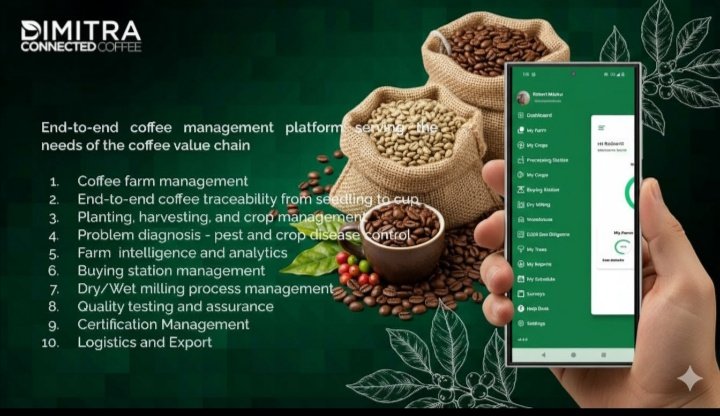
Connected Coffee is $DMTR @dimitratech‘s agricultural digitization platform which:
✅️digitize farmer & plot data
✅️geolocate every farm
✅️track harvest & quality information
✅️generate EU-compliant traceability
✅️provides auditable documents from farm to export
$BTC

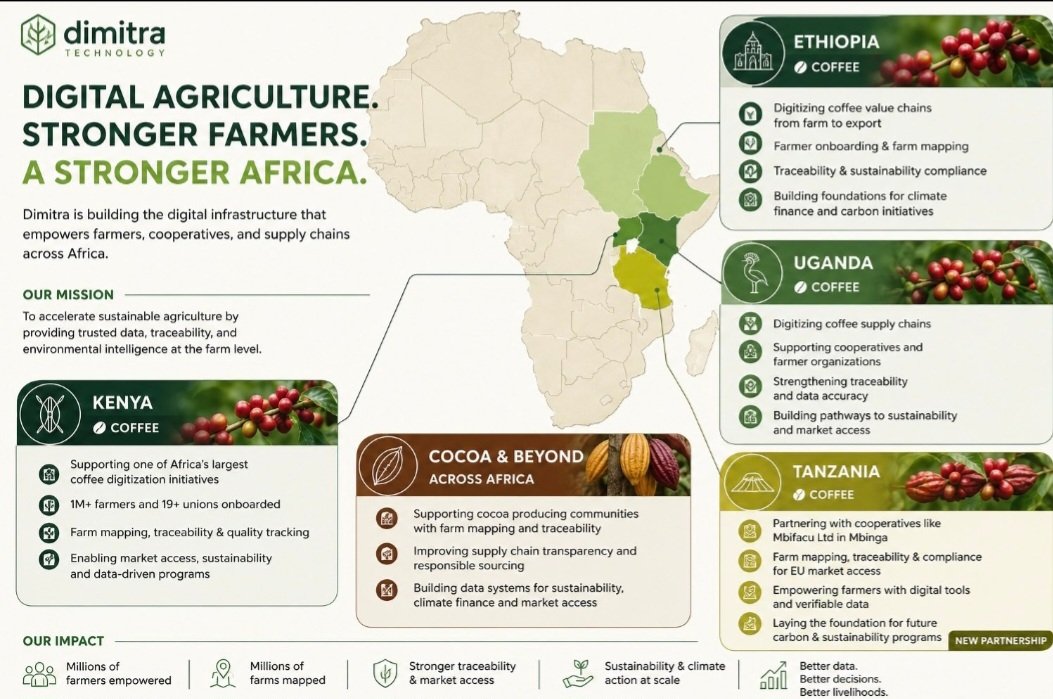
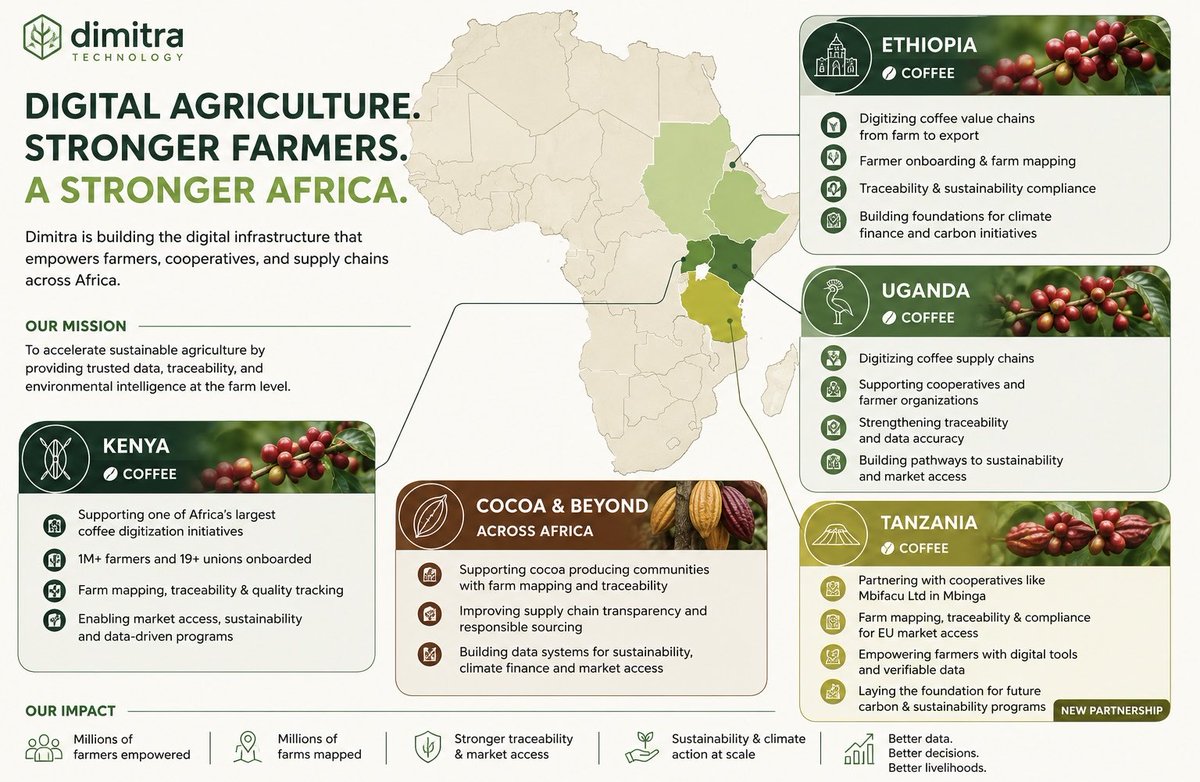
Africa’s Digital Agriculture Transformation Is Accelerating !!
Kenya 🇰🇪 , Uganda 🇺🇬 , Ethiopia 🇪🇹 , and now Tanzania 🇹🇿
This partnership is also part of a much larger story.
And most of this is indirectly powered by $DMTR || @dimitratech !!
Across Africa, agriculture is increasingly moving toward digital systems that help farmers access markets, financing opportunities, sustainability initiatives, and climate related programs.
Dimitra has been steadily expanding across the continent, working alongside cooperatives, farming organizations, and agricultural communities to help establish those foundations.
Dimitra’s work spans coffee, cocoa, environmental compliance, carbon initiatives, and farm level digital infrastructure that connects producers with global markets.
The company’s experience supporting large scale coffee digitization efforts in Kenya demonstrates what becomes possible when technology is deployed in a way that directly benefits farmers and cooperatives.
Now that experience is beginning to take root in Tanzania.
And for one of the world’s most underrecognized coffee origins, the timing couldn’t be more important.
1
18
114

Philippines central bank requires VASPs to strengthen token listing review standards and ban privacy coins. Tokens must be evaluated on issuer background, market maturity, usage, transparency, traceability, security, redemption, liquidity, and legal compliance.
6