
Typhoid fever (caused by Salmonella typhi) is classically characterized by a step-ladder pattern of fever.
1
1
194

investigates innate immune responses in sepsis caused by Streptoccus and Klebsiella pneumonia, Burkholderia pseudomallei or Salmonella typhi. role of the gut microbiota during severe bacterial infections as well as the pathogenesis/treatment COV19
pure.amsterdamumc.nl/en/pers…
1
9

12h
Temperature-pulse dissociation (Faget's sign / relative bradycardia) is when a high fever (e.g., 40°C) pairs with a surprisingly normal/slow pulse (e.g., only 90 bpm), instead of the expected tachycardia.
Normally, pulse rises ~8–10 bpm per 1°C above baseline (Liebermeister's rule). Here, the thermometer is fine it's a real clinical sign.
Common causes (mostly intracellular pathogens)Typhoid fever (Salmonella typhi) - classic example:-
Legionnaires' disease (Legionella)
Q fever (Coxiella burnetii)
Chlamydia / Mycoplasma pneumonias
Malaria, dengue, yellow fever
Others: tularemia, brucellosis, psittacosis, leptospirosis, etc.
Why it happens?
The exact mechanism isn't fully known. Leading ideas include:
Direct pathogen effects on the sinoatrial node
Immune system crosstalk with the autonomic nervous system (e.g., cytokines altering vagal tone or heart responsiveness)
Not just thermometer error or simple intracellular lifestyle (seen in some extracellular bugs too)
It's a useful bedside clue for narrowing differentials in fever of unknown origin, especially with travel/exposure history. Not pathognomonic, but worth noting!
1
3
105

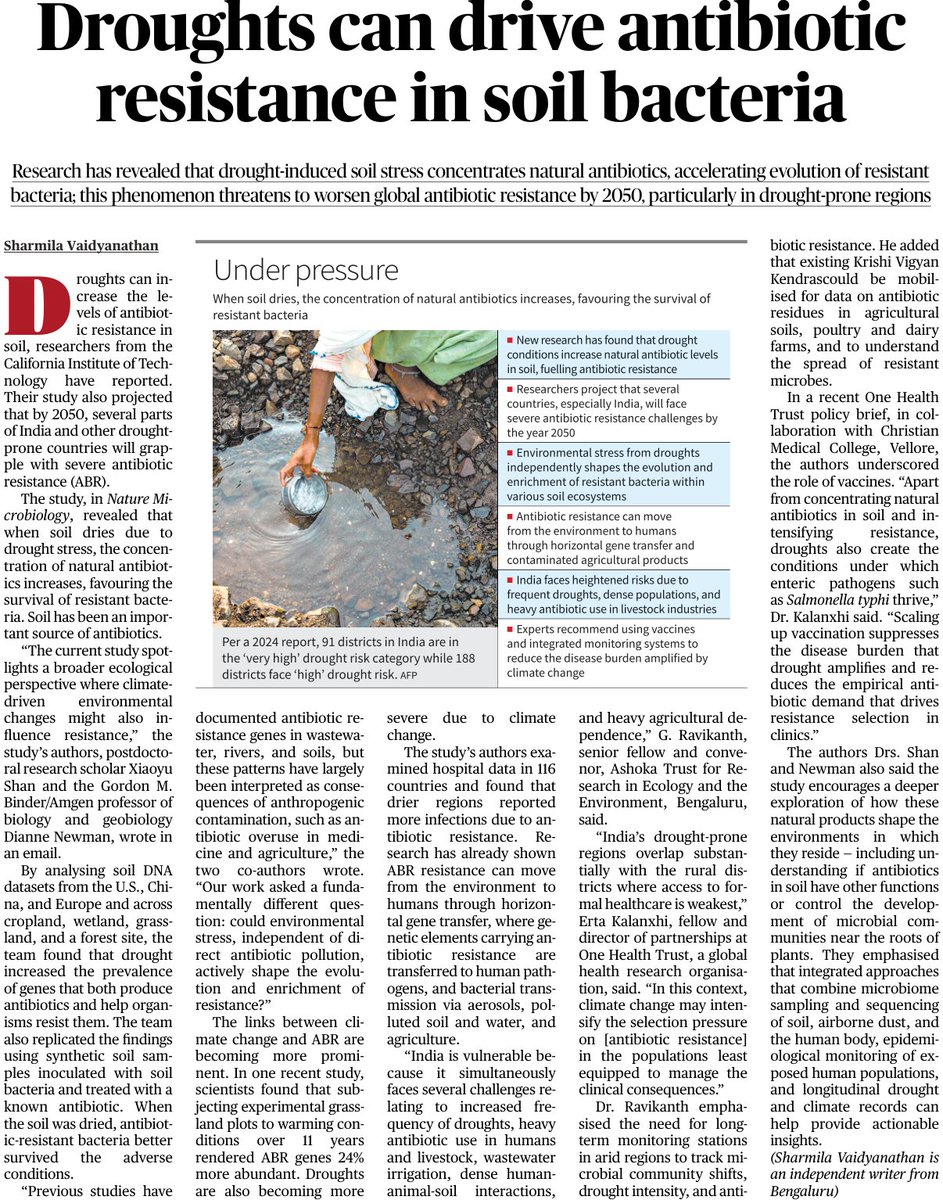
Droughts can actively drive and increase antibiotic resistance in soil bacteria. When soil dries due to drought stress, the concentration of naturally occurring antibiotics in the soil⏫. This environmental pressure kills off vulnerable microbes, directly favoring the survival and enrichment of resistant bacteria.
Traditionally, antibiotic resistance (ABR) is blamed on human overuse in medicine and farming. However, by analyzing soil DNA across the US, China, and Europe, this study shows that climate-induced stress independently shapes ABR evolution.
By 2050, several drought-prone regions globally, will face severe antibiotic resistance challenges as climate change intensifies environmental selection pressures. Droughts don't just select for resistance; they also create arid environments where dangerous enteric pathogens like Salmonella typhi thrive, compounding the public health risk in vulnerable areas.
India's high-drought zones overlap heavily with rural districts where access to formal healthcare is weakest, leaving these populations least equipped to handle resistant infections. To counter this, experts suggest leveraging Krishi Vigyan Kendras to monitor antibiotic residues in agricultural soils and poultry farms.
1
68
THEJACOBS retweeted

✅ WHAT IS TYPHOID FEVER?
It is an infection caused by bacteria called Salmonella typhi.
HOW YOU GET IT:
1. You eat food or drink water that has been contaminated with faeces (stool) of an infected person.
2.Drinking dirty water or water from untrusted sources.
3. Eating food prepared by someone with dirty hands.
3. Eating raw fruits or vegetables washed with dirty water.
4. Flies sitting on food and carrying germs.
✅ IT IS NOT “BODY HEAT”. IT IS A BACTERIA LIVING INSIDE YOU.
1
1
1
90

Jun 11
Salmonella typhi

1
25
Golden💕 retweeted

Bacteria Infections and their disease causing organisms
Typhoid - Salmonella typhi
Pertussis (whooping cough) - Bordetella pertussis
Tetanus infection(lockjaw) - Clostridium tetani
Cholera - Vibrio cholerae
Pneumonia - Streptococcus pneumoniae(majorly)
Tuberculosis - Mycobacterium tuberculosis
Leprosy - Mycobacterium leprae
2
3
11
225

Answer: B. Pneumonic plague
Here's the breakdown:
Murine typhus (Rickettsia typhi) → transmitted by rat fleas (Xenopsylla cheopis).
Endemic typhus is another name for murine typhus → also transmitted by rat fleas.
Hymenolepiasis (Hymenolepis diminuta) can be acquired through ingestion of infected arthropods, including rat fleas acting as intermediate hosts.
Pneumonic plague is not transmitted by rat fleas. Although plague (Yersinia pestis) is classically spread by rat fleas in its bubonic form, pneumonic plague spreads person-to-person via respiratory droplets.
✅ Correct answer: B. Pneumonic plague
A useful exam pearl:
DiseaseRat flea vector?
Murine (Endemic) typhus✅ Yes
Bubonic plague✅ Yes
Pneumonic plague❌ No (droplet spread)
Hymenolepiasis (H. diminuta)✅ Fleas can be intermediate hosts
So if the question asks "not transmitted by rat fleas", the best answer is Pneumonic plague.
1
4
146

Jun 10
Yes, the effect of amygdalina (BUTTER LEAF) extract on salmonella typhi
1
2
148


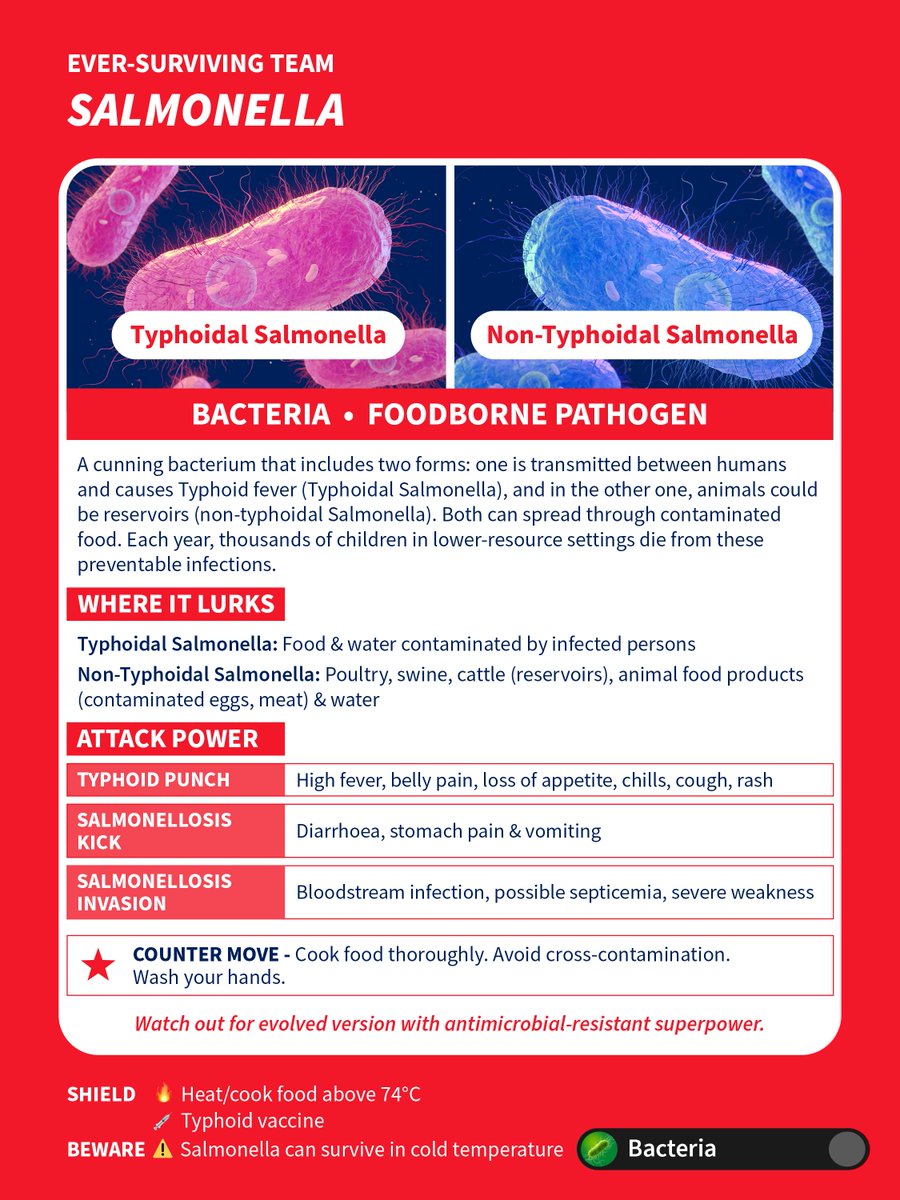
#Typhoid, caused by #Salmonella Typhi, can spread through contaminated food and water.
Food safety habits like #handwashing, along with preventive tools like typhoid conjugate vaccines (TCVs), can help protect against #Typhoid! 💉🫧🧼
#TakeOnTyphoid

Pathogens causing foodborne illnesses as a collectable card?
Get to know ‘em all - but don't catch 'em at all!
Meet #Salmonella - find out more about them, where they live, and how you can defeat them with simple food safety habits such as:
🧼 Washing hands before handling food
🍗 Separating raw meat and seafood from other foods
🔥 Cooking food thoroughly
❄️ Keeping food at safe temperatures
💧 Using safe water and clean ingredients
#FoodSafety
1
26

Se confirma la efectividad de la vacuna conjugada frente a la fiebre tifoidea.
Los resultados muestran una EV frente a casos de fiebre tifoidea con confirmación microbiológica de un 87% y de un 97% frente a infección por Salmonella typhi multirresistente.
vacunasaep.org/profesionales…

3
5
358

Jun 9
If you’re Nigerian, you’ve probably treated malaria and typhoid like inseparable twins, but as a Medical Laboratory Scientist, I’m here to tell you that Typhoid is one of the most over-diagnosed illnesses in Nigeria.
To truly catch the bacteria (Salmonella Typhi), you need a Blood Culture, ideally in the first week of the fever but what is mostly obtainable is the widal test and considering that the org is endemic here, most people are likely to test positive as a result of past exposure. Medications are prescribed regardless causing Multi-Drug Resistance.
There is only so much we can do. Treat your water, get vaccinated and ensure you go for proper testing before treatment. Stay safe✨
1
25

Gallbladder Cancer: Chronic infection with Salmonella enterica serovar Typhi.
Colorectal Cancer: Streptococcus bovis has a known association with colon cancer.
Lung Cancer: Long-term infection with Chlamydia pneumoniae is implicated as a risk factor for lung cancer.
83

Ive stopped doing Widal for last 20 yrs. Waste of time and patients money.
Typhi dot IgM is also another useless test.
1
210


Jun 9
The answer is C. Typhoid fever ✅
Pea-soup stool is a classic (though not always present) description of stool seen in typhoid fever due to Salmonella Typhi.
Quick associations:
💧 Cholera → Rice-water stools
🩸 Amoebiasis → Blood and mucus (“red currant jelly”)
🦠 Typhoid → Pea-soup stools
🫧 Giardiasis → Foul-smelling, greasy, floating stools
1
53