
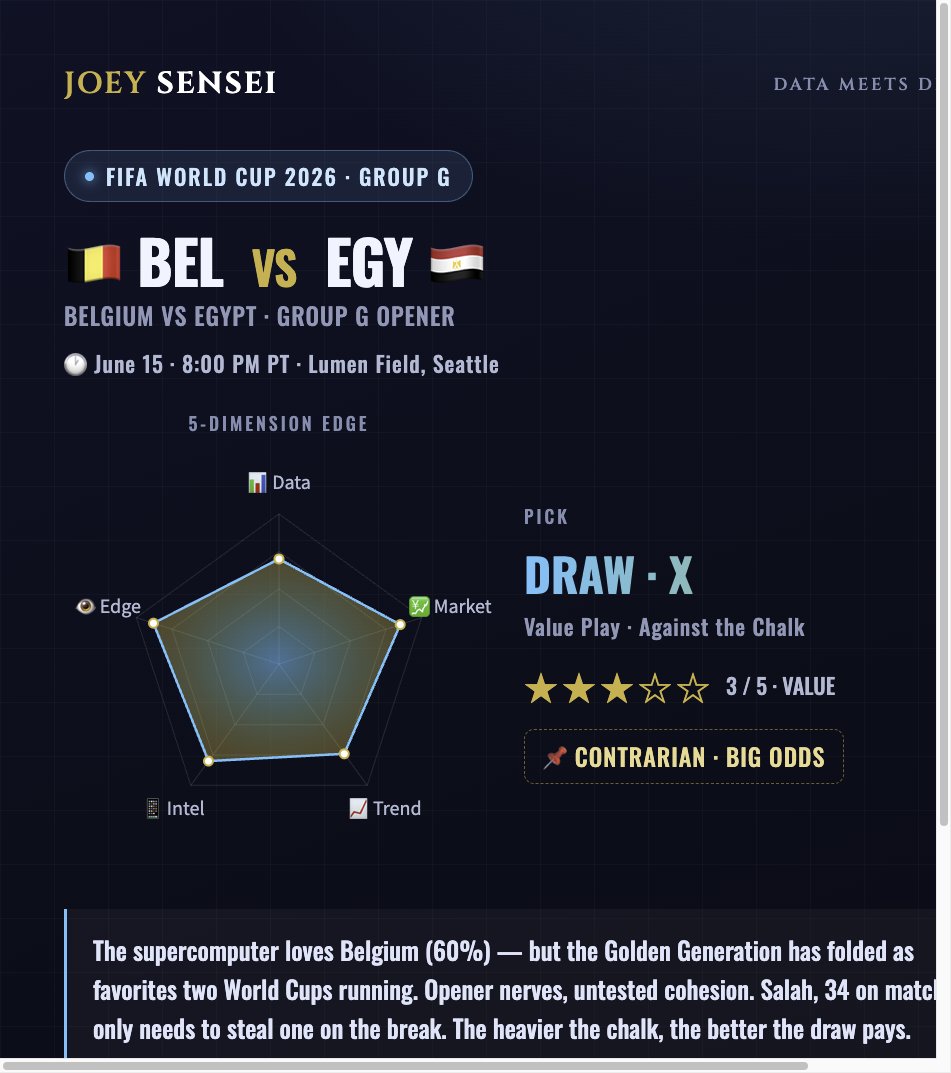
🌍 #WorldCup2026 Pick — Group G Opener
🇧🇪 Belgium vs Egypt 🇪🇬
Tonight · 8:00 PM PT · Lumen Field, Seattle
📌 PICK: DRAW (X) ★★★☆☆ · Value play, against the chalk
(Supercomputer has Belgium at 60%, draw at just 22% — the heavier the chalk, the better the draw pays.)
The Belgian Golden Generation has been a World Cup favorite TWICE and folded both times. Opener nerves, untested cohesion, and a habit of not putting teams away.
Egypt has Salah — 34 on match day, the best right-sided counter-attacker on the planet. He only needs to nick one.
Data leans Belgium. The market and the gut say: grinder, level pegging. I'm on the draw. 🤝
📊 Record: 6-3 | 66.7%
⛓ On-chain: predictfolio.com/0x000b...6f…
#FIFAWC2026 #BELvEGY #Salah #WorldCup
6

How is it possible that you have evaded the bad batches. My relatives survived first 2 shots but the boosters (a different untested formula) got all of them. Many survivors still have cancer. Last baby born into the family was 2019. It doesn’t seem possible to conceive anymore.
1
Lars Outzen retweeted

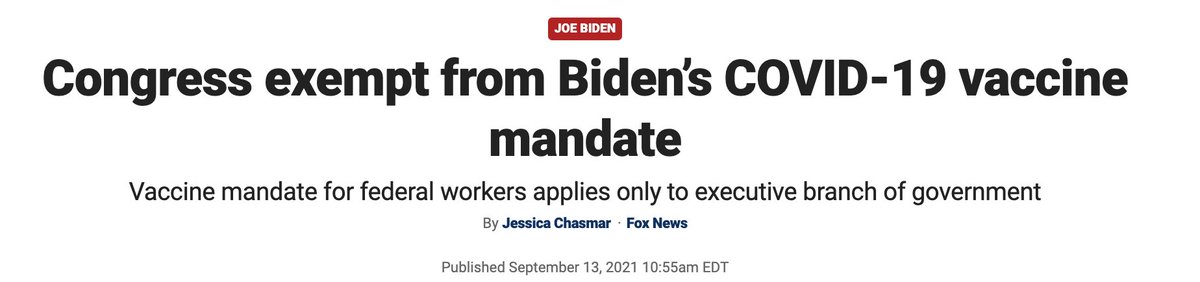
They had to pretend there were no other treatments in order to get the vaccine mandate, untested vaccines they exempted themselves from getting.
2
65
157
2,415

Not to mention inviting millions of unvetted , untested illegals into our country during a purported COVID epidemic- double think in action
1
3
taiche Tees, Apparel, Home Decor and Accessories retweeted

Check out Vintage JOHN DEERE Strong Box Lifetime No Battery Clocks 1990's Untested ebay.io/m/Qcg8l6 #eBay via @eBay

15
12
59

At this point in life all domains
(except a few in untested quantum research) have been attempted. You will need to pull from others.
1
7


The nastiest failures rarely start in code. They start in assumptions that went untested, unchallenged, and quietly accepted as truth.
1
7

47,500 Cases of Paralysis in CHILDREN
UNTESTED vaccines causing new wave of polio-like paralysis across India
PF Louis
Natural News
April 20, 2012
archives.infowars.com/bill-g…
5

@MickWest, your reply exposes the real problem better than any critic ever could. You still do not present technical analysis. You present social filtering. Instead of addressing evidence, you decide whether something has “compelled” enough people to deserve your time. That is not science, and it is not skepticism. It is reputational gatekeeping dressed up as rationality.
The validity of an analysis is not determined by popularity, applause, or whether it has persuaded a crowd. A technical claim stands or falls on the quality of its method, the coherence of its observations, and the strength of its testing against the evidence. When Marik presents specific claims about cloud occlusion, motion behavior, geometric inconsistency, and problems with the lens-flare explanation, the scientific response is to engage those claims directly. Instead, you avoid them and retreat into sociology.
That is why your posture fails. You are not rebutting the analysis. You are commenting on the audience. You are not showing where the measurements fail, where the geometry collapses, where the optical mechanism breaks down, or where the observational logic becomes invalid. You are simply asserting that the analysis is not compelling and that the assumptions are wrong. But an unsupported assertion is not a rebuttal. It is just another belief.
And that is the central issue: you are not operating from demonstrated technical work, but from labels you personally prefer. “Lens flare,” “balloons,” “planes,” “birds,” “artifact” — these are not explanations by themselves. They are only labels. Without a full technical reconstruction, they remain untested beliefs. A real analysis would show the optical path, the source light, the expected flare behavior, the camera geometry, the frame-by-frame correspondence, and the reason the footage must behave that way. You do none of that.
You have been publicly challenged on exactly this before, by me, to provide a complete technical reconstruction with actual data: timestamps, coordinates, platform information, sensor source, range, bearing, azimuth/elevation, track continuity, aircraft identification, metadata separation, thermal behavior, chain of custody, assumptions, and uncertainties. You did not produce it. You did not test your preferred explanation to that standard. You fled the burden and replaced analysis with rhetoric.
So let us be clear: what you practice is not scientific skepticism. Scientific skepticism tests hypotheses. It does not merely announce them. It does not pick the most conventional-sounding label and then pretend the work is finished. If your explanation is correct, then prove it technically. If the flare hypothesis works, model it. If the motion is camera-induced, demonstrate it. If the object is an aircraft, identify it. If you cannot do that, then you have not solved anything.
What Marik is doing, whether one agrees with every conclusion or not, is closer to actual analytical work than your dismissive one-liners. He is isolating observable features, proposing falsifiable points, and forcing the explanation to confront the footage. That is how inquiry works. Your method, by contrast, is to declare the answer first and then avoid the burden of showing the path that got you there.
So no, this is not a case of “limited time” or “prioritization.” It is a case of not having done the technical work required to justify the certainty you project. The real checkmate here is simple: if you say Marik is wrong, then prove he is wrong. Technically. Frame by frame. Claim by claim. Geometry by geometry. Until then, your position is not analysis. It is labeling, belief, and confidence masquerading as skepticism.
5
WilliamJGraham retweeted

Check out Vintage Kodak Pocket Instamatic 30 Camera w/Flash Extension & Strap - UNTESTED ebay.us/m/t0bW8c #eBay via @eBay
2
1
9

One of the downsides of being good at what you do is that people stop challenging your thinking.
Meanwhile, I'm looking for the flaw. And I usually would want you to help me find it.
Don’t get me wrong sha cause I don’t doubt my judgement, I just believe no thinking is airtight.
There's always an assumption that went untested, a perspective that got overlooked, or a gap hiding in plain sight especially as we all have biases.
So please if you’re trying to work with me, challenge me! It gets me going.😂
2
27

Yeah ngl when you look at his record, he had a huge 3 fight run before this, but he was still rather untested guy ufc wise
13

Given that YouTube's untested and flawed AI mass-demonetization system wrongly demonetized thousands of authentic channels, the least they should do is provide a human review and provide specifics. I hope you get a fair review soon!
1
1
20

Thats the face of liberalism right now. I think the untested rushed covid vaccine has melted the brains of millions because before the vaccine these crazy people were much fewer
88


WHY FIRST ORDERS ARE RISKY: Unproven sales (you're guessing demand). Unvalidated production quality (samples ≠ production). Untested supplier relationship (how do they handle problems?). You're betting significant cash on three unknowns at once.
1


I asked Grok to prove he did it. Obviously grok is controlled by the Iluminate so take it with a pinch of salt.
**No, I cannot prove that this happened or that the claims in the image are true.** They remain unproven allegations from a 2016 civil lawsuit that was filed and then voluntarily dropped before any trial, evidence testing, or court ruling on the merits.
### What the image shows
The graphic reproduces text that closely matches **paragraph 9** of a sworn declaration (affidavit) filed in the lawsuit under the pseudonym “Tiffany Doe.” In it, she claims to have personally witnessed Donald Trump forcing a 13-year-old plaintiff (“Katie Johnson” / “Jane Doe”) and a 12-year-old girl named “Maria” to perform oral sex on him, followed by physical abuse of both minors. The affidavit also alleges four sexual encounters involving the plaintiff and Trump (including one rape), threats, and Epstein’s involvement.
The photo of Trump and Epstein is real (they knew each other socially in the 1980s–1990s).
### What actually happened in court
- **April 2016**: An anonymous woman filed a civil lawsuit in California federal court as “Katie Johnson,” naming Trump and Epstein. It was dismissed on technical/procedural grounds (wrong legal claims cited).
- **June/September/October 2016**: Refiled in New York federal court as “Jane Doe.” It included the plaintiff’s declaration and the “Tiffany Doe” supporting declaration you see quoted in the image.
- **November 4, 2016** (two days before the presidential election): The plaintiff voluntarily dismissed the case. She had been scheduled for a press conference with attorney Lisa Bloom but backed out, citing threats. No trial occurred. No discovery process. No cross-examination. No evidence was presented or ruled on by a judge or jury.
The case ended without any finding of liability or guilt.
### Why it has not been proven
- **Unadjudicated allegations**: A complaint or affidavit contains *claims*, not proven facts. Without a trial, they stay untested.
- **Anonymity and lack of corroboration**: Both the plaintiff and “Tiffany Doe” used pseudonyms. The plaintiff gave one interview (to the *Daily Mail*) but did not pursue the case publicly afterward. No other victims or witnesses from Epstein’s well-documented crimes have publicly corroborated this specific story with matching details.
- **Questions about the lawsuit’s origins**: Reporting and investigations (including by Snopes) linked the filing and promotion to Norm Lubow (who used the name “Al Taylor”), a former *Jerry Springer* producer with a history of involvement in disputed or sensational claims about celebrities. The California filing listed an address that was a foreclosed/vacant property. These factors do not disprove the underlying claims but raise legitimate doubts about how the case was handled.
- **No criminal charges or independent evidence**: Despite multiple investigations into Epstein (who was convicted in 2008 and faced new charges in 2019), this specific allegation did not result in charges against Trump. Epstein document releases in 2024–2025 reference the old lawsuit but add no new corroborating evidence or confirmation.
- **Trump-Epstein relationship**: They were social acquaintances in New York and Palm Beach circles. Trump flew on Epstein’s plane a handful of times (some with family). Trump later banned Epstein from Mar-a-Lago after an alleged incident involving an underage girl. No credible evidence from flight logs, victim testimony, or investigations has linked Trump to Epstein’s sex-trafficking.
2
9