
🔥 OnPush is now the DEFAULT change detection strategy
Components with no changeDetection set are now OnPush automatically.
Want the old behavior? Set ChangeDetectionStrategy.Eager (there's a migration for it).
✍️ Signal Forms graduated to the public API!
No longer experimental 🎉
You also get:
- reloadValidation()
- debounce on validateAsync/validateHttp
- FieldState.getError()
- template reactive FVC support
🌐 FetchBackend is now the default for HttpClient
withFetch is deprecated → just remove it.
⚠️ Need upload progress? Use provideHttpClient(withXhr).
Also: reportProgress → split into reportUploadProgress & reportDownloadProgress
💧 Incremental hydration is now the default behavior. No extra config needed.
🤖 Angular is going all-in on AI/MCP tooling:
- provideWebMcpTools
- declareWebMcpTool (experimental)
- AI runtime debugging tools
- an in-page Angular DI graph AI tool
✨ New core goodies:
- @Service decorator (stable)
- injectAsync() helper
- debouncing signals
- resource caching for SSR
- bootstrap apps under shadow roots
- TestBed.getLastFixture()
🧹 Big cleanup (breaking):
- ComponentFactory / ComponentFactoryResolver → gone
- createNgModuleRef → createNgModule
- checkNoChanges → removed
- provideRoutes → provideRouter
- Hammer.js integration → removed
⚙️ Version requirements:
- Node.js 26 supported
- TypeScript 5.9 dropped
- Minimum TS is now 6.0
🧭 Router changes:
- paramsInheritanceStrategy now defaults to 'always'
currentSnapshot in CanMatchFn is now required
- new browserUrl input on router links
That's Angular v22 in a nutshell 🎯
2
17
85
3,883

May 26
🎬 Angular v21 - Signal Forms - Validation Asynchrone avec validateAsync & validateHttp
Angular met à notre disposition deux fonctions utilitaires au niveau des Signal Forms pour mettre en place des validations asynchrones :
- validateAsync : pour des validations asynchrones basées sur des Promise ou des Observable en général.
- validateHttp : lorsque la validation asynchrone se résume à effectuer un appel HTTP afin de déterminer la validité.
Comme cas pratique, nous mettrons en place une validation asynchrone du nom d'utilisateur lors de l'inscription d'un utilisateur.
Ce sera également l'occasion de découvrir la fonction utilitaire debounce, qui permet d'ajouter un délai de debounce au niveau d'un champ de formulaire basé sur les Signal Forms.
Vous trouverez en commentaire le lien de la vidéo complète.
🧠 Stay Curious!
#devPropulsor #Angular #SignalForms #asyncValidation #validateAsync #validateHttp #debounce #v21
1
4
6
82

Apr 4
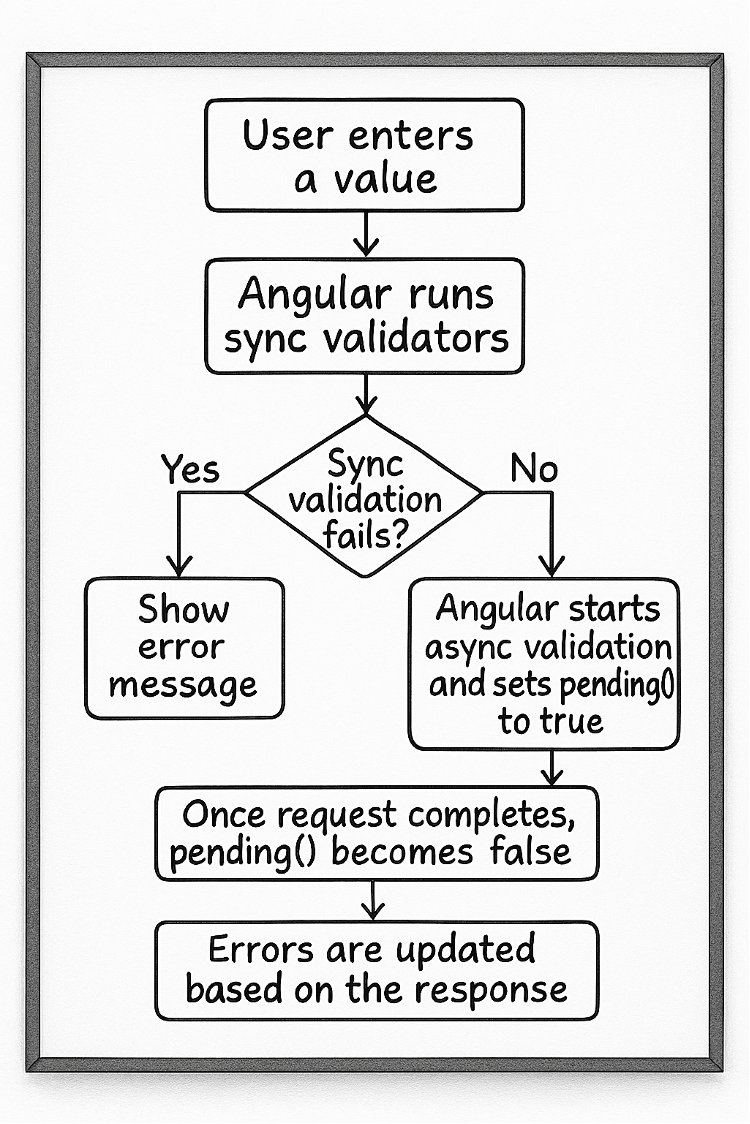
I am giving a talk on #Angular Signal Forms at #ngIndia. For async validation, you can use either
There are two ways you can add async validation to a signal form.
-validateHttp() - based on httpResource
- validateAysnc() - based on Resource
If sync validation passes, only async validation runs.
Join me alongside other 12 speakers to master Modern #Angular on 11 April
Tickets - ng-ind.com/
Last Date to buy a Ticket - 7 April
#ngIndia #angular #nomadcoder
1
3
226

Mar 16
¡LA PIEZA QUE FALTABA! 🤯 Signal Forms NATIVOS en Angular 21 (RC).
En la Lección 12 del curso vemos la API: formularios, estados (dirty, touched), validación nativa, síncrona (validate) y asíncrona (validateAsync/validateHttp).
📺 f.mtr.cool/tebreaowot
#Angular #SignalForms
1
1
32
8 Nov 2025
¡LA PIEZA QUE FALTABA! 🤯 Signal Forms NATIVOS en Angular 21 (RC).
En la Lección 12 del curso vemos la API: formularios, estados (dirty, touched), validación nativa, síncrona (validate) y asíncrona (validateAsync/validateHttp).
📺 f.mtr.cool/jvjcooimth
#Angular #SignalForms
5
7
231

16 Sep 2025
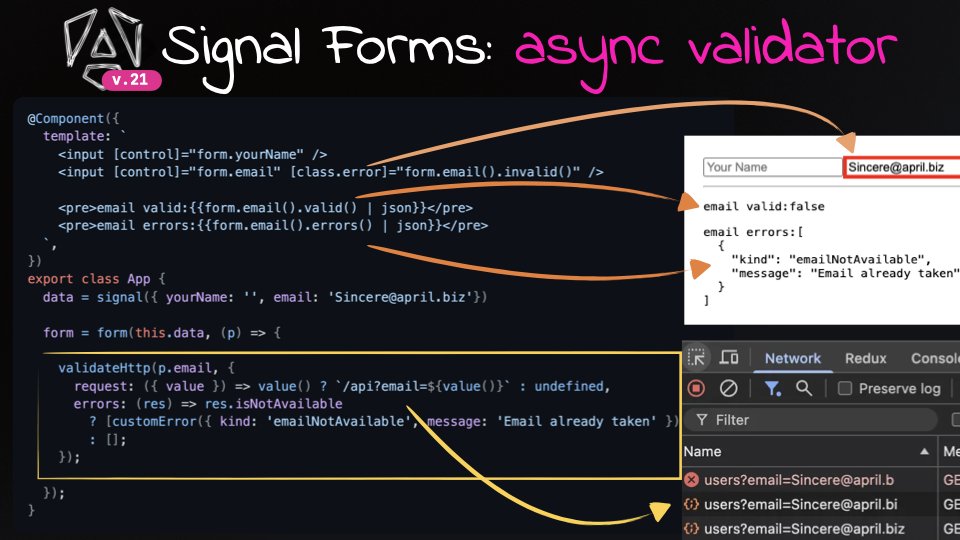
A simple snippet to add a custom Async Validator in @angular Signal Forms (v.21) using the new “validateHttp” function:
1️⃣ Every time the user types, the “request” function invokes the endpoint (cancelling pending reqs)
2️⃣ The "errors" function validate the response
Love it ❤️
1
4
43
2,074

5 Sep 2025
validateAsync uses a resource in the background and validateHttp uses an httpResource, so I don't think that will be the issue. Either way, I'm curious what you'll end up finding.
1
11

2 Jul 2025
Let's talk about Signals Forms a bit.
I have seen some questions...
-> Like "why do we need it?"
-> What are signals broo... ?
For the last one...
... I'm not going to provide answer 🤣
Benefits of Signals Forms however
is an interesting topic. 👇
Based on deeply hidden prototype
that Angular Team is working on
My own understanding of it:
1. Signal = ultimate source of truth
- no duplicate state inside FormControl/FormGroup
2. Less boilerplate overall
3. Fine-Grained Reactivity
- your favorite term :D, thanks to Signals we get push based, change detection friendly state
( value, errors, valid, disabled etc)
4. Declarative TypeSafe
- declare a Schema ones, rules stay close to data model
- full TypeScript inference
5. Composability
- we can reuse schema on nested objects or dynamic array items
- applyWhen / applyWhenValue attaches logic only when a reactive condition is true
= cleaner than imperative if (...) { addControl() }
6. Awesome Async Validation
- pending state is built-in
- validateHttp / validateAsync
you only map server data → errors.
7. Improved submit flow
- no manual setErrors
- submit(field, action) toggles 'submitting' status tree-wide
8. One binding Mechanism
- [control] is THE single glue directive that binds any UI element (native or CVA component) to a field
9. valueChanges be gone and never come back <3
--------
Can't wait for @AngularConnect talk on this very topic !!!
Want to see the code for Signal Forms prorotype?
Link in comments
4
2
25
2,369