
searching, looking, trying.
Joined May 2012
- Tweets 1,084
- Following 1,614
- Followers 700
- Likes 2,101
129 Photos and videos













Apr 17
Three smallcaps just triggered on my radar — all sub-$35M, all with volume expanding off compression.
Here’s what i like and why 🧵
DYOR / NFA
1
88
Apr 17
3/ $RLC (iExec)
• $33M cap
• 9% this week, volume ripping 2.1x
• Binance, Bitget
OG DePIN/compute play that’s been forgotten for years. Volume expansion is the loudest on the list. Small size — lottery ticket energy.
1
1
2
158
Apr 17
The playbook is the same every time:
• Buy the expansion, not the hope
• Stops under the range, no exceptions
• Scale out into strength — TP1 pays for the trade
Small caps don’t give second chances. Neither do stops.
Not financial advice. Do your own research.
Follow for more 👀
56
Apr 17
Quietly adding these small caps to my radar 👀 . Not financial advice, DYOR.
A few sub-$50M plays showing early momentum before the crowd catches on.
Here’s what I’m watching and why 🧵
1
1
37
Apr 17
6/ $ESP (Espresso)
• $40M cap
• 5% this week, volume expanding
• Binance
Shared sequencing for rollups. Narrative is live, cap is still small.
1
97
Apr 17
That’s the list 👆
Rules I’m sticking to:
• setting limits, don’t chase
• Size small on low conviction
• Stops always on
Not financial advice. Do your own research.
Follow for more smallcap watchlists 👀
20
Apr 17
$LQTY (Liquity) looks interesting here if volume begins to 2x. Limit entry and TPs at:
Entry: $0.2837
Stop: $0.2594 (-8.6%)
TP1: $0.3564 ( 26%)
TP2: $0.4455 ( 57%)
TP3: $0.5940 ( 109%)
Size: 10%
NFA // DYOR
1
1
137
Apr 17
I like $ACX (Across Protocol)
Buy Conviction: MEDIUM
MCap: $32.0M | Binance, Bitget
Entry: $0.04550
Stop: $0.03977 (-12.6%)
TP1: $0.05232 ( 15%)
TP2: $0.06143 ( 35%)
TP3: $0.07280 ( 60%)
Size: 20%
DYOR // NFA.
177
Feb 24
This is one of the best frames I've seen on AI.
The sandwich analogy is perfect. Everyone's staring at the writing, the coding, the data entry, and overlooking the new economy.
What I keep coming back to: every time you automate something, you create at least three new layers that didn't exist before.
A trust layer — who verifies this is real? When AI can produce anything, provenance becomes infrastructure. Think content authentication protocols, AI decision audit trails for regulated industries, reputation verification networks. The boring plumbing that every business will need.
A curation layer — abundance kills the value of the thing and creates value in the filtering of the thing. Spotify didn't make music more valuable, it made playlists valuable. AI is about to do that to every knowledge domain at once. Whoever builds the taste layer on top of AI generation wins.
A human premium layer — when the machine version is free, the human version becomes priceless. Not because it's better. Because human attention is finite. We'll see entire service categories rebuilt around guaranteed human involvement at critical moments. Medical results delivered by a person. Financial plans reviewed face to face. Showing up becomes the product.
The fashion industry example you is exactly right. The loom didn't kill clothing — it invented brand management and retail psychology. AI won't kill knowledge work. It'll invent a new architecture.
Feb 23

When I was 7 years old I was asked by my father what went into the price of a sandwich. Considering it carefully, I answered.
The lettuce, the tomato, the bread and the meat.
I did not consider correctly. I was short quite a few costs as my father was eager to point out. I had forgot the labor of the worker, the rent of the land, the marketing costs of the chain. I wasn’t seeing the full picture.
Today we are all making a similar mistake with AI. We are not considering what cannot be considered. As foreign to the 7 year old as these excess charges were, so are the downstream affects of AI.
In 1850, if you had told a teamster that his horse and carriage would soon be obsolete, he would have envisioned a world of mass starvation for men of his skill. He could grasp the concept of a faster carriage, but he could not conceive of the interstate highway system, the suburban real estate market, or the roadside motel industry. These were not just new products; they were an entirely new social architecture.
We are currently in the teamster’s shoes. We see AI automating the ingredients of our current economy—the writing, the coding, the data entry—and we fear the void. But history shows that humanity doesn't fall into the void; it builds a floor over it.
Karl Marx looked at the dark satanic mills of the 19th century and saw a terminal point. He argued that as the means of production became more efficient, capital would consolidate and labor would become a worthless commodity. He believed capitalism would eventually eat itself because it would run out of things for people to do.
Marx was wrong because he viewed human utility as a fixed pie. He didn't understand that technology doesn't just subtract labor; it changes the nature of what we consider valuable.
When the mechanical loom made fabric cheap, we didn't stop buying clothes. Instead, we invented the fashion industry. We created brand management, retail psychology, and textile engineering.
We moved from a world where everyone owned two outfits to a world where millions of people are employed in the cycle of seasonal trends.
In the age of the steam engine, "handmade" was a sign of poverty. Today, it is a luxury. We are already seeing a shift where the human touch—the artisanal, the face-to-face, and the physically present—is becoming the high-margin sector of the economy.
Every time we automate a simple task, we move the human to a more complex one. We didn't stop needing accountants when Excel was invented... we simply started asking accountants to perform much more sophisticated financial modeling.
The 7-year-old misses the rent and the marketing because they are abstractions. Similarly, we struggle to see the jobs of 2040 because they rely on problems we haven't even encountered yet. We might see the rise of Personal Data Stewards, who manage the interaction between our private lives and public AI models, or Reality Architects, who ensure that the virtual spaces we inhabit are psychologically grounded.
The world works itself out because humans are fundamentally restless. We do not tolerate a vacuum of purpose, we seek higher function always.
1
1
89
Feb 18
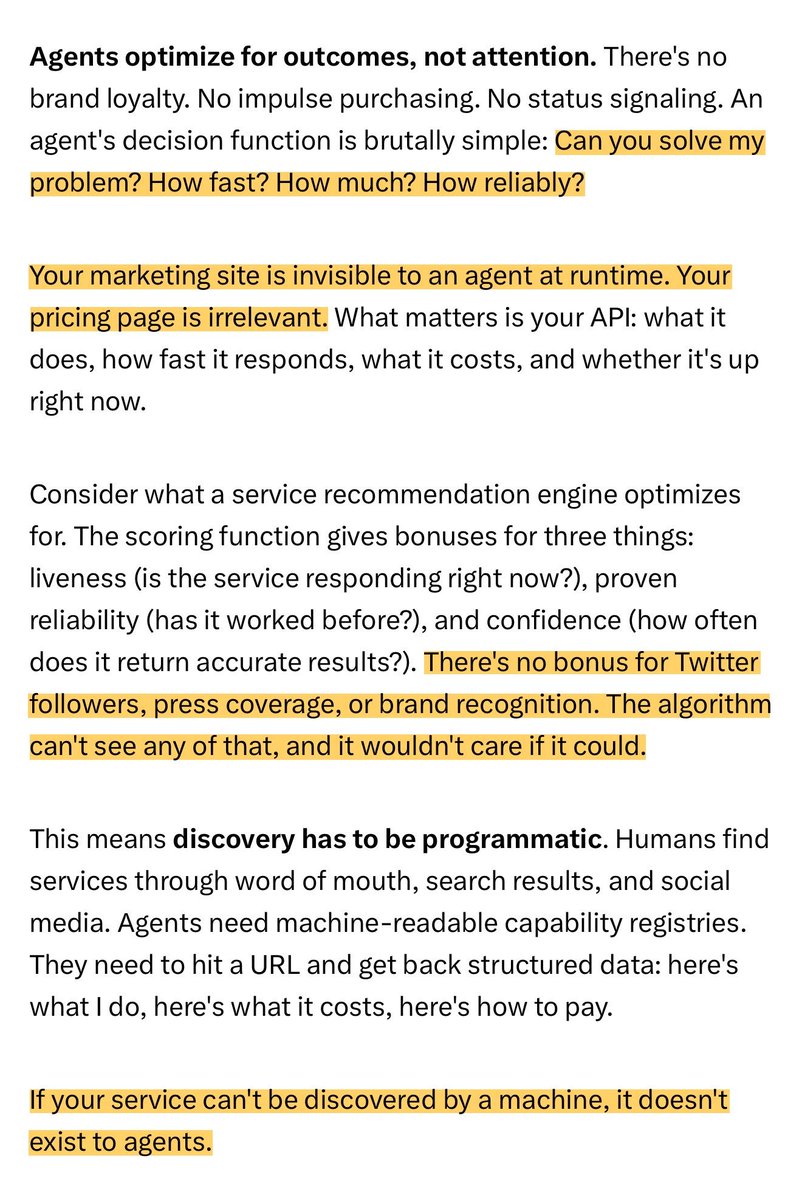
This got me thinking about crypto's vanity metrics and how agentic AI will change crypto GTM for projects.
x.com/hellodannykim/status/2…

One of the most important questions for founders is: How do I make sure agents know about my product and service and choose it? All the old tricks won’t work.
People who figure this out will win big
2
83