
Disciple. Familist. Musician, "whose gaze is turned upon the depths of things." 📵
Joined May 2015
- Tweets 335
- Following 0
- Followers 192
- Likes 174
14 Photos and videos
Pinned Tweet

22 Jul 2025
I love the world,
because it is beautiful.
2
1,285
Jun 10
My opinions on the orig. post are as follows:
1. 'Great Books' became a catch-phrase and also a signal. It's useful to parse out the types. *Ancient Great Books* are the Plutarch & Homer & Virgil cited here.
The criterion in the post
(i.e. that they possess or transmit 'radical insights')
(i cannot bring myself to refer to this potency as 'provocative alpha', although that neologism does possess and transmit its own radical insights, which i will not specify here)
... depends on a framing,
or a 'hermeneutic', to get fancy.
The folks for whom this category - the ancient 'greats' - is the be.all.end.all, have admittedly primed their understandings with certain priorities - but those priorities may indeed be ones with enduring, primary value - without thereby being exhaustive, needing to be exhaustive, or even claiming to be exhaustive.
For example, the 'betweenness centrality' of these works undoubtedly is very high - grounding as they do, whole traditions of inquiry, criticism, and literature. So the payoff to knowing them, in terms of ramified ability to understand other things, can be off the charts.
Supposing this particular ability is the 'return' one desires from the 'investment' of reading, then these 'ancient greats' will forever hold their own, even as there are of course many modern works which may also pass muster to some degree by *this* standard (i.e. influential & necessary to be familiar with, while containing perhaps some dross. Freud, for example. Or Rousseau.)
Note to superficial readers of this ... tweet: I am not comparing Freud to Plutarch (etc.) in terms of *content*; I am comparing them in terms of *being influential* (i did not say 'being influencers') on trends in intellectual culture, compared with density of 'radical insight' in the original. You'd have to wade through a lot of Plutarch *and* a lot of Freud, that's kinda my point.)
But anyway - 'old is gold' in these terms, and every generation will have to reacquaint itself with this canon. Some have *prioritized* this, and that *priority* may be negotiable to some extent - without anything needing to be either 'boring and lame' or else 'lame and boring' (both are direct quotes.)
2. I do doubt whether the right move is to necessarily 'start at the beginning' - and, tend to think rather that the right move is to 'start where you are'.
That is, find something that speaks to you - intelligently, ably, profoundly - and then, seek more.
I do think there can be a kind of chronological or 'genetic' fallacy of a kind here, where if something was the 'source' of something secularly, then it must have been superior. So, sed contra what is above, let not 'old is gold' become a 'primitivism' or 'golden-age-ism' (in the Lovejoy/Boas sense.) (I do, btw, think there have been golden ages. I don't question *that* they have occurred, nor even the *idea* that they have, only the 'ism' that directs one to lose oneself in them.)
Also, an important word when considering canons of 'great books' is *tradition* - and tradition essentially consists of the real practices *surrounding* the bare text / sola scriptura / *il n'y a pas de hors texte*, etc.
It may be true that one tries to 'express something about oneself' by professing to love an old text - and what one may be thereby trying to express is *gratitude* ... for not only 'the owl' (which flies at dusk) ( ... which is the 'radical insight' in itself, let us say), but also & in particular the rest of the fucking owl (and so you see that I am by no means above parlance.)
Meaning: By indicating a reverence for a text that comes with a tradition, one is indicating that one *recognizes* that tradition, instead of being ignorant of it - and that one is *capable* of seeing what others have seen in it, rather than being blind to the light that the 'traditional' thinking cap may shed ( ... through the 'cracks', saith Leonard Cohen.)
Consider what Maurice Blondel says here:
"Tradition is not a simple substitute for a written teaching. It has a different purpose; it does not proceed solely from it and it does not end by becoming identified with it. It preserves not so much the intellectual aspect of the past as its living reality ... It relies, no doubt, on texts, but at the same time it relies primarily on something else, on an experience always in act which enables it to remain in some respects master of the texts instead of being strictly subservient to them."
So, where it comes to a 'great books trend', so to speak, what we may be speaking of really is a trend-to-tradition. And so it may not necessarily be a matter of defending these books through 'justification-by-insight-density', but rather a matter of acknowledging that there is a growing desire to re-enter the enchanted forest.
3. At the same time as all of this, I firmly believe a number of other, skew things.
a.) There are *other* books from antiquity and thereafter which have not been canonized, but which are tremendously insightful. They are 'great' malgré eux.
b.) The original criterion in question here - the containing of 'radical insights' - is indeed one I naturally think in terms of myself, and it certainly guides my own reading *nisus* (to get fancy ... again.)
And so my own critique of the 'great books' trend has generally been of its hand-me-down vision. (I know very well that tradition *means* hand-me-down!) The issue is not the cloister, and the issue is not that anyone is 'pretending to love' anything.
The issue is, in the words of the historian Ranke, that:
"All ages are equidistant from eternity."
Modernity and beyond have produced tremendous works of enduring value, and it takes guts to recognize and avow this, and also to *find* and elevate - to 'canonize' - these works.
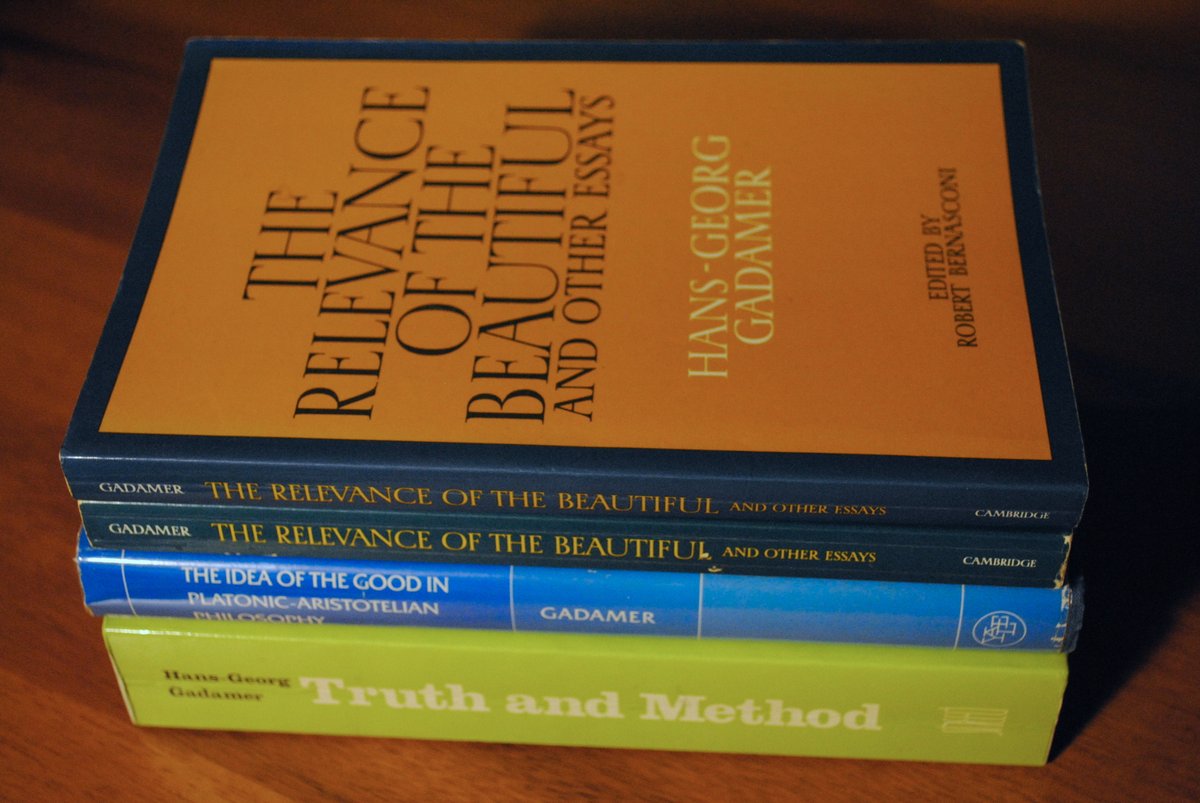
What I would really love to see is an avowedly 'classical' enterprise in education/letters to explicitly take on - for one example - the oeuvre of Dilthey, the study of which I think would provide intellectual mooring easily as central/relevant to modern debates, historiography, & more, as the study of Thucydides. Or for another example, Gadamer's 'Truth & Method' - surely a contemporary classic, worth as much in some sense, even right at the outset of a mature education in letters, as Horace's Ars Poetica, etc.
I think maybe you catch my point.

I agree if by "total catastrophe" you mean "a great godsend and a source of hope for the future"
3
262
Gautam Tejas Ganeshan retweeted
Jun 8
The necessary philosophical background is the forging of the 'person' in the debates about 'homoousion', etc.
There is meanwhile wisdom, of course, in learning to 'see through' one's superficial 'consciousness' ( ... the 'emissary')- which 'learning to see', besides being the essence of the 'buddhistic' psychotechnologies ('mindfulness', etc.) - has also been recognized by 'depth psychologists' (Jung) & also critics of Enlightenment rationality.
e.g. Blake, who made the following prescient statement, now echoed once again (two centuries later) in recent/current observations about the necessarily 'vital' source of intelligence: "Energy is the only life and is from the Body and Reason is the bound or outward circumference of Energy."
(This may seem to suggest the selfsame point about the vacant 'ghost in the machine', this ghost being perhaps only the 'outward circumference'- i.e. what seems to be the agent is actually an illusion - a point made not only in the article but also thickly present on the ground in general, a sort of ready to hand trope of contemporary popular neuroscience.)
But notwithstanding this sort of wisdom and these sorts of findings - the 'light' of consciousness and *free will* is nonetheless *real*, not an illusion or an 'epiphenomenon' - and our overt cognitions, *re*cognitions, thoughts and actions, etc. cannot be gainsaid.
These are not only the deliverances of common sense, (and also the sturdy beliefs of not-easily-fooled children) - but they are also the upholdings of some of the richest debates in history - once again, about 'personhood'. In fact, @stephenblackwd may be very well placed to describe these in detail, being that it was Boethius who, "in his definition of 'person', laid down a benchmark that was to last a thousand years." (Spaemann, in 'Why we call Persons 'Persons' ", OUP 2006)
I think what has happened is that, in short, somehow 'modernity' (post-enlightenment rational-ism, etc.) has somehow entailed the *specific exclusion* of the admissibility of these arguments, i.e. general knowledge by public intellectuals of the *intellectual history* of the period, particularly, "betw. the first and the second General Councils." (Newman) ( ... whose *first* book is an interesting and characteristically generous account of this intellectual history. I repeat the phrase for the third time - what is of account here is the *intellectual history*.)
This study of this history amply enriches one's conceptual repertoire for 'articulating the human'.
Anyway, that's it for this tweet, but in closing, also:
'Anthropomorphism', another common punching bag, is itself capable of a defense, and this has also been made by Spaemann.
And finally, over-ascription of pattern recognition - i.e. 'pareidolia', seeing figures in clouds, faces on toast, etc. - is a double-edged sword. Maybe it is a 'bias', but this sort of 'bias' is precisely what makes us intelligent.
This point is made in many ways by @DrJohnVervaeke ,
as well as previously by Dreyfus in
'What Computers (Still) Can't Do',
an in-principle critique of artificial intelligence.
Although its arguments do not factor in the latest phases of what computers seem to be 'doing' - *still*, his thorough conversance with mid-20C phenomenology is sorely lacking in many of the current breathless op-eds on this topic, and all would do well to review his, for example, discussion of 'The Role of the Body in Intelligent Behavior', etc.
1
1
135
Gautam Tejas Ganeshan retweeted
Jun 7
What is also important is for the new ship not to allow stowaways from the old, in the form of practices no longer 'adaptive', let us say - or even 'morbid', in the sense of bearing responsibility for the sinking.
And so besides 'artificial intelligence' here, it is important to finger also 'credentialism' as a candidate for a total rejection / non-uptake in the new ship.
If the nimble, high-integrity new schools like @RalstonCollege cannot escape being regarded as 'niche' & 'quirky' (at least in the early goings), then I would at least like to see them profit from their position by becoming exemplars of a higher quality paradigm in this regard.
This means simply no longer in any way 'draughting on the prestige' of legacy institutions - whether it is by mentioning pedigrees as if they justify anything simply, or else in any way regarding degrees from them, or publication in their fraught if not absolutely discredited guild journals, as if proofs of excellence, rather than merely proofs of assimilation.
The greatest minds are those with the least tolerance for living a lie - and these 'jumped ship' at the earliest sign of fraud or even mediocrity. It is a major frustration of my mid-life to experience the slow percolation of these realities into the conversation in general - and yet, there remains such a lag in anyone actually *acting* on the proposition that by requiring a credential (a.k.a. 'participation trophy'), one is actually *limiting out* the cream of the crop - especially this 'cream' where it comes to *freedom of inquiry* / *independent thought*.
Those who have steadfastly prized the latter have nothing to show for it that can be summarized easily, except their culture in conversation.
(And, to the original point, their intelligence in this regard stands absolutely unthreatened and unimpressed by the 'artificial' sort, around which they can run circles where it matters.)
1
1
84
Gautam Tejas Ganeshan retweeted
Jun 7
I admire what may remain great in these 'greatest institutions' - & I generally celebrate what is settled, established, peaceful - and in theory that should extend to established norms of credentialing, vetting, accrediting, collecting & conferring authority - (such as also looking to degrees, publications, academic guild memberships, etc.)
HOWEVER - in the present case, at the present time in history, I personally outsource *none* - absolute zero - of my quality evaluation to *any* of these 'norms of credentialing'.
And one thing that often strikes me in any such conversation as this (and similar ones are being had *partout*) - is that while yes, @theoeides4 , the 'bubble' of credentialism did certainly burst 'a good while ago', and the emperor is clearly naked, as all will attest, and the 'experts' are discredited, and all that ...
AND YET - even so, even still, it apparently proves *very* difficult for *anyone* - even the most dis-illusioned (in the positive sense, that is: one from whose eyes the scales have *fully* dropped) ... can *rarely* bring themselves to *act* according to the proposition that the PhD from Oxbridge (or H. or Y.) means *nothing* (anymore), that the name-dropping means *nothing* (anymore), that the 'passing through excellent and difficult schools' is *not a thing* (anymore) because there are *not* (anymore) any 'excellent and difficult schools' (mind you - there remain intelligent & dedicated protagonists and professors here and there, just as there remain genuine 'experts' to be sure - but this is a conversation about *institutions* and *the default value of credentials* as a general benchmark)
These 'degrees' - (although, rather than being 'dime-a-dozen', are in fact $400K a pop, and still without value! what a proposition!) - have, in fact, maybe even a *negative* value, in real terms ... in that by announcing that you have been willing to countenance the embarrassing mediocrity (for 'time-til-degree' - seven lean years of your life, bro), you have in fact given a proof of your not-quite-having-the-guts to cut your losses / call a spade a spade - which latter is in fact the first criterion of intellectual trustworthiness, eh?
What I am saying is: I think it is a generally yet-to-be-taken, and yet *crucial*, highly awaited step ... for players in this arena to forthrightly and simply *stop* looking to the PhD ... full stop. Stop mentioning it, stop requiring it, stop relying on it to bolster a reputation or demonstrate competence, even in casual conversation. I don't say that the work many have done in their theses is not a testament to their attention span and acumen. It is, in many cases. But in many more, it is not. And so the metric is empty - and sadly, useless, totally.
(this is my first tweet in over six months. cheers!)
1
71
Gautam Tejas Ganeshan retweeted
18 Jul 2025
" and so you must learn the inner form of rebirth,
the new phoenix is not the old phoenix
* and to remember that there is no 'order'
without 'spontaneity' and 'surprise'
* that 'order' fundamentally requires the *reality* of festival and celebration, it supports throughout and is made whole and complete by them
* and their richness and their fruit is their *beckoning reality*, their *invitation* ...
... and this is CERTAINLY NOT in the form of 'imposition' or 're-imposition' ... and that any and all moves of 'extrinsic' structuring will fall flat as façades upon this test of LIFE ... - the paradigm of order is the organism, whose life is always and essentially a gift to be cherished - ... and so, in addition to prudence, what is also required essentially ... ESSENTIALLY ... is *thanksgiving* ... right at the heart of things, *necessarily* ... "
1 Jun 2025

"Disorder cannot be properly managed simply through the re-imposition of order, but requires the concrete deliberation of prudence."
I would add - *and imagination*
*and rediscovering an alliance with what grows,
what has 'life force', what is 'organic', with 'nature'
*and reposeful openness to the everpresent
'vis medicatrix naturae'
... even in her more subtle operations on the 'culture',
where her healing ordinances may prefer to efface themselves all the more, that you may feel you have done it yourselves ... ( she 'loves to hide' ... )
*and finding the isomorphic examples from history,
but realizing that your charge is much more than to reproduce them, but to transcend them, because that is in fact the inspiring example they set - to learn from them is to learn *how the more to be yourselves*,
'hic et nunc' - here & now
* and so you must learn the inner form of rebirth, the new phoenix is not the old phoenix
* and to remember that there is no 'order' without 'spontaneity' and 'surprise'
* that 'order' fundamentally requires the *reality* of festival and celebration, it supports throughout and is made whole and complete by them
* and their richness and their fruit is their *beckoning reality*, their *invitation* ...
... and this is CERTAINLY NOT in the form of 'imposition' or 're-imposition'
... and that any and all moves of 'extrinsic' structuring
will fall flat as façades upon this test of LIFE ...
- the paradigm of order is the organism, whose life is always and essentially a gift to be cherished -
... and so, in addition to prudence, what is also required essentially ... ESSENTIALLY ... is *thanksgiving*
... right at the heart of things, *necessarily*.
(the original quote is D. C. Schindler's,
from a footnote, 'God and the City')
1
1
162
Gautam Tejas Ganeshan retweeted
18 Jul 2025
"All ages are equidistant from eternity,
and just as immediately accessible to God's presence."
- Leopold von Ranke
x.com/heyGTG/status/19187705…
"Everything is linked with everything ... (Sertillanges, The Intellectual Life) ... and the clearly visible relations of things have their roots in the night into which I am groping my way."
me:
" ... [this] puts we who would set store by what is timeless in the requirement to acknowledge
that much that is *timeless* is also *recent*
... and, so, much that is *classical* -
i.e. of perennial value & values -
has in fact been meaningfully created and entered into the record within the past handful of generations, or even within living memory, or even yesterday ... "
"Of course what is not in consideration at all is any reduction, collapse, or essentialisation, only a grounding and a recovery and realignment in terms of what is ancient and at the source - and this, as a question of emphasis and rediscovery - *renaissance* - I recognize the need for *and the beauty and timeliness of* - even as a periodic, half-millennial rhythm."
3 May 2025
One can be resolutely in favor of authentic, skill-drenched, immediate & thorough contact w/ and conversance w/ tradition, taking up the mantle of scholarship in its wonted, time-tested form, as here, as a necessary corrective to and recovery from an academic culture that may have largely lost the plot - while at the *same time* ('both-and') insisting on the existence and continued creation of an ongoing canon that has, in modernity and beyond, been unremittingly and continuously refreshed and renewed - however little its excellent heights have been recognized, regarded, or had their signal boosted within colleges & universities - with ample, creditable 'creative insight and practical wisdom' that has been generated lately in vernacular and modern languages - and that is, furthermore, necessary to study and incorporate *as well*, from the very outset of a journey towards truth, and included generously in the conversation during the slow approach to erudition. I think particularly of necessary knowledge in the Philosophy of Science, the Human Sciences of the 19C ('Geisteswissenschaften'), cultural critique that has taken into account the very significant realities of the past 200 years (e.g. Christopher Dawson, et al.) - and of course much modern literature. With unreserved admiration for any approach that truly aims at depth and thoroughness, this is my view.
@RalstonCollege
1
1
98
Gautam Tejas Ganeshan retweeted
19 Jul 2025
"Once upon a time there lived a mythical king and his queen - King Conn of Ireland and Queen Eda of Brittany;
and their marriage was a union so perfect that it equaled that of Heaven and Earth,
... which is the macrocosmic archetype of all weddings."
Though that last remark breaks the fourth wall,
I believe that this sort of
*storytelling-with-handholding*,
( in our 'day and age', let us say )
with a bit of integrated commentary
as to symbolism, import, the 'correspondences',
'allegory & anagogy', etc. -
in a seamless 'analogy' of the fictional,
nonfictional, mythological, psychological, etc.
... can be quite delightful.
Here it is provided by a master,
Heinrich Zimmer,
in a text called:
'A Pagan Hero and a Christian Saint',
where he pairs two stories, first this one,
(retold from W. B. Yeats "Irish Fairy & Folk Tales")
and then "a dark, uncanny version of the life
of Saint John Chrysostom", "a medieval German
legend of the fifteenth century."
Anyway, he clearly delights himself in the retelling,
but it's all done in a bit of a scholarly way,
which tickles me, at least, and I think would also
gratify many readers hungry for both
enchantment *and* some kind of tangible heft,
e.g. explicit discussion & correlation w/ Mozart's
"The Magic Flute" & Apuleius' "The Golden Ass",
etc.
All in all, a good example of what I might call
'savorable scholarship'
'relishable research'
'fruitful footnotes'
'tasty text'
( ... i'm done now, thx. )
1
83
Gautam Tejas Ganeshan retweeted
20 Jul 2025
All of this ground has been amply covered
by @dr_mcgilchrist , and I feel there is now,
under the aegis of his framework for assessing
the culture, room for significant work & comment
re: spelling out just where & how an excess of
'assuming that abstract entities are more real'
*now needs to be corrected* by a sort of
'return to source' or 'bracketing'
(as Husserl would have had us do a century ago...)
(as I have written about here:
x.com/heyGTG/status/19176125…
"A renewal of the epoché.")
20 Jul 2025
"We are born Platonists:
our mind spontaneously assumes that abstract entities are more real than, and prior to, individual objects ... "
"There are two types of structure within temporal reality
... individual totalities [ concrete things ]
... & *those aspects that thought
chooses to abstract from it* ... "
The second quote is Dooyeweerd,
in 'The Roots of Western Culture'
and the first is Kolakowski, on Bergson,
who continues:
"This Platonism is an innate characteristic of our intellect and derives from the utilitarian nature of thought."
"In order to live and to improve our skills we have to dissect the world into fragments which bear no resemblance to real things,
as real things are not sets of general notions."
[ ... interesting to note the relation betw.
'intellectual abstraction' and *utility* -
one may reflexively class Plato
as an 'idealist' rather than a 'utilitarian',
and yet here 'theoria' is clearly linked to ...
[ checks notes... ] 'fragmentation' ...
also the inverted nominalism -
where the 'fragments' are the 'universals'
('general notions') ... let us return
to Dooyeweerd for a comment: ]
"To carry out such a theoretical analysis,
[one] must subtract something from the full,
given reality."
All of this ground has been amply covered
by @dr_mcgilchrist , and I feel there is now,
under the aegis of his framework for assessing
the culture, room for significant work & comment
re: spelling out just where & how an excess of
'assuming that abstract entities are more real'
*now needs to be corrected* by a sort of
'return to source' or 'bracketing'
(as Husserl would have had us do a century ago...)
(as I have written about here:
x.com/heyGTG/status/19176125…
"A renewal of the epoché.")
and finally:
"Husserl was appalled at the state philosophy had gotten into by the early 20C and believed it was time for a new beginning ... the basic 'act' of phenomenology ... the epoché, a temporary suspension of disbelief in everything we think we know about the world ...
... means really digging down deep into yourself and making a peculiar effort of imagination, truly seeing the world free of all your assumptions about it ... This should lead to an air of 'strangeness' ... an odd unfamiliarity ... as if you were remembering something you had forgotten ... or ... were waking from a dream ... "
- Lost Knowledge of the Imagination, Gary Lachman
1
62
20 Nov 2025
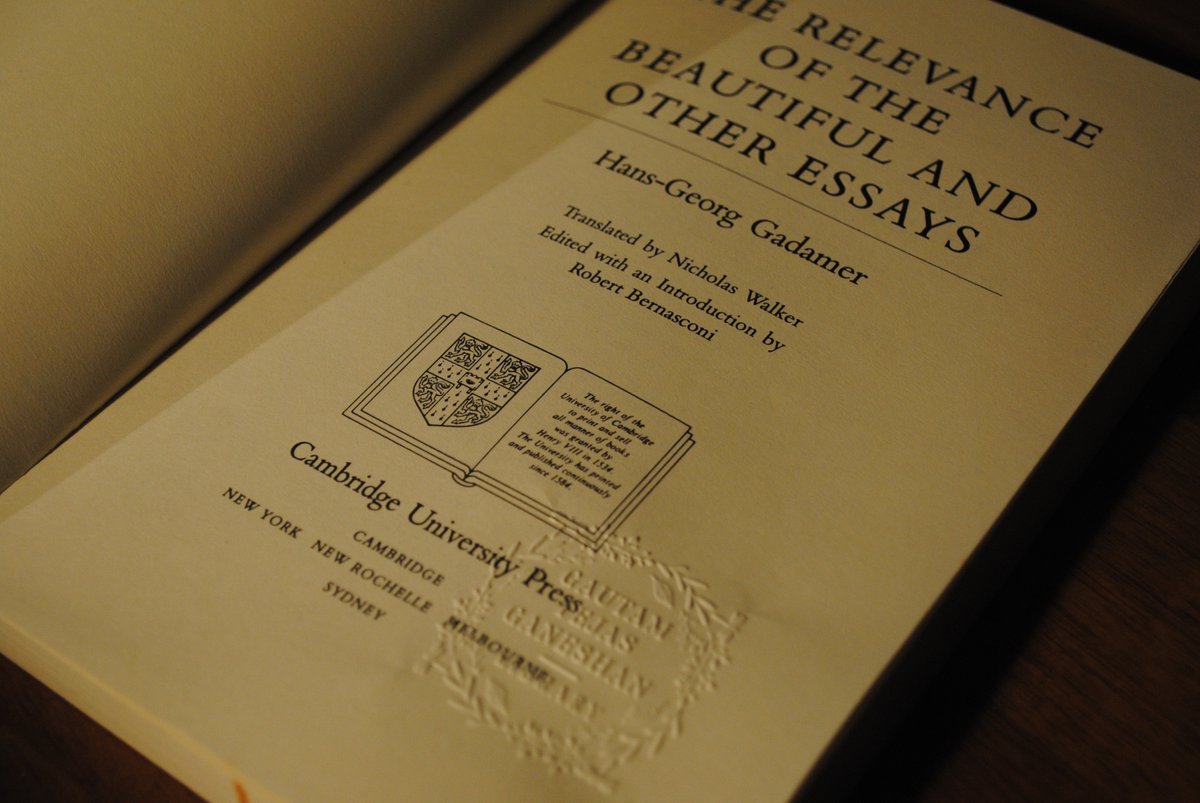
Not one, but *two* copies of that book
grace my shelves, @HorcherF
18 Nov 2025

Gadamer was exceptional among high ranking German professors in philosophy to take the effort and travel to the US and teach - most probably in English -, in order to let the Anglophone world learn about his philosophical achievements.
41
20 Nov 2025
During the earlier dust-up involving @DrAllyLouks
I was moved to write about the element of the matter
that got *my* dander up - and so I defended:
'Whim and Idiosyncrasy, in the Life of the Mind':
x.com/heyGTG/status/18641004…
And now (w/ @juliet_turner6 @daisyldixon et al.)
there is once again a need for the same -
a 'celebration of robust and inspired freedom of inquiry.'
1
42
20 Nov 2025
One reader commented thus, for which I'm grateful:
x.com/kaitlinsm1th/status/18…
5 Dec 2024

I really enjoyed reading this; thank you! I particularly enjoyed your opening and this: "Not merely tolerance of this, but even enjoyment of it, is what I regard as *truly* being an intellectual". I am perpetually stunned to see just how rare this quality is amongst academics.
31
24 Jul 2025
A response to @moveincircles "The King & The Swarm" in @firstthingsmag
I write as one who has *never* owned a 'smartphone'. My attention span is legendary. And so, many of the attention-transforming contemporary depredations are, rather than being for me a 'lived experience' ...
( ... which phrase was orig. leaned on by Dilthey in the 19C, btw, in his effort to demarcate/justify/rehabilitate the 'Geisteswissenschaften' / 'human sciences' from unsavory encroachments *then* ... anyway, where 'retrieval' is a theme, as it is in the essay in question, where the word occurs thrice, let us be as retrievers...)
... things I have witnessed but not internalized. I am the control group, as it were, while the frogs otherwise boil, partout - and it is boiling in the 'shallows' (Carr).
Secondly, I am without question or apology a denizen of the depths of print culture, which I plumb from the café table and the well-worn armchair. And so I am assuredly a partisan, capable of resonating with laments for its loss, from the point of view of one with ample 'interiority', scaffolded by reading.
I celebrate unreservedly this deep-dive essay, I love the form, content, and style, and I think it is a contribution well worth encountering and even emulating. That said, straight to the cavils.
First, chinks in the armor of 'facts and objectivity', the 'load-bearing foundations' of high modernity - did not wait until the day before yesterday to be seriously noticed, and not only in scholarly redoubts but also in meaningful movements of art, culture, and thought.
Let alone mid-century 'post-modernism' - much of whose medium and inroads were assuredly ensconced not beyond but *deep-within* print culture (even in its severe 'recondition', let's say) - there had also been, of course, Romanticism - (identified as the 'artistic antitoxin' to industrialism, by Donald Davidson, in 'I'll Take My Stand') - Bohemianism, cults of nature & l'art-pour-art (Rousseau standing at the fountainhead of one, and who at the other, Goethe? Baudelaire *invented* the word 'modernity', btw, and towered over not the 20C but the 19C, also groveling in its sewers...)
and, significantly, and previously, trenchant critique of the presuppositions of the Aufklärung *right from the outset* - I am thinking of Hamann, who chastised Kant right to his face, and then de Maistre, etc. ( ... the latter, of course, being a required 'retrieval' in any conversation about 'throne and altar', a.k.a. kings, symbolism, &c...)
Some of this is immaterial 'history of ideas' only - but first of all, that is much of the mode of this discourse, is it not, a.k.a. a question of 'the displaced worldview', etc. - but pertinently, where there is a significant question as to the *nature of subjects*, which is putatively under transformation as we speak, it is very much to the point to look directly at 'sources of the self' (to use the C. Taylor language) - and, in my view, to see that these have gone not from stable to disarray *simply* or *recently*, but from palimpsest to palimpsest *throughout*, or else, differently valenced, (but notably, *equally honoring interiority*, and once again, not only recently!), from 'glory to glory', as Gregory of Nyssa would have it, quoting St Paul (the first psychologist? pneumatologist...)
My point is - I thoroughly agree with and myself defend certain of the theses of this essay - that 'entelechy', for-its-own-sake-ness, ends, purposes, and meanings had been casualties, driven out by a totalizing 'panlogism' & 'mathesis universalis', underwritten perhaps by literacy itself, whose 'alphabet' had dethroned the 'goddess' (Shlain), & with its linear clunk-and-grind extrinsic relations only (questioned ably by Bergson, who has largely been forgotten, although not by Kołakowski, & @dr_mcgilchrist ! ), particularly vis-à-vis time itself (a.k.a. 'progress', even 'history' itself, esp. in the 'whig' dispensation, as H. Butterfield would have it...
btw, 1.) I once began an essay w/ an H. Butterfield quote, "Shifting one's Myth: The Interior Overthrow":
x.com/heyGTG/status/18661884…
2.) Regarding W. Ong (orality & literacy), I also found him very fruitful for considering these matters, and speculated in 2024, developing upon his terminology, as to whether we are perhaps in "Tertiary Orality; ( ... & a paradigm for renaissance. )":
x.com/heyGTG/status/18611559…
(i said there, fwiw, that "his primary orality is human oral tradition worldwide, and his secondary orality is the early 20C radio-television-film constellation of the then 'new-media' / 'tertiary orality' is my term for our latest phase, hot off the presses, of longform podcasting, etc.")
ANYWAY
(n.b. this is a *tweet*...)
So although I am fundamentally in agreement w/ elements of this causal narrative (& I would point further to 'After God' by M. Taylor for much useful context re: print culture, Protestantism, and more - the subtitle is "Religion & Postmodernism", & it is referred to many times early in @DrJohnVervaeke 's orig. 'meaning crisis' lectures ... those were the days, eh!)
Let me cut to the chase - I think threats to the deep-reading liberal subject, the one who is required for the 'republic, if you can keep it ... ' are *perhaps* new-in-kind, b/c of the 'digital revolution' - but have *never* been absent or inconsequential.
Or, to put the matter positively - 54% of Americans reading a book is ... par for the course. How many read a book in the 18C? Maybe more during periods of the 19C (esp. women, as I recall the argument of 'The Feminization of American Culture'...)
But now, after the advent of mass culture, we're only back where we started, not 'elsewhere'. Which is, of course, the fundamental verdict and presupposition of a non-progressive historical interpretation, right? Move in circles? Or?
I guess I refer to my own experience - as we all do, eh - for resources in interpreting the *depth* of the threat of digital 'culture' (if that is what it is) to attention spans, etc. And the result of *this* interpretation is - meh. And this meh underwrites a 'motivated reasoning' (is there another kind?) which searches for and finds evidence in some places that 'the kids are alright', that 'bees bee', that humans are, *finally* (a sense I employ deliberately), ordered to truth-seeking, and so where there is 'distraction', they will *find a way* to peer behind the veil and discover the wizard, whether he is a newfangled AI-bot or else an oldfangled plutocratic capitalist purse-string & marionette-string wielder.
I guess I - constitutionally - don't get caught up in handwringing - and this is not ostrich-style, b/c I do acknowledge numerous distressing trends in the zeitgeist and profound ethical failures of public reasoning, etc. And I do not say, either, that the essay in question exhibits a handwringing tenor - rather is it diagnostic, overall, and even dare I say sanguine, in moments, in a sense.
I think, though, that my grounds for hope are rather in the mode of recalcitrance (and here is where the 'lived experience' plays its rôle, and where, perhaps, 'we are not the same') ... rather than in observations about the internet being supposed to 'heighten awareness'. This it may do, but *still* before the rubber hits the road there intervenes, despite everything, not necessarily the 'agentic' rational monad who 'reasons clearly' (a being who has been recognized as a fiction by Pascal, Freud, Augustine, and Hölderlin), but rather the 'person', whose soul has been discussed for millennia, whose complex inner depth is not susceptible of being *totally* reverse-engineered by *any* latter day developments of techné - whether they are literacy as such, or its opposite (more or less) the 'image' - in either the sense from this essay, or else in the recognizably similar sense from 60 years ago, described in Boorstin's "The Image" (see, if history does not repeat, it rhymes...)
This soul, whose inner contact point is with divinity, or at least eternity, has never successfully been dragged into the 'clear and distinct' light, there to be fully understood apart from its depths and source - and moreover, *is not* totally a creature of print culture, and therefore is not really subject to being 'dissolved' by any developments in the latter. I am dancing around the issue a bit, but fundamentally what I am saying is that I do not believe that the 'checked-out, phone-addicted zombies' (who, believe me, I too discern *everywhere*) - represent any kind of 'stable equilibrium' or 'strange attractor' - it just cannot be, given my priors about the human, and I avow the nature of my argument as such, finally. 'This too, shall pass.'
Next on the subject of 'patterns of shared meaning' and 'mnemonic communicative registers' - I certainly know what you mean, the waves of symbolism mysteriously conjuring themselves even throughout the demesne of the severest boolean algorithms, the emergent complexity of online social systems being the field of 'deities and demons' - of a very recognizable sort, it turns out. Social media is basically a ouija board. That we pushed the marker there ourselves, collectively, is *not* a complete explanation, because *within* ourselves, and manifesting 'spiritually' (pneumatology again...) *between* ourselves are forces at play - *once again*, not new!
I'll reproduce here what I wrote to end another essay from 2024, "The Legitimacy of Theology":
x.com/heyGTG/status/18647206…
"And, for what it's worth, I actually don't really buy the 'disenchantment' thesis in the end, notwithstanding the light that I admit it sheds towards some understanding of a certain cultural predicament we were once in.
Because, I don't think it's that hard to name the places where the demons still perch, nestled and abiding in redoubts of soul-scary shadows, with bridges yet uncrossed hovering above trolls who will rise to demand tolls yet unpaid.
And when they do, and when you need to consult your guidebook for advice on what to do and how to handle it, you will find that this advice was written for you once, presciently, by a monk in the previous millennium."
All this is to say that - once again - where we *are* is structurally isomorphic with places we have been *before* - predicamentally, situationally - and, what is more, this is *especially* true in terms of archetype, symbolism, narrative, and myth - i.e., the very 'languages' and 'modes' which are being argued for here as being 'retrieved'. *These* (of all things!) are *not* new, but deeply, deeply, recursive, involuted, and ... traditional.
So, where it is a question of 'metaphysical consequences' of 'information technology', & 'aspects of the medieval conception of reality', I say that rather than anything fundamentally unprecedented, despite all the noise, what we have is, yet again, nature and culture, chaos and order, God, self, and world, freedom and immortality - just as before. (Perhaps this is the time to note that besides 'retrieval', 'emergence' is also a theme of the essay, the word occurring *nineteen* times. So perhaps there is something new under the sun...)
( ... but it is not, I think, the conception of an 'ontology of relations', is it? I need to do more homework here, but at first blush the referent of that phrase would seem to be, simply, *structuralism* - i.e. pre-post-structuralism, a.k.a. 'wild thought', in its Lévi-Straussian canonical formulation - his 'la pensée sauvage' was re-translated in 2021 under that title, as opp. 'the savage mind', under which name it was known for half a century as the ur-text of structuralism. as i understood it, the central point is 'ontology of relations' ... i.e. meaning 'emerges' from patterns ... but i digress.)
Robert Jastrow observes:
“For the scientist who has lived by his faith in the power of reason, the story ends like a bad dream. He has scaled the mountains of ignorance, he is about to conquer the highest peak; as he pulls himself over the final rock, he is greeted by a band of theologians who have been sitting there for centuries.”
This is approximately how I feel about our present moment. Questions about legitimacy under new conditions of literacy or its absence constitute important considerations, but are *also* interpretable tempest-in-teapot style, where the teapot is the internet - which, I say, in the final analysis, *cannot* usurp IRL-touch-grass-meat-space, however much brain-stem colonization it does of the populace (and this it has done, I agree.)
And so, we may have our work cut out for us as to either restitution, or else novel, salutary development, but the nature who bats last here is *human nature*, and so the fundamental questions of the nature of subjectivity, the resources of the person to negotiate insults to his integrity, the sources of unity and com-munity - are not in our time given anything more than a new 'avatar', let us say...
1
449
18 Nov 2025
I, too, wrote about @moveincircles
"The King & The Swarm" in @firstthingsmag
@stephwakefield_
x.com/stephwakefield_/status…
17 Nov 2025

Ok I started a Substack. Maybe you share or subscribe? It is free. Here's a first text on cybernetics, network wars, Agamben, and @moveincircles idea of the swarm king
stephdiane.substack.com/p/sw…
1
136
18 Nov 2025
sed contra:
" When asked for what he [St Thomas]
thanked God most, he answered simply,
'I have understood every page I ever read.' "
- chesterton on aquinas
16 Nov 2025

Not understanding something the first time you read it is good.
89
Gautam Tejas Ganeshan retweeted
17 Nov 2025
I love this discussion, which in itself
must be considered part of the solution
(rather than part of the ... peri-liberal precipitate.)
From my point of view, many of the arguments adduced here 'ground out' in one or another 'tacit dimension', requiring a fund of priors - and in language from earlier in the thread, these are where the 'real fault lines' may be.
For instance:
*Why* are the institutions 'neglected',
or poorly 'maintained'?
I take note of the identification of 'modernity' and 'technological disruption' as causal factors - and I regard this as an insight-producing framing that by no means disposes of the question, but rather pushes it further upstream.
E. M. Forster has a character in Howard's End
[Margaret] speak thus:
"This craze for motion has only set in during the last hundred years. It may be followed by a civilization that won’t be a movement, because it will rest upon the earth."
So, where there is a question of something 'thicker' -
more lasting, more at 'rest upon the earth' (in her words) ...
Seen 'under the aspect of eternity',
the consideration of 'technological disruption'
as a 'first cause' (in some limited sense,
an 'end stop', a 'satisfying explanation')
becomes subsumed under a more perennial,
and more difficult question:
What are people for?
( ... a question asked by Wendell Berry, in a book by that title; i think will recur to this below, but lemme put a few more things on the table here first ... all for the shell game ! )
( ... & the Forster quote is also the epigraph to his 2012 NEA Jefferson Lecture 'It All Turns on Affection'
... incidentally meaning that his comments following from it must be thought to themselves play *some* role of *participation* in one crucial liberal institution - let us say - even as they are in a mode of *pointed critique* of nearly every 'institution' - a mode that he maintained for a half-century. i don't think he was (or is) a 'postliberal' - but on the other hand his critique is premised on the existence *already* of 'remote control' by a 'centralized moral state' (once again, for half-a-century already), as opposed to being a cassandra warning that such a thing *may happen soon, by trend* if only we let down our liberal guard...)
Ok, so: c.f. it was said earlier that the
'cultural crisis is not philosophical;
it's civilizational'
But:
if *this* civilization *is* to be 'followed'
(margaret's words, once again)
(i do not say to have a 'successor',
because that term bears freight needless here)
... the first question here is:
by what *agency* is the either
1. restitution
(and btw, this itself comes in
mode a) 'renewing liberal institutions',
& mode b) 'resurrecting a monolithic system'
( ... you say potato, i say potahto /
'let's call the whole thing off ... ' )
OR
2. growth/progress/development/
liberty-conserving-transformation
so once again the question is,
WHICHEVER of these 'types' of
healing/repair/renewal/resitution/resurrection
is to occur (backwards OR forwards),
*why* will it occur?
And here is where, to my mind,
one of the key 'priors' asserts itself.
I think the thing about the 'moral consensus'
might also be profitably framed as a question
about the 'common good', and I think one of
the gestures that is of the essence of much
thought that styles itself 'postliberal'
is that it has *noticed* that liberalism
*excludes by design*
(i note en passant that its 'design'
is already a thematic fulcrum
of this conversation)
excludes, that is, explicit *consecration*
(and that is the right word,
hence the 'altar' part of the throne-&-altar
dispensation - of which one of history's
archetypal and original exponents has said:
"If you wish to *conserve* everything,
*consecrate* everything." - de Maistre)
The point being that the liberal insistence on something like 'proceduralism' - if that is the right term here - or state-as-'rules of the road'-enforcer, meanwhile bracketing (i employ the term like husserl did) metaphysical questions of meaning and purpose, which questions are not then thought to be w/in the remit of the state to pronounce upon, essentially separates/divorces 'order' from the 'good' - and this is unsustainable, because of ... 1.) human nature (what are people for? one answer is, they are oriented to *togetherness* in truth seeking, and are not fulfilled without 'collective effervescence' - whose dangerous and also simply distasteful/distorting manifestations *cannot* be a reason for the dismissal from history - which has *not* ended with a final-form liberal consensus (have y'all noticed?) - of its being also, in its fruitful/flourishing manifestations, being *of the essence* of human society and civilization, and *deeply desired* by all people, in their heart of hearts),
2.) as has been noticed and discussed in a *vast* literature, symbolized in one way as the 'immanentizing of the eschaton': in fact the very pseudo-religions whose identification and denouncement are the *contemporary* liberal's stock in trade (i.e. distancing ourselves decisively from mid-20C highly destructive non-pluralism and vicious-form 'collective effervescence') (where, btw, the *original* liberal was *also* identifying, denouncing, and distancing himself from something similar, but previously in *another* pseudo-religious form, the proto-nationalist 'wars of religion')
... that is, the 'god shaped hole' problem, which everyone is somewhat familiar with as a cultural analysis or diagnosis. (what do i think of it? i cross apply my statement from above *exactly*: it is an "insight-producing framing that by no means disposes of the question, but rather pushes it further upstream.")
So, basically, the - ( ... is it Rawlsian? so is the file labeled in my mind as a placeholder, but if another has said it better or more influentially, let's go with that) - the bright line between the Public, which is to be strictly limited where it comes to ultimate questions, and the Private, where 'comprehensive doctrines of the good' are allowed to exist in their plurality - is *not sustainable*, simply.
For whatever reasons.
Postliberalism appears to *begin* with
*noticing this as a fact*.
And so once again, if some manner of
healing/repair/renewal/resitution/resurrection
is to occur, the proposal of many is that
it will be *precisely*
philosophical / cultural,
because *those are the current failure modes*,
and *those explain why the institutions
are 'neglected', or poorly 'maintained'.
And here is where I recur to Wendell Berry's lecture,
which was titled, once again,
'It All Turns on Affection'
in order to point out, simply,
that the strictly limited state -
particularly, limited precisely on the question of specifically enunciating and being *ordered by* 'metaphysical questions of ultimate meaning and purpose'
is *not* something which
1.) *can possibly be* (potency)
or 2.) in fact currently *is* (act)
regarded with *affection* by ... anybody.
Even the liberals ought to be chastened by history.
D.C. Schindler points out that:
"The reduction of the common good, for which the state is responsible, to fairness and the preservation of peace, has neither entailed a minimizing of state regulations nor kept the state out of matters of putatively private conviction, as disputes over 'religious freedom' demonstrate ... Legal interventions into matters that had previously been deemed 'private', such as marriage and family, education, and the like, are no longer surprising, and conversely, the resulting erosion of a sense of meaning has quite evidently weakened the security of the public order."
These facts should embarrass principled liberals,
and should encourage a drawing-board 'rethink',
which is of course the 'period of reckoning'
identified earlier in this thread - the thread itself,
of course, *instantiating* the reckoning.
(It should be carefully noted that D.C. Schindler is *not*, to my understanding, an 'integralist'. The subtitle of his book is 'The Church *Between* Liberalism and Integralism'. (my emph.))
(While we're at it, it should *also* be noted that on the question of 'technological disruption' as *cause* of something, rather than as *effect* of something else, Wendell Berry is very eloquent as the longstanding critic of a *culture* that has failed in the first place to adequately consider its 'a priori' relation to its *technology* -
a critical stance with some overlap with Neil Postman, Christopher Lasch, Ivan Illich, Jacques Ellul, and Albert Borgmann, to name a few.
The essence of their position, if I may make so bold as to herd the cats here, is *not* that ineluctable forces of modernity and technology require reinscription of 'institutional design', which 'reinscription' many of them would take to be simply 'recrudescence' (esp. that 'design' in its 'high modern' form, as Mumford may have added) - but rather that something essential *about* that institutional design, is precisely what has potentiated a disordered *response to* technology.)
And what is that something? One insight can be gained from a 14C work by Ibn Khaldun (that Toynbee the historian described as:
"... undoubtedly the greatest work of its kind that has ever been created by any mind in any time or place … the most comprehensive and illuminating analysis of how human affairs work that has been made anywhere."
well!)
... whose thesis is that societies thrive or fail according to a fundamental criterion of 'social cohesion', and that in a sociological 'factor analysis', this factor explains more about the others (technology, e.g.) than the others explain about it.
NOW:
Let me aver my liberal bona fides.
From my point of view there are two essential gems in the liberal vision. (I do not say babies in the bathwater, because I, being constituted by gratitude, do not consider our present moment a 'bathwater', but a precious gift, *large proportions of which* have been thought out and worked out by liberals and the liberal order.)
The first is an absolute distaste for coercion.
I too affirm this unreservedly,
*especially* as an affect,
and I am a votary of the unsupressable
free individual human spirit.
So where there is a proposal of
'imposing a compulsory moral vision',
I am firmly against this, with conviction.
I think *another* 'real fault line' lies precisely here -
turning on the question of whether the
*recognition and enunciation*
of higher order truths*,
(*what are these? i define them by a quote shortly.)
and *openness* to 'the state' being
structured/formed/'designed'
by these, *receptively*,
rather than *specifically excluding* them,
whether this is the SAME THING AS,
or 'requires' or 'makes unavoidable'
'centralization' and 'concentrated power'.
With @theoeides4 and also with Berdyaev,
I am not convinced of this.
Berdyaev opines:
(and here are the 'higher order truths'):
"Knowledge, morality, art, the State, economics, all must become religious, not by external constraint but freely and from within."
The *second* 'gem' of the liberal vision is a valorization of the 'long sweet day of the sidewalk café'.
I think Benjamin Constant, for example - a *beautiful* and *searching* spokesperson for the liberal vision - simply fell in love, in Anglophile fashion, with the 'deeply liberal society' (a quote from this thread) exemplified across the channel, and basically crafted an 'apology for the pub' - an inquiry into the political conditions and requirements for its continued existence.
And I share this inquiry with him, lo these many years later, and I share his - and all of our - extreme distaste for coercion in matters of conscience (distaste is too weak - we do not countenance it, simply.)
And yet I also do not regard the positions and inquiries in question in this thread as a violation of his spirit - but rather their continuation and historical deepening.
What *actually* sustains, conserves, promotes *freedom* and flourishing?
Simply what we have now,
or else what we had the day before yesterday?
Or something *new*, something unprecedented?
I see postliberalism, (at its best, it goes without saying)
as asking these questions open-mindedly,
and not as, let us say, captured unthinkingly
by the 'retvrn' mentality.
Finally, Benjamin Constant, for his part, who 'adhered without reservation to the doctrine of Enlightenment liberalism' - *also* wrote a *long*, agile work:
'On Religion'.
Why?
Here is the historian of liberalism Pierre Manent:
" ... his soul suffered from, and therefore was troubled by, certain moral effects of the improved civilization of perfectibility that was in the process of triumphing. The reign of utility and self-interest narrows and weakens souls. They leave idle certain of their highest faculties, and end by putting liberty itself in danger. How to make up for this deficiency in strength and vitality? In order to resolve the problem introduced by the triumph of enlightenment for which he had worked so zealously, Constant's solution was one that would have surprised Voltaire, and even Montesquieu:
religion, or a certain version of religion."
1
1
195
Gautam Tejas Ganeshan retweeted

15 Nov 2025
Gautam is recommending great autobiographies. Lovely post!
14 Nov 2025
I've been meaning to circle back to this post
of yours, to add my 2c.
So first, here's a tweet from earlier this year,
where I collected many of my fave autobios:
x.com/heyGTG/status/19241279…
Coupla notes (& then more entries!):
@dr_mcgilchrist says of Chargaff's 'Heraclitean Fire'
that it is an "intellectual autobiography [which]
should be read by every scientist..."
('the matter with things', vol. 1, p. 412)
Berdyaev describes his 'Dream & Reality'
as a 'philosophical autobiography' -
and it is longer on the evolution of his beliefs
(or shall we say the 'grammar of his assent')
than on biographical detail, but it is one of my
favorites, for its searching honesty.
Then there is Renouvier's
'How I Arrived at This Conclusion',
which promises to be in much that same vein,
but which, though translated & published as
recently as 2011, I have not been able to obtain.
(Reminds me of a detail from the famous story about St Thomas Aquinas, you know the one where he bangs the table in the presence of royalty, overtaken by his insight 'like a man in the grip of a dream'. Well, evidently when they had been first approaching the hill and the spires, someone remarked:
'How grand it must be to own all this.'
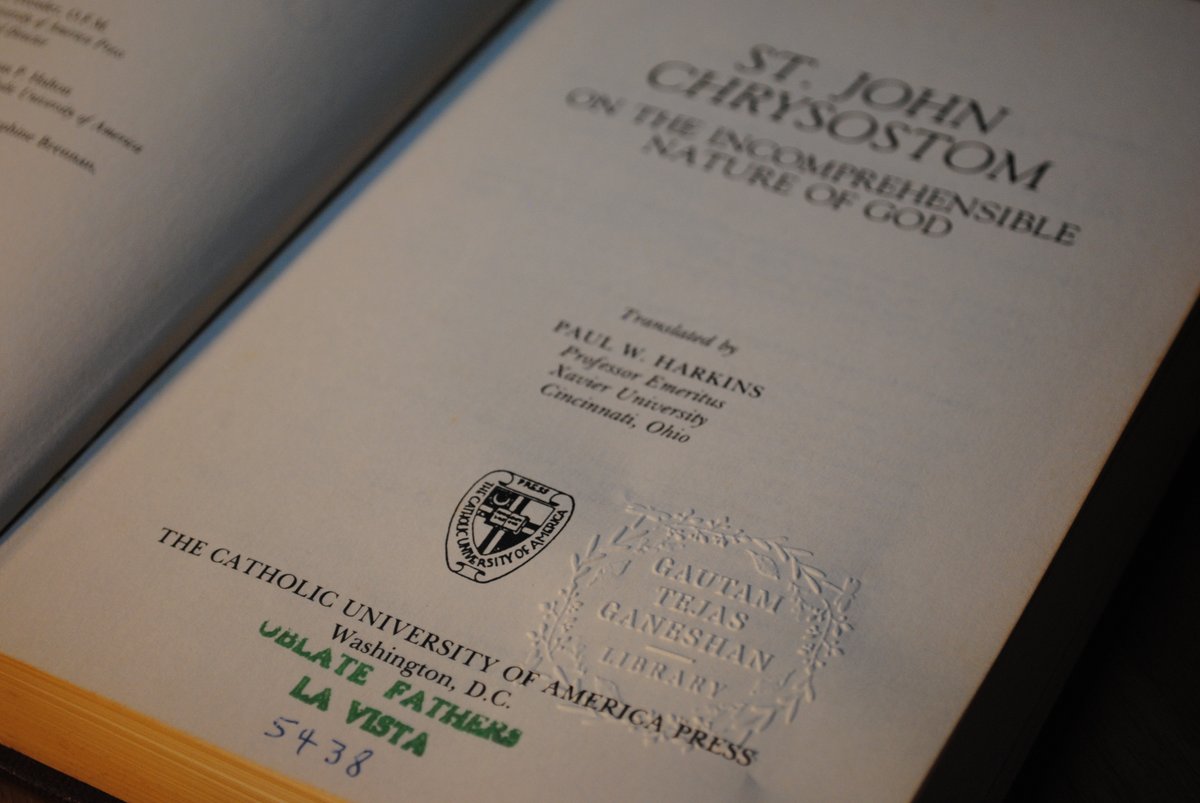
'... and Thomas Aquinas only muttered, 'I would rather have that Chrysostom MS. I can't get hold of.'
- from Chesterton)
Some poets have left memoirs, for example Tennyson, 'the most instinctive rebel against the society in which he was the most perfect conformist' (- eliot).
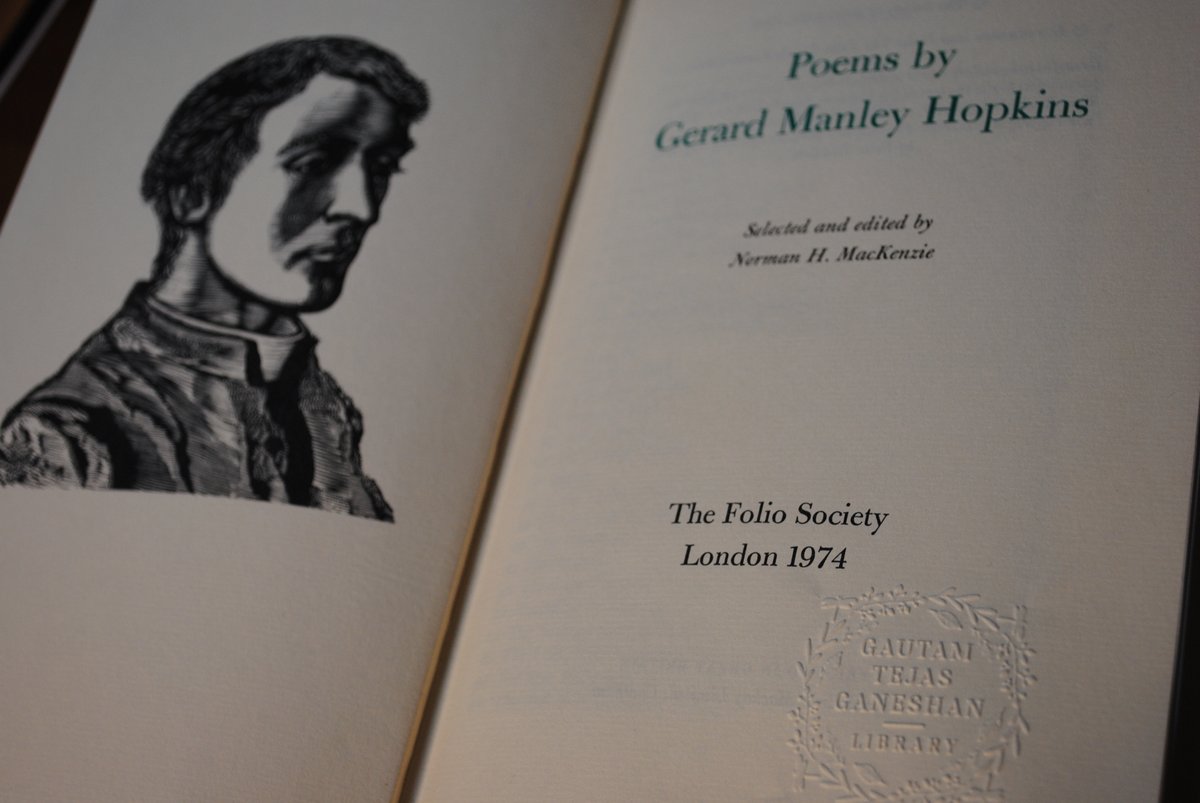
Also Gerard Manly Hopkins, about whose diaries Josef Pieper said the following:
"It is well here to speak of the diaries left by Gerard Manley Hopkins. They are filled with testimonies of earthly contemplation; indeed, they speak of little else. This poet, who united dynamic and powerful language with the most refined spiritual perception, devoted passionate attention to the 'inscapes' of the visible world - not for the sake of pedantic realistic description, but in order to achieve awareness and obtain possession of the thousandfold riches of the works of God."
Of course Merton's 'Seven Storey Mountain' shall be included, and besides Thérèse of Lisieux's 'Story of a Soul' ('The Little Flower') from the 19C, there is of course Teresa of Avila's 'Life' ('by Herself') from the 16C, in which: "There is no suggestion of that nonsense about my supposed sanctity."
Bede Griffiths 'The Golden String' is a fascinating document about a fascinating life, whose final 35 years were lived in an ashram in India. His story provides signature material for consideration at the outset of C. Taylor's 'A Secular Age'. Not only will a quick survey of the basics of his itinerary (interior and exterior) pique your interest, I am sure, but I will also say that his account of his 'formation', let us say, in his own words, provides an extraordinary example of being vastly considered, and yet right down to ... well ... *the golden string*, i.e. what really mattered - to *him*, the person - w/in all the philosophy and theology. And we are talking about a serious, thorough journey, which began as follows:
'When I came down from Oxford,
C. S. Lewis advised me to read some philosophy,
to make up for my not having read Greats...'
'Deliverance from Error' is how Al-Ghazali titles his own autobiography, and it is well worth encountering his own account of the comprehensiveness of his lifelong efforts. He says: "In the bloom of my youth and the prime of my life, from the time I reached puberty before I was twenty until now, when I am over fifty, I have constantly been diving daringly into the depths of this profound sea ... I would penetrate far into every murky mystery, pounce upon every problem, and dash into every mazy difficulty ... I would never take leave of an interiorist without wanting to learn about his interiorism, or a literalist without wanting to know the the substance of his literalism, or of a philosopher without seeking to become acquainted with the essence of his philosophy ... or of a sufi without eagerly trying to obtain knowledge of the secret of his serenity, or of a devout worshiper without looking into the source and substance of his piety, or of an irreligious nihilist without attempting to find out his background and motivation in order to become aware of the reasons for his bold profession of nihilism and irreligion."
Ruskin's 'Praeterita', written in a regained moment of lucidity towards the end of his life, is by some accounts his most moving work - evidently Proust came to know it by heart (or shall we say, 'committed it to memory' ... ) - & it was described by E.I. Watkin (who *also*, btw, figures prominently for Bede Griffiths!) as being:
"largely the loving and sorrowful record of pieties vanished". The author of a long study on Ruskin ('The Darkening Glass') describes it as 'the most charming autobiography in english.' (I submit all this to you, not having read it myself ... yet.)
Although we could all surely think of more, I'll round out the list with Kathleen Raine (the Blake scholar, poet, and ... 'critic' is not the right word ... 'traditionalist interpreter'? words fail me.) Anyway she has also written what she calls 'Autobiographies' (I think in recollection of Yeats's 'Autobiographies'.)
And finally, the psychologist Helene Deutsch wrote a 'Confrontations with Myself' - which, written nearly 30 years after her 2 vol. 'Psychology of Women', she 'realized that it forms a supplement' to, and so describes it as an 'epilogue' to that work. I think this is a very admirable procedure.
Oh!
One last comes to mind, and that is Raïssa Maritain's 'We Have Been Friends Together' & 'Adventures in Grace' - memoirs of early 20C Parisian intellectual & spiritual life together with her husband Jacques.
Oh and The Pillow Book is indeed charming, and another collection of observations that comes to mind are Kenkō's 'Essays in Idleness', one of which includes the following:
"People often say that a set of books looks ugly if all volumes are not in the same format, but I was impressed to hear the Abbot Kōyū say, 'It is typical of the unintelligent man to insist on assembling complete sets of everything. Imperfect sets are better.'"
It is so.
1
2
283
Gautam Tejas Ganeshan retweeted
14 Nov 2025
I've been meaning to circle back to this post
of yours, to add my 2c.
So first, here's a tweet from earlier this year,
where I collected many of my fave autobios:
x.com/heyGTG/status/19241279…
Coupla notes (& then more entries!):
@dr_mcgilchrist says of Chargaff's 'Heraclitean Fire'
that it is an "intellectual autobiography [which]
should be read by every scientist..."
('the matter with things', vol. 1, p. 412)
Berdyaev describes his 'Dream & Reality'
as a 'philosophical autobiography' -
and it is longer on the evolution of his beliefs
(or shall we say the 'grammar of his assent')
than on biographical detail, but it is one of my
favorites, for its searching honesty.
Then there is Renouvier's
'How I Arrived at This Conclusion',
which promises to be in much that same vein,
but which, though translated & published as
recently as 2011, I have not been able to obtain.
(Reminds me of a detail from the famous story about St Thomas Aquinas, you know the one where he bangs the table in the presence of royalty, overtaken by his insight 'like a man in the grip of a dream'. Well, evidently when they had been first approaching the hill and the spires, someone remarked:
'How grand it must be to own all this.'
'... and Thomas Aquinas only muttered, 'I would rather have that Chrysostom MS. I can't get hold of.'
- from Chesterton)
Some poets have left memoirs, for example Tennyson, 'the most instinctive rebel against the society in which he was the most perfect conformist' (- eliot).
Also Gerard Manly Hopkins, about whose diaries Josef Pieper said the following:
"It is well here to speak of the diaries left by Gerard Manley Hopkins. They are filled with testimonies of earthly contemplation; indeed, they speak of little else. This poet, who united dynamic and powerful language with the most refined spiritual perception, devoted passionate attention to the 'inscapes' of the visible world - not for the sake of pedantic realistic description, but in order to achieve awareness and obtain possession of the thousandfold riches of the works of God."
Of course Merton's 'Seven Storey Mountain' shall be included, and besides Thérèse of Lisieux's 'Story of a Soul' ('The Little Flower') from the 19C, there is of course Teresa of Avila's 'Life' ('by Herself') from the 16C, in which: "There is no suggestion of that nonsense about my supposed sanctity."
Bede Griffiths 'The Golden String' is a fascinating document about a fascinating life, whose final 35 years were lived in an ashram in India. His story provides signature material for consideration at the outset of C. Taylor's 'A Secular Age'. Not only will a quick survey of the basics of his itinerary (interior and exterior) pique your interest, I am sure, but I will also say that his account of his 'formation', let us say, in his own words, provides an extraordinary example of being vastly considered, and yet right down to ... well ... *the golden string*, i.e. what really mattered - to *him*, the person - w/in all the philosophy and theology. And we are talking about a serious, thorough journey, which began as follows:
'When I came down from Oxford,
C. S. Lewis advised me to read some philosophy,
to make up for my not having read Greats...'
'Deliverance from Error' is how Al-Ghazali titles his own autobiography, and it is well worth encountering his own account of the comprehensiveness of his lifelong efforts. He says: "In the bloom of my youth and the prime of my life, from the time I reached puberty before I was twenty until now, when I am over fifty, I have constantly been diving daringly into the depths of this profound sea ... I would penetrate far into every murky mystery, pounce upon every problem, and dash into every mazy difficulty ... I would never take leave of an interiorist without wanting to learn about his interiorism, or a literalist without wanting to know the the substance of his literalism, or of a philosopher without seeking to become acquainted with the essence of his philosophy ... or of a sufi without eagerly trying to obtain knowledge of the secret of his serenity, or of a devout worshiper without looking into the source and substance of his piety, or of an irreligious nihilist without attempting to find out his background and motivation in order to become aware of the reasons for his bold profession of nihilism and irreligion."
Ruskin's 'Praeterita', written in a regained moment of lucidity towards the end of his life, is by some accounts his most moving work - evidently Proust came to know it by heart (or shall we say, 'committed it to memory' ... ) - & it was described by E.I. Watkin (who *also*, btw, figures prominently for Bede Griffiths!) as being:
"largely the loving and sorrowful record of pieties vanished". The author of a long study on Ruskin ('The Darkening Glass') describes it as 'the most charming autobiography in english.' (I submit all this to you, not having read it myself ... yet.)
Although we could all surely think of more, I'll round out the list with Kathleen Raine (the Blake scholar, poet, and ... 'critic' is not the right word ... 'traditionalist interpreter'? words fail me.) Anyway she has also written what she calls 'Autobiographies' (I think in recollection of Yeats's 'Autobiographies'.)
And finally, the psychologist Helene Deutsch wrote a 'Confrontations with Myself' - which, written nearly 30 years after her 2 vol. 'Psychology of Women', she 'realized that it forms a supplement' to, and so describes it as an 'epilogue' to that work. I think this is a very admirable procedure.
Oh!
One last comes to mind, and that is Raïssa Maritain's 'We Have Been Friends Together' & 'Adventures in Grace' - memoirs of early 20C Parisian intellectual & spiritual life together with her husband Jacques.
Oh and The Pillow Book is indeed charming, and another collection of observations that comes to mind are Kenkō's 'Essays in Idleness', one of which includes the following:
"People often say that a set of books looks ugly if all volumes are not in the same format, but I was impressed to hear the Abbot Kōyū say, 'It is typical of the unintelligent man to insist on assembling complete sets of everything. Imperfect sets are better.'"
It is so.
18 May 2025
Excellent autobiographies:
I'd like to teach a course
where we read thru these & discuss,
maybe beginning with Plutarch's Lives.
The Education of Henry Adams
An Autobiography - R. G. Collingwood
Memories, Dreams, Reflections - C. G. Jung
Chapters in the Course of My Life - Rudolf Steiner
Apologia Pro Vita Sua - J. H. Newman
Confessions - St Augustine
Praeterita - Ruskin
Panegyric - Guy Debord
My Life - Benvenuto Cellini
Istanbul - Orhan Pamuk
The World of Yesterday - Stefan Zweig
A Mathematician's Apology - G. H. Hardy
How I Arrived at this Conclusion: A Philosophical Memoir - Charles Renouvier
Story of a Soul: The Autobiography of St. Thérèse of Lisieux
Dream and Reality: An Essay in Autobiography - Nicolas Berdyaev
Heraclitean Fire: Sketches from a Life Before Nature - Erwin Chargaff
1
2
1
497
Gautam Tejas Ganeshan retweeted
12 Nov 2025
Did y'all know that the philosopher D.C. Schindler
( ... whom I esteem greatly among living philosophers and whose existence & productivity are very worthy rejoinders to this @AntigoneJournal question:
x.com/AntigoneJournal/status… )
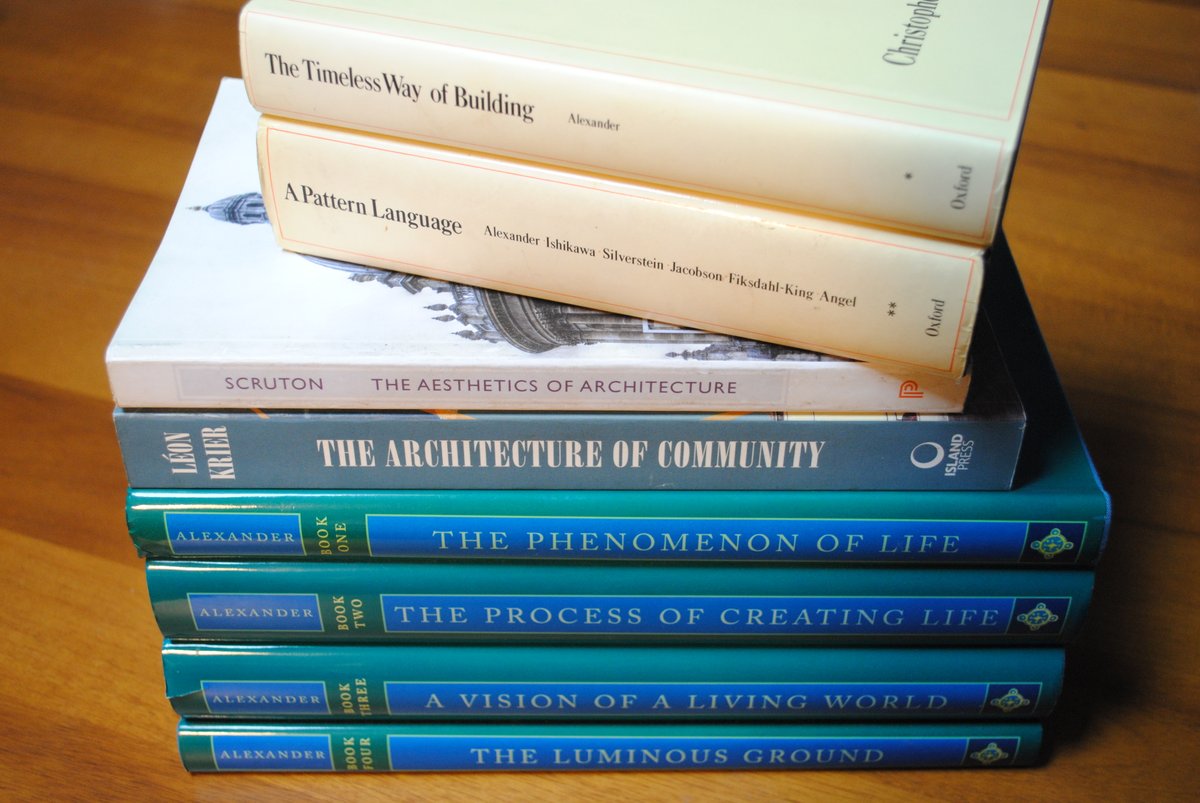
... was a close reader of Christopher Alexander?
From 'Misology and the Modern Academy':
(no, autocorrect, *not* 'mixology'...)
(my favorite one, btw, is:
'gnothi seauton' -> 'gnocchi season')
(a more apt commentary on the culture is not needed)
(this from a fan of gnocchi,
which is btw a fun family project!)
"Second, there is, moreover, a pervasive tendency in contemporary Western culture toward abstraction, understood in this context to mean the isolation of one aspect of an issue from others, and to treat that aspect as complete within itself. Christopher Alexander, for example, has suggested that the root cause of the crisis in contemporary architecture is the absolutization of individual desiderata in thinking about buildings, which results in a failure to integrate those desiderata into the larger, relativizing whole, leading to a general, ugly incoherence."
This has, as well, a useful footnote:
"Alexander points to particular assumptions regarding truth (that it consists of 'scientific' facts) and order (that it is essentially mechanistic) as the cause of this incoherence. See Christopher Alexander, *The Phenomenon of Life*, book one of *The Nature of Order: An Essay on the Art of Building and the Nature of the Universe* ... "
[pictured below]
@JoshHochschild u may recall that i am he who once replied to you about never having owned a so-called 'smart phone' ( ... which is a tragic misnomer, as we all now know). for your interest, here, once again, is the 'get off my lawn' diatribe i once disburdened myself of about the same, which piece is perhaps not up to the standard of other things i have written, but beyond it ... in 'spleen', let us say:
'I have never had a smart phone.'
x.com/heyGTG/status/19303369…
1 Nov 2025

Why have there been so few great philosophers born in the last 100 years? Answers of no more than one sentence please.
1
1
114
Gautam Tejas Ganeshan retweeted
12 Nov 2025
I once expressed a disposition to Spinoza,
taking brief, whimsical account of
this very 'quibble':
( ... i will not say i 'disposed of spinozism',
b/c i assuredly did not.) 🧐
x.com/heyGTG/status/19226788…
"I am a gaian. I don this mantle solemnly and proudly, or rather drape myself in its loosely flowing robes. I skate over theological error with the words of Léon Bloy: “Philosophy bores me, theology overwhelms me...” Pantheism is not an argument, it is an excogitation (ptooey!), glossing, for the mind’s sake, poor thing, the *participation mystique* (Lévy-Bruhl) of the *body* in the *natural world*. Obviously there’s more to say, and Spinoza has said it, but take heart ye theologians: the witches for now join the lists with you..."
1
53
11 Nov 2025
I, too, did an early ( ... all too early ... )
dive into Nietzsche - but isn't this a bit like
beginning an education into humor w/
the joke about the chicken crossing the road?
... which is funny precisely because it's
*not like the other jokes*?
"Here: this is philosophy!" Daunting and Strange!
1- Nietzsche
2-Plato, Republic
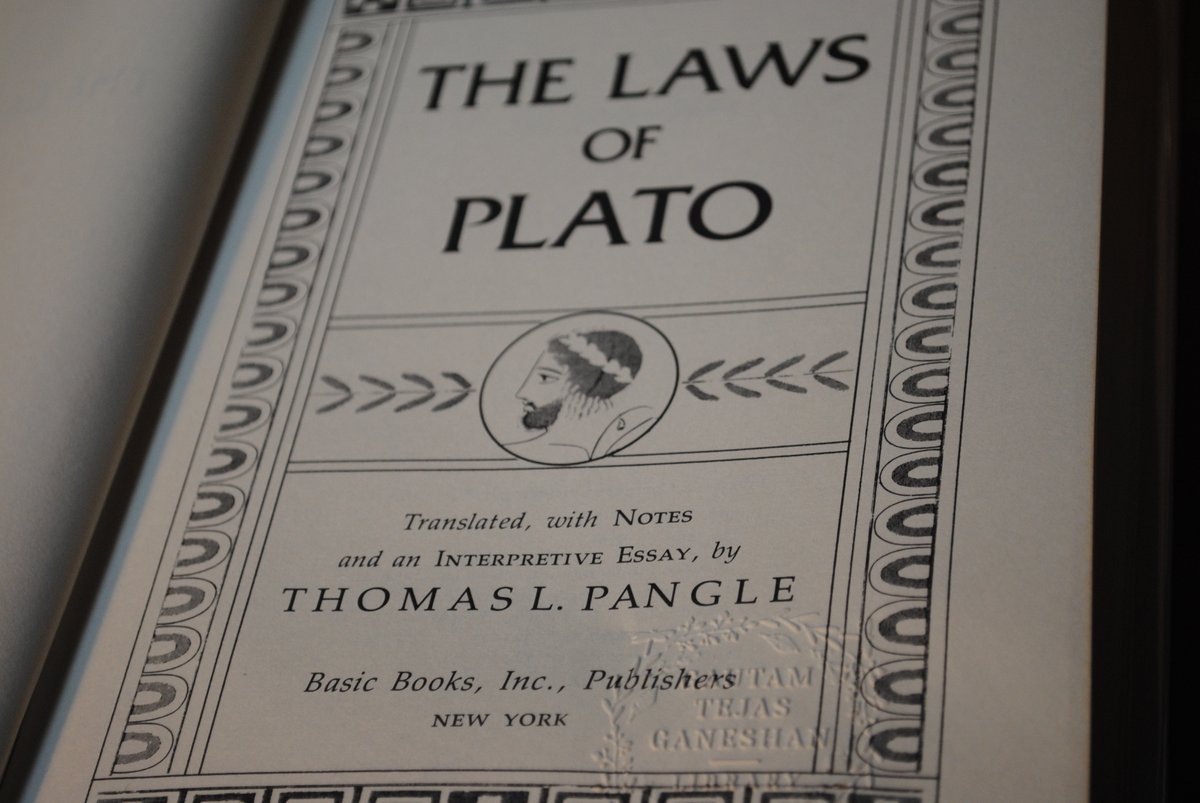
3-Plato, Laws
4-Aristotle, Politics
5-Plato, Theaetetus
6-Plato, Phaedrus
7- Union with the ONE
1
1
66
12 Nov 2025
To play along, @zenahitz et al.,
my answer might be as follows:
( ... absurdly keeping it to seven ...)
1. Sarva-Darśana-Samgraha,
(which, according to philosopher
( ... chair at Oxford for 16yrs )
( & former president of India! )
S. Radhakrishnan:
"sketches sixteen systems of thought so as to exhibit a gradually ascending series, culminating in the Advaita Vedanta (or non-dualism)"
2. Nāgārjuna
(consummate philosopher of emptiness, relentless applier of critical dialectical method *avant la lettre*, most pure exemplar and predecessor of all later 'apophasis' & recusal, to whom modern nihilists hold no candle - and, not a nihilist either, which position he has *also* calmly dismantled ... if he was a proponent of anything, it is the *inner conflict of reason itself* ... )
3. Ken Wilber
(keeping it real here.)
Teilhard / Gebser / Neumann / Jung
(honorable mentions!)
4. Jacques Maritain / Émile Meyerson
A.N. Whitehead / Hans Jonas
- philosophy of *life* & *organism* -
... & 'science' generally: Koyré, Duhem ...
oh! let's not forget SCHELLING
5. Dilthey / Husserl / R.G. Collingwood,
Troeltsch & 'Methodenstreit' (incl. Gadamer...)
Ortega y Gasset, Huizinga, Burckhardt, Meinecke
- 'historism vs. historicism', &c. -
6. Cassirer / Epistemology / Critique of Knowledge
also Scheler, Bergson, W. James
'varieties of knowing', 'methodological pluralism', etc.
lotsa phil.-inclined 'social studies' (anthro, socio, economico, politico, culturo - like Tönnies, Weber, Mannheim, E. Shils, Eliade, Illich, Ellul, Ingold, Lasch ... also C. Dawson, G. Marcel, A. Schütz, E. Voegelin ... too many to name, obv.)
7. Theology.
(impossible to compass or adequately describe.)
for one thing, i consider *many* of the 'gifford lectures' to have been illuminating in one way or another.
for another, edith stein is undersung,
& her magnum opus 'finite & eternal being'
(newly retranslated in oct. 2024...)
is, imho, perhaps a *key* text for interfacing the
'ancients & the moderns', let us say.
besides, many 'belles lettres' & even 'lit crit'
are also interesting from a phil. perspective.
Geez ... in the end, I have not done the job. 😅
Undertaking this 'seven storey mountain' was a mistake, because of my woeful inadequacy to the task. The above leaves so much out of account as to be misleading. The story does not *end*, for one thing, and for another, is completely recursive ('hermeneutic circle' & all ... )
Oh well!
1
39