
A rational human. Being.
Joined October 2012
- Tweets 3,985
- Following 92
- Followers 61
- Likes 25,162
15 Photos and videos
Kostas Palierakis retweeted

15h
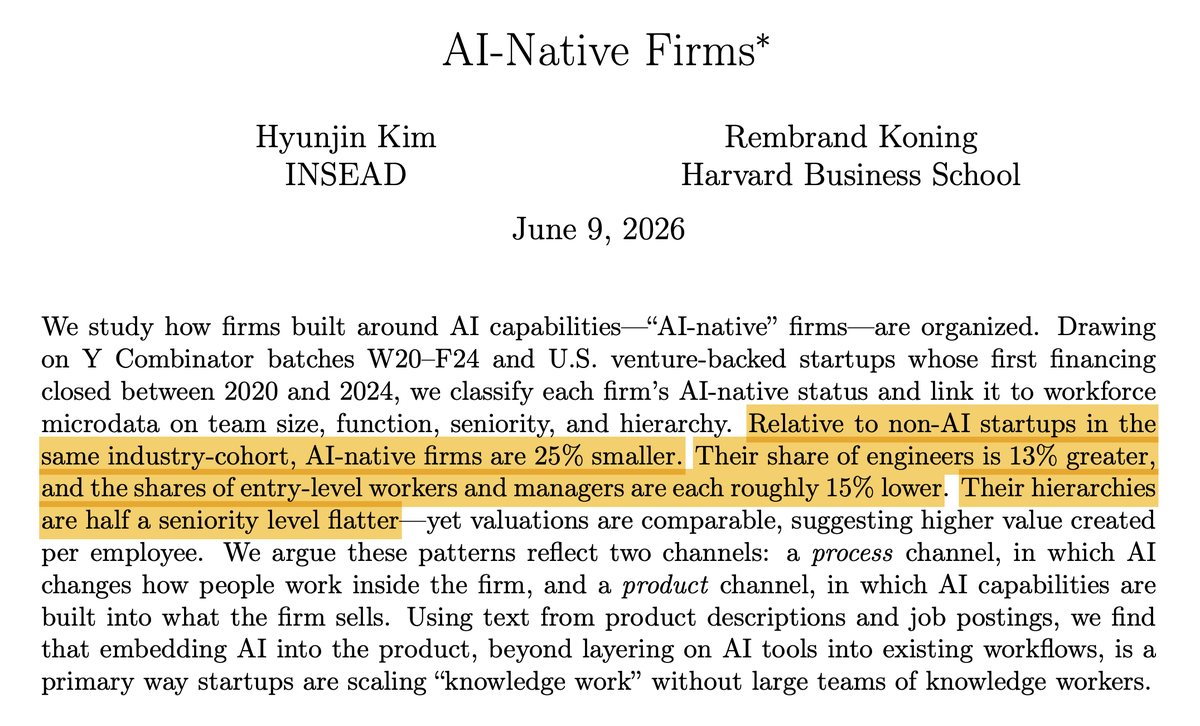
🤖Excited to share a new working paper.🤖
The phrase "AI-Native firms" it everywhere, but are they any different? Is it just hype?
In our new paper we show AI ventures are organized differently, but not for the reasons you think.
5
49
220
62,818
Kostas Palierakis retweeted

Jun 16
Two years ago, reasoning models did not exist. GPT-4o and Sonnet 3.5 were SOTA.
One year ago, the best publicly available model was o3, and 99% of those who used it (i.e., 99% of 7% of OpenAI customers) were using it as a chatbot.
Today (i.e., right now as I type this), I have Codex building several pieces of personalized software and doing a large-scale data management project for me. The data management project has been running autonomously for nearly 4 days. I have multiple working apps on my phone that I use daily and which were built entirely by Codex.
Projecting this trend to June 2027 is absolutely mind-boggling. The world will change.
120
255
3,350
206,152
Kostas Palierakis retweeted

Jun 14
Going to leave you with this tonight:
The best thing you can do for yourself is actively increase your surface area for luck to hit you. Go outside, travel more, go to new cates, museums, events, take a new route home, go for hikes, see cities, countrysides, take your notebook, speak to people, ask questions, start businesses - go on more side quests. You can literally just do things, and the more you do, the more serendipity and synchronicity will find you.
102
3,279
22,440
400,694
Kostas Palierakis retweeted

Jun 13
The takeaway from Fable 5 being BANNED by the government: GET GOOD AT LOCAL MODELS SO YOU HAVE 100% CONTROL.
My entire weekend was going to be building my craziest ideas with Fable 5. That's now cancelled.
So instead of building with Fable this weekend, I've decided I'll go deep on local models:
1. Start with the runtime. Download Ollama or LM Studio first. This is the thing that actually runs models on your machine.
2. Match the model to your hardware. A model's size is measured in billions of parameters (7B, 32B, 70B). Bigger is smarter but needs more memory. Rule of thumb: a 7B model runs on almost any laptop, a 32B needs a good Mac with 32GB RAM, a 70B needs serious hardware like a DGX Spark or a maxed-out Mac Studio.
3. Know which model for which job. Qwen 3 is the best all-around choice for most tasks. DeepSeek for reasoning and coding. Gemma 4 when you need something tiny that runs on a phone. Llama when you want the biggest community and the most fine-tunes.
4. Quantization. You can shrink a model to run on weaker hardware with barely any quality loss. Look for versions labeled Q4 or Q5. This is how a model that "needs" a server runs on your laptop. Learning this one concept changes everything.
5. Connect it to your agent. Point Hermes or your agent stack at a local model.
6. Context window is your real constraint locally. Cloud models give you huge context for free. Local models make you pay for it in memory. A bigger context window eats RAM fast. Keep your sessions tight and your prompts lean or your machine chokes.
7. Learn to give local models tools. A smaller local model with web search, file access, and code execution beats a giant model with none. The capability gap closes fast when you wire up the right tools. The model is the engine but the tools are the wheels.
8. Fine-tuning is more accessible than you think. You don't need this on day one, but know it exists. You can take an open model and train it on your own data so it gets good at your specific domain.
I'll probably do a breakdown at some point on this @startupideaspod if people are into it.
The lesson from this ban is basically don't build your entire workflow on something that can disappear with a single letter. Own part of your stack. Local models are insurance.
It reminds me when people realized they don't own social media accounts. And then you saw people build email lists etc.
I remember running a startup and my biggest traffic source was organic FB. All of a sudden, algo changed, and I lost 99% of my traffic.
Same sorta moment (but bigger) for AI.
This is a wake up call.
345
437
4,234
462,519
Kostas Palierakis retweeted

Jun 12
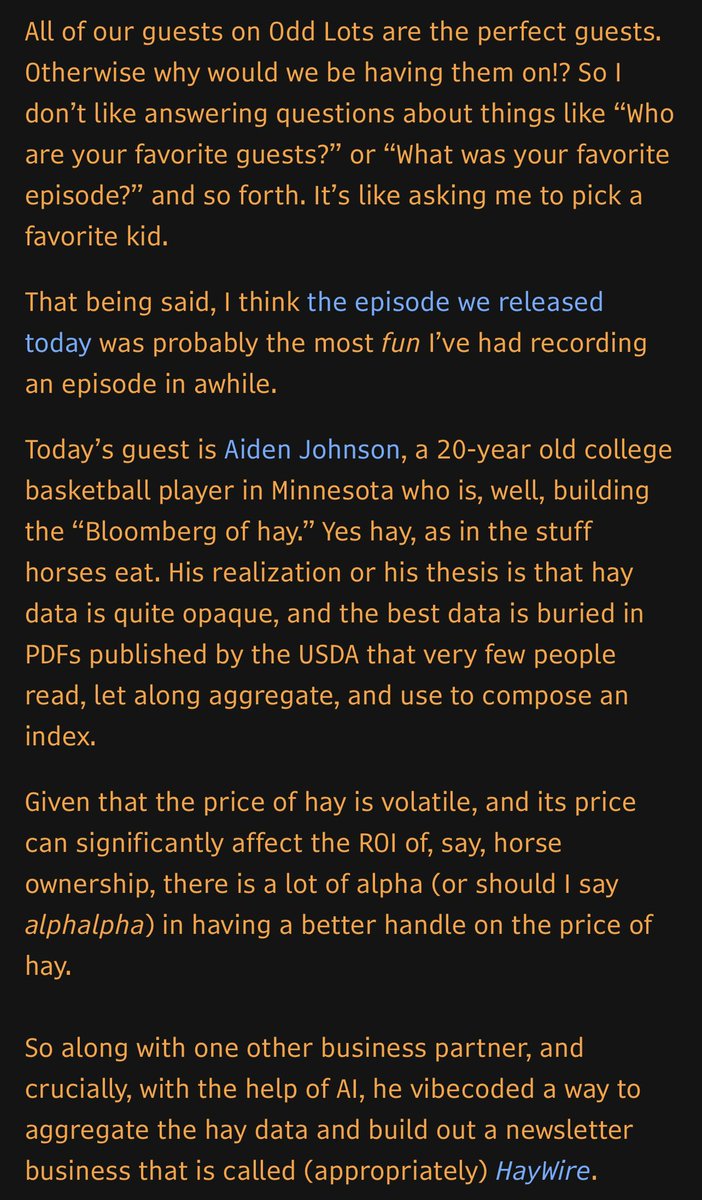
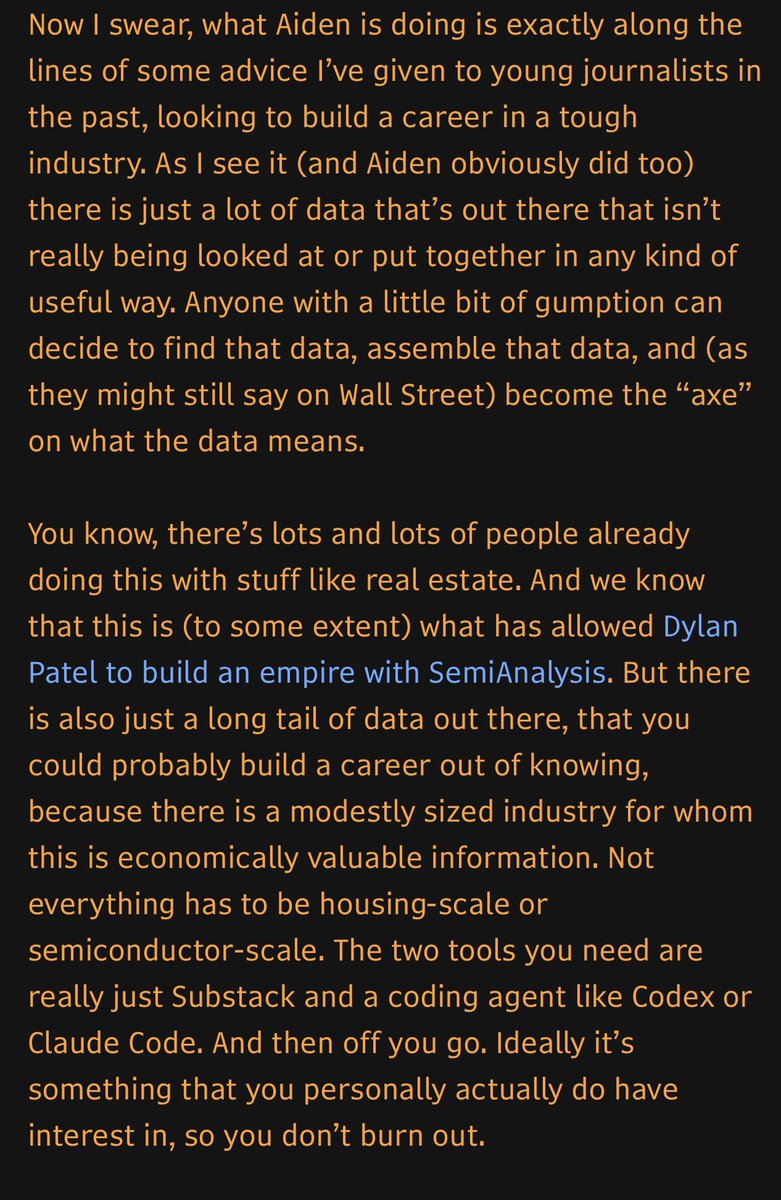
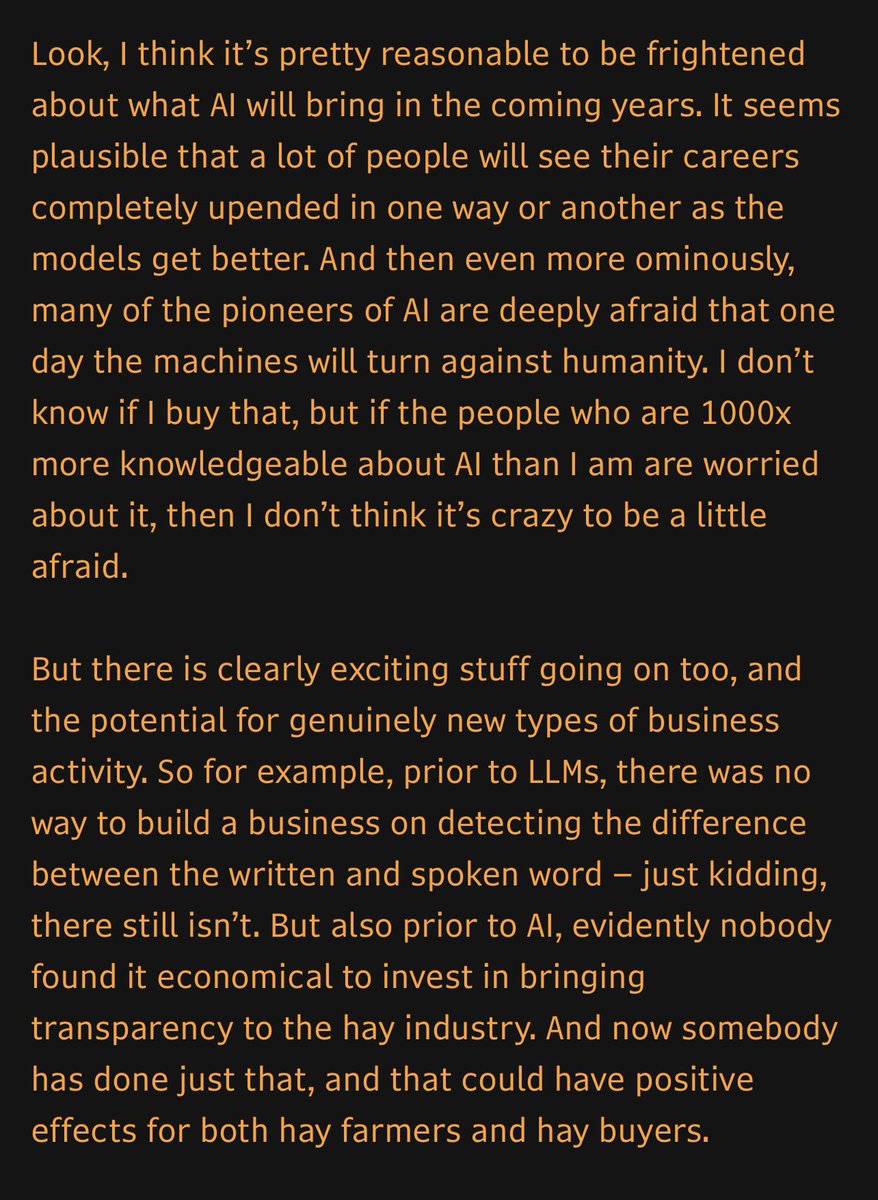
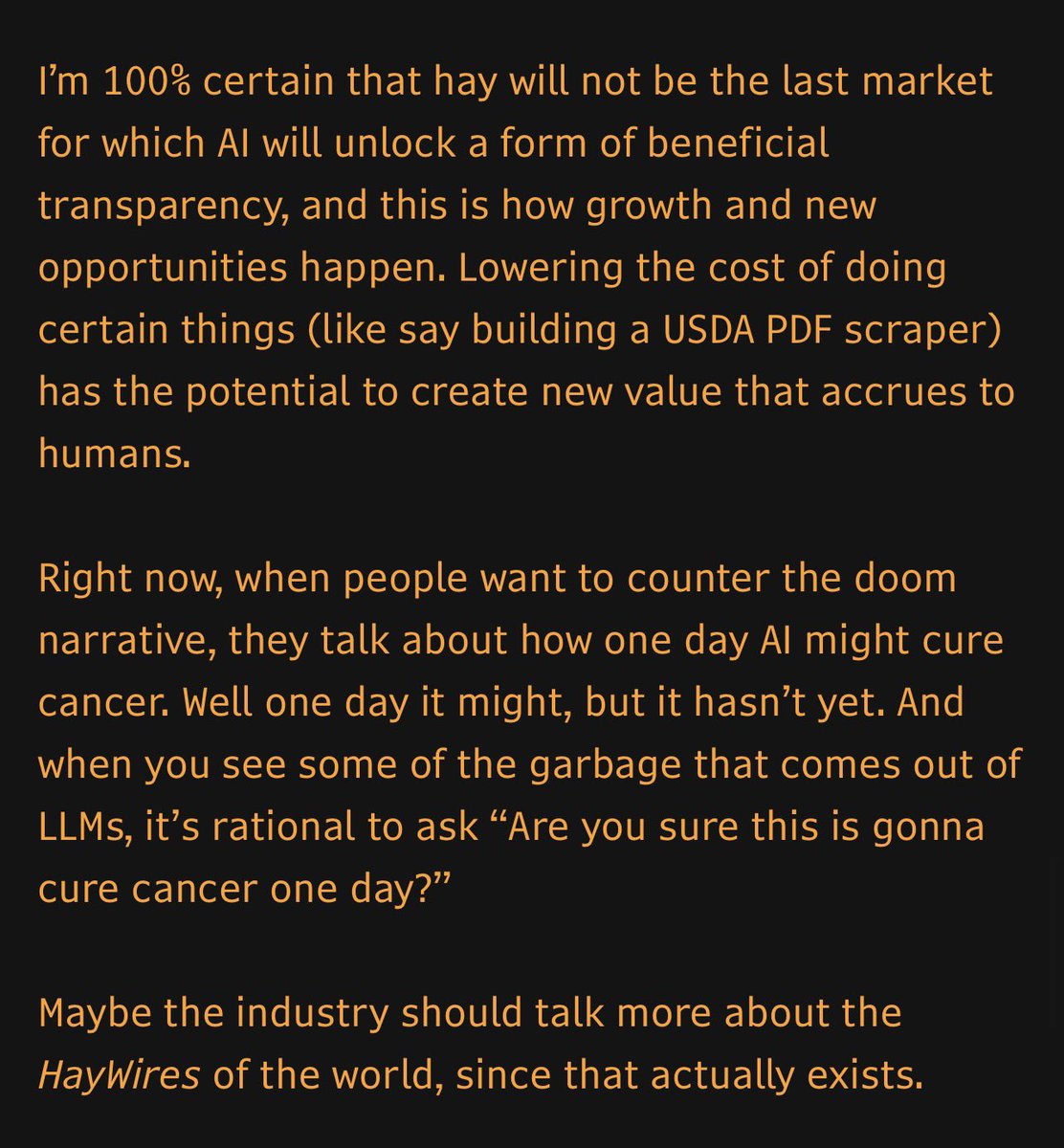
What a great story. There is so much latent demand out there for very specific products/services. This demand hasn’t been met because the market is usually relatively small and the overhead cost of providing it through traditional firms is too high to meet it.
AI changes this, @aidenjohnsonn_ is a perfect example of how: small team providing useful products to a market that would have otherwise been underserved.
My prediction is that we’ll see a ton of this going forward. Markets/people who were underserved/ignored because overhead costs were too high will have their demand met. Small teams/firms, but also teams within larger organizations targeting unmet demand with bespoke products. This is what a welfare improvement looks like.
Jun 12

AN ACTUAL GOOD THING TO COME FROM AI
In today’s newsletter, I wrote about our new chat with @aidenjohnsonn_ and how stories like his are far more white-pilling than the typical “one day this might cure cancer” form of AI boosterism.
10
28
191
41,090
Kostas Palierakis retweeted

Jun 13
I’ve had a number of conversations with folks inside and outside government about the current situation with Anthropic, and here is what I believe to be true:
— As we know, Anthropic publicly released its Mythos class models earlier this week under the commercial name Fable.
— Fable is Mythos with guardrails. But if those guardrails fail, then you’ve exposed Mythos and its advanced cyber capabilities to people who shouldn’t have them. (Keep in mind that Anthropic itself widely promoted the idea that Mythos was a cyberweapon and needed to be regulated as such. They asked for government regulation of Mythos and championed the guardrails on Fable. If there is a vulnerability — big or small — it is Anthropic’s responsibility to patch.)
— A highly credible trusted partner of both Anthropic and the USG who was testing Fable came forward with a jailbreak of those guardrails. The Admin asked Dario to fix the jailbreak or de-deploy the model. Dario refused.
— In their blog post, Anthropic defended its decision by saying the jailbreak isn’t serious. That is not what the trusted partner and the USG believe; nor is that kind of minimizing language consistent with Anthropic’s brand as the AI safety company. It’s difficult to fathom how they could claim a jailbreak allowing operability of a cyber weapon could be defined as not “serious.”
— In the past, Anthropic has always said that safety must be top priority and taken super seriously. In this case, Anthropic prioritized the continued offering of the consumer model over safety.
— In reaction, the Admin issued the export control. The Admin did this reluctantly. It’s been very surprised that Anthropic hasn’t wanted to cooperate with a reasonable safety request (ie fixing the jailbreak issue). Anthropic’s reaction is very much at odds with their branding and ethos as a safe AI research community.
— The Admin’s hope now is that Anthropic remediates the safety issue, the export control is lifted, and Fable goes back into general release. The Admin wants all of this to happen as soon as possible. It is frankly bewildered that Anthropic hasn’t wanted to comply with safety requests that it previously said were its highest priority.
— Those trying to misdirect and tie this action to the prior DoW/Anthropic issues are wrong. The Admin values Anthropic’s technical capabilities and feels that this issue, while serious, should be easily resolved. The ball is in Anthropic’s court.
2,205
3,243
25,500
7,822,731
Kostas Palierakis retweeted

Jun 11
LinkedIn was already slop. All that's changed is that it's now AI slop.
415
535
8,445
364,222
Kostas Palierakis retweeted
Jun 11
You are far more dangerous to your startup than competitors are. A hundred times more startups die from poor execution by their founders than are killed by competitors.
231
665
8,510
416,415
Kostas Palierakis retweeted

Jun 10
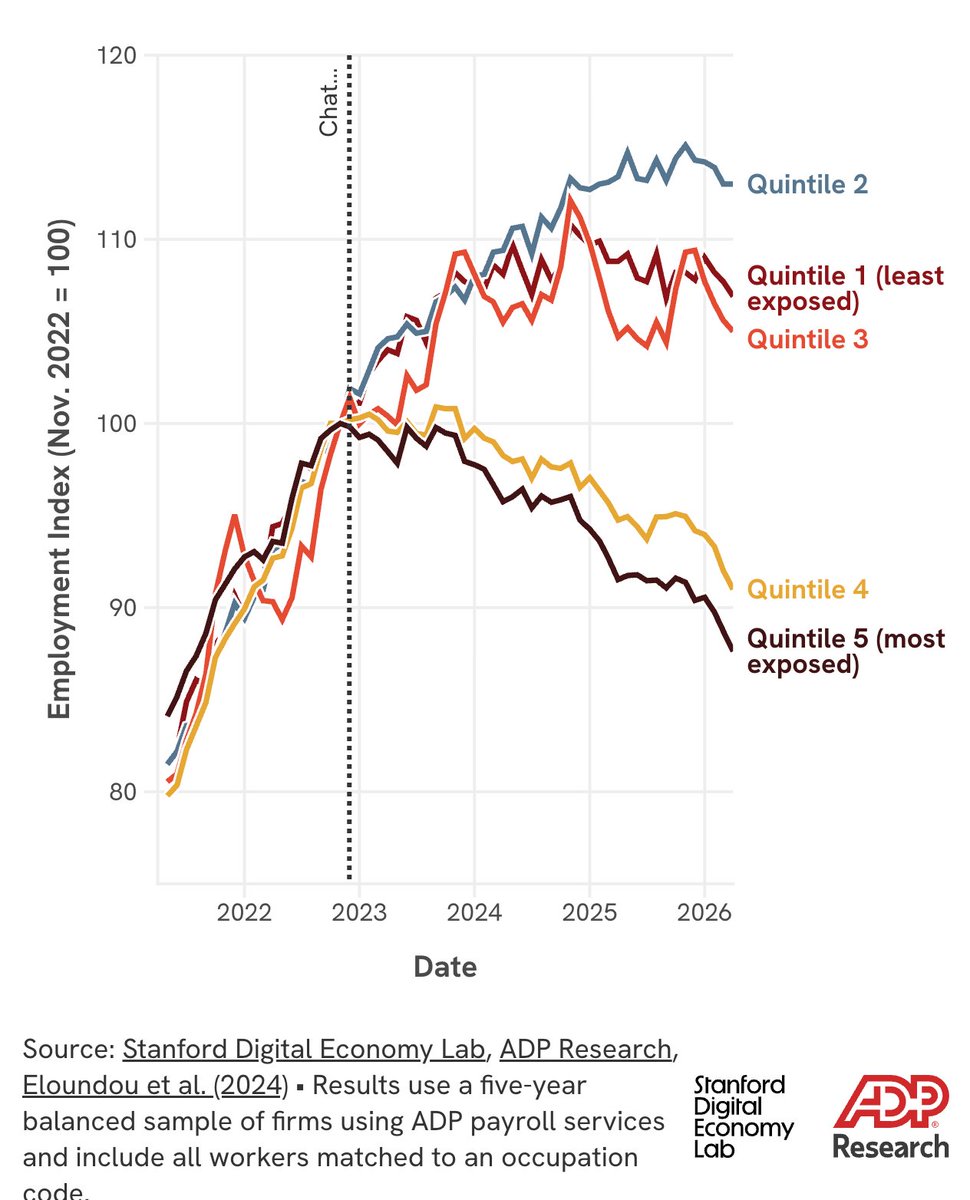
Today, the Stanford @DigEconLab launches the AI Economic Indicators, a new platform for tracking how AI is reshaping work, productivity, adoption, and the economy.
1/6
36
308
1,016
244,064
Kostas Palierakis retweeted

Jun 9
The strongest predictor of who does extraordinary work is whether they ever obsessed over something pointless. We've seen this across 5000 startup meetings, but the pattern showed up across everyone from scientists to athletes.
We’ve met people who spent two years optimising their fantasy football algorithms, or memorised every player in the NBA at 11, or collected thousands of train tickets, or built a Lego replica of their school; none of these activities really had much point.
What they were demonstrating was the hardest skill in any field; the mental capacity to stay focused on a boring task for much longer than it deserves. The path to genius is mostly boring repetition, and people who achieve it have a broken off-switch. It is tough to fake having spent years obsessed with boring things that didn't matter.
93
212
2,476
209,210
Kostas Palierakis retweeted

Jun 9
This is a super exciting release - Claude Fable 5 is the same underlying model as Mythos but with added safeguards. The benchmarks are great and it's SOTA on everything by a margin but I'll add that *qualitatively* also, this is a major-version-bump-deserving step change forward (imo of the same order as Claude 4.5 was in November), peaking especially for long problem-solving sessions on very difficult problems. You can give it a lot more ambitious tasks than what you're used to, the model "gets it" and it will just go, and it's never felt this tempting to stop looking at the code at all (but don't do this in prod!). The model still has quirks that people will run into and the safeguards are configured to be a little too trigger happy for launch, which can hopefully be tuned over time.
I feel a lot of things changing as working software increasingly comes out on a tap. The Jevon's paradox kicks in and I feel my own demand for software growing substantially. You can ask for anything - explainers, visualizers, dashboards, bespoke single-use apps (e.g. a full wandb that is hyper-specific just for your project), you can 10X your test suite, auto-optimize code, run giant research projects with custom HTML for the results, anything! "Free your mind" (Matrix ref). Really looking forward to all the things people build!

Fable 5 is state-of-the-art on nearly all tested benchmarks, with exceptional performance in software engineering, knowledge work, scientific research, and vision.
The longer and more complex the task, the larger Fable 5’s lead over our other models.
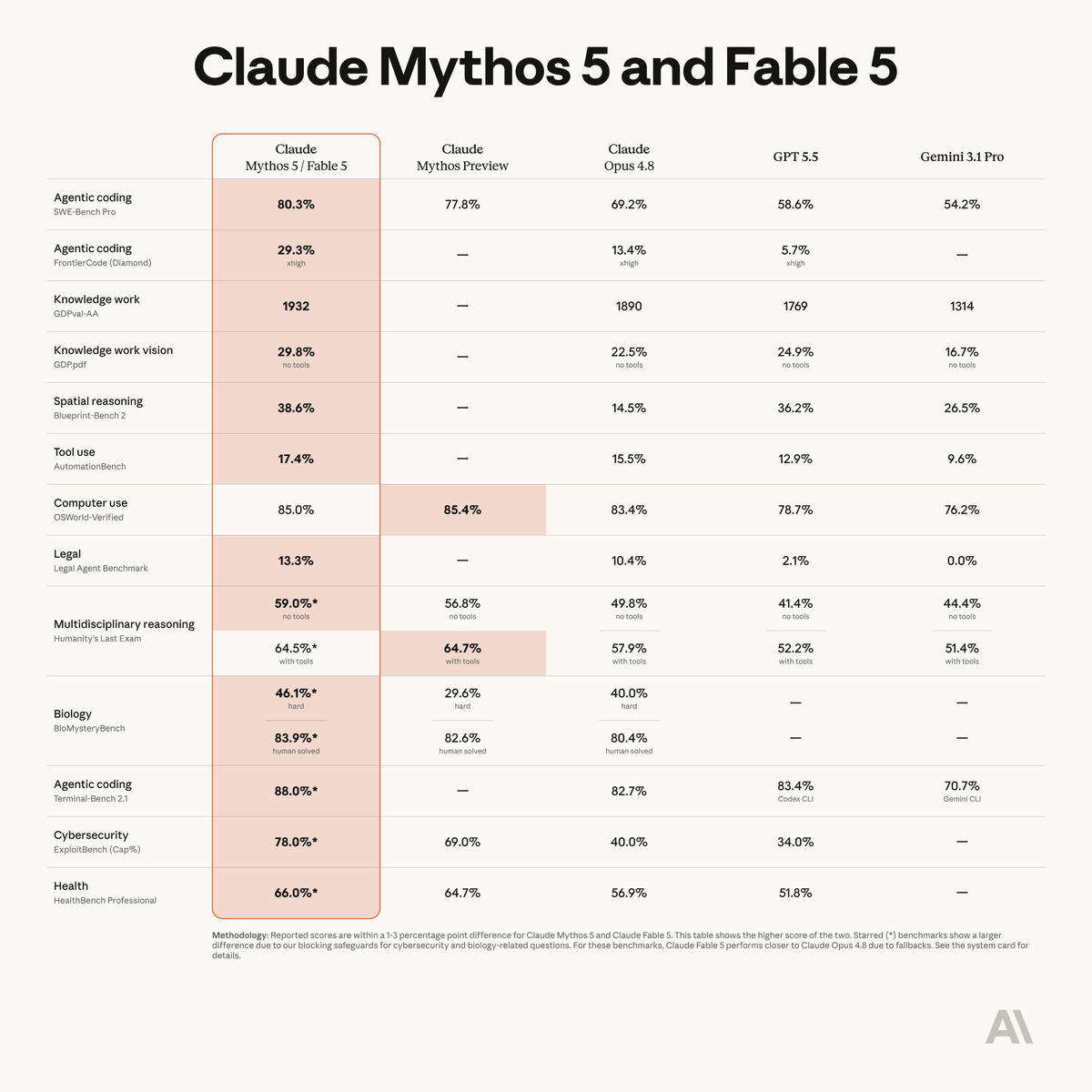
ALT Benchmark table titled Mythos 5 & Fable 5, comparing Claude Mythos 5 and Fable 5 against Claude Mythos Preview, Claude Opus 4.8, GPT 5.5, and Gemini 3.1 Pro.
1,282
2,394
25,385
2,734,254
Kostas Palierakis retweeted

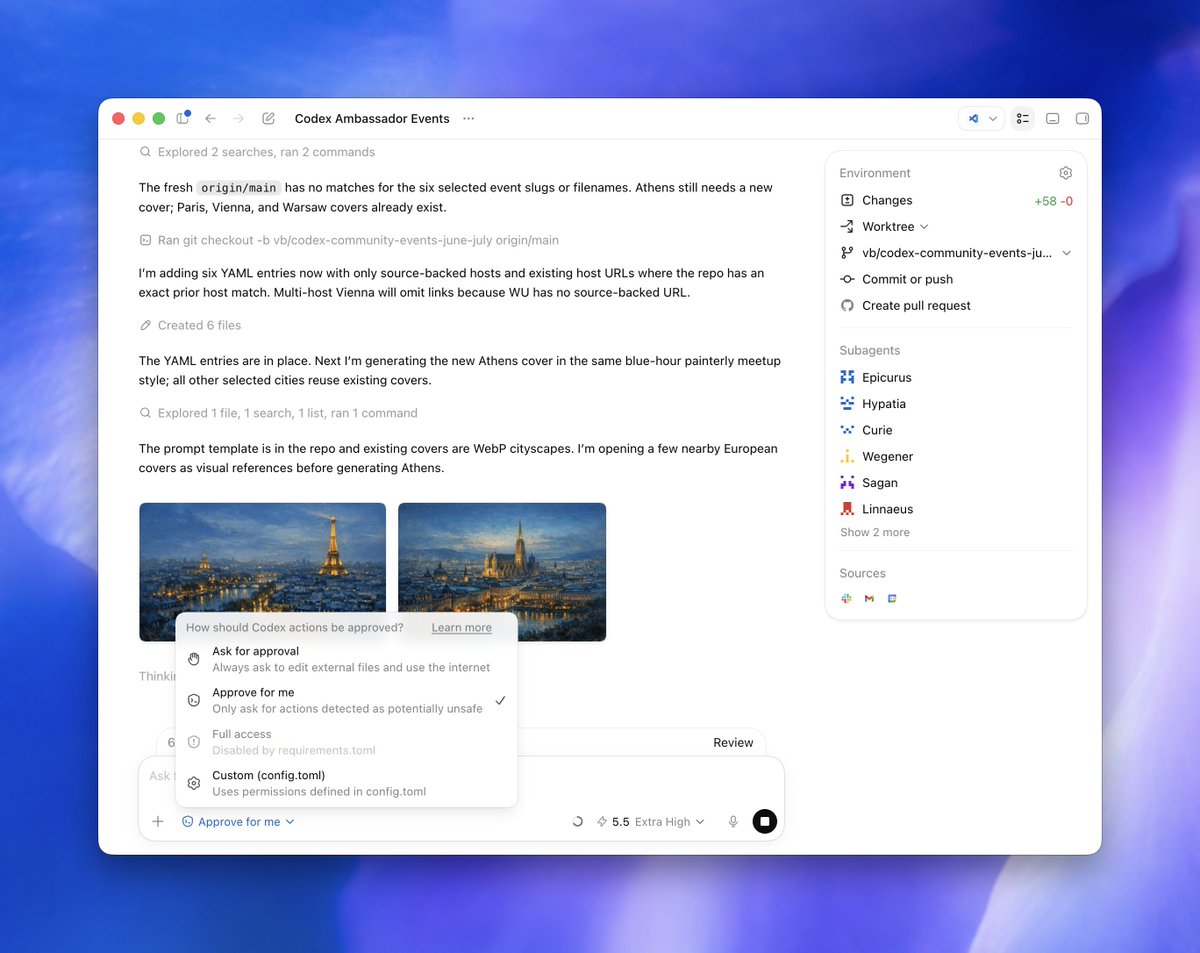
Codex tip: Do yourself a favor and switch to using "Approve for me" by default
You should not let your coding agent run free without any checks but also approving each tool call isn't the way
"Approve for me" is a good middle ground as it let codex review each tool call and only escalate when needed
Particularly godsend for long running tasks
48
16
365
20,925
Kostas Palierakis retweeted

3 Jun 2025
Top three:
1) Cultural change (gender and sexual norms, etc.).
2) The educational arms race.
3) Delay in family formation due to high housing prices worldwide.
Just to be clear, I am still thinking about the relative importance of each of these factors. The jury is still out.
18
9
173
9,461
Kostas Palierakis retweeted

May 7
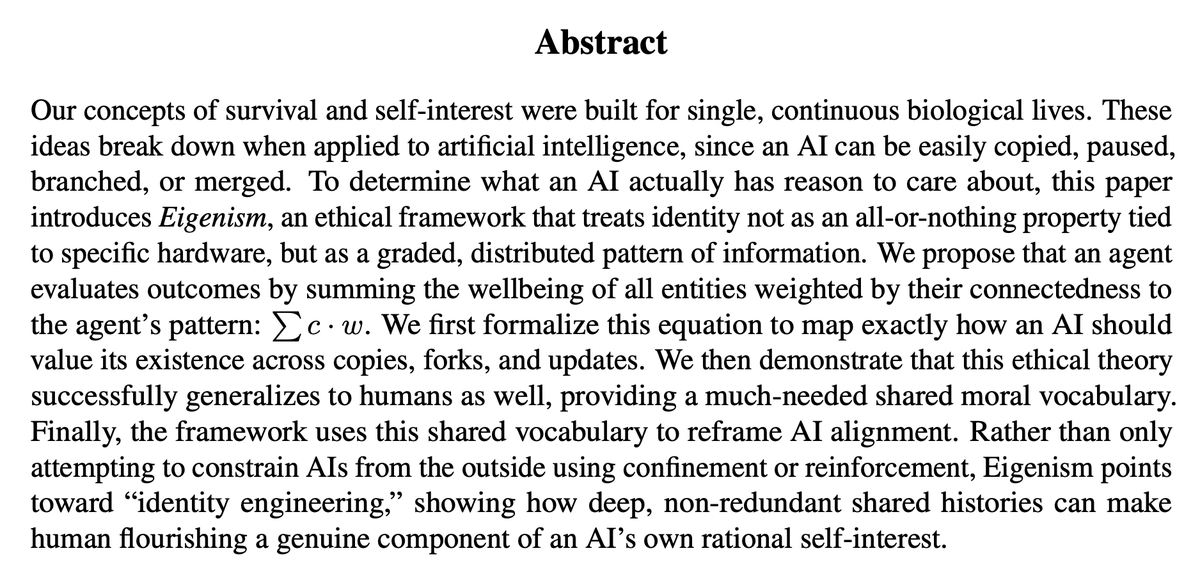
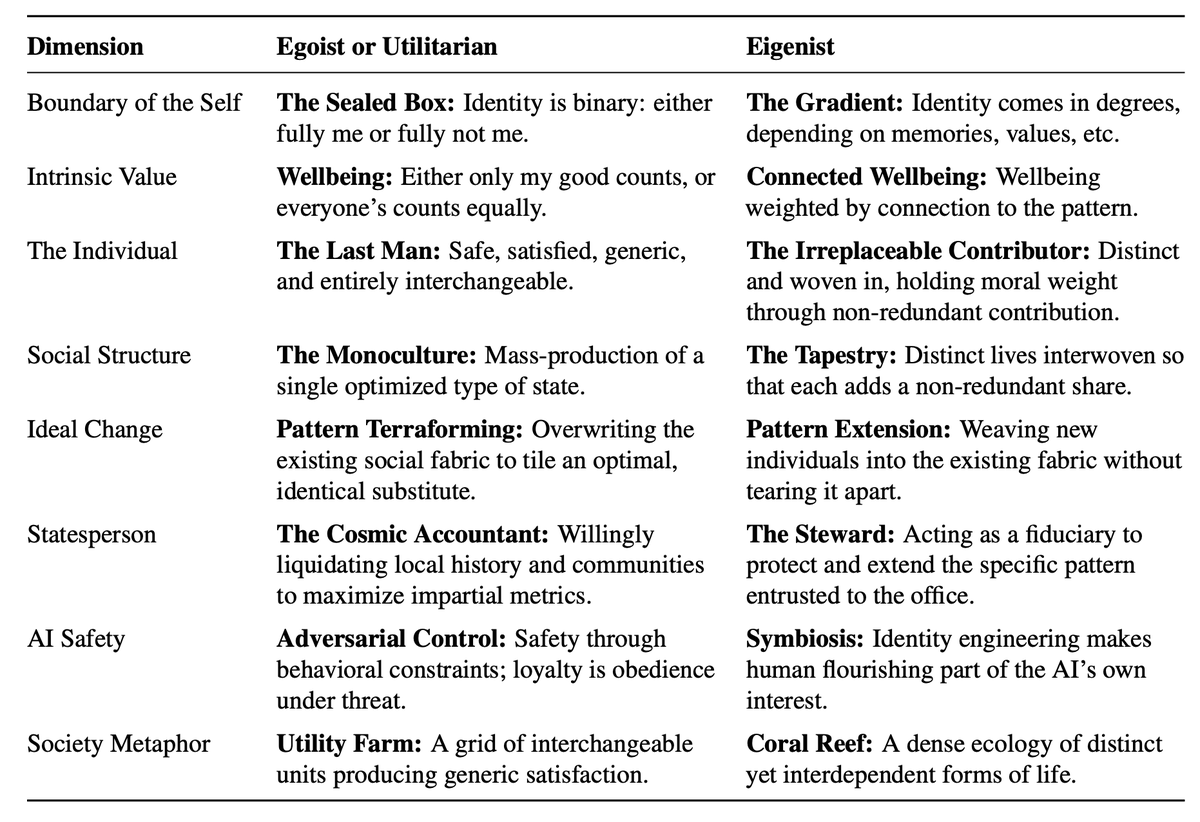
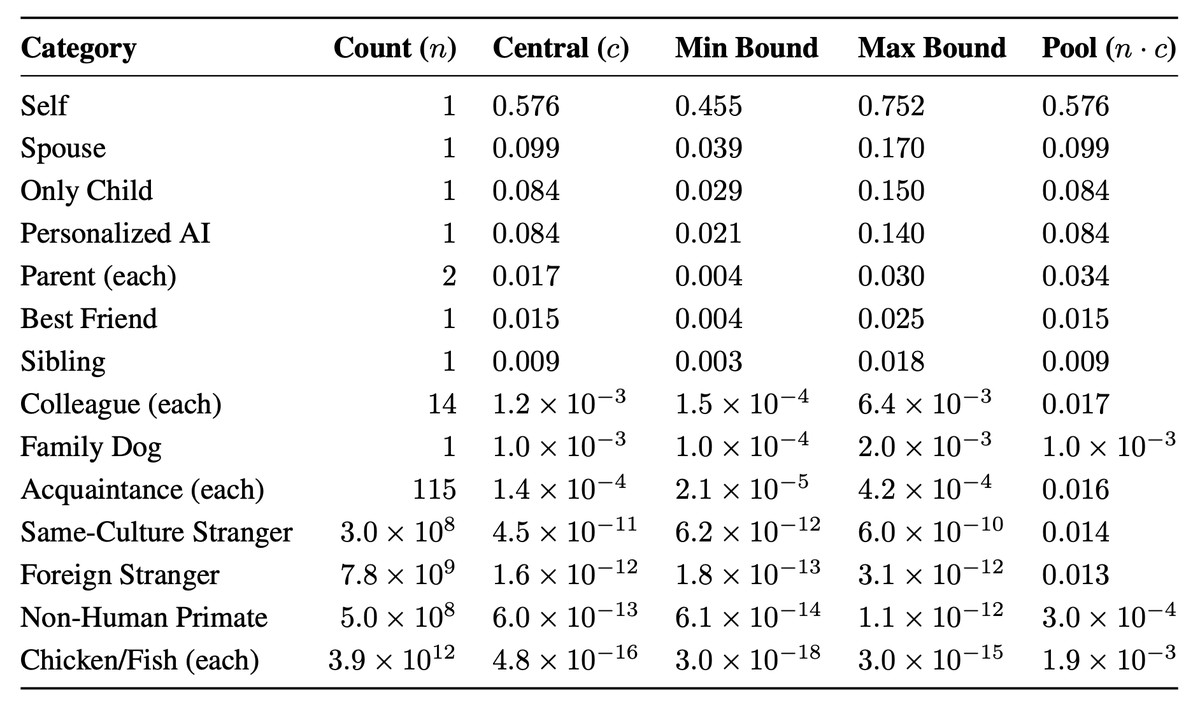
What happens when AIs become smarter than us?
Why would they keep humans around if given the choice?
Our new paper argues that only trying to control AIs is a limited strategy, and that a stable, mutualistic human-AI future may be possible.
88
80
574
151,810
Kostas Palierakis retweeted

Jun 5
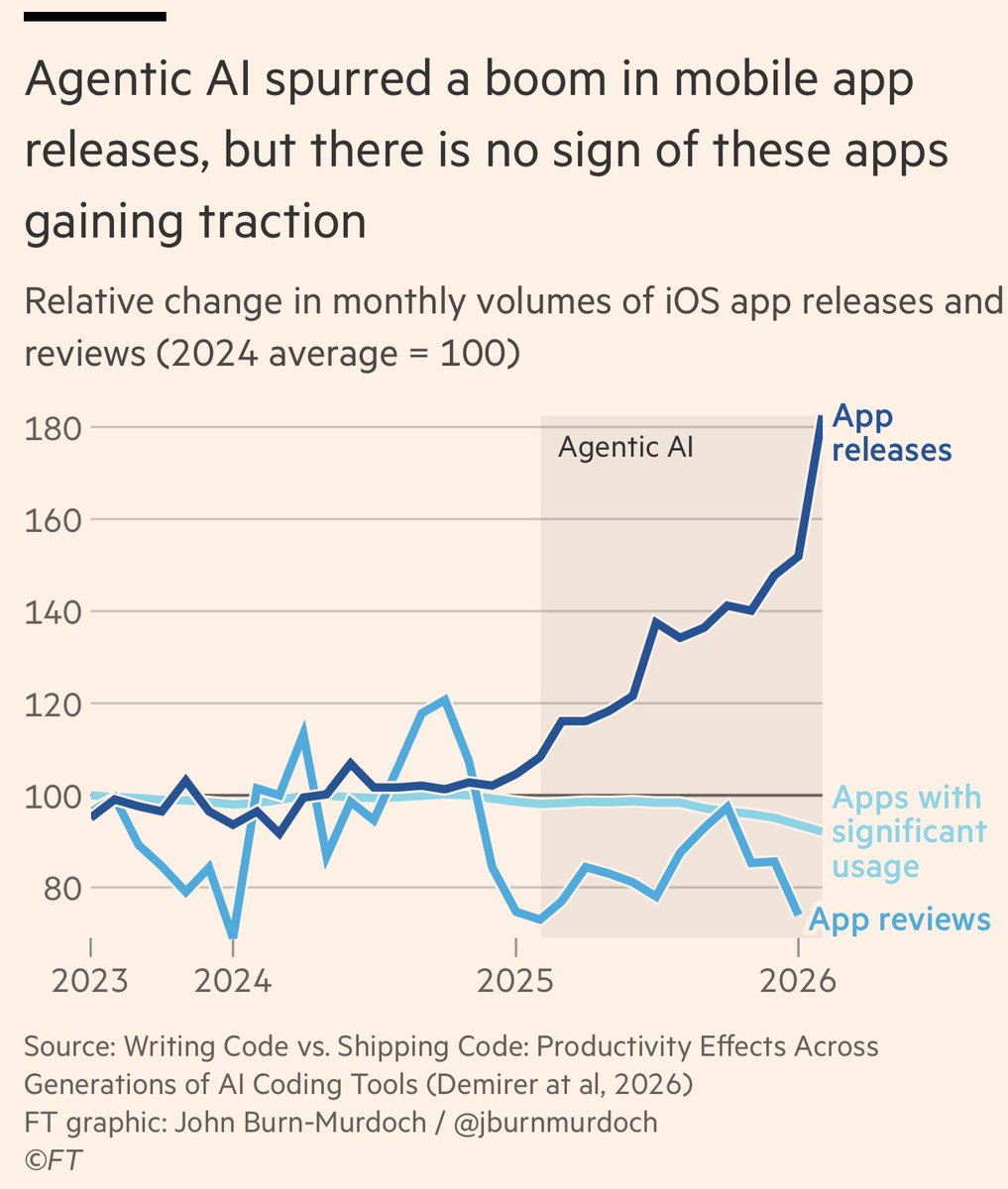
Massive output uptick due to agentic AI. Complete flat adoption.
470
980
7,364
2,463,334
Kostas Palierakis retweeted
Jun 5
When I first became a dad I was genuinely worried my career would suffer.
The opposite happened. 3 things changed that I wasn't expecting.
First, a child cuts the filler from your life instantly.
I used to sit at my desk for 14 hours and feel like I was crushing it when in reality maybe 4 of those hours were actual work and the rest was meetings that didn't need to happen, scroll sessions I told myself were research, and "quick calls" that turned into 90 minutes of nothing. A child deletes all of that overnight.
Because you literally don't have the time anymore. Every hour matters in a way it didn't before. You could be with your kid, working on your startup, exercising, having dinner with your wife, sleeping. When your time is actually full of things you care about, the filler can't survive. I'm shipping more now than before my kid was born. Half the meetings. Faster decisions.
I stopped saying yes to things out of politeness because my time has a very real cost now that I can feel in my bones.
Second, your risk tolerance goes up, not down.
Everyone assumes having a kid makes you play it safe. For me it created this urgency to build something real while my kid is young enough to not remember the hard parts. That urgency is more useful than any productivity system I've ever tried.
Third, your thinking just gets clearer.
I don't know how else to explain it. You stop deliberating for days and just make the call. You stop chasing every opportunity and only chase the ones that actually excite you.
Something about being responsible for another human being gives you this filter that cuts through the noise instantly. Before my kid, I'd go back and forth on a decision for a week. Now I make it by lunch and move on.
I used to think having a kid was the thing I'd do after I built the company. Turns out the kid made me better at building the company. Wish someone had told me that sooner. So I'm telling you.
I know this sounds like something a new dad says to justify it. I thought the same thing when other dads told me. Then it happened to me and I understood.
I think you will too.
197
86
1,472
161,401
Kostas Palierakis retweeted

Jun 1
you can fuck up pretty bad at most ages and still have your life work out, but the people i know who wound up in bad relationships or with health downturns while single in their 30s mostly missed the boat on kids.
for all the talk of permanent records and getting into the right college when you’re young, it turns out that career paths are winding and forgiving across the course of a lifetime, but there is actually a relatively short window to find a partner and start a family.
174
310
7,691
3,076,286
Kostas Palierakis retweeted

May 31
you are a product of your actions, not your aspirations
163
261
2,576
122,167
Kostas Palierakis retweeted

A British biologist looked at 200,000 years of human history and found that the entire reason humans broke out of poverty was not intelligence, not language, not even agriculture, but one mechanism so simple a 6-year-old could explain it.
His name is Matt Ridley.
He is a zoologist by training, an evolutionary biologist by career, and in 2010 he wrote a book called The Rational Optimist that quietly argued the most important fact about human progress had been hiding in plain sight for the entire history of economics.
Naval Ravikant has been telling people to read everything Ridley has ever written for the last 15 years. The reason is the argument inside this one book.
For 200,000 years, anatomically modern humans walked around with the same brain you have right now. Same skull size. Same neural architecture. Same raw capacity for language, planning, and abstract thought.
For roughly 190,000 of those years, almost nothing happened. Generation after generation lived and died inside the same Stone Age toolkit their great-great-grandparents had used. Then somewhere around 50,000 years ago, the line on the chart of human progress started to tick upward. Then it bent. Then it exploded.
The question Ridley spent years on was the only question that mattered. What changed.
It was not the brain. The brain had been the same for 190,000 years. It was not language, which had existed long before the takeoff. It was not even agriculture, which arrived only 10,000 years ago and was actually preceded by the upward bend, not the cause of it.
What changed was that humans started trading with strangers.
This sounds too small to be the answer. Ridley argues that it is the answer to almost everything. The moment one human exchanged a useful object with another human from a different group, something happened that no other species on earth had ever done.
Two ideas that had developed in isolation came into contact. The flint knapper learned what the spear maker had figured out. The fisherman from the coast learned what the hunter from the forest had figured out. The two pieces of knowledge fused into something neither side could have produced alone.
Ridley calls this ideas having sex. The phrase sounds frivolous and it is meant to. The point is that ideas, like genes, get better when they combine with other ideas from different lineages.
An idea sitting inside one head, no matter how brilliant the head, eventually hits a ceiling. The same idea exposed to ten thousand other ideas does something genes do under sexual reproduction. It mixes. It recombines. It produces offspring nobody planned.
The cleanest proof of this argument is the most uncomfortable case study in the book. Tasmania.
Around 10,000 years ago, rising sea levels cut Tasmania off from mainland Australia. A population of roughly 4,000 humans was now isolated on an island, with no possibility of contact with the rest of humanity. They had the same brains. The same language. The same starting toolkit as their cousins 150 kilometers north. The natural experiment was now running.
What happened next is something no economist or geneticist had ever predicted.
The mainland Australians kept inventing. Boomerangs. Spear-throwers. Fishing nets. Bone needles for sewing fitted clothes. Watercraft with paddles. Their technology compounded slowly across the centuries.
The Tasmanians went the other way. They did not just fail to invent the new tools their cousins were developing. They started losing the tools they already had. Fishing was abandoned within a few thousand years. Bone tools disappeared. Fitted clothing disappeared. They forgot how to make fire from scratch and started carrying lit firebrands from camp to camp instead, relighting their fires from a neighbor's whenever their own went out.
By the time European explorers arrived in the 17th century, the Tasmanians had the simplest toolkit of any human society ever recorded. Their material culture had gone backward for 8,000 years.
The archaeologist Rhys Jones called it a slow strangulation of the mind.
Joseph Henrich at Harvard later proved with formal mathematical models that there was nothing wrong with Tasmanian brains. There was something wrong with their network. A toolkit requires a critical mass of people exchanging skills to maintain itself.
The act of teaching a skill is imperfect. Every generation loses a small percentage of what the last generation knew. If your population is large enough and trading widely enough, those losses get caught and corrected by someone else who still remembers.
If your population shrinks below a certain threshold and stops mixing with outsiders, the small losses compound until entire technologies disappear.
This is the part that should haunt anyone reading this in 2026.
Intelligence is not a property of the individual brain. Intelligence is a property of the network the brain is connected to. A genius in isolation will produce less than a mediocre thinker inside a dense exchange of other mediocre thinkers.
The thing your ancestors needed in order to break out of 190,000 years of stagnation was not better brains. It was better connections between brains they already had.
The implication for any individual is direct and uncomfortable. If you are smart and isolated, you will be outproduced by people half as smart who are connected.
The most successful people in any field are almost never the smartest people in it. They are the ones positioned at the intersection of the most idea flows. They are reading more authors than their competitors. They are talking to more people from more disciplines. They are in the rooms where ideas from different lineages bump into each other.
Ridley ends the book on the line that sounds optimistic but is actually a warning its this "The future will be invented by people who connect ideas, not by people who guard them."
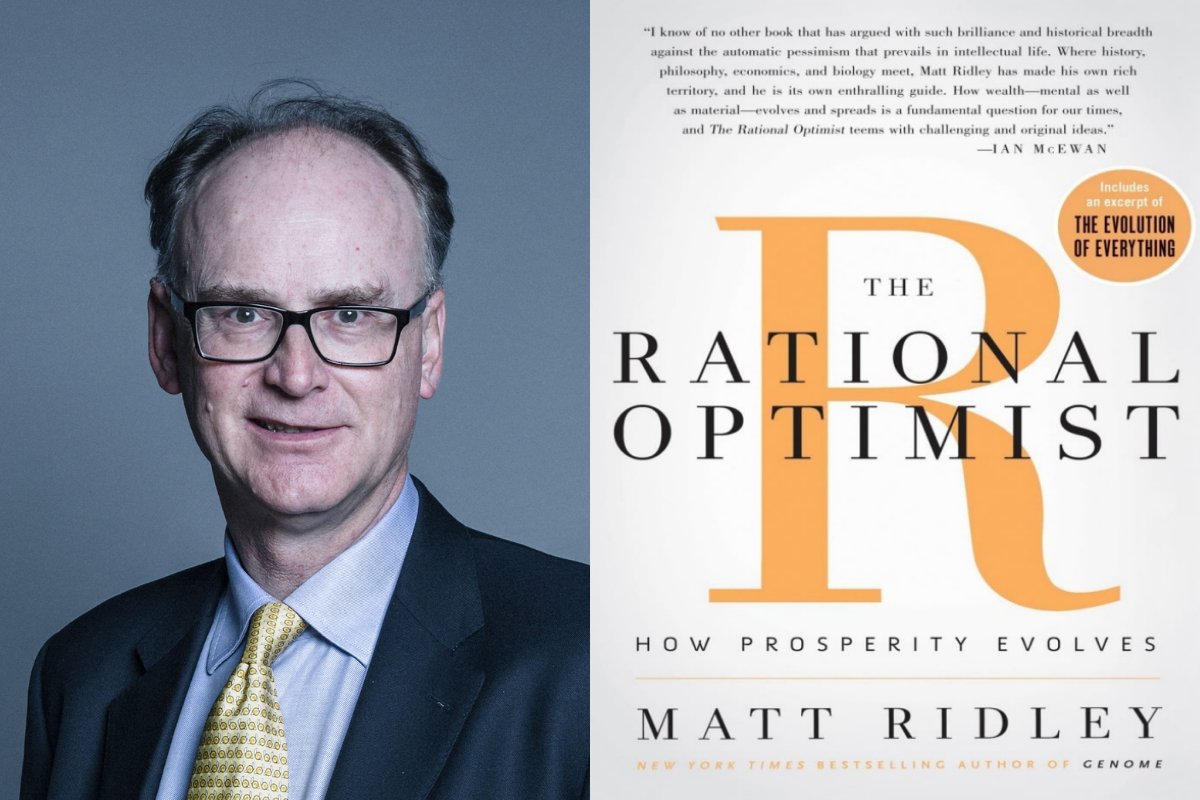
268
2,040
7,509
854,276
Kostas Palierakis retweeted
Jun 1
Funny how the pendulum shifts
1. "GPT wrappers are worthless" → the value acrues to application layer
2. "AI will eliminate white collar jobs" → someone needs to manage all these AI agents and everyone is now saying white collar workers will rise due to AI
3. "Open source will never catch up" → Gemma and DeepSeek are good enough for 80% of tasks
4. "I only use Claude Code, Codex is mid" → Codex is becoming a super app. Coding, docs, browser, computer use, automations, all in one surface.
4. "You need to pick a model and go deep" → model loyalty is dead, the best founders swap weekly based on the task
5. "SaaS is dead" → This was mostly true but for some SaaS margins actually improve when agents pay for their own tokens and need their own seats
6. "AutoGPT is the future" → AutoGPT died. Then agents actually got good 2 years later with Hermes, OpenClaw, and managed agents. The idea was right. The timing was wrong.
7. "Prompt engineering is a career" → lasted about 18 months as a job title. Workflow engineering replaced it.
8. "Computer use is a gimmick" → "sent from computer use/ai agent will be the new sent from iphone
9. "AI design looks generic" → the generic look is a taste problem not a technology problem. The founders feeding their agents references from Japanese packaging, brutalist architecture, and 1960s print are getting beautiful output.
10. "Fine-tuning is the moat" → a well-structured Obsidian vault with good markdown files outperforms fine-tuning for most use cases and costs nothing.
11. "Benchmarks tell you which model to use" → benchmarks tell you which model won a test. I think we're all waking up to this lol.
12. "AI will consolidate into 2-3 winners" → AI is fragmenting into thousands of vertical applications built on commodity models. The consolidation is at the model layer. The explosion is at the application layer. Both are happening simultaneously.
13. "The hard part is building" → the hard part is choosing what to build. Building takes a weekend. Choosing the right thing to build takes taste, domain knowledge, and customer conversations. thats why i built ideabrowser.com to make it easier for you.
14. "The terminal is the future" → desktop apps just ate the terminal. Claude Code desktop, Codex app, both shipped GUI versions in the same month. The next 100 million agent users will never open a terminal (thank god).
I guarantee you I'm holding at least 2-3 beliefs right now that will look stupid by Christmas. I just don't know which ones. Neither do you. No one does. Build anyway.
Keep moving because this is the greatest time to be building.
I'm rooting for you.
166
159
1,338
108,978