
Joined January 2012
- Tweets 3,514
- Following 1,724
- Followers 3,589
- Likes 6,544
107 Photos and videos
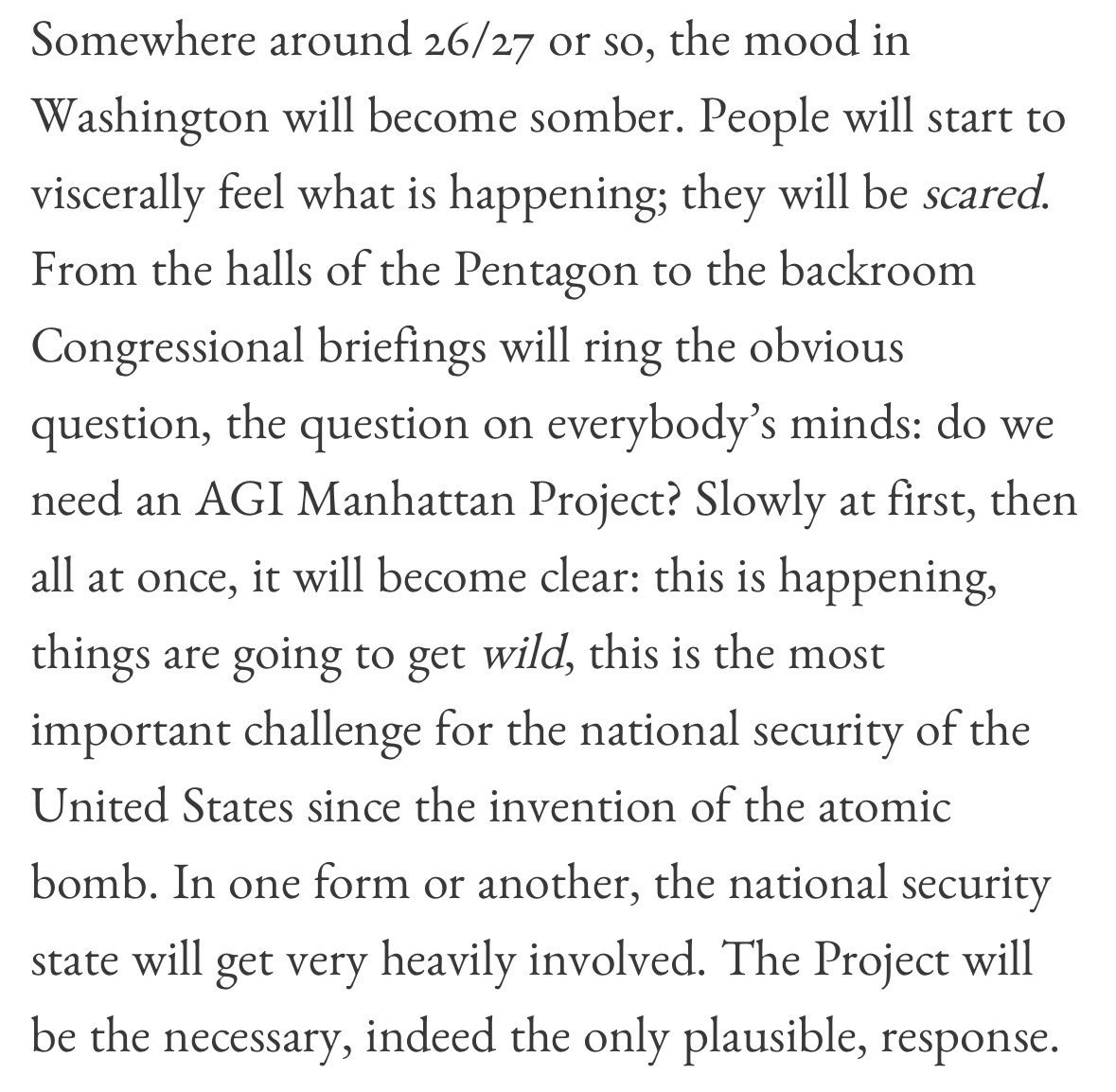





Situational awareness was written three years ago and proved remarkably prescient
8
11
297
19,273
7
1,014
Ian Tracey retweeted

Jun 12
Your next finance hire is an agent.
We’re looking for a few design partners to shape what it becomes.


4
3
48
3,506

Jun 10
OpenAI has a golden window to counter position against Anthropic and fully embrace the "open" in their name
I really hope so at least
7
1
51
3,970
Jun 10
There's a blue ocean of problems in Applied AI that require more than something off the shelf.
Now you can get the domain expertise and velocity of @tryramp engineering inside your organization automating the toil of the financial back office.

Services are the future. Today we launched Ramp’s AI services motion.
It's easy to buy an AI subscription. It's hard to transform your company to actually run on agents.
Here’s our entire strategy.
1) Why now
Services are the new software (Sequoia)
Human labor TAM >> software license TAM. The market is bearish on seats and subscriptions.
Every enterprise AI company is doing this -- the labs have poured billions into services partnerships and their own deployment functions. Superintelligent models alone are not enough.
Palantir proved this is a strong business model: deeply embed engineers, build on top of a powerful platform, and customize extensively.
2) The real problem
Companies want AI. But the gap between "we have AI tools" and "agents run our workflows and we spend way less time" is enormous.
What we've found across over 50 companies we engaged with: agents start replacing real work when there is: complete data, read/write access across systems, agent-friendly policies. Most big companies struggle because:
- processes live in operators' heads
- dozens of disconnected systems (legacy ERPs, endless one-off excel sheets, etc.)
- archaic software with poor or no API access
Good data in the right place is a hard prereq to working agents.
Also, vibing in localhost ≠ a production system your enterprise can rely on. You still need hosting, ci/cd, observability, feedback loops, good interfaces. And taste to know what's even worth automating.
Everyone has a bulldozer, but most jobs just need a shovel pointed at the right spot.
What companies usually need is to be made agent-friendly. That's exactly what we do.
3) What we do
We focus on what Ramp does best -- finance.
And we embed FDEs that:
-> understand your problems
-> identify high-leverage, high-impact workflows that fit agents
-> scope the solution
-> connect your data
-> capture your context
-> deploy agents and often bespoke software for humans to collaborate with them
-> drive the business metrics that matter
Discovery and scoping are crucial. Building is easier than ever and thus judgement about what to build is more important than ever.
We're not a generic AI services arm, we're finance domain experts. Across the spectrum of financial operations, we help companies find and frame the problems worth automating -- similar to the taste a founder has in choosing which problems are worth solving (ex-founders make great FDEs).
Here’s the stack we deliver:
- Production infrastructure. Shipping an index.html from Claude isn't the same as creating a repo, hosting in a cloud service, ci/cd, testing, setting up evals, managing memories and skills, adding feedback loops, ensuring uptime, incident management, etc. Agents don't one-shot production systems yet. Production software is hard -- we build, host, and run it for you in a single-tenant, dedicated cloud environment. Most operators don’t have the time, knowledge, or experience to do this e2e. We help abstract the low-leverage plumbing so they can focus on the essential parts of their jobs.
- Data connectivity. Most enterprises have data lakes, but data is often incorrect, stale, or entirely missing. And write interfaces vary dramatically. Ideally we can use MCPs or CLIs, but usually it’s poorly documented APIs, SFTP, manual uploads, and email.
- A context layer. Things people have done for years aren't written down, so an agent can't do them until we capture that context -- ranging from simple policies to complex decisions. This usually involves creating policy documents, shared agent memories, and skills.
- Evals and feedback loops. How you know an agent is doing a good job, and how it improves over time.
4) Why Ramp AI Solutions
We focus on finance because it’s the vertical we know deeply, have structural advantages, and are most differentiated:
- Data. 70k customers use our core product, over $200B in annual payments, years of vendor data, millions of transactions and bills monthly.
- Money-movement primitives and partnerships. Global money movement rails, partnerships with banks, Visa, Stripe, etc. You don’t want to vibecode international wires for bill payments.
- An intelligence layer on top: fraud detection from hundreds of millions of expenses, PO-to-invoice matching, state-of-the-art OCR, and fine-tuned models for accounting coding, spend routing, policy review, etc.
Unlike the labs, we’re not incentivized to sell tokens.
Ramp is an AI fiduciary and an impartial broker to deliver AI that is:
- model-agnostic -- we benchmark all the leading models (labs, open source) and fit the right one to each task
- and token-efficient by design
Our main incentive is business outcomes -- which is Ramp’s mission, to save our customers time and money.
I’m extremely bullish about our motion, and the broad industry growth of AI-native services.
If you're a finance leader trying to be more agent-native,
If you’re interested in joining our FDE team,
I’d love to talk 🙂

5
4
108
46,895
Jun 10
Agents take away the easy, straightforward work
But 100x leverage means if you work on the wrong things you are much further away in resources and time than you were before (slop cannons)
Jun 10

hot take (?): people should think more and “grind” less
models increase productivity and execution speed but that also means it increases the cost of making the wrong decision/taking the wrong path
it becomes increasingly important what decisions you make and people should think more about what they do before doing it
7
1,168
Jun 8
"I didn't sleep at all last night, I was too busy using Claude Code"
I'm hearing this all the time in conversations with friends now
Using AI is super fun, and that's not by accident
Differentiating between dopamine loops disguised as productivity and real impact is going to become a core skill in 2026
4
1
50
11,703
Jun 8
What if your next great finance hire was an agent?
On the Financial Intelligence team within @tryramp's Applied AI org, that's what we're building: an agent that proactively flags issues, gives recommendations, and reasons about financial planning across the dozens of mission critical systems finance teams juggle today.
I'm hiring a frontend leaning full-stack engineer to shape the surface that brings it to life: dashboards, charts, and spreadsheets finance teams trust and act on, powered by real production AI on top of a unified semantic layer.
If we get this right, 70,000 businesses will spend less time on financial ops toil and more time on their missions.
NYC or SF. Details below, DMs open!
4
1
38
3,404
Jun 8
3
592
Jun 7
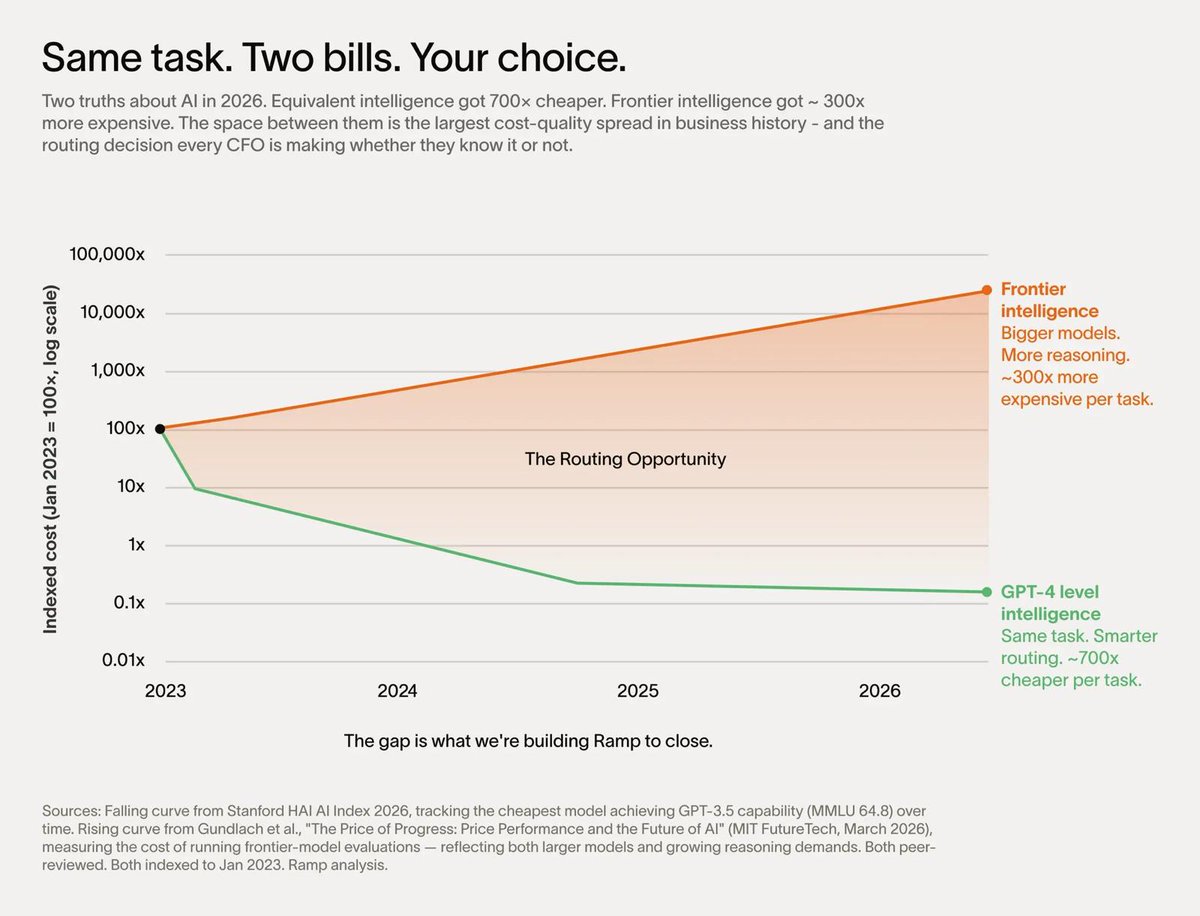
Do we really need AGI to proofread a document or classify an incoming email?
In the early 2020s, as the modern data stack took over, a wave of warehouse observability and cost-optimization startups showed up to tame it.
The same wave is just starting for AI in 2026 for the gnarlier problem of managing the cost of intelligence.
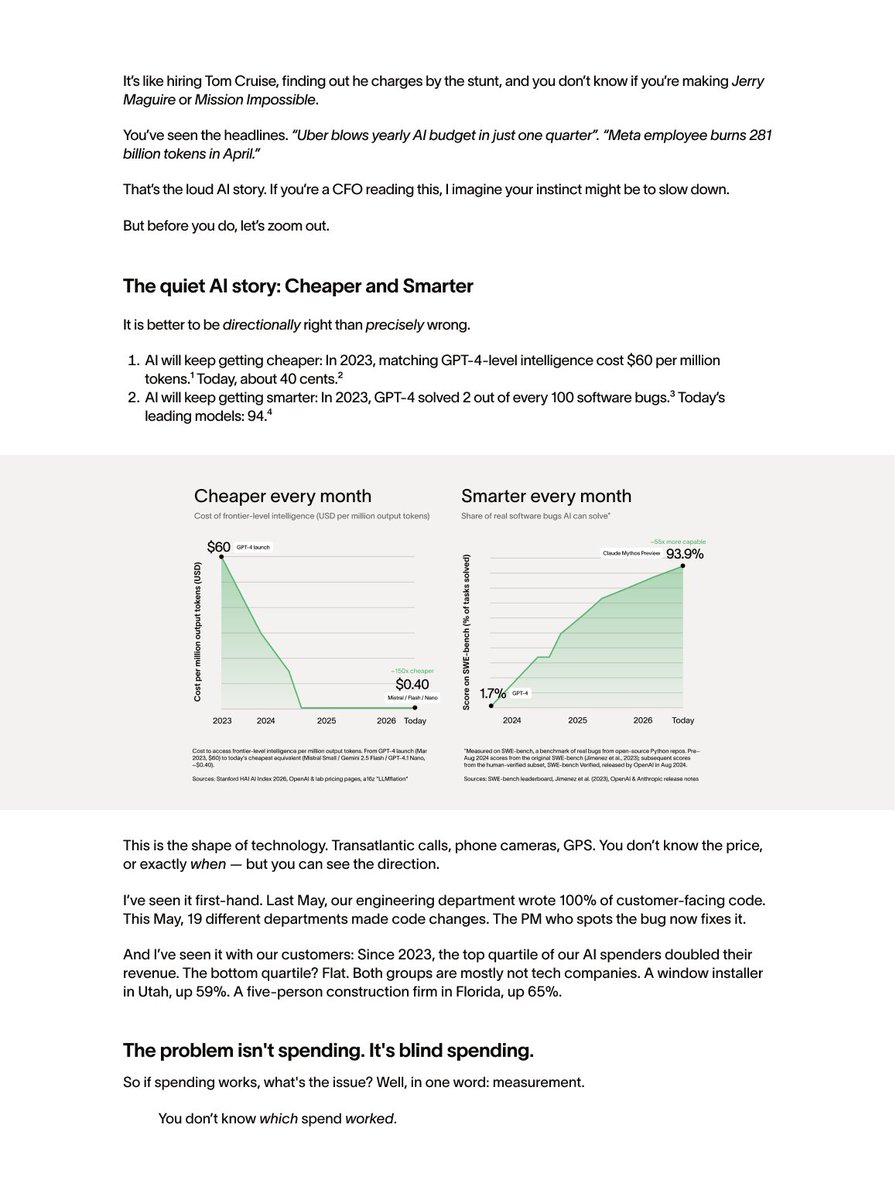
The setup is wild: equivalent intelligence got ~700x cheaper since 2023 while frontier models got ~300x more expensive.
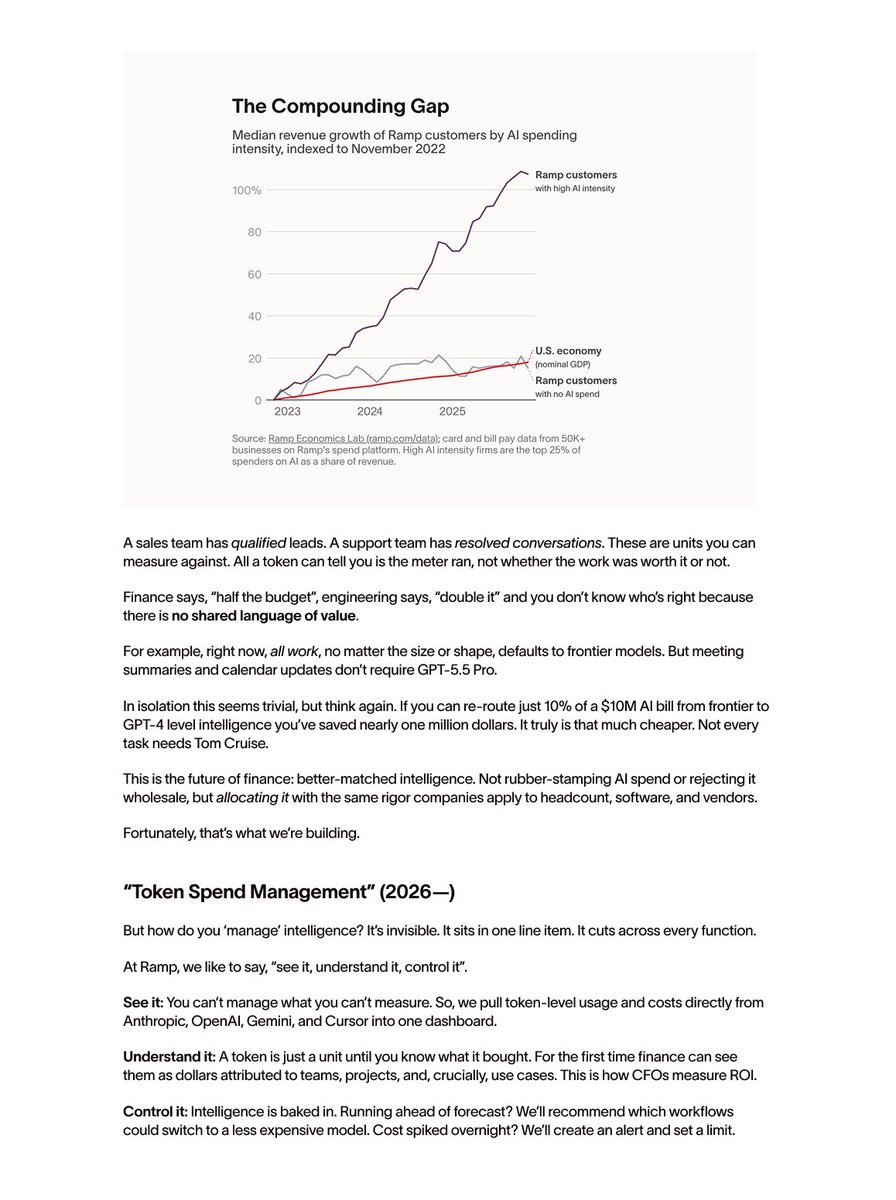
When I talk to CFOs and finance teams cost/ROI is consistently their biggest concern. They want to let people experiment without runaway spend.
This opportunity is an order of magnitude larger and far more complex than dwh costs ever were.
Curious how others are approaching it: how is your team handling AI spend vs. letting people experiment?
4
1
21
2,749

"What is Stack?"
"How can my accounting firm set it up??"
"Who am I and why am I here???"
2 of these questions will be answered in this 11:32 min demo, enjoy
Jun 3

Introducing Stack.
The AI operating system that lets accounting firms take on more clients without hiring. Learns your firm's process, runs the close, posts the journals. Fully auditable.
We’re living through the biggest shift in accounting since the spreadsheet.
5
7
178
66,189
Jun 5
1. talent wants to live here
2. density and proximity to most verticals on earth
3. close to Europe and timezones
4. finance capital (hft, quant, tech shops)
5. world class schools

NYC is quietly becoming a serious AI hub. Why is this actually happening? I've talked to folks and no one has an answer.
10
9
255
26,676
Jun 4
It's Day 275 for me at @tryramp.
Going in, I assumed the glowing reputation was marketing, but it isn't. It's unlike any other place I've worked in my career. What I've seen so far:
Attracting and nurturing top talent is the primary strategy. The bet is ingrained in every part of the culture: the problems and markets are too big to ever be finished, over-index on people and trust them to unlock the value.
Young, high-slope people own entire product lines and 0→1 bets earlier than they "should." Of the engineers in my org who've left, ~70% started a company instead of joining one.
Like many great companies, it's hard to articulate what category we're building in anymore. The simple idea of using a corporate card to save companies time and money has evolved into an ambitious AI financial operations platform, an AI R&D lab @RampLabs, and a software factory with Inspect.
I believe finance is the most underrated place to be building AI right now. Most of the work is exactly what agents are good at: pulling numbers, reconciling, chasing approvals, catching the thing that doesn't add up, and almost none of it has been automated. It's a huge, tedious, mission-critical, expensive surface that everyone has. The last 20 years were spent digitizing the workflow; now agents can do the work on top.
I'm still surprised most days. To me that's the rarest part.
Jun 4
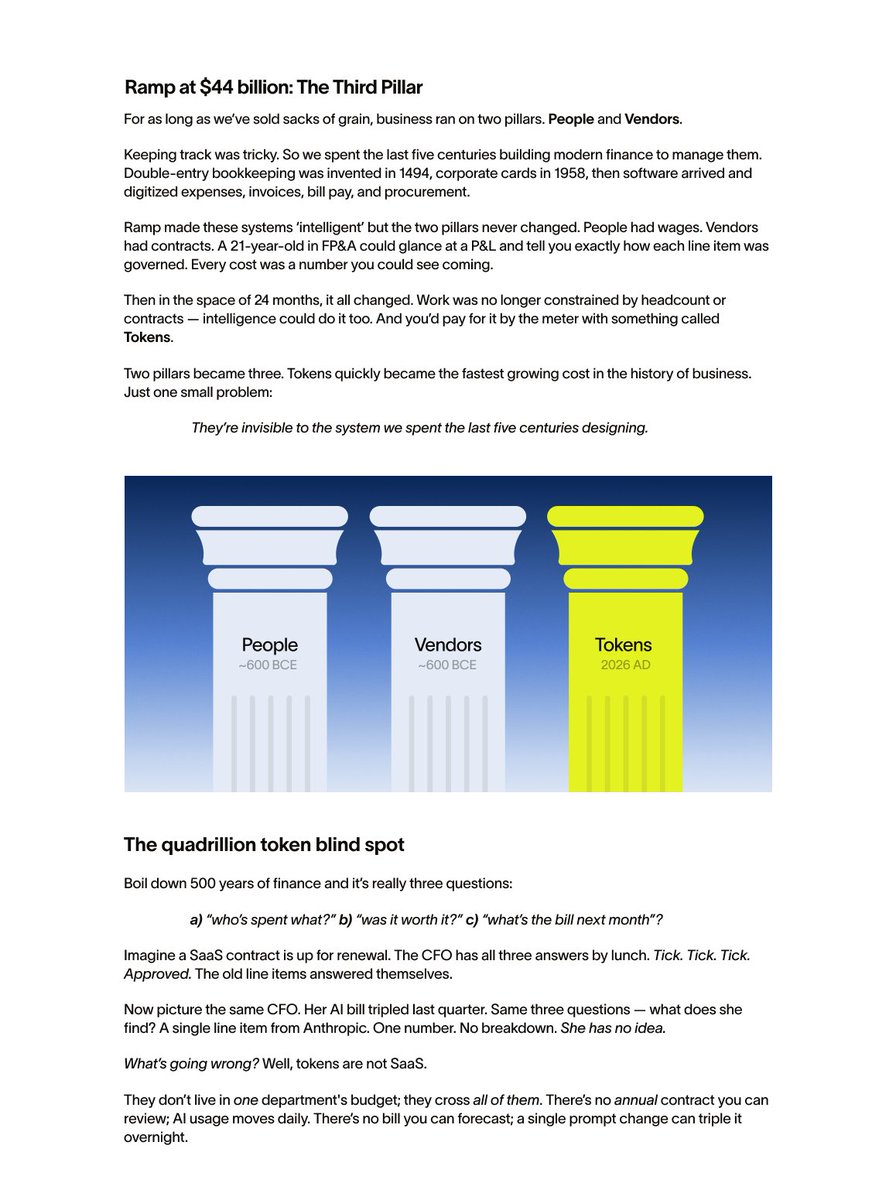
Today, Ramp raised $750M at a $44B valuation.
Last time we grew this fast, we were 1/20th the size.
For 2000 years, business was built on two pillars. Today, a third: intelligence.
It’s your least governed cost. It’s also your single greatest opportunity.
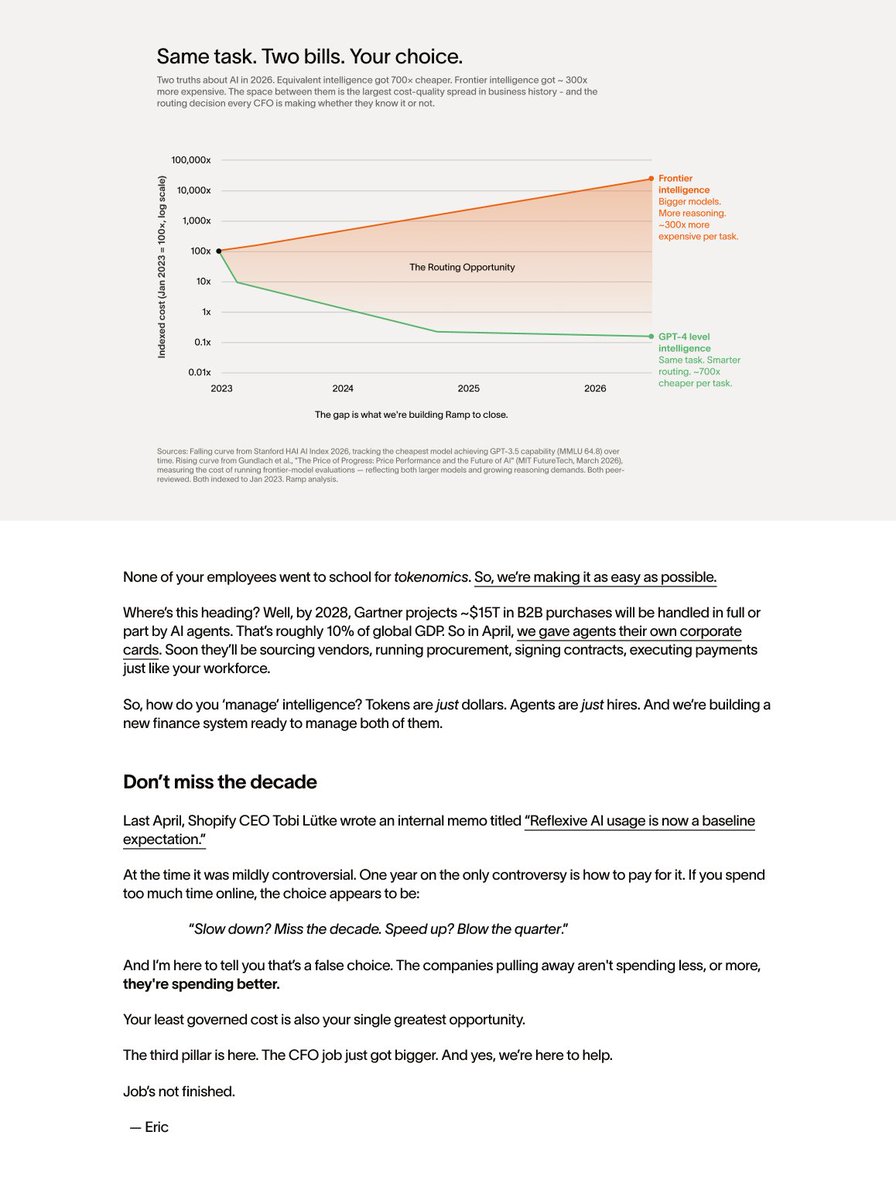
2
2
33
2,492
Ian Tracey retweeted

Jun 4
My goodness the Ramp folks are absolute animals.
This memo is very good btw. They are really looking around the corner. Frontier models are not becoming cheaper as literally every lab spokesperson says. The models are getting more expensive and when the focus starts turning to ROI the decision of what model to use for which task becomes ever more important.
I can't say much about the valuation, which granted is absolutely insane, except the team is absolutely bonkers and the products they build are exceptionally well done.
Kicking myself that I left my museum quality corporate card in a card reader at the Bowery citizenM. That thing was beautiful.
Congrats folks. It really is amazing seeing how far this company has gone since I became a user in mid-2022. 👏🏻
Jun 4
Today, Ramp raised $750M at a $44B valuation.
Last time we grew this fast, we were 1/20th the size.
For 2000 years, business was built on two pillars. Today, a third: intelligence.
It’s your least governed cost. It’s also your single greatest opportunity.
4
14
232
62,677
Jun 4
Best advice I could give folks early in career

Follow talent density
The best people I know are always trying to assess where the best people are going
If you are early career - you’re correct to optimize for the crowd you’d learn most from than anyone else
Follow the smart people - it always pays off
4
882
Jun 3
Things are going to get very wierd very soon
Jun 3

Today, we’re excited to introduce Miso One, the most emotive voice model in the world.
Miso One is an 8-billion-parameter text-to-speech model for highly expressive speech generation. It emotes like a human and responds faster than a human, with just 110 milliseconds of latency.
We’ve open-sourced the model weights, with API access coming soon.
Hear how Miso One sounds in the thread below.
53
114
3,384
985,949