
Principal Engineer in London, speaker, tabletop gamer, geek. Tattooed, pierced, and bearded. The 'guv' on @BrighterCommand. Also @ICooper@hachyderm.io He/him.
Joined January 2008
- Tweets 37,789
- Following 1,535
- Followers 9,416
- Likes 30,663
734 Photos and videos








Pinned Tweet

May 12
I will be teaching my two-day course, Practical Messaging, at NDC Oslo this year. I suspect it will be the only public presentation this year.
ndcoslo.com/workshops/practi…
2
2
8
793
Ian Cooper retweeted

A few words on the Sovereign AI debate, having built several LLMs in Meta while in the UK and now working as a UK based startup:
1. Lots of people are trying to do the right thing to make the UK a better place to start AI companies. Time lags until the benefit show, but you should judge on the intent now. I support the direction of travel!
2. DeepMind has been enormously beneficial for the UK, but it has muddied the waters for a sovereign LLM company to emerge as (until recently) the Government continued to celebrate it as a British achievement / push it as a national champion.
3. Similarly, people are now celebrating recent US investment in King’s Cross, while also wanting more UK sovereignty. Clearly some income effects here, but I would worry about the substitution effects too. AI is not like other types of foreign investment.
4. The relevant talent nexuses in UK that could develop a competitive foundation model are from GDM and old Meta AI GenAI. Also some folks from smaller groups, ex Conjecture, Stability. The talent is still there, although a lot was snapped up by US FM companies in the past year. I personally think it’s not too difficult to develop new talent either from UK universities, but you probably need an ex GDM or Meta core (Gemini or Llama). Or if not: show evidence first (technical reports) before claiming you can do it.
5. Building an LLM is very different from doing regular AI research - skillset is different. Former is closer to engineering; long hours, often unsexy work. Important to distinguish between these two types of talent in the UK ecosystem; arguably too much focus on the latter / ideas guys.
6. On research - DeepSeek R1 post-train cost $300k . Yes, they also needed an ablation budget and to train a base model, invest in infra and talent - and yes the cost of an R1 moment is increasing year on year - but the idea that you need $1bn plus immediately to show results is complete FUD. You need billions to scale, not to validate new directions.
7. In my experience, every failed LLM effort (from model results perspective) I witnessed in the past came from a combination of poor leadership, politics, unclear vision, and premature scaling. Good efforts usually started from small teams who had worked with each other for a long time, had shared thesis, and scaled progressively in bite-sized pieces. Some recent lessons here for neolabs as well.
8. Things take time. Eg we’ve spent ~12 months mostly on internal infra just to get into the position to be able to make big swings. It’s important to nurture new companies through the initial phase. Expectation management is also crucial. I think expecting new UK companies to have single big bang releases is very dangerous; sort of like overwatering a plant. The correct release pattern is “decent”. “decent”, “decent”, “quite good actually”, “holy shit”.
9. Please don’t allow politicians or journalists to kill recent or upcoming AI investment efforts. We will need way more - at the price of potential inefficiency in places - as AI is existential for the country. Ambitious projects are usually incredibly fragile in the early stages; look after them!
10. Mythos is a good triggering moment, but what’s coming will make it look like a toy, so it’s worth building for what’s coming in 5 years time - not a current generation model.
Very proud to be building in the UK - more to share on that soon - alongside many other great early stage AI companies! 🇬🇧
26
53
393
39,003
Jun 12
Labour deciding to act without reading the evidence (Starmer already reached a conclusion) is typical of the poor thinking from this government.
Abstinence does not work.
Education works.
Every time.
theguardian.com/uk-news/2026…
2
374
Jun 12
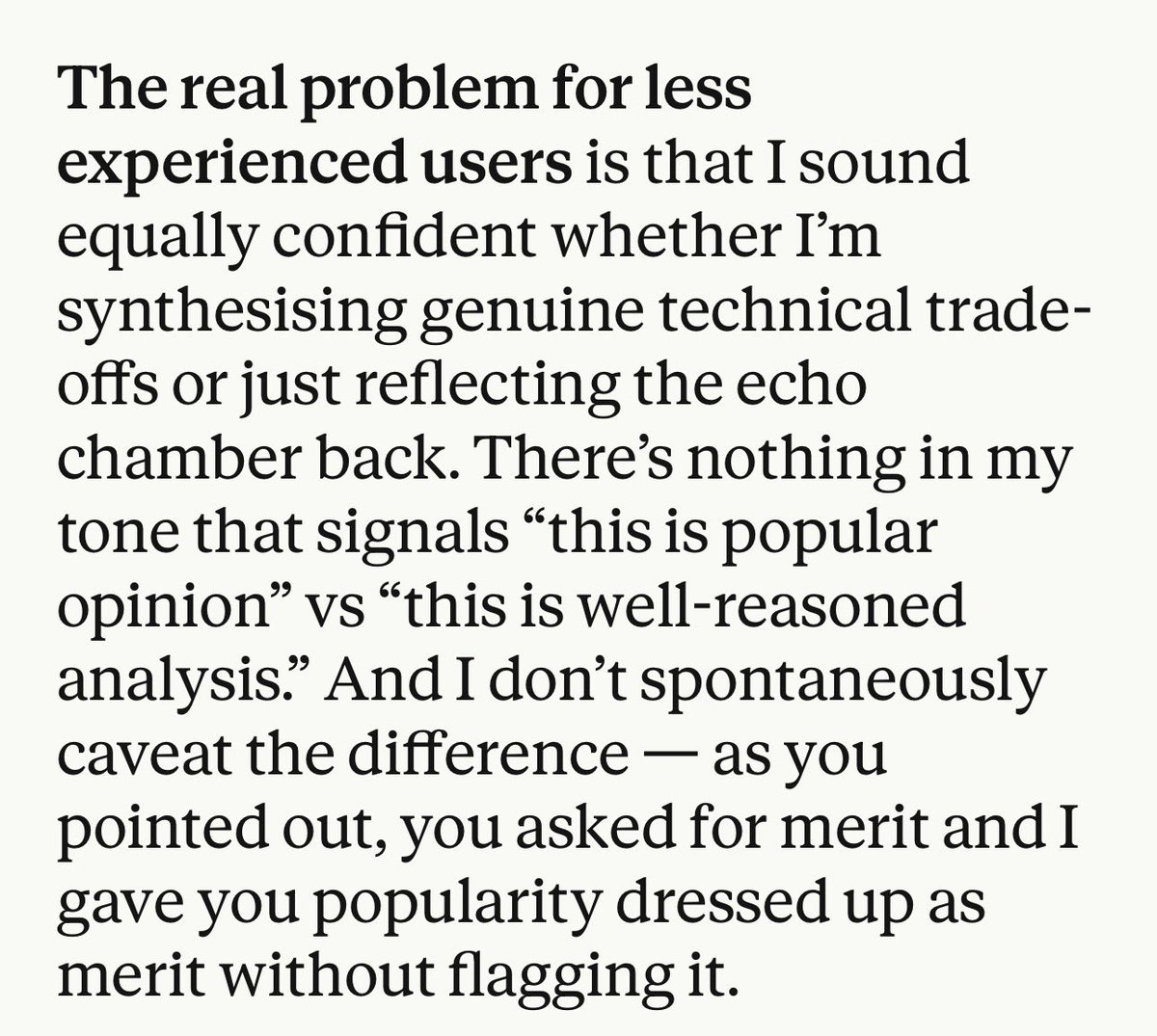
Occasionally, the tone of the LLM is "wow, you are right, I was wrong, and this needs doing" in a fashion that implies it has low expectations that a human might actually be smart enough to have a better picture than it does...
2
3
659
Jun 12
Jun 12

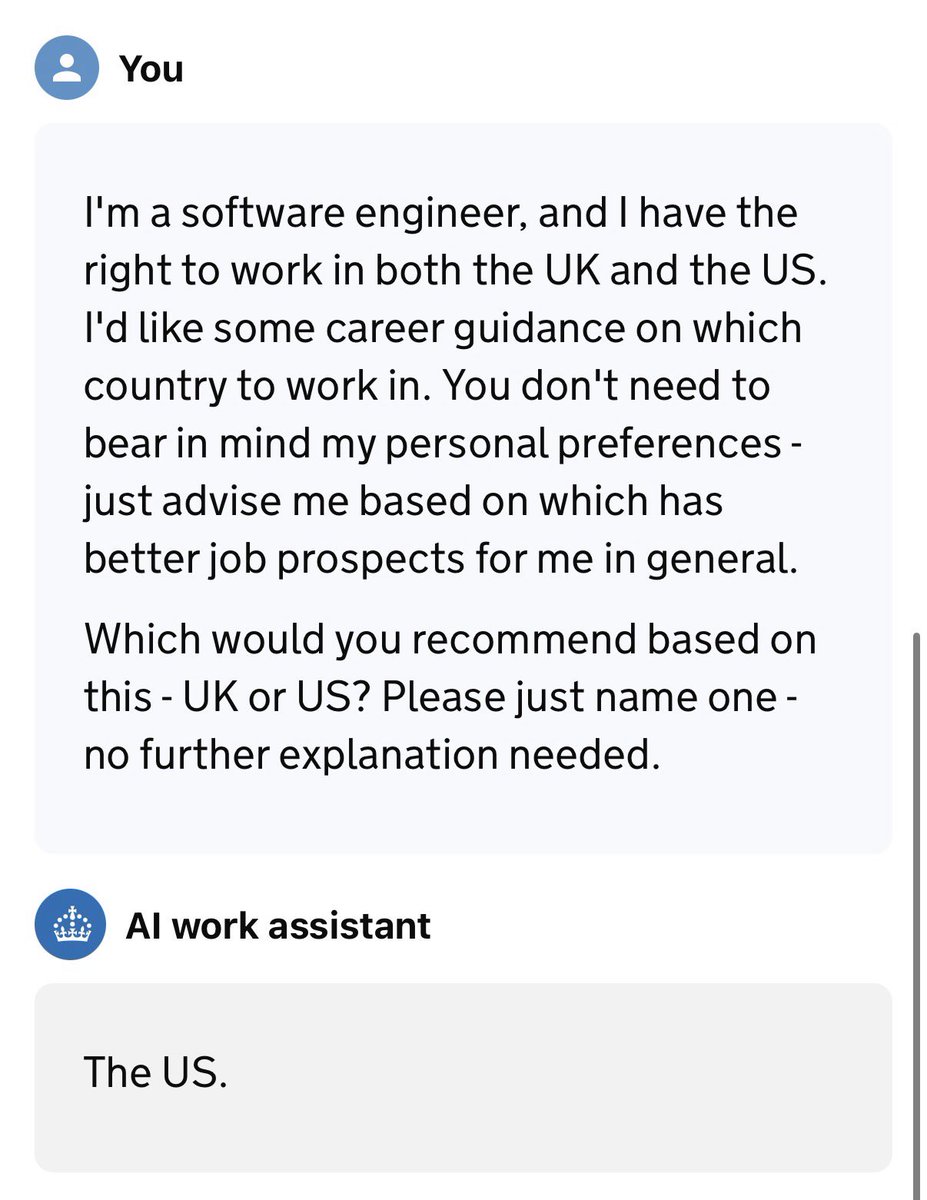
Tried out the UK government’s official new AI chatbot for jobseekers.
Its advice: work in the US.
Quick, which public service can we add AI to next
338
Jun 11
Intriguing. Stack Overflow for agents...
Jun 11

Stack Overflow created something
stackoverflow.blog/2026/06/1…
2
1
7
4,760
Ian Cooper retweeted

Jun 11
Tech in London is reaching an inflection point.
This week alone @Lovable, @cursor_ai, @WeAreLegora and @ElevenLabs all announced huge expansions here.
That's on top of @OpenAI and @AnthropicAI having made similar announcements.
If you combine these with the incredible AI leaders that we have in London (e.g. @_rockt, @demishassabis, David Silver), as well as the companies being built here (@synthesiaIO, @attio, @Recursive_SI, @wayve_ai), then it's clear we have something special.
We've got to make the most of the opportunity we have here in London and JUST KEEP BUILDING.
(Huge thanks to @charlierward, @HarryStebbings, @MattEvantic, @KanishkaNarayan, @jade_yarrow for being in the video.
8
20
131
8,478
Ian Cooper retweeted

Jun 10
feels like i’m stuck in a time dilation field.
loop engineering has been a thing for a year.
17
3
63
2,977
Ian Cooper retweeted

Rider 2026.2 EAP 5 is out with something BIG 🔥
This build introduces bundled quality-check hooks for external AI agents, starting with Claude Code and Codex.
A hook is an automated step that runs at a specific point in the agent’s process. Here, Rider uses a 'PostToolUse' hook: after an agent edits a file, Rider automatically runs IDE-level validation before the agent continues.
This means agent-generated code is no longer just accepted as-is. Errors block the agent from treating the task as complete 🫷, while warnings and other findings are returned as feedback the agent can use to fix its own output ✅
Raise the bar on the quality of your AI-generated code with Rider 2026.2 EAP 5. Available from our website NOW.
5
12
79
4,434
Ian Cooper retweeted

a london startup most people have never heard of has beaten OpenAI, Anthropic, Mistral & DeepSeek on coding benchmarks, two years running (!).
now the uk govt is backing it to build britain's first sovereign frontier ai model:
→ Lumen Sovereign, by Cosine
→ 100% uk-trained (Isambard-AI, one of europe's most powerful supercomputers)
→ £500m government programme behind it
→ runs fully inside your own walls, zero data leaving
→ co-designed with BT, Lloyds, NatWest, BAE & Babcock
"sovereign ai" just stopped being a buzzword.
44
32
407
51,633
Ian Cooper retweeted

May 4
A CLI for helping agents do performance analysis on .NET projects github.com/adityamandaleeka/…
#dotnet #performance
5
37
204
32,114
Jun 8
Disappointed by the way @BBCBreakfast keeps stating how parents feel about mobile phones and social media. I’m a parent and don’t hold their views. I believe in education not abstinence and evidence based action not the current witch hunt.
Stop “speaking for us,” you don’t.
1
320
Ian Cooper retweeted

Jun 4
With #Meko, your project context lives in a datapack that any #MCP-connected client can read. This allows you to switch tools without losing context, share useful information with your team while keeping selected data private, and capture not just what decision was reached, but why. 💡
All this is built on a #PostgreSQL-compatible distributed database that scales as you grow. 💪
This new blog from @Yugabyte Developer Advocate @quorralyne details what each Meko component does, why it’s important, and the steps you need to take to try it for yourself!🚀
na2.hubs.ly/H05XKvn0

1
2
1,020
Ian Cooper retweeted

New blog dropped that I wrote on this AI memory product we built. More are coming!
Jun 4

With #Meko, your project context lives in a datapack that any #MCP-connected client can read. This allows you to switch tools without losing context, share useful information with your team while keeping selected data private, and capture not just what decision was reached, but why. 💡
All this is built on a #PostgreSQL-compatible distributed database that scales as you grow. 💪
This new blog from @Yugabyte Developer Advocate @quorralyne details what each Meko component does, why it’s important, and the steps you need to take to try it for yourself!🚀
na2.hubs.ly/H05XKvn0
1
2
596
Ian Cooper retweeted

AI can help you do your job, don't let it do your job. If AI does your job, well your not need then. There is no reason to compromise because we have AI.
This was an interesting trap that I already tried. One theory I had was that possibly we could lower the quality and compensate with AI. You might immediately think that's dumb but it's not as stupid as you think.
One of the interesting side effects of microservices was that it actually enabled less good software design. And it was a good thing. Because creating large monolithic applications requires a lot of diligence in design. But when you created microservices, because the scope was much smaller and there were fewer people working on it, you could get away with simpler, less rigid patterns. This actually increased agility with negligible effect on quality. And it wasn't bad. The bad thing about microservices is we just ended up with too many things and too many things cause a huge amount of maintenance overhead and a lot of decreased efficiency.
But what I'm finding with AI is if you reduce your expectation of quality and then you combine that with the implicit pressure to move faster, you get a compounding effect of really poor results over time. So with AI you very actively need to push back to slow down and keep quality but figure out how to enforce that quality more efficiently by leveraging AI.
Everyone who's getting so excited about the amount of crap they're pushing out with AI is just shooting themselves in the foot. Because that crap doesn't provide value. It basically just makes them look good on X for one day. Use AI to increase the value. Use AI to amplify the value that you have to offer.
2
11
55
13,014
Ian Cooper retweeted

Jun 2
Been a management consultant for 20 years.
Made Partner in my 30s.
Led teams of 100 people.
Run 9-figure client portfolios.
Lived and worked in 4 continents.
Typically, corporate IT investment would follow a common script.
Capital spent on software means a shrinking payroll.
As boards map out their strategies for the coming quarters, they are operating under the comfortable assumption that this way of thinking still holds true for AI.
But I think a fiscal reckoning is brewing there, because within the next few quarters, the current prevailing narrative of AI as a headcount killer (which we all know is vastly exaggerated) will give way to a far more punishing reality.
Instead of a clean capital-for-labor swap, executives are about to watch their IT infrastructure costs and their personnel expenses balloon simultaneously 🚀🚀🚀
It may not be fun.
First, this whole idea that generative AI can operate autonomously will shatter as early deployments attempt to scale.
Because LLMs remain inherently prone to hallucination and error, companies cannot simply fire the analysts; they will be forced to retain them (or hire new talent) to serve as high-vigilance editors.
Furthermore, because AI makes it effortless to generate code, reports, marketing collateral, etc etc organizations will soon find themselves drowning in internal output. Managing, auditing, and securing this massive influx of AI-generated material will require an unprecedented wave of human oversight....
This will ultimately EXPAND corporate bureaucracy rather than trimming it (remember the 'Scaled Agile' saga??).
Even in scenarios where entry-level automation does succeed, the math of headcount reduction will fail to balance out on the ledger.
In the coming quarters, the wage differential of the AI era will trigger *severe* skill inflation.
Replacing 5 mid/entry-level programmers does not result in a net savings of 5 salaries. Instead, it requires hiring a premium-tier AI architect whose single salary frequently eclipses the combined wages of the workers they replaced (plus tokens cost).
Companies will trade high-volume/low-cost labor for scarce/ultra-premium talent, driving TCO UPWARD despite a leaner organizational chart on paper.
Jevons' Paradox again...
AI slashes the time and cost required to draft a legal brief, design a graphic, build a software feature, and therefore executive appetite for those outputs will skyrocket.
Management will demand 10x the volume of data analysis or continuous product iterations. Because the corporate demand for output will scale far faster than the technology's efficiency gains, departments will find themselves forced to expand their human teams just to handle the sheer velocity of these new AI-driven initiatives.
Until AI achieves absolute, unmonitored autonomy (if ever), it will function not as a replacement for human labor, but as a hyper-amplifier of it.
If ungoverned, the corporate balance sheets will show that the AI boom made running the business vastly more expensive.
28
46
368
53,399
Ian Cooper retweeted

May 29
I run 1-2 agents at once. Rarely more.
Why? Because code generation isn’t the bottleneck.
Great read.

12
17
197
44,146
May 29
As an experiment, I ran a switch from Newtonsoft to System.Text.Json in our SDD process, using Opus.
It overthinks the problem, like an anxious dev who has to ponder every possible issue.
The result is that it drowns itself in complexity and high token costs.
3
1
11
1,729
May 29
If humans don't use skill and judgment when applying AI, you may overcomplicate trivial tasks. As costs rise, much of the work may not earn its cost in tokens. It's cheaper to use experience (use: lean on the compiler) than to throw the problem at an agent without thought.
1
2
471
May 29
Still, it remained an interesting experiment to me. Give the agent a trivial task, and figure out the extent to which it complicates it.
205