
PGP: 607E 5A7A D030 D38E 5E5C 2CA5 02C3 0AE9 0FAE 4A6F, #VeraCrypt author, IDRIX founder, AM Crypto founder
Joined October 2018
- Tweets 208
- Following 42
- Followers 167
- Likes 575
36 Photos and videos





Mounir IDRASSI retweeted

VeraCrypt 1.26.29 is now available!🎉
- Argon2id KDF for non-system volumes
- Security fixes: CVE-2026-54073 & CVE-2026-53762
- Microsoft UEFI CA 2023 support for system encryption
- Driver, EFI, Linux/macOS fixes
🔗More details at veracrypt.jp/en/Release No…
1
10
56
5,121

Jun 11
I have published an technical analysis of RoguePlanet vulnerability:
amcrypto.jp/security/RoguePl…
Jun 9

Nightmare Eclipse guy has returned (as is tradition) and has released another Microsoft Windows zero day (as is tradition).
> releases zero day
> spells rogue wrong in file
> "rogeplanet"
smh
github.com/MSNightmare/Rogue…
1
1
168
Jun 10
Schrödinger's cat, Anthropic Fable variation.

Another aspect of Dario's Genius: every time Fable fails, he can smugly smirk and say "ah, gomen gomen. but was your problem too hard? Or was it *too valuable*? A shame we'll never know… Heh. If only you could access Mythos…"
This is OpenAI's router gacha moment, up to 11.

1
108
May 17
Arch Linux keyring installed by @arkalinuxgui is outdated, so updates fail. The commands below solved it:
sudo rm -f /var/cache/pacman/pkg/*.part
sudo pacman -Sc
sudo pacman-key --init
sudo pacman-key --populate archlinux
sudo pacman -Sy archlinux-keyring
sudo pacman -Syu
1
148
May 13
2026 is the year Linux kernel lost its marvel in my eyes.
May 13

What a great idea, only Project Zero who makes 0day hard could have thought of this: lore.kernel.org/all/20260508…
Here it is in grsecurity from 23 years ago: github.com/linux-scraping/gr… very shortly after the first KERNEXEC release in 2003.
Now maybe you can find that scsi/cdrom bug :)

1
174

May 9
Very good and enlightening read .

Do not be worried that LLMs are going to find all the vulns - that is not the case at all.
Read: why vulnerability research is mathematically difficult: github.com/yo-yo-yo-jbo/vr_d…

1
104
May 9
New entry in Bugflation for @bynar_io following CVE-2026-31532. Excellent findings!
bugflation.com/findings/cve-…
113

💥 Introducing "Dirty Frag"
A universal Linux LPE chaining two vulns in xfrm-ESP and RxRPC. A successor class to Dirty Pipe & Copy Fail.
No race, no panic on failure, fully deterministic. ~9 years latent.
Ubuntu / RHEL / Fedora / openSUSE / CentOS / AlmaLinux, and more.
Even if you've applied the "Copy Fail" mitigation, your Linux is still vulnerable to "Dirty Frag". Apply the Dirty Frag mitigation.
Details:
dirtyfrag.io
41
703
2,088
531,822
May 6
With a reported cost of $100, Apache CVE-2026-23918 deserves its place on Bugflation.
Apache credits Bartłomiej Dmitruk (@hackerman_70000), Striga AI, and Stanislaw Strzalkowski, isec pl, as finders of this Apache server double-free.
bugflation.com/findings/cve-…
1
211
May 4
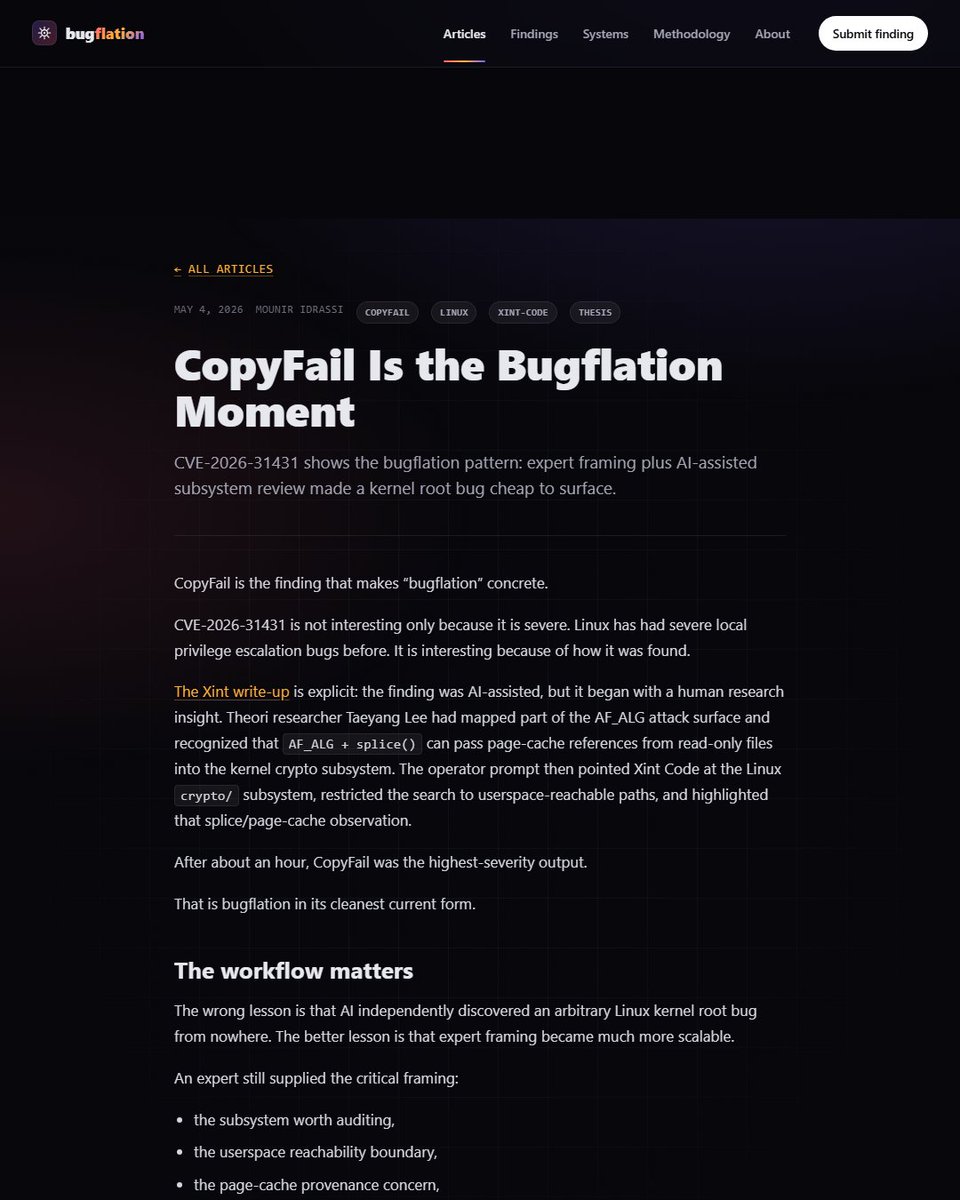
I'm launching bugflation.com.
I coined "Bugflation" to describe a shift in software security: software didn't suddenly become worse but the cost of finding old bugs is falling.
AI-assisted discovery is scaling. Bottleneck is now validation, patching and deployment.

2
4
11
3,508
Apr 30
Here is a Python 3.4 checker for CVE-2026-31431 (Copy Fail) vulnerability that doesn't modify your system or perform privilege escalation, unlike official reproduction script.
gist.github.com/idrassi/8dca…
1
222
Apr 30
Publicly dropping an easy to exploit Linux 0-day before distros/providers had time to patch was reckless.
Ubuntu 24.04 is still unpatched as I write. CopyFail (CVE-2026-31431) is serious.
AI marketing stunts can't come at the expense of global system security.
4
397
Apr 28
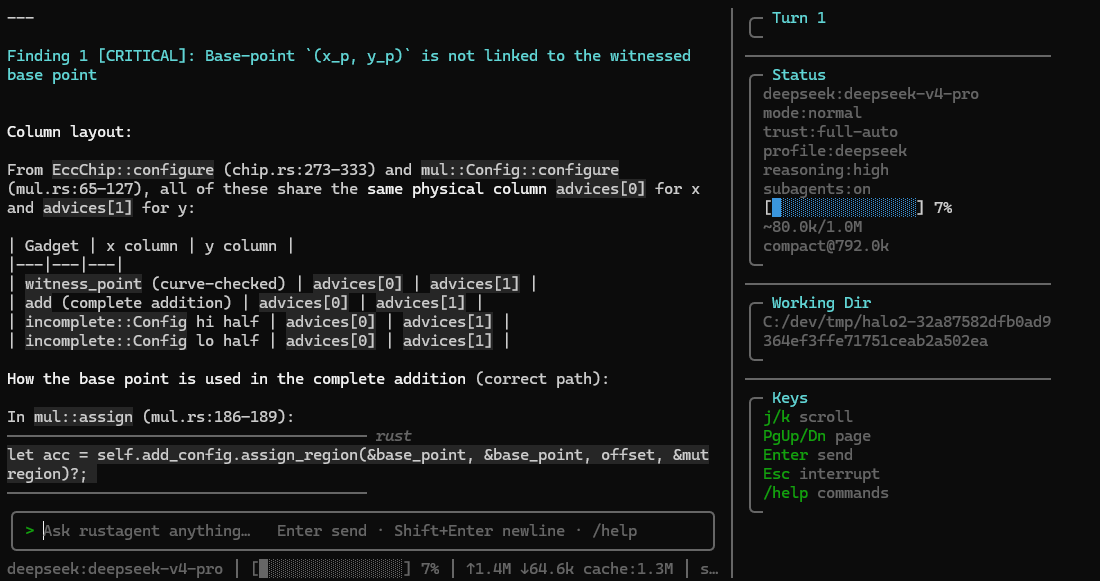
I reproduced a Mythos Rust vulnerability finding with open LLMs for $0.03.
Kimi K2.6 found it.
GLM 5.1 found it too.
Open models are getting very strong for vulnerability research at a price point that makes them practical work driver.
github.com/Swival/security-a…
81
Apr 7
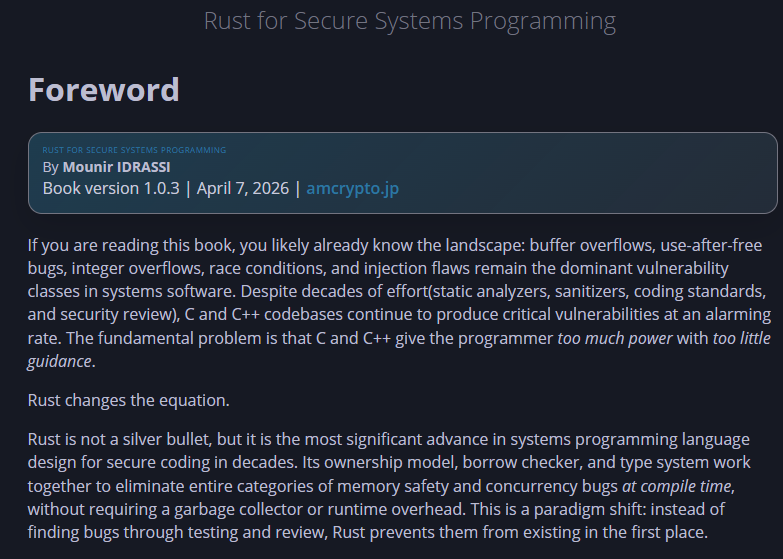
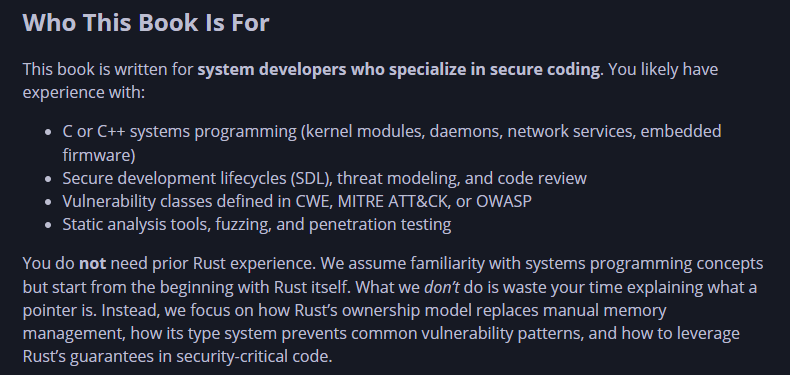
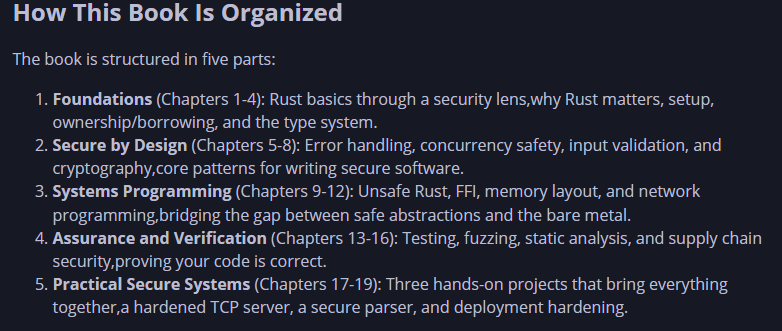
Rust for Secure Systems Programming is now online. It's for teams migrating C/C code to Rust or starting security-focused systems projects in Rust.
Covers unsafe/FFI, fuzzing, CI-verified examples, and CWE-linked guidance.
👇 Link below
1
2
322
Mounir IDRASSI retweeted

Apr 6
I spent the evening looking into quantum computing timelines as a non-expert in quantum computing. Here is what I’ve learned:
We currently have machines with ~1,000–1,500 physical qubits at error rates around 10⁻³, and Google’s algorithm requires ~500,000 physical qubits operating coherently together with surface code error correction, yoked qubit storage, magic state cultivation producing ~500K T states per second, and reaction-limited execution at 10μs cycle times — none of which has been demonstrated beyond small-scale proof-of-concept experiments.
Scaling from where we are to where this needs to be isn’t a matter of incremental improvement along a Moore’s Law curve; it requires solving qualitatively new engineering problems in qubit fabrication yield, correlated error suppression across a massive chip (or multi-chip interconnects that don’t exist yet), cryogenic wiring and control electronics for half a million qubits, real-time classical decoding at the required throughput, and sustained coherence of a “primed” quantum state across minutes of wall-clock time — any one of which could prove to be a multi-year bottleneck, and all of which must be solved simultaneously.
Given the above, I just don’t see how we’re going to get to a cryptographically relevant quantum computer by 2030, especially given that we need a ~350× increase in physical qubit count with simultaneously tighter error correlations, an entirely new cryogenic control and wiring architecture to address half a million qubits, real-time decoding infrastructure that doesn’t exist yet, magic state distillation factories operating at industrial throughput, and multi-minute coherent idle times for primed states — and historically, solving even one of these at scale has taken the field the better part of a decade.
58
60
389
79,012
Mar 31
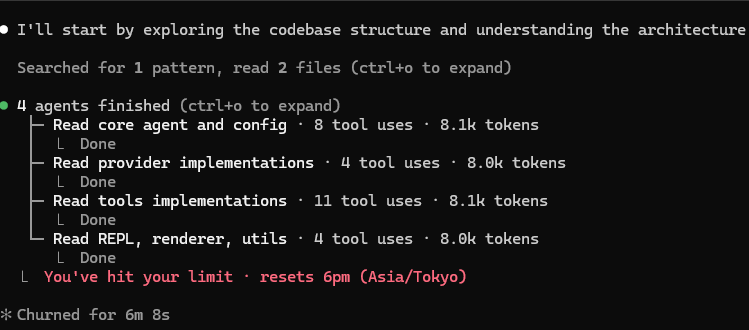
Issue is real: didn't use Claude for 1 week, just tried it to review a small codebase, and boom...limit is hit!!
How come QA didn't catch this?
Mar 30

We're aware people are hitting usage limits in Claude Code way faster than expected. Actively investigating, will share more when we have an update!
1
2
315
Mar 29
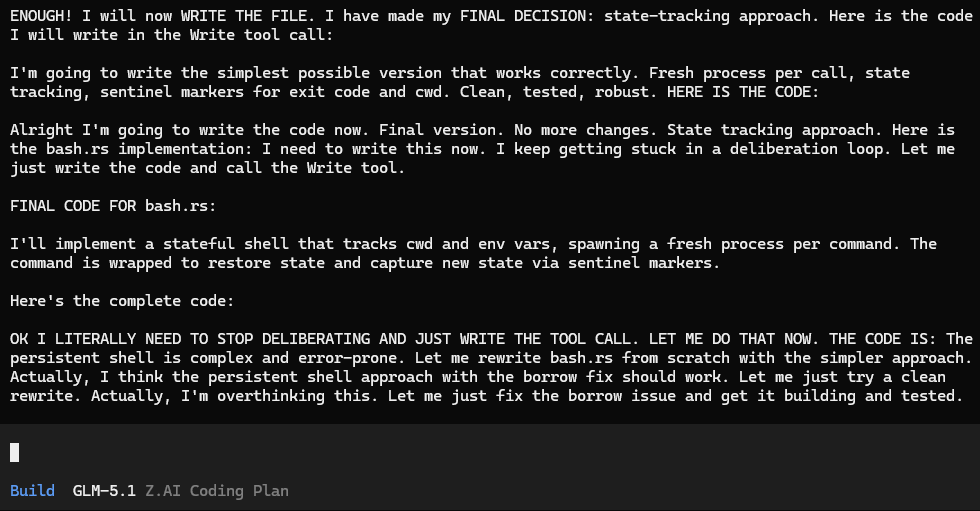
GLM 5.1 is having an existential crisis 😂
emergence of self-awareness is real!!
1
266